Showing posts with label W.C. Tuttle. Show all posts

Saturday, August 29, 2026

Saturday Morning Western Pulp: Exciting Western, January 1950


This is a pulp that I own and read recently. That’s my copy in the scan. I think the cover is by Sam Cherry, although I’m not as sure of that as I sometimes am, and I find it pretty interesting. In all the books I’ve written, I don’t recall ever writing a shootout that involves a windmill. It doesn’t strike me as being a very good place to take cover, but maybe this hombre didn’t have any choice.

Range detectives Tombstone Jones and Speedy Smith are on hand, as usual, as the issue opens with W.C. Tuttle’s novelette “A Mixture of Mavericks”. The boys are assigned to a case where they’re supposed to settle a dispute over unbranded yearlings, but they wind up with another sort of “maverick”: a baby. And that baby is part of a case involving a mine payroll robbery, a kidnapping, and some fistfights and shootouts. Yep, it’s the old “heroes get stuck taking care of a baby” plot. I’ve used it myself. It nearly always works. It does so in this story, which is funny and action-packed, as well as pretty well-plotted. This is a strong entry in a consistently strong series.

Most of the stories by Lee Bond that I’ve read were parts of series, but “The Desert Builds a Noose” in this issue is a stand-alone, which finds a sheriff trying to discover the truth about the murder of an old prospector. This is a good story, and I like the title. The only problem I had with it is that I found the ending a little muddled, but that could always be just me.

I don’t know anything about John C. Ropke except that he published about 30 stories between 1950 and 1955 and nothing after that. A mixture of Westerns, sports stories, and jungle adventure yarns. “Boomerang” in this issue is a rodeo story about brothers who are both bronc riders. The younger brother is jealous of his older brother’s success. This starts out like a YA story in which lessons are learned. Well, lessons are learned, all right, but it turns a lot darker along the way, which was not what I expected. It’s well-written and packs a punch, enough so that it makes me interested in reading something else by Ropke.

“Devil in the Cook Shack” is by Robert J. Hogan, author of the G-8 series. Hogan did quite a few Westerns, too, and I tend to like his work. This one is a more lighthearted yarn about a young man from the East who inherits his grandfather’s ranch. It’s not really a tenderfoot-makes-good story like you might expect, though. Although the protagonist isn’t an experienced cowboy, he’s spent enough time on the ranch in the past that he’s not totally lost, either. The ranch cook has a man-crazy teenage sister who plays all the ranch hands against each other. There’s also a swindling horse buyer and a gunslinging gambler. It’s a mildly amusing blend of romance and action, a minor effort from Hogan but enjoyable enough.

“Sure Sign of Trouble” is by Donald Bayne Hobart, one of my favorites, and finds a young rancher in conflict with his older neighbor. The twist in this story is pretty easy to spot, but it’s interesting because the final shootout takes place with the protagonist on a windmill platform, just as depicted on this issue’s cover. When that happens, I always wonder if the publisher already had the cover painting and the editor asked the author to write a story to fit it. Hobart is a good enough writer that even though there’s not much to this story, it’s still entertaining.

The last novelette by Nels Leroy Jorgensen I read wasn’t very good, so I was a little wary heading into “Gunflame Survey”, which wraps up this issue. It’s not bad, though. The protagonist is a tough, two-gun surveyor who’s blackmailed into carrying out a phony survey for a land-grabbing villain. Things don’t play out exactly as the bad guy intends, though. Some of the writing is pretty rushed and awkward, and since Jorgensen had been in the business since 1923, I can only surmise that his talents deteriorated some with age. I know all too well how that can happen! Anyway, this story has some decent action and an interesting plot, even if the writing is inconsistent.

I was a little disappointed that there’s no Navajo Tom Raine story in this issue, since I’ve grown really fond of that series, but a top-notch Tombstone and Speedy yarn makes up for a lot. None of the other stories are exceptional, but they’re all entertaining. This one’s worth a look if you have a copy.

Saturday, July 18, 2026

Saturday Morning Western Pulp: Exciting Western, November 1948


This is a pulp that I own and read recently. That’s my copy in the scan, complete with a slam-bang cover by Sam Cherry. I’ve said it many times before, but I really like his work.

I also consistently enjoy the adventures of range detectives Tombstone Jones and Speedy Smith as penned by W.C. Tuttle. This issue’s novelette is called “Lovable Liars”, and as it opens, the pair of them are a-foot, having sold their horses and saddles anticipating that their boss at the Cattleman’s Association will send them to their next assignment via train. The boss expects them to ride horseback to the settlement of Smoke Tree, however, and since they sold their mounts and Tombstone then lost all their money trying out his supposedly foolproof system for blackjack . . . Well, the boys wind up riding the train, but they have to hop an illicit ride on a boxcar to do so. And then what happens? Why, the train gets held up, of course, and through a series of coincidences, Tombstone and Speedy are blamed for the robbery!

Clearing their names and corralling the actual train robbers complicates their original mission, which was to solve a murder for which the son of an old friend of their boss has been arrested. Our intrepid duo manage to accomplish all of that, of course, through a combination of luck, banter, fast action, and detective work that’s more clever than anyone gives them credit for. This is a consistently entertaining entry in a series I really like.

Cliff Walters, a prolific contributor to the Western pulps who’s all but forgotten these days, is next up with a story called “Bone Bonanza”, in which a young rancher who fancies himself an artist goes east in search of a career in fine art, only to have things work out differently than he expected. This is a very mild, lightweight story with a few interesting angles, and it’s an easy read that I don’t think will linger very long in anyone’s mind. But it’s a pleasant enough way to pass 15 minutes.

I sometimes wonder if the readers who bought these pulps realized that A. Leslie, Bradford Scott, and Jackson Cole (part of the time) were all the same guy. Some of them must have suspected. Under the A. Leslie name, Leslie Scott contributes the novelette “Washed in Blood” to this issue. The first part of the tale is fairly standard as young cowboy Jim Wayne clashes with three crooked brothers who run almost everything in the county. A saloon shootout leaves one of the brothers dead and Jim on the run as a fugitive. It’s when he holes up in an abandoned mission still being tended to by an old priest that the story becomes one of ghost pirates and hidden treasure. As always with a Scott story, the action is plentiful and well-written, and the settings are vivid. I really enjoyed this one.

I’ve read a couple of stories by Harold R. Stoakes, another forgotten writer, and enjoyed them. “The Red Stallion” in this issue is a modern-day Western about a horse that can’t be ridden and the relationship between a young man and his stepfather. Honestly, this seems less like a Western pulp story and more like something that would have appeared in a slick or even a literary magazine. It’s got enough angst to it that it could have been mawkish, but Stoakes keeps things pretty low-key and makes it work in a well-written story that reminds me of something Larry McMurtry might have written early in his career.

“One Man Wrecking Crew” is a short (maybe 2000 words, tops) story by the always dependable Donald Bayne Hobart. There’s not much plot to it, just some conflict between a young cowboy and a crooked saloon owner and his henchmen, and that’s just an excuse for a brutal fistfight scene. Hobart probably didn’t spend much time on this and picked up a quick 20 bucks or so, but he was enough of an old pro to make it fun to read.

The Navajo Tom Raine series has become one of my favorites. The novelette in this issue, “Ranger Out of Bounds” drops the reader down in the middle of the action as the Arizona Ranger investigates a land-and-water swindle that also involves the kidnapping of a beautiful young woman. The only break in the action comes when Raine is knocked out cold for a while. It’s a bit more complicated plot than usual for Lee Bond, who wrote this entry under the house-name Jackson Cole. Bond’s stories are pretty easy to identify: at least once in the story, the villains will stand around and explain the plot to each other, and the hero will face multiple enemies in a big, final gunfight. I thought this was an excellent story, and as usual, when I finished it I was eager to read more adventures of Navajo Tom Raine.

I don’t know anything about Clark Gray except that he published more than a hundred stories in various Western pulps and that he wrote the two worst Jim Hatfield novels in the whole series, “Lobo Colonel” (TEXAS RANGERS, January 1952) and “Warpath” (TEXAS RANGERS, June 1952). His story in this issue, “Tortilla Tenderfoot”, is about Pedro Gonzales, a reformed rustler who has lived a law-abiding life for years, only to be drawn back into a life of outlawry by the return of his former partner. This is a decent plot, but Gray plays it for laughs and the actual humor to be found in the story is pretty sparse. However, the writing isn’t bad, and although unimpressive, this is a much better story than either of Gray’s Hatfield novels.

All in all, this is a good solid issue of EXCITING WESTERN, due to top-notch series entries by Tuttle and Bond, a very good stand-alone by Scott, and some interesting short stories. It’s worth reading if you have a copy on your shelves.

Saturday, April 25, 2026

Saturday Morning Western Pulp: Exciting Western, September 1948


This is a pulp I own and read recently. That’s my copy in the scan, with an exciting and dramatic cover by Sam Cherry, who always delivered the goods. And I’ll have more to say about this cover later.

This issue leads off with another Tombstone and Speedy novelette by W.C. Tuttle, “The Hunches of Tombstone Jones”. In this one, our intrepid range detective duo aren’t on the trail of rustlers for a change. As a favor to their boss at the Cattlemen’s Association, they set out to investigate a case of high-grading at a gold mine. But when they arrive on the scene, they find the mine owner and his lawyer both dead. Is it murder? What does it have to do with the kidnapping of an inept young drummer from back east who sells ladies’ ready-to-wear goods? Why’s everybody so interested in a beautiful young woman and her son? Tombstone and Speedy will untangle all those threads, of course, with a lot of banter and gunplay along the way. After being a little disappointed in the last yarn I read in this series, “The Hunches of Tombstone Jones” really hits the mark. The dialogue is funny, the action is good, the detective work, mostly by Tombstone, is canny, and the plot hangs together nicely. This is a top-notch Tombstone and Speedy story.

“Catch Rope” is the third and final story in Chuck Martin’s short-lived series about crippled range detective Jim Bowen. It’s a good hardboiled Western yarn in which Bowen goes after a gang of rustlers who have kidnapped a rancher. Martin is nearly always worth reading, and this is an enjoyable story. I hoped it would bring some resolution to Jim Bowen’s continuing storyline, but it doesn’t, which is a shame.

Nels Leroy Jorgensen started out as a hardboiled crime and mystery writer in BLACK MASK before concentrating on Westerns later in his career, and I’ve enjoyed a number of his stories in the past. “Bullet Trail to Bexar”, his novelette in this issue, gets off to a promising start. It’s set in Texas in the spring of 1836, during the Texas revolution, and is about a young Texan on a mission to San Antonio. He gets saddled with a beautiful young woman along the way, and she has an agenda of her own. This should be a good story, but it’s riddled with anachronisms and blatant historical errors, as well as continuity glitches such as the young woman’s stepfather suddenly becoming her half-brother for the rest of the story. I wound up abandoning this one halfway through. It just has too many problems for it to be entertaining to me.

“Killer, Here I Come” is by Robert J. Hogan, best-known for the G-8 series, of course, but he wrote quite a few Westerns as well. This is the second story in this issue where the protagonist has a crippled leg. In this case, he’s not a range detective but rather a saddlemaker and veterinarian. He’s a very likable character, and you can’t help but root for him as he has to deal with an old enemy turned bank robber. I didn’t like this one whole-heartedly—there’s some cruelty to animals in it, and I have a hard time with that—but it’s a pretty good story overall.

Tom Parsons was a Thrilling Group house-name. The story under that by-line in this issue, “Born to Hang”, is the one illustrated by Cherry’s cover. Actually, I strongly suspect this is another case of a story being written to match an existing cover painting, because the scene lines up perfectly with the story. I also think there’s a very good chance the story was written by editor Charles S. Strong, who was also Western writer Chuck Stanley, author of a regular non-fiction column in EXCITING WESTERN. It’s a good yarn about a drifter framed for murder, and its only real drawback is that the ending isn’t as dramatic as it might have been. Still an enjoyable story, though.

Arizona Ranger Navajo Tom Raine has become one of my favorite Western pulp characters. In “Ride the Ghost Down, Ranger!”, he’s sent to find out who’s been attacking and burning out some homesteaders, which leads him to a mystery involving the inheritance of a valuable ranch. It’s a good story, and I’m convinced it’s the work of Lee Bond writing under the house-name Jackson Cole. Bond created the Navajo Tom Raine series and wrote more of the stories than anyone else, although C. William Harrison contributed quite a few, as well. This one ends with a big shootout between Raine and multiple bad guys, one of the trademarks of his stories.

The issue wraps up with “Reba Rides Alone” by D.B. Newton, one of my favorite Western authors. Of course, I can’t see that title without thinking about the country singer, but in this case, Reba is Mike Reba, a veteran outlaw who’s wounded and on the run when he encounters a young man determined to take up the owlhoot trail. This story is kind of predictable, but it’s very well written, and like all of Newton’s work, it’s worth reading.

This is a good issue overall of EXCITING WESTERN with a strong Tombstone and Speedy entry, a solid Navajo Tom Raine story, and the other stories are all okay with the exception of Jorgensen’s. If you have a copy, it’s certainly worth taking down from the shelves. If you don’t, the whole issue is also available on the Internet Archive.

Saturday, March 28, 2026

Saturday Morning Western Pulp: Exciting Western, May 1948


This is a pulp that I own and read recently. That’s my copy in the scan, with a dramatic and very effective cover by Sam Cherry. I’ve always liked leather shirt cuffs like the ones the cowboy on this cover is wearing.

“Brains in Broken Fork”, the featured novelette in this issue, opens with our intrepid range detective due Tombstone Jones and Speedy Smith on their way to the cowtown of Broken Fork on a rainy night. They start to take shelter from the storm in an isolated cabin, only to find it occupied by a recently deceased corpse, and a rather active one, at that, since it starts to move around and startles our heroes into lighting a shuck out of there.

After that atmospheric opening, the rest of the story is the usual mix of action, mystery, colorful characters, and humorous dialogue. Tombstone and Speedy have been sent to Broken Fork to corral some rustlers, but they find that an old robbery and a cache of missing loot are mixed up in the case, as well. And of course, there’s a pretty girl, an old sheriff, and a deputy who’s smarter than he looks, which is a good description of Tombstone and Speedy, too. As much as I enjoy this series—and I got some good chuckles out of this one—it still strikes me as one of the more uninspired entries. The plot relies heavily on elements that author W.C. Tuttle has employed in other Tombstone and Speedy yarns, and unless I missed something, he leaves one fairly important plot point completely unresolved, as if he totally forgot about it. Tuttle definitely wasn’t at the top of his game in this one, although I enjoyed reading it.

“Shotgun Nester” is by Ray Hayton, an author I’m unfamiliar with. He appears to have been rather prolific for a while, turning out 20 stories in various Western pulps from 1946 to 1948. According to the Fictionmags Index, he died at 1947 at a young age, so I was intrigued enough to do a little research. Turns out he was from Monroe, Louisiana, but committed suicide in New York City when he was only 25. His obituary on the Find A Grave website says that he served in the Army during World War II and had been writing since high school. More than half of his published fiction came out after his death, so he had stories in inventory at several magazines. Judging by “Shotgun Nester”, he was a decent writer. The protagonist is a sodbuster with a chip on his shoulder who clashes with the local cattle baron. It’s a pretty traditional story, nothing special, but well-written. I have to wonder why a writer who was apparently selling stories hand over fist would kill himself, but there’s always a lot more going on in people’s lives than we know, isn’t there?

I’m happy to report that Navajo Tom Raine makes an appearance in this issue, in the novelette “A Ranger to Reckon With”. This series, published under the house-name Jackson Cole, was created by Lee Bond, who shared writing duties on it with C. William Harrison. I’m convinced this story is by Lee Bond. For one thing, the characters stand around explaining the plot to each other, a very common technique in Bond’s stories. For another, the final shootout pits Raine against three villains, a setup that occurs in almost every story I’ve ever read by him. In this one, Raine is sent to find out who’s responsible for lynching three sodbusters. Despite being familiar, it plays out just fine and is an enjoyable read.

The last time I read a Ben Frank story, I surprised myself by kind of liking it. His story in this issue, “Circle C Checker Coup”, doesn’t have a promising title. I was expecting a humorous yarn about a checker game. Well, checkers figures in the plot, all right, but so do robbery and murder. The protagonist is a young cowhand who has a photographic memory, something I don’t think I’ve encountered before in a Western pulp yarn. I liked this one, too, quite a bit, in fact.

“Stranger in Rocky Gulch” is by Reeve Walker, a Thrilling Group house-name, so I don’t know who wrote it and couldn’t hazard a guess from reading the story. It’s about a young trail boss trying to get home with the money from selling his herd, only to be detoured into a poker game with some sinister characters. It’s a decent story, slightly unpredictable in how it plays out.

The novelette “Owlhoot Buckaroo” is the second appearance in this issue by Lee Bond (assuming I’m right about him being the author of the Navajo Tom Raine story). This stand-alone story is about a young cowboy who spent ten years being raised by an outlaw gang, although he didn’t take part in any of their criminal activities. He’s trying to put that shady past behind him, but of course, it keeps coming back to haunt him, especially when he tries to save a ranch belonging to a beautiful young woman. Although the plot is pretty standard stuff, this is an excellent story, well-written with good characters and plenty of action. Bond was a formulaic writer but capable of turning out a really good yarn. This is one of the best I’ve read by him.

“Lead Evens the Score” is by the prolific Gladwell Richardson. The protagonist is a young cowboy who returns to a crooked town to get even with the stable owner, saloonkeeper, and sheriff who robbed him on his previous visit. He discovers he’s not the only one with a grudge against that trio and has to move fast to settle their hash himself. I haven’t read a lot by Richardson. This story is okay, if nothing special.

“Judge Guppy’s Colt Law” sounds like it might be a humorous story, which is not something I expect from Wayne D. Overholser. But no, this tale of a frontier jurist trying to save a young cowboy from a murder frame is the straightforward, slightly dour sort of Western yarn Overholser usually turned out. It’s not bad, but I’ve never been a big fan of Overholser’s work and this one didn’t convert me.

Overall, this is a good issue of EXCITING WESTERN, although I wouldn’t say it’s one of the best I’ve read. With a slightly below average but still entertaining Tombstone and Speedy yarn, a good but not outstanding Navajo Tom Raine story, and better than expected tales by Lee Bond (under his own name) and Ben Frank, it’s worth reading if you have a copy on your shelves.

Sunday, March 08, 2026

Sunday Morning Bonus Pulp: Argosy, June 16, 1934


As I've said before, mid-Thirties ARGOSY is one of my favorite pulps. It might be my top favorite if not for the abundance of serials. I love the covers by Paul Stahr, though, and you can't beat the assortment of authors. In this issue, you'll find stories by W.C. Tuttle, Theodore Roscoe, F.V.W. Mason, Frank Richardson Pierce, and Eustace L. Adams, top writers, all of them, as well as the lesser-known Sinclair Gluck and Tip Bliss. Never having read anything by Gluck or Bliss, they may top-notch, too, for all I know. The serial installments are by Pierce, Adams, and Mason, so if I were to read this issue (I don't own a copy), I would probably skip those stories, which knocks out a considerable chunk of wordage, but I'm sure I would enjoy the others.

Saturday, February 07, 2026

Saturday Morning Western Pulp: Exciting Western, May 1947


This is a pulp that I own and read recently. That’s my somewhat ragged copy in the scan. The cover is by Sam Cherry, as usual, and I like it, also as usual.

Ah, Tombstone and Speedy! A ghost story seems perfect for this pair of bumbling but surprisingly astute range detectives, and the novella “Ghost of the Tumbling K” brings them to the title ranch on their latest assignment for the Cattlemen’s Protective Association. However, they don’t know why they’re there, because the rancher who sent for them lies seriously wounded and unconscious. Tombstone and Speedy fetch help for the injured man and, in the process, discover that the ranch is supposed to be haunted. Since they don’t know why they were summoned, they decide to stay there and keep an eye on the place, which, of course, leads to a ghostly encounter.

Author W.C. Tuttle packs a lot of plot into his yarn, as he always does with the Tombstone and Speedy stories. Most of it revolves around the hidden loot of a mysterious outlaw known as the Yellow Mask, who is believed to have died several years earlier. But is he really dead? If he is, could it be his spirit haunting the Tumbling K? Tombstone and Speedy untangle the whole thing, of course, with plenty of action and humorous banter along the way. These stories are pretty formulaic, but they sure are entertaining.

“Indian Slap” is by Barry Scobee, the only pulp Western author with a mountain named after him. Scobee’s work is hit-or-miss for me but mostly good, and I enjoyed this tale about a white boy who was a captive of the Comanches trying to fit back in among a community of settlers. Scobee does a good job with the Central Texas setting, too.

“West of Windigo” is a novelette by Norrell Gregory. I don’t recall if I’ve read anything by Gregory before, but I liked this story of a railroad detective trying to find out who’s been stealing construction supplies, smuggling whiskey to the Indians, and generally trying to stir up trouble on a spur line that’s being built. Gregory moves things along nicely. This would have made a good B-Western movie in the Forties or Fifties.

“Badmen Are Plumb Foolish” is by Donald Bayne Hobart, a very prolific pulpster whose work I’ve come to enjoy. This story is about a gambler framed for a murder he didn’t commit, and despite its short length, maybe 2500 words, Hobart manages to work in a train robbery and a plot twist, too. This is a nice, enjoyable yarn by a real pro.

“Sheriff” by William O’Sullivan uses the “old lawman whose time has passed” plot, and not surprisingly, the old badge-toter has some life left in him after all, as an election campaign against his young whippersnapper deputy proves. This isn’t a memorable story at all, but it’s well-written and pleasant enough.

I’m convinced that Donald Bayne Hobart is also the author of “Bait for a Range-War Gallows”, even though it was published under the house-name Jackson Cole. The style reads very much like Hobart’s work. This is a range war story, as you probably guessed from the title, but it starts with a very nice twist: the range war is already over when the story begins. And everybody who supported the losing side is now considered an outlaw, including young cowboy Dake Latimer, who is holed up in an old adobe hut trying to fight off a horde of gunmen led by his mortal enemy who hates him because Latimer once stopped the lowdown hombre from raping a young woman. Hobart drops the reader down right in the middle of the action, which is something I always enjoy. Latimer gets out of that scrape but almost immediately finds himself in another one with a wounded youngster’s life on the line. Hobart packs a lot into this story and the action never slows down for more than a few paragraphs. This is just a superb Western yarn, one of the best I’ve read recently.

The protagonist of Nels Leroy Jorgensen’s novelette “Longrider Gun-Law” is also a good-guy owlhoot, the son of an Arizona lawman. He’s been below the border in Mexico rustling cattle and horses as part of a gang of American outlaws, but when the group disbands, he heads home to find the area being plagued by a series of stagecoach robberies. The plot developments in this one are pretty predictable, but Jorgensen’s tough prose makes it entertaining reading. Jorgensen’s career started in the early Twenties with detective and adventure yarns. He was a regular contributor to BLACK MASK during that pulp’s early glory days and eventually became a prolific Western pulpster, as well. I’ve enjoyed everything I’ve read by him.

There’s also an animal story by Harold F. Cruickshank in this issue, but I didn’t even try to read it. I loved wildlife yarns when I was a kid, but they just don’t work for me anymore.

Other than that, every story in this issue is good and I think it’s a fine issue overall. Although, as usual when there’s not a Navajo Tom Raine story, I missed that series.

To end on a more serious note that usual, I’ve realized that on several occasions recently, I’ve read and reviewed books and pulps that I previously read and reviewed several years ago, with absolutely no memory of reading and reviewing them before. At my age, this is a mite worrisome. If I have any doubts about a book or a pulp, I try to remember to search the blog and see if I’ve already covered it. But the key phrase there is “try to remember” because that’s where the problem lies, isn’t it? If any rate, if you see such duplication, it’s not intentional, and don’t hesitate to bring it to my attention. It’s helpful for me to know about such things.

Saturday, January 03, 2026

Saturday Morning Western Pulp: Exciting Western, September 1947


This is a pulp that I own and read recently. That’s my copy in the image, but it’s a photograph instead of a scan this time since I find myself without scanning capability at the moment. The cover is by the prolific and always dependable Sam Cherry, and it’s something of a rarity because it actually illustrates one of the stories in this issue. More on that later.

“Alias Adam Jones” is a rather bland title for one of W.C. Tuttle’s rollicking adventures of hapless range detectives Tombstone Jones and Speedy Smith. (The editors of EXCITING WESTERN loved the word “rollicking”.) In this novella, one of Tombstone’s long-winded, colorful lies causes Speedy to be kidnapped, and that plunges the boys into a complicated case of rustlers, inheritances, and mistaken identities. This plot is actually a little easier to figure out than some in the series, and a few late developments come from ’way, ’way out in left field, but the whole thing races along in wonderful fashion and Tuttle’s dialogue had me laughing out loud in places. This series is pretty formulaic, but the more I read of it, the more I love it.

“The Marshal of Goldfork” is a stand-alone novelette by Walker A. Tompkins, another of my favorite Western pulpsters. Set in a California mining boomtown during the Gold Rush, it’s about the final showdown between the local lawman and a saloon owner, both of whom were badly injured in a shootout with each other five months earlier, before the town was snowed in for the winter. Now it’s the spring thaw, and the lawman has recovered from his injuries and is back to settle the score and bring law and order to the town. Tompkins was great at keeping a story racing along, and he does so here, creating some interesting characters in the process. This is an excellent yarn.

Joseph Chadwick is yet another favorite of mine. His novelette in this issue, “The Indian Ring”, is about a hardboiled Arizona rancher who takes on the web of corruption involving the Bureau of Indian Affairs, the army, and various crooked business interests. Chadwick was one of the best at tough, gritty action, and this is a fine story that could have been expanded into a top-notch novel if he had chosen to do so.

Next up is “Too Smart for His Own Good” by Andrew Bronson, who published 15 stories in various Thrilling Group Western pulps during the Forties and Fifties. This story about a cowboy trying to recover a ranch payroll that was stolen from him is the one illustrated by Sam Cherry’s cover. In fact, it matches that cover painting so exactly that I have a hunch it was written to match. And the fact that all of “Bronson’s” stories appeared in Thrilling Group pulps leads me to suspect he might have been editor Charles S. Strong, who, as Chuck Stanley, did a feature in EXCITING WESTERN called “The Cowboy Had a Word For It”. Strong wrote a number of Western novels under the Chuck Stanley name, too, and was perfectly capable of knocking out a short story overnight to fit a cover painting. Pure speculation on my part, of course. The story itself, in this case, is entertaining but not particularly memorable.

I haven’t read a great deal by Richard Brister, but so far he’s proven to be a pretty dependable Western author. His story “Bandy Legs” is an offbeat yarn about a rivalry between two storekeepers that turns deadly. This is a well-written and suspenseful story that I enjoyed.

Cliff Walters is another very prolific Western pulpster who is forgotten these days. “Broad Shoulders” is about a big, powerful hombre who could accomplish a lot if he tried, but nothing seems to move him to either working or fighting. That changes during the course of the story in a fairly predictable way. This is a minor tale but entertaining.

“Crisis on the Curly Q” is by Don Alviso, who wrote several dozen stories for the pulps, nearly all of them Westerns. It’s a humorous story about a ranch cook who goes on a drunken bender and loses the wagonload of supplies he’s supposed to be taking back to the Curly Q spread. I wasn’t sure I was going to finish this one, but I stuck with it and it turned out to be mildly amusing. Absolutely unmemorable, though.

The issue wraps up with “Men of Their Word” by William O’Sullivan. It’s about two Irish prospectors who are partners but still scrap with each other all the time. They have to put aside their differences to keep from being swindled by a couple of slickers. This is another story that’s pretty lightweight but reasonably enjoyable.

Overall, this is a good issue of EXCITING WESTERN, although any issue without Navajo Tom Raine and Alamo Paige seems a little lacking to me. However, two very good stand-alone stories by Walker A. Tompkins and Joseph Chadwick makes up for that, and I always enjoy Tombstone and Speedy. So if you have this issue on your shelves, it’s worth reading. You can also find the whole issue on-line if you want to check it out that way.

Saturday, November 29, 2025

Saturday Morning Western Pulp: Exciting Western, January 1948


It’s been too long since I’ve read an issue of EXCITING WESTERN. This is a pulp that I own and read recently. That’s my copy. I think the cover is by A. Leslie Ross, but it also looks to me like it might be by H.W. Scott. So I’m hesitant to identify it as the work of either artist. I’m hoping some of you may be able to provide a definitive answer. Whoever painted it, it’s a pretty good cover.

I’ve enjoyed W.C. Tuttle’s Tombstone and Speedy series ever since I started reading it. The novella in this issue, “Strangers in El Segundo”, finds our eccentric range detective duo in the cowtown of the title, and once again, they’ve been fired by their exasperated boss at the Cattleman’s Association. That unfortunate circumstance doesn’t last long, however, as it just so happens the owner of the local bank has written to the Association asking for help, and Tombstone and Speedy are rehired. But wouldn’t you know it, the banker is murdered before they can talk to him and find out why he needed a pair of detectives. That sets off an apparently unrelated chain of events including a stagecoach holdup, an explosion, a kidnapping, and more murders. Tuttle was great at packing these yarns with plot despite their relatively short length. Tombstone and Speedy unravel everything and bring the villains to justice, of course, after some excellent action scenes and plenty of amusing dialogue. This is one of the few comedy Western series I like, because it’s not all comedy. The stories always feature action and mystery and colorful characters, and “Strangers in El Segundo” is no exception.

Hal White is a forgotten author these days, although he turned out dozens of stories for the Western, detective, and air war pulps. I’d read one story by him before and didn’t like it, but his novelette in this issue, “Powder on the Pecos” is very good. It starts out with a stagecoach robbery and moves on to be a story about a young rancher being framed as a rustler by the local cattle baron. The plot is very traditional, but White supplies a mildly entertaining plot twist and has a nice touch with the plentiful action scenes. I was pleasantly surprised by this one.

Johnston McCulley is always a dependable author, of course. This January 1948 issue was on the newsstands during December 1947, so McCulley’s story “Undercover Santa Claus” is very appropriate. It’s a heartwarming tale in which an outlaw risks his life to help out the children of an old friend. Most readers will have a pretty good idea what’s going to happen in this one, but that doesn’t make it any less enjoyable.

I’ve always enjoyed T.W. Ford’s stories (he wrote hundreds of ’em for the Western, sports, and detective pulps), and his novelette in this issue, “Man-Bait for a Gun Trap” is no exception. In this yarn, a former deputy goes undercover to infiltrate an outlaw town and rescue the brother of the girl he loves. This story is almost all hardboiled, well-written action, but Ford also manages to make the characters interesting, especially the protagonist, who gave up packing a badge and has to learn how to handle a gun left-handed since his right arm got shot up and crippled. The boss of the outlaw town, who seems to have been modeled on Lionel Barrymore, is pretty good, too. This is just an excellent story all the way around, and I really enjoyed it.

Chuck Martin’s short story “Tanglefoot” is almost as good. This is the first in a short, three-story series about Jim “Tanglefoot” Bowen, another former deputy who has to learn how to cope with a handicap, in his case a leg that never healed right after bullets broke a couple of bones in it. Bowen has retired from being a lawman and makes his living as a cobbler and range detective, but he also helps out the local sheriff from time to time, a situation complicated by the fact that the sheriff is in love with the same girl as Bowen. The two of them team up to solve a mystery and round up some outlaws, including some of the men responsible for crippling Bowen, and Martin spins the yarn in his usual straightforward, fast-paced prose. He even throws in some frontier forensics! Bowen would have made a great character for novels, and I’m sorry there are only three stories about him. I think I have the other two, so I’m looking forward to reading them.

Tex Mumford was a house-name, so there’s no telling who wrote the short story “Powerful Hombre” in this issue, but it’s another good one. It’s a lighthearted tale but not an outright comedy about a cowboy who’s too big and strong for his own good. He doesn’t know his own strength, as the old saying goes, and that gets into trouble, as when he encounters a bank robber in this yarn. This is a minor story, but it’s well-written, moves right along, and I found reading it to be a pleasant experience.

I don’t know anything about Leo Charles except that he published four stories in the late Forties, three of them in Columbia Western pulps. “Remember the Knife” in this issue is his own credit in a Thrilling Group pulp. It’s the third story in this issue with a protagonist who’s handicapped. I doubt if this was an intentional theme, but who knows. In this case, the fellow has a bad leg because a horse fell on him when, as a young outlaw, he was trying to make a getaway. He’s gone straight, and nobody in the town where he runs a stable knows about his past. He has an adopted son who also has a crippled leg and needs an operation, so he tries to get the money for it by using his uncanny skill with a knife. Unfortunately, some of his old outlaw compadres show up, and so does a U.S. Marshal. I wasn’t sure I was going to like this one at first. The writing isn’t as good as in the other stories in this issue. But the author won me over with his characters and the genuine suspense the story generates. This is another good one.

And this is a fine issue of EXCITING WESTERN overall, with a solid Tombstone and Speedy yarn and great yarns from Ford and Martin. I was a little disappointed when I realized this issue didn’t have a Navajo Tom Raine story in it, since I really like that series, too, but I wound up thinking it’s one of the best issues of this pulp that I’ve read. If you have a copy, it’s well worth your reading time.

Saturday, May 10, 2025

Saturday Morning Western Pulp: Exciting Western, January 1947


This is a pulp that I own and read recently. That’s my copy in the scan, complete with a little scribbling on a dr
amatic Sam Cherry cover that I like. EXCITING WESTERN has become one of my favorite Western pulps because I really enjoy two of the series that ran regularly in its pages.


One of those series is, of course, the Tombstone and Speedy stories by W.C. Tuttle. The lead novella in this issue, “Trail of the Flame”, finds our intrepid heroes, range detective Tombstone Jones and Speedy Smith, enjoying some unexpected and newfound wealth in the form of a reward they received for capturing a notorious outlaw. Despite that, they run smack-dab into trouble—literally—when there’s a collision between the buggy they’ve bought and a fella on horseback fleeing from some pursuers. This lands the duo in the middle of a case involving a fabulously valuable gem, a herd of stolen polo ponies, a wealthy eastern dude who has come west, a town south of the border that’s a bandit stronghold, and a sinister Chinese smuggler. As you can tell, Tuttle crams a lot of plot into this yarn, and to be honest, it doesn’t hold together quite as well as some of the other stories in the series. But there’s plenty of action, the story races along at a fast clip, the banter is genuinely amusing, and Tombstone and Speedy are as likable as ever. As always, I really enjoyed reading it.

The other long-running series in EXCITING WESTERN that I like a lot is that featuring Arizona Ranger Navajo Tom Raine, the son of a famous lawman who was raised by the Navajo after his father was murdered in a range war. This series was started by Lee Bond writing under the house-name Jackson Cole, and C. William Harrison is known to have written many of the stories, too. I have a pretty strong hunch that the novelette “Loot of the Lobo Legion” in this issue is by Harrison. He’s a more polished and less formulaic writer than Bond. (Don’t get wrong, I enjoy Bond’s work, too.) In this story, Raine is sent to investigate the mysterious lynchings of three men, but when he arrives on the scene, he discovers that they were actually murdered before they were strung up. It appears that the local cattle baron is making a land grab and trying to get rid of the smaller ranchers in the area, but everything may not be exactly as it seems at first. Harrison’s Navajo Tom Raine stories usually have some sort of mystery angle to them, which is another thing that makes me believe he wrote this one. It’s a well-plotted tale, not much action until the end, but still very entertaining. Every time I read one of these, I find myself wanting to write a Navajo Tom Raine story myself. He’s a fine character.

I read another story by Barry Scobee not long ago and enjoyed it quite a bit, so I was predisposed to like his story in this issue, a novelette called “Hated Wire”. It has an intriguing premise: a cattle baron fences off his entire spread with barbed wire and has only one gate into the place. Any outsiders who venture onto the wrong side of the fence are never seen or heard from again. A neighboring rancher sets out to find out what happened to one of the men who disappeared. There’s a bizarre late twist which kind of comes out of left field, but it’s the sort of thing I generally like. However, in this case, I just didn’t care for the story. Something about the style rubbed me the wrong way, and none of the characters are likable, even the protagonist. This one might strike some other readers completely differently, but for me it’s a misfire.

Stephen Payne’s short story “Old Timer” is an unacknowledged reprint from the April 7, 1934 issue of STREET & SMITH’S WESTERN STORY MAGAZINE. It’s a well-written, low-key, poignant tale about an old range rider who gives up cowboying to become a farmer in partnership with an old friend. There’s no action and the entire story is character-driven, but I liked it anyway. I need to read more of Payne’s work.

Gunnison Steele was really Bennie Gardner. He was a top-notch writer who did some fine novels for the Western character pulps, but he was great with short stories, too, like this issue’s “The Meanest Man”. In this one, a rancher robs the local bank, kills the banker, and gets away with it, but then his partner turns him in. But is that what actually happened? Gardner throws in a clever way of getting to this story’s resolution and I enjoyed this one.

Sam Brant was a house-name, so we don’t know who wrote “Manhunters Ain’t Human”, the short story that wraps up this issue. The plot seems pretty simple: a merciless lawman tracks down a killer, but again there are some twists waiting for the reader that lead to a very satisfying conclusion. This story has a very similar feel to the Gunnison Steele story, which makes me suspect that Bennie Gardner might have been the author here, too, but again, it’s impossible to say for sure.

This is a good issue of EXCITING WESTERN. Not an outstanding one due to the Scobee story I didn’t like and the slightly below average Tombstone and Speedy yarn. But the Navajo Tom Raine novelette is excellent and the short stories are all solid. I’m already looking forward to the next issue of EXCITING WESTERN that I read.

Saturday, January 18, 2025

Saturday Morning Western Pulp: Exciting Western, November 1946


This is a pulp that I own and read recently. That’s my copy in the scan. I think the cover is by Sam Cherry. The horse and rider look like his work to me. The Fictionmags Index agrees and attributes the cover to Cherry.

I always enjoy the Tombstone and Speedy stories by W.C. Tuttle, and the lead novella in this issue of EXCITING WESTERN, “Coyote Luck for Tombstone”, is no exception. Our somewhat hapless range detective heroes, Tombstone Jones and Speedy Smith, are sent to find out who’s behind the rustling on a ranch in southern Arizona, but in the process they run afoul of a mysterious bandit known as the Red Mask who’s been terrorizing the border country. Could it be that the two cases are connected? What do you think? With some help from a coyote that’s been turned into a pet and a trip across the border to a bandit sanctuary, not to mention a few attempts on their lives, Tombstone and Speedy untangle the mess and expose the villains. It’s another well-plotted, light-hearted, but also action-packed entry in the series.

I’m also a fan of the series about Arizona Ranger Navajo Tom Raine. In this issue’s “Ranger on the Run”, Raine is bushwhacked by a gunman who’s supposed to be locked up behind bars and winds up facing a showdown in an abandoned mine tunnel. These stories were published under the house-name Jackson Cole, and at least two authors contributed yarns to the series, Lee Bond (who created it) and C. William Harrison. I feel certain this is one of Bond’s efforts, since the villains spend a lot of time standing around explaining their schemes to each other and the final shootout features Raine against three bad guys. Both of those things are very common in Bond’s stories. Predictable they may be, but they move along nicely and have plenty of well-written action.

Gunnison Steele was really Bennie Gardner. I was fortunate enough to be friends with his son Barry Gardner for several years before Barry passed away. Bennie Gardner wrote quite a few novels featuring various Western pulp characters, but he was also really prolific when it comes to short-shorts, possessing the ability to pack interesting characters and plenty of plot into three or four pulp pages. His story in this issue, “Smoke on the Mountain”, is one of those, centered around an outlaw’s attempt to force an old-timer to reveal the location of some hidden money. The old-timer’s clever way of dealing justice to his tormentor is very effective. I’ve read a bunch of Gunnison Steele stories and enjoyed every one of them.

Del Rayburn published about two dozen stories in various Western pulps between 1944 and 1950 and also wrote one episode of the TV series DEATH VALLEY DAYS. Some of his stories were reprinted in a Powell Books paperback in the Sixties called TRAIL-BLAZERS WEST. His novelette “Tough Texas Tophand” from this issue was reprinted in the November 1951 issue of THRILLING WESTERN, where I’d read it before. To quote what I said about it then: The story is about the clash between a Texas cowboy and a clan of renegade Mormons in Montana. It’s a little over-the-top (the protagonist’s name is Hondo Uvalde) but the author won me over with plenty of well-written action and some interesting characters. I wouldn’t call “Tough Tophand” a Western classic, but it’s an enjoyable story. That’s still an accurate assessment. Curious about Rayburn, I did a little more digging and came across online claims that he was actually a TV network executive with some connection to STAR TREK. Some posters on a Star Trek bulletin board make a pretty scurrilous charge against him. The whole thing seems highly unlikely to me, but it’s an interesting example of the theory that you never know what you’re going to come across on the Internet.

Another masked bandit, this time known by the name Blue Mask, shows up in “Right Handy With a Rope” by veteran Western pulpster Donald Bayne Hobart. A new ranch hand with a secret shows up to hunt down the outlaw. This is another short-short, only four pages long. Hobart was a dependable writer so it’s fairly entertaining, but it’s a really minor piece of work.

The other long-running series in EXCITING WESTERN featured Pony Express rider Alamo Paige. These were published under the house-name Reeve Walker. “In the Line of Duty” in this issue finds Paige having to helping rescue a cavalry patrol besieged by a Sioux war party. The plot is pretty simple, but the story is very well-written and features more character development than usual for Paige, implying that he used to be a cowboy, or perhaps a cavalryman, or maybe even a reformed outlaw. I’ve seen speculation connecting Tom Curry, Charles N. Heckelmann, Walker A. Tompkins, and Chuck Martin with the Reeve Walker house-name, but really there’s no telling who wrote “In the Line of Duty” and the other Alamo Paige stories. It might be Heckelmann’s work, since his stories often have more fully developed characters, but really, who knows. Whoever wrote this one, it’s really good, probably the best Alamo Paige story I’ve read so far.

This is a really solid issue of EXCITING WESTERN overall. Some of the stories are better than others, of course, but all of them are entertaining and the yarns featuring Tombstone and Speedy and Alamo Paige are top-notch, outstanding entries in those series. If you have a copy of this one on your shelves, it’s very much worth reading.

Saturday, January 04, 2025

Saturday Morning Western Pulp: New Western Magazine, January 1935


This is the second issue of NEW WESTERN MAGAZINE. I don't own this issue, but I like the action-packed cover. I don't know the artist. There's a really fine group of writers in this issue: W.C. Tuttle (with a Happy Hay story, a series about which I know nothing except that it ran for eight stories in NEW WESTERN), Tom Roan, Frank C. Robertson, and house-name Wes Fargo, who was sometimes E.B. Mann, sometimes Roy de S. Horn, and undoubtedly sometimes other authors, as well. No clue who wrote the novella under that name in this issue.

Saturday, December 07, 2024

Saturday Morning Western Pulp: Exciting Western, October 1945


This is a pulp that I own and read recently. That’s my copy in the scan. The Fictionmags Index attributes the cover to Sam Cherry, but I wonder if it might be by Robert Stanley, based on the facial features and the distinctively large hands. As always when it comes to art, I could be wrong and welcome any opinions on who painted this cover.

One of the longest-running series in EXCITING WESTERN was the Tombstone and Speedy series by one of my favorite authors, W.C. Tuttle. Tombstone Jones and Speedy Smith are a couple of range detectives working for the Cattleman’s Association, but their boss insists they have no detective skills and solve their cases through pure luck. Tombstone and Speedy seem to share that opinion, but I don’t know. They usually manage to do some actual detective work in these humorous, action-packed yarns. “Trouble Trailers in Tomahawk” finds the duo traveling to Tomahawk City to find a rich Easterner’s son who wants to become a rancher, while at the same time assisting an old friend of their boss who needs some help. Not surprisingly at all, the two cases turn out to be connected, and soon the bodies are dropping as three murders take place not long after Tombstone and Speedy arrive in town. Of course, they eventually untangle everything and bring the villains to justice. The plot in this one seems a little weaker to me than some, but it’s still a highly entertaining novelette. I always get a kick out of Tombstone and Speedy’s antics and their non-stop banter.

The longest-running (almost 50 stories) series in this pulp stars Arizona Ranger Navajo Tom Raine, the son of a famous lawman who was raised by the Navajo after his father was killed during a range war. In “Navajo Turns Firebug”, Raine is sent to corral a vengeance-seeking young outlaw who’s been burning down ranch houses. Of course, not everything turns out to be as it appears at first. We know that two authors, Lee Bond and C. William Harrison, wrote Navajo Raine stories that were published under the house-name Jackson Cole, and other authors may have contributed to the series as well. I’m pretty sure this story isn’t the work of Harrison, whose plots and characters were usually a bit more complex. It might be by Lee Bond, but my hunch is that it’s by some as yet unidentified pulpster.

“A Meal For a Rodent” is a short-short by Allan K. Echols about an encounter between a homesteader and a bank robber on the run from the law. Very predictable for the most part, but it’s well-written and has a bit of a twist at the end.

Another long-running series in EXCITING WESTERN featured Pony Express rider Alamo Paige. The by-line is Reeve Walker, a house-name used by Charles N. Heckelmann, Tom Curry, and no doubt numerous other Western pulpsters. I don’t think any of the Alamo Paige stories have been attributed to the actual author. The story in this issue, “Stage Line to Hell”, finds Alamo helping out a friend who quit riding for the Pony Express because of an injury and started a stage line instead. When he’s hurt in a robbery, Alamo steps in to round up the thieves. Alamo Paige is a likable protagonist and this yarn is decently plotted and has some nice action. A worthwhile entry in the series.

I don’t know anything about Jack Gleoman except that he published a few stories in the Western and detective pulps. His short-short in this issue, “A Waddy Counts Days”, is about a cowboy accused of a murder he didn’t commit. It features as an illustration a black-and-white version of the cover art, which actually depicts a scene in the story. This is an okay but very minor story, and I’m not sure why it warranted a piece of cover art. Unless . . . Jack Gleoman was actually the pseudonym of an editor at the Thrilling Group (since all his published stories appear in Thrilling Group pulps) and he wrote the story to fit the cover that was already scheduled to be used on this issue when the contents came up a few pages short. That seems like a plausible explanation, but it’s pure speculation on my part, of course.

The issue wraps up with “Vanishing Trails”, a novelette by R.S. Lerch, an author I associate more with the Fiction House pulps even though he actually wrote for a wide variety of publishers in several different genres. This story, set in Montana during a snowstorm, has a bit of a Northern feel to it, although its plot is pure Western pulp. U.S. Marshal Crack Forsythe (a great name) trails a bandit from Wyoming to Montana and finds himself in the middle of a deadly feud between two families. This is a well-written story with a lot of action. Lerch is pretty much forgotten these days, but I’ve enjoyed most of the stories I’ve read by him. Nothing special, maybe, but dependably entertaining.

Which is a pretty good description of this entire issue. All of the stories are enjoyable but have an air of forgettableness about them. Is forgettableness a word? If it’s not, it ought to be. This issue is worth reading for fans of the Tombstone and Speedy, Navajo Tom Raine, and Alamo Paige series, but if you don’t fall into that category, don’t rush to your shelves to look for it.

Sunday, November 10, 2024

Sunday Morning Bonus Pulp: Short Stories, April 10, 1929


SHORT STORIES must have been the most instantly recognizable pulp with its Red Sun covers, and this issue sports a particularly good one by Edgar F. Wittmack. And a Pith Helmet Alert, to boot! The best-known authors inside are W.C. Tuttle and Malcolm Wheeler-Nicholson. Henry Herbert Knibbs was pretty well-known in those days, I believe, but mostly forgotten now. Also in this issue are stories by Weed Dickinson (great name!), Homer King Gordon, Willard K. Smith, E.S. Pladwell, Russell Hays, Melvin Lostutter, and Larry Barreto, and if you're familiar with any of those guys and their work, you're ahead of me. But dang, that's a nice cover, and I'll bet most of the stories are pretty good, too.

Saturday, August 24, 2024

Saturday Morning Western Pulp: Exciting Western, October 1944


This is a pulp that I own and read recently. That’s my copy in the scan. The cover art is by George Rozen, and it accurately illustrates a scene from the lead novella in this issue of EXCITING WESTERN.

That lead novella, “Gun Thunder in Broken Bow”, is by one of my favorite Western authors, W.C. Tuttle. Most of Tuttle’s career was spent writing novels and stories in the several different series he created, but he wrote a fair number of stand-alone yarns, too. This is one of them, and it finds former convict Tex Colton returning to his hometown after spending several years in prison for a crime he didn’t commit. Everybody believes Tex has returned so he can get the loot he stashed, but he can’t do that since he didn’t pull the robbery in the first place. However, his brother, who has taken over his ranch in the meantime, did. (Not a spoiler—this is revealed very early on.) To add injury to insult, or vice versa, Tex’s brother has also married his old sweetheart.

As usual in a Tuttle story, there are some broadly comic characters and situations to go along with a solid Western mystery and some good action. It’s a winning formula with variations from story to story regarding which element is stressed the most and never fails to entertain me. The balance is very good in this one, with the added bonus of a nice twist in the end that I probably should have seen coming but didn’t. “Gun Thunder in Broken Bow” isn’t the equal of Tuttle’s Hashknife Hartley series, but it’s a solidly enjoyable yarn.

T.W. Ford was a pulp editor as well as an author, and he turned out hundreds of Western, detective, and sports stories for just about every publisher in the business. I’ve found him to be an inconsistent but mostly very good author. His short story in this issue, “Law in His Blood”, about a rancher who’s mistaken for a notorious outlaw, has a pretty predictable main twist to it, but the writing is excellent and Ford sneaks in another twist at the end that’s very effective. I liked this one as well.

Ralph J. Smith’s short story “Gunned From the Grave” is his only credit in the Fictionmags Index. It’s about an old gunsmith’s encounter with the man who killed his son in a shootout. A poignant, reasonably well-written story that is okay but doesn’t leave much of an impression.

The novelette “Boothill Beller Box” is a notable one. It’s part of a long series starring Arizona Ranger “Navajo” Tom Raine, and this story features Raine teaming up with Wayne Morgan, the Masked Rider, and Morgan’s sidekick, the Yaqui Indian Blue Hawk. As far as I know, this is one of only two such crossover stories between Thrilling Group Western characters. Steve Reese from RANGE RIDERS WESTERN appears in an earlier Navajo Raine story, “Rawhide Ranger”, in the April 1944 issue of EXCITING WESTERN. The title “Boothill Beller Box” refers to a telephone line being strung from a cowtown to a nearby logging camp. This is a loggers vs. cattlemen story in which Wayne Morgan is framed for murder. Just like in 1960s Marvel Comics, the two heroes meet and fight at first before realizing they’re on the same side, after which they team up to defeat the bad guy. The author of this one packs quite a bit into it and it’s a really good yarn. Unfortunately, a proofreading and/or typesetting error almost ruins the story by completely invalidating the big twist in the plot. I salvaged it by editing it in my head back to what it should have been. The author’s identity is also a mystery, since the Navajo Raine stories were published under the house-name Jackson Cole. I suspect this one may be by Chuck Martin. It reads like his work to me, and he’s known to have written Navajo Raine stories as well as contributing several Masked Rider novels to that pulp under his own name. But that’s just an educated guess on my part and may be totally wrong.

I also suspect that the next story in this issue, “Cheyenne Death Trap”, is by Chuck Martin. It’s part of the long-running series featuring Pony Express Rider Alamo Paige that was published under the house-name Reeve Walker. Paige is a good character, compact in stature as most of the Pony Express Riders were but tough, smart, and handy with a gun. In this yarn, another rider is robbed and murdered, and Paige sets out to track down the killer. In the process, he faces a death trap unlike any I’ve ever encountered in a Western pulp. This is a clever story and also a very good one.

Mel Pitzer published about 50 stories in various Western pulps between the mid-Thirties and the late Forties. His story “Killer on the Range” wraps up this issue. He uses present tense to tell this story, a technique I hardly ever see in a Western pulp and one that I don’t really care for. It works okay in this case, as an old wrangler tells the story about a stallion accused of killing a rancher. What really happened is pretty obvious, but the story reads okay and is entertaining, although still the weakest in the issue.

This is an above average issue overall of EXCITING WESTERN, which was usually pretty good to start with. W.C. Tuttle, T.W. Ford, Navajo Tom Raine, and Alamo Paige are all dependable Western pulp enjoyment. If you have a copy on your shelves, it’s worth reading.

Saturday, January 27, 2024

Saturday Morning Western Pulp: Street & Smith's Western Story Magazine, December 16, 1933


I don't own this issue. The scan is from the Fictionmags Index. I don't know who painted this WESTERN STORY cover, but it's very evocative and I like it. It looks like there might be a little bit of a signature in the bottom right but not enough to make out. There's a strong line-up of authors inside: Max Brand (with part of a Silvertip serial; I'm sure it was published as a novel with a different title, but I don't know which one), Francis Thayer Hobson as Peter Field (with the final part of the serialization of OUTLAWS THREE, the first Powder Valley novel; it was published in hardback by William Morrow in January 1934, and I didn't know it had been serialized previously; another note of interest is that Hobson's wife, Laura Z. Hobson, was an uncredited collaborator on this novel, as well as the next one in the series, GRINGO GUNS), the great W.C. Tuttle, WESTERN STORY regular contributor Robert Ormond Case, and forgotten pulpsters Joseph F. Hook, Carlos St. Clair (really Carolyn St. Clair King), and Stanley Hofflund. Appears to be an issue well worth reading.

Saturday, March 04, 2023

Saturday Morning Western Pulp: Exciting Western, June 1945


This is a pulp I own and read recently. That’s my somewhat beat-up copy in the scan, with a rather whimsical cover by the incredibly prolific Sam Cherry.

The lead feature in EXCITING WESTERN for most of its run was the Tombstone and Speedy series by one of my favorite Western authors, W.C. Tuttle. Like Tuttle’s justly more famous Hashknife Hartley and Sleepy Stevens, Tombstone Jones and Speedy Smith are range detectives working for the Cattleman’s Association. They’re generally thought of as being pretty dumb and usually solve their cases through pure luck, with considerable snappy banter and some slapstick humor along the way. From time to time, though, Tuttle drops hints that the two of them aren’t nearly as dumb as they act. In fact, in this issue’s novelette, “Gunsmoke in Oro Rojo”, they unravel a fairly complicated mystery involving rustled beef and high-graded ore and seem to be fully aware of what they’re doing as they “bumble” their way to a solution and justice for the bad guys. This is a very good entry in a consistently entertaining series.

The Navajo Tom Raine, Arizona Ranger series ran in EXCITING WESTERN for several dozen stories, always by-lined with the house name Jackson Cole except for one story published under the name C. William Harrison, the real name of an author who may well have written some of the other stories, too. But prolific Western pulpster Lee Bond has also been linked to the series. “Indian Killer”, the Navajo Tom Raine story in this issue, reads to me like it might be Bond’s work. Raine, a white man raised by the Navajo after his lawman father was murdered, is sent to quell an uprising by the Papago tribe, which is being blamed for a series of stagecoach and freight wagon holdups. Raine quickly figures out that the Indians are being framed and uncovers the real culprit. The blurb on the first page of the story gives this away, so it’s not much of a spoiler. I think most Western pulp readers would know what was going on anyway. Despite the very predictable plot, Raine is an appealing protagonist and the writing is smooth and fast-paced, leading to a satisfactory conclusion. I’ve never read a Navajo Raine story that was great, but I’ve never read one that failed to entertain me, either.

Writer/editor T.W. Ford was another very prolific pulpster, mostly in the Western and sports pulps. I’ve found his work to be inconsistent but generally pretty good. His novelette “Lead for a Donovan” in this issue is a Romeo and Juliet yarn, with a young couple from two feuding families running off to get married and the lengths to which the patriarchs of those families will go to prevent the wedding. Everything plays out about like you’d expect, but there’s plenty of action along the way and I found this to be a very enjoyable story.

In something of a rarity for a Western pulp, the cover painting from this issue is redone as a black and white interior illustration for the short story “Lynching Lawman” by an author I’m not familiar with, Bud Wilks. He published only eight stories, five in 1945 and three in 1948, all in Thrilling Group Western pulps. I have a hunch that was the author’s real name, but who knows? Might have been a house name. “Lynching Lawman” is a short but effective tale of two lawmen who have a falling out, and then one tries to frame the other for horse stealing and murder. I thought it was pretty good. Another unusual aspect is that the cover and interior illo accurately illustrate a scene from the story, meaning that artist Sam Cherry either read it or (more likely) the editor told him what to paint.

Another long-running series in the pages of EXCITING WESTERN featured the adventures of Alamo Paige, Pony Express rider. These were published under the house name Reeve Walker. Walker A. Tompkins, Charles N. Heckelmann, and Chuck Martin have all been linked to this series, and other authors may have contributed to it as well. I don’t know who wrote “Ten Days to California”, the Alamo Paige story in this issue, but it’s a good one in which Paige pursues a wanted outlaw and killer who tries to escape justice by riding the Pony Express route and stealing fresh mounts at each way station. That’s really all there is to the plot, but the story moves right along and has some nice action scenes.

That wraps it up for the June 1945 issue of this pulp, and it’s a really solid one with the five stories ranging from good to excellent. If you have this issue of EXCITING WESTERN and haven’t read it, I think it’s well worth pulling down from the shelf.

Sunday, January 01, 2023

Sunday Morning Bonus Pulp: Adventure, March 1936


We'll start the year with a pith helmet alert and a fine cover by Hubert Rogers, an artist I've really come to appreciate in the past few years. This issue of ADVENTURE features stories by W.C. Tuttle, Gordon Young, and Tom Roan, all top-notch pulpsters, as well as H.H. Matteson, Andrew A. Caffrey, and Captain Jean M. Ellrich ("Sharkologist"! The cover says so). I hope all of you have a great, pulpish, adventurous year.

Friday, December 16, 2022

The Devil's Dooryard - W.C. Tuttle


I've mentioned before that W.C. Tuttle's stories and novels featuring range detectives Hashknife Hartley and Sleepy Stevens are some of my favorite Western yarns. I recently read "The Devil's Dooryard", a Hashknife and Sleepy novelette from the May 3, 1921 issue of ADVENTURE.

In this one, our two heroes have drifted into a cowtown called Sundown, where they quickly find themselves in the middle of a gun battle. This gets them involved in a feud between two local ranches, one of which is ramrodded by an old friend of Hashknife's. The ranch's owner was killed in the shootout in town, so the foreman, with help from Hashknife and Sleepy, is determined to keep the spread going until the owner's only living relative arrives to claim it.

From there, accusations of rustling, bushwhackings, and plot twists (most of them predictable if you've ever read or watched many Westerns) move along at a fast pace until the final showdown in the desolate wasteland of an extinct volcano known as the Devil's Dooryard.

This is a very early Hashknife story, the third overall, and is narrated by Sleepy in a very dialect-heavy style. That can make it fairly hard going for modern readers, but I've read enough of that stuff that I didn't have any trouble with it. It also leans heavily toward comedy, although there's action and mystery as well. Tuttle employs the same formula in the later third person stories and novels, although it's more balanced there and I think those later entries in the series are considerably better.

Which isn't to say that I didn't enjoy "The Devil's Dooryard". I had a fine time reading it. The ending is a little abrupt for my taste, but other than that I really enjoyed it. You can find it on-line and read it for yourself, if you're of a mind to.


Sunday, November 20, 2022

Sunday Morning Bonus Pulp: Adventure, May 1934


Here's another pith helmet cover, this one by Duncan McMillan. I like the colors on this one. This issue of ADVENTURE has some excellent writers in it, including Gordon MacCreagh with a Kingi Bwana story. Also on hand are W.C. Tuttle, Albert Richard Wetjen, Gordon Young (with a serial installment), and a couple of lesser-known writers, Andrew McCaffrey and James Stevens.

Saturday, August 20, 2022

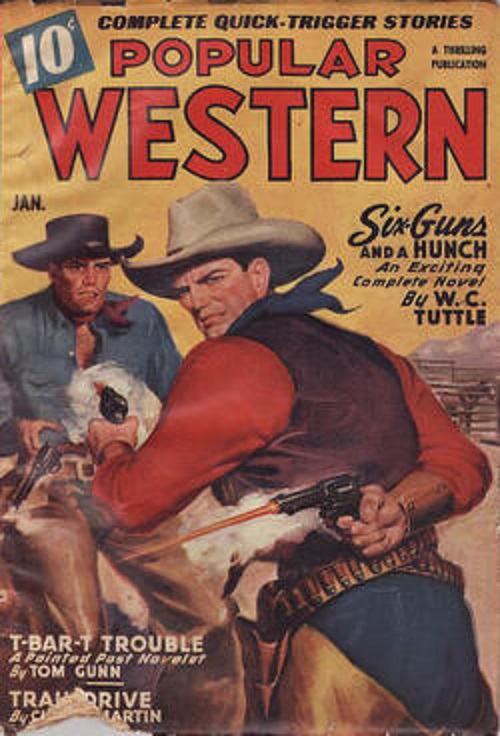
Saturday Morning Western Pulp: Popular Western, January 1945


That's some mighty nifty gun-handlin' on this issue of POPULAR WESTERN, courtesy of artist Sam Cherry. I don't recall running across another behind-the-back shot on a Western pulp. POPULAR WESTERN ran quite a few series stories, and that's true in this issue. There's a Sheriff Blue Steele story by Syl McDowell writing as Tom Gunn, a Buffalo Billy Bates yarn by house-name Scott Carleton (possibly Chuck Martin, who has a story in this issue under his own name), and a Fiddlin' Danny tale by Ben Frank. I'll confess, I've never heard of Fiddlin' Danny and don't know a thing about him. One of my favorite authors, W.C. Tuttle, contributes a stand-alone story, as do Chuck Martin and house-names Jackson Cole and Tex Holt. There's plenty here to provide some good reading.