Showing posts with label Syl McDowell. Show all posts

Saturday, March 09, 2024

Saturday Morning Western Pulp: Thrilling Western, July 1952


This is a pulp I own and read recently. That’s my copy in the scan. The cover is credited on the Fictionmag Index to Sam Cherry, and after looking at the faces, I do believe it’s Cherry’s work, but it’s also kind of an atypical cover for him.

It's also a little unusual that the lead novella in this issue, featured on the cover, is a story by an author who had never appeared in the pulps before. In fact, “Blood on the Lode” is one of only two stories credited to James D. Pinkham in the FMI. A novelette by him appeared in MAX BRAND’S WESTERN MAGAZINE in 1953. I wondered briefly if the name was a pseudonym for a better-known Western writer, but I decided that probably wasn’t the case. Pinkham’s style is distinct enough that I don’t recall encountering it under any other name.

And it’s a maddeningly frustrating style, too. The story is one that hasn’t been done to death in Western pulp fiction and is reasonably accurate historically, too. In 1853, a pair of California Rangers are sent to a mining boomtown to clean up the lawlessness there. The heroes, Luke Corbin and the Alamo Kid, are Texans who rode with the Rangers there while Texas was a republic, and they’ve followed their old commander, Captain Harry Love, to California. So far, so good. Corbin and the Kid are fine protagonists. In their new job, they’re up against a crooked judge and a gambler/saloon owner who’s the mastermind of a gang of claim jumpers. Or is he? His beautiful, redheaded partner in the saloon is known as the Flame and has some secrets of her own. This is good stuff, and it’s done well in stretches with some great action scenes.

But then everything lurches to a halt as Pinkham spends several columns of dense prose summing up his character’s activities. Corbin wanders around talking endlessly to various characters, and Pinkham doesn’t even give us interesting dialogue, just dry recaps of what’s being discussed. Then we’re off again on another well-done ambush or shootout, but the previous scene has robbed the story almost completely of any momentum. He keeps up this pattern all the way through the story.

Despite those flaws, there’s enough to like in “Blood on the Lode” that I wish Pinkham had written more. He could have been a promising author.

I’ve never cared for Ben Frank’s work, although the readers must have because his Doc Swap series of humorous stories ran for a long time in TEXAS RANGERS. His story in this issue of THRILLING WESTERN is a stand-alone, “The Lucky Horseshoe Case”, in which a couple of cowpokes try to become private detectives. I told myself to give it a fair chance, but it’s just awful and I only made it through a couple of pages.

The “Man’s Business” referred to in Gile A. Lutz’s story of the same name is a gunfight between two ranchers over a waterhole. However, things don’t turn out as you might expect. This is a pretty minor story, but Lutz was a solid pro and makes it readable and entertaining.

“There’s Trouble in Hardpan” is the third Swap and Whopper story by Syl McDowell that I’ve read recently. This is another humorous series that I never liked, but for some unfathomable reason, I’ve started enjoying them. Tastes change, I guess. This novelette finds the two drifting protagonists running across an orchard in the middle of the desert and clashing with a cantankerous veterinarian. As always, it’s lightweight stuff, but it moves right along and is mildly amusing.

Steuart Emery wrote a lot of excellent cavalry stories for various Western pulps, most of them appearing in TEXAS RANGERS. But there’s one in this issue of THRILLING WESTERN called “Phantom Sabers”, and it’s the usual top-notch job from Emery. It features a clash between a bookish young lieutenant and an overbearing captain and winds up with a very clever twist when a patrol is surrounded and on the verge of being wiped out by Apaches. As far as I know, Emery never wrote any Western novels, which is a shame.

This issue wraps up with “Chalk Butte Conflict”, a novelette by Ben T. Young in which a Texas cowboy wins a Wyoming ranch in a poker game. He’s too fiddle-footed to settle down, so when he arrives in Wyoming, he plans to sell the spread as quickly as he can and move on. The foreman who works for the local cattle baron rubs him the wrong way, though, and the cattle baron has a beautiful daughter (what cattle baron doesn’t?), so our protagonist decides to stick around for a spell and trouble inevitably erupts. I don’t recall if I’ve ever read anything else by Young, who wrote around a hundred stories, mostly Westerns, during the Forties and early Fifties, but this is a very good story, told in an appealing breezy style, with a likable protagonist and plenty of action. It ends this issue on a high note.

So this issue of THRILLING WESTERN is a mixed bag with no truly outstanding stories but a couple of very good ones, several that are entertaining, and only one clear miss, as far as I’m concerned. It’s about as middle-of-the-road as you can find for a Western pulp, but I enjoyed reading it.

Saturday, December 16, 2023

Saturday Morning Western Pulp: Thrilling Western, September 1951


This is a pulp that I own and read recently. That’s my copy in the scan. The cover art is by George Rozen, who has become one of my favorite Western pulp cover artists even though he’s probably best remembered for his covers on various issues of THE SHADOW.

I don’t know anything about Alexander Wallace except that he produced about three dozen stories for various pulps, mostly from Fiction House, between 1946 and 1954. His novelette “The White Peril” in this issue has an Indian as its protagonist, a young Crow chief called Blue Star, who has to battle a white gunrunner with plans to arm the Sioux, who are bitter enemies to the Crow. I don’t recall reading anything else by Wallace, but maybe I should because the writing in this one is very good. The story moves along well and I enjoyed it.

“Water Power” is a more humorous story than the others I’ve read by Ed La Vanway. It’s about a water witcher using a divining rod to head off a war between a cattle baron and some sodbusters. It’s pretty lightweight but okay reading.

Joseph Chadwick has become one of my favorite hardboiled Western authors. His novelette “Home to Boot Hill” features a first-person narrator, sort of unusual for Westerns of this era, a former Texas Ranger who fears he’s gone gun-shy. But he returns home to New Mexico anyway to help his old flame (who is now married) fight off attempts by the local cattle baron (yeah, another of those pesky cattle barons) to force her off her ranch. Nice gritty action and an offbeat protagonist make this one work all the way around. I liked it a lot.

Next up is the novelette “The Saddle Pards at Buzzard Butte”, an entry in a series I usually skip, Swap and Whopper by Syl MacDowell. These are slapstick comedy Westerns starring a couple of hapless saddle tramps, Swap Bootle and Whopper Whaley. (Think sort of Abbott and Costello in the contemporary West, but not quite.) I decided I was going to read this one and stick with it to the end, no matter what. And I did. It’s a bizarre concoction featuring a guitar, road construction, and a baseball game. To my surprise, I actually smiled a couple of times. MacDowell was a good writer. His more traditional Westerns are usually pretty entertaining. Although it’s not saying much, this is my favorite Swap and Whopper story so far. Will that make me go back and dig out all the ones I’ve skipped in the past? Not likely. But if I come across another one, I’ll at least give it a try.

C. William Harrison is a consistently good writer, so it’s no surprise that his short story “Granger—Draw or Die!” is an enjoyable yarn. It’s about a cowboy who gives up that life to become a farmer and his inevitable clash with the cattleman who’s his former employer. Well done, with some good characters and action.

I’m pretty sure I read H. Bedford-Jones’s novelette “Dead Man’s Boots” in the November 1936 issue of THRILLING WESTERN in which it first appeared. It’s reprinted in this issue, and since it’s been more than 20 years since I read it the first time, I tackled it again. It’s a fine story (I’m not sure Bedford-Jones was capable of writing anything else) about a gun-swift drifter riding away from trouble in the border country and right into more trouble involving a double-cross partnership between a crooked saloon owner and a cattle baron. (Lots of cattle barons in this issue.) While the plot is suitably twisty and there’s plenty of action, I’ve always felt that while Bedford-Jones’s traditional Westerns are good, they’re not quite as strong as his historical and straight adventure yarns. “Dead Man’s Boots” is a prime example of that. There’s nothing wrong with it except that it reads like the sort of story that dozens of other Western pulpsters could have written just as well. Maybe that’s holding HB-J to a higher standard than I should, I don’t know, but that’s the way this story struck me.

I always enjoy Ray Gaulden’s work, too. His short story in this issue, “Boom Town Trouble-Shooter” is a mining story involving a boom town (no surprise there, considering the title) and yet another crooked saloon owner. Gaulden packs quite a bit of plot and action into a story of less than 10 pages and does a good job of it.

Ernest Haycox’s short story “Skirmish at Dry Fork” is a reprint from the July 25, 1942 issue of the slick magazine COLLIER’S. But it’s right at home in THRILLING WESTERN, as well. It’s about a group of cavalry troopers who visit a town for a celebration on payday and their inevitable clash with a bunch of cowboys leading to a saloon brawl. Then a young soldier falls for one of the soiled doves who works in the saloon, leading to more trouble. Since this is an Ernest Haycox story, you know it’s well-written, and while Haycox’s work sometimes leaves me a little cold, I really liked this one. Some nice action and very good characters and a few poignant touches make it work really well.

“Six-Gun Specter” is a short story bylined Johanas L. Bouma, rather than the more common J.L. Bouma. It’s a tale about a young man with two outlaw brothers who’s trying to escape his family’s shady past. A stagecoach robbery and a beautiful young woman prove to be turning points for him. This is a pretty good story marred by a very rushed ending.

Robert Ferguson is the author of “Medicine”, a short story about an Apache attack on an isolated ranch in Arizona. Ferguson published only a handful of stories. This is the only one I’ve read, and I didn’t like it at all. Didn’t care for the writing, didn’t like the characters, and almost didn’t finish it. That happens sometimes. Might’ve just been me.

Overall, I’d say this is an above-average issue of THRILLING WESTERN, based on the good cover by George Rozen, the stories by Ernest Haycox, Joseph Chadwick, and Alexander Wallace, and the offbeat elements in some of the other stories. And I even kind of enjoyed the Swap and Whopper yarn! Maybe I will check out some of the others in the series.

Saturday, October 07, 2023

Saturday Morning Western Pulp: Popular Western, September 1938


This fellow has a definite Buck Jones look about him. Maybe it's the hat. Is that an A. Leslie Ross cover? I don't know. Might be. But I do know that there are some good writers in this issue of POPULAR WESTERN, including Johnston McCulley, Gunnison Steele (Bennie Gardner), Tom Gunn (Syl McDowell, with a Painted Post yarn), Wayne D. Overholser, Larry Harris, and Russell A. Bankson. Looks like an issue worth reading.

Saturday, June 03, 2023

Saturday Morning Western Pulp: Popular Western, September 1944


Sam Cherry's cover on this issue of POPULAR WESTERN is a slightly humorous one, which is a little unusual for him. His covers were dramatic and often action-packed, but most of the time they're not funny. I like this one quite a bit. The blonde reminds me of Gloria Grahame. Inside are stories by Syl McDowell (a Sheriff Blue Steele yarn under the Tom Gunn pseudonym), Johnston McCulley, Oscar J. Friend, Cliff Walters, Alfred L. Garry, and house names Scott Carleton (a Buffalo Billy Bates story) and Jackson Cole.

Saturday, October 15, 2022

Saturday Morning Western Pulp: Thrilling Ranch Stories, December 1934


Now there's an Angry, Gun-Totin' Redhead for yuh! Thet cowboy with her don't look so stalwart, though, and there's no sign of a Wounded Old Geezer. THRILLING RANCH STORIES was the Thrilling Group's answer to RANCH ROMANCES, but the stories had plenty of action, too, judging by most of the covers. This issue features stories by L.P. Holmes, A. Leslie Scott, Cliff Farrell, Syl McDowell, Stephen Payne, Wilton West, and house-name Jackson Cole. All those hombres knew how to burn plenty of powder in their yarns.

Saturday, August 20, 2022

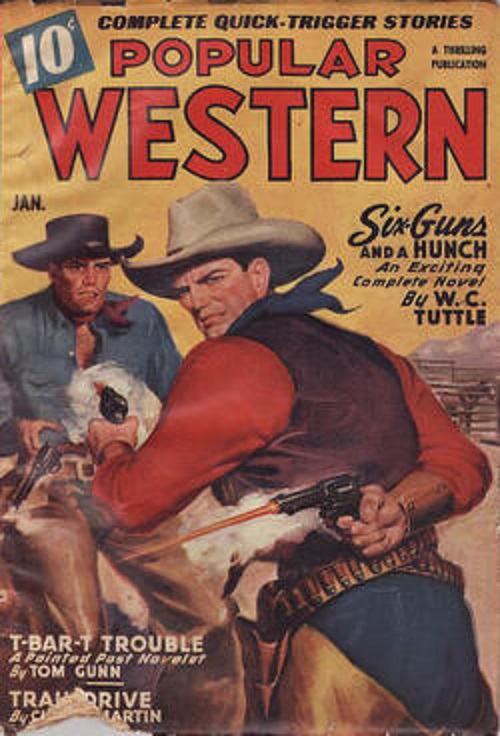
Saturday Morning Western Pulp: Popular Western, January 1945


That's some mighty nifty gun-handlin' on this issue of POPULAR WESTERN, courtesy of artist Sam Cherry. I don't recall running across another behind-the-back shot on a Western pulp. POPULAR WESTERN ran quite a few series stories, and that's true in this issue. There's a Sheriff Blue Steele story by Syl McDowell writing as Tom Gunn, a Buffalo Billy Bates yarn by house-name Scott Carleton (possibly Chuck Martin, who has a story in this issue under his own name), and a Fiddlin' Danny tale by Ben Frank. I'll confess, I've never heard of Fiddlin' Danny and don't know a thing about him. One of my favorite authors, W.C. Tuttle, contributes a stand-alone story, as do Chuck Martin and house-names Jackson Cole and Tex Holt. There's plenty here to provide some good reading.

Saturday, February 05, 2022

Saturday Morning Western Pulp: Popular Western, December 1947


Here we have Injury to a Squeezebox on this issue of POPULAR WESTERN, but somehow I doubt if that will become a recurring category like Injury to a Hat. But you never know about these things. The lead story in this issue is a non-series yarn by the great W.C. Tuttle. Also in the issue are installments in two series that ran regularly in POPULAR WESTERN, Sheriff Blue Steele by Tom Gunn (probably Syl McDowell) and Sheriff Egg and Deputy Ham by Alfred L. Garry. I like what I've read of the Blue Steele series. The other authors in this issue are the always reliable Joseph Chadwick, C.V. Tench (a reprint from the March 1933 issue of ALL STAR WESTERN & FRONTIER MAGAZINE, a pulp I'm not familiar with) and the little-remembered Ted Fox and Andrew Bronson.

Saturday, July 10, 2021

Saturday Afternoon Western Pulp: Thrilling Western, September 1944


More proof, as if we needed it, that sitting down to a "friendly" game of cards was just about the most dangerous thing you could do in the Old West. This is a Sam Cherry cover and quite a dynamic one. As usual in THRILLING WESTERN during the Forties, there's a Walt Slade yarn by Bradford Scott (A. Leslie Scott) and another appearance by Syl MacDowell's Swap and Whopper, plus stories by the great W.C. Tuttle, Gunnison Steele (Bennie Gardner), Dixon Wells (author/editor Samuel Mines), and a couple of prolific but lesser-known pulpsters, Hal White and John A. Thompson. (Sorry I'm running late today.)

Saturday, May 09, 2020

Saturday Morning Western Pulp: Thrilling Western, April 1936


This issue of THRILLING WESTERN has a nice dramatic cover, probably by Richard Lyon. I'm not sure about that, but it looks like his work to me. Inside are stories by some prolific pulpsters, including Thrilling Group stalwarts Lee Bond, Syl MacDowell (with a second story under the pseudonym Tom Gunn), Donald Bayne Hobart, and "Jackson Cole" (probably either Bond or Hobart, I'd guess, since they each have a story in this issue). Plus the well-regarded Stephen Payne and a couple of authors I'm not familiar with, James W. Egan and Victor Kaufman. Looks like an entertaining issue.

Saturday, November 23, 2019

Saturday Morning Western Pulp: Thrilling Western, March 1945


Here's an issue of THRILLING WESTERN with an action-packed cover. I don't know the artist. But the table of contents is full of Thrilling Group stalwarts: Leslie Scott with a Walt Slade novella, Syl MacDowell with a Swap and Whopper yarn, Donald Bayne Hobart, Ben Frank, Cliff Walters, and Mel Pitzer, all familiar names if you read the Western pulps published by Standard Publications. I'm not that fond of some of 'em, mind you, but I've found Scott and Hobart to always be worth reading.

Saturday, April 13, 2019

Saturday Morning Bonus Pulp: Popular Western, January 1944


The cover of this issue of POPULAR WESTERN is further proof, as if we needed it, that every poker game in the Old West ended in a shootout or a brawl. I'm sure there are plenty of fisticuffs and gunplay in the stories inside, which are by Tom Gunn (actually Syl McDowell, in this case, with another Painted Post yarn featuring Sheriff Blue Steele), Gunnison Steele (Bennie Gardner), Laurence Donovan, Oscar J. Friend, and house-name Scott Carleton with a Buffalo Billy Bates story. I've always found POPULAR WESTERN to be a pretty good Western pulp, and I'm sure this issue is no exception.

Saturday, July 07, 2018

Saturday Morning Western Pulp: Thrilling Western, September 1950


This is a pulp I own and read recently. The scan is from my copy. I don’t know who the artist is, but if you check the lower right corner, you’ll see that this is an Injury to a Hat cover. I’ve been reading issues of THRILLING WESTERN for years now and always enjoy them, although there are usually one or two stories in each issue I don’t care for.

This issue leads off (as most issues from 1940 to 1950 did) with a Walt Slade, Texas Ranger story by Bradford Scott, who was really the highly prolific and distinctive A. Leslie Scott. “The Sky Riders” is one of the last stories in the pulp series. There would be only two more after it. But a few years later Scott began writing paperback novels for Pyramid Books featuring the Walt Slade character, mostly originals but some expansions from pulp yarns. That paperback series ran even longer, all the way into the early Seventies. There’s a Walt Slade novel from 1968 called THE SKY RIDERS, and while I haven’t read it, I wouldn’t be at all surprised if it’s an expansion of this pulp novella.

This one opens with a very evocation scene involving a killing on a high natural bridge running between two sides of a canyon. Scott always wrote good action scenes and good descriptions of the settings, and both of those elements are on display here. Walt Slade, an undercover Texas Ranger who most folks believe to be the notorious outlaw El Halcon (The Hawk), witnesses that shooting, and his investigation plunges him into the hunt for a gang of owlhoots known as the Sky Riders because they’re usually spotted riding along some rimrock, silhouetted against the sky.

Anybody who’s read more than one or two Walt Slade yarns will know exactly what’s going on in this story and will pick out the hidden mastermind of the outlaws with no trouble. The geography of the region plays a big part in the plot, as it often does in Scott’s stories, and he handles it very well, resulting in some vivid scenes. Sure, the whole thing is formulaic, but I always enjoy Scott’s work anyway. It’s pure comfort reading for me.

I have the opposite reaction to the Swap and Whopper series by Syl MacDowell, which ran even longer than the Walt Slade series, starting in 1939 and continuing until 1952. Slapstick Westerns are a hard sell for me to start with. The Swap and Whopper stories feature a couple of saddle tramps, one tall and skinny, the other short and fat, who always wind up in bizarre situations. Part Mutt and Jeff, part Abbott and Costello, and well written enough by old pro Syl MacDowell, but dang, this series just doesn’t work for me. I’ve started dozens of them and finished only a few. The one in this issue, “The Talking Bear”, is not one that I finished.

Nels Leroy Jorgensen wrote scores of stories during a pulp career that lasted approximately thirty years, from the early Twenties to the early Fifties. He turned out detective, aviation, adventure, and war stories in addition to Westerns. I first became aware of him as a Western writer but later discovered that his work appeared frequently in BLACK MASK during the Twenties and Thirties, most notably with a series about a gambler named Black Burton (a series that wound up in BLACK BOOK DETECTIVE during the Forties). Jorgensen’s novelette in this issue, “Gunstorm on the Wagon Trail”, has a good title and the plot, about a couple of guys who own a freight company trying to get a wagon train full of badly needed supplies (including medicine) through a gauntlet of Mexican bandidos and Apache renegades, is interesting as well. I thought the actual writing was pretty bland, though, with lots of long paragraphs of the protagonist thinking about what’s going on. I finished the story, but it never really caught my interest much.

I’ve never read a story by Johnston McCulley that I didn’t like, and “Agency Injun” continues that streak. It’s a minor yarn about a cavalryman trying to prove that a friendly Indian didn’t commit a murder at an army post, but McCulley tells it well. This one has an illustration by the great Nick Eggenhoffer, too, which certainly doesn’t hurt anything.

I read a story by L. Kenneth Brent in an issue of THRILLING WESTERN last year and enjoyed it. His tale in this issue, “Gunsmoke Freeze-Out”, is even better. It’s a “small rancher vs. cattle baron” story, with the added complication that a rustler the small rancher testified against in court has gotten out of prison and is coming back to try to kill him. It’s a standard plot, but Brent’s writing is good and he creates some genuine suspense along the way. I’ll be keeping an eye out for more of his stories.

Like Nels Leroy Jorgensen, Harold F. Cruickshank had a pulp career that lasted from the Twenties to the Fifties. During that time he wrote several hundred stories, specializing during the first part of his career in war and air war stories before branching out into Westerns and sports yarns. He was a highly regarded air war writer, but I haven’t read any of those stories. In Westerns, he had a long-running back-up series in RANGE RIDERS WESTERNS about the settlers in Sun Bear Valley. I’ve read some of these (also known as the Pioneer Folk series) but never cared much for them. His novelette in this issue, “Branch Line to Hell”, is a stand-alone about a railroad surveyor who’s trying to survey a spur line over the opposition of a ruthless local cattle baron. It’s a good title, but unfortunately that’s the best thing about this story. Cruickshank’s writing just doesn’t appeal to me, and all the technical details of surveying and railroad construction are just confusing, so I wasn’t quite sure what was going on some of the time. I think maybe I’ve read enough of Cruickshank’s work, although I am still curious about his air war stories.

So far this issue of THRILLING WESTERN is batting .500. I’ve liked three of the stories and disliked the other three. But there are four short stories left.

I don’t know anything about Dupree Poe except that I’ve seen his name in various Western pulps. He sold several dozen stories to the Thrilling Group in the late Forties and early Fifties, along with a few to MAMMOTH WESTERN and the Ace Western pulps, WESTERN ACES and WESTERN TRAILS. His story “Hangman’s Tree” in this issue is a little unusual for the era in that the plot revolves around a rancher’s suspicion that his wife is having an affair with an outlaw who’s hiding out on the ranch and pretending to be a cowhand. This sets off a string of events that include a lynching, a visit by another outlaw, and the rancher’s near death in quicksand. (Quicksand, of course, is one of the things that improve any story, and if the greatly missed Bill Crider was still with us, I have a hunch he would agree.) Anyway, there’s also a good dog in this story, and that helps, too. “Hangman’s Tree” is almost too grim, but I wound up thinking that it’s a decent story.

Ben Frank is the pseudonym of Frank Bennett, an author who wrote under his real name for both the pulps and the slicks in the Forties and Fifties. He was more prolific as Ben Frank and is best remembered for a back-up series that appeared in many issues of TEXAS RANGERS featuring a cagey old-timer known as Doc Swap. He also wrote a comical Western about a deputy named Boo-Boo Bounce. As I mentioned above, with a few exceptions (Robert E. Howard and W.C. Tuttle come to mind), I’m not much of a fan of comedy Westerns. I don’t care for the Boo-Boo Bounce stories at all. The Doc Swap yarns are at least readable because they’re usually well-plotted. Frank’s stand-alone story in this issue of THRILLING WESTERN, “One Man Justice” features another old-timer and his attempt to bring to justice the man who tried to murder his son-in-law. This isn’t a comedy; Frank plays it completely straight and gives the tale a nice hardboiled, suspenseful tone, as well as a twist or two. This one took me by surprise. I wasn’t expecting to like it, but I did, quite a bit.

Robert J. Hogan was the author of G-8 AND HIS BATTLE ACES, of course, along with a lot of other air war stories, but he also wrote a considerable number of Westerns. His story in this issue, “Badge for a Bandit”, uses the old plot of an outlaw trying to go straight. In this case, the young man has even become a deputy, but then his old gang shows up intending to rob the bank. I generally enjoy Hogan’s stories, but I never could work up much interest in this one.

The final story is “Heading Into Trouble”, a short, simple yarn about a bank messenger, a stagecoach driver, and a shotgun guard trying to get a stagecoach carrying a lot of money through a gauntlet of outlaws. It’s almost non-stop action, which is good, and the writing is okay. The by-line is the house-name Jackson Cole, which was often used when an author had more than one story in an issue. In this case, though, the style doesn’t strike me as being similar to any of the other authors in this issue. In fact, it reminded me of the work of Charles S. Strong, an editor at the Thrilling Group who wrote Western fiction under the name Chuck Stanley as well as detective and adventure yarns under his own name. That’s just a guess on my part, however. It could have been someone else who wrote “Heading Into Trouble”. Whoever did, I thought it was an okay story.

Overall, I’d say this is a below average issue of THRILLING WESTERN. The two best stories are the Walt Slade novella and Ben Frank’s story, and there are several I don’t think are very good at all. But considering the sheer number of Western pulps published, they can’t all be great. I’m confident that I’ll have better luck the next time I take one off the shelf.

Sunday, November 26, 2017

Sunday Morning Bonus Pulp: Thrilling Adventures, May 1934


I've seen a lot of "guy fighting a bear" covers over the years--on pulps, on men's adventure magazines, and on outdoor and hunting magazines. This is a pretty good one. There are some top pulpsters inside this issue of THRILLING ADVENTURES as well: L.P. Holmes, Arthur J. Burks, Frederick C. Painton, Charles Green, L. Ron Hubbard, John Scott Douglas, and Syl McDowell.

Saturday, December 17, 2016

Saturday Morning Western Pulp: Thrilling Western, February 1947


If I had the actual pulp, I could probably tell for sure, but from the scan it looks like this may be an injury to a hat cover. Or maybe that's some sort of design on the guy's hat, I'm not sure. But either way I'm confident that "Blind Trails at Broken Butte" by W.C. Tuttle is a pretty good story because Tuttle was about as consistent a Western writer as you're ever going to find. I hate to say it because I don't care for the Swap and Whopper series by Syl McDowell, but "Billboard Buckaroos" isn't a bad title, either. Elsewhere in this issue of THRILLING WESTERN are stories by old pros Hal G. Evarts, Harold Cruikshank, and William O'Sullivan.

Saturday, September 03, 2016

Saturday Morning Western Pulp: Texas Rangers, August 1938


This is an excellent early issue of TEXAS RANGERS, with a Jim Hatfield novel by J. Edward Leithead, a Long Sam Littlejohn story by Lee Bond, and a story by Tom Gunn (probably Syl McDowell). Leithead wrote only three Hatfield novels, but they're all good.

Saturday, August 27, 2016

Saturday Morning Western Pulp: Popular Western, August 1949


A nice jailbreak cover on this issue of POPULAR WESTERN. I don't know who the artist is. Inside is a nice line-up of stories featuring L.P. Holmes, Bruce Douglas, Norman Daniels (writing as Charles Alan Gregory), William O'Sullivan, Syl McDowell (a Painted Post story as by Tom Gunn), and the house-name Scott Carleton (a Buffalo Bill Bates story; I don't recall who wrote these).

Saturday, July 23, 2016

Saturday Morning Western Pulp: Exciting Western, April 1946


Injury to a hat alert! I like this cover by Sam Cherry, as I do most of Cherry's work. I also like EXCITING WESTERN, especially the Tombstone and Speedy stories by W.C. Tuttle. They're not as good as the Hashknife and Sleepy stories, but they're pretty entertaining. There's also an Alamo Paige story by Reeve Walker (a house name; I think maybe Walker Tompkins wrote this series), and stories by Syl McDowell, Gunnison Steele (Bennie Gardner), Archie Joscelyn, and Barry Scobee (the pride of Fort Davis, Texas). Looks like a good issue.

Saturday, November 28, 2015

Saturday Morning Western Pulp: Popular Western, September 1941


A busy but effective cover on this issue of POPULAR WESTERN, and the contents look good, too, with a Sheriff Blue Steele story by Tom Gunn (Syl McDowell), a Buffalo Billy Bates story by Scott Carleton (a house-name, so I don't know who wrote this one, although for some reason I seem to recall that Walker Tompkins wrote the Buffalo Billy Bates series), and yarns by William L. Hopson, Wayne D. Overholser, Donald Bayne Hobart, and Larry A. Harris.

Friday, July 31, 2015

Forgotten Books: The Sheriff of Painted Post - Tom Gunn (Syl MacDowell)


Tom Gunn was the primary pseudonym of prolific Western pulpster Syl MacDowell. It may have been used as a house-name from time to time, but my impression is that Tom Gunn was usually MacDowell. And he's certainly the author of the long-running Painted Post series, which appeared in POPULAR WESTERN for almost twenty years. MacDowell took a number of the early stories, combined and expanded them into novels, and then sold them to the hardcover publisher Julian Messner. Some of them subsequently appeared as paperback reprints from Pocket Books.

THE SHERIFF OF PAINTED POST is the first of those paperback editions, and although it doesn't say so anywhere in the book, it's a "fix-up" of the first three stories in the series: "The Sheriff of Painted Post" (POPULAR WESTERN, November 1934), "Blue Steele Rides Again" (December 1934), and "Painted Post Pizen" (February 1935). The Julian Messner hardback edition came out later in 1935, the Pocket Books paperback in 1951. That's the edition I read, and the cover scan is from my copy.

With all that bibliographic information out of the way, how's the story, you ask? Well, it's pretty darned good. The paperback cover by Edward Vebell and the cover copy are spoilers, but it doesn't matter much because MacDowell reveals to the reader almost right away that the mysterious stranger who rides out of the lava hills is a wanted outlaw named "Wolf" Gray. Gray has escaped from prison in Idaho, but he's basically a decent sort who wants to put his owlhoot past behind him. He decides to take the name Smith, but when he encounters a happy-go-lucky cowpoke named Shorty Watts, a misunderstanding leads to the stranger being called Blue Steele instead, and the name sticks. The two new friends ride on to the nearby town of Painted Post, the center of some rangeland being plagued by the sinister rustler El Scorpio, and wouldn't you know it, the local sheriff is murdered by one of the outlaws just as Steele and Shorty arrive. Steele guns down the killer before the varmint can escape, so naturally enough, the citizens of Painted Post decide that he should be the new sheriff. What better way to break from his outlaw past than by becoming a lawman, Steele thinks, so he agrees, but only on the condition that he can have Shorty as his deputy.

As you can tell from that description of the opening couple of chapters, this is pure Western pulp, the sort of thing you've read in scores of stories and novels and seen in countless B-movies. Steele and Shorty go on to break up El Scorpio's gang and bring the ringleader to justice in the first section of the novel. The second involves competing cattle drives that play a part in the ongoing war between Painted Post and the neighboring town of Los Palos, a struggle that's complicated by the arrival of hated sheep in the area, and in the third and final section of the book, Sheriff Steele's lawless past not only crops up again, but Painted Post is threatened by a dam project that will put the town underwater. Interesting plots, but very traditional, nothing ground-breaking here.

But if it's pure pulp, MacDowell does it very well. Steele's background gives him a little more depth than some of the Western pulp heroes, rather than him being just another gun-dummy, and Shorty is a fine sidekick, tough and competent when he needs to be despite functioning as the comedy relief most of the time. There's a little too much "Yuh mangy polecat!" dialogue for my taste, but you have to expect that from the era. MacDowell's action scenes are top-notch, and he keeps things moving along at a nice pace. I liked this one enough that I checked my shelves and found the other Pocket Books reprint I have, PAINTED POST GUNPLAY, and ordered a couple more on-line. Plus I have quite a few issues of POPULAR WESTERN with Painted Post stories in them, and I'll get around to those eventually.


Oddly enough, considering that I liked this one, Syl MacDowell is also the author of what is probably my least-favorite Western pulp series, the Swap and Whopper stories that ran in THRILLING WESTERN. I've always thought I really ought to like those because the lead characters were clearly inspired by Abbott and Costello and I love Abbott and Costello. But the stories are really slapsticky and Western comedies walk a pretty thin line with me. The only author who seems able to succeed consistently in that genre as far as I'm concerned is W.C. Tuttle, and I think that's because Tuttle wrote good solid Westerns that had comedy in them, instead of the other way around.

THE SHERIFF OF PAINTED POST falls into the same category, a solid Western with some comedy. I doubt if I'll ever consider Syl MacDowell in the upper ranks of Western pulp authors along with Tuttle, Walt Coburn, T.T. Flynn, and many others, but I'll definitely read more of his work.


Sunday, May 29, 2011

Painted Post Gunplay Cover

This is the cover on the Sheriff Blue Steele novel Rich Prosch asks about in the comments on yesterday's Western pulps post.  It looks pretty good, but I haven't read it yet.  I will . . . eventually.