Showing posts with label Arthur J. Burks. Show all posts

Sunday, April 12, 2026

Sunday Morning Bonus Pulp: Top-Notch, February 1936


I don't know who painted the cover on this issue of TOP-NOTCH -- Tom Lovell, maybe? -- but it's pretty dramatic. TOP-NOTCH was getting near the end of its long run by this point but was still publishing some very good authors. In this issue are stories by Arthur J. Burks, Major George Fielding-Eliot, William Merriam Rouse, Samuel Taylor, and Robert H. Leitfred. The other authors aren't familiar to me: Paul Randell Morrison, Edmund du Perrier, Hal Firanze, and Kurt von Rachen. Wait a minute, Kurt von Rachen was L. Ron Hubbard, so I guess I've heard of him after all. Controversial though he may be, I like Hubbard's pulp stories for the most part, and for all I know, those other guys were fine writers. So this is probably a decent issue. 

Sunday, February 22, 2026

Sunday Morning Bonus Pulp: Thrilling Detective, August 1933


I don’t actually own that many detective pulps (although a 1931 issue of DETECTIVE FICTION WEEKLY was the first actual pulp I ever owned), so when I’m in the mood to read one, I often head for the Internet Archive. That’s where I recently read the August 1933 issue of THRILLING DETECTIVE. I don’t know who painted the cover. While it’s not a great one, it’s certainly not bad.

Ed Lybeck is a mostly forgotten writer these days. A few years ago, Altus Press published a collection of the four stories he wrote for BLACK MASK, which I read and thought was excellent. Lybeck wrote the lead novella in this issue, “Coins of Murder”, in which a Secret Service agent with the unlikely name Everard Kynaston literally stumbles over a case involving murder, a Chinese tong, and a scheme to destroy the American economy by flooding it with a previously unknown supply of gold. The plot is pretty weak, the criminal mastermind might as well be wearing a big sign on his back that reads CRIMINAL MASTERMIND, and the story reminds me a little of some of Sax Rohmer’s later Fu Manchu novels without being anywhere near as good. However, Lybeck’s lean, gritty prose is fun to read, and the opening pages of this yarn are particularly effective. This isn’t as good as the stories Lybeck wrote for BLACK MASK, but it’s worth reading if your expectations aren’t too high.

“The Corpse From Chicago” is a novelette with an intriguing opening: a hotshot gangster from the Windy City is murdered while sitting in the lobby of the Plaza Hotel in New York City, surrounded by people, and yet nobody saw who killed him. A tough police detective gets the case and the story is almost non-stop action after that as he uncovers a war between two gangs of crooks trying to take over the marijuana racket. I’d never heard of the author of this one, James H.S. Moynihan, but he published almost a hundred detective and gang stories in various pulps during the Thirties and Forties. This one is okay. I’m not sure the plot completely makes sense, but Moynihan’s terse prose races right along nicely.

“The Giordano Mob” actually is non-stop action, as private detective Ed King goes after the gangsters responsible for the death of a young operative who works for the same agency. King is known as the Speed Demon, for some reason, and refuses to use a gun or knife, relying only on his fists as he battles the bad guys. This story is part of a series of his adventures written by a forgotten pulpster named Barry Brandon. Other than King’s canine sidekick, there’s not much memorable about this one. The plot’s just too thin to amount to much.

“Picture Frame” by H.M. Appel is an actual murder mystery built around photographic tricks and an isolated cabin on the shores of Lake Michigan where a group of men have an informal gun club devoted to skeet shooting. One of them winds up dead, of course, and it’s pretty obvious the killer can be found among the other three. This is the sort of short, bland yarn that showed up frequently in the mystery digests of later decades such as EQMM and AHMM. There’s nothing wrong with it, but it’s not very compelling.

Perley Poore Sheehan was a prolific, well-regarded author of adventure fiction in the pulps, but he also wrote detective yarns, including a series about a masked crimefighter known as Doctor Coffin, who was actually a retired Hollywood character actor who also owned a chain of undertaking parlors. I think there were 15 of these novelettes, some of which have been collected, but I’d never read any until “The Chicken King” in this issue. And it really has me scratching my head, because this tale of Doctor Coffin battling the head of “the poultry racket” is just terrible. The plot makes no sense, and the writing, other than a few outbursts of lurid violence, is bland and boring. This is the next-to-last story in the series, and it reads as if the author were tired of it. I really ought to try some of Sheehan’s other work, because he couldn’t have been this bad all the way through his career.

Allan K. Echols is remembered mostly as a Western writer, but he wrote crime, detective, and Weird Menace stories, too. “The Murder Trail” in this issue is about a would-be crook who decides to hold up a gambling den in Harlem. Everything goes wrong, and the fellow has to go on the run, after which things just get worse and worse. This is a fairly good story that reminds me of Cornell Woolrich’s work, without being as well-written. It’s bleak as all get-out, with a relentless sense of doom that Echols captures well.

Arthur J. Burks was another very prolific pulpster who wrote just about every genre except Westerns. “The Gun” in this issue is a short story about a hitman. It’s well-written, effective, but doesn’t end quite as dramatically as it might have. This may be the first thing I’ve read by Burks, and it wouldn’t excite me about reading more by him, but his work has a pretty good reputation and I’m sure I’ll try something else by him.

The issue wraps up with “The Crimson Blade” by “John L. Benton”, a well-known Thrilling Group house-name, so there’s no telling who actually wrote it. A scene in the story matches the cover illustration, which makes me think the painting came first and one of the regular authors wrote the story to match. In this one, a cop investigates the murder of a society doctor who’s rumored to be pushing dope to wealthy women. It appears that a low-class junkie killed the doctor, but the cop believes the guy was framed and sets out to prove it. This is a solid little yarn that’s well-written. The plot might have been better with another twist or two, but it works okay.

Overall, I can’t really recommend this issue. I found a couple of the stories almost unreadable, and the best ones were no more than okay. Maybe this isn’t a fair comparison, but the same month this issue of THRILLING DETECTIVE was on the stands, BLACK MASK featured stories by Erle Stanley Gardner, Frederick Nebel (a Donahue story), Raoul Whitfield, Roger Torrey, Norvell Page, and Donald Barr Chidsey, while DIME DETECTIVE had stories by T.T. Flynn, Frederick Nebel (a Cardigan story), Leslie T. White, and John Lawrence. Next time I’m in the mood for a detective pulp, I’ll probably go for one of those titles.

Sunday, January 11, 2026

Sunday Morning Bonus Pulp: Mystery Novels and Short Stories, September 1939


This is the first issue of MYSTERY NOVELS AND SHORT STORIES, a short-lived Weird Menace pulp that managed six issues total in 1939, '40, and '41. I have no idea who painted that cover, but it's a wild one. [Update: The cover art is by William Soare. Thanks to b.t. for the ID!] The presence of house-name Mat Rand in the Table of Contents, as well as Abner Sundell being the editor, tells us that this is a Columbia pulp, undoubtedly a very low-budget affair, but it certainly looks intriguing. The other authors on hand, other than Rand, all seem to be real guys: Arthur J. Burks, Harold Ward, Vernon James, Dugal McDougal, and Lazar Levi. I recognize Burks and Ward, the other guys not so much. But I'd be interested in checking it out if I had a copy, which I don't, and it doesn't appear to be available on-line. I'm trying to remember if I've ever read anything by Arthur J. Burks. He wrote almost everything for the pulps except Westerns. I ought to try some of his stories. 

Sunday, November 23, 2025

Sunday Morning Bonus Pulp: The Feds, October 1936


THE FEDS was a G-Man pulp published by Street & Smith, a company that usually was very successful with anything they put out there. Not so with THE FEDS, which lasted for only 15 issues in 1936 and '37. But its lack of longevity can't be attributed to the generally pretty good covers, including this one on the second issue which is probably collectable because of the presence of all those Ku Klux Klansmen on it. I don't know who painted it. Nor were the writers any slouches. This issue features stories by Steve Fisher, Wyatt Blassingame, W.T. Ballard, Arthur J. Burks, William G. Bogart, Laurence Donovan, Jean Francis Webb, George Allan Moffatt (Edwin V. Burkholder), James Duncan (Arthur Pincus), and house-name Bruce Harley. Probably some good reading there. I don't own this issue and it doesn't appear to be available on-line, but if I did have a copy of it, I wouldn't hesitate to give it a try. 

Sunday, November 09, 2025

Sunday Morning Bonus Pulp: Thrilling Detective, December 1935


This issue of THRILLING DETECTIVE sports a gruesome but eye-catching and dramatic cover by Rafael DeSoto. Nothing good ever comes from a suit of armor on a pulp cover! Inside this issue are stories by Barry Perowne (a Raffles yarn), Arthur J. Burks, Steve Fisher, Dwight V. Babcock, John Scott Douglas, Paul Hawk, Edmond Du Perrier, and the oddly named Tom Erwin Geris, who, if you rearrange the letters, turns out to be none other than Mort Weisinger, who wrote quite a few pulp stories but is best remembered as the long-time editor of the Superman titles at DC Comics during the Silver Age. He had a reputation as quite a curmudgeon as far as the writers and artists were concerned, but I didn't know any of that at the time. I just read the comic books and enjoyed them. I don't believe I've ever read any of his pulp stories, though.
 

Sunday, July 06, 2025

Sunday Morning Bonus Pulp: Thrilling Adventures, December 1932


Pith helmet alert! Seeing bullets whizzing through Stetsons was common on Western pulp covers, but I don't recall ever seeing any Injury to a Hat covers involving pith helmets. Surely, there must have been some. Allan K. Echols, author of the cover story in this issue of THRILLING ADVENTURES, was best known for his Westerns, but obviously he wrote some jungle yarns, too. Something about this one seems to me like the cover painting might have existed first and Echols wrote the story to fit it, but that's pure speculation on my part and could be entirely wrong. The other authors in this issue make it a pretty strong lineup: Malcolm Wheeler-Nicholson, Arthur J. Burks, Anthony M. Rud, Wayne Rogers, Perley Poore Sheehan (with a Captain Trouble story--I have a collection of those and need to get around to reading them!), and Thomson Burtis. Those guys were all popular, prolific pulpsters who knew how to spin a yarn.

Sunday, April 20, 2025

Sunday Morning Bonus Pulp: 10 Action Adventures, January 1939


10 ACTION ADVENTURES appeared for only one issue in 1939, despite this being listed as Volume 1, Number 3. The newsstands must have been just a little too crowded for it to find its audience, because it looks like a pretty good adventure pulp. The cover is by Norman Saunders, and inside are stories by E. Hoffmann Price (with his name misspelled on the cover), Arthur J. Burks, Carl Rathjen, Lurton Blassingame (Wyatt's brother and better remembered as a literary agent), William J. Langford, and house-names Paul Adams, Ralph Powers, Rexton Archer, Cliff Howe, and Clint Douglas. I have no idea who wrote the house-name stories, but Price is always a possibility. I wonder if Ace Magazines, the publisher, even intended for 10 ACTION ADVENTURES to continue past this one issue, or if it was some sort of clearing house to get rid of some inventory. Chances are we'll never know, but if anybody is aware of the circumstances, I'd love to hear about it.

Sunday, October 20, 2024

Sunday Morning Bonus Pulp: Top-Notch Detective, September 1938


TOP-NOTCH DETECTIVE lasted for only three issues, of which this is the first one. That cover has enough going on that I thought at first it might be by Norman Saunders, but it's actually by J.W. Scott. The fact that this pulp didn't last long couldn't be due to the quality of the authors in its pages. This issue features stories by Cleve F. Adams, Arthur J. Burks, G.T. Fleming-Roberts, Edward Ronns (Edward S. Aarons), Norman A. Daniels, Henry Treat Sperry, and Orlando Rigoni, as well as a number of other, lesser-known authors. That's a pretty strong lineup and an indication of a pulp worth reading.
Sunday, September 22, 2024

Sunday Morning Bonus Pulp: Thrilling Wonder Stories, April 1948


This issue of THRILLING WONDER STORIES has a good, if somewhat offbeat, cover by Earle Bergey. I don't think I've ever seen a Bergey cover that I didn't like. And the lineup of authors inside can't be beat: Arthur Leo Zagat, Henry Kuttner, Arthur J. Burks, Carl Jacobi, Frank Belknap Long, George O. Smith, and a couple of pseudonyms, Matt Lee (who was really Sam Merwin Jr.) and Kenneth Putnam (who was really Philip Klass, much better known under his pseudonym William Tenn). I don't own this issue, but if you want to check it out, the whole thing is online here.

Sunday, May 19, 2024

Sunday Morning Bonus Pulp: Thrilling Adventures, August 1938


Covers like this always remind me of LAWRENCE OF ARABIA, although this issue of THRILLING ADVENTURES came out long before that movie, of course. I don't know the artist. The painting might have been inspired by the story "The Desert Legion", by the only house-name in the issue, Jackson Cole, or maybe it was one that Standard Magazines had in inventory. Doesn't matter, since it does its job either way and makes me want to read this issue. I just might, if I actually owned a copy, which I don't. There's a strong line-up of authors in its pages, too: Johnston McCulley, Arthur J. Burks, Ward Hawkins, Lt. John Hopper, Charles S. Strong (who was also an editor of Thrilling Group pulps), and Kenneth Sinclair. 

Sunday, August 20, 2023

Sunday Morning Bonus Pulp: Detective Novels Magazine, October 1940


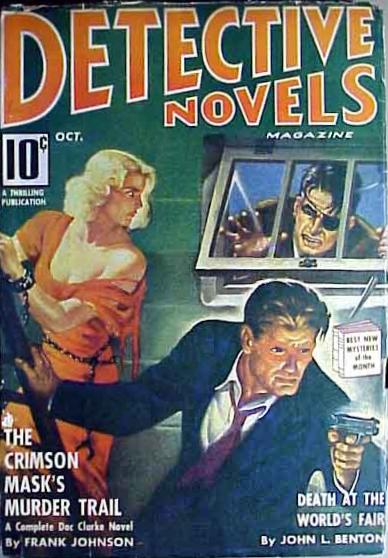
I don't know who did this cover, but the guy in the eyepatch is certainly sinister-looking. It's safe to say that Norman A. Daniels wrote more than half of this issue since both of the lead "novels" are by him: a Crimson Mask story under the pseudonym Frank Johnson and a Candid Camera Kid story under the pseudonym John L. Benton. I really like the Candid Camera Kid series. The Crimson Mask stories are about two-fisted pharmacist and part-time crimefighter Robert "Doc" Clarke. I've read one or two of them and they're okay, slickly written as always with Daniels' work. Other stories in this issue are by the prodigiously prolific Arthur J. Burks, a forgotten pulpster named Robert Gordon, and Rod Brink, whose story here is his only credit in the Fictionmags Index. He may well have been Norman Daniels, too. 

Monday, August 14, 2023

Slaves of the Blood Wolves - Robert Weinberg, ed.


This is a modern-day reprint published by Wildside Press of a collection originally edited and published by Robert Weinberg in 1979 that reprinted four Weird Menace pulp stories from the Thirties. The Weinberg edition has a very nice cover by Stephen Fabian that the Wildside Press reprint also uses. This collection features four authors who were million-words-a-year guys, or close to it, anyway.

The author who leads off this collection, Arthur J. Burks, definitely produced more than a million words a year for a number of years during the pulp era. He wrote all types of stories, as well: detective, aviation, adventure, science fiction, even a few Westerns and sports yarns. He was a prolific contributor to the Weird Menace pulps. His story “Slaves of the Blood Wolves” appeared in the December 1935 issue of TERROR TALES. It’s about a doctor and nurse flying into a blizzard to reach a remote Canadian settlement where the doctor’s father once lived. The people there are beset by two calamities: a mysterious wasting disease and the threat from a horde of starving, blood-hungry wolves. Things turn nasty quickly, as you might expect. Unlike most Weird Menace stories, there’s no real mystery or Scooby Doo ending in this one, just pure action and horror. It’s well-written but maybe a little too over the top for my tastes. (Yes, such a thing is possible, believe it or not.)

Wyatt Blassingame had a great career in the pulps, writing hundreds of detective, Western, and sports stories in addition to being one of the leading authors of Weird Menace yarns. His novelette “Satan Sends a Woman” appeared in the January 1936 issue of TERROR TALES. In it, two-fisted adventurer Ed Roland explores a sinister Alabama swamp where several men have disappeared. The swamp is also the only way to reach an area of the coast where a ship carrying a fortune in pearls is supposed to have run aground some years earlier. Not only does Roland have to deal with the regular dangers that a swamp poses (snakes, alligators, quicksand, etc.), but he also encounters a strangely beautiful young woman who may not be what she seems. Like the Burks yarn that precedes it in this collection, “Satan Sends a Woman” doesn’t really follow the Weird Menace formula, but it’s well-written and gallops along in an entertaining fashion. I’ve read quite a few stories by Blassingame in the past few years and always enjoy his work.

Norvell Page is best known for writing most of the Spider novels, of course, but he wrote a bunch of other stuff for the pulps, including stories for some of the Weird Menace magazines. His novella “The Red Eye of Rin-Po-Che” appeared in the November 1939 issue of DIME MYSTERY MAGAZINE. Its protagonist is globe-trotting Irish adventurer Moriarity O’Moore, who is in a New York City nightclub one evening when a beautiful young woman jumps up from a table as he’s passing by, throws her arms around him, and kisses him like he’s her long-lost lover. Only thing is, O’Moore has never laid eyes on her before. But the man she’s with is a sinister-looking bozo, and when she begs O’Moore for help, you know he’s going to play along with the gag, whatever it is. And so off we gallop into a yarn that’s almost non-stop action as O’Moore battles to save a beautiful girl and a fabulously valuable ruby from the evil clutches of some cultists and their high priest. As with the first two stories in this collection, “The Red Eye of Rin-Po-Che” isn’t a standard Weird Menace yarn, either, and it probably would have been more at home in a detective pulp or some magazine like ARGOSY. But I’m not complaining, because this is a great tale that reminds us Norvell Page was one of the top action writers in the pulps, right up there with Robert E. Howard and Lester Dent. There’s a second Moriarty O’Moore story, “The Red Eye of Kali”, which also appeared in DIME MYSTERY a year later, in the November 1940 issue, but it appears never to have been reprinted.

This collection wraps up with “Girl of the Goat-God” by Arthur Leo Zagat, one of the top names in Weird Menace pulps and also the author of numerous detective, science fiction, and adventure yarns. Originally published in the November 1935 issue of DIME MYSTERY MAGAZINE, this story actually does fall firmly within the usual Weird Menace boundaries: there’s a sinister old house with some sinister gardens, a statue of Pan that may be coming to life and killing people, a swamp, a beautiful young woman with a menacing aunt, a stalwart hero who loves the girl, and a herd of goats that stampedes at the worst possible time. All of it told in Zagat’s slick, breathless prose that makes the pages just race by. Anybody who has read many Weird Menace stories will figure out the ending pretty quickly, but that doesn’t matter. The fun lies in how Zagat gets there, and it’s a lot of fun indeed.

As we’ve seen, SLAVES OF THE BLOOD WOLVES isn’t really that representative of the Weird Menace genre, but every story in it is very well-written and highly entertaining. My favorite is the Norvell Page yarn with its fantastic action and pace, but the other stories are all well worth reading as well. For pulp fans, I give this collection a high recommendation.


Sunday, July 16, 2023

Sunday Morning Bonus Pulp: Air Trails, July 1931


Frank Tinsley provides a dramatic cover on this issue of AIR TRAILS, Street & Smith's entry into the aviation pulp market. There are some top-notch writers in this issue, too: Raoul Whitfield, George Bruce, Arthur J. Burks, Robert J. Hogan, and the lesser-known Kirkland Stone, Warren Elliot Carleton, Kent Sagendorph, and Barry Thompson. I've read only sparingly in the aviation and air war pulps, but I've enjoyed what I've read.

Sunday, October 02, 2022

Sunday Morning Bonus Pulp: Thrilling Mystery, December 1935


This is the second issue of THRILLING MYSTERY, launched by the Thrilling Group to compete with the success of Popular Publications’ leading Weird Menace pulp DIME MYSTERY. I don’t know who did the cover, but it’s plenty garish and eye-catching. An e-book reprint of this pulp is available from Radio Archives, so being both time- and attention span-challenged, I read it recently.

Wyatt Blassingame was one of the top Weird Menace authors over at Popular, so it’s no surprise to find him leading off this issue with a novelette called “The Flame Demon”. I’ve liked everything I’ve read by Blassingame, but unfortunately, this yarn about a villain calling himself the God of Fire comes across to me as pretty uninspired. There are some nice action scenes—lots of big fires, and the protagonist finds himself in a really harrowing position—but Blassingame seems to have phoned in the muddled plot, which requires quite a bit of unconvincing exposition in the final pages to explain. I don’t have any way of knowing, of course, but I suspect that Rogers Terrill at Popular rejected this story and Harvey Burns, the editor at THRILLING MYSTERY, snapped it up because of Blassingame’s name recognition in the genre.

“Voice From Hell”, a short story by Jack D’Arcy (really D.L. Champion, creator of the Phantom Detective), is a Poe-like tale with a clever twist to it about a murderer tormented by his crime. It’s a slight but enjoyable story and an improvement over Blassingame’s novelette.

This issue really begins to pick up steam with “Ghouls of the Green Web”, a novelette from the dependable G.T. Fleming-Roberts. It’s set in a small Kansas city during the Dust Bowl, one of the few pulp stories I’ve read to use that bit of real-life history in its plot. Fleming-Roberts does a really nice job with it, too. The writing is excellent. Fleming-Roberts’ prose can be lurid, over the top, and genuinely creepy when it needs to be, and then turn around and achieve a terse, hardboiled, poetic effect. The menace seems a bit more realistic than some, as well. I really enjoyed this one.

I don’t know anything about James Duncan, author of the novelette “Blood in the Night” except that his real name was Arthur Pincus and that he wrote dozens of mystery, detective, and Weird Menace stories for a variety of pulps. His story in this issue is a bit of a kitchen-sink tale, with a witch’s curse, murders that appear to have been committed by a vampire, and an old house full of heirs to a fortune who benefit by knocking each other off, a set-up reminiscent of an Agatha Christie novel, plus a master detective who is, at least, nothing like Hercule Poirot. Duncan pulls it all together and makes it work in a reasonably entertaining fashion.

Likewise, I know very little about Saul W. Paul, author of the short story “Forest of Fear”. That appears to have been his real name, and he sold about a dozen stories in the Thirties, mostly to the Spicy pulps. This story, about a honeymooning young couple who encounter a deadly menace in the woods, is only borderline Weird Menace and has nothing even apparently supernatural about it, but it does strike a few nicely creepy notes.

Arthur J. Burks was a million-words-a-year man, so I’m surprised I haven’t read more by him, only a few stories here and there. His novelette in this issue, “Demons in the Dust”, is another Dust Bowl yarn, but Burks carries the situation so far that this story reads more like post-apocalyptic science fiction than Weird Menace. And as post-apocalyptic SF, it’s not bad, although the plot—the protagonist and his newlywed wife try to escape from a particularly bad dust storm—is a little thin. But there’s lots of action and it’s well-written, making for a bleak but satisfying tale.

H.M. Appel is another author I’m not familiar with, except for seeing on the Fictionmags Index that he wrote several dozen stories for various Weird Menace and detective pulps. His short story “Hooks of Death” isn’t really Weird Menace, either, despite being fairly grisly in places. It’s about a young highway patrolman’s pursuit of a serial killer stalking a particular stretch of road. The prose has plenty of momentum and the hero’s background furnishes a nice twist.

Jack Williamson isn’t a name I expected to encounter in the Table of Contents in a Weird Menace pulp, but in addition to being one of the giants of science fiction, Williamson also wrote a considerable amount of fantasy and horror, so it’s not that much of a stretch. His novelette “Grey Arms of Death” is about some very Cthulhu-like creatures from the depths of the Atlantic Ocean stalking some deep-sea explorers and invading a lonely cliffside mansion. I don’t know if Williamson ever read Lovecraft, but based on this story I feel like there’s a good chance he did. This is pure Weird Menace, and Williamson, already a very seasoned pro in 1935, throws himself into the breakneck, lurid prose with great gusto. This is a fast-moving and very entertaining story, probably my favorite in the whole issue.

Overall, this issue of THRILLING MYSTERY is a satisfying read, even though some of the stories don’t fit the Weird Menace genre that well. I have no way of knowing, but since it was only the second issue, I suspect that the stories by Duncan, Paul, and Appel were intended originally for POPULAR DETECTIVE or possibly as back-ups in THE PHANTOM DETECTIVE and were pulled out of inventory to go in THRILLING MYSTERY. But that’s pure speculation on my part.

Sunday, April 03, 2022

Sunday Morning Bonus Pulp: Famous Detective Stories, August 1951


Never trust a guy in a gas mask, that's my motto. This blonde certainly shouldn't have. I don't know the artist on this cover, but I like it. Arthur J. Burks is probably the biggest name in this issue, followed by T.W. Ford, Seven Anderton, and Thomas Thursday. Columbia house-name Mat Rand is also on hand, along with a bunch of writers I've never heard of, such as Betty Brooks and D.A. Kyle. I'm not sure if anybody in this issue of FAMOUS DETECTIVE STORIES deserves the FAMOUS label, but that doesn't mean the stories aren't good. (Burks, Ford, and Thursday still have work in print.)

Sunday, October 24, 2021

Sunday Morning Bonus Pulp: Crime Busters, June 1938


The cover's not bad on this issue of CRIME BUSTERS (I don't know the artist), but man, look at the authors and series inside: Lester Dent with a Click Rush story, Walter B. Gibson (as Maxwell Grant) with a Norgil the Magician story, Norvell Page with a story featuring Angus Saint Cloud, the Death Angel (don't know this series, but what a great name!), Theodore Tinsley with a Carrie Cashin story, plus yarns by Frank Gruber, Wyatt Blassingame, and Arthur J. Burks. This looks like an absolutely great issue.

Sunday, June 20, 2021

Sunday Morning Bonus Pulp: Strange Detective Stories, January 1934


Clifford Benton's cover for this issue of STRANGE DETECTIVE STORIES is pretty exciting. I don't think I'd heard of Benton before. Looks like he did only a few pulp covers, all of them either for this magazine or its predecessor, NICKEL DETECTIVE. There's a strong group of writers in this issue, too: Norvell W. Page, E. Hoffmann Price, Arthur J. Burks, Frederick C. Painton, Ralph Perry, Harold Ward, Samuel Taylor, and a couple less familiar to me, Jack Smalley and Les Tillray. This is Tillray's only entry in the FMI. Might have been a pseudonym, might've just been his only sale. I don't know much about STRANGE DETECTIVE STORIES, but based on this issue, it appears to have been a pulp worth reading.

UPDATE: I've learned from Lynn Munroe that the Les Tillray story in this issue, "Terror Trail", was actually written by none other than Erle Stanley Gardner, and that its original title was "Death Trail". Many thanks to Lynn for this great bit of literary detective work!

Sunday, May 23, 2021

Sunday Morning Bonus Pulp: Astounding Stories, November 1933


I don't know about you, but I find that cover by Howard V. Brown intriguing. Scans of this issue are available on-line. I may have to see if I can find time to read it. The line-up of authors is certainly a strong one: Murray Leinster, Jack Williamson, Arthur J. Burks, Harl Vincent, Wallace West, Robert H. Leitfred, Desmond Hall (writing as Ainslee Jenkins), and a couple of lesser-known authors, Stuart Jackson and Holloway Horn. You can find a PDF of this issue here

Sunday, March 14, 2021

Sunday Morning Bonus Pulp: Astounding Science-Fiction, June 1939


This cover by Graves Gladney almost looks like it would be more at home on a detective pulp, rather than an issue of ASTOUNDING SCIENCE-FICTION. Either way, I like it. There's a fine line-up of authors in this issue, too: Jack Williamson (with an installment of a Legion of Space serial), Clifford D. Simak, Nat Schachner, Arthur J. Burks, Ross Rocklynne, and Harl Vincent. I'm not sure if I've ever read anything by Schachner or Vincent, but I've read and enjoyed all the other authors.

Sunday, November 01, 2020

Sunday Morning Bonus Pulp: Thrilling Detective, January 1934


There are skeletons on this THRILLING DETECTIVE cover by Rafael DeSoto. That's appropriate enough for the day after Halloween, right? Inside are some top-notch authors, including Norman A. Daniels, Johnston McCulley, Arthur J. Burks, Lawrence A. Keating, Thrilling Group house-name C.K.M. Scanlon (if I had to guess, really Keating or Daniels), and little-known authors Barry Brandon and Walter A. Sinclair.