Showing posts with label John L. Benton. Show all posts

Sunday, February 22, 2026

Sunday Morning Bonus Pulp: Thrilling Detective, August 1933


I don’t actually own that many detective pulps (although a 1931 issue of DETECTIVE FICTION WEEKLY was the first actual pulp I ever owned), so when I’m in the mood to read one, I often head for the Internet Archive. That’s where I recently read the August 1933 issue of THRILLING DETECTIVE. I don’t know who painted the cover. While it’s not a great one, it’s certainly not bad.

Ed Lybeck is a mostly forgotten writer these days. A few years ago, Altus Press published a collection of the four stories he wrote for BLACK MASK, which I read and thought was excellent. Lybeck wrote the lead novella in this issue, “Coins of Murder”, in which a Secret Service agent with the unlikely name Everard Kynaston literally stumbles over a case involving murder, a Chinese tong, and a scheme to destroy the American economy by flooding it with a previously unknown supply of gold. The plot is pretty weak, the criminal mastermind might as well be wearing a big sign on his back that reads CRIMINAL MASTERMIND, and the story reminds me a little of some of Sax Rohmer’s later Fu Manchu novels without being anywhere near as good. However, Lybeck’s lean, gritty prose is fun to read, and the opening pages of this yarn are particularly effective. This isn’t as good as the stories Lybeck wrote for BLACK MASK, but it’s worth reading if your expectations aren’t too high.

“The Corpse From Chicago” is a novelette with an intriguing opening: a hotshot gangster from the Windy City is murdered while sitting in the lobby of the Plaza Hotel in New York City, surrounded by people, and yet nobody saw who killed him. A tough police detective gets the case and the story is almost non-stop action after that as he uncovers a war between two gangs of crooks trying to take over the marijuana racket. I’d never heard of the author of this one, James H.S. Moynihan, but he published almost a hundred detective and gang stories in various pulps during the Thirties and Forties. This one is okay. I’m not sure the plot completely makes sense, but Moynihan’s terse prose races right along nicely.

“The Giordano Mob” actually is non-stop action, as private detective Ed King goes after the gangsters responsible for the death of a young operative who works for the same agency. King is known as the Speed Demon, for some reason, and refuses to use a gun or knife, relying only on his fists as he battles the bad guys. This story is part of a series of his adventures written by a forgotten pulpster named Barry Brandon. Other than King’s canine sidekick, there’s not much memorable about this one. The plot’s just too thin to amount to much.

“Picture Frame” by H.M. Appel is an actual murder mystery built around photographic tricks and an isolated cabin on the shores of Lake Michigan where a group of men have an informal gun club devoted to skeet shooting. One of them winds up dead, of course, and it’s pretty obvious the killer can be found among the other three. This is the sort of short, bland yarn that showed up frequently in the mystery digests of later decades such as EQMM and AHMM. There’s nothing wrong with it, but it’s not very compelling.

Perley Poore Sheehan was a prolific, well-regarded author of adventure fiction in the pulps, but he also wrote detective yarns, including a series about a masked crimefighter known as Doctor Coffin, who was actually a retired Hollywood character actor who also owned a chain of undertaking parlors. I think there were 15 of these novelettes, some of which have been collected, but I’d never read any until “The Chicken King” in this issue. And it really has me scratching my head, because this tale of Doctor Coffin battling the head of “the poultry racket” is just terrible. The plot makes no sense, and the writing, other than a few outbursts of lurid violence, is bland and boring. This is the next-to-last story in the series, and it reads as if the author were tired of it. I really ought to try some of Sheehan’s other work, because he couldn’t have been this bad all the way through his career.

Allan K. Echols is remembered mostly as a Western writer, but he wrote crime, detective, and Weird Menace stories, too. “The Murder Trail” in this issue is about a would-be crook who decides to hold up a gambling den in Harlem. Everything goes wrong, and the fellow has to go on the run, after which things just get worse and worse. This is a fairly good story that reminds me of Cornell Woolrich’s work, without being as well-written. It’s bleak as all get-out, with a relentless sense of doom that Echols captures well.

Arthur J. Burks was another very prolific pulpster who wrote just about every genre except Westerns. “The Gun” in this issue is a short story about a hitman. It’s well-written, effective, but doesn’t end quite as dramatically as it might have. This may be the first thing I’ve read by Burks, and it wouldn’t excite me about reading more by him, but his work has a pretty good reputation and I’m sure I’ll try something else by him.

The issue wraps up with “The Crimson Blade” by “John L. Benton”, a well-known Thrilling Group house-name, so there’s no telling who actually wrote it. A scene in the story matches the cover illustration, which makes me think the painting came first and one of the regular authors wrote the story to match. In this one, a cop investigates the murder of a society doctor who’s rumored to be pushing dope to wealthy women. It appears that a low-class junkie killed the doctor, but the cop believes the guy was framed and sets out to prove it. This is a solid little yarn that’s well-written. The plot might have been better with another twist or two, but it works okay.

Overall, I can’t really recommend this issue. I found a couple of the stories almost unreadable, and the best ones were no more than okay. Maybe this isn’t a fair comparison, but the same month this issue of THRILLING DETECTIVE was on the stands, BLACK MASK featured stories by Erle Stanley Gardner, Frederick Nebel (a Donahue story), Raoul Whitfield, Roger Torrey, Norvell Page, and Donald Barr Chidsey, while DIME DETECTIVE had stories by T.T. Flynn, Frederick Nebel (a Cardigan story), Leslie T. White, and John Lawrence. Next time I’m in the mood for a detective pulp, I’ll probably go for one of those titles.

Sunday, July 27, 2025

Sunday Morning Bonus Pulp: Thrilling Detective, January 1945


I don't know who did the cover on this issue of THRILLING DETECTIVE, but how can you go wrong with a good-looking, redheaded female cabbie with a skeleton in the back seat? The best-known authors in this issue (which I don't own) are Edward S. Aarons writing under his pseudonym Edward Ronns, C.S. Montanye, and Allan K. Echols, best remembered for his Westerns. Also on hand are Benton Braden (twice, once under his own name and once as Walter Wilson) and Armstrong Livingston, plus house-name John L. Benton.

Sunday, February 09, 2025

Sunday Morning Bonus Pulp: Popular Detective, June 1945


The cover of this issue of POPULAR DETECTIVE caught my eye and intrigued me enough to read a PDF of the issue downloaded from the Internet Archive. Carnivals were common settings for pulp detective yarns and I’ve always enjoyed carny fiction. I don’t know who did this cover, but there’s a lot going on and I like it.

It's also an extremely accurate representation of a scene in the short story “Clown of Doom” by John L. Benton, a Thrilling Group house-name commonly used by Norman A. Daniels but also by Oscar J. Friend and Donald Bayne Hobart. The narrator/protagonist is named Ed Rice, which instantly rings some bells and raises some questions. Was John L. Benton, in this case, actually Emile C. Tepperman, and is “Clown of Doom” really an entry in Tepperman’s long-running Ed Race series which ran as back-up stories in THE SPIDER? Maybe an editor at Popular Publications rejected the story so Tepperman changed one letter in his hero’s name and sent it over to the Thrilling Group? Ed Race, after all, was a juggler and trickshot artist who had many adventures set in the carnival world.

Well, I can’t prove it, of course, but my answer to both of the questions I posed above is “I don’t think so.” For one thing, Ed Rice, in this story, is a spieler, a ballyhoo guy, not a marksman or juggler. The story is told in slangy, present-tense, first-person narration that doesn’t sound anything like Tepperman’s Ed Race stories. And the fact that the scene on the cover exactly matches the action in the story makes me believe that a lot more likely scenario is that this yarn was written to match an already existing cover painting. The author was probably one of the regular contributors to POPULAR DETECTIVE and the other Thrilling Group detective pulps. Whatever the truth of this situation is, the story is a pretty good one, a fast-paced yarn about a murder at a traveling carnival.

Elsewhere, the issue leads off with the novella “Motto For Murder” by Frank Johnson, also a Thrilling Group house-name used mostly by Norman A. Daniels. My hunch is that he didn’t write this story, but he might have. Private eye Rufus Reed and his two partners, his wife Pat and his younger brother Johnny, are hired to find out who’s been knocking off defendants in high-profile murder trials right after they’ve been found not guilty. It’s a fairly interesting plot and there are some excellent action scenes, but the characters are all kind of bland and I never was as intrigued as I hoped to be. Not a terrible story, but certainly forgettable.

“Pilot to Murderer” is by Walt Sheldon, a prolific pulpster who went on to a career as a well-respected paperback novelist in the Fifties and Sixties. It has a great concept: the crew of a B-17 Flying Fortress bomber on a top-secret mission discovers that there’s a murderer among them. It's up to the pilot, who also narrates the story, to figure out who the killer is. This is a terrific story that lives up to the idea. I really need to read more by Sheldon.

“Death By Proxy” by M.D. Orr is part of a series featuring British Intelligence agent Archie McCann, who battles Japanese espionage plots in New Guinea while pretending to be an anthropologist. This is the first one I’ve read. In this story, a would-be assassin turns up dead, so Archie has to solve the murder of a man who tried to kill him. The setting and the concept are great, and Archie is a likable, interesting protagonist, but the writing never worked up much urgency or suspense for me. Still, there’s enough to like that I’d be interested in reading more in the series.

Mel Watt’s novelette “The Chair Is Not Cheated” features as its sleuth an actor who plays the villainous Dr. Coffin on a radio crime drama. He has to turn detective in real life when a friend of his is accused in what seems to be an open-and-shut case of murder. What really happened is pretty predictable, but the story moves along at a decent pace. Watt could have done more with the radio background, too. Although it reads like the start of a series, this is the only “Dr. Coffin” story of which I’m aware.

Joe Archibald wrote a long (approximately 70 stories) series about private detective Willie Klump, all of which appeared in POPULAR DETECTIVE except the final two, which were published in THE SAINT DETECTIVE MAGAZINE and MIKE SHAYNE MYSTERY MAGAZINE. These are comedy detective yarns, a sub-genre which, like comedy Westerns, I don’t usually care for. I had never read a Willie Klump story before, and I’m not a big fan of Archibald’s work in general, so “The Witness Share” in this issue kind of had two strikes against it to start with. But there are always exceptions, so I was willing to give it a chance, and I’m glad I did. Willie is a hapless, wise-cracking narrator who, like W.C. Tuttle’s Tombstone and Speedy, isn’t as dumb as he seems at first. In fact, he’s fairly sharp as he solves a case of jewel robbery and murder.  I enjoyed this story quite a bit more than I expected to, and I’d be happy to read more about Willie Klump.

Overall, this issue of POPULAR DETECTIVE is a really mixed bag. None of the stories are terrible and I had no trouble finishing all of them. Only one, “Pilot to Murderer”, is outstanding, but “Clown of Doom” and “The Witness Share” aren’t bad. The others all have something going for them, even if they didn’t have me flipping the digital pages with a great deal of enthusiasm. I don’t mean to damn with faint praise here. This issue is okay and I’m glad I read it, and I found enough to like that I might read another issue of POPULAR DETECTIVE in the reasonably near future. Just not right away.

Sunday, July 21, 2024

Sunday Morning Bonus Pulp: Thrilling Detective, July 1933


This is a pretty grim cover by Rafael DeSoto on this early issue of THRILLING DETECTIVE. As is common with a Thrilling Group pulp, several of the authors in this one are house names: Robert Wallace, G. Wayman Jones, John L. Benton, and Kerry McRoberts. (I believe "McRoberts" went into the service during World War II and became Captain Kerry McRoberts.) The only author with a recognizable real name is William H. Stueber, who wrote some of the early Masked Rider novels. The others on hand, none of whom are the least bit familiar to me, are Maxwell Smith, Barry Brandon, and Russell Stanton. I suspect there are some decent stories in here, but I don't own a copy and this issue doesn't appear to be on-line, so I can't be sure.

Sunday, February 25, 2024

Sunday Morning Bonus Pulp: Detective Novels Magazine, February 1939


That looks like a Richard Lyons cover to me, but I could certainly be wrong about that. This issue of DETECTIVE NOVELS MAGAZINE has stories by some fine authors in it. The lead novella is by the always entertaining E. Hoffmann Price, and there's also a novella by Norman A. Daniels, who's almost as dependable as Price. Three short stories round out the issue. The three authors responsible for those are Donald Bayne Hobart (with an entry from his long-running series about private eye Mugs Kelly); a pulpster I haven't heard of, Avin H. Johnston, who wrote more than two dozen detective, Western, and adventure yarns for various pulps; and John L. Benton, a Thrilling Group house-name who was probably Daniels in this case but might have been Hobart. I don't own a copy of this pulp, but it looks like it would be enjoyable reading if I did.

Sunday, August 20, 2023

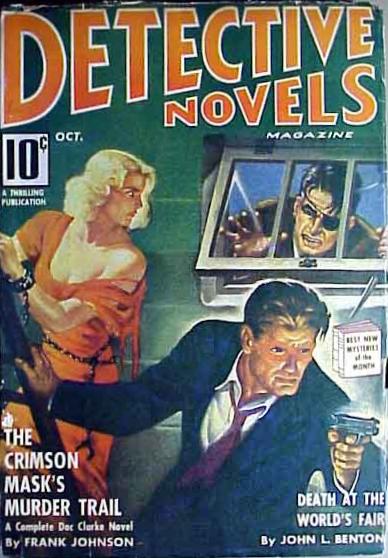
Sunday Morning Bonus Pulp: Detective Novels Magazine, October 1940


I don't know who did this cover, but the guy in the eyepatch is certainly sinister-looking. It's safe to say that Norman A. Daniels wrote more than half of this issue since both of the lead "novels" are by him: a Crimson Mask story under the pseudonym Frank Johnson and a Candid Camera Kid story under the pseudonym John L. Benton. I really like the Candid Camera Kid series. The Crimson Mask stories are about two-fisted pharmacist and part-time crimefighter Robert "Doc" Clarke. I've read one or two of them and they're okay, slickly written as always with Daniels' work. Other stories in this issue are by the prodigiously prolific Arthur J. Burks, a forgotten pulpster named Robert Gordon, and Rod Brink, whose story here is his only credit in the Fictionmags Index. He may well have been Norman Daniels, too. 

Sunday, July 02, 2023

Sunday Morning Bonus Pulp: Mystery Book Magazine, Summer 1948


This is a nice dramatic cover on this issue of MYSTERY BOOK MAGAZINE. I don't know the artist. When I spotted it while looking through the Fictionmags Index, I got excited for a minute because this issue features a Mike Shayne story I hadn't heard of, "Murder is a Habit". But a little investigation seems to indicate that it's actually a condensation of the novel BLOOD ON THE STARS. Any confirmation or other information will be much appreciated. Besides the Shayne story, this issue includes yarns by Judson P. Philips, Roy Vickers, Cyril Plunkett, O.B. Myers, Jules Archer, and house-name John L. Benton.

UPDATE: The cover artist is Rudolph Belarski. Thanks to Ed Hulse for that identification. The artwork was recycled for the cover of a Mike Shayne novel, fittingly enough, on BODIES ARE WHERE YOU FIND THEM, Popular Library #192.


Sunday, September 19, 2021

Sunday Morning Bonus Pulp: Detective Novels Magazine, December 1939


It's safe to say that Norman A. Daniels wrote more than half of this issue of DETECTIVE NOVELS MAGAZINE, since he has two novellas in it, one under his own name and an entry in his excellent Candid Camera Kid series as John L. Benton. In addition, there's a story by house-name J.S. Endicott, which might well be Daniels, too, and a story by an author named Temple Franklin who has only one credit in the Fictionmags Index, so that might be a Daniels pseudonym, too. We'll probably never know. The other author in this issue is the little known but apparently real Arthur W. Phillips. I don't know who did the cover art, but the scene has a lot going on and I like it.

Sunday, April 04, 2021

Sunday Morning Bonus Pulp: Thrilling Detective, February 1951


I'm used to seeing Sam Cherry's covers on Western pulps, but he also did a lot of work in other genres, and on paperback covers, as well. Here's one on an issue of THRILLING DETECTIVE, and I like it a lot. Inside are stories by Stewart Sterling, Norman A. Daniels (writing as Wayland Rice), D.L. Champion, house-names John L. Benton and Robert Wallace (who might well be either Sterling or Daniels in this case), and little known authors B.J. Benson and Burt Sims.

Sunday, November 04, 2018

Sunday Morning Bonus Pulp: Popular Detective, June 1944


Cigars . . . cigarettes . . . bullets! (You know, that wouldn't be a bad title for a pulp detective yarn, and it would fit this cover.) I don't know who did this cover, but I like it quite a bit. Inside this issue of POPULAR DETECTIVE are stories by J. Lane Linklater, Joe Archibald, and three house-names, John L. Benton, Frank Johnson, and Michael O'Brian. Norman Daniels wrote under all three of those names, so he could have authored one or more of these stories, but there's really no way to know at this point. It looks like an entertaining issue no matter who wrote the stories.

Sunday, July 15, 2018

Sunday Morning Bonus Pulp: Detective Novel Magazine, Spring 1949


This issue of DETECTIVE NOVEL MAGAZINE features an eye-catching cover by Rudolph Belarski. And that's the purpose of a pulp cover, isn't it? The featured story in this issue is a reprint (possibly abridged) of a 1939 novel by Q. Patrick, actually Richard Webb and Hugh Wheeler, who also wrote as Jonathan Stagge and their best-known pseudonym, Patrick Quentin. There are also stories by William Campbell Gault and Arthur Leo Zagat, both top-notch pulpsters, and John L. Benton, a Thrilling Group house-name, so the author of that one was probably pretty good, too.

Sunday, June 03, 2018

Sunday Morning Bonus Pulp: Mystery Book Magazine, Summer 1950


"The Best in New Detective Fiction", this cover from MYSTERY BOOK MAGAZINE proclaims, and I think they could make a persuasive argument. Inside this issue are "The Case of the Dancing Sandwiches" by Fredric Brown, also known as one of the famous Dell 10 Cent Books (see below), as well as stories by John D. MacDonald, Philip Ketchum, D.L. Champion (creator of the long-running Phantom Detective series), the house-name John L. Benton, and a couple of authors I've never heard of, Jonathan Joseph and Bryant Ford. I don't know if that's actually the best, but it's pretty darned good.