
Showing posts with label Harold R. Stoakes. Show all posts

Saturday, July 18, 2026

Saturday Morning Western Pulp: Exciting Western, November 1948


This is a pulp that I own and read recently. That’s my copy in the scan, complete with a slam-bang cover by Sam Cherry. I’ve said it many times before, but I really like his work.

I also consistently enjoy the adventures of range detectives Tombstone Jones and Speedy Smith as penned by W.C. Tuttle. This issue’s novelette is called “Lovable Liars”, and as it opens, the pair of them are a-foot, having sold their horses and saddles anticipating that their boss at the Cattleman’s Association will send them to their next assignment via train. The boss expects them to ride horseback to the settlement of Smoke Tree, however, and since they sold their mounts and Tombstone then lost all their money trying out his supposedly foolproof system for blackjack . . . Well, the boys wind up riding the train, but they have to hop an illicit ride on a boxcar to do so. And then what happens? Why, the train gets held up, of course, and through a series of coincidences, Tombstone and Speedy are blamed for the robbery!

Clearing their names and corralling the actual train robbers complicates their original mission, which was to solve a murder for which the son of an old friend of their boss has been arrested. Our intrepid duo manage to accomplish all of that, of course, through a combination of luck, banter, fast action, and detective work that’s more clever than anyone gives them credit for. This is a consistently entertaining entry in a series I really like.

Cliff Walters, a prolific contributor to the Western pulps who’s all but forgotten these days, is next up with a story called “Bone Bonanza”, in which a young rancher who fancies himself an artist goes east in search of a career in fine art, only to have things work out differently than he expected. This is a very mild, lightweight story with a few interesting angles, and it’s an easy read that I don’t think will linger very long in anyone’s mind. But it’s a pleasant enough way to pass 15 minutes.

I sometimes wonder if the readers who bought these pulps realized that A. Leslie, Bradford Scott, and Jackson Cole (part of the time) were all the same guy. Some of them must have suspected. Under the A. Leslie name, Leslie Scott contributes the novelette “Washed in Blood” to this issue. The first part of the tale is fairly standard as young cowboy Jim Wayne clashes with three crooked brothers who run almost everything in the county. A saloon shootout leaves one of the brothers dead and Jim on the run as a fugitive. It’s when he holes up in an abandoned mission still being tended to by an old priest that the story becomes one of ghost pirates and hidden treasure. As always with a Scott story, the action is plentiful and well-written, and the settings are vivid. I really enjoyed this one.

I’ve read a couple of stories by Harold R. Stoakes, another forgotten writer, and enjoyed them. “The Red Stallion” in this issue is a modern-day Western about a horse that can’t be ridden and the relationship between a young man and his stepfather. Honestly, this seems less like a Western pulp story and more like something that would have appeared in a slick or even a literary magazine. It’s got enough angst to it that it could have been mawkish, but Stoakes keeps things pretty low-key and makes it work in a well-written story that reminds me of something Larry McMurtry might have written early in his career.

“One Man Wrecking Crew” is a short (maybe 2000 words, tops) story by the always dependable Donald Bayne Hobart. There’s not much plot to it, just some conflict between a young cowboy and a crooked saloon owner and his henchmen, and that’s just an excuse for a brutal fistfight scene. Hobart probably didn’t spend much time on this and picked up a quick 20 bucks or so, but he was enough of an old pro to make it fun to read.

The Navajo Tom Raine series has become one of my favorites. The novelette in this issue, “Ranger Out of Bounds” drops the reader down in the middle of the action as the Arizona Ranger investigates a land-and-water swindle that also involves the kidnapping of a beautiful young woman. The only break in the action comes when Raine is knocked out cold for a while. It’s a bit more complicated plot than usual for Lee Bond, who wrote this entry under the house-name Jackson Cole. Bond’s stories are pretty easy to identify: at least once in the story, the villains will stand around and explain the plot to each other, and the hero will face multiple enemies in a big, final gunfight. I thought this was an excellent story, and as usual, when I finished it I was eager to read more adventures of Navajo Tom Raine.

I don’t know anything about Clark Gray except that he published more than a hundred stories in various Western pulps and that he wrote the two worst Jim Hatfield novels in the whole series, “Lobo Colonel” (TEXAS RANGERS, January 1952) and “Warpath” (TEXAS RANGERS, June 1952). His story in this issue, “Tortilla Tenderfoot”, is about Pedro Gonzales, a reformed rustler who has lived a law-abiding life for years, only to be drawn back into a life of outlawry by the return of his former partner. This is a decent plot, but Gray plays it for laughs and the actual humor to be found in the story is pretty sparse. However, the writing isn’t bad, and although unimpressive, this is a much better story than either of Gray’s Hatfield novels.

All in all, this is a good solid issue of EXCITING WESTERN, due to top-notch series entries by Tuttle and Bond, a very good stand-alone by Scott, and some interesting short stories. It’s worth reading if you have a copy on your shelves.

Saturday, April 15, 2023

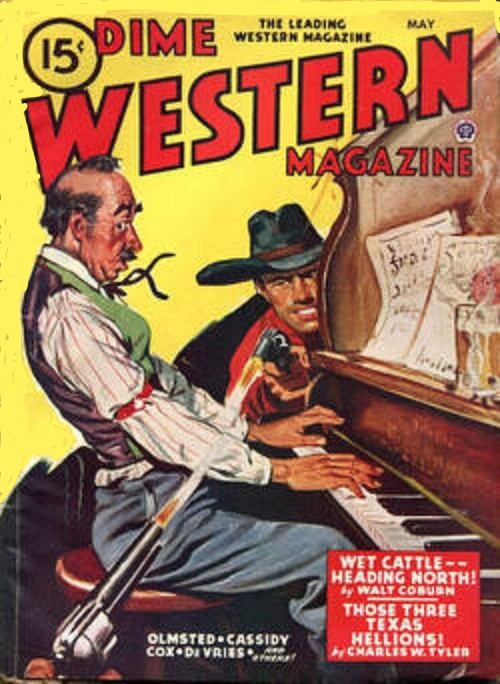
Saturday Morning Western Pulp Revisited: Dime Western, May 1946


I’ve featured this issue before, but a friend sent me a copy of the actual pulp and I read it this week. Thanks, Ryan! Here’s how I opened that previous post: “We already know that it wasn't safe to play poker or go to the barber shop in the Old West, but now we realize that you couldn't even sit down to tickle the ivories without winding up in the middle of a gunfight, thanks to this cover on DIME WESTERN, Popular Publications' leading Western pulp.” I’m unsure of the artist on this cover. It might be Robert Stanley; he was doing a lot of covers for DIME WESTERN during this era.


The first story is by an author whose name is somewhat familiar to me, but I don’t believe I’ve ever read anything by him until now: Charles W. Tyler. Although billed as a novel, “Those Three Texas Hellions!” is fairly short, closer to novelette length. The three Texas Hellions in question are a couple of old-timers called Dewlap and Wattles and a gun-fast youngster known as the Hairpin Kid. You might guess from those names that this is a humorous Western, and if you’ve been paying attention you know that I generally don’t like those much unless they’re by Robert E. Howard or W.C. Tuttle. Well, Tyler is not in the same league as those two, but this story isn’t bad. One of the old codgers gets his hands on a map that’s supposed to lead to the Lost San Saba Mine, and in their search for it they cross trails with a gang of outlaws and a Texas Ranger. The humor doesn’t descend too far into slapstick, there’s plenty of action, and the characters are more likable than I expected them to be. Based on this story, I’d read more by Tyler.

By the way, despite the Table of Contents page claiming “All Stories New—No Reprints!”, a story by Charles W. Tyler entitled “Those Three Texas Hellions!” also appeared in the June 1943 issue of STAR WESTERN. Whether this is the same story, or whether Tyler just reused the title, I don’t know. I’d have to compare both issues, and I don’t own that STAR WESTERN. Not that it really matters.

Next up is “Manhunt at Gillams”, a tense story about a man catching up to the outlaw who robbed him at an isolated way station. The authors are Everett and Olga Webber, who wrote several historical novels together. Everett Webber contributed around 70 Western and detective stories to various pulps and slicks during the Thirties, Forties, and Fifties, sometimes in collaboration with his wife Olga. This is a low-key, well-written yarn that reminded me a little of Ernest Haycox’s work.

Also featured on the cover is Walt Coburn’s novelette “Wet Cattle—Heading North!” Despite the title, the story has a lot more to do with stealing horses rather than cattle. By this point in his career, Coburn’s drinking problem was bad enough that the editors at Popular Publications supposedly had to rewrite his manuscripts to make them publishable. I don’t know if that’s true or not. This one, like most of Coburn’s stories from this era, is so weighted down with back-story that it takes a long time for the actual plot to get going. I’m a big fan of Coburn’s work, but this is a pretty weak entry. There are a few bits of description that really ring true and authentic, and the action scenes are well-done, but mostly it just muddles along, hard to follow. If this was someone’s first Coburn story, they’d probably have a difficult time understanding why he was so popular.

Harry F. Olmsted’s longest-running series, written under the pseudonym Bart Cassidy, featured drifting good-guy outlaw Tensleep Maxon in more than 120 stories between 1933 and 1951. “Tensleep—Wedding Buster” in this issue is typical of the series: in colorful first-person narration, Tensleep finds himself in the middle of trouble at a Mormon wedding. I’ve read a few of the stories in this series, and while I love Olmsted’s work overall, I’m not a big fan of the Tensleep stories. This one’s not bad, certainly readable and entertaining, but it’ll never be one of my favorite series.

It's always cool when I read a pulp and come across a story by an author I’ve actually met. Thomas Thompson was the long-time story editor on the TV show BONANZA, but before that he had a successful career as a Western pulpster and novelist. He was also at the Western Writers of America convention in Fort Worth in 1986, where I met him and got to talk to him briefly. His story in this issue, “The Killer and the Lady”, is a low-key tale about a woman whose old suitor returns, but unfortunately, he's become an outlaw. This is a well-written story, and with its emotion and characterization, it also reminds me of Ernest Haycox.

Old pro William R. Cox contributes the novelette “A Range to Die For!” This is a cattleman vs. nesters story, but Cox gives it a nice twist that brings about a very satisfying resolution. I enjoyed this one a lot.

“War Smoke on Black Hill” is by another author whose name is vaguely familiar to me, Marvin De Vries. It’s about an army scout trying to solve the mystery of who betrayed a patrol and led them into an Indian ambush. Not a bad story, although it’s very obvious where the plot is going.

“As a Man Fights—” by Harold R. Stoakes is a decent little action yarn about an unlikely subject: the clash between a riverboat captain with a load of sugar and the owner of a sorghum mill who’s making molasses. No range war here or water rights battle in this one. It’s a sweetener war, instead. I don’t know anything about Stoakes except that he wrote several dozen Western stories in the Forties and Fifties. This one is off-beat enough that I liked it.

Another series by Harry F. Olmsted that appeared regularly in DIME WESTERN under Olmsted’s name featured Friar Robusto, an adventurer in Spanish California. Robusto isn’t an actual priest, he only pretends to be one, and he has a masked secret identity as a Robin Hood outlaw known as the Phantom Highwayman. Any resemblance to Johnston McCulley’s Zorro series probably isn’t coincidental. These are more historical swashbucklers than traditional Westerns, but I love them. Every one I’ve read has been great, including “Friar Robusto at the Devil’s Deadline” in this issue. This is the 23rd and final story in the series, and it finds Robusto caught up in political upheaval between the King of Spain and the Viceroy of Spanish California. Lots of blood-and-thunder action, including several sword fights, and Robusto is a great character. If you’re a fan of the serial ZORRO’S FIGHTING LEGION, like I am, you’ll find a lot of the same feeling in Olmsted’s Friar Robusto stories. This series would be a good candidate for reprinting, and with only 23 novelettes, it could be done in three or four volumes.

Overall, this is a very solid issue of a consistently good Western pulp. The stories range from good to excellent, with the best being the Friar Robusto yarn and the weakest the one from Walt Coburn, and it’s not terrible, just not up to the standards of his best work. I had a very good time reading this issue.