Showing posts with label Harry F. Olmsted. Show all posts

Saturday, August 15, 2026

Saturday Morning Western Pulp: Big-Book Western Magazine, February 1949


This is a pulp that I own and read recently. That’s my battered copy in the scan. I thought at first the rather garish cover was by Robert Stanley, but the more I look at it, the less sure I am of that. The initials PKH are carved into the bar, and I’m wondering if those are the artist’s initials or if they’re there for some other reason. If they do belong to the artist, I can’t figure out who it is. But whoever painted it, it’s an action-packed, eye-catching cover.

Those four big novels mentioned on the cover are actually more like novelettes. The first one is “Colt-Cure for Woolly Fever” by Peter Dawson, who was actually Jonathan Glidden, brother of Fred Glidden, who was better known as Luke Short. Jon Glidden was an excellent Western author and has been one of my favorites for a long time. I believe I was in seventh grade when I first read one of his novels. Anyway, as you’re expect from the title, this story is a cattlemen-vs-sheepmen yarn, but that’s the only thing about it that’s standard. Instead of a range war tale, this is actually a clever bank heist story complete with multiple double-crosses and hidden identities, told in a fast-paced, breezy style that’s more humorous than most of the Peter Dawson stories. I figured this one would be good, but it’s even better than that. It’s a terrific story, one of the best I’ve read by Jonathan Glidden.

Everett M. Webber collaborated on some well-regarded historical novels with his wife Olga but also wrote quite a few Western, detective, and general fiction stories for the pulps and slicks. His story in this issue, “Those Who Have Eyes—” is about a small-town sheriff trying to solve a robbery in order to protect his friend, a Chinese man who owns a restaurant. There’s not much to it, but it’s reasonably well-written.

Clifton Adams is another long-time favorite of mine. Many of his stories are set in Oklahoma, where he lived, and deal with the oil business in the early days of the territory, as is the case with “Blood Buys a Black-Gold Empire”. (As I’ve mentioned before, I figure the editors at Popular Publications came up with many of these story titles.) In this story, a range detective from Texas rides north to Oklahoma in answer to a summons from an old friend, a sheriff who has more troubles than he can handle in an oidfield boomtown. Unfortunately, somebody tries to bushwhack our protagonist on his way there, and when he does arrive, it’s just as the sheriff is being murdered, a crime for which the Texan is framed. Convicted and sentenced to hang, he has to break out of jail in order to find out what’s really going on and clear his name. This is a top-notch Adams yarn, well-written, full of action and interesting characters, and I always enjoy oilfield stories. This is a very good one.

“Hell-on-the-Law!” by prolific Western pulpster Tom Roan is also a bank robbery story, and it’s pretty clever in its setup, too. But once the job is pulled, it becomes a really nice chase story as a veteran lawman with a secret of his own goes after the robbers. Roan’s work can be hit-or-miss with me, but this one has excellent characters, plenty of action, and a compelling pace. Another top-notch story in what’s shaping up to be a very good issue.

“Stranger on the Dodge” by Walker A. Tompkins, another old favorite of mine, is actually billed as a novelette, and it’s a good one. A fugitive from a bogus murder charge rides into the middle of a war between sodbusters and cattlemen. It’s a standard plot, but Tompkins puts the familiar elements into play with such skill that the story is a pure pleasure to read.

John Jo Carpenter was the pseudonym of John Reese, who went on to write a number of well-regarded Western and crime novels under his own name, several of which were filmed. His story in this issue, “Last of the Wild Fayettes”, is a romance in which an ambitious young cowboy clashes with a cattle baron over the rancher’s beautiful daughter. Despite being a little on the lighthearted side, there are a couple of brutal, well-written fistfights. This is very much in the vein of such John Wayne movies as McCLINTOCK! and NORTH TO ALASKA, and if it had more plot, it would have made a good movie, too.

William R. Cox was the author of the very first grown-up paperback I ever bought, the Gold Medal Western BIGGER THAN TEXAS, so I’ve always had a bit of a soft spot for his work. His town-tamer novelette in this issue, “Hot Time at End-of-Track”, seems to have been loosely based on the early careers of Wild Bill Hickok and Bat Masterson, even though both of those historical characters are mentioned in the story. Marshal John Steel takes on the Texas trail drivers who have Wichita “treed”. For a fairly simple plot, Cox really gives this tale an epic feeling. John Steel, cool under fire but haunted by past tragedy, is a superb protagonist. This is just a great story with complex, well-developed characters.

I always think of Talmage Powell as a crime and detective writer, but he did a bunch of Westerns, as well. “Smoky Lesson” in this issue is about an old gunfighter who visits the town where the woman he once loved is buried, only to find himself mixed up in a war between a crooked saloon owner and a crusading young newspaperman. The twist in this one is pretty obvious but still effective, and Powell’s hardboiled prose is excellent, as usual.

This issue wraps up with the novelette “King of the Washoe Outcasts” by another old favorite, Harry F. Olmsted. This is set in Nevada during the silver boom and about a young, down-on-his-luck miner who decides to turn owlhoot, only to discover that he’s not ready to cross that line. Based on some actual history, this story features a lot of double dealing and characters with actual shades of gray to their personalities, as well as plenty of well-written action. This is another really good story in an issue full of good stories.

In fact, this issue of BIG-BOOK WESTERN MAGAZINE is one of the best Western pulps I’ve ever read. There’s not a bad story in the bunch, and several of them are in the top ranks of work I’ve encountered from their authors. If you happen to own a copy and haven’t read it yet, I give it a very high recommendation.

Saturday, February 14, 2026

Saturday Morning Western Pulp: All Western Magazine, February 1937


This is a pulp that I own and read recently. That’s my copy in the scan. Although there’s no cover credit on the TOC page and it’s unattributed on the Fictionmags Index, I suspect it’s the work of Arthur Mitchell. It looks like one of his paintings, and he did a lot of covers for ALL WESTERN MAGAZINE during this period.

The lead novella, “Gun Smoke on the Pecos”, is the third and final story in the Roaming Reynolds series by Charles M. Martin. I haven’t read the first one, but I read the second one a while back and liked it fairly well. In this story, Roaming Reynolds and Texas Joe, a pair of drifting cowboys/gunfighters/adventurers, return to their home country in West Texas and immediately find themselves mixed up in a range war. The plot is very much by-the-numbers, right down to the rancher the boys are working for having a beautiful daughter, and Martin’s heavy-handed pulp cowboy lingo and narrative style wear thin pretty quickly. If I’m being honest, and I try to be here, this is a rather mediocre story. And yet . . . the numerous action scenes work really well, the setting rings true, and Martin does a good job of playing up the epic, mythological clashes between Roaming Reynolds and the evil gunfighter on the other side. When they face off at the end, I could hear Ennio Morricone music welling up inside my head. So this novella has that going for it, anyway, and ultimately, that was enough for me, but you might feel differently.

Harry F. Olmsted is one of my favorite Western pulp authors. His story “Headboard Tally” in this issue packs quite a bit of plot in a few thousand words. It’s a revenge yarn, as a cowboy tries to track down the four men responsible for lynching his brother, but as it opens, he’s already killed three of the four and doesn’t know the identity of the final man. He finds out in what turns out to be a pretty far-fetched coincidence, but Olmsted writes well enough I’ll cut him that much slack. For a story that’s mostly bleak and dark, this one turns out to have a heartwarming element to it, as well. It worked for me, and I enjoyed it quite a bit.

James P. Olsen, who also wrote a lot for the pulps as James A. Lawson, was a consistently good author, with many stories that tend toward over-the-top action. For that reason, “Malachi Murphy—Cowboy” is something of an oddity among Olsen’s work in that it’s a quiet little slice-of-life story about an old cowboy spending the winter at an isolated high country line camp. Not much happens, but it’s well-written and the title character is an interesting one.

I’ve read quite a few stories over the years by Hapsburg Liebe, real name Charles Haven Liebe. While his work is usually enjoyable, I’ve never considered myself a fan of his stories. “Bullet” is about a teenage boy whose father is an outlaw. When Bullet’s pa and another owlhoot rob a bank and are caught, it’s up to Bullet to save them from being lynched. This is a well-written, cleverly plotted story, one of the best from Liebe that I’ve read.

Darrell Jordan is best remembered for almost a hundred stories he wrote for the aviation and air war pulps, but he also turned out a few detective and Western yarns, including the novelette “Range War Nemesis” in this issue. The protagonist, young cowboy Brad Bannon, wants to repay the man who grubstaked his father twenty years earlier, but that effort lands Brad in the middle of a range war, and the fact that he’s a dead ringer for a notorious gunman complicates the issue. This isn’t a bad story and there are some nice action scenes, but the plot is pretty muddled and hard to keep up with. I don’t recall ever reading anything by Jordan before. I ought to try one of his aviation stories.

Sam H. Nickels wrote the long-running Hungry and Rusty series in WILD WEST WEEKLY as well as a lot of stand-alone stories under his own name and various house-names. His stories appeared outside of the pages of WILD WEST WEEKLY from time to time, too, as in this issue with “When the Sheriff Lied”. This is a pretty good action yarn with a protagonist who pretends to be an outlaw and winds up saving a lawman’s life. The reason behind the deception isn’t very surprising, but the story works effectively.

Ralph Condon was a life-long newspaperman who wrote several dozen stories for various Western pulps in the Thirties and Forties. “Red Trail” is about a cowboy and his grizzled old sidekick trying to track down a herd of stolen horses. It’s almost all action and fairly well-written, nothing special but entertaining enough.

There’s also a story by S. Omar Barker in his Boosty Peckleberry series, and that’s another one I don’t read. Just not a fan of humorous tall tales, I guess.

Overall, this is probably the weakest issue of ALL WESTERN MAGAZINE I’ve read, with most of the stories falling into the readable but unmemorable range. The ones by Olmsted and Olsen are the best, but I wouldn’t put either in the top rank of those authors’ work. I believe I’ve now read all the issues of ALL WESTERN that I own and I probably won’t seek out any more.

Saturday, December 27, 2025

Saturday Morning Western Pulp: Lariat Story Magazine, December 1936


For the last Saturday Morning Western Pulp of the year, here's an issue of LARIAT STORY MAGAZINE with a nice cover by John Drew. Walt Coburn and Eugene Cunningham are the big-name authors in this one. Homer King Gordon and Edgar L. Cooper were prolific and popular at the time but forgotten today. Bart Cassidy is remembered because that pseudonym was used often, but not always, by Harry F. Olmsted. But Cooper is known to have used it, as well, and since he has a story in this issue under his own name, I think it's at least possible that he was Bart Cassidy in this case, not Olmsted. John Starr was a widely-used house name, so there's no telling who wrote the story under that byline in this issue, and Dan Dermody has only two credits in the Fictionmags Index, this one and a story in the July 1927 issue of NORTH-WEST STORIES. Despite what the cover says, T.W. Ford is nowhere to be found in this one, but he had a story in the previous issue that might have been scheduled for this one originally but got bumped up a month for some reason. I hope to be back next week with some comments on a pulp I own and have read.

Saturday, August 02, 2025

Saturday Morning Western Pulp: All Western Magazine, August 1936


This is a pulp that I own and read recently. That’s my copy in the scan, with a cover by Arthur Mitchell, an almost forgotten but consistently pretty good artist who did most of the covers for ALL WESTERN MAGAZINE. This was Dell’s flagship Western pulp (maybe its only Western pulp, I don’t really know), and although I haven’t read many issues, they’ve all been good so far.

This issue leads off with the novella “Deuce of Diamonds”, the second in a short-lived series by Charles M. Martin about a drifting cowboy and troubleshooter known as Roaming Reynolds. There are three stories in the series. I don’t have the first one, but I do have the third one in addition to this one and will be getting to it soon, I expect. In this one, Reynolds and his sidekick, a 16-year-old cowpoke called Texas Joe, drift their way into a range war when they interrupt a setup by two hardcases intended to result in the death of a rancher’s son. This leads to a bunch of action in the next twenty-four-hour span, including ambushes, fistfights, the discovery of a rustled herd, and a stampede.

Martin, who also wrote a lot for the pulps as Chuck Martin, has a distinctive style that I enjoy, although he does get pretty heavy-handed with the “Yuh mangy polecat” dialect. And his plots are very traditional, nothing that Western pulp readers haven’t encountered many times before. But he spins his yarns with such enthusiasm that I can’t help but enjoy them. Martin was a colorful character who supposedly made little grave markers for the villains he killed off in his stories and planted them in his backyard. I like his work, but reading it is always a slightly bittersweet experience for me because, like Walt Coburn, he eventually committed suicide. Making a living in the pulps definitely took a toll on some writers.

Sam H. Nickels was another Western pulp author who turned out hundreds of stories, many of them in a long-running series in WILD WEST WEEKLY about a couple of cowboys nicknamed Hungry and Rusty. He also wrote many stand-alone stories under the house-names common in that pulp. Now and then he published a story under his own name in a different pulp, such as “Mud in Mooney’s Eye” in this issue of ALL WESTERN MAGAZINE. The protagonist is known as Mournful Mooney because of his sad disposition, which is caused by his habit of running afoul of the law. Mooney, despite not looking like much, is hell on wheels when it comes to shooting and fighting. He seems like he ought to be a series character, too, but as far as I know, this is his only appearance. In it, he’s hired as a lawman to tame a wild town. The results are entertaining, if not particularly memorable. Nickels was a decent writer.

Harry F. Olmsted is one of my favorite Western pulp writers. He’s almost completely forgotten because he never wrote any novels, but he turned out more than 1200 pieces of shorter fiction. His story in this issue, “Empty Shells”, is about a sinister gunfighter who turns up in a frontier town looking for the son of a local rancher who has just taken over the spread after his father passed away. Clearly, the gunman is there to settle a score with the young man, who was something of a shady character himself, running with outlaws, before coming home and trying to settle down. Of course, Olmsted is too good a writer not to put a twist on what seems apparent. The prose is spare and clean, the dialogue isn’t overloaded with dialect (although there is a little), and the suspense builds steadily throughout this one. “Empty Shells” is an excellent story and a good example of why I enjoy Olmsted’s work so much.

Carson Mowre is better remembered as a pulp editor rather than a writer, but he turned his hand to fiction, too, now and then, and published several dozen stories, most of them Westerns. He contributes a novelette, “One Night in Ten Sleep”, to this issue. As the title indicates, all the action takes place in one night in the frontier settlement of Ten Sleep, where a stranger called Tennessee Parker rides into town and finds himself in the middle of a war between a crooked judge on one side and a crooked sheriff and deputy on the other. Parker plays the two sides against each other (I was reminded a little of Hammett’s RED HARVEST) because he has an agenda of his own that doesn’t become clear until the end of the story. This one features some of the most brutal and graphic violence I’ve encountered in a Western pulp yarn. It has interesting characters, the pace is swift and never really lets up, and I really enjoyed it. I’ll have to keep an eye out for more of Mowre’s fiction.

I normally don’t read the non-fiction features in Western pulps, but one in this issue caught my attention. It’s “The Blond Cossack” by Ed Earl Repp, whose work I usually enjoy. This is an interesting article about an outlaw known as Russian Bill, who was part of the Cowboy faction in Tombstone along with the Clantons and Johnny Ringo. Russian Bill claimed to be the son of a princess and told people he was forced to flee from Russia for political reasons after being a Cossack there. Whether there was any truth to that story remains unknown, but Repp’s recounting of it is vivid and interesting. Repp was known to use ghostwriters and the prose in this is a little toned down from his fiction, so another writer may have had a hand in it, but the Cossack parts of it read like Repp’s work to me.

I love S. Omar Barker’s cowboy poetry and the non-fiction columns he wrote for RANCH ROMANCES and TEXAS RANGERS, but his fiction usually isn’t to my taste. For ALL WESTERN MAGAZINE, he wrote a series of humorous stories about a yarn-spinning old cowboy named Boosty Peckleberry. In this issue’s “All Ears”, Boosty is telling his bunkhouse mates about an alcoholic mule named Napolean. I’m sorry to say that I didn’t make it all the way through this one. This sort of stuff just doesn’t resonate with me, but I’m sure plenty of readers found it funny and charming because Barker was very popular for a long time.

Like Charles M. Martin, J.E. Grinstead was an actual cowboy at one time in his life, and his stories have a ring of authenticity. “Six-Gun Music” begins with a violent encounter in a saloon between a down-on-his-luck stranger and a local gunman/bully, and that leads to rustling and ambushes. I’ve enjoyed what I’ve read by Grinstead in the past, and this is one of his best stories.

Galen C. Colin is another very prolific pulpster who’s mostly forgotten today. His story “Death Takes the Trail” is actually a dying message mystery, although not a very complicated or clever one. It leads to a good action scene, though. While I’ve read better by Colin, this is an okay yarn.

Overall, this issue of ALL WESTERN MAGAZINE is a solidly entertaining Western pulp. The stories by Olmsted, Mowre, and Grinstead are the best, and the others are all enjoyable with the exception of the S. Omar Barker tall tale, and other readers might like that a lot better than I did. I have several more issues of ALL WESTERN on hand and will be getting to them soon, I hope.

Saturday, June 28, 2025

Saturday Morning Western Pulp: Lariat Story Magazine, November 1931


Although not as common as the iconic trio of stalwart cowboy, gun-totin' redhead, and wounded geezer, or the poker game that erupts in gunplay, or the shootout that takes place inside or in front of a barber shop, there's a scene that shows up on Western pulp covers from time to time featuring some gun-hung hombre standing in front of a wanted poster bearing his name and likeness. The November 1931 issue of LARIAT STORY MAGAZINE features one such cover. I don't know who did the artwork. I tend to prefer the later issues of LARIAT STORY, but these early issues have some good authors in their pages, too. This issue includes stories by Harry F. Olmsted, Stephen Payne, John G. Pearsol, Ray Humphreys, Dabney Otis Collins, and Frank Carl Young. Miles Overholt is mentioned on the cover, but isn't actually in this one, according to the Fictionmags Index. I don't own this issue, but Olmsted, Pearsol, and Payne are always worth reading.

Saturday, April 12, 2025

Saturday Morning Western Pulp: Dime Western Magazine, February 15, 1935


The wounded hombre on this cover doesn't appear to be an Old Geezer, but we have two-thirds of our iconic trio, the Stalwart Cowboy and the Angry, Gun-Totin' Redhead. Great work on this cover by Walter Baumhofer, one of my favorite pulp cover artists. And inside, we have stories by Walt Coburn, Harry F. Olmsted, Bart Cassiday (also Harry F. Olmsted), Oliver King (actually Thomas E. Mount, who was better known under his pseudonym Stone Cody), John G. Pearsol, and John Colohan. That's a fantastic line-up of authors, but it was just another issue of DIME WESTERN MAGAZINE. I don't own this issue so I haven't read it, but I'm confident that it's a great one.

Saturday, March 15, 2025

Saturday Morning Western Pulp: .44 Western Magazine, February 1948


I don't own this issue, so the information about it and the cover scan come from the invaluable Fictionmags Index. .44 WESTERN MAGAZINE, like all the other Popular Publications Western pulps, had good covers and good authors filling its pages. Robert Stanley did the excellent art on this cover (thanks to Robert R. Barrett for the artist ID), and I think it's the first one I've come across where a pocket watch gets shot, instead of some hombre's hat. Inside this issue are stories by William Heuman, Harry F. Olmsted, Dan Cushman, Tom Roan, Lee E. Wells, Clee Woods, Ben Frank, James Shaffer, and Harrison Colt. I'm not a fan of Ben Frank's work and don't really know anything about Shaffer or Colt, but the others are all dependable Western pulpsters. 

Saturday, April 13, 2024

Saturday Morning Western Pulp: Dime Western Magazine, January 1946


This is a pulp that I own and read recently. That’s my copy in the scan. My guess as to the cover artist is Robert Stanley, but I’m not certain about that. There are a couple of things about this one I don’t like—the guy’s hands and arms don’t look quite right to me, and neither does his holster—but overall it’s an effective cover.

I’ve said this many times before and probably will again, but Walt Coburn was really inconsistent in his work, especially in the second half of the Forties onwards. But he’s still one of my favorite Western authors because when he’s on his game, he’s really, really good. “Mail-Order Outlaw” in this issue is one of his really, really good stories. The cover calls it a novel, but at 16 pages, even with fairly small print left over from the war years and paper rationing, it’s more of a novelette. Even so, Coburn manages to give this tale of a young cowpuncher who falls in with a gang of bank robbers a bit of an epic feeling. The action is great, the protagonist is very likable, and the villains are despicable. It’s also more tightly plotted than many of Coburn’s stories, which tend to sprawl around and get melodramatic. The sense of authenticity is there as always. No matter how over-the-top Coburn’s plots could get, the characters and settings always ring true. This is a superb story, one of the best by Coburn that I’ve read.

I don’t know much about Michael Oblinger, just that he wrote several dozen stories for various Western pulps. His short story “Hell-on-the-Hoof” starts out with a horse identifying a killer, but that’s just the opening act in a very convoluted tale about an accused murderer hunting down the real culprits. I didn’t think this story was well-written and didn’t care for it.

Since the cover date on pulps was the off-sale date, that means this January 1946 issue of DIME WESTERN was actually on the stands in December 1945. Accordingly, there’s a Christmas story included in the line-up, the novelette “Colt Christmas at Bitter Creek” by Rod Patterson. Last year I read a pulp yarn by Patterson that I enjoyed quite a bit, as well as his novel WHIP HAND, which I found pretty flat and uninspired. Now that I’ve read this story, I’m starting to suspect that Patterson was better at less than novel length. “Colt Christmas at Bitter Creek” is about the showdown between two feuding ranches during a blizzard. It’s well-written, moves right along, and has a nice hardboiled tone. I still want to try more of Patterson’s novels, but I’ll be keeping an eye out for his pulp stories.

Charles Handley is another forgotten pulpster. His story “The Devil’s Sky-Pilot” is a short-short about an outlaw-turned-preacher—or is he? The twist ending in this one is pretty predictable, but it still works and the story is fairly entertaining.

Tom W. Blackburn often wrote stories that weren’t about the usual cowboys, outlaws, lawmen, etc. The protagonist of the novelette “Battle Call For Big-Wheelers” is a partner in a freight company located in a Sierra Nevada mining boomtown. Double-crossed by a man he considered a friend, framed by a rival for murder, Cole Banning finds himself in a mighty deep hole and Blackburn just keeps piling more trouble on his head until I honestly wondered how in the world Banning was going to get out of this mess. But he does, and although the resolution might have been just a tad too quick and convenient, this is still a really good story with interesting characters, strong writing, and plenty of action. Blackburn’s work is nearly always good and this one is no exception.

John Richard Young wrote a couple of dozen Western and adventure stories for various pulps in the Forties and Fifties. His story in this issue, “Law of the Blizzard-Born” is an animal yarn about an old hunter stalking a wolf. This type of story with little or no dialogue and some, if not most, of the story written from the point of view of the animal is one that I just have trouble reading. I wound up skimming this one and didn’t like it.

The novelette that wraps up this issue, “The Phantom Hangman of Yellow Jacket”, is another mining camp story. Somewhat unusual for a Western pulp, it’s also a murder mystery as a ruthless vigilante known as The Citizen is killing people in the camp for no apparent reason. The son of a mine owner who is one of the victims returns from San Francisco, where he’s been something of a wastrel, to grow up and get to the bottom of things. As it turns out, this story isn’t a particularly strong mystery, but it does have a good protagonist and some nice action as it moves along at a fast pace. The author, Harry F. Olmsted, is one of my favorites. Olmsted was known to farm out some of his work, much like Ed Earl Repp, so there’s no way of knowing if some other author had a hand in this one. The story reads like the other Olmsted stories I’ve read, but that may be because even on the ghosted stuff, he did a lot of editing and revising. Regardless of the details, which we’ll likely never know, this is a solid, entertaining yarn.

Overall, this issue of DIME WESTERN MAGAZINE is quite a mixed bag. There are a couple of stories I didn’t like, but the others range from good to excellent and include one of the best Walt Coburn stories I’ve read. So I’d say that if you have a copy on your shelves, it’s well worth reading.

Saturday, April 06, 2024

Saturday Morning Western Pulp: Street & Smith's Western Story Magazine, April 15, 1939


This issue of the iconic Western pulp WESTERN STORY sports a particularly striking cover by Norman Saunders. And it's an all-star issue as far as the authors represented in its pages, too: T.T. Flynn, Harry F. Olmsted, Ray Nafziger, Cliff Farrell, Tom Roan, Tom Curry, and Frank Richardson Pierce. Man, that's a strong line-up! The Flynn story is "Death Marks Time in Trampas", which was the title story in a collection published by Five Star in 1998 that was my introduction to his work. I've read a bunch of his novels and stories since then and enjoyed them all.

Saturday, December 09, 2023

Saturday Morning Western Pulp: Dime Western Magazine, February 1939


I don't own this one, but that's a heck of a cover and I'd read it if I had a copy. I don't know who did the art. Tom Lovell, maybe? But there's no doubt the line-up of authors is great: Walt Coburn, Harry F. Olmsted (three times, twice as himself and once with a Tensleep Maxon story as by Bart Cassidy), Ray Nafziger, Cliff Farrell, Robert E. Mahaffey, and Lloyd Eric Reeve. That's an All-Star bunch of Western pulpsters. And yet, it's just another issue of DIME WESTERN. What an era that was.

Saturday, April 15, 2023

Saturday Morning Western Pulp Revisited: Dime Western, May 1946


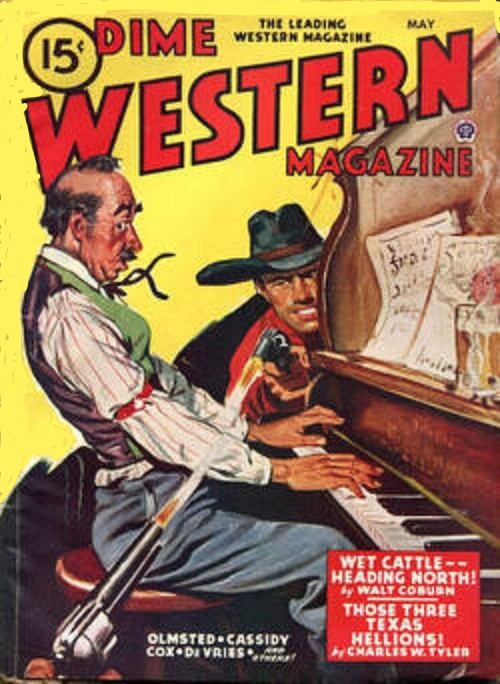
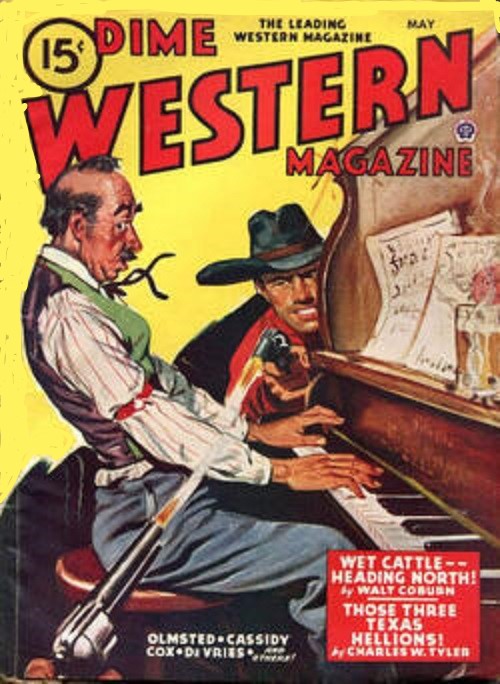
I’ve featured this issue before, but a friend sent me a copy of the actual pulp and I read it this week. Thanks, Ryan! Here’s how I opened that previous post: “We already know that it wasn't safe to play poker or go to the barber shop in the Old West, but now we realize that you couldn't even sit down to tickle the ivories without winding up in the middle of a gunfight, thanks to this cover on DIME WESTERN, Popular Publications' leading Western pulp.” I’m unsure of the artist on this cover. It might be Robert Stanley; he was doing a lot of covers for DIME WESTERN during this era.


The first story is by an author whose name is somewhat familiar to me, but I don’t believe I’ve ever read anything by him until now: Charles W. Tyler. Although billed as a novel, “Those Three Texas Hellions!” is fairly short, closer to novelette length. The three Texas Hellions in question are a couple of old-timers called Dewlap and Wattles and a gun-fast youngster known as the Hairpin Kid. You might guess from those names that this is a humorous Western, and if you’ve been paying attention you know that I generally don’t like those much unless they’re by Robert E. Howard or W.C. Tuttle. Well, Tyler is not in the same league as those two, but this story isn’t bad. One of the old codgers gets his hands on a map that’s supposed to lead to the Lost San Saba Mine, and in their search for it they cross trails with a gang of outlaws and a Texas Ranger. The humor doesn’t descend too far into slapstick, there’s plenty of action, and the characters are more likable than I expected them to be. Based on this story, I’d read more by Tyler.

By the way, despite the Table of Contents page claiming “All Stories New—No Reprints!”, a story by Charles W. Tyler entitled “Those Three Texas Hellions!” also appeared in the June 1943 issue of STAR WESTERN. Whether this is the same story, or whether Tyler just reused the title, I don’t know. I’d have to compare both issues, and I don’t own that STAR WESTERN. Not that it really matters.

Next up is “Manhunt at Gillams”, a tense story about a man catching up to the outlaw who robbed him at an isolated way station. The authors are Everett and Olga Webber, who wrote several historical novels together. Everett Webber contributed around 70 Western and detective stories to various pulps and slicks during the Thirties, Forties, and Fifties, sometimes in collaboration with his wife Olga. This is a low-key, well-written yarn that reminded me a little of Ernest Haycox’s work.

Also featured on the cover is Walt Coburn’s novelette “Wet Cattle—Heading North!” Despite the title, the story has a lot more to do with stealing horses rather than cattle. By this point in his career, Coburn’s drinking problem was bad enough that the editors at Popular Publications supposedly had to rewrite his manuscripts to make them publishable. I don’t know if that’s true or not. This one, like most of Coburn’s stories from this era, is so weighted down with back-story that it takes a long time for the actual plot to get going. I’m a big fan of Coburn’s work, but this is a pretty weak entry. There are a few bits of description that really ring true and authentic, and the action scenes are well-done, but mostly it just muddles along, hard to follow. If this was someone’s first Coburn story, they’d probably have a difficult time understanding why he was so popular.

Harry F. Olmsted’s longest-running series, written under the pseudonym Bart Cassidy, featured drifting good-guy outlaw Tensleep Maxon in more than 120 stories between 1933 and 1951. “Tensleep—Wedding Buster” in this issue is typical of the series: in colorful first-person narration, Tensleep finds himself in the middle of trouble at a Mormon wedding. I’ve read a few of the stories in this series, and while I love Olmsted’s work overall, I’m not a big fan of the Tensleep stories. This one’s not bad, certainly readable and entertaining, but it’ll never be one of my favorite series.

It's always cool when I read a pulp and come across a story by an author I’ve actually met. Thomas Thompson was the long-time story editor on the TV show BONANZA, but before that he had a successful career as a Western pulpster and novelist. He was also at the Western Writers of America convention in Fort Worth in 1986, where I met him and got to talk to him briefly. His story in this issue, “The Killer and the Lady”, is a low-key tale about a woman whose old suitor returns, but unfortunately, he's become an outlaw. This is a well-written story, and with its emotion and characterization, it also reminds me of Ernest Haycox.

Old pro William R. Cox contributes the novelette “A Range to Die For!” This is a cattleman vs. nesters story, but Cox gives it a nice twist that brings about a very satisfying resolution. I enjoyed this one a lot.

“War Smoke on Black Hill” is by another author whose name is vaguely familiar to me, Marvin De Vries. It’s about an army scout trying to solve the mystery of who betrayed a patrol and led them into an Indian ambush. Not a bad story, although it’s very obvious where the plot is going.

“As a Man Fights—” by Harold R. Stoakes is a decent little action yarn about an unlikely subject: the clash between a riverboat captain with a load of sugar and the owner of a sorghum mill who’s making molasses. No range war here or water rights battle in this one. It’s a sweetener war, instead. I don’t know anything about Stoakes except that he wrote several dozen Western stories in the Forties and Fifties. This one is off-beat enough that I liked it.

Another series by Harry F. Olmsted that appeared regularly in DIME WESTERN under Olmsted’s name featured Friar Robusto, an adventurer in Spanish California. Robusto isn’t an actual priest, he only pretends to be one, and he has a masked secret identity as a Robin Hood outlaw known as the Phantom Highwayman. Any resemblance to Johnston McCulley’s Zorro series probably isn’t coincidental. These are more historical swashbucklers than traditional Westerns, but I love them. Every one I’ve read has been great, including “Friar Robusto at the Devil’s Deadline” in this issue. This is the 23rd and final story in the series, and it finds Robusto caught up in political upheaval between the King of Spain and the Viceroy of Spanish California. Lots of blood-and-thunder action, including several sword fights, and Robusto is a great character. If you’re a fan of the serial ZORRO’S FIGHTING LEGION, like I am, you’ll find a lot of the same feeling in Olmsted’s Friar Robusto stories. This series would be a good candidate for reprinting, and with only 23 novelettes, it could be done in three or four volumes.

Overall, this is a very solid issue of a consistently good Western pulp. The stories range from good to excellent, with the best being the Friar Robusto yarn and the weakest the one from Walt Coburn, and it’s not terrible, just not up to the standards of his best work. I had a very good time reading this issue.

Saturday, March 25, 2023

Saturday Morning Western Pulp: Star Western, October 1943


I feel like I should know who painted this cover, but I don't. Maybe one of you can help me out. STAR WESTERN was always one of the top pulps in the genre. This issue features six novelettes by Walt Coburn, Harry F. Olmsted, Les Savage Jr., Tom Roan, William R. Cox, and Fred Gipson. That's right, Mr. Old Yeller his own self, who wrote a bunch of stories for the Western pulps. At one point, I was talking to an academic press about editing a collection of them, but nothing ever came of it. That's a great bunch of writers in this issue of STAR WESTERN, which was nothing unusual back in those days.

Saturday, January 21, 2023

Saturday Morning Western Pulp: Ace-High Western Magazine, February 1937


This issue of ACE-HIGH WESTERN MAGAZINE sports a very nice Tom Lovell cover and the usual assortment of top-notch Western pulpsters we've come to expect from Popular Publications: Walt Coburn, Harry F. Olmsted, Ray Nafziger, Cliff Farrell, Stone Cody (Thomas Mount), Robert E. Mahaffey, and Norrell Gregory. That's pretty close to an all-star lineup.

Saturday, August 06, 2022

Saturday Morning Western Pulp: Star Western, February 1942


What a great cover on this issue of STAR WESTERN! I don't know the artist, but he did a fine job. Not only do I want to read a story with that scene in it, I want to write one. Maybe I will. Meanwhile, the lineup of authors in this issue is very good, too: Harry F. Olmsted, Tom Roan, Stone Cody (Thomas Mount), W. Ryerson Johnson (with a Len Siringo story), William R. Cox, and John G. Pearsol. That's a really solid bunch of Western pulpsters.

Saturday, July 16, 2022

Saturday Morning Western Pulp: Dime Western Magazine, December 15, 1934


Replace one of the Stalwart Heroes (probably the guy in the red shirt) with a Wounded Old Geezer, and you'd have another instance of the trio that shows up on so many Western pulp covers. We've certainly got the Angry, Gun-Totin' Redhead, although I question her aim a little bit. I think this cover is by either Walter Baumhofer or Tom Lovell, but as always, I could certainly be wrong about that. As usual, DIME WESTERN has some great authors in its pages: Walt Coburn, W.C. Tuttle, Harry F. Olmsted writing as Bart Cassidy with one of his Tensleep Maxon stories, Ray Nafziger, Robert E. Mahaffey, and C.K. Shaw. The C.K. stands for Chloe Kathleen, by the way. Shaw was one of the relatively few female authors to contribute prolifically to the Western pulps. My impression is that Tuttle didn't appear very often in Popular Publications pulps, but I could be wrong about that, too. At any rate, this appears to be a fine issue. 

Saturday, June 25, 2022

Saturday Morning Western Pulp: Lariat Story Magazine, May 1940


The cover on this issue of LARIAT STORY MAGAZINE has a lot going on, and I like it. I don't know the artist, but if I had to venture a guess, I'd say A. Leslie Ross or H.W. Scott. But I could be completely wrong about that. I know I'm right about there being some good authors in this issue, starting with Walt Coburn, Harry F. Olmsted, James P. Olsen, and Art Lawson. There's a Bart Cassidy story, and that's probably Olmsted, too, as well as one by house-name John Starr, who could be almost anybody. Frank H. Richey, who has one of the cover-featured stories, wrote only half a dozen stories in the late Thirties and into 1940; this appears to be his last one. I don't know anything about him. The other story in this issue is by the more prolific but equally obscure Don Stuart. All I know about him is that he's not "Don A. Stuart", the pseudonym of legendary science fiction editor/author John W. Campbell.

Saturday, May 28, 2022

Saturday Morning Western Pulp: Dime Western, May 1946


We already know that it wasn't safe to play poker or go to the barber shop in the Old West, but now we realize that you couldn't even sit down to tickle the ivories without winding up in the middle of a gunfight, thanks to this cover on DIME WESTERN, Popular Publications' leading Western pulp. This issue features a couple of the magazine's most prolific authors, Harry F. Olmsted (twice, once with a Friar Robusto story under his own name and again with a Tensleep Maxon story as by Bart Cassidy) and Walt Coburn. Also on hand are Thomas Thompson (famous for being the story editor on BONANZA for many years), William R. Cox, Harold De Vries, and Charles W. Tyler. The only thing I can play on the piano is "Chopsticks", and I'm not sure I could manage that with bullets whistling around me.

Saturday, January 22, 2022

Saturday Morning Western Pulp: Dime Western Magazine, June 1946


I'm not quite sure of everything that's going on, but dang, what a great cover anyway! Pure action and drama. I'm sure there's a lot of that in the stories in this issue of DIME WESTERN, too, since the authors are Walt Coburn, Harry F. Olmsted, Frank Bonham, William R. Cox, Van Cort (Wyatt Blassingame), and Ralph Perry. By this point, Coburn (supposedly) wasn't at the top of his game because of his drinking, but I still enjoy his work from all eras of his career.

Saturday, November 20, 2021

Saturday Morning Western Pulp: Lariat Story Magazine, June 1932


Here's another excellent cover by Arthur Mitchell, this time on an issue of LARIAT STORY MAGAZINE. This pulp always had good writers, and this issue is no exception: Walt Coburn, Harry F. Olmsted, Art Lawson, C.K. Shaw, Foster-Harris, and Samuel Taylor all have stories in this one. Taylor is probably better remembered for his mysteries than his Westerns, but he wrote a lot in both genres.

Saturday, November 06, 2021

Saturday Morning Western Pulp: Dime Western, October 15, 1934


Nearly all of the DIME WESTERN covers from this era feature the same redheaded girl, usually angry and toting a gun. With covers like this, you can understand why she was mad. Tied to a cactus? That's just not right. You can't go wrong, though, with the authors in this issue: Walt Coburn, Harry F. Olmsted (twice, once as himself and once as Bart Cassidy with a Tensleep Maxon story), E.B. Mann (with a Whistler novelette), Miles Overholt, and Malcolm Reiss, who's probably better remembered as an editor for Fiction House but who turned out a decent number of pulp stories himself.