Showing posts with label Robert Stanley. Show all posts

Saturday, February 28, 2026

Saturday Morning Western Pulp: Ace-High Western Stories, January 1949


I don't own this pulp, but like most of the Western pulps from Popular Publications, this issue of ACE-HIGH WESTERN STORIES has a good bunch of authors inside and an eye-catching cover. My hunch is that Robert Stanley painted it, but I'm not sure about that. Walt Coburn leads things off, as he so often does, and also on hand are Roe Richmond, Tom Roan, William R. Cox, Eli Colter, James Shaffer, Harold F. Cruickshank, Spencer Frost (whose name isn't familiar to me), and Richard L. Nelson, who's interesting because that's a pseudonym of William L. Hamling, much more famous as an author and editor and the publisher of the science fiction digests IMAGINATION and IMAGINATIVE TALES, as well the founder of the soft-core empire that included Nightstand Books, Midnight Reader, etc., books written by Robert Silverberg, Lawrence Block, Donald E. Westlake, Evan Hunter, Ben Haas, Harry Whittington, and many other legendary authors under assorted pseudonyms and house-names.

Saturday, December 07, 2024

Saturday Morning Western Pulp: Exciting Western, October 1945


This is a pulp that I own and read recently. That’s my copy in the scan. The Fictionmags Index attributes the cover to Sam Cherry, but I wonder if it might be by Robert Stanley, based on the facial features and the distinctively large hands. As always when it comes to art, I could be wrong and welcome any opinions on who painted this cover.

One of the longest-running series in EXCITING WESTERN was the Tombstone and Speedy series by one of my favorite authors, W.C. Tuttle. Tombstone Jones and Speedy Smith are a couple of range detectives working for the Cattleman’s Association, but their boss insists they have no detective skills and solve their cases through pure luck. Tombstone and Speedy seem to share that opinion, but I don’t know. They usually manage to do some actual detective work in these humorous, action-packed yarns. “Trouble Trailers in Tomahawk” finds the duo traveling to Tomahawk City to find a rich Easterner’s son who wants to become a rancher, while at the same time assisting an old friend of their boss who needs some help. Not surprisingly at all, the two cases turn out to be connected, and soon the bodies are dropping as three murders take place not long after Tombstone and Speedy arrive in town. Of course, they eventually untangle everything and bring the villains to justice. The plot in this one seems a little weaker to me than some, but it’s still a highly entertaining novelette. I always get a kick out of Tombstone and Speedy’s antics and their non-stop banter.

The longest-running (almost 50 stories) series in this pulp stars Arizona Ranger Navajo Tom Raine, the son of a famous lawman who was raised by the Navajo after his father was killed during a range war. In “Navajo Turns Firebug”, Raine is sent to corral a vengeance-seeking young outlaw who’s been burning down ranch houses. Of course, not everything turns out to be as it appears at first. We know that two authors, Lee Bond and C. William Harrison, wrote Navajo Raine stories that were published under the house-name Jackson Cole, and other authors may have contributed to the series as well. I’m pretty sure this story isn’t the work of Harrison, whose plots and characters were usually a bit more complex. It might be by Lee Bond, but my hunch is that it’s by some as yet unidentified pulpster.

“A Meal For a Rodent” is a short-short by Allan K. Echols about an encounter between a homesteader and a bank robber on the run from the law. Very predictable for the most part, but it’s well-written and has a bit of a twist at the end.

Another long-running series in EXCITING WESTERN featured Pony Express rider Alamo Paige. The by-line is Reeve Walker, a house-name used by Charles N. Heckelmann, Tom Curry, and no doubt numerous other Western pulpsters. I don’t think any of the Alamo Paige stories have been attributed to the actual author. The story in this issue, “Stage Line to Hell”, finds Alamo helping out a friend who quit riding for the Pony Express because of an injury and started a stage line instead. When he’s hurt in a robbery, Alamo steps in to round up the thieves. Alamo Paige is a likable protagonist and this yarn is decently plotted and has some nice action. A worthwhile entry in the series.

I don’t know anything about Jack Gleoman except that he published a few stories in the Western and detective pulps. His short-short in this issue, “A Waddy Counts Days”, is about a cowboy accused of a murder he didn’t commit. It features as an illustration a black-and-white version of the cover art, which actually depicts a scene in the story. This is an okay but very minor story, and I’m not sure why it warranted a piece of cover art. Unless . . . Jack Gleoman was actually the pseudonym of an editor at the Thrilling Group (since all his published stories appear in Thrilling Group pulps) and he wrote the story to fit the cover that was already scheduled to be used on this issue when the contents came up a few pages short. That seems like a plausible explanation, but it’s pure speculation on my part, of course.

The issue wraps up with “Vanishing Trails”, a novelette by R.S. Lerch, an author I associate more with the Fiction House pulps even though he actually wrote for a wide variety of publishers in several different genres. This story, set in Montana during a snowstorm, has a bit of a Northern feel to it, although its plot is pure Western pulp. U.S. Marshal Crack Forsythe (a great name) trails a bandit from Wyoming to Montana and finds himself in the middle of a deadly feud between two families. This is a well-written story with a lot of action. Lerch is pretty much forgotten these days, but I’ve enjoyed most of the stories I’ve read by him. Nothing special, maybe, but dependably entertaining.

Which is a pretty good description of this entire issue. All of the stories are enjoyable but have an air of forgettableness about them. Is forgettableness a word? If it’s not, it ought to be. This issue is worth reading for fans of the Tombstone and Speedy, Navajo Tom Raine, and Alamo Paige series, but if you don’t fall into that category, don’t rush to your shelves to look for it.

Saturday, July 20, 2024

Saturday Morning Western Pulp: 10 Story Western Magazine, June 1947


This looks like a Robert Stanley cover to me, although, as always, I could be wrong. But I think I'm correct about there being some very good Western pulp authors inside this issue of 10 STORY WESTERN MAGAZINE: D.B. Newton, Philip Ketchum, William R. Cox, John Reese (with two stories, one under his usual John Jo Carpenter pseudonym, one under a name I haven't encountered before, Camford Cheavly), and Robert Turner, along with the lesser known Harold R. Stoakes, Ben T. Young, Jim Chapman, Ray Hayton, and Jimmy Nichols (who was really Jhan Robbins, fairly prolific under both names but little remembered). Like all the Popular Publications Western pulps, 10 STORY WESTERN MAGAZINE was consistently good.

Saturday, April 13, 2024

Saturday Morning Western Pulp: Dime Western Magazine, January 1946


This is a pulp that I own and read recently. That’s my copy in the scan. My guess as to the cover artist is Robert Stanley, but I’m not certain about that. There are a couple of things about this one I don’t like—the guy’s hands and arms don’t look quite right to me, and neither does his holster—but overall it’s an effective cover.

I’ve said this many times before and probably will again, but Walt Coburn was really inconsistent in his work, especially in the second half of the Forties onwards. But he’s still one of my favorite Western authors because when he’s on his game, he’s really, really good. “Mail-Order Outlaw” in this issue is one of his really, really good stories. The cover calls it a novel, but at 16 pages, even with fairly small print left over from the war years and paper rationing, it’s more of a novelette. Even so, Coburn manages to give this tale of a young cowpuncher who falls in with a gang of bank robbers a bit of an epic feeling. The action is great, the protagonist is very likable, and the villains are despicable. It’s also more tightly plotted than many of Coburn’s stories, which tend to sprawl around and get melodramatic. The sense of authenticity is there as always. No matter how over-the-top Coburn’s plots could get, the characters and settings always ring true. This is a superb story, one of the best by Coburn that I’ve read.

I don’t know much about Michael Oblinger, just that he wrote several dozen stories for various Western pulps. His short story “Hell-on-the-Hoof” starts out with a horse identifying a killer, but that’s just the opening act in a very convoluted tale about an accused murderer hunting down the real culprits. I didn’t think this story was well-written and didn’t care for it.

Since the cover date on pulps was the off-sale date, that means this January 1946 issue of DIME WESTERN was actually on the stands in December 1945. Accordingly, there’s a Christmas story included in the line-up, the novelette “Colt Christmas at Bitter Creek” by Rod Patterson. Last year I read a pulp yarn by Patterson that I enjoyed quite a bit, as well as his novel WHIP HAND, which I found pretty flat and uninspired. Now that I’ve read this story, I’m starting to suspect that Patterson was better at less than novel length. “Colt Christmas at Bitter Creek” is about the showdown between two feuding ranches during a blizzard. It’s well-written, moves right along, and has a nice hardboiled tone. I still want to try more of Patterson’s novels, but I’ll be keeping an eye out for his pulp stories.

Charles Handley is another forgotten pulpster. His story “The Devil’s Sky-Pilot” is a short-short about an outlaw-turned-preacher—or is he? The twist ending in this one is pretty predictable, but it still works and the story is fairly entertaining.

Tom W. Blackburn often wrote stories that weren’t about the usual cowboys, outlaws, lawmen, etc. The protagonist of the novelette “Battle Call For Big-Wheelers” is a partner in a freight company located in a Sierra Nevada mining boomtown. Double-crossed by a man he considered a friend, framed by a rival for murder, Cole Banning finds himself in a mighty deep hole and Blackburn just keeps piling more trouble on his head until I honestly wondered how in the world Banning was going to get out of this mess. But he does, and although the resolution might have been just a tad too quick and convenient, this is still a really good story with interesting characters, strong writing, and plenty of action. Blackburn’s work is nearly always good and this one is no exception.

John Richard Young wrote a couple of dozen Western and adventure stories for various pulps in the Forties and Fifties. His story in this issue, “Law of the Blizzard-Born” is an animal yarn about an old hunter stalking a wolf. This type of story with little or no dialogue and some, if not most, of the story written from the point of view of the animal is one that I just have trouble reading. I wound up skimming this one and didn’t like it.

The novelette that wraps up this issue, “The Phantom Hangman of Yellow Jacket”, is another mining camp story. Somewhat unusual for a Western pulp, it’s also a murder mystery as a ruthless vigilante known as The Citizen is killing people in the camp for no apparent reason. The son of a mine owner who is one of the victims returns from San Francisco, where he’s been something of a wastrel, to grow up and get to the bottom of things. As it turns out, this story isn’t a particularly strong mystery, but it does have a good protagonist and some nice action as it moves along at a fast pace. The author, Harry F. Olmsted, is one of my favorites. Olmsted was known to farm out some of his work, much like Ed Earl Repp, so there’s no way of knowing if some other author had a hand in this one. The story reads like the other Olmsted stories I’ve read, but that may be because even on the ghosted stuff, he did a lot of editing and revising. Regardless of the details, which we’ll likely never know, this is a solid, entertaining yarn.

Overall, this issue of DIME WESTERN MAGAZINE is quite a mixed bag. There are a couple of stories I didn’t like, but the others range from good to excellent and include one of the best Walt Coburn stories I’ve read. So I’d say that if you have a copy on your shelves, it’s well worth reading.

Sunday, February 18, 2024

Sunday Morning Bonus Pulp: Adventure, January 1946


This is a pulp that I own and read recently. That’s my copy in the scan. The cover art is by Robert Stanley. I’m so used to seeing his work on mystery and Western pulps and paperbacks, I’m not sure I would have recognized it in a pure adventure setting like this. But it’s a good cover and I like it.

If you’re like me, you saw “One For France and One For Me” by Georges Surdez and thought, “Ah, a French Foreign Legion yarn!” Surdez was famous for them. But no, this novella (and it’s almost long enough to be an actual novel) takes place entirely in France. Captain Norman Kenton, an American pilot who was shot down over France during the war, returns several months after V-E Day to look up the members of the Resistance who helped him avoid capture by the Nazis. It’s not just gratitude that motivates Kenton. One of those Resistance members was a beautiful young woman.

But he runs into more trouble than he expects and finds himself involved in black marketeering, a vengeance quest against people who collaborated with the Germans, murder, espionage, and tragedy. Sounds great, doesn’t it?

Well, it’s actually just okay, because the plot pokes along at an exasperating pace, and a lengthy flashback in the middle of the story derails things even farther. I generally like Surdez’s work, and the final scene of this one, which takes place in a courtroom, is pretty good, but things just take too long to get there. Good plot, good characters, not so good execution.

The next story, “Un-Reversible Error” by Wallis Reef, also involves a court case, as you might guess from the title. It’s a contemporary (for the time the pulp was published) Western mystery with the protagonist being an old sheriff. The tone is a little light without the story being an actual comedy. The plot involves a hoodlum who looks like he’s going to get away with murder until the sheriff comes up with a surprise. Not an outstanding yarn, but fairly entertaining.

Stuart Cloete’s name is familiar to me. I think I may even own a few of his novels set in Africa. His short story in this issue, “A Death in the Family”, is a grim tale about two twin brothers discussing a family tragedy that took place in the trenches of World War I. The whole thing is a little slow and bland until Cloete springs a wry, triple-twist ending that took me by surprise and redeems the story for the most part.

“The Peacekeeper” by Hugh Fullerton is a short bit of folklore/tall tale about Finn McCool. Or something. I can’t be more precise than that because I didn’t read much of the story before saying, “Nope, not for me.” Something about Fullerton’s style just grated on me.

“Blood and Guts” by William Langer is much better. It’s a well-written, character-driven story about an Army medic seeing his first action during an assault on a Japanese-held island in the Pacific.

“You Ain’t Gonna Believe This” is a Runyonesque tale about a prizefighter with four arms. Lawton Ford’s story evokes a few smiles, but no outright chuckles.

“The Shadow of a Mountain” by William Arthur Breyfogle is set in an unnamed Central American country where the German general who’s in command of the army stirs up a war with a neighboring country. There’s also a volcano that’s about to erupt. This starts out like it’s going to be a comedy but turns pretty grim before it’s over. Not a bad story, but decidedly odd.

It's not surprising that my favorite story in the issue is by Day Keene, who had a good career in the pulps before becoming one of the top paperback authors of the Fifties and Sixties. “In the Halls of Montezuma” is a crime yarn that also has a military angle, as a prizefighter-turned-gangster sets out getting his revenge on the guy who caused his fall from grace. The big twist at the end is completely predictable, but Keene was such a good storyteller that it doesn’t matter.

The final story in the issue, “The Mule That Loined Brooklyn” by Nick Boddie Williams, is similar in one way to Surdez’s “One For France and One For Me”. It’s about a downed pilot trying to escape from the enemy in World War II, only Williams’ story is set in Burma, the enemies are the Japanese, and the story is more of a farce than anything else. It’s okay, but lightweight enough to float off.

With that lineup of stories, this issue never rises above the merely okay level and flirts with below average. Day Keene’s story is good but definitely a minor entry in his body of work, and it’s the highlight. Langer’s story about the Army medic is also worth reading. There are some good issues of ADVENTURE from this era, but this one is pretty forgettable.

Saturday, January 13, 2024

Saturday Morning Western Pulp: Ranch Romances, August 1967


This is a pulp that I own and read recently. I’m pretty sure that the art in the inset is by Robert Stanley. I don’t have any idea who did the rest of the cover. That’s my copy in the scan.

Or is it a pulp? It’s slightly smaller than regular pulp dimensions, and the page edges are trimmed. And it was published long after the pulp era is considered to be over. However, it’s definitely not a digest, and it’s proudly part of an unbroken publication stretching back to 1924 (“43rd Year of Publication”, it says on the title page), so I’m calling it a pulp.
 
And as I’ve mentioned numerous times in the past, RANCH ROMANCES is the only pulp I remember seeing on the newsstands when I was a kid. Everything else was gone by then. But it’s entirely possible I laid eyes on this very issue on the magazine rack in Stephenville Drugs, where we always stopped on our way through Stephenville, Texas, so I could check out the comic book and paperback spinner racks. But I wouldn’t have even considered buying it because, you know, it had ROMANCES in the title and I was 14 years old. (I bought the first two paperback reprints of THE SPIDER, the ones by R.T.M. Scott that came bound together, at least one Mac hardboiled mystery novel by Thomas B. Dewey, and my first ever copy of PLAYBOY at Stephenville Drugs, along with other things I don’t remember, I’m sure.)

Okay, to get out of the weeds of nostalgia and move on to the August 1967 issue of RANCH ROMANCES . . . this is the first of the later, semi-pulp issues I’ve read. By the time the magazine’s run ended in 1971, it was all-reprint, but there are only a couple of older stories in this issue and the rest are new. It leads off with the short story “Wolf At His Heels” by A.E. Schraff, which is about a young outlaw being pursued by a dogged lawman not out of a sense of justice but on a mission of personal vengeance. It’s a well-written story with a satisfying ending. I’d never heard of A.E. Schraff before, but according to the Fictionmags Index, the A.E. stands for Anne Elaine. She wrote more than a dozen stories for RANCH ROMANCES, ZANE GREY WESTERN MAGAZINE, and FAR WEST during the Sixties, Seventies, and Eighties, then did a handful of mystery yarns for ALFRED HITCHCOCK’S MYSTERY MAGAZINE in the Eighties. That’s all I know about her, but based on this story, she was a pretty good writer.

And sure enough, a little research tells me this from Goodreads: “Anne Elaine Schraff grew up in Cleveland, Ohio. She received both her bachelor's and master's degrees from California State University at Northridge and taught high school for ten years.

Anne paid her way through college by writing short stories for magazines. Since college she has written hundreds of stories and over eighty books including historical fiction, biographies, science books, and her favorite, fictional books for young people. She is published as both Anne Schraff and Anne E. Schraff.

Her background, which she describes as "multicultural, lower middle-class neighborhood, including African Americans, Mexican Americans, Arab Americans, and Filipino Americans," is her greatest inspiration when writing.”

Lee Martin has been used as a pseudonym by several different writers, but the Lee Martin who wrote the short story “Live Bait” in this issue was actually Margery Lee Martin, author of several dozen Western and mystery stories in the Sixties. “Live Bait” is sort of the opposite of “Wolf At His Heels” because in this story, a lawman is the target of some outlaw brothers who want to kill him, and they’re willing to use another brother’s widow to trap their quarry. This is another solid yarn with a satisfying, if predictable, ending.

Mona Jennings has only one credit in the Fictionmags Index, her short story “Indian Girl” in this issue. Mostly domestic drama with a little action at the end, this tale is about a young rancher who finds an Indian girl with her leg caught in an animal trap and takes her home to care for her injury. He has a younger brother and sister, all of them made orphans by an Indian attack several years earlier. Emotional turmoil ensues. Another well-written tale, although the ending is a little too unresolved for my taste.

Giff Cheshire was an old pro, of course. His novelette “Dry Summer” in this issue is a reprint from the 2nd July, 1956 number of RANCH ROMANCES. It’s the story of a young cowboy caught in the middle of a clash between a big rancher and a group of smaller ranchers over water rights. The plot is very traditional, but the story is well-written for the most part. I’ve read enough by Giff Cheshire now to know that I usually find his work a little on the bland side, and that’s true of this yarn.

W.J. Reynolds was another prolific Western pulpster, authoring approximately 120 stories between the mid-Forties and the early Seventies, most of them appearing in various Western pulps, but he also sold Western stories to some of the lower-rung men’s magazines such as ADAM and KNIGHT. I’ve read several stories by him and enjoyed them all. In “Bloody Butte”, his yarn in this issue, an army scout rescues a girl from a gang of marauders and scalphunters, and then they have to escape the gang’s pursuit, eventually forting up at the butte of the title.

In 1967, when this issue reprinted Elmer Kelton’s novella “Die by the Gun” (original appearance in the 2nd January Number, 1954 issue of RANCH ROMANCES), Kelton was a well-regarded author of traditional Western stories and novels, but he was still several years away from the elevated literary reputation he would begin to enjoy later in his career. One of the lines he often used when speaking to groups was “Louis L’Amour’s heroes are seven feet tall and invincible. Mine are five-foot-seven and nervous.” I don’t know if Dolph Noble, the protagonist of this tale, qualifies as nervous, but he certainly has his share of angst to deal with. He’s the sheriff of a West Texas county and has a wild younger brother who wants to be either a lawman or an owlhoot and isn’t all that particular about which. He’s in love with the wife of an outlaw whose gang has been plaguing the area. The townspeople believe he hasn’t been able to corral the gang because he’s holding back on account of his feelings for the woman. His ambitious but flawed former deputy wants to take his job away in the next election. So Dolph has plenty of trouble on his plate, and Kelton keeps twisting the screws to make it worse for him. Not surprisingly, this is easily the best story in the issue, with solid writing and excellent characterization.

This is the first of the Sixties issues of RANCH ROMANCES that I’ve read, and overall it’s very good. Cheshire’s story is the weakest in the bunch, and it’s not bad, just not as good as the others. I think the tone isn’t as hardboiled as the Fifties issues I’ve read, and the romance elements are played up a little more, but there’s still good action in every story. It came out in the summer between eighth and ninth grade for me. As I mentioned above, I wouldn’t have bought it at the time . . . but if I had, I would have enjoyed it. It’s well worth reading if you have a copy on your shelves.

Saturday, October 08, 2022

Saturday Morning Western Pulp: Dime Western Magazine, December 1945


Injury to a Hat alert! This one was drilled cleanly by a bullet, looks like. I believe this is a Robert Stanley cover. It also looks like there are some good authors in this issue of DIME WESTERN MAGAZINE, which comes as no surprise. On hand are Walt Coburn, Frank Bonham, William R. Cox, C. William Harrison, and Bob Obets, as well as Jackson V. Scholz, better known for his sports stories. Another good issue of one of the top Western pulps.

Saturday, April 16, 2022

Saturday Morning Western Pulp: Star Western, September 1948


One of Popular Publications' flagship Western pulps, along with DIME WESTERN, STAR WESTERN was still going strong in the late Forties, with this issue being a prime example. Behind that dramatic Robert Stanley cover are stories by a really fine group of writers: T.T. Flynn, Tom W. Blackburn, Frank Bonham, Van Cort (Wyatt Blassingame), John Jo Carpenter (John Reese), Kenneth Perkins, and writer/editor Art Lawson with two stories, one under his name and one as by William Fargo.

Saturday, February 19, 2022

Saturday Morning Western Pulp: Western Action, January 1947


The cover on this issue of WESTERN ACTION is credited to Robert Stanley. It doesn't look exactly like a typical Stanley cover to me, but maybe I'm just used to his Mike Shayne covers. Archie Joscelyn has two stories in this issue, one under his own name and the lead novella as by Al Cody. Also on hand are T.W. Ford, Ralph Berard (Victor H. White), and Cliff Campbell, the last of those a house-name who could have been any of the other guys in this issue, or even none of them, although that doesn't seem likely. The Columbia pulps edited by Robert W. Lowndes were low-budget affairs but often quite good.

As a bonus, here's the cover of the Pocket Books edition of the novel BITTER CREEK, under the Al Cody by-line. There was also a hardback edition published by Dodd, Mead.


Friday, August 27, 2021

Forgotten Books: Arrow in the Dust - L.L. Foreman

Art by Ron Lesser

Bart Laish is not your typical stalwart Western hero. He’s a gambler, a gunfighter, and when ARROW IN THE DUST, L.L. Foreman’s novel from 1954 opens, an army deserter, having enlisted in order to hide out from the law only to take off for the tall and uncut rather than being thrown in the guardhouse for brawling. Not a nice guy.

And yet, through a series of frankly far-fetched coincidences, Laish finds himself wearing a general’s uniform, inheriting command of a bunch of inexperienced soldiers, and called upon to protect a wagon train bound for Fort Laramie from an Indian horde composed of warriors from several rival tribes who have banded together for some unknown reason. Oh, and with that wagon train is the dead general’s wife, who also happens to be one of Laish’s old flames.
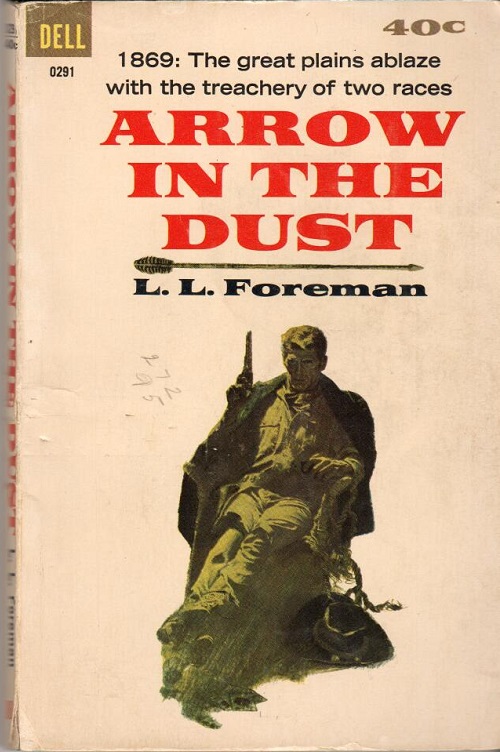
Despite my long-windedness in describing it, the plot in ARROW IN THE DUST plays out pretty simply: make it to Fort Laramie without the whole wagon train being massacred. Throw in some romantic complications along the way. Does all this adversity offer Bart Laish a chance at redemption? I think you know the answer to that.


Original 1954 edition, art by Robert Stanley

While the elements that make up ARROW IN THE DUST may be pretty standard, L.L. Foreman does an absolutely superb job of blending them into a compelling, suspenseful Western yarn. This novel doesn’t have as much action as some—a lot of it is kind of a slow burn—but when violence does erupt, it’s very effective, and the final battle with the Indians is spectacular. Foreman devotes a lot of time to characterization and also writes very well about the landscape. His prose is nothing fancy, but it moves along in fine fashion.

L.L. Foreman was an Englishman, born in London and spending the first twenty years of his life there before moving to the United States. He started writing for the Western pulps in 1934 and continued for more than twenty years, expanding his career into novels in the Forties and writing until his death in the Sixties. ARROW IN THE DUST is an expansion of the novella “Platte River Gamble”, published in the June 1953 issue of ZANE GREY’S WESTERN MAGAZINE. It’s a really fine novel, and if you’re a fan of traditional Westerns, I give it a high recommendation.


Original novella version, cover art by Robert Stanley

There’s a personal story that goes with this one, too. In the Sixties, some of my relatives lived in the tiny, West Texas oilfield town of Goldsmith, northwest of Odessa. Every couple of years we would drive out there to visit them, usually in the summer, and would spend two or three weeks with them. My uncle was a hunter and taught me how to shoot and reload ammo. (I’ve long since lost my reloading skills, but I’m still a decent shot.) He was also an avid reader of Western novels, and during one trip, I read a Western paperback he had on hand. For years I didn’t recall the author or title, but for some reason the cover illustration stuck in my head: it was a painting of a cavalryman in a long coat, no hat, sitting with his legs stuck out in front of him. I had a feeling that it might be STEEL TO THE SOUTH by Wayne D. Overholser, but when I finally got curious enough to look up that book a few years ago, I couldn’t find any editions of it with a cover like that.

Well, that got my curiosity up even more. I knew the book was published by Dell. The size of it and the blue-edged pages were enough to tell me that. So I looked through listings of Dell Westerns and didn’t find it. I looked up other Overholser books, with still no luck. I was starting to think maybe my memory was playing tricks on me (believe it or not, that’s been known to happen). But one day, I got the idea of asking about it and describing the cover I remembered on the Men’s Adventure Paperbacks group on Facebook. Less than an hour later, I had the answer, complete with a picture of the book: ARROW IN THE DUST by L.L. Foreman. I never would have guessed that.

Not only did I now know what the book was, my friend on Facebook even offered to send me the copy he had. I traded him a couple of my books for it, and that’s the copy you see up at the top of this post, complete with cover art by Ron Lesser featuring model Steve Holland—neither of whom I knew anything at all about when I first read this book more than fifty years ago. I’ve finally gotten around to rereading, and I thoroughly enjoyed it. I had no memory of the plot from reading it all those years ago, so it was like a new book to me. And now you know . . . the rest of the story, as Paul Harvey used to say.

(Hmm. Why did I think it was STEEL TO THE SOUTH by Wayne D. Overholser, a book that, as far as I know, I’ve never read? I wonder if I should find a copy and read it . . .)

Saturday, July 13, 2019

Saturday Morning Western Pulp: 10 Story Western Magazine, April 1947


And thus another Old West poker game comes to a violent end. Not only that, but look at the bullet hole in the guy's hat brim. Injury to a Hat Alert! I love this cover, which I'm pretty sure is by Robert Stanley. It's the little details that really make it work, like the two matches tucked in the cowboy's hat band and the royal flush laid out on the table. A lesser artist might not have even thought of those things. 10 STORY WESTERN MAGAZINE always had a good group of authors, and this issue is no exception: Tom W. Blackburn, Joseph Chadwick, Gunnison Steele (Bennie Gardner), Carl McK. Saunders (Philip Ketchum; "Saunders" is a pseudonym he used mostly for mystery and detective yarns), John Jo Carpenter (John Reese), Rod Patterson, Richard Brister, and Harrison Colt, a name I've always thought must be a pseudonym, but I don't know if it really was. Plus the familiar, instantly recognizable yellow-and-red color scheme. I'm a big fan of 10 STORY WESTERN and this looks like an excellent issue.

Saturday, March 18, 2017

Saturday Morning Western Pulp: Wild West Weekly, June 15, 1940


Robert Stanley is probably best known for his paperback covers, but he did a number of pulp covers, too. I really like this one for WILD WEST WEEKLY. The colors are very eye-catching. So is that title, "The Devil's Calling Card", the lead novel by Chuck Martin, who also wrote as Charles M. Martin. Elsewhere in the issue is a Sonny Tabor yarn by Paul S. Powers writing as Ward M. Stevens, plus an installment of the serial "Don Hurricane" by Brad Buckner (our ol' pard Ed Earl Repp) and stories by J. Allan Dunn (writing as John B. Strong) and S. Omar Barker. Looks like a fine all-around issue.