Showing posts with label Steve Holland. Show all posts

Wednesday, September 24, 2025

Review: Montana Fury - Al Cody (Archie Joscelyn)


Archie Joscelyn started his pulp career all the way back in 1921 and wrote steadily for them, mostly Westerns, until the late Fifties, after which he devoted his efforts entirely to novels and was still turning them out until the late Seventies. He wrote under his own name and numerous pseudonyms, the most common of which was Al Cody. He probably published more books under the Cody name than any of the others.

MONTANA FURY, as by Al Cody, is from fairly late in Joscelyn's career, published originally in hardcover by library market publisher Avalon Books in 1967 and reprinted in paperback a couple of years later by Macfadden-Bartell, which is the edition I read. That’s my copy in the scan. The protagonist is a young man named Jake Cassius, an orphan who runs away from the family he’s been living with in Kansas and joins a cattle drive headed for Montana. The reason he wants to go to Montana is that he saw a young woman in Kansas and fell in love with her at first sight, and she was on her way to her family’s ranch in Montana.

The first half of the novel follows Jake’s adventures on the cattle drive and forms a well-done coming-of-age yarn. Then there’s an abrupt plot twist and Jake takes the blame for a murder he believes was committed by his best friend. He goes on the run from the law and heads for Montana, winds up pretending to be a U.S. marshal, and finds himself smack-dab in the middle of a range war involving the family of the girl he's in love with.


MONTANA FURY is almost a kitchen-sink book like Louis L’Amour’s TO TAME A LAND (my favorite L’Amour novel), but Joscelyn doesn’t throw quite as many elements into his tale as L’Amour did. And the writing is very different. For most of his career, Joscelyn was a very traditional Western writer, telling his stories in simple prose, but as he got older, his style changed some and this book is a good example. The dialogue has an oddball, mock-Shakespearean tone to it, reminding me of DEADWOOD without all the cussin’. There’s a certain similarity to Frederick Faust’s Max Brand novels, too, although Joscelyn, who grew up on a ranch in Montana, has more realistic settings than Faust.

I’ve read some of Joscelyn’s novels from the Seventies where this tendency is really exaggerated, and they’re not very good. MONTANA FURY is odd and distinctive, but I think it still works overall and I enjoyed it. Anyone who hasn’t read Joscelyn’s work before, though, probably shouldn’t start with this one. Try one of his novels from the Forties or Fifties instead.

Now, in the spirit of full disclosure, I actually bought this book for the Ron Lesser cover featuring model Steve Holland. Lesser did several covers for various Western novels based on reference photographs from the same photo shoot with Holland wearing that long coat. I own several of those books. There’s also a Lesser painting based on that shoot that was never used for a Western novel cover . . . yet. I’ll have more information about that at a later date.

Friday, March 29, 2024

Men's Adventure Quarterly #10: The Vietnam Issue -- Robert Deis and Bill Cunningham, eds.


The tenth issue of MEN’S ADVENTURE QUARTERLY is out, this time around focusing on the best stories and artwork from the men’s adventure magazines dealing with the Vietnam war. Those of you who have been following MAQ from the beginning know that it’s one of the best publications out there, and this new issue more than maintains that very high standard. You’d expect nothing less from editors Robert Deis and Bill Cunningham, ably assisted on this issue by Paul Bishop and Rob Morris.

As before, the stories reprinted in this issue are split between true tales (or mostly true) and those that are entirely or almost entirely fictional. For me, the high point of the non-fiction pieces is “MIG Bait” by the prolific MAM writer and military historian Robert F. Dorr, from the February 1968 issue of MAN’S MAGAZINE. It was my pleasure and honor to get to know Bob Dorr a little before he passed away several years ago, and I’ve become a big fan of his work. His story about the first supersonic dogfight in the air over Vietnam is exciting and well-written. I also enjoyed the profile of Barry Sadler by Garth Roberts that appeared in the October 1966 issue of MAN’S WORLD. I remember quite well when Sadler’s song “The Ballad of the Green Berets” was a huge hit and played on the radio all the time. That article also mentions author Robin Moore and his bestselling novel THE GREEN BERETS, which I remember buying off the spinner rack at Lester’s Pharmacy when it was brand-new, so that just adds to the nostalgic appeal of that piece for me. Also in the non-fiction realm, but fiction-related, Paul Bishop contributes a terrific article about the various series of paperback novels centering around the war in Vietnam.

As for the fiction, one of my favorites is “Saigon Nymph Who Led the Green Berets to the Cong’s Terror Headquarters” (MALE, August 1966) by Mario Cleri, who, as all of you already know, was really Mario Puzo, the author of THE GODFATHER and numerous other novels. Puzo was a prolific contributor to the MAMs as both a writer and an editor. I think this story is the first thing I’ve read by him other than THE GODFATHER, all those years ago, and it’s an excellent yarn about a colonel in Army Intelligence going after the VC terrorists responsible for his younger brother’s death.

The other top fictional tale for me is “Saga of Mad Mike Kovacs and His Battling Lepers of Vietnam”, from the January 1967 issue of MALE, by Glenn Infield. This is the first thing I’ve read by Infield, and it’s great, every bit as over-the-top as you might imagine from the title. Fast-paced and very well-written, I thoroughly enjoyed it. Rob Morris contributes informative introductions to both this story and to Robert F. Dorr’s “MIG Pilot”.

On the visual front, this issue is as beautifully produced as all the other issues of MAQ, featuring dozens of covers and interior illustrations along with two lengthy galleries, one spotlighting many of the Vietnam-related covers on which the legendary Steve Holland appeared, and the other featuring Raquel Welch accompanying Bob Hope to Vietnam on one of his famous USO tours. Back in those days I never missed the TV specials drawn from footage of those UFO shows, and I remember quite well the one on which Raquel appeared. It was nice revisiting those days.

So this is another great job all around, and I give a big old recommendation to the Vietnam Issue of MEN’S ADVENTURE QUARTERLY. It’s available in two different formats on Amazon: a full-color paperback edition and a black-and-whitepaperback edition, or you can buy the full-color edition directly from editor and publisher Robert Deis on eBay.

Friday, September 16, 2022

Steve Holland: Cowboy - Michael Stradford


Considering all the Western paperbacks I read growing up in the Sixties and Seventies, how in the world is it that I never noticed the same guy is on nearly all of them?

And that hombre, of course, was none other than Steve Holland, the best and busiest paperback cover model in history. The new book from Michael Stradford, STEVE HOLLAND: COWBOY, covers that part of Holland’s career with an informative introduction and scores of beautifully reproduced paperback covers (with a few comic book covers included for good measure). The book also features many of the original paintings without the cover copy, and it’s fascinating to see how they were put to such good use to sell paperbacks to guys like me.

Even more fascinating to me are the reference photos of Holland taken by the various artists who painted those covers. Seeing how those images started out alongside what they became is great fun. So is going through this volume and thinking, “I’ve read that book . . . I’ve read that book . . . I’ve read that book.” Which brings me back to my original point: how come I never noticed Steve Holland was on all those covers?

Well, I attribute that to the skill of the artists involved, as well as to Holland himself for being able to strike so many different attitudes in his poses. He was the best at what he did, no doubt about that.

Michael Stradford is the world’s leading expert on Steve Holland. This volume is the third book he’s devoted to Holland’s career, following STEVE HOLLAND:THE TORN SHIRT SESSIONS (about Holland posing as Doc Savage for the long-running series of Bantam paperbacks) and STEVE HOLLAND: THE WORLD’SGREATEST ILLUSTRATION ART MODEL. For readers like me who grew up with shelves full of paperbacks with Steve Holland covers, all three volumes are packed with fun and nostalgia, and I give them my highest recommendation.

Friday, August 27, 2021

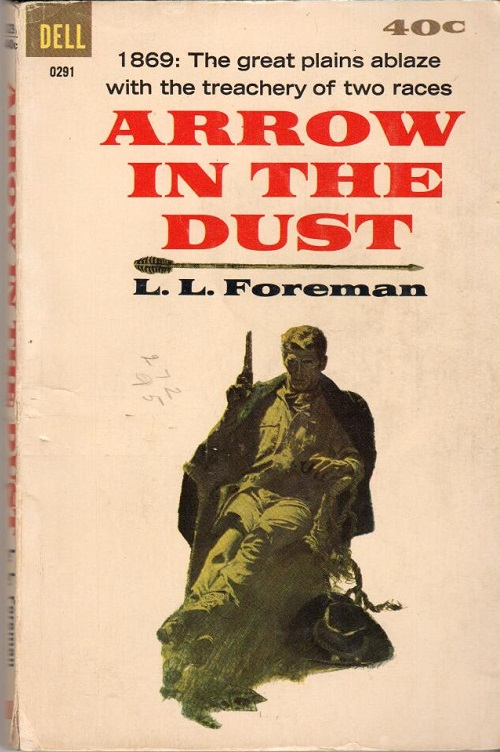
Forgotten Books: Arrow in the Dust - L.L. Foreman

Art by Ron Lesser

Bart Laish is not your typical stalwart Western hero. He’s a gambler, a gunfighter, and when ARROW IN THE DUST, L.L. Foreman’s novel from 1954 opens, an army deserter, having enlisted in order to hide out from the law only to take off for the tall and uncut rather than being thrown in the guardhouse for brawling. Not a nice guy.

And yet, through a series of frankly far-fetched coincidences, Laish finds himself wearing a general’s uniform, inheriting command of a bunch of inexperienced soldiers, and called upon to protect a wagon train bound for Fort Laramie from an Indian horde composed of warriors from several rival tribes who have banded together for some unknown reason. Oh, and with that wagon train is the dead general’s wife, who also happens to be one of Laish’s old flames.

Despite my long-windedness in describing it, the plot in ARROW IN THE DUST plays out pretty simply: make it to Fort Laramie without the whole wagon train being massacred. Throw in some romantic complications along the way. Does all this adversity offer Bart Laish a chance at redemption? I think you know the answer to that.


Original 1954 edition, art by Robert Stanley

While the elements that make up ARROW IN THE DUST may be pretty standard, L.L. Foreman does an absolutely superb job of blending them into a compelling, suspenseful Western yarn. This novel doesn’t have as much action as some—a lot of it is kind of a slow burn—but when violence does erupt, it’s very effective, and the final battle with the Indians is spectacular. Foreman devotes a lot of time to characterization and also writes very well about the landscape. His prose is nothing fancy, but it moves along in fine fashion.

L.L. Foreman was an Englishman, born in London and spending the first twenty years of his life there before moving to the United States. He started writing for the Western pulps in 1934 and continued for more than twenty years, expanding his career into novels in the Forties and writing until his death in the Sixties. ARROW IN THE DUST is an expansion of the novella “Platte River Gamble”, published in the June 1953 issue of ZANE GREY’S WESTERN MAGAZINE. It’s a really fine novel, and if you’re a fan of traditional Westerns, I give it a high recommendation.


Original novella version, cover art by Robert Stanley

There’s a personal story that goes with this one, too. In the Sixties, some of my relatives lived in the tiny, West Texas oilfield town of Goldsmith, northwest of Odessa. Every couple of years we would drive out there to visit them, usually in the summer, and would spend two or three weeks with them. My uncle was a hunter and taught me how to shoot and reload ammo. (I’ve long since lost my reloading skills, but I’m still a decent shot.) He was also an avid reader of Western novels, and during one trip, I read a Western paperback he had on hand. For years I didn’t recall the author or title, but for some reason the cover illustration stuck in my head: it was a painting of a cavalryman in a long coat, no hat, sitting with his legs stuck out in front of him. I had a feeling that it might be STEEL TO THE SOUTH by Wayne D. Overholser, but when I finally got curious enough to look up that book a few years ago, I couldn’t find any editions of it with a cover like that.

Well, that got my curiosity up even more. I knew the book was published by Dell. The size of it and the blue-edged pages were enough to tell me that. So I looked through listings of Dell Westerns and didn’t find it. I looked up other Overholser books, with still no luck. I was starting to think maybe my memory was playing tricks on me (believe it or not, that’s been known to happen). But one day, I got the idea of asking about it and describing the cover I remembered on the Men’s Adventure Paperbacks group on Facebook. Less than an hour later, I had the answer, complete with a picture of the book: ARROW IN THE DUST by L.L. Foreman. I never would have guessed that.

Not only did I now know what the book was, my friend on Facebook even offered to send me the copy he had. I traded him a couple of my books for it, and that’s the copy you see up at the top of this post, complete with cover art by Ron Lesser featuring model Steve Holland—neither of whom I knew anything at all about when I first read this book more than fifty years ago. I’ve finally gotten around to rereading, and I thoroughly enjoyed it. I had no memory of the plot from reading it all those years ago, so it was like a new book to me. And now you know . . . the rest of the story, as Paul Harvey used to say.

(Hmm. Why did I think it was STEEL TO THE SOUTH by Wayne D. Overholser, a book that, as far as I know, I’ve never read? I wonder if I should find a copy and read it . . .)

Wednesday, February 03, 2021

Now Available: The Bill Kellaway Quartet - Gwyn Evans


From my friend Steve Holland and the Bear Alley Books website: 


“You have heard of a man who, for a wager, offered to sell genuine sovereigns—in the days of sovereigns—at sixpence a time on London Bridge, and not a soul would buy them.”

“Yes,” said Kellaway. “But you don’t surely mean that—that your offer is on a par with that?”

Dr. Lenoir nodded.

“My question is perfectly genuine,” he answered.

“Would you like a million pounds—and if so, are you prepared to fulfil the necessary conditions?”

Kellaway glanced sharply at his companion’s pale, impassive face. It was as expressionless as the bronze Sphinx itself.

“Of course I could do with a million quid—who couldn’t?” he said. “The point is, who’s going to give it me, and what have I got to do to get it?”

Hercules, Esq. by Gwyn Evans introduces Bill Kellaway, a brash, bright young ex-reporter who had spent years in Africa, returning to England when Egypt regained its sovereignty. When readers first meet Bill he is at his lowest. Penniless, he stands by Cleopatra's Needle on Victoria Embankment, wondering where he can find the money to pay for a cigarette... and then he feels a hand touch his sleeve and a voice asks: "Would you like a million pounds, my friend?"

A born venturer, Kellaway follows the stranger and finds himself at the whim of a group of millionaires who challenge him to complete six tasks that will acquaint him well with the underworld. On condition that his agreement remains a secret and that he makes no attempt to identify his employers, or seek their help if arrested, Kellaway receives the first of his six "labours" in a note attached to a dead body.

Following his first adventure, Kellaway surfaced again in The Homicide Club to face the strange, exclusive Q Club, its membership limited to five, all millionaires and men of vicious character. To relieve the tedium of their wealth, they devise a contest in which each attempts to commit the perfect crime. Symphony Sam becomes their unwilling agent and Bill Kellaway a potential member. Bill joins, but on learning of their criminal activities, determines to wage a secret war against them…


In Satan Ltd., Quentin Steele, the leader of the Shadow Club, is on the verge of collapse through an overstrained heart, when Bill Kellaway finds him and takes him to his rooms. Here he is urged to take the place of Steele as leader of the Club. Partly because of his love of adventure, and partly because of his whole-hearted approval of the aims of the Club, Kellaway agrees. His adventures thereafter make absorbing reading.

And, finally, in The Return of "Hercules, Esq.", Sam Hicks, better known as ‘Symphony Sam’ has turned detective and stars in three thrilling stories—“The Man from Abyssinia,” “The Secret of All Baba's Jars,” and “The Man with the Diamond Mask.” With the aid of ex-Fleet Street newspaperman and eccentric millionaire Bill Kellaway, the pluperfect Henry Henry, and the calmly efficient Miss Candy Lee, he sets up the S.S. Detective Bureau opens its office directly opposite Scotland Yard—to the intense fury of Detective-Inspector Barker, who wants nothing more than to put Sam back in clink.

Created in 1928, the first Bill Kellaway novel, Hercules, Esq., was a great success, serialised in the pages of Union Jack before appearing in hardcovers in both UK and USA. Even as a sequel appeared, the film rights to the debut novel sold for a then-staggering £3,000 —the equivalent of over £130,000 today. Evans reputedly spent his share within a fortnight, hosting some of the brightest, booziest parties Chelsea had ever seen, and not one of his creditors saw a penny from his payout.

About the author

Gwyn Evans (1898-1938) was born in Bangor, North Wales, the son of a Weslyan minister. He turned to writing fiction after a brief career as a journalist in Egypt. He is best known for his tales of Sexton Blake, written in the Golden Age of the detective. His slick, racy style, colourful characters and bizarre plots led one editor to exclaim: “He turned out stuff like a factory, nearly all of it superlatively clever.”

The mercurial Evans lived in the heart of Bohemia and was a heavy smoker and a heavy drinker, which eventually led to his early death at the age of 39.

For much more on Evans, read Gwyn Evans: The Lunatic, the Lover and the Poet, written by Steve Holland, which is now available in a similar 6" x 9" format to the four Bill Kellaway novels, with a portrait of Evans on the front cover. The earlier, larger (A4), heavily illustrated version is also still available from Bear Alley Books.

All of these books are available in the U.S. from Lulu, and you can find them here. I love a good British thriller, and I'm looking forward to reading them.

Friday, November 13, 2020

Forgotten Books: Hit the Dirt: Six of the Best Comic Book Adventures from Battle Picture Library - Steve Holland, ed.


BATTLE PICTURE LIBRARY was a British comic book series featuring World War II stories of approximately 60 pages in each issue, much like COMMANDO, which is still being published today. BATTLE PICTURE LIBRARY debuted in 1961 and ran until 1985, but it was most popular in the Sixties and Seventies. There are a number of anthologies of stories collected from its pages, and I’ve rounded up several of them. These volumes were edited by my friend Steve Holland, and he’s done a fine job of putting them together. The first one I’ve read is HIT THE DIRT, which concentrates on the war on the ground. These reprints don’t include writer and artist information, so I can’t tell you who wrote and drew these stories, but I can tell that they’re good.

The first one, “Top Secret”, is from BATTLE PICTURE LIBRARY #160. It’s about a team of British and Canadian commandos infiltrating a castle in Germany where some sinister scientific research is going on that could change the course of the war. The team has the usual sorts of conflicts and back-stories among its members, but that traditional plot is executed very well and the script holds a surprise or two along the way. This is an excellent tale to begin the book.

“Diggers Defiant”, from BATTLE PICTURE LIBRARY #128, starts out as a P.O.W. story as a group of Australians escapes from a Japanese prison camp where they’re being used as slave labor to build an airstrip. That seems like enough for a complete story right there, but this yarn follows several of the men as they return to the war. It’s an interesting tale as it considers the effects that their brutal experience has had on them and how it influences them as they continue to battle the Japanese.

Originally published in BATTLE PICTURE LIBRARY #119, “Fire—and Destroy!” intertwines the stories of a soldier disgraced in battle because of a mistake that resulted in the deaths of sixty British soldiers, and the war correspondent who’s trying to get to the truth of the matter. This is an excellent story with lots of emotional depth to go with the plentiful action and some top-notch art, to boot.

“Honours Even”, from BATTLE PICTURE LIBRARY #133, follows a British soldier from Dunkirk to the fighting in the aftermath of D-Day and the odd circumstances that keep allowing him to win medals and honors that maybe he doesn’t deserve. The unknown author of this one does an excellent job of characterization, ultimately leaving it up to the reader to decide what their opinion is of the protagonist.

“The Scorpion’s Sting”, from BATTLE PICTURE LIBRARY #129, is about a tough British sergeant who run any risk to protect his men, even when that courage borders on recklessness with his own life. The reason for that is a secret the sergeant carries, and it’s a very nice twist, followed by another twist very late in the story. I saw that one coming, but it’s still effective, making this an unusual but very good yarn.

This collection wraps up with “Blood Feud”, from BATTLE PICTURE LIBRARY #123. This story is set in Burma and centers around the clash between two officers, one of whom believes the other is to blame for a Japanese trap that cost the lives of almost an entire company. When they have to work together on a mission to protect a vital bridge deep in the jungle, fireworks are inevitable, and not just between British paratroopers and Japanese soldiers. This yarn has the same sort of moral grayness that runs through many of these stories, but it also has the best art I’ve seen so far in any of these British war comics. I have no idea who the artist is, but he did an excellent job.

Overall, HIT THE DIRT is a really good collection. All the stories are good, and there’s a nice variety in settings and plots. I don’t know how many such volumes there are, but I’m going to be looking for more of them.

Friday, March 11, 2011

Forgotten Books: Sin is a Redhead - Steve Harragan (William Maconachie)

Observant readers of this blog with a good memory may recognize this cover art. That's because it was used, with some minor modifications, on the cover of Orrie Hitt's novel PUSHOVER, which I wrote about a while back. That comes as no surprise, since the publisher of SIN IS A REDHEAD, Universal Publishing and Distributing, later published sleaze novels under the Beacon Books and Softcover Library imprints, and smaller publishers like that often reused cover art. (UPD also published a wider variety of paperbacks in the Sixties and Seventies under the Award Books imprint, including scores of the Nick Carter, Killmaster novels before that series moved over to Ace/Charter and eventually Berkley.)


I've finally gotten around to reading SIN IS A REDHEAD. Great cover, great title, okay book. "Steve Harragan", the author, is also the main character. Harragan the character is a former crime reporter who hit it big playing the ponies and retired to become a man about town/hardboiled amateur detective. Some websites refer to him as a private eye, but he's not, at least not in this book. In SIN IS A REDHEAD, Harragan is driving down the street in New York City when he spots the beautiful Flame Tilson. He makes her acquaintance, finds out that she's the girlfriend of jazz trumpeter Siggy Houston, and regretfully decides that there won't be any romance with the gorgeous Flame.


But then she calls on him for help, Siggy winds up dead, Flame disappears, and Steve (who, to be honest, is not the brightest guy in the world) winds up on the spot for the murder. So off he goes, galloping around the New York underworld trying to find the real killer and rescue Flame from the bad guys. Along the way he winds up in a couple of pretty diabolical death traps, which he barely escapes.


There's not much detective work in this book. It's more of a straight-ahead thriller, and while it's not particularly good overall, there are some nice scenes here and there and some surprisingly funny lines. It's written in that breezy Carter Brown style, and again, it's no big surprise to find that like Alan G. Yates, the author of the Carter Brown books, "Steve Harragan" the author is also an Englishman, William Maconachie. In fact, SIN IS A REDHEAD is actually a reprint of a British novel, REDHEAD RHAPSODY!, originally published by Hamilton & Company in London, probably in 1950, and reprinted in the States by Uni-Books in 1952. In the original version, both character and author were named "Bart Carson". The name was changed for the American edition, and the character was also given an eye-patch. All this information is courtesy of the top-notch British researcher and bibliographer Steve Holland, author of the indispensable history of post-war British paperbacks THE MUSHROOM JUNGLE. More details about Maconachie and the Bart Carson/Steve Harragan series can be found on Holland's excellent blog Bear Alley.


SIN IS A REDHEAD and the other Harragan paperbacks (which are actually digest size) seem to be pretty easy to come by, although some of them are a little pricey. I'm not going to run right out and order the others, but I found enough to like in this one that if I ever come across other books in the series I won't hesitate to pick them up if the price is reasonable.