Showing posts with label Ron Lesser. Show all posts

Saturday, June 27, 2026

Now Available: The Art of Ron Lesser, Volume 3: Wild, Wild Westerns - Robert Deis and Bill Cunningham, eds.


THE WEST WAS WILD!

And no one could visualize its raw, untamed fury and pioneer spirit like artist RON LESSER. From 1959 to today, Ron has painted hundreds of book covers, movie posters, advertisements and gallery artwork depicting the drama, the people, and the colorful vistas of the Old West.

In this 3rd volume of our The Art of Ron Lesser series we examine his portfolio of work in the Western genre illustrating some of the classics from writers like Luke Short, Louis L'Amour, John Benteen, J.T. Edson, and many more. This volume is a unique look into the life and work of an artist who had a powerful impact on our pulp culture, and framed how we look at that period of American history.

The Art of Ron Lesser Vol. 3: Wild, Wild, Westerns is a companion to Vol 1: Deadly Dames and Sexy Sirens and Vol. 2: Dangerous Dames and Cover Dolls. All three showcase and provide insight into the 65+ year career of the artist and his groundbreaking work within the art, publishing, advertising, and entertainment industries.

This 3rd volume feature 150 pages of full color artwork and commentary by one of the masters of the western genre. It is a unique art book of a unique artist.

(I'm extremely proud to be part of this project. It boggles my mind a little to look at all the cover images in this beautiful volume and realize how many great books I bought and read over the decades had covers by Ron Lesser. Being able to help pay tribute to him and his work is very gratifying. If you're also a Lesser fan or just a fan of iconic paperback art, this volume is available on Amazon or directly from the publisher.)

Wednesday, September 24, 2025

Review: Montana Fury - Al Cody (Archie Joscelyn)


Archie Joscelyn started his pulp career all the way back in 1921 and wrote steadily for them, mostly Westerns, until the late Fifties, after which he devoted his efforts entirely to novels and was still turning them out until the late Seventies. He wrote under his own name and numerous pseudonyms, the most common of which was Al Cody. He probably published more books under the Cody name than any of the others.

MONTANA FURY, as by Al Cody, is from fairly late in Joscelyn's career, published originally in hardcover by library market publisher Avalon Books in 1967 and reprinted in paperback a couple of years later by Macfadden-Bartell, which is the edition I read. That’s my copy in the scan. The protagonist is a young man named Jake Cassius, an orphan who runs away from the family he’s been living with in Kansas and joins a cattle drive headed for Montana. The reason he wants to go to Montana is that he saw a young woman in Kansas and fell in love with her at first sight, and she was on her way to her family’s ranch in Montana.

The first half of the novel follows Jake’s adventures on the cattle drive and forms a well-done coming-of-age yarn. Then there’s an abrupt plot twist and Jake takes the blame for a murder he believes was committed by his best friend. He goes on the run from the law and heads for Montana, winds up pretending to be a U.S. marshal, and finds himself smack-dab in the middle of a range war involving the family of the girl he's in love with.


MONTANA FURY is almost a kitchen-sink book like Louis L’Amour’s TO TAME A LAND (my favorite L’Amour novel), but Joscelyn doesn’t throw quite as many elements into his tale as L’Amour did. And the writing is very different. For most of his career, Joscelyn was a very traditional Western writer, telling his stories in simple prose, but as he got older, his style changed some and this book is a good example. The dialogue has an oddball, mock-Shakespearean tone to it, reminding me of DEADWOOD without all the cussin’. There’s a certain similarity to Frederick Faust’s Max Brand novels, too, although Joscelyn, who grew up on a ranch in Montana, has more realistic settings than Faust.

I’ve read some of Joscelyn’s novels from the Seventies where this tendency is really exaggerated, and they’re not very good. MONTANA FURY is odd and distinctive, but I think it still works overall and I enjoyed it. Anyone who hasn’t read Joscelyn’s work before, though, probably shouldn’t start with this one. Try one of his novels from the Forties or Fifties instead.

Now, in the spirit of full disclosure, I actually bought this book for the Ron Lesser cover featuring model Steve Holland. Lesser did several covers for various Western novels based on reference photographs from the same photo shoot with Holland wearing that long coat. I own several of those books. There’s also a Lesser painting based on that shoot that was never used for a Western novel cover . . . yet. I’ll have more information about that at a later date.

Monday, February 10, 2025

Review: The Art of Ron Lesser, Volume 2: Dangerous Dames and Cover Dolls - Robert Deis, Bill Cunningham, Daniel Zimmer, eds.


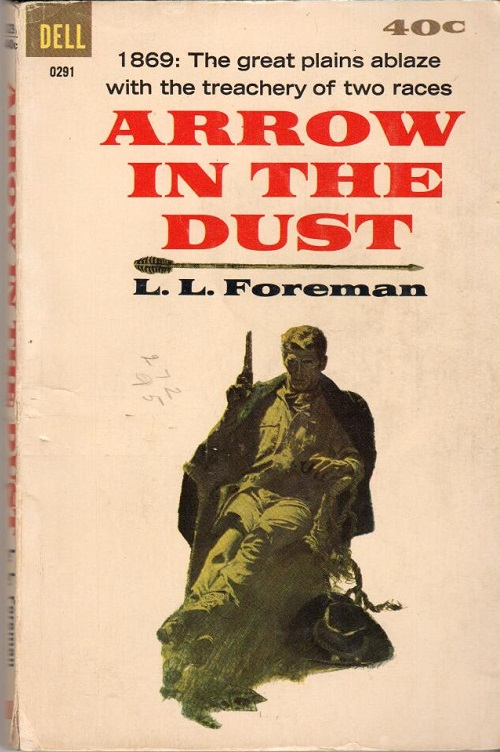
I’ve become a big fan of Ron Lesser’s artwork in the past few years. Well, actually, I’ve been a big fan of Ron Lesser’s artwork for about 60 years, because that’s how long ago it was when I first started noticing it on paperback covers as I avidly looked through the new books on the spinner racks, searching for the next one I was going to read. I loved his covers—but I had no idea they were painted by Ron Lesser. In fact, one of my early favorite covers, the one on the second Dell edition of L.L. Foreman’s novel ARROW IN THE DUST, was painted by Lesser, although I didn’t discover that until decades later. I couldn’t even begin to tell you how many books I picked up because I was intrigued by the covers he painted.

A couple of years ago, THE ART OF RON LESSER, VOLUME 1: DEADLY DAMES AND SEXY SIRENS, spotlighting those paperback covers, was one of my favorite books of the year. Now I’ve read THE ART OF RON LESSER, VOLUME 2: DANGEROUS DAMES AND COVER DOLLS—maybe I should say, feasted my eyes on—the second volume devoted to Lesser’s art from editor Robert Deis and Bill Cunningham, joined this time around by Daniel Zimmer, with an assist from Tim Hewitt. Zimmer provides a fine biographical essay about Lesser and Joe Jusko, a top-notch artist himself, contributes an excellent foreword, but of course, the real appeal of this beautiful book is the art, scores of excellent reproductions of paintings done by Lesser after his days of doing paperback covers were mostly over. Most of them, as you’d expect, feature beautiful women, but there are top-notch Civil War and Western paintings as well. Lesser was always one of those guys who could illustrate anything and do a fantastic job of it. But let’s face it, his paintings of Bettie Page, Marilyn Monroe, Brigitte Bardot, and others will just take your breath away.

Then there’s my favorite section of the book: as Lesser puts it in his commentary, cover paintings for books that don’t actually exist. These might as well have come off some of those paperbacks from the spinner racks, the kind I’ve loved for most of my life. And I’d love to read those books now, even if they don’t exist. Heck, I’d write them!

If you’re a paperback lover or just enjoy some absolutely wonderful art, I give my highest recommendation to THE ART OF RON LESSER, VOLUME 2: DANGEROUS DAMES AND COVER DOLLS. It’s available on Amazon in hardback and paperback editions. I loved it.

Saturday, January 11, 2025

Saturday Morning Western Pulp: Masked Rider Western Magazine, July 1938


I don’t own a copy of this pulp, but I recently read an e-book reprint of it that’s also available in a paperback edition. I don’t have any idea who did the pulp cover.  The lead novel was also reprinted in paperback around 1970 by Curtis Books with a cover by Vic Prezio. The fellow on the cover of that paperback edition is definitely our old friend Steve Holland. (Thanks to Martin O'Hearn for his helpful info on the paperback edition.)

“Iron Horse Gunsmoke” is the third Masked Rider novel after the series was taken over by Better Publications and became part of the Thrilling Group, after the first dozen or so issues were published by Ranger Publications. It’s the second Masked Rider tale by veteran pulpster Donald Bayne Hobart, who wrote 19 Masked Rider novels, more than any other writer who contributed to the series. (Walker A. Tompkins was second with 18.) For those of you who don’t recall, the Masked Rider was more than likely inspired by/an homage to/ripped off from The Lone Ranger. He’s a good guy outlaw who wears a mask and travels with a faithful Indian companion as they drift around the West, helping folks in need, dispensing justice to owlhoot varmints, and generally adventuring. But as it turns out, the character is a lot more interesting than you might think. Unlike The Lone Ranger, who only occasionally uses disguises, the Masked Rider spends a large portion of each novel pretending to be drifting cowboy Wayne Morgan. The novels make it clear that Morgan is not the character’s true identity; he’s just as fictional as the Masked Rider himself. Somewhere in the mists of the past, the Masked Rider and his family ran afoul of injustice, and that’s why he dons a black cape and mask and sets out to right wrongs. But who he really is or what his actual background might be, we never find out. His Yaqui friend Blue Hawk, like Tonto to The Lone Ranger, is no mere sidekick. He’s an equal partner in the fight against lawlessness and is tough and smart and just as much of a badass as The Masked Rider. They’re a great team.


In “Iron Horse Gunsmoke”, Hobart gives us a nice twist in the plot. In most Western novels featuring the building of a railroad, the cattlemen are all for it since the steel rails will make it easier for them to ship their herds to market. In this novel, however, through a series of misunderstandings, as well as events manipulated by shadowy villains, the railroaders and the ranchers are mortal enemies, and it’s up to the Masked Rider to uncover what’s really going on and expose the true villains behind the violence erupting on the range. It’s a breakneck, full-tilt yarn full of shootouts, ambushes, fistfights, avalanches, and dynamite blasts. I’ve become a fan of Hobart’s work in recent years because of this high-speed pacing and his solidly written action scenes. He has a good handle on the Masked Rider and Blue Hawk, too, and the supporting characters are always colorful and interesting in a Hobart novel. I raced through this story and really enjoyed it.

Tom Gunn was a house-name used by Syl McDowell on the Sheriff Blue Steele series. Frank Gruber has also been linked to that name, but it’s likely that other Thrilling Group regulars also used it. The short story under that by-line in this issue, “Roaring Verdict”, doesn’t strike me as the work of either McDowell or Gruber. There’s really no telling who wrote this short tale of the violent confrontation between an old lawman and a cunning outlaw. It’s almost all action and well-written, but it probably could have used some sort of plot twist. Even so, it’s an entertaining story.

The issue wraps up with “That Bond of Courage”, a short story by George H. Michener, a fairly prolific but forgotten Western pulp author. It’s about the wintry clash between two sodbusters and a local cattle baron. There’s an attempted murder, a trek through a blizzard, and some unexpected redemption. This is a well-written, low-key story that comes to a satisfactory conclusion. Nothing earthshaking here, but I liked it.

Overall, this is a good issue of MASKED RIDER WESTERN MAGAZINE. The Masked Rider novel by Donald Bayne Hobart is a solidly entertaining Western adventure yarn, and it takes up most of the pages. I’m a Hobart fan and I’ve become very interested in his work, so I expect to read something else by him in the near future.


Friday, August 04, 2023

Blue Mascara Tears - James McKimmey


The original 1965 Ballantine edition of James McKimmey’s novel BLUE MASCARA TEARS sports one of my favorite Ron Lesser covers (see below). If I’d seen this on a spinner rack back then, I would have had to buy it. As it is, I just read the new Stark House reprint of the book, in a double volume with 24 HOURS TO KILL, which I reviewed a couple of weeks ago. So this is my second McKimmey novel, but it certainly won’t be my last.

BLUE MASCARA TEARS is a hardboiled cop novel centering around Inspector Jack Cummings, who works in a big city that I think is probably San Francisco, although McKimmey doesn’t ever specify that. Cummings is investigating two cases, the murder of a gambler who was gunned down in his hotel room by an intruder who stole a wad of money from him and the rape of a neighborhood teenage girl. At the same time, he’s carrying out a vendetta of sorts against gangster Knocko Cutter, whom Cummings blames for the gambler’s murder even though he has an alibi. Knocko is protected by higher-ups in the police department, so Cummings has to battle that corruption, too, as he tries to get to the bottom of the two cases.

This book races along until about two-thirds of the way through when it suddenly appears that Cummings has solved everything. Ah, but then there’s a suspicious suicide that Cummings believes is murder, and in a way the whole thing starts again. The suspense ratchets up more and more until McKimmey really had me turning to the pages to get to the very emotional ending.

BLUE MASCARA TEARS is an excellent novel with a complicated protagonist. Is Cummings right about Knocko Cutter’s involvement with the crimes, or is he too obsessed with getting the gangster and letting that cloud his judgment? Is he so afraid of the corruption rubbing off on him that he sees it where there isn’t any? These questions lurk in the back of the reader’s mind, and even Cummings sometimes questions his own objectivity. This is a pretty philosophical book for a hardboiled crime novel, but McKimmey never lets it bog down with navel-gazing. It stays tough and fast all the way through. I give it a high recommendation, especially since you can get it in that double volume with an equally compelling yarn, 24 HOURS TO KILL.


Friday, June 30, 2023

The Art of Ron Lesser, Volume 1: Deadly Dames and Sexy Sirens - Robert Deis, Bill Cunningham, and J. Kingston Pierce, eds.


THE ART OF RON LESSER, VOLUME 1: DEADLY DAMES AND SEXY SIRENS is the latest fantastic art book from the editing combo of Robert Deis and Bill Cunningham, joined this time by crime fiction expert J. Kingston Pierce. This book really got its start from a series of interviews with Lesser conducted by Pierce. Expanded versions of those interviews are included in this volume, along with features on Lesser’s favorite models (including his wife; that's her on the cover above) and reproductions not only of dozens of paperbacks for which he did the covers but also the original paintings which were used on those covers.

In a word, beautiful.

But of course, I’m going to say more than a word. Any book with Bill Cunningham handling the production is going to be very well done, and DEADLY DAMES AND SEXY SIRENS is no exception. This is a substantial hardback volume, and the cover reproductions are some of the best I’ve ever seen. Those covers looked great on spinner racks, but they look even better at the large size made possible by a book like this.

The text put together by Bob Deis is informative and entertaining. I knew who Ron Lesser is but knew very little about him. Pierce’s interviews and Deis’s features provide plenty of background about Lesser’s life and career.

What really strikes me about this book is realizing how many of those paperbacks with Ron Lesser covers I bought over the years! I could flip through the pages and say, “Yeah, I had that one and that one and that one . . .” Clearly, Lesser’s covers helped sell those books to me. I’m certainly guilty of misidentifying some of his covers as being by Robert McGinnis, as Deis mentions is common. In recent years I think I’ve gotten a little better eye for such things. I’m happy to have those earlier misconceptions of mine cleared up, because Ron Lesser deserves all the credit he can get for being a substantial part of my reading life.

This is just the first of several planned volumes on Lesser’s career. It concentrates on the covers that feature beautiful women. Later volumes will zero in on Lesser’s work for Western, war, and adventure paperbacks. I can’t wait to see them. If you’re a long-time paperback fan and want to relive some glorious days, I give DEADLY DAMES AND SEXY SIRENS my highest recommendation. It’s one of the best books I’ve read so far this year.

Friday, August 27, 2021

Forgotten Books: Arrow in the Dust - L.L. Foreman

Art by Ron Lesser

Bart Laish is not your typical stalwart Western hero. He’s a gambler, a gunfighter, and when ARROW IN THE DUST, L.L. Foreman’s novel from 1954 opens, an army deserter, having enlisted in order to hide out from the law only to take off for the tall and uncut rather than being thrown in the guardhouse for brawling. Not a nice guy.

And yet, through a series of frankly far-fetched coincidences, Laish finds himself wearing a general’s uniform, inheriting command of a bunch of inexperienced soldiers, and called upon to protect a wagon train bound for Fort Laramie from an Indian horde composed of warriors from several rival tribes who have banded together for some unknown reason. Oh, and with that wagon train is the dead general’s wife, who also happens to be one of Laish’s old flames.

Despite my long-windedness in describing it, the plot in ARROW IN THE DUST plays out pretty simply: make it to Fort Laramie without the whole wagon train being massacred. Throw in some romantic complications along the way. Does all this adversity offer Bart Laish a chance at redemption? I think you know the answer to that.


Original 1954 edition, art by Robert Stanley

While the elements that make up ARROW IN THE DUST may be pretty standard, L.L. Foreman does an absolutely superb job of blending them into a compelling, suspenseful Western yarn. This novel doesn’t have as much action as some—a lot of it is kind of a slow burn—but when violence does erupt, it’s very effective, and the final battle with the Indians is spectacular. Foreman devotes a lot of time to characterization and also writes very well about the landscape. His prose is nothing fancy, but it moves along in fine fashion.

L.L. Foreman was an Englishman, born in London and spending the first twenty years of his life there before moving to the United States. He started writing for the Western pulps in 1934 and continued for more than twenty years, expanding his career into novels in the Forties and writing until his death in the Sixties. ARROW IN THE DUST is an expansion of the novella “Platte River Gamble”, published in the June 1953 issue of ZANE GREY’S WESTERN MAGAZINE. It’s a really fine novel, and if you’re a fan of traditional Westerns, I give it a high recommendation.


Original novella version, cover art by Robert Stanley

There’s a personal story that goes with this one, too. In the Sixties, some of my relatives lived in the tiny, West Texas oilfield town of Goldsmith, northwest of Odessa. Every couple of years we would drive out there to visit them, usually in the summer, and would spend two or three weeks with them. My uncle was a hunter and taught me how to shoot and reload ammo. (I’ve long since lost my reloading skills, but I’m still a decent shot.) He was also an avid reader of Western novels, and during one trip, I read a Western paperback he had on hand. For years I didn’t recall the author or title, but for some reason the cover illustration stuck in my head: it was a painting of a cavalryman in a long coat, no hat, sitting with his legs stuck out in front of him. I had a feeling that it might be STEEL TO THE SOUTH by Wayne D. Overholser, but when I finally got curious enough to look up that book a few years ago, I couldn’t find any editions of it with a cover like that.

Well, that got my curiosity up even more. I knew the book was published by Dell. The size of it and the blue-edged pages were enough to tell me that. So I looked through listings of Dell Westerns and didn’t find it. I looked up other Overholser books, with still no luck. I was starting to think maybe my memory was playing tricks on me (believe it or not, that’s been known to happen). But one day, I got the idea of asking about it and describing the cover I remembered on the Men’s Adventure Paperbacks group on Facebook. Less than an hour later, I had the answer, complete with a picture of the book: ARROW IN THE DUST by L.L. Foreman. I never would have guessed that.

Not only did I now know what the book was, my friend on Facebook even offered to send me the copy he had. I traded him a couple of my books for it, and that’s the copy you see up at the top of this post, complete with cover art by Ron Lesser featuring model Steve Holland—neither of whom I knew anything at all about when I first read this book more than fifty years ago. I’ve finally gotten around to rereading, and I thoroughly enjoyed it. I had no memory of the plot from reading it all those years ago, so it was like a new book to me. And now you know . . . the rest of the story, as Paul Harvey used to say.

(Hmm. Why did I think it was STEEL TO THE SOUTH by Wayne D. Overholser, a book that, as far as I know, I’ve never read? I wonder if I should find a copy and read it . . .)