Showing posts with label L.L. Foreman. Show all posts

Saturday, August 23, 2025

Saturday Morning Western Pulp: Western Aces, December 1934


WESTERN ACES usually had good covers, like this one by Rafael DeSoto that appeared on the magazine's second issue. The authors inside are a mixture of the well-known and the obscure. L.L. Foreman, Philip Ketchum (writing as Carl McK. Saunders), Orlando Rigoni, Larry A. Harris, and Clyde A. Warden (writing as Les Rivers) were all prolific, solid Western pulpsters. Eugene R. Dutcher, Leon V. Almirall, and Francis P. Verzani are less well-remembered, but that doesn't mean their stories aren't good. I don't own this issue, but that cover sure would have caught my eye if I'd been browsing the newsstand back in 1934. If I'd had a spare dime, there's a good chance I would have bought it.

Saturday, November 23, 2024

Saturday Morning Western Pulp: Street & Smith's Western Story, August 30, 1941


This issue of the iconic WESTERN STORY sports a fine, very dramatic cover by A. Leslie Ross, one of my favorite pulp and paperback cover artists. The authors inside are no less notable: Harry Sinclair Drago, L.L. Foreman (with a Preacher Devlin novella), Tom W. Blackburn, S. Omar Barker, Frank Richardson Pierce (as Seth Ranger), George Michener, and Eric Howard. Definitely looks like an issue worth reading. I don't own a copy, or I just might. I do have Harry Sinclair Drago's novel BUCKSKIN EMPIRE, one installment of which is serialized in this issue. May have to see if I can find the book.

Sunday, December 10, 2023

Sunday Morning Bonus Pulp: Adventure, November 1943


This is a pulp that I own and read recently. The cover is by Maurice Bower, an artist I’m not familiar with who did quite a few covers for ADVENTURE during this period. It’s an okay cover, not one of my favorites by any means, but it promises excitement inside and that’s what it was supposed to do.

The first thing I noticed about this issue is that it has a story by Georges Surdez in it. Surdez is always good. But when I opened it up, the story by him is actually the first installment of a two-part serial set in World War II. Boo! I don’t own the issue with the second part, and it doesn’t appear to be online, so I wound up skipping this one. I also skipped the final installment of “The Fleet in the Forest”, a five-part historical serial about the War of 1812 by Carl D. Lane. It was published as a novel. Maybe I’ll read it one of these days, as I find the War of 1812 interesting.

The next thing I noticed is that there are three non-Western short stories by authors best remembered for their Westerns. “Collision Hazard” by L.L. Foreman is one of several stories in this issue set during World War II. It’s a tale of naval action centered around a tugboat, not the usual vessel you’d think of in a story like this. But it’s an excellent yarn, very tense and well-written. Foreman was one of the best Western pulpsters and he demonstrates his skill here, too. “Message to Manakas” is by Hal G. Evarts Jr. (son of the early Western novelist Hal G. Evarts Sr.) and is another World War II yarn about a soldier of Greek descent being infiltrated into Crete to deliver a message to the leader of the Greek underground. It’s well-written but maybe not quite as exciting as it should have been. “Break-Through” by Robert E. Mahaffey, one of the regulars in various Popular Publications Western pulps, is a short-short about a couple of GIs driving a truck in North Africa. It has a twist ending that I didn’t see coming, and that makes it effective.

“Gray Is For Apple” is another short story set during the war, a nice little yarn about an Australian soldier in the New Guinea campaign who’s a fantastic marksman despite a handicap he has to overcome. The author, Christian Folkard, was an Australian journalist and war correspondent who published only three stories in the pulps, in 1943 and ’44. This is the first of that trio, and it’s a good one.

The novelette “One Little Slip” is a Northern by H.S.M. Kemp, who wrote plenty of them for various pulps. It’s a cleverly plotted tale in which a Mountie solves a murder. I liked it quite a bit.

The other novelette in this issue is “Red Justice” by William Du Bois. It’s part of a series about an army officer named Captain John Carter (Really? That’s the name you want to use?) who battles the Seminole Indians during the 1830s. There’s a lot of back-story from the other entries in the series, I didn’t care for the protagonist, and the writing never resonated with me. I read it, but I didn’t care for it.

There’s also an article by Hugh B. Cave about PT boats that’s actually an excerpt from his non-fiction book on the subject LONG WERE THE NIGHTS. Cave’s work is always worth reading, and I’ve been interested in PT boats ever since being a fan of McHALE’S NAVY in its original run 60 years ago, so I read and enjoyed this article even though I usually skip the non-fiction content in fiction magazines.

So this issue of ADVENTURE is a really mixed bag. None of the stories are outstanding, but the ones by Foreman, Evarts, Mahaffey, Folkard, and Kemp are all okay, entertaining yarns without being all that special. Don’t rush to your shelves for this one, but if it’s handy you might find it worth reading.

One more note: in the back of this issue and others of the era is a column called “Lost Trails”, where readers can write in, in hopes of reconnecting with friends or relatives they’ve lost track of. Most of these notes are fairly bland, if vaguely poignant, but one in this issue caught my eye: “Louis Sixt, probably known as Bob Six, last heard of Gananoque, Ont., and Vancouver, B.C. Age about 26, height 4’ 10”, weight 135 lbs., gray eyes, back-brushed straight brown hair. Scrapper, gambler, seafaring man. Anyone having knowledge of his whereabouts please write his brother Paul Sixt c/o Adventure.” What a great description! And now I want to write a series of pulp yarns about a scrappy little guy named Bob Six knocking around and having adventures all over the world. I’ll probably never do it, of course, but it’s fun to think about. Just out of curiosity, I tried to look up Louis Sixt and his brother Paul, but I couldn’t find out anything about them. Maybe one of their descendants will read this and email me one of these days. Stranger things have happened, as the saying goes.

Wednesday, February 15, 2023

Last Stand Mesa - L.L. Foreman


LAST STAND MESA was first published in the February 1951 issue of ZANE GREY’S WESTERN MAGAZINE and then reprinted by Ace Books in 1969 as half of an Ace Double Western, on the other side of Philip Ketchum’s MAD MORGAN’S HOARD, which I read and reviewed last week. Steve Holland lends his iconic visage to the paperback cover by Sol Korby. This is the edition I read, not the magazine version, but as short as the Ace edition is (110 pages), I doubt if Foreman had to expand it much, if any.

The protagonist of this novel is Mike McLean, an outlaw on the dodge after a failed bank robbery. Mike may be an owlhoot, but he’s a decent hombre at heart and he often finds himself in danger because he can’t resist helping folks who are in trouble. In this case, as he’s fleeing a posse in New Mexico Territory, he pauses to rescue an eccentric old tinhorn gambler from a shootout. Throwing in together, they run from trouble . . . but wind up riding right into the middle of a three-cornered range war.

The Triangle T, run by Amery Roone and his gunhawk minions, Roose’s Regulators, wants to force out all the smaller ranchers in the area. Those spreads are targeted by the outlaw gang led by Bloodywire Brokus, as well. Mike McLean sticks up for the underdog, as usual, and tries to help the small ranchers, but the situation is complicated by the fact that the boss outlaw, Brokus, has a beautiful daughter known as the Cheyenne Flame, and Mike falls for her right away.

This is one of those novels where things don’t turn out exactly as you expect them to. Just when it seems like Foreman is setting things up a certain way, the situation reverses. These twists allow Foreman to pack a lot of plot into this book, as well as some good action and excellent characterization. Foreman’s work is usually a tad more eloquent than most pulp Westerns, and LAST STAND MESA is no exception. It’s a very well-written traditional Western that I really enjoyed.

If you want to know more about Foreman, here's an excellent article about him on the Pulp Flakes website. By the way, I wasn’t familiar with cover artist Sol Korby, but looking into his background led me to this interview with him conducted by Michael Stradford. I give both of these high recommendations, as well.

Art by Nicholas S. Firfires


Saturday, July 02, 2022

Saturday Morning Western Pulp: 10 Story Western Magazine, June 1942


The cover on this issue of 10 STORY WESTERN MAGAZINE has an unusual but very effective perspective. I don't know the artist. 10 STORY WESTERN was considered a second-string Western pulp from Popular Publications, but I've always thought it was consistently good to very good, with a lot of excellent authors appearing in its pages. In this issue, for example, are stories by Tom W. Blackburn, L.L. Foreman, Philip Ketchum, Tom Roan, Robert E. Mahaffey, John G. Pearsol, M. Howard Lane, Rolland Lynch, and George Armin Shaftel. Some of those are better remembered than others, but they were all prolific, well-regarded pulpsters.

Friday, August 27, 2021

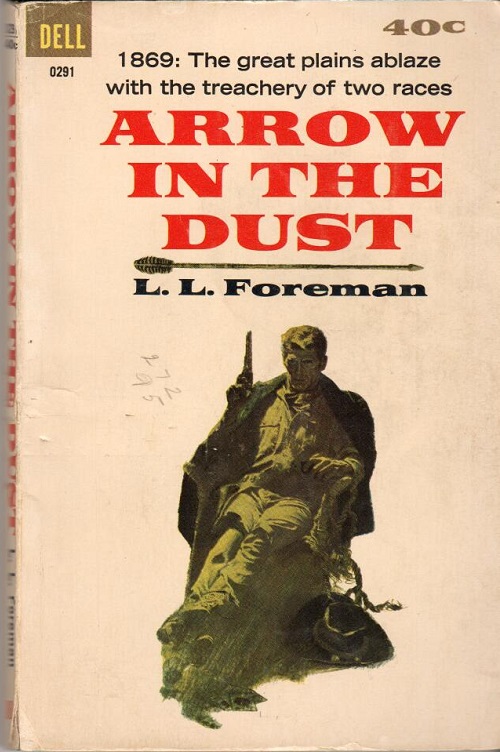
Forgotten Books: Arrow in the Dust - L.L. Foreman

Art by Ron Lesser

Bart Laish is not your typical stalwart Western hero. He’s a gambler, a gunfighter, and when ARROW IN THE DUST, L.L. Foreman’s novel from 1954 opens, an army deserter, having enlisted in order to hide out from the law only to take off for the tall and uncut rather than being thrown in the guardhouse for brawling. Not a nice guy.

And yet, through a series of frankly far-fetched coincidences, Laish finds himself wearing a general’s uniform, inheriting command of a bunch of inexperienced soldiers, and called upon to protect a wagon train bound for Fort Laramie from an Indian horde composed of warriors from several rival tribes who have banded together for some unknown reason. Oh, and with that wagon train is the dead general’s wife, who also happens to be one of Laish’s old flames.

Despite my long-windedness in describing it, the plot in ARROW IN THE DUST plays out pretty simply: make it to Fort Laramie without the whole wagon train being massacred. Throw in some romantic complications along the way. Does all this adversity offer Bart Laish a chance at redemption? I think you know the answer to that.


Original 1954 edition, art by Robert Stanley

While the elements that make up ARROW IN THE DUST may be pretty standard, L.L. Foreman does an absolutely superb job of blending them into a compelling, suspenseful Western yarn. This novel doesn’t have as much action as some—a lot of it is kind of a slow burn—but when violence does erupt, it’s very effective, and the final battle with the Indians is spectacular. Foreman devotes a lot of time to characterization and also writes very well about the landscape. His prose is nothing fancy, but it moves along in fine fashion.

L.L. Foreman was an Englishman, born in London and spending the first twenty years of his life there before moving to the United States. He started writing for the Western pulps in 1934 and continued for more than twenty years, expanding his career into novels in the Forties and writing until his death in the Sixties. ARROW IN THE DUST is an expansion of the novella “Platte River Gamble”, published in the June 1953 issue of ZANE GREY’S WESTERN MAGAZINE. It’s a really fine novel, and if you’re a fan of traditional Westerns, I give it a high recommendation.


Original novella version, cover art by Robert Stanley

There’s a personal story that goes with this one, too. In the Sixties, some of my relatives lived in the tiny, West Texas oilfield town of Goldsmith, northwest of Odessa. Every couple of years we would drive out there to visit them, usually in the summer, and would spend two or three weeks with them. My uncle was a hunter and taught me how to shoot and reload ammo. (I’ve long since lost my reloading skills, but I’m still a decent shot.) He was also an avid reader of Western novels, and during one trip, I read a Western paperback he had on hand. For years I didn’t recall the author or title, but for some reason the cover illustration stuck in my head: it was a painting of a cavalryman in a long coat, no hat, sitting with his legs stuck out in front of him. I had a feeling that it might be STEEL TO THE SOUTH by Wayne D. Overholser, but when I finally got curious enough to look up that book a few years ago, I couldn’t find any editions of it with a cover like that.

Well, that got my curiosity up even more. I knew the book was published by Dell. The size of it and the blue-edged pages were enough to tell me that. So I looked through listings of Dell Westerns and didn’t find it. I looked up other Overholser books, with still no luck. I was starting to think maybe my memory was playing tricks on me (believe it or not, that’s been known to happen). But one day, I got the idea of asking about it and describing the cover I remembered on the Men’s Adventure Paperbacks group on Facebook. Less than an hour later, I had the answer, complete with a picture of the book: ARROW IN THE DUST by L.L. Foreman. I never would have guessed that.

Not only did I now know what the book was, my friend on Facebook even offered to send me the copy he had. I traded him a couple of my books for it, and that’s the copy you see up at the top of this post, complete with cover art by Ron Lesser featuring model Steve Holland—neither of whom I knew anything at all about when I first read this book more than fifty years ago. I’ve finally gotten around to rereading, and I thoroughly enjoyed it. I had no memory of the plot from reading it all those years ago, so it was like a new book to me. And now you know . . . the rest of the story, as Paul Harvey used to say.

(Hmm. Why did I think it was STEEL TO THE SOUTH by Wayne D. Overholser, a book that, as far as I know, I’ve never read? I wonder if I should find a copy and read it . . .)

Saturday, January 02, 2021

Saturday Morning Western Pulp: Dime Western, November 1939


We get the year started off right with a crowded but effective cover for DIME WESTERN. I don't know the artist. Inside are some great authors--Walt Coburn, L.L. Foreman, Cliff Farrell, Harry F. Olmsted (writing as Bart Cassidy), and Robert E. Mahaffey--as well as some great story titles: "Gun Guide for Satan's Border Jumpers", "Blood Call of the Lawless", "Bullet-Heir of Lost Ranch", and "Champion of the Empty-Saddle Legion", among others. I love the titles in the Popular Publications Western pulps.

Saturday, April 20, 2019

Saturday Morning Western Pulp: Two-Gun Western, November 1953


This issue of TWO-GUN WESTERN features another appearance of the trio who turn up on so many Western pulp covers: the Stalwart Cowboy, the Wounded Geezer, and the Gun-Toting Girl. True, there's a little variation on this one. The Geezer isn't quite as old as some, but he's still got the blood-stained bandage on his head. And the Girl is a brunette instead of the usual redhead and is also showing a little more cleavage than most. But as always, their presence makes for a good cover. What's puzzling is why stories by Philip Morgan (who?) and John Lumsden (again, who?) are featured on that cover, when inside there are also yarns by Noel M. Loomis, Bennie Gardner (once as Gunnison Steele and once as house-name Johnny Lawson), Jonathan Glidden (as Peter Dawson), L.L. Foreman, Stephen Payne, and Lee Floren. There are also stories by house-names Brent North and Ken Jason, who was also at various times Bennie Gardner or Jon Glidden, so the story in this issue may be by one of them. Or it might be by editor Robert O. Erisman, who was known to use the name as well and sell stories to himself. Hard to say. All I really know is that this looks like a pretty good issue.

Saturday, September 30, 2017

Saturday Morning Western Pulp: Western Story, January 3, 1942


Another fine H.W. Scott cover on this issue of WESTERN STORY, and look at that line-up of authors inside: William Colt MacDonald, L.L. Foreman, Philip Ketchum, H.A. DeRosso, Glenn Wichman, and Seth Ranger, who was really Frank Richardson Pierce. Great Western reading week after week.

Saturday, August 26, 2017

Saturday Morning Western Pulp: New Western, April 1950


I'll resist the temptation to make a cliffhanger joke here. This looks like the usual fine issue of NEW WESTERN, with stories by L.L. Foreman, Giff Cheshire, George C. Appell, Rod Patterson, W. Edmunds Claussen, Max Kesler, and Robert L. Trimnell. With the exception of Foreman and Cheshire, those aren't big names, but the other guys were pretty solid pulpsters for the most part.