Wednesday, July 31, 2024

The Shadowed Circle Compendium - Steve Donoso, ed.


I’ve been a big fan of THE SHADOWED CIRCLE, a beautifully produced journal devoted to The Shadow, ever since it began publishing a few years ago. Now we have THE SHADOWED CIRCLE COMPENDIUM, an even prettier volume reprinting some of the best articles from the first seven issues of the regular journal, plus half a dozen new articles that make this book well worthwhile even if you’ve read the others in their original appearances.

The highlight of the new articles, for me, is “The Shadowed Seven”, in which editor/publisher Steve Donoso asked more than twenty fans and/or scholars of The Shadow to select their seven favorite Shadow stories, the ones they would take with them to the proverbial desert island. (In the spirit of full disclosure, I contributed to this article myself.) All the different incarnations of the character were fair game for this exercise: pulps, comics, movies, and the radio show. There’s a good representation of all of those, although the pulp novels dominate the lists. I didn’t make a count or anything like that, but it seemed to me that the very first novel, “The Living Shadow”, was mentioned more than any of the others, which makes sense. After all, it established the character and set the tone for everything that was to come after. Several of the other early pulp novels were very popular, too. Even now, more than 50 years after I read them the first time, I vividly recall the great action scenes, the incredible shoot-outs between The Shadow and the hordes of gangdom, and how enthralled I was by them.

Other new articles include a look at The Shadow’s appearances in various fanzines over the past 40-some-odd years, checklists of the novels and reprints, and “The Essential Shadow Reference Collection”, devoted to the various books that have been written about the character.

If you haven’t been reading THE SHADOWED CIRCLE, the compendium is definitely a best-of-the-best volume and is likely to send you scurrying to pick up back issues of the regular journal. If you’ve been reading it from the start like me, you’ll have a great time revisiting old favorites and taking in the new material. THE SHADOWED CIRCLE COMPENDIUM is available in hardback and paperback editions, and if you’re a Shadow fan, or a fan of the pulps in general, it gets my highest recommendation.


Sunday, July 28, 2024

Sunday Morning Bonus Pulp: North*West Romances, Fall 1945


I like posting snowy covers of Northern pulps during the summer when the weather is hot. This one is by the always-excellent George Gross. This issue of NORTH*WEST ROMANCES also has some fine authors in its pages, most notably Dan Cushman, Les Savage Jr., and William Heuman. Those three are enough to make any pulp issue worthwhile by themselves. Also on hand are R.S. Lerch, Kenneth P. Wood, Larry McLane, R.A. Emberg, Paul Selonke, and Michael Oblinger. I like listing the authors' names, even the ones I've never heard of, because every so often somebody will be searching on-line for mentions of a relative, and then they email that So-and-So was their grandfather or great-uncle or something, and they're excited to see the name in a post. That always makes me feel good.  

Saturday, July 27, 2024

Saturday Morning Western Pulp: Texas Rangers, May 1949


This is a pulp that I own and read recently. That’s my copy in the scan. The cover art is by the very prolific Sam Cherry and is certainly quite dramatic. We know Jim Hatfield’s horse Goldy is all right, but even so, that’s quite a spill he’s taking.

The Hatfield novel in this issue is “The Wasteland Empire”, written by series creator Leslie Scott writing under the house-name Jackson Cole. It’s strictly a mining boomtown yarn. There are mentions of some cattle ranches in the area but nary a sign of any rustlers, which is a little unusual for a Scott story. Hatfield—and Scott—get to put their mining backgrounds to good use in this one, as a gold strike attracts trouble to the West Texas boomtown of Gravel Bank, and Hatfield is sent in undercover to find out who’s behind the outlawry and put a stop to it.

The identity of the mastermind is pretty obvious and Hatfield figures out who it is fairly early on, but he has to round up enough proof to take action. Along the way, there are several shootouts and ambushes and Hatfield is trapped underground and almost killed not once but twice before he brings the head varmint to justice.

As always in a Scott novel, there are vivid descriptions and over-the-top action scenes, but the plot seems a bit thinner than usual. I wouldn’t go so far as to say that “The Wasteland Empire” was phoned in, but it does have a certain workman-like air about it. Still entertaining, of course. I don’t think Scott was capable of writing a story that’s not fun to read. But it’s not in the top rank of his Hatfield novels.

There are only two back-up stories in this issue of TEXAS RANGERS. The first, “Empty Holsters”, is by-lined Sam Brant, which was a frequently used house name in Thrilling Group Western pulps. I can’t even make a guess who wrote this one. There’s nothing distinctive about the style. The plot concerns a veteran lawman who has to solve a bank robbery in which his young deputy is implicated. Nothing special by any means, but it's well-written enough that I found it enjoyable reading.

The Long Sam Littlejohn series by Lee Bond was the longest-running back-up series in TEXAS RANGERS, more than 50 stories from 1936 to 1952. I’ve read a lot of them and enjoyed every one. These yarns about a good-guy outlaw pursued by a stubborn lawman and getting into one fracas after another are very formulaic, but it’s a formula I like. In this issue’s story, “Long Sam Flies a Flag”, he gets mixed up in a border dispute and a land grab centered around the Rio Grande changing course. There’s just enough action and plot to make a fine short story.

While this isn’t an outstanding issue of TEXAS RANGERS, it’s a good one, with all three stories providing enjoyable reading, and if you have a copy, it’s worth taking it down from the shelf and giving it a try.

Friday, July 26, 2024

A Rough Edges Rerun: Armed . . . Dangerous . . . Brett Halliday (Robert Terrall)


A while back I had an email conversation with an author friend of mine [probably Steve Mertz] about the relative merits of Robert Terrall’s Mike Shayne novels. When I was first reading the Shayne novels back in the Sixties and early Seventies, I didn’t know that Davis Dresser, the original Brett Halliday, had had so many ghost-writers contributing to the series. But I did know that as the Sixties went on, I began to like the novels less, and by the Seventies, I didn’t care for them at all. Later, of course, I found out that Robert Terrall was the author of the books I didn’t like.

However, a number of people whose opinions I respect do like Terrall’s Shayne novels, and since I hadn’t read one in close to forty years, I thought I ought to do so and see if my opinion of them has changed since then.

Well . . . it has and it hasn’t.

ARMED . . . DANGEROUS . . . , from 1966, is one of the books I never got around to reading back then. It’s got a nice McGinnis cover, at least on the first edition, and although Mike Shayne is nowhere to be seen, the opening section certainly has plenty of action and intrigue to recommend it. Early on, there’s a beautiful French blonde, a jewel heist, the brutal shooting of an off-duty cop, and a kidnapping. But there’s a twist coming, and I’ll admit, Terrall slipped it right past me for a good while, although I caught it before it was revealed. From that point on, there are a lot more twists, as the story takes on a much larger scale and becomes part caper novel/part thriller with international implications. It’s very well written, a little dated in some respects today but not all that much, and the pace is spectacular, leaving the reader whipping through the pages to see what’s going to happen. There’s even a bit of humor as Terrall name-checks another of his pseudonyms. This is a very entertaining novel. The problem is, it’s barely a Mike Shayne novel.

Oh, a character named Shayne plays a huge part in it, make no mistake about that, but he’s so lacking in personality that the protagonist could be almost anybody. There’s no sense that this is the same character who inhabits all the books in the series actually written by Davis Dresser. Terrall may have been a better wordsmith than Dresser was, I won’t argue that point, but Dresser’s Shayne is a fascinating character, no more honest than he has to be but with a decent core, and maybe one of the most intelligent characters in mystery fiction, who is always two steps ahead of the other people in the books and three steps ahead of the reader. I think most of the other authors who ghosted full-length Shayne novels were able to capture this to a certain extent, and Terrall did, too, at first, but as his stint on the series went on, I believe he lost his handle on the character. However, I could be wrong about this, and I plan to read more of his books to see what I think.

In the meantime, should you read ARMED . . . DANGEROUS . . .? Absolutely. It’s well-written and a lot of fun. If it had featured anybody but Mike Shayne, I’d give it an unqualified recommendation. But if you’ve never read a Shayne novel before, this is definitely not the place to start.

(This post originally appeared on July 10, 2009. And despite what I said in it, I haven't read any more of Terrall's Shayne novels since then. I'm sure this comes as no surprise to most of you, who know by now that I have the attention span of a six-week-old puppy.)

Wednesday, July 24, 2024

Selling the Wild West: Popular Western Fiction 1860-1960 - Christine Bold


From time to time, I get in the mood to read some non-fiction, but it’s usually non-fiction about fiction. Case in point, SELLING THE WILD WEST: POPULAR WESTERN FICTION 1860-1960 by Christine Bold, published in 1980 by Indiana University Press. A friend of mine recommended this book to me, and the author’s name was familiar. I remembered that she contributed some of the essays about various authors in TWENTIETH CENTURY WESTERN WRITERS. So it seemed like something I might enjoy.

The book has an intriguing concept: it’s an examination of the way Westerns became a mass-produced genre with a lot of constraints and rules that developed because of the way it was published, as well as how some authors of Westerns were able to achieve distinct authorial voices despite those constraints and rules. Bold starts with the dime novels and progresses through the early Twentieth Century and the pulp and original paperback eras, doing quick surveys of each of those publishing methods and then analyzing in more detail the careers of several different authors from each time period.

I’m not a big fan of dime novels, but I enjoyed reading about their origins and learned a few things. The authors Bold concentrates on in this section are Ned Buntline, Prentiss Ingraham, Edward S. Ellis, and Edward L. Wheeler. I knew quite a bit about Buntline and Ingraham (I once edited a novel in which Buntline is the main character, THE DIME NOVELIST by Clay More), but Ellis and Wheeler were pretty much new to me. Bold also discusses the different approaches of the two main publishers of dime novels, Beadle & Adams and Street & Smith.

In the section on the early Twentieth Century, Bold focuses on the big sellers—Owen Wister, Zane Grey, Max Brand (Frederick Faust), and Emerson Hough—as well as Frederic Remington, who (I didn’t know this) wrote several novels as well as being a legendary artist of the American West. Brand, of course, is something of a transitional figure, bridging the early days of Wister and Grey with the pulp era that he dominated. I’ve read a lot about Wister (who originated much of what we think of as Western fiction), Grey (the first bestseller in the genre), and Brand (the first King of the Pulps), but I knew much less about Remington and Hough. Neither of whom I’ve ever read, by the way.

Moving on, Bold covers the careers of several writers who “escaped” from the pulps: Alan Le May, Ernest Haycox, Jack Schaefer, and Louis L’Amour. Le May I know mostly from the movies based on his books, although I have read the novel THE SEARCHERS (and didn’t like it as much as the movie). I’ve read and loved both of Schaefer’s novels, SHANE and MONTE WALSH. I’ve come to appreciate Haycox’s work, although I have a preference for his pulp era novellas before he “escaped” those untrimmed pages. And while I haven’t read all of L’Amour’s novels and stories, by any means, I’ve read a bunch of them. L'Amour comes in for the greatest amount of criticism from Bold. She praises his marketing abilities but doesn’t seem to think much of his writing.

The book wraps up with some brief coverage of “Anti-Western Westerns” from the Seventies such as E.L. Doctorow’s WELCOME TO HARD TIMES and Ishmael Reed’s YELLOW BACK RADIO BROKE DOWN. There’s also a mention of what Bold erroneously refers to as “Playboy Westerns”, clearly a reference to the various Adult Western series published under house names. Comparing them to dime novels is fair game, I think. There are certainly similarities in the way they’re produced. But I’ve never heard anybody else refer to them as Playboy Westerns, a misnomer Bold picked up probably from the fact that Playboy Paperbacks published two of the early Adult Western series, Slocum by Jake Logan and Raider and Doc by J.D. Hardin, before those series were sold to Berkley.

SELLING THE WILD WEST is an enjoyable book with plenty of interesting insights. There are stretches where the academic density of the writing made my eyes start to glaze over a little, but for the most part it moves right along and is quite entertaining if you’re interested in the subject. Which I am, considering that a huge part of my own career has been spent writing books within a specific system and following the rules (mostly unwritten) of that system, while at the same time trying to establish my own voice and get across the things that I want to get across. That’s been a lot of fun and I think I’ve been somewhat successful at it.

Monday, July 22, 2024

Witchery Plus: A Weird Tales Trilogy - Keith Chapman


Several years ago my friend Keith Chapman published a pair of stories--a fantasy in the mold of Clark Ashton Smith and a sword and sorcery yarn--in a double volume. He's redone that book, added a third story, this time a modern-day horror yarn set in Australia, and published it as WITCHERY PLUS: A WEIRD TALES TRILOGY, which is available in both e-book and print editions on Amazon.

"Night Howl" is the new story in this volume. Chapman sold a number of comic book scripts to Charlton for their horror titles, and the original version of this story was one of them, but it went unpublished when Charlton switched over to mostly reprints. Converted to prose, it appeared first on the BEAT TO A PULP website and now is in print for the first time. It's about a pair of lovers on the run from a murder charge, and in that respect, it works very well as a noir crime yarn. But there's also a possibly supernatural element involving an old Gothic paperback featuring a heroine with the same name as one of the characters in this story. Are the bizarre events of that old paperback replaying themselves in real life? Chapman uses that question as the springboard for a very well-written tale that generates suspense all the way to the end.

Now here's what I had to say (slightly edited) about the other two stories when I reviewed them back in 2013:

"After an interesting introduction that addresses the genesis of these tales, Chapman produces a fine Clark Ashton Smith pastiche set in Smith's evil-haunted French province Averoigne, "Black Art in Yvones". A young protagonist, a beautiful blonde, and a sinister femme fetale even give this tale a slight noirish feel. In the second novelette in this collection, Chapman ventures into sword-and-sorcery territory with "Wildblood and the Witch Wife", featuring a very likable pair of adventurers reminiscent of Fritz Leiber's Fafhrd and the Gray Mouser. It's set in historical England rather than a fantasy world, but there's still plenty of sorcery and action."

Although probably best known for his Westerns, Keith Chapman is one of those authors who can write just about anything and do a good job of it. He's a fine storyteller, as these stories amply demonstrate. If you've never sampled his work before, WITCHERY PLUS would be a very good place to start. 

Sunday, July 21, 2024

Sunday Morning Bonus Pulp: Thrilling Detective, July 1933


This is a pretty grim cover by Rafael DeSoto on this early issue of THRILLING DETECTIVE. As is common with a Thrilling Group pulp, several of the authors in this one are house names: Robert Wallace, G. Wayman Jones, John L. Benton, and Kerry McRoberts. (I believe "McRoberts" went into the service during World War II and became Captain Kerry McRoberts.) The only author with a recognizable real name is William H. Stueber, who wrote some of the early Masked Rider novels. The others on hand, none of whom are the least bit familiar to me, are Maxwell Smith, Barry Brandon, and Russell Stanton. I suspect there are some decent stories in here, but I don't own a copy and this issue doesn't appear to be on-line, so I can't be sure.

Saturday, July 20, 2024

Saturday Morning Western Pulp: 10 Story Western Magazine, June 1947


This looks like a Robert Stanley cover to me, although, as always, I could be wrong. But I think I'm correct about there being some very good Western pulp authors inside this issue of 10 STORY WESTERN MAGAZINE: D.B. Newton, Philip Ketchum, William R. Cox, John Reese (with two stories, one under his usual John Jo Carpenter pseudonym, one under a name I haven't encountered before, Camford Cheavly), and Robert Turner, along with the lesser known Harold R. Stoakes, Ben T. Young, Jim Chapman, Ray Hayton, and Jimmy Nichols (who was really Jhan Robbins, fairly prolific under both names but little remembered). Like all the Popular Publications Western pulps, 10 STORY WESTERN MAGAZINE was consistently good.

Friday, July 19, 2024

The Spider: The Hangman From Hell - Will Murray


As I’ve mentioned before, I have vivid memories of how I discovered both The Spider and Operator 5: I bought the first two Berkley reprints of The Spider, THE SPIDER STRIKES! and THE WHEEL OF DEATH, both by R.T.M. Scott, when they were packaged together in a buy-one-get-one-free deal, off the paperback spinner rack at a drugstore in Stephenville, Texas, where we always stopped when my parents were going to visit relatives in Blanket, Zephyr, and Brownwood. I picked up the Corinth Regency paperback reprint of the Operator 5 novel LEGIONS OF THE DEATH MASTER (by Frederick C. Davis writing under the house name Curtis Steele) off the spinner rack in Trammell’s Pak-a-Bag Grocery in downtown Azle. (Several times a week, I drive by the building where Trammell’s used to be. It’s now a Mexican restaurant, and whenever I go in there, I can look over in the bar area and see the exact spot that spinner rack used to stand.)

But I digress, as the saying goes. You know you can’t get a straight review from me without a healthy dose of nostalgia accompanying it. So, to get to why we’re all here today . . . THE HANGMAN FROM HELL is the latest novel from Will Murray teaming up the iconic pulp heroes The Spider and Operator 5, and man, is it good! One of Richard Wentworth’s associates who keeps an eye on crime in Europe for him comes to New York with some important information. But when Wentworth meets the ship he’s traveling on, he finds that his informant has been murdered. Then Wentworth’s assistant Ram Singh is attacked and nearly killed by a giant attacker wielding a hangman’s noose attached to a razor-sharp sickle. Wentworth’s investigation reveals that this attacker, a deadly assassin known as The Hangman, works for the burgeoning political terror group known as the Purple Shirts, and he’s come to the United States for the specific purpose of killing Operator 5, America’s top secret intelligence ace.

Wentworth and Jimmy Christopher, Operator 5’s real name, have crossed paths before and an uneasy truce exists between them. They usually have the same goal but much different methods in achieving it. Operator 5, as a government agent, has to stay within the law (mostly) while Wentworth, as the vigilante known as The Spider, takes the law into his own hands and metes out what he considers justice without hesitation. It's an explosive relationship as both of them try to track down the Hangman and find out the details of the terrible scheme the Purple Shirts are planning to coincide with a big rally in Central Park.

There’s not quite as much breakneck action in this novel as there’s been in previous Spider novels by Murray, but the investigation by our two heroes plays out with compelling urgency, and when violence does erupt, it's packed with the apocalyptic excitement that’s a trademark of the Spider yarns going back to Norvell Page, the principal author of the series back in its pulp days. Page came up with some great murder methods for his villains to use, but Murray goes him one better in this novel: the attack on New York by the Purple Shirts is one of the most ghastly I’ve encountered in pulp adventure fiction. It’s truly creepy stuff, but it’s also very effective in raising the stakes and making the reader root for Wentworth and Jimmy Christopher even more.

I also like the way Murray ties this novel in with several of the original novels from both series. It fits perfectly and naturally and there’s never a sense of it being forced into canon. This is the way to write new novels based on classic pulp series, which, of course, is exactly what you’d expect from Will Murray.

I had a great time reading THE HANGMAN FROM HELL, as you’d expect since I’m a big fan of both The Spider and Operator 5. It’s one of the best books I’ve read so far this year and I give it a very high recommendation. And it’s put me in the mood to read some of the original pulp novels again. Whether I’ll get around to it, we’ll have to wait and see. But if I do, you’ll read the reviews here, as usual.

Wednesday, July 17, 2024

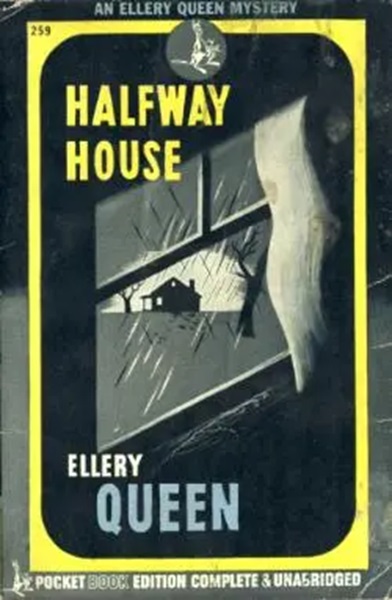
Halfway House - Ellery Queen (Frederic Dannay and Manfred B. Lee)


A while back I read an Ellery Queen novel for the first time in many years and found that I didn’t enjoy it as much as I expected to. My review of that book met with considerable disagreement from EQ fans. That really made me want to read another one in the series because sometimes, to be honest, if I don’t like a book it’s more my fault than the book itself. In looking over the list of EQ novels, I made an interesting discovery: I’d read all of the early novels (the ones with a place name and an object in the title, starting with THE ROMAN HAT MYSTERY), and many of the later books from the late Fifties through the Sixties and Seventies, but almost none of the books from the middle period. The first one on the list that I was pretty sure I hadn’t read was HALFWAY HOUSE, from 1936, so I figured that’s the one I would try next and, if I enjoyed it, would continue on from there. (It was suggested in some of the discussion of the previous EQ review that some of the books are best read in order.)

HALFWAY HOUSE opens in Trenton, New Jersey, where Ellery has stopped over on his way back to New York. He runs into an old friend, attorney Bill Angell, who makes plans to travel to New York with Ellery after a brief meeting with his brother-in-law, a traveling salesman. This meeting is supposed to take place at an isolated house on the Delaware River. When Bill gets there, his brother-in-law is dead, stabbed in the heart. Naturally, Bill calls his old friend the great detective to help him find out what happened.

It's difficult to talk much about the plot in this novel without venturing too far into spoiler territory. Let’s just say that someone close to Bill is arrested for the murder, put on trial (in a lengthy sequence that takes up the whole middle section of the book), and convicted. But Bill and, of course, Ellery aren’t convinced that person is actually guilty, so Ellery continues his investigation and eventually uncovers the real killer—but not before pausing to interject a Challenge to the Reader, a regular feature of the EQ series in the early days.

I don’t know what sort of reputation this novel has among Ellery Queen fans, but man, I absolutely had a great time reading it. Ellery hasn’t quite shed all of his Philo Vance-like origins, but such instances are few and far between and not all that annoying. Mostly he’s a very likable protagonist. The story moves along briskly, the plot has plenty of twists and turns, the clues are planted fairly, and the writing is good enough that I was eagerly flipping the pages to find out what happened. And the Challenge to the Reader brought back a lot of good memories from when I was a regular reader of the series decades ago. (For the record, I actually did pick out the killer in this one, and it was mostly deduction, not guesswork.)

I really enjoyed HALFWAY HOUSE and am glad to see that I’m still an Ellery Queen fan. I’m going to continue with the series soon.