Thursday, June 30, 2022

The Paperback Fantastic, Volume Two: Fantasy


Following up on the success of THE PAPERBACK FANTASTIC, VOLUME ONE: SCIENCE FICTION, editor and publisher Justin Marriott switches his emphasis to fantasy in the second volume. THE PAPERBACK FANTASTIC, VOLUME TWO: FANTASY also features dozens of reviews of various novels and comic books, with great cover art from those books and top-notch production by Marriott and Bill Cunningham. The reviewers in this volume are Steve Carroll, S. Clayton Rhodes, Andreas Decker, James Doig, Ian Millsted, Roy Nugen, John Peel, Scott Ranalli, Penny Tesarek, Tom Tesarek, and Benjamin Thomas.

Most of the reviews are of heroic fantasy/sword-and-sorcery novels and story collections, with a few side ventures into sword-and-planet and more literary fantasy. Given that, it’s not surprising that books by Robert E. Howard, Karl Edward Wagner, Michael Moorcock, and Fritz Leiber dominate the table of contents. Howard is one of my all-time favorite authors, of course, so that’s fine with me, and I read all of Leiber’s stories about Fafhrd and the Gray Mouser back in the day, as well. I’m less familiar with Moorcock and Wager, although I’ve read and enjoyed both. There are also reviews of books by John Jakes and Lin Carter that I recall reading with great fondness, and a couple of reviews of books by an author I want to read, C.L. Werner, although I haven’t gotten around his work yet. Two of Kenneth Bulmer’s heroic fantasy novels are reviewed, including the first book in his long-running Dray Prescot series, and although I’ve read and enjoyed several of Bulmer’s historical novels, I’ve never read his fantasy. I need to get around to those books, as well.

I enjoyed Volume Two of this series every bit as much as I did Volume One, and for the same reason: it’s well-done, very informative, and highly entertaining. If you’re a long-time reader of heroic fantasy like I am, you really should pick it up, because I think you’ll have a fine time reading it.

Tuesday, June 28, 2022

The Paperback Fantastic, Volume One: Science Fiction - Justin Marriott, ed.


You can count on Justin Marriott to produce some excellent fanzines. The creator and editor of BATTLING BRITONS, MEN OF VIOLENCE, THE PAPERBACK FANATIC, HOT LEAD, and others recently launched THE PAPERBACK FANTASTIC. Volume One covers science fiction and features dozens of reviews of science fiction novels (and a few comic books and graphic novels), along with several features about science fiction paperbacks and, as usual in Marriott’s publications, plenty of great artwork on all the cover reproductions. Bill Cunningham deserves a lot of credit for the great design work on this trade paperback.

The reviews themselves are by Marriott, Tim Deforest, Andreas Decker, Dave Karlen, John Peel, Jeff Popple, Scott Ranalli, Penny Tesarek, Tom Tesarek, and Benjamin Thomas. They cover a wide variety of books and authors, ranging from the early Edgar Rice Burroughs/scientific romance years through the pulp era to the New Wave and beyond. Books by Robert Silverberg, Harlan Ellison, Poul Anderson, and many other classic SF authors are reviewed. Some are books I’ve read, and for the most part I agree with those reviews. Some are books I’d like to read, if I can ever get around to it. All of them are well-written and entertaining. I even learned a few things, such as the fact that David Grinnell was actually a pseudonym of Donald A. Wollheim. I’m not sure how I never ran across that so far, but it was news to me. And it might prompt me to read some of the books under the Grinnell name, although the one reviewed in this volume doesn’t get very high marks.

Overall, I had a great time reading THE PAPERBACK FANTASTIC, VOLUME ONE: SCIENCE FICTION. It concentrates mostly on the sort of SF that I grew up reading and enjoying, and if you’re a fan of that genre, I give it a high recommendation.

Monday, June 27, 2022

Ghost of the Hardy Boys - Leslie McFarlane


When I was a kid, my older brother owned a book called THE SHORT-WAVE MYSTERY. Although I never really discussed the matter with him, I assume he had the book because he was a ham radio operator and was interested in all things connected to short-wave radio. I wasn’t interested in short-wave radio (I tried for a while to learn Morse code but was an abysmal failure at it), but the book had the word “Mystery” in the title and promised action and adventure, so I read it.

That was my introduction to the Hardy Boys.

I thoroughly enjoyed the book and quickly realized there were dozens more entries in the series to be found on the shelves of the school library, as well as in the local public library. I read them all and enjoyed them and bought some of the new volumes coming out then with their bright blue covers. It didn’t take me long to figure out that I didn’t like the new ones nearly as much as the older ones. Even the ones that were supposed to be older, some of the first in the series, in fact, were missing something, and a close reading of the copyright page told me what it was. These were rewritten books, not the originals at all. Not fair! I wanted the real thing. I wanted the chums and the roadsters. Even at that relatively early age, my tastes in fiction already tended toward the older stuff. So I refused to read the rewritten versions and sought out the originals, although I grudgingly read the new ones currently being written in the mid-Sixties. All this made me pretty sure that the author, Franklin W. Dixon, maybe wasn’t a real guy. I already had a tenuous grasp on the concepts of pseudonyms and house-names. But I never really wondered who the actual author was.

By the Seventies, it began to be generally known that the author of those early Hardy Boys books was a man named Leslie McFarlane. He even wrote a memoir about those days called GHOST OF THE HARDY BOYS. I had a copy of that original edition, published in 1976, but never got around to reading it before it was lost in the Fire of ’08. I thought about replacing it from time to time and checked to see what used copies were going for on-line, but they were all more than I wanted to pay. Then I discovered that it was reprinted earlier this year, and that edition was much more affordable. So I got a copy and finally read GHOST OF THE HARDY BOYS.

It’s a wonderful book. McFarlane’s style is fast and funny and very readable, which is no surprise considering how I devoured those Hardy Boys books he wrote. He starts with a little personal background and then launches right into the tale of how he started working for the Edward Stratemeyer Syndicate in the first place and eventually got the assignment of launching the Hardy Boys series. The middle section of the book does sag a little as McFarlane flashes back to his childhood and adolescence and tells us probably more than we need to know about the little town in Canada where he grew up, but it’s still pretty interesting because he was a good writer and does a fine job of recapturing that time and place.

Then he finishes strong with more chapters on the Hardy Boys and the rest of his career. There are plenty of insightful comments about the life of a writer, especially the life of a writer who spends a lot of his career turning out popular fiction under other names. I had to nod in agreement with him a lot of times, especially when he talks about how, if you’re going to take the money to do a job, you ought to do the best job you can. I get really annoyed when I read a house-name book and can tell that the writer thinks he’s slumming and can just slap something out. The limits of my talent may keep from accomplishing what I’m trying to do at times, but I’m still going to try.

I’m wandering off into the weeds here when what I really want to do is tell you how much I enjoyed GHOST OF THE HARDY BOYS. If you’re a fan of that series or just like to read about writers, I give it a very high recommendation and I’m glad it’s back in print.

By the way, my brother had another book I read that had an influence on me, an edition of THE LONE RANGER by Fran Striker (although we know now it was actually written by and first published under the author’s real name, Gaylord Dubois). But that’s a whole other story. 

Sunday, June 26, 2022

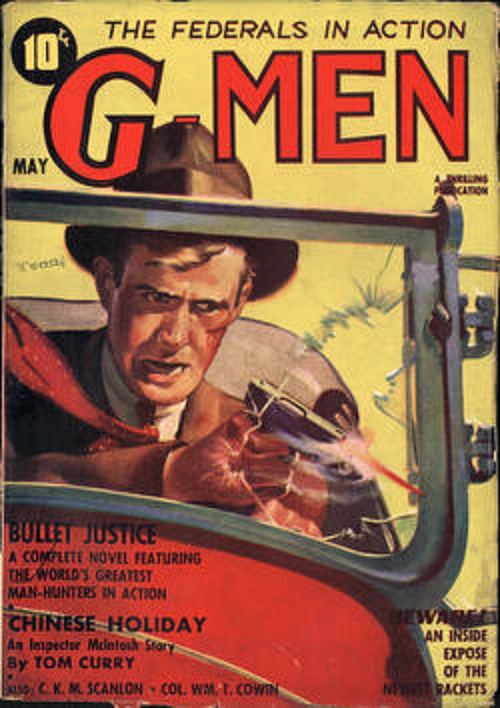
Sunday Morning Bonus Pulp: G-Men, May 1937


The red and yellow color scheme that was so common on Western pulps made it onto covers in other pulp genres as well, for example this issue of G-MEN. I don't know the artist, but I want to say it might be Richard Lyon. I've really enjoyed the Dan Fowler stories I've read over the years and ought to read more of them. The one in this issue of probably by Charles Greenberg, who wrote some Phantom Detective novels that I liked. Tom Curry, Steve Fisher, and Westmoreland Gray have short stories in this issue. Curry's Westerns are long-time favorites of mine.

Saturday, June 25, 2022

Saturday Morning Western Pulp: Lariat Story Magazine, May 1940


The cover on this issue of LARIAT STORY MAGAZINE has a lot going on, and I like it. I don't know the artist, but if I had to venture a guess, I'd say A. Leslie Ross or H.W. Scott. But I could be completely wrong about that. I know I'm right about there being some good authors in this issue, starting with Walt Coburn, Harry F. Olmsted, James P. Olsen, and Art Lawson. There's a Bart Cassidy story, and that's probably Olmsted, too, as well as one by house-name John Starr, who could be almost anybody. Frank H. Richey, who has one of the cover-featured stories, wrote only half a dozen stories in the late Thirties and into 1940; this appears to be his last one. I don't know anything about him. The other story in this issue is by the more prolific but equally obscure Don Stuart. All I know about him is that he's not "Don A. Stuart", the pseudonym of legendary science fiction editor/author John W. Campbell.

Friday, June 24, 2022

The Devil's Ransom - Albert Richard Wetjen


“The Devil’s Ransom”, a novelette from the October 1939 issue of ACTION STORIES, is considered the third story in the Stinger Seave series, but actually, Seave is more of a supporting character in this one. It’s an epic tale in which author Albert Richard Wetjen brings together several of his series heroes. Seave, Typhoon Bradley, Jack Barrett (Captain Hi-Jack), and Big Bill Gunther join forces to rescue an old friend and mentor of theirs who has discovered gold on a remote island in the South Seas. (I didn’t know there was gold in the South Seas, but okay, I can go along with that.) That old friend has been double-crossed and taken prisoner by a group of villains who have plagued our heroes in the past, and they’ve even brought in the German government and involved a German battleship in their evil scheme.

It takes an action-packed, Dirty Dozen-like mission to set things right. Typhoon Bradley is in command, and this is more his story than Seave’s. Bradley is an excellent protagonist, too. I’m going to have to see if I can hunt up more of the stories featuring him. In this case, everything works out quite satisfactorily, and I like the way Wetjen establishes connections between his various series. Someone needs to do a big reprint collection of these connected stories.

I’m halfway through the Stinger Seave stories now and plan to read the next one soon. They’re great for working in between bigger books and projects.

Tuesday, June 21, 2022

The Shadowed Circle #3 - Steve Donoso. ed.


THE SHADOWED CIRCLE #3 more than lives up to the high standard set by the first two issues of this journal devoted to the iconic character The Shadow. As I’ve mentioned before, I’ve been a fan of The Shadow for close to sixty years now, and I never tire of reading not only his adventures, but also reading about the character in his many incarnations.

This issue starts off with a great cover by legendary comic book artist Steve Rude, with some modifications by Steve Novak. The first article, by Albert J. Emery, delves into The Shadow’s involvement with World War II and asks a simple but compelling question: Why didn’t The Shadow just kill Adolf Hitler? Emery does a fine job of exploring this subject. (This article also mentions novelist E.L. Doctorow, who, as a editor at Signet in the early Sixties, was the editor on the American editions of some of the Carter Brown mystery novels, a completely irrelevant fact that’s always interested me, anyway.)

Todd Severin and Keith Holt give us Part Two of their history of The Shadow’s pulp magazine, which covers that publication all the way to its end. It’s interesting and well-written and features an illustration by the late Frank Hamilton, whose great artwork has graced so many pulp fanzines over the decades. I’m always happy to see his work again.

Will Murray contributes an article about his experiences as a writer for Starlog covering the filming of the Shadow movie starring Alec Baldwin. I remember enjoying the movie overall, despite having some real problems with the script. The look of it was almost perfect in some respects, though, and Murray’s recollections are a lot of fun.

Tim King writes about one of the supporting characters in the pulp series, the communications expert Burbank, and speculates on how Walter B. Gibson came up with that name. King makes an excellent case, too, and I strongly suspect that he’s right.

There’s a fine interview with writer and producer Michael Uslan, conducted by Darby Kern, that sheds some light on the DC comic book series from the Seventies that featured The Shadow, a series that I bought, read, and enjoyed a great deal. Uslan seems like a really nice guy, as well as a top-notch writer.

It's hard to review a book of reviews, but Steve Donoso does so with his review of John Olsen’s THE SHADOW IN REVIEW. I was a fan of Olsen’s website where some of this material ran originally, and Donoso’s review of the book prompted me to order a copy.

Tim Hewitt rounds out the issue with a look at the Canadian issues of The Shadow’s pulp magazine, including some similar but different covers. I knew nothing about this part of the magazine’s history, so I was both educated and entertained.

All in all, editor Steve Donoso and his crew have produced the best issue so far of THE SHADOWED CIRCLE. I have a feeling they’re just getting started. You can subscribe on the journal’s website or buy individual issues on Amazon, and be sure to check out their Facebook page, as well.

Monday, June 20, 2022

Davy Jones' Loot - Albert Richard Wetjen


“Davy Jones’ Loot”, the second Stinger Seave story from Albert Richard Wetjen, appeared in the December 1938 issue of ACTION STORIES. This is a flashback to the early days of Seave’s career as the fast-shooting skipper of a trading ship in the South Seas. While stealing some pearls from an island lagoon under Japanese jurisdiction, Seave encounters another sea captain who will become a long-running enemy of his. The clash between the two of them, which goes back and forth in this tale, finally resolves in a particularly satisfying manner.

The plot in this story isn’t as complex as in the previous entry in the series, “Terror Island”, but once again Wetjen hints at a much larger story going on. It reads as if the tale of Stinger Seave’s career might turn into a real South Seas epic. Whether or not Wetjen actually gets around to spinning those yarns, or just continues to drop tantalizing hints at them, we’ll just have to wait and see, I suppose. While “Davy Jones’ Loot” isn’t as good as “Terror Island”, I enjoyed it a great deal and will keep reading. You can find this one at the Pulpgen Archive, too.

Sunday, June 19, 2022

Sunday Morning Bonus Pulp: Dime Mystery, July 1942


By the middle of 1942, DIME MYSTERY wasn't really a Weird Menace pulp anymore, but some influences still remained. Some of the Weird Menace authors moved right on over into writing more traditional mystery yarns, although judging by the titles, some bizarre elements remained. Wyatt Blassingame is an example in this issue, with a story called "Death Doesn't Care". Another story, "Satan Rocks the Casket", sounds even more like a Weird Menace story, but since the author is Francis K. Allan (not known as a Weird Menace guy) writing as Joe Kent, it's unlikely this story strays too far from the usual detective pulp fare. Allan has another story in this issue under his own name. Also on hand are Day Keene, William R. Cox, and William Campbell Gault, and that's a great trio of authors right there. I don't know the cover artist, but he (or she) turned in a dramatic image. Mummy cases always mean trouble.

Saturday, June 18, 2022

Saturday Morning Western Pulp: Thrilling Western, August 1935


I think that's a roulette wheel behind the cowboy in this cover by R.G. Harris, adding to our list of unsafe activities in the Old West. I've heard of losing your shirt while gambling, but I think he's carrying it to an extreme. This issue of THRILLING WESTERN includes stories by Ray Nafziger (writing as Grant Taylor), Syl MacDowell, Allan K. Echols, Claude Rister, Cliff Walters, Wilton West, Frank Carl Young, and house-name Jackson Cole. With the exception of Nafziger, MacDowell, and Echols, none of those are remembered much today, but I'm sure it was an entertaining issue.