Tuesday, January 31, 2023

Man's Favorite Sport? (1964)


This is a late Howard Hawks-directed comedy that I somehow never saw until now. I remember when it came out and it’s been on television many times, but I missed it anyway. I’m glad I finally caught up to it since Hawks is one of my favorite directors.

In a role that seems to have been written for Cary Grant, Rock Hudson plays an Abercrombie & Fitch salesman who specializes in fishing gear and has even written a successful book on fishing. But he has a secret: he’s never been fishing in his life. Then the publicity director (Paula Prentiss) for a lake lodge that sponsors a big fishing tournament has the bright idea of having Hudson’s character enter the competition. Hudson’s boss agrees. When he finally admits to Prentiss’s character that he can’t fish, she sets out to teach him. Slapstick hijinks ensue, as does romance, of course. This is, after all, a screwball romantic comedy from the director who made BRINGING UP BABY and MONKEY BUSINESS.

I enjoyed MAN’S FAVORITE SPORT? quite a bit. The reviews on IMDB talk about how hilarious it is, but I didn’t really find that to be the case. Consistently amusing and good-hearted, yes, definitely. I smiled a lot, chuckled a time or two, but didn’t really laugh out loud. I got caught up in the story, though, and the cast is good. I’ve never been a big Rock Hudson fan, but he’s a likeable lug and handles the slapstick stuff fairly well. Paula Prentiss really had that cute, early Sixties, Mary Tyler Moore thing going on. Or maybe Mary Tyler Moore had a Paula Prentiss thing going on, take your pick. Either way, I always liked her. John McIver, Norm Alden, and Roscoe Karns provide sturdy support. Maria Perschy, a beautiful German actress who didn’t make a lot of American films, is good as Prentiss’s sidekick. Charlene Holt, a latter-day member of the Hawks stock company, plays Hudson’s fiancee and doesn’t have much to do, but she’s spectacular to look at in one scantily dressed scene.

Hawks was past his peak when he made this film, but he was still a very good director and keeps things moving along quite well in MAN’S FAVORITE SPORT? It’s a good but not great film and is certainly worth watching.

Sunday, January 29, 2023

Sunday Morning Bonus Pulp: Complete Stories, September 5, 1931


I like oil derrick covers. It's kind of an odd thing, I know, but it probably comes from spending quite a bit of time in West Texas when I was young. This COMPLETE STORIES cover is by Gerard Delano. COMPLETE STORIES strikes me as one of Street & Smith's lesser pulps, but some good authors appeared in its pages. This issue has stories by William E. Barrett, Hal Dunning (a White Wolf story), C.S. Montanye, Lawrence C. Blochman, and Bertrand Sinclair, among others.

Saturday, January 28, 2023

Saturday Morning Western Pulp: Texas Rangers, April 1954


This is a pulp I own and read recently. That’s my copy in the scan, with the usual excellent, evocative cover by Sam Cherry.

The Jim Hatfield novel in this issue is “The Seventh Bullet”, written by Walker A. Tompkins under the Jackson Cole house name. Tompkins was the third-most prolific author of Hatfield novels after Leslie Scott (who created the series) and Tom Curry, who between them wrote a little more than half the series’ entire run. Tompkins wrote a bunch of them, though, and the ones I’ve read have ranged from very good to excellent.

By the Fifties, the Hatfield stories were a little grittier and more realistic than the ones from the Thirties and Forties, and “The Seventh Bullet” is no exception. As it opens, Hatfield is in a West Texas cowtown to pick up a prisoner: a member of a counterfeiting/smuggling ring that has been flooding the country with fake ten-dollar gold pieces. The prisoner also murdered the local sheriff, leaving the lawman’s beautiful blond daughter to pin on the badge and take the varmint into custody.

Hatfield’s mission seems simple: deliver the prisoner to Austin. But of course, things don’t work out that way. The prisoner is rescued by a shadowy gunman wielding a six-shooter that somehow fires seven bullets instead of the usual six. Naturally, Hatfield’s not going to let a prisoner get away, and in the process of going after him, the Ranger sets out to bust up the counterfeiting ring and discover the mastermind behind it.

Tompkins keeps things moving along at a brisk pace with plenty of action, and as usual, he throws in some clever plot twists, too, such as the method the villains use to smuggle the phony coins into the country. “The Seventh Bullet” isn’t in the top rank of Tompkins’ Hatfield novels, but it’s a solid, very entertaining yarn.

Moving on to the backup stories, first up is a short story entitled “The Brass Ring”, by an author whose work I’m not very fond of, Ben Frank. This is a stand-alone, not part of Frank’s two series featuring Doc Swap and Deputy Booboo Bounce. It’s a mild little comedy, the sort of thing Frank specialized in, featuring a good-hearted rancher who’s too much of an easy touch for hard-luck stories and is always broke because of it. It’s really predictable but pleasant enough that I read the whole thing.

“Ride to Tucson” by W.J. Reynolds couldn’t be more of a contrast. This is a grim, violent, suspenseful yarn about a man and woman trying to escape from a band of marauding Apaches in Arizona Territory. I’ve read several stories by W.J. Reynolds and been impressed by them. This is another good one. I don’t know anything about Reynolds except that between the mid-Forties and the early Seventies, he wrote about 120 Western and crime stories for assorted pulps, digests, and men’s magazines. I’m always glad to see his name in a Table of Contents.

George Kilrain was a pseudonym used by one of my favorite Western writers, William Heuman, for approximately 30 stories in various Western and sports pulps in the decade between the mid-Forties and the mid-Fifties. The Kilrain novelette in this issue, “Too Tough”, is, in fact, the final story to be published under that name. And it features one of the most unusual protagonists I’ve come across in Western pulps: a two-fisted, fast-shootin’ ventriloquist. Sad Sam Bones is a vaudeville performer, a comedian and song-and-dance-man as well as a ventriloquist, who travels the West performing with different theatrical troupes and also righting wrongs. In this tale, he helps out a theater owner in a mining boomtown whose shows keep getting sabotaged. This results in a number of fistfights and shootouts in which Sad Sam’s enemies keep underestimating him because, going by his description, he looks a lot like Don Knotts. And how I would have loved to see Don play the part on TV! Anyway, the ending of this story really makes it seem like Heuman intended it to be the first of a series, but as far as I know, it’s Sad Sam’s only appearance. That’s a shame, because this is a great story and I really enjoyed it. (Heuman also used the Kilrain name on two novels, SOUTH TO SANTA FE and MAVERICK WITH A STAR, both published as halves of Ace Doubles.)

You know Gordon D. Shirreffs’ work is nearly always good. He rounds out this issue with the short story “The Hollow Hero”, about a deputy marshal’s clash with a notorious gunman recently released from a 20-year stretch in Yuma Prison. The man claims he wants to go straight and even opens a law office, but are his old killer instincts still there just waiting to be unleashed? This one has a decent plot, some nice action, and a clever resolution. It’s minor Shirreffs, but that’s still pretty darned good.

Overall, this is an exceptional issue of TEXAS RANGERS with a good Jim Hatfield novel, a terrific story by William Heuman, and solid yarns by Gordon D. Shirreffs and W.J. Reynolds. Even the Ben Frank story is inoffensive and mildly entertaining. If you’re a TEXAS RANGERS fan and have this one on your shelves, it’s well worth reading.

Friday, January 27, 2023

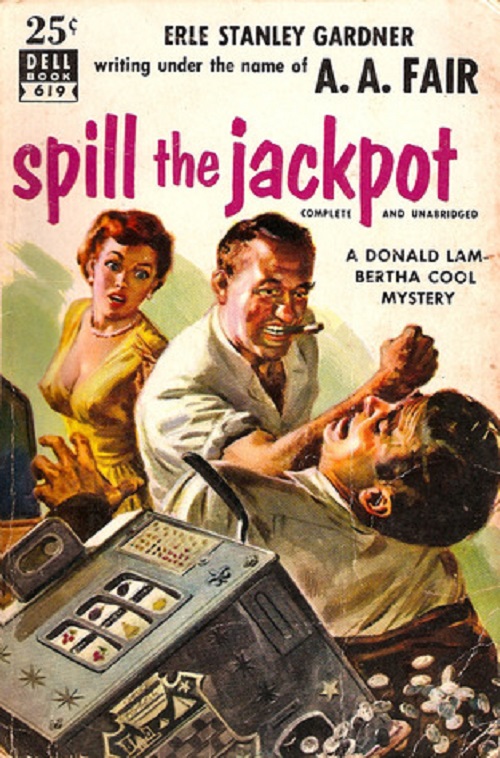
Spill the Jackpot - A.A. Fair (Erle Stanley Gardner)


SPILL THE JACKPOT, published in hardcover by William Morrow in 1941 and reprinted in paperback more times than I’m going to count, is the fourth Donald Lam/Bertha Cool novel by Erle Stanley Gardner writing as A.A. Fair. Or the fifth if you count THE KNIFE SLIPPED. It doesn’t really matter, because either way this novel is early enough in the series that I got the feeling Gardner was still experimenting a little, deciding exactly how he wanted things to go with these books. As a result, he tries several things that are a little different.

For one thing, as this book opens Bertha has lost a lot of weight due to a stay in a sanitarium in Salt Lake City where she recovered from a bad bout of flu and pneumonia. When Donald arrives to pick her up, she’s not exactly thin, but she’s slimmed down enough to seem almost like a different person. Gardner even gives her a possible romantic interest in a man she meets on the plane going back to Las Vegas, where she and Donald are supposed to meet a potential client before returning to Los Angeles.

Wouldn’t you know it, the guy they meet on the plane turns out to be the client. He’s a wealthy businessman who wants to hire the B. Cool Detective Agency to locate a missing young woman who was engaged to his son. The only thing Donald and Bertha have to go on is that the missing girl got a letter from somebody in Las Vegas.

After that, things get very complicated, very quickly, even for a Gardner novel. Donald gets a lesson on how to steal from slot machines. He gets knocked down by a punch-drunk ex-boxer who then becomes a friend and ally. He meets several attractive young women, some of whom are probably not trustworthy. He tangles with another ex-boxer who’s definitely not a friend. He gets hauled in by the Vegas cops. And eventually, somebody winds up dead, a murder that Donald feels compelled to solve, even though in the middle of the investigation he up and quits Bertha’s agency.

Bertha, meanwhile, hangs out in the hotel and flirts with their client while Donald goes off to the desert for several days and then makes a quick trip to Reno and back. The reader knows not to take his resignation from the agency too seriously, of course, and as always, Donald figures out who committed the murder.

But along the way, Gardner gives us a long section where Donald, the girl he’s fallen for, and the amiable ex-boxer spend several days camping in the desert and Donald gets lessons in pugilism. This has almost nothing to do with the plot and reads more like Gardner was trying his hand at some Hemingwayesque mainstream fiction . . . and I loved it. The writing is very vivid, reminiscent of Gardner’s Whispering Sands stories without the mystery and adventure elements. It’s just Donald, his girl, and his friend getting back to nature for a while. This is such nice stuff I could have read a whole novel of it, I think.

Of course, sooner or later Donald has to go back and solve the crime, which he wraps up neatly, but also with a double reverse that I actually didn’t figure out until several hours after I’d finished the book. And when it hit me what actually happened, it was almost a jaw-dropping moment. Donald is always thinking two or three steps ahead of everybody else in the book, and Gardner was definitely that far ahead of me.

I was prepared to say in this review that the changes Gardner makes in Bertha are a big misfire (and they still don’t really ring true for me), but by the end of the book he’s resolved that angle satisfactorily, too. Overall, SPILL THE JACKPOT is one of my favorite books in the series. I’m reading/rereading the Cool and Lam books in order, and it’s pretty interesting to watch Gardner’s development as a writer . . . and to think about what he might have done if he had gone in different directions.


Monday, January 23, 2023

The Maverick Star - L.P. Holmes


I usually read several L.P. Holmes novels every year. As I’ve mentioned before, he’s become one of my favorite Western authors, and since I came to his work fairly late in my life, there are still a bunch of his novels that I haven’t read yet. I won’t get to all of them, but he’s always reliable when I need an entertaining Western yarn.

The most recent one I’ve read by him is THE MAVERICK STAR, published as a paperback original by Ace Books in 1969. I’m pretty sure this isn’t a reprint of one of Holmes’ stories from the Western pulps, where he was very prolific in the Twenties, Thirties, and Forties. It begins with the funeral of a veteran lawman who, as sheriff, has kept the peace between two feuding cattle barons whose ranches are the biggest in the area. Each of those cattle barons has a hand-picked man he wants to replace the sheriff, but instead the job goes to the town marshal . . . who only packs the star for half an hour before he’s gunned down, shot in the back.

The county commissioners still don’t want to give the job to one of the other candidates, so they turn to Logan Keogh, the foreman of the other big ranch in the area. With considerable reluctance, Keogh accepts, knowing that he’ll probably have a target on his back, too. And sure enough, there are attempts on his life as he tries to keep the feuding cattle barons from going to war against each other and find out who killed the previous sheriff before the shadowy murderer succeeds again.

THE MAVERICK STAR is a well-paced traditional Western yarn with a little more of a mystery angle than some, and I don’t mind admitting that I didn’t figure out who the killer was ahead of time. The solution actually took me a little by surprise. The action scenes are excellent, although the book probably could have used a few more of them. By the time this book came out, Holmes had been a professional writer for more than forty years, and it’s not uncommon for an author’s work not to have quite as much fire and passion after they’ve been in the game for that long.

But like a good wide receiver in football who may have lost a step in speed, Holmes can still get by on savvy and experience. He knows what he’s doing, and THE MAVERICK STAR is a solid, entertaining tale that kept me turning the pages. I enjoyed it and think it’s worth reading if you’re a fan of traditional Westerns. That’s my beat-up copy in the scan, by the way.

Sunday, January 22, 2023

Sunday Morning Bonus Pulp: Spicy-Adventure Stories, February 1938


H.J. Ward provides another typically lurid cover on this issue of SPICY-ADVENTURE STORIES. Inside are some of the usual Spicy authors: Robert Leslie Bellem (as Jerome Severs Perry), E. Hoffmann Price, Hugh B. Cave (an Eel story as Justin Case), Edwin Truett Long (as Dale Boyd and Charles Daw), and two authors not known to be house-names, Ross Flynn and Wyreck Brent. However, both guys published only a few stories and only in various Spicy pulps, so I wouldn't put too much faith in those being their real names.

Saturday, January 21, 2023

Saturday Morning Western Pulp: Ace-High Western Magazine, February 1937


This issue of ACE-HIGH WESTERN MAGAZINE sports a very nice Tom Lovell cover and the usual assortment of top-notch Western pulpsters we've come to expect from Popular Publications: Walt Coburn, Harry F. Olmsted, Ray Nafziger, Cliff Farrell, Stone Cody (Thomas Mount), Robert E. Mahaffey, and Norrell Gregory. That's pretty close to an all-star lineup.

Friday, January 20, 2023

Luciano's Luck - Jack Higgins


Years ago I read and enjoyed quite a few books by Jack Higgins, but then he started writing a series about a character I didn’t care for (Sean Dillon) and I got out of the habit of reading his books. Plus his writing seemed not as good, much like Alistair Maclean in the later stages of his career.

But I found myself in the mood to read one of his books, and I’m a sucker for books about gangsters, so I gave LUCIANO’S LUCK a try. The plot is an intriguing one: During World War II, a British intelligence agent arranges for Lucky Luciano to be released temporarily from prison so that they can parachute into Sicily and try to make an alliance with the capo of the Mafia there to assist the allies in their upcoming invasion of the island. So it’s a gangster book and a World War II book. Right up my alley.

And I enjoyed it, too, although it’s not without its faults. It was published originally in 1981, about the time Higgins’ books started to get not quite as good. This one is still pretty well-written. The main problem I have with it is that the plot takes a long time to really get going. The mission in Sicily doesn’t actually begin until the book is half over. Before that there’s a lot of assembling the team stuff, including the introduction of a lot of supporting characters and several Nazi bad guys. That results in not much action, which continues even after the scene switches to Sicily.

Ah, but the last 50 or so pages! That last section is a whirlwind of action with unexpected plot twists that really had me galloping along to find out what was going to happen. If the whole book had been like that, LUCIANO’S LUCK would be a classic, and also exhausting. As far as I’m concerned, it redeems the book overall and makes me glad I read it. I think I need to go back and catch up on some of the earlier Jack Higgins books I haven’t read. I have quite a few of them. Meanwhile, if you want to give LUCIANO’S LUCK a try, it’s still available in both e-book and paperback editions.

Wednesday, January 18, 2023

Dark Avenger: The Strange Saga of The Shadow - Will Murray


One of the first books I ever bought about pulps was THE DUENDE HISTORY OF THE SHADOW MAGAZINE by Will Murray, an author/editor/pulp fan who I probably met through our mutual friend Tom Johnson. This was more than 40 years ago, so some of the details have slipped my memory. But I was a big fan of The Shadow, having listened to the radio shows, read all the original novels published by Belmont (having no idea at the time that they were written by Dennis Lynds, another guy who would become a friend years later) and all the reprinted pulp novels from Bantam, Pyramid, Jove, Tempo, Dover, etc. So I dived into THE DUENDE HISTORY OF THE SHADOW MAGAZINE with great enthusiasm and was well-rewarded. I loved it. It’s one of the all-time best books about pulps, in my opinion. Plus it’s a beautiful oversized paperback with a great cover by Frank Hamilton.

Of course, my copy was lost in the Fire of ’08 and I never got around to replacing it.


But now we come to today, and Will Murray’s latest book DARK AVENGER: THE STRANGE SAGA OF THE SHADOW. This is a greatly revised and expanded version of THE DUENDE HISTORY OF THE SHADOW MAGAZINE and includes all the information Murray gleaned from the past forty-some-odd years of research. I opened it with the same enthusiasm I felt four decades ago and wasn’t the least bit disappointed. This is the best, most exhaustive volume about a single pulp magazine ever written.

Anything you want to know about THE SHADOW MAGAZINE is in here. The authors are covered extensively (mostly Walter B. Gibson, of course, but there’s plenty about Theodore Tinsley, Bruce Elliott, and Lester Dent, as well), as well as the editors and illustrators and the Street & Smith executives who were involved in the magazine’s production. The entire run of 325 novels is broken down into distinct categories, and Murray explores how they were written, how the series evolved, and the various influences that caused that evolution. He touches on the various versions of The Shadow after the pulp ended, but this is mostly about the 18-year run between 1931 and 1949. Rightly so, as far as I’m concerned since the pulp Shadow is my favorite.

The cover of this new edition is by Joe DeVito, who has done great covers for many of Murray’s books in recent years. I really like this one because it captures The Shadow’s personality quite well and also includes Myra Reldon, one of The Shadow’s agents from the novels who usually isn’t featured in artwork about the character and the pulp. An excellent job all around by DeVito. The book also includes a lot of the interior illustrations by Frank Hamilton from the earlier edition. I always loved Hamilton’s work and am very pleased to see these illustrations again. They really bring back a bygone era of pulp fandom filled with printed fanzines and books like THE DUENDE HISTORY OF THE SHADOW MAGAZINE.

Even if you’re a fan of The Shadow and read the original version, you’re going to want to read the new edition, too. I raced through it, unable to put it down, having the time of my life reliving memories of the Shadow novels I’ve read and being reminded of all the great ones still waiting for me to read. Between the great journal THE SHADOWED CIRCLE and the books devoted to the character by Will Murray, this is the new Golden Age of Shadow Fandom. DARK AVENGER gets my highest recommendation. It’s available in both e-book and trade paperback editions.

Tuesday, January 17, 2023

Critic's Choice (1963)


This will be a pretty short review. I was looking forward to CRITIC’S CHOICE since it’s a Bob Hope movie I’d never seen, and I’m a big Bob Hope fan. He plays an acerbic theater critic in New York. Lucille Ball is his wife, who decides to write a play of her own. John Dehner is a producer friend of theirs who decides to put the play on Broadway. Rip Torn is the womanizing director. Jim Backus is the psychiatrist neighbor of Hope and Ball. Richard Deacon is a rival theater critic.

Other than a few—very few—slightly amusing moments, this is a terrible movie. Why hire Bob Hope and then give him a dreary, depressing script that never lets him be Bob Hope? He and Ball are both miscast. Nobody in the movie is very likable, except for a couple of kid actors. I’d just as soon have continued to miss this one. I don’t like to write bad reviews, but this was just a big disappointment.