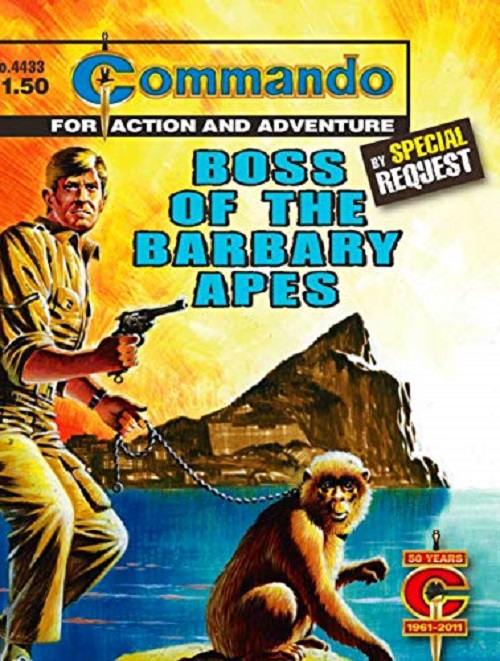
Since 1713 the mighty Rock of Gibraltar has been British, a massive stone fortress guarding the Mediterranean. But in World War Two, the Nazis had plans for capturing the Rock and knocking out the garrison by using deadly nerve gas. And all that stood in the way of the Germans was one lance-corporal and one small Barbary ape.
Wednesday, March 22, 2023
Commando #4433: Boss of the Barbary Apes - Eric Hebden
Since 1713 the mighty Rock of Gibraltar has been British, a massive stone fortress guarding the Mediterranean. But in World War Two, the Nazis had plans for capturing the Rock and knocking out the garrison by using deadly nerve gas. And all that stood in the way of the Germans was one lance-corporal and one small Barbary ape.
Tuesday, March 21, 2023
Bullet Train (2022)
I don't post much anymore about current or near-current movies. I don't know why. I used to all the time. But this movie is so downright goofy that I had to say something about it. Half a dozen assassins/professional criminals find themselves traveling on a bullet train in Japan. They're there on different missions and aren't aware of the others, but as the movie goes on, it's gradually revealed that everything is tied together and some of the characters aren't who they appear to be. This is definitely a movie not to watch with one eye. You've got to pay attention to have any idea what's going on.
And even then, I'm not sure if everything makes complete sense, but I'm not sure I care, either. The movie is full of fast-paced, over-the-top action and snappy dialogue, and I like complicated plots like that. The cast, led by Brad Pitt and the great character actors Michael Shannon and Hiroyuki Sanada, is good all around. There are several celebrity cameos to watch for. It's a little bloodier than I like, but in a movie about professional assassins, you've got expect some of that. Toward the end, the action is so over-the-top that it gets fairly ludicrous, but no more so than the Fast and Furious movies, and hey, I love those.
I had a really good time watching BULLET TRAIN. I don't think it's a great movie, but it sure is entertaining.
Monday, March 20, 2023
Wanted for Questioning - Wilfred McNeilly
This is another Sexton Blake paperback from 1965. That’s my cover-creased copy in the scan. It answers a question I had, but I’ll get to that later. In a clever opening that shows Blake isn’t infallible, he’s tricked into shooting a potential client. There’s no question that Blake pulled the trigger and killed the man. But who’s the real murderer, Blake or the villain who set up the situation? Despite being Blake’s friend, Detective Superintendent Grimwald feels compelled to arrest him. However, Blake talks Grimwald into giving him 24 hours to carry out his own investigation. 24 hours to save himself from a murder charge, in other words.
This novel is from the era when Blake is running a good-sized private detective
agency in London, so that means the usual group of supporting characters is on hand: assistant Edward Carter, also known as Tinker; beautiful secretary and
part-time detective Paula Dane; receptionist Marion Lang, also beautiful and a
part-time detective; reporter Arthur “Splash” Kirby; and Blake’s faithful
bloodhound Pedro.
Their only possible approach is to investigate the victim and hope that will
lead to the killer. The victim is a former music hall comedian, part of a duo
that’s roughly the British equivalent of Laurel and Hardy. He’s risen above
those humble beginnings and become a wealthy showbiz entrepreneur. He became
connected with Blake in the first place because he suspected that someone was
embezzling money from his various enterprises. Blake and his helpers turn up
several suspects. Somebody tries killing Blake, indicating they’re on the right
trail. Paula and Marion also wind up in danger. Eventually everything gets
sorted out, of course, but not before Blake gets arrested.
The plot maybe relies a little too much on coincidence, but the solution is a
clever one. I figured it out, but not until pretty late in the game. The pacing
is very good. I flew through the book quickly and enjoyed every minute of it.
A few weeks ago when I read and reviewed another Blake novel from this era,
MURDERER AT LARGE, I speculated about who might have been behind the W.A. Ballinger
house-name on that one. My friend Keith Chapman suggested, based on what I wrote
about the book, that it might have been Wilfred McNeilly, so I deliberately
picked a McNeilly novel for my next Sexton Blake. WANTED FOR QUESTIONING has
some definite similarities to MURDERER AT LARGE: a show business setting, a
considerable amount of humor, and an occasional philosophical digression. The style
is so much the same that I’m confident McNeilly also wrote at least the first
draft of MURDERER AT LARGE. I plan to read more of McNeilly’s work for further evidence,
though. I have two or three more of them around here.
In the meantime, I’m really enjoying the stories from this era of Blake’s
career. WANTED FOR QUESTIONING is a good one, and if you’re a Sexton Blake fan,
too, I give it a solid recommendation.
Sunday, March 19, 2023
Sunday Morning Bonus Pulp: Short Stories, July 1951
SHORT STORIES was still using those red sun covers even this late in its run. This one is by Everett Raymond Kinstler. By this time, the magazine was using a lot of reprints. Every story in this issue, in fact, is a reprint. But with authors such as Ernest Haycox, William Chamberlain, Cliff Farrell, Bennett Foster, Edward Parrish Ware, Jackson Gregory, and Stephen Chalmers, most readers probably still got their money's worth. By the way, I have carried a knife in my teeth before, and while climbing up a cliff, to boot. Sometimes I think it's a wonder my friends and I survived childhood.
Saturday, March 18, 2023
Saturday Morning Western Pulp: Range Riders Western, January 1948
This is a pulp that I own and read recently. My copy has a big chunk out of the front cover, so I’ve used the image from the Fictionmags Index. I think that cover is by George Rozen, but I wouldn’t swear to that. RANGE RIDERS (title later changed to RANGE RIDERS WESTERN) was one of the Thrilling Group’s Western pulps, published officially by Better Publications. It ran for 75 issues from December 1938 through April 1953. The lead novel in each issue featured Steve Reese, Hank Ball, and Dusty Trail, a trio of range detectives who work for the Cattlemen’s Protective Association. Reese, who is actually the hero of the series with Hank and Dusty providing support and occasional comic relief, also has a commission as a U.S. Marshal, so he has jurisdiction wherever he goes.
“The Bloody Bull Trail” in the January 1948 issue is by Oscar J. Friend,
probably best remembered as an editor and literary agent, but he wrote a good
number of Western and science fiction novels, too. He probably created the
Steve Reese series since he was the main author of those novels during the
pulp’s early years, then returned late in its run to contribute two more
stories, of which this is the first. As the story opens, Reese is on the trail
of a missing prize bull which was stolen from an Arizona rancher. Reese is also
looking for another range detective who was assigned to the case first but has
disappeared. Another rancher in the area, a Mexican don whose spread is an old
Spanish land grant, also wanted that bull, so he’s the prime suspect in its
theft, not to mention the disappearance of the other detective.
What Reese finds is that he and Hank and Dusty (who show up not long after he
does) are in the middle of a complex plot involving water rights, gun
smuggling, and a Mexican bandit known as El Gato. Murder ups the stakes as our
heroes do a lot of riding and fighting and shooting to untangle all those
threads.
Friend was an excellent writer whose work has more humor and literary touches
than that of many Western pulpsters. At the same time, he never neglects the
action and keeps this story moving along at a brisk, very satisfying pace. By
this time, most Western writers, Friend included, had abandoned the “yuh mangy
polecat” dialogue, making “The Bloody Bull Trail” read more like a yarn that
could have been written in the Fifties, Sixties, or Seventies. It’s smooth and
well-done and very entertaining. I liked it a lot.
I’ve always found it a little odd that none of these novels from RANGE RIDERS were
reprinted in paperback during the Sixties and Seventies, like the other
characters from the Thrilling Group’s Western hero pulps, Jim Hatfield, the Rio
Kid, and the Masked Rider. Seems like they would have been prime material for
reprinting by Popular Library or Curtis Books. “The Long Noose”, also by Friend
and from the first issue of the pulp, was reprinted in hardback by Gateway
Press in 1942 and in paperback by Handi-Books in 1947. The main characters’
names were changed in these reprints. I used to have a copy of the Gateway
Press edition. Steve Reese became Simon Carter. I don’t remember what Hank Ball
and Dusty Trail were changed to. All of Friend’s early novels from the series
were also reprinted in England but apparently THE LONG NOOSE is the only
American reprint from the series.
Moving on from the lead novel, the next story is a short-short, “Walk Out and
Die”, published under the house-name Sam Brant. The Brant name has been
connected to Frank Gruber, Louis L’Amour, and Syl McDowell. I think I remember
reading somewhere that some of the Sam Brant stories may be by L. Ron Hubbard.
I don’t think any of those authors wrote “Walk Out and Die”. It’s a tense
little story about a sheriff with a prisoner who’s the target of a vengeful
family of owlhoots. To me, it reads like the work of Bennie Gardner, better
known under his pseudonym Gunnison Steele, and since there’s a Gunnison Steele
novelette next up in this very issue, I suspect that Gardner wrote “Walk Out
and Die” as well. He turned out a lot of short-shorts like this. Unfortunately,
although “Walk Out and Die” starts out well, the ending is pretty weak and
leaves a lot unresolved.
That Gunnison Steele novelette I mentioned is “Heir to Boothill Range”. It uses
the very common plot of a young man returning to his hometown to find out who
framed his father for rustling and then lynched him seven years earlier. While
there’s nothing new about this one, plot-wise, Gardner does a good job with it,
giving us a well-paced yarn with a likable protagonist, some fine action
scenes, and a nicely handled romantic element. I nearly always like Bennie
Gardner’s work and this is no exception.
Since this is a January issue, that means it was on the newsstands during
December, so fittingly enough there’s a Christmas story, “A Happy Christmas” by
C.V. Tench. This is a Northern, a suspenseful yarn about a trapper/prospector
who has a sinister visitor on Christmas Eve. I guessed the late twist in this
one, but it’s still an enjoyable, effective tale.
“Killer’s Cue” by William O’Sullivan has an unusual protagonist, an elderly
Chinese cook who works in a saloon and hotel in a mining camp. He turns
detective in order to find out who killed his best friend, an old codger
prospector. The murderer’s identity is really obvious, but that doesn’t keep
this from being a good story.
Harold F. Cruickshank wrote a bunch of aviation stories for the pulps, but from
the mid-Forties through the early Fifties, he wrote a Western short story
series called the Pioneer Folk (sometimes listed as the Sun Bear Valley series)
that ran in RANGE RIDERS WESTERN. These stories feature a young married couple,
Dal and Mary Baldwin, and their friends and neighbors in Sun Bear Valley. The
one in this issue is called “Good Neighbor Gunfire”. To be honest, I skipped
it, because I’ve forced myself to read some of this series in the past and
never liked any of them. At this point, there aren’t many things I’m going to
force myself to read.
The issue wraps up with “Trail Drive” by A. Kenneth Brant, a pseudonym for
Brent Ashabranner. This generically-titled yarn about a trail boss trying to
get a herd across a waterless stretch is well-written. Not much to it, but I
enjoyed it.
Overall, I think this is a good issue of RANGE RIDERS WESTERN. The lead novel
is excellent, one of the best in the series I’ve read, the Gunnison Steele
novelette is very good, and all the stories are entertaining (except for the
one I skipped, which may be good, too, just not to my taste). It’s been a while
since I read an issue of this pulp. I think I may need to see if I can rustle
up some more of them. (No pun intended.)

Friday, March 17, 2023
Battle for the Wastelands #2: Serpent Sword - Matthew W. Quinn
Here's the blurb I gave this novel: "There's no sophomore slump in SERPENT SWORD, the second book in Matthew Quinn's Battle for the Wastelands series, which combines post-apocalyptic science fiction, family saga, and Western elements. That's an ambitious combination, but Quinn pulls it off in fine fashion. SERPENT SWORD has plenty of action, compelling characters, and an intriguing, well-developed villain/anti-hero in Grendel, the dictator of the northern realms who's trying to take over the rest of the continent. This is an excellent series."
To expand on this a little . . . Dang, this is a good yarn. One of the most interesting parts of this series is the tangled family tree of the characters. The warlord villain Grendel has a number of children, including one with the sister of his greatest enemy, and this really amps up the political intrigue as he tries not only to survive the ongoing war against his rule but also to ensure a stable future when he's gone. If that sounds like he's the protagonist of this series, well, in some ways he is, despite being the bad guy.
Quinn does a fine job with the ground-level soldiers, though, following a platoon in the forces trying to drive Grendel from power. There's plenty of action, not just scheming, including some spectacular aerial combat involving dirigibles. The world-building is top-notch, too, as Quinn peels away more layers from the complex back-story of what the world has become in the future.
I can give this series a definite recommendation. It's well-written, has complex characters, and is packed with action. The books have great covers by Matthew Cowdery, too. Available in paperback and e-book editions from Amazon.
Wednesday, March 15, 2023
Men's Adventure Quarterly #6: The Heist Issue - Robert Deis, Bill Cunningham, Paul Bishop, and Jules Burt, eds.
Somehow I fell behind in my reading of MEN'S ADVENTURE QUARTERLY, absolutely one of the best publications on the market today. This situation cannot be allowed to stand, of course. So I've now read the sixth volume in the series, The Heist Issue, and no surprise, it continues the high standards of the previous issues.
MEN'S ADVENTURE QUARTERLY reprints the best stories and art from the dozens of men's adventure magazines published in the Fifties, Sixties, and Seventies. As I've mentioned before, I always wanted to buy and read these magazines when I was a kid but seldom did because of the difficulty of smuggling them into the house. (Racy covers, you know. I ran into the same problem with a lot of paperbacks.)
The Heist Issue contains stories by some top-notch writers: bestsellers Martin Cruz Smith and Thomas Chastain (under pseudonyms), veteran wordsmith Donald Honig (who's had a story in every issue of MAQ so far for a good reason: they're all excellent yarns), and paperbacker Grant Freeling, who authored several movie novelizations.
My favorite story in this issue, though, is by the obscure Eugene Joseph, quite possibly a pseudonym for a better-known writer. His story "G.I. Stickup Mob That Heisted $33 Million in Nazi Gold", from the November 1967 issue of MALE, is a well-written, fast-moving tale that includes a lengthy flashback full of top-notch World War II action. This would have made a great movie in the Sixties.
Honig's "Band of Misfits" from the January 1970 issue of ACTION FOR MEN is another stand-out. Editor Robert Deis compares this story of a casino robbery to Donald E. Westlake's Parker series, and that's a legitimate comparison. The hardboiled tone in this one is really good.
All the stories are a lot of fun, as are the introductions by Deis and his fellow editor Bill Cunningham, along with guest editors Paul Bishop and Jules Burt. Cunningham's design work, as always, is spectacular, making MAQ a great showcase for art by Mort Kunstler, Gil Cohen, Samson Pollen, Earl Norem, and others.
The photo feature this time around focuses on Angie Dickinson, who made several heist and caper movies in her career. Angie is an all-time favorite of mine, and more than a dozen pages of sultry photos of her just makes this an even better issue. I give it a very high recommendation.
You can buy MEN'S ADVENTURE QUARTERLY: THE HEIST ISSUE on Bob Deis's website or his eBay store. And I'll be back in the near future with a look at the next issue, GANG GIRLS!, which is already on hand.
Monday, March 13, 2023
The Whistler - E.B. Mann
THE WHISTLER by E.B. Mann is a 1954 Pocket Books paperback with a nice cover by Lou Marchetti. It’s a reprint of a book published a year earlier by Greenberg Publishers, a company that I believe mostly targeted the lending library market. More importantly for our purposes, it reprints three novellas from the pulp DIME WESTERN starring a character known as The Whistler, who is actually James Bonnet Sinclair, Jr., the owner of a ranching empire he inherited from his father. But rather than being a rich cattleman, Sinclair leaves the running of that business to others and roams around the frontier seeking adventure as a range detective and Deputy U.S. Marshal. He carries two guns, is almost supernaturally fast and accurate with them, and whistles when he’s under stress or deep in thought, sort of like Doc Savage’s trilling. (By the way, I don’t think Doc influenced the character in any way, since the first Whistler story came out in the April 1933 issue of DIME WESTERN, a mere month after the first issue of DOC SAVAGE.)
My hunch is that THE WHISTLER reprints the first three novellas in the series,
but I haven’t been able to confirm that since the book doesn’t use the original
titles or provide any bibliographic information. The first story in the book,
called simply “The Whistler”, reads like the debut of a series, though. Jim
Sinclair shows up in the vicinity of one of the ranches he owns, although he
keeps his true identity a secret. He’s there to investigate some rustling in
the area, but he barely arrives before somebody tries to bushwhack him. Then he
runs into a young fugitive who’s being unjustly blamed for the rustling, and of
course, there’s a rancher’s beautiful daughter in the mix, too, as well as some
crooked lawmen and a deadly gunfighter who may be a match for The Whistler when
it comes to gunplay. Mann keeps things moving along at a breakneck pace, and
the action scenes are great. I think this is probably “The Death Whistler” from
the April 1933 issue of DIME WESTERN.
The second story in this collection, “Outlaws Rule”, uses a very similar plot.
There’s an unjustly accused young fugitive (this one is wounded), a rancher’s
beautiful daughter, some crooked lawmen, and a gang of rustlers. Everything
plays out in much the same way, too, at a fast pace and with plenty of
well-written gunfights. Mann throws in a hired killer pretending to be The
Whistler, too, which certainly helps. I suspect but am not certain that this is
“Guns for the Whistler” from the January 1934 issue of DIME WESTERN. I am
certain that it was expanded into Mann’s 1935 novel RUSTLERS’ ROUNDUP, since I
have a copy of that one and it’s the same story with the same characters, with
some elements from the first story worked in to make it longer.
“Doctored Guns”, the third and final novella, starts out differently, with a
bushwhack attempt in a mining town. Jim Sinclair has drifted into town on a
case just in time to save an old codger from getting gunned down. This lands
him in the middle of a scheme involving mining fraud and bank robbery, which
just happens to be what brought him to the area in the first place. There’s no
rustling in this yarn, and no rancher’s beautiful daughter, either. The only
thing it has in common with the other two is the presence of some crooked
lawmen. It’s the best of the three, as well, with a great pace and a smashing
climax. This was originally (maybe) “The Whistler’s Gun-Warning”, from the May
1934 issue of DIME WESTERN.
The Whistler is an extremely likable protagonist, although he's not the strangest lawman ever to ride the Western plains as the book cover claims, and Mann writes superb action
scenes. His gunfights are some of the best I’ve read in the Western pulps. The
plots of these three novellas are a little weak, I thought, but I still enjoyed
the stories very much and found them to be well worth reading. As far as I know,
the other three Whistler novellas have never been reprinted, but I still have
the novel EL SOMBRA to read.
Sunday, March 12, 2023
Sunday Morning Bonus Pulp: Startling Stories, November 1947
This is a pulp that I own and read recently. That’s my copy in the scan. The cover is by Earle Bergey, a little more sedate than usual and not one of his better ones, but still not bad. Unlike the fans at the time (more about that later), I’m a big fan of Bergey’s work.
I’ve been reading stories by Murray Leinster, whose real name was Will F.
Jenkins, for more than 50 years. I’m sure some of his stories were in various
science fiction anthologies I read in junior high and high school. His novella “The
Man in the Iron Cap” is the lead story in this issue of STARTLING STORIES. I’d
barely started reading it when I came across this gut-punch of a passage:
The world, of course, was bright and new and shining on its sunlit side, and
restful and peaceful and secure where night clothed it. In the countries where
the sun shone men and women worked and children played and where the stars
looked down they slept quietly.
But all assured themselves that they were secure. They were perfectly,
perfectly safe. The world was made safe by Security, which was an organization
of quite the wisest men on earth. They were at once the greatest scientists and
the most able administrators. They had the welfare of everybody in mind.
They had begun, of course, by forbidding anybody to experiment with atom bombs
because the human race could be wiped out by so few of them. They could make
all the earth's atmosphere poisonously radioactive. Then everybody would die.
But Security prevented that.
And presently it forbade the use of atomic energy as such in any form because,
of course, any generator of atomic power makes radioactivity which may escape
into the air. Not long after that, the wise men of Security learned that
someone had been experimenting with germs and by accident had created a new and
very deadly mutation.
It could have been used in biological warfare, but also it could have released
a new and very deadly plague upon the world. So Security forbade experiments
with germs. And still later a physicist discovered the principle of a very tiny
generator which developed incredibly high voltages. Beams of deadly radiation
became possible. So Security had to take steps to protect the world from that.
Security was very wise and very conscientious. It did not stop all scientific
advance, of course. Its scientists experimented very carefully, in especially
set-up Experimental Zones, with all due care that nothing could happen to
endanger the people of Earth. Which meant, naturally, that they did not make
any very dangerous experiments.
In time Security took a fatherly interest in public health because new plagues
sometimes arise in nature. It issued directives governing quarantine and
medicine in general and, of course, travel by individuals because individuals
are sometimes disease carriers. And presently it was inevitable that Security
should give advice on education, and arrange that technical knowledge should be
restricted to stable personalities.
In a complex modern civilization a single paranoiac could cause vast damage if
he were technically informed. So presently everybody took psychological tests,
and those who received technical educations were strictly licensed by Security.
Then libraries were combed and emptied of dangerous facts that lunatics could
use to the detriment of mankind.
The people of Earth were very secure. They were protected against everything
that Security could imagine as happening to them. But they weren’t free any
longer. The tragedy was that many of the guiding minds of Security were utterly
sincere, though there were self-seekers and politicians merely seeking soft
jobs and importance among Security officials.
The guiding minds believed devoutly that they served humanity by using their
greater knowledge and wisdom to protect human beings from themselves. But
somehow, knowing their own motives, they did not see that they had created the
most crushing tyranny ever known to men.
Looking around at our world, that’s chillingly prescient and would keep
this story from being published in any mainstream SF market today. It’s also a
little long-winded and repetitive, which is this story’s main flaw. Leinster
recapitulates what’s going on a lot. Also, the plot depends on several huge
coincidences.
That said, “The Man in the Iron Cap” has some real strengths, too. The
protagonist is a scientist named Jim Hunt, who has been sentenced to life in
prison for unauthorized experiments involving telepathy. He escapes, but then
he stumbles into an alien invasion of telepathic, blood-sucking creatures from
outer space that have taken over a mountainous, rural area and are gradually
expanding into nearby cities. The Little Fellas, as their mind-controlled
victims refer to them, are some of the creepiest villains I’ve ever encountered
in science fiction. This story is really a cross between SF and horror. Leinster
throws in some nice twists, as well, as Jim Hunt tries to figure out a way to
defeat the aliens, and the ending is very satisfying. Leinster expanded this
into a novel called THE BRAIN STEALERS, which was published as half of an Ace SF
Double in 1954. I haven’t read that version and likely never will, but I really
enjoyed “The Man in the Iron Cap” despite the somewhat dated writing.
I’ve been reading Jack Williamson’s work about as long as I have Murray Leinster’s. The first Williamson I remember reading is his novel GOLDEN BLOOD, which I bought in the Lancer Easy-Eye edition off the paperback spinner rack in Tompkins’ Drug Store when it was new. I really ought to reread that book one of these days. His short story “Through the Purple Cloud”, which appeared originally in the May 1931 issue of WONDER STORIES, is reprinted as a Hall of Fame Classic in this issue of STARTLING STORIES. That may be stretching it a little. The plot has an airliner flying through a purple cloud that suddenly appears in the sky in front of it and winding up crashing on a savage world in another dimension. Among the few survivors are an engineer (a lot of protagonists from this era of SF are engineers, of course), a beautiful girl, and a villainous brute. The struggle to survive and eventually get back to our own world ensues. This is mostly an action story with a little scientific speculation, but it’s well-written and moves right along at an entertaining pace. It’s actually a minor Williamson yarn, as far as I’m concerned, but I’m a big fan of his work and found it enjoyable if not quite a classic. I should note that it’s the cover story in both its pulp appearances, with the art on the WONDER STORIES cover provided by Frank Paul.
I’ve heard of British SF author John Russell Fearn for a long time, too, but unlike Leinster and Williamson, I’ve read very little by him. His story in this issue, “Chaos”, written under the pseudonym Polton Cross, is a “last days of Atlantis” yarn, in which Atlantis is a scientific paradise until something goes wrong and leads to its destruction. It’s well-written but a little dry for my taste.
The final story is “Anastomosis” by Clyde Beck, an early SF fan who published only four stories. This one is probably more fantasy than SF, a whimsical domestic comedy about a math professor, his young children, a mysterious visitor, and a gizmo. It reminded me a little of some of Robert Bloch’s humorous stories. Mildly amusing and worth a few smiles.
Wrapping things up is a lengthy editorial department/letters column called “The Ether Vibrates”. Some familiar names show up: Chad Oliver, Lloyd Arthur Eshbach, Stanley Mullen, Lin Carter, and Virgil Utter. The other correspondents are probably well-known to those more familiar with SF fandom from that era than I am. Several of them complain about Earle Bergey’s covers. One even calls them immoral. Me, I still like those Bergey space babes.
After that little digression, I should mention that the editor of STARTLING STORIES at this point in its run was none other than Sam Merwin Jr., who bought the first story under my name for MIKE SHAYNE MYSTERY MAGAZINE approximately 30 years later and had a huge impact on my career by asking me to write one of the Mike Shayne novellas under the Brett Halliday house-name. As I’ve mentioned many times before, I owe Sam a big debt, not just for the stories he bought but for the hastily scrawled but always enthusiastic and encouraging notes he sent along with dozens of story rejections in 1975 and ’76 when I was trying to break in. He put me on the path I’ve followed for almost half a century now.
Overall, I think this is a very good issue of STARTLING STORIES. If you want to check it out, the whole thing is available at the Internet Archive.
Saturday, March 11, 2023
Saturday Morning Western Pulp: Wild West Weekly, November 7, 1942
I feel like I should know who painted this cover. Tom Lovell? R.G. Harris? Maybe someone who's better than me at artist IDs can give us a definitive answer. But one thing I do know is that WILD WEST WEEKLY was almost always fun to read, and this issue doesn't look like any exception. Walker A. Tompkins has two stories in this one, a Tommy Rockford yarn under his own name and a stand-alone story under the house-name Andrew A. Griffin. House-names William A. Todd and Nelse Anderson are in this issue, as well; Norman W. Hay wrote the Risky McKee story as by Todd, and Bennie Gardner wrote the stand-alone Anderson. Also on hand are C. William Harrison, S. Omar Barker, and James P. Webb. A very solid line-up and a good cover, typical of WILD WEST WEEKLY.