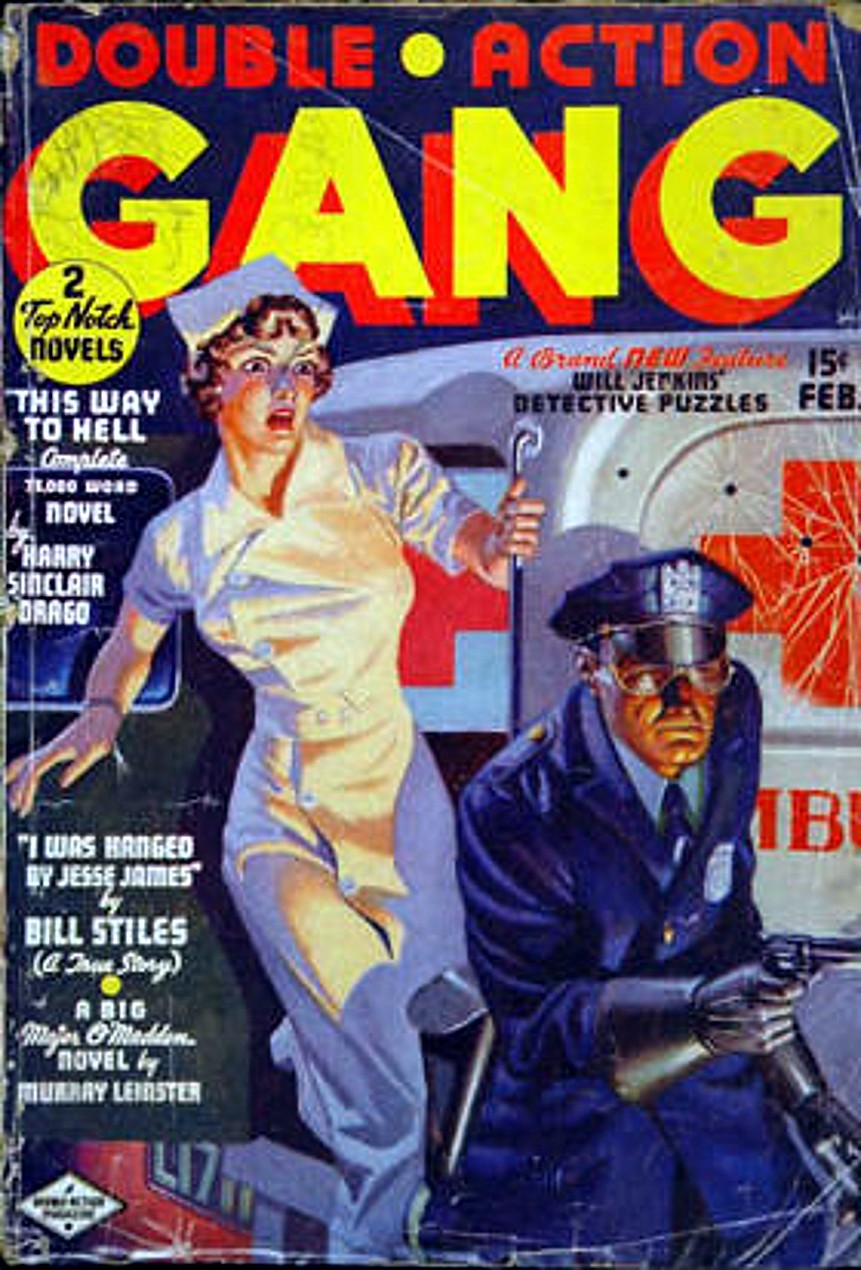
This is a pulp that I own and read recently. That’s my copy
in the scan. The cover is by Earle Bergey, a little more sedate than usual and
not one of his better ones, but still not bad. Unlike the fans at the time
(more about that later), I’m a big fan of Bergey’s work.
I’ve been reading stories by Murray Leinster, whose real name was Will F.
Jenkins, for more than 50 years. I’m sure some of his stories were in various
science fiction anthologies I read in junior high and high school. His novella “The
Man in the Iron Cap” is the lead story in this issue of STARTLING STORIES. I’d
barely started reading it when I came across this gut-punch of a passage:
The world, of course, was bright and new and shining on its sunlit side, and
restful and peaceful and secure where night clothed it. In the countries where
the sun shone men and women worked and children played and where the stars
looked down they slept quietly.
But all assured themselves that they were secure. They were perfectly,
perfectly safe. The world was made safe by Security, which was an organization
of quite the wisest men on earth. They were at once the greatest scientists and
the most able administrators. They had the welfare of everybody in mind.
They had begun, of course, by forbidding anybody to experiment with atom bombs
because the human race could be wiped out by so few of them. They could make
all the earth's atmosphere poisonously radioactive. Then everybody would die.
But Security prevented that.
And presently it forbade the use of atomic energy as such in any form because,
of course, any generator of atomic power makes radioactivity which may escape
into the air. Not long after that, the wise men of Security learned that
someone had been experimenting with germs and by accident had created a new and
very deadly mutation.
It could have been used in biological warfare, but also it could have released
a new and very deadly plague upon the world. So Security forbade experiments
with germs. And still later a physicist discovered the principle of a very tiny
generator which developed incredibly high voltages. Beams of deadly radiation
became possible. So Security had to take steps to protect the world from that.
Security was very wise and very conscientious. It did not stop all scientific
advance, of course. Its scientists experimented very carefully, in especially
set-up Experimental Zones, with all due care that nothing could happen to
endanger the people of Earth. Which meant, naturally, that they did not make
any very dangerous experiments.
In time Security took a fatherly interest in public health because new plagues
sometimes arise in nature. It issued directives governing quarantine and
medicine in general and, of course, travel by individuals because individuals
are sometimes disease carriers. And presently it was inevitable that Security
should give advice on education, and arrange that technical knowledge should be
restricted to stable personalities.
In a complex modern civilization a single paranoiac could cause vast damage if
he were technically informed. So presently everybody took psychological tests,
and those who received technical educations were strictly licensed by Security.
Then libraries were combed and emptied of dangerous facts that lunatics could
use to the detriment of mankind.
The people of Earth were very secure. They were protected against everything
that Security could imagine as happening to them. But they weren’t free any
longer. The tragedy was that many of the guiding minds of Security were utterly
sincere, though there were self-seekers and politicians merely seeking soft
jobs and importance among Security officials.
The guiding minds believed devoutly that they served humanity by using their
greater knowledge and wisdom to protect human beings from themselves. But
somehow, knowing their own motives, they did not see that they had created the
most crushing tyranny ever known to men.
Looking around at our world, that’s chillingly prescient and would keep
this story from being published in any mainstream SF market today. It’s also a
little long-winded and repetitive, which is this story’s main flaw. Leinster
recapitulates what’s going on a lot. Also, the plot depends on several huge
coincidences.
That said, “The Man in the Iron Cap” has some real strengths, too. The
protagonist is a scientist named Jim Hunt, who has been sentenced to life in
prison for unauthorized experiments involving telepathy. He escapes, but then
he stumbles into an alien invasion of telepathic, blood-sucking creatures from
outer space that have taken over a mountainous, rural area and are gradually
expanding into nearby cities. The Little Fellas, as their mind-controlled
victims refer to them, are some of the creepiest villains I’ve ever encountered
in science fiction. This story is really a cross between SF and horror. Leinster
throws in some nice twists, as well, as Jim Hunt tries to figure out a way to
defeat the aliens, and the ending is very satisfying. Leinster expanded this
into a novel called THE BRAIN STEALERS, which was published as half of an Ace SF
Double in 1954. I haven’t read that version and likely never will, but I really
enjoyed “The Man in the Iron Cap” despite the somewhat dated writing.

I’ve been reading Jack Williamson’s work about as long as I have Murray
Leinster’s. The first Williamson I remember reading is his novel GOLDEN BLOOD,
which I bought in the Lancer Easy-Eye edition off the paperback spinner rack in
Tompkins’ Drug Store when it was new. I really ought to reread that book one of
these days. His short story “Through the Purple Cloud”, which appeared originally
in the May 1931 issue of WONDER STORIES, is reprinted as a Hall of Fame Classic
in this issue of STARTLING STORIES. That may be stretching it a little. The plot
has an airliner flying through a purple cloud that suddenly appears in the sky
in front of it and winding up crashing on a savage world in another dimension.
Among the few survivors are an engineer (a lot of protagonists from this era of
SF are engineers, of course), a beautiful girl, and a villainous brute. The struggle
to survive and eventually get back to our own world ensues. This is mostly an
action story with a little scientific speculation, but it’s well-written and
moves right along at an entertaining pace. It’s actually a minor Williamson
yarn, as far as I’m concerned, but I’m a big fan of his work and found it
enjoyable if not quite a classic. I should note that it’s the cover story in
both its pulp appearances, with the art on the WONDER STORIES cover provided by
Frank Paul.
I’ve heard of British SF author John Russell Fearn for a long time, too, but
unlike Leinster and Williamson, I’ve read very little by him. His story in this
issue, “Chaos”, written under the pseudonym Polton Cross, is a “last days of
Atlantis” yarn, in which Atlantis is a scientific paradise until something goes
wrong and leads to its destruction. It’s well-written but a little dry for my
taste.
The final story is “Anastomosis” by Clyde Beck, an early SF fan who published
only four stories. This one is probably more fantasy than SF, a whimsical
domestic comedy about a math professor, his young children, a mysterious
visitor, and a gizmo. It reminded me a little of some of Robert Bloch’s
humorous stories. Mildly amusing and worth a few smiles.
Wrapping things up is a lengthy editorial department/letters column called “The
Ether Vibrates”. Some familiar names show up: Chad Oliver, Lloyd Arthur
Eshbach, Stanley Mullen, Lin Carter, and Virgil Utter. The other correspondents
are probably well-known to those more familiar with SF fandom from that era
than I am. Several of them complain about Earle Bergey’s covers. One even calls
them immoral. Me, I still like those Bergey space babes.
Another interesting letters section comment comes in response to a reader request for stories from some of the old-time SF authors. One of the authors he mentions is Ed Earl Repp. The editor's response says that Repp is staying busy with the "writing school" he runs (quote marks mine). We know from Frank Bonham's great essay "Tarzana Nights" that Repp wasn't running an actual school for writers. He was farming out Western pulp work to several writers, providing them with plot ideas, then selling the stories under his own name and splitting the money with the ghostwriters. Bonham seems rather bitter about this, but having been on both sides of that equation myself, I think Repp's operation was reasonably fair. He could have paid the ghosts less than half and found plenty of writers who'd be happy to get the work.
After that little digression, I should mention that the editor of STARTLING STORIES at this point in its run
was none other than Sam Merwin Jr., who bought the first story under my name
for MIKE SHAYNE MYSTERY MAGAZINE approximately 30 years later and had a huge
impact on my career by asking me to write one of the Mike Shayne novellas under
the Brett Halliday house-name. As I’ve mentioned many times before, I owe Sam a
big debt, not just for the stories he bought but for the hastily scrawled but always
enthusiastic and encouraging notes he sent along with dozens of story
rejections in 1975 and ’76 when I was trying to break in. He put me on the path
I’ve followed for almost half a century now.
Overall, I think this is a very good issue of STARTLING STORIES. If you want to
check it out, the whole thing is available at the Internet Archive.