Showing posts with label Max Allan Collins. Show all posts

Friday, August 28, 2026

A Rough Edges Rerun Review: Spade & Archer - Joe Gores


Joe Gores’ SPADE & ARCHER is a prequel to Dashiell Hammett’s THE MALTESE FALCON, one of the greatest – if not the greatest – private eye novels ever written. I have to admire anyone who would even attempt such a thing, let alone an author who could pull it off successfully. Thankfully, Gores does.

He starts with what I think is a brilliant decision to structure the novel in the form of three linked novellas, harkening back to Hammett’s novels RED HARVEST and THE DAIN CURSE. SPADE & ARCHER is a little different, of course, because its component parts were written to be published together, instead being published first as separate stories in BLACK MASK. Also, the time span of SPADE & ARCHER is longer than what you usually find in novels that were actually cobbled together from pulp yarns, since the three parts take place in 1921, 1925, and 1928. The first part begins with Sam Spade in Tacoma, working for the Continental Detective Agency (that’s right, he’s a Continental Op), but it’s not long before he moves to San Francisco and opens his own one-man agency, hiring a seventeen-year-old girl named Effie Perrine as his secretary. He investigates the theft of a small fortune in gold coins from a ship that arrives in San Francisco and also locates the runaway teenage son of a wealthy banker.

Those two plotlines crop up again in the second part, set four years later, which finds Spade investigating the death of another banker that might be natural causes, might be suicide, or might be murder. Gores continues weaving together strands from the first two parts in the concluding section, in which Spade takes on a partner, an old detective acquaintance named Miles Archer who happens to be married to a woman who was in love with Spade before he went off to fight in World War I. The newly-formed Spade & Archer agency investigates the theft of a large amount of cargo from the San Francisco docks, while Spade on his own tries to track down a quarter of a million dollars in buried treasure. Gores winds up tying everything together in a complex plot worthy of the pulp era.


That faithfulness to the roots of the hardboiled PI genre is this book’s greatest achievement, as far as I’m concerned. Other than a greater amount of frankness about the fact that Spade is sleeping with Iva Archer and with some of his female clients, SPADE & ARCHER really could have been written and published in the 1920s. Some authors these days, if they were trying to write a prequel to THE MALTESE FALCON, probably would have felt compelled to coarsen the language and make the sex and violence more graphic. Not Gores. He’s content to spin a pulp yarn and does a magnificent job of it.

Some readers are opposed to the concept of pastiches in general, and I can understand that. It would be pretty hypocritical of me to feel that way, however, since I’ve always made a large part of my living writing about characters created by other people. I do believe, though, that an author writing a pastiche ought to at least try to stay faithful to the spirit of the original creation. That’s what Joe Gores has done in SPADE & ARCHER. I’m sure a lot of you have read this book already, but if you haven’t, it gets my highest recommendation. It’s a wonderful novel, and probably the best thing I’ve read so far this year. And it really, really makes me want to reread some Hammett.

(Despite my good intentions [road to Hell paved with, etc., etc.] I don't recall reading anything else by Dashiell Hammett since this post originally appeared on May 1, 2009. I have, however, read Max Allan Collins' terrific RETURN OF THE MALTESE FALCON and highly recommend it as well. SPADE & ARCHER is still available in e-book and paperback editions, and if you're a private eye fan and haven't read it yet, you should grab a copy and remedy that.)

Monday, January 05, 2026

Review: Return of the Maltese Falcon - Max Allan Collins


I’m starting the new year off well with an excellent novel from Max Allan Collins. I’ve been a fan of THE MALTESE FALCON since I read the novel in high school, the first thing by Dashiell Hammett I ever read, I believe. Needless to say, I was hooked. Now the original magazine version of the novel, as serialized in the iconic pulp BLACK MASK, is in public domain, and that’s what Collins has used as the starting point for his new novel RETURN OF THE MALTESE FALCON, which, as he points out, is a continuation rather than a true sequel.

And if, by some chance, you’ve never read Hammett’s novel, stop right now and read it before you read this review, and absolutely don’t tackle Collins’ novel until you’ve read the original, because they’re both, of necessity, full of spoilers. I mean it!

The action starts a week after the end of THE MALTESE FALCON, in December 1928. The dead Miles Archer’s desk has been removed from the office of Spade & Archer, and Effie Perrine, Sam Spade’s secretary, has put up a Christmas tree in its place. (Does that make this a Christmas novel? It sure does!)

A potential client pays a visit to Spade’s office. She’s Rhea Gutman, Casper Gutman’s daughter, and she wants to hire Spade to find the real Falcon. The one in Hammett’s novel was a fake, remember? Rhea is the first of four clients who give Spade a retainer to find the dingus. The others are Chicago gambler Dixie Monahan, Corrine Wonderly, the younger sister of femme fatale Brigid O’Shaughnessy, and Steward Blackwood, an official from the British Museum who claims that institution is the true owner of the Falcon.

Spade plays all these characters against each other. He has run-ins with the cops. A dead body turns up. Spade is hit on the head and knocked out, and he’s captured by a gunman who wants to kill him. This is great stuff in the classic hardboiled private eye mode, the kind of thing that Dashiell Hammett invented, along with Carroll John Daly. Stylistically, Collins’ fast-moving, straight-ahead prose isn’t quite as stripped down as Hammett’s, but it’s certainly in the same ballpark.

Being constrained to use only the elements to be found in the original novel’s pulp serialization turns out to be a good thing. Collins is able to bring on-stage characters who were only mentioned before and invent new ones who fit perfectly in that setting. The resolution of the mystery and the way the book wraps everything up are extremely satisfying.

A number of years ago, I read and loved Joe Gores’ prequel novel SPADE & ARCHER. RETURN OF THE MALTESE FALCON is even better. I’m glad Max Allen Collins wrote it, and I’m grateful to Hard Case Crime for publishing it. It’ll be out officially in e-book and hardcover editions tomorrow. For hardboiled fans, I give it my highest recommendation.

Monday, February 20, 2023

Spillane: King of Pulp Fiction - Max Allan Collins and James L. Traylor


The first Mickey Spillane novel I ever read was THE DEEP, a hardback I checked out from the library when I was 12 years old and in the sixth grade. By that time I was already volunteering at the local library and could check books out to myself without anybody saying, “Hey, kid, are you sure you’re old enough to read that?”

My second Spillane novel, and my introduction to Mike Hammer, was KISS ME, DEADLY, another library hardcover I took with me and read while my family was visiting my aunt in Blanket, Texas. I still remember reading it in the big brown armchair that was my favorite reading spot in her house.

Just like I remember reading the Signet paperback of THE SNAKE in the repurposed World War II barracks building that served as the high school study hall, or, best of all, reading ONE LONELY NIGHT in a chair on the porch of my sister’s house one summer day, blown away by the great opening, the even better ending, and all the stuff in between.

Which is my long-winded, nostalgia-wallowing way of saying that I love Mickey Spillane’s books. I read them all, I reread one now and then over the years, and I read and enjoyed many of the Spillane novels that Max Allan Collins completed from various fragments and outlines and notes. Mike Hammer is one of my all-time favorite fictional private eyes and Mickey Spillane one of my favorite writers. One of the things I’m most proud of from my tenure as the editor of Rough Edges Press is that I got to work on the great Spillane collection STAND UP AND DIE!

So for a while now, I’ve been looking forward to SPILLANE: KING OF PULP FICTION, the first in-depth biography of Spillane by that same Max Allan Collins and his excellent collaborator James L. Traylor. Spillane is long overdue for such a volume, and Collins and Traylor have done a magnificent job of delivering it.

I learned a lot about Spillane’s childhood, adolescence, and young adulthood than I ever knew before, and the book is illustrated with photos I’d never seen. Spillane really comes alive in the biographical sections, a driven but affable guy, true to his blue collar roots, never pretentious, but treating his work a lot more seriously than the impression his self-deprecating attitude might convey. Spillane, clearly, was able to take the job of putting words on paper with great seriousness while recognizing the absurdities of much of the publishing business and all the trappings that go with it. My kind of guy, in other words.

Woven through the biography is a critical discussion and appreciation of each of Spillane’s novels. As Collins and Traylor point out, you can’t really talk about Spillane’s novels without talking about the endings, so spoilers abound and anyone who hasn’t read the books should consider themselves warned. The thing of it is, even when you know the endings, the books still hold fabulously on rereading. Some of them I enjoyed even more, because knowing what was coming, I could appreciate how cleverly Spillane set everything up. One of the great joys of writing is planting a seed that doesn’t come to fruition until much later on.

Collins and Traylor also cover the various moves, TV shows, radio shows, comic strips, and comic books based on Spillane’s work, as well as his early comic book scripting and his possible sales to the pulps and the slicks. (For the record, I’m absolutely convinced that Spillane sold hardboiled detective yarns to various pulps under the name “Frank Morris” . . . and I hope to see a collection of those stories someday.)

There are helpful listings of Spillane’s novels and collections in publication order, and also a chronological listing of all the Mike Hammer novels including the ones Collins completed for Spillane. This is very helpful because for a while now I’ve been toying with the idea of reading/rereading the Hammer series in order, including the Collins titles. Whether anything will come of this, I don’t know—I have lots of great ideas I never get around to—but in case I do, this list will be very valuable.

I really enjoyed SPILLANE: KING OF PULP FICTION. It’s entertaining, informative, and very nostalgic, but above all, just plain fun to read. It’s the best book I’ve read so far this year and is a lock for my top ten list at the end of the year. It's available in print, e-book, and audio editions. If you’re a Spillane fan, you’ve probably already bought it. If you’re thinking about it but haven’t pulled the trigger yet, go ahead.

Mike Hammer would. And then tell you it was easy.

Tuesday, December 06, 2022

The Big Bundle - Max Allan Collins


Max Allan Collins’ Nathan Heller series began in 1983 with TRUE DETECTIVE. (Almost 40 years ago? How is that possible?) TRUE DETECTIVE is one of the best private detective novels I’ve ever read. Through 18 more novels and story collections since then, Collins has maintained an incredibly lofty standard on this series and kept it alive through several different publishers, a pretty impressive feat in itself.

The Heller series moves to Hard Case Crime, a match that seems well-nigh perfect to me, with THE BIG BUNDLE. The Heller novels always involve real-life crimes, and in this one, it’s a high-profile kidnapping in Kansas City in which the six-year-old son of a wealthy Cadillac distributor is abducted. The kidnappers want $600,000 in ransom money. There’s something off about the whole deal, however, and Heller is called in to try to help recover the boy before it’s too late.

A lot of twists and turns and violence and tragedy ensue. The kidnappers are caught, but only half of the ransom money is recovered. What happened to the other half? That’s the question that brings Heller back to Missouri five years later, in a high-stakes mystery involving not only many low-level criminals but also Bobby Kennedy and Jimmy Hoffa.

As always, the research is thorough and meticulous, the background is fascinating, and the pace is great. Collins had me staying up later than usual and flipping the pages to find out what was going to happen. And of course, Nathan Heller is a great protagonist, smart, stubborn, plenty tough when he needs to be. THE BIG BUNDLE is classic private-eye fiction, just like the rest of the Heller series. I had a great time reading it and give it a high recommendation. It’s available in e-book and audio editions now, and a hardcover is on the way.

Friday, July 15, 2022

From the Files of . . . Mike Hammer - Mickey Spillane and Ed Robbins


As a Mickey Spillane and Mike Hammer fan for more than fifty years, I was surprised that I didn’t even know this book existed until recently. Published by Hermes Press in 2013, FROM THE FILES OF . . . MIKE HAMMER reprints the Mike Hammer comic strip that ran for less than two years in 1952 and ’53 and is still available in both print and digital editions.

Editor Max Allan Collins provides the usual fine introduction, covering the background for the strip and information on who did what. The art is by Ed Robbins, an artist I’m not really familiar with, but he does a great job all the way through, with superb storytelling and a version of Hammer that just looks right. Mickey Spillane provided plots and contributed to some of the scripts, and Robbins handled much of the writing as well as the art. Veteran comics scripter Joe Gill worked on the strip early on but didn’t last long.

Although the strips ran in the usual daily and Sunday form, with different storylines in each format, this volume collects them in different sequences. In the first daily continuity, “Half-Blonde”, Mike Hammer, always the champion of the underdog, investigates the murder of a bum. Not surprisingly, the case turns out to have a much larger scope than that. While in the hospital recuperating from injuries suffered during that case, Mike finds himself involved in the mystery of “The Bandaged Lady”. In “The Child”, he’s hired to rescue the kidnapped child of a mob boss.

The title of the next daily continuity, “Another Lonely Night”, harkens back to what many, including myself, consider Spillane’s best novel, ONE LONELY NIGHT. In this one, Mike is targeted for death by mob killers after he witnesses a gangland execution. “Christmas Story” is a minor but predictably heart-warming tale in which Mike, feeling like Scrooge, corrals a shoplifter dressed as Santa Claus. Finally, in “Adam and Kane”, Mike has an actual client for once, an elderly criminal who hires him to locate his long-estranged son.

The title of the first Sunday storyline is “Comes Murder”, which, as Collins explains in his introduction, is designed to fit with the strip’s overall title: “From the Files of Mike Hammer . . . Comes Murder”. It’s likely that Spillane scripted this story himself. It certainly reads like his work. Mike protects a young couple from a vindictive gambling kingpin, but there’s more to it than a bad debt. He gets a hand in this case from a beautiful blond Amazon who may or may not be trustworthy.

Another beautiful blonde figures prominently in the plot of “The Sudden Trap”. Mike is passing through a small town when he spots a Hollywood starlet who’s out of place there . . . especially since she was believed to have been killed in a car wreck two years earlier. Mike’s curiosity won’t allow him to move on until he’s solved the mystery of her true identity.

The third and final Sunday continuity is the aptly named “Dark City”, in which Mike gets mixed up in the dangerous affairs of a beautiful redhead and her shell-shocked Korean War vet brother. Several panels in this story are considerably more suggestive than most comic strips were in those days, and it’s thought that may have contributed to the strip’s cancellation. I’m just glad Spillane and Robbins were able to finish the storyline. It wraps everything up in a downbeat but effective manner.

I really had a fine time reading this book. It brought back a lot of memories of racing through Mike Hammer novels in study hall at school, on my parents’ front porch, and at my sister’s house. The art is good, the scripts are top-notch, and I can’t imagine any Spillane fan not enjoying this collection. FROM THE FILES OF . . . MIKE HAMMER gets a very high recommendation from me.

Monday, January 10, 2022

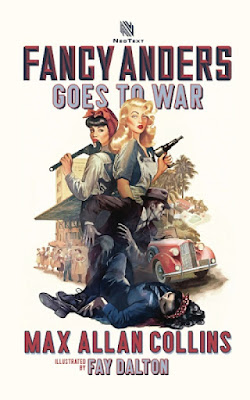
Fancy Anders Goes to War: Who Killed Rosie the Riveter - Max Allan Collins


Fancy Anders is a rich, beautiful blond socialite during World War II. She worked as a secretary in her father’s successful private detective business, and when he’s called back to active duty, she takes over the agency. Not as a detective, mind you, but simply somebody to refer potential clients to other agencies and keep the business existing in name only.

Now really, what rich, beautiful blond socialite is going to be satisfied with a set-up like that? Especially when a young woman who works in an aircraft plant dies under suspicious circumstances, and the man who owns the plant is an old friend of Fancy’s family? Naturally, Fancy decides to go undercover and join the millions of women who have entered the workforce with most of the men off at war. She’s determined to find out if the young woman’s death was an accident, as it appears at first . . . or murder.

FANCY ANDERS GOES TO WAR: WHO KILLED ROSIE THE RIVETER? is a book that seems to have been designed with me as the target audience. And since Max Allan Collins is one of the modern masters of the historical mystery, it doesn’t disappoint in the slightest. This is a highly entertaining novel, with a fast pace, a suitably twisty plot, and a great protagonist in Fancy Anders. The cover and illustrations by Fay Dalton just make it that much more appealing. I had a wonderful time reading this book and give it a high recommendation. And I’m happy to know that there are at least two more Fancy Anders tales in the works, because I’m looking forward to reading them, too.

Monday, May 03, 2021

Shoot-Out at Sugar Creek (Caleb York #6) -- Mickey Spillane and Max Allan Collins


The Caleb York series, written by Max Allan Collins and based on a character created by Mickey Spillane, started out strong and has gotten better as it goes along, coming to an end (for now) with a terrific range war novel that stands with the best of the classic Western writers.

Following closely on the events of the previous book, former gunfighter and Wells Fargo detective Caleb York, currently a lawman in Trinidad, New Mexico, finds himself caught up in the clash between two strong women: Willa Cullen, the beautiful young ranch owner York wants to marry, and Victoria Hammond, newly arrived in the territory and determined to start a cattle empire built on rustling, intimidation, and outright murder if that's what it takes. The fight over water rights between Willa and Victoria expands to include a number of hired gunmen on both sides and plenty of blood being spilled.

Collins never lets up on the pace in this book. It races along with plenty of action and characterization and occasional bits of humor. In Victoria Hammond, it also has one of the most despicable villains I've encountered lately, willing to sacrifice her own flesh and blood to gain what she wants and a more than worthy adversary for York. The regular supporting characters show up, too, including York's scruffy sidekick/deputy Jonathan P. Tulley (in my head, he's always played by the great Al "Fuzzy" St. John) and saloon owner Rita Filley, part of an uneasy romantic triangle with York and Willa. (If you ask me, and nobody did, York should pick Rita.)

In his acknowledgments, Collins also has a nice mention of the Western Fictioneers for the research help the group provided. It's always good to see WF get a little publicity.

I hope Collins finds time in his schedule to continue this series. I've really enjoyed it. I think I've compared them before to the Amos Flagg series by Clifton Adams writing as Clay Randall. If you're a fan of traditional Western action novels, I give the Caleb York books a very high recommendation.

Monday, March 02, 2020

Hot Lead, Cold Justice - Mickey Spillane and Max Allan Collins


The Caleb York series of Western novels, based on characters created by Mickey Spillane and written by Max Allan Collins, is a series that started off very good and has gotten better with each book. The fifth book, HOT LEAD, COLD JUSTICE, will be out later this year, and I’m fortunate enough to have read an early copy of it.

I hate snow and ice in real life, but for some reason I’ve always enjoyed books that use winter weather as part of the setting, especially Westerns. That’s the case in this book, which finds a blizzard bearing down on Trinidad, the small town in New Mexico Territory where Caleb York, gunfighter and former Wells Fargo detective, is now the town marshal. The weather isn’t the only trouble in store for York and Trinidad: a group of bank robbers—including one who had a deadly personal grudge against York—plans to hit the bank in a nearby town and then hide out in Trinidad while the hunt for them dies down. They manage to do this, but York figures out what’s happening and a dangerous game of cat and mouse develops in the blizzard-battered settlement.

Collins’ prose is as smooth and effective as ever in this story that races along in a very satisfying manner. York is a likable, stalwart hero, and his uneasy romantic triangle with ranch owner Willa and saloon owner Rita continues to be interesting. His deputy Tulley is a great sidekick, and the rest of the supporting cast works well. The villains are properly despicable, especially their leader, the ruthless outlaw “Burn ‘em” Burnham.

One thing I especially like about this series is that the books range from 60,000 to 65,000 words, just about the perfect length for a Western. There’s no fat on the bones. Collins provides the reader with plenty of characterization to make the players in his tale interesting, while at the same time keeping the pace moving along briskly. This series reminds me of the Amos Flagg series by Clifton Adams writing as Clay Randall. Readers who enjoy good, solid traditional Westerns definitely should make the acquaintance of Caleb York, and if you already have, you’ll want to grab HOT LEAD, COLD JUSTICE. It’s great stuff.

Wednesday, July 10, 2019

Last Stage to Hell Junction - Mickey Spillane and Max Allan Collins


First of all, is that a great title or what? LAST STAGE TO HELL JUNCTION. I can see it on the cover of a Popular Publications Western pulp or a Gold Medal paperback. In fact . . .

But more on that later. What you need to know is that this is the fourth Caleb York novel by Max Allan Collins based on the character created by Mickey Spillane. Former Wells Fargo detective/gunfighter Caleb York is still the sheriff of the small town of Trinidad, New Mexico Territory, and as usual, trouble’s not long in cropping up. York is also still juggling on-again, off-again romantic relationships with two women, beautiful blond ranch owner Willa Cullen and beautiful brunette saloon owner Rita Filley. The two women find themselves on the same stage bound for the neighboring town of Las Vegas, where there’s a railroad spur that will take them to Denver for shopping trips. Also on the stage is the most successful businessman in Trinidad, who owns banks and other enterprises throughout the Southwest.

The stagecoach hasn’t gone very far before it’s jumped by an outlaw gang led by a charismatic former actor gone bad. Their target is the businessman, who they kidnap to hold for ransom. They take the two women along with them as well, and everybody holes up in the ghost town of Hale Junction, which some wag has renamed Hell Junction on the sign at the edge of town. When Caleb York finds out about this, he sets out to rescue the hostages and deal with the outlaws, of course, but doing that without getting his friends killed proves to be a tricky job.

As always, Collins’ prose is just as smooth and fast-flowing as can be, and his characters are interesting, including the villains. I’m particularly fond of York’s deputy, reformed drunk and desert rat Jonathan Tulley. He’s a fine sidekick. I don’t know how the author sees him, but in my head he’s always Al “Fuzzy” St. John. Collins does an excellent job of making things worse and worse for his protagonist, until you really do start to wonder how York will be able to sort things out.

Now, as for that Gold Medal connection . . . I realized as I was reading this book that the series reminds me of the Amos Flagg novels written by Clifton Adams under the name Clay Randall in the Sixties. Flagg and York are very different characters, of course, but the books are the same sort of tough, fast-moving Western yarns with colorful casts and plenty of action. The York books could have almost been written and published then. If you’re looking for good, solid traditional Westerns with a hardboiled edge, I highly recommend LAST STAGE TO HELL JUNCTION and the other Caleb York novels.

Monday, January 29, 2018

The Last Stand - Mickey Spillane


The 100th anniversary of Mickey Spillane’s birth is coming up, and Hard Case Crime is marking the occasion by publishing a new volume containing two never-before-published Spillane stories.

The first is a novella entitled “A Bullet for Satisfaction”, which appears to have been written by Spillane in the early to mid-Fifties but never edited and submitted. Max Allan Collins has worked from the original manuscript to smooth out inconsistences and bridge the different parts of the story together. The result is a lightning-paced crime yarn that’s like a Fifties paperback in miniature. The protagonist is Homicide detective Rod Dexter, who works in a medium-sized city somewhere in the Midwest. He’s trying to solve the murder of a recently elected state representative, and it’ll come as no surprise that Dexter soon finds himself up to his neck in crooked politicians, gangsters who are trying to take over the town, imported hitmen, and a number of beautiful women who may or may not be trustworthy. Dexter winds up getting kicked off the force when his investigation gets too close to uncovering the truth, but does that stop him? What do you think? That he’s gonna get his hands on a gat and continue cutting a bloody swath through the bad guys?

I think we all know the answer to that.

Spillane packs enough plot into this yarn for a full-length novel, along with plenty of action, some great dialogue, and several really harrowing scenes of violence. This is good stuff, and I can’t imagine any fan of classic era Spillane not having a great time reading it.

THE LAST STAND is the final novel Mickey Spillane completed, just a few weeks before his death. I don’t know how much editing and polishing Collins did on this one, but I suspect not much. The voice is very consistent with the other later Spillane novels I’ve read, SOMETHING’S DOWN THERE and DEAD STREET.

THE LAST STAND is a contemporary Western and more of an adventure novel than a mystery. The protagonist, successful businessman Joe Gillian, is flying a vintage World War II airplane, a hobby of his, across the desert southwest when engine trouble forces him to set down in the middle of nowhere. He’s in a bad spot, but he soon encounters Sequoia Pete, who lives on a fairly close-by Indian reservation. Pete’s horse has thrown him and run away, so he’s stranded, too. They have to walk back to the reservation, which takes several days, but they make it and by the time they do, they’ve become good friends. Then Gillian meets Pete’s beautiful sister Running Fox, and thinks maybe the bad luck with his plane wasn’t so bad after all.

Naturally enough, it’s not long before trouble breaks out involving three different plotlines: the search for a legendary fortune in gold hidden in the Superstition Mountains and the attempted murder of an old prospector; the discovery of a mysterous mineral that may have incredible scientific and military applications; and the jealousy of Running Fox’s other suitor, a massive Indian known as Big Arms, who wants to beat Gillian to death. Spillane adds some gangsters and federal agents to the mix, then weaves everything together perfectly in a fast-moving tale. It’s told in third person, rather than first, and although the stakes are plenty high, the tone isn’t as dark as much of Spillane’s earlier work. There’s even a hint of breeziness about it, which is not something you expect from Spillane, but it’s balanced by a poignant, elegeiac undercurrent of change and the passage of time and inevitable endings. And he does an excellent job of capturing the southwestern landscape as well.

THE LAST STAND is a fine novel that I thoroughly enjoyed. Along with “A Bullet for Satisfaction”, it makes this volume another real winner from Hard Case Crime. Its publication is a major event for any fan of Spillane’s work, and I give it my highest recommendation.


Monday, January 01, 2018

The Bloody Spur - Mickey Spillane and Max Allan Collins


Famous gunfighter Caleb York is still the sheriff of Trinidad, in New Mexico Territory, and he has trouble on his hands again as several newcomers arrive in Trinidad in the opening pages of THE BLOODY SPUR, the third novel in this series by Max Allan Collins based on characters created by Mickey Spillane.

The new arrivals in town are a representative of the Santa Fe Railroad, which wants to build a spur line to Trinidad (there’s where the title comes from); an ex-convict and former partner of York’s friend, rancher George Cullen; and a notorious gun for hire known as the Preacherman, who has come to Trinidad with a couple of minions to kill someone. York just doesn’t know who.

Complications quickly ensue. The railroad wants to build its spur line through George Cullen’s ranch. Cullen is opposed to the idea, but his daughter Willa (with whom York has had an on-again, off-again romance) supports the idea. York has to find out who the Preacherman’s target is, and just what is Cullen’s old partner up to, anyway? Before any of that can be sorted out, a tragedy occurs, and it’ll come as no surprise that what appears at first to be an accidental death is actually murder . . .

As you might expect, THE BLOODY SPUR is as much mystery novel as it is Western adventure, and it doesn’t skimp on either element. There’s plenty of both gunplay and detection before Caleb York untangles everything and delivers his own brand of justice. I’ve really enjoyed this series, and I think this is the best book so far. It’s well-plotted, and Collins’ style is about as smooth as any you’ll find, making for a very fast, entertaining read. I really enjoy his characters, too, especially Jonathan Tulley, former desert rat and current deputy to Caleb York. If these books were Western B-movies from the Forties (which they resemble in some ways), Tulley would have to be played by one of my favorite sidekicks, Al “Fuzzy” St. John.

THE BLOODY SPUR will be out later this month, but it’s available for pre-order, and if you’re looking for a very good traditional Western, I give it a high recommendation.


Wednesday, November 22, 2017

The Big Showdown - Mickey Spillane and Max Allan Collins


I enjoyed the first book in this series, THE LEGEND OF CALEB YORK, which was Max Allan Collins' novelization of an unproduced movie script Mickey Spillane wrote for his friend John Wayne. I think the second book, THE BIG GUNDOWN, by Collins based on Spillane's characters, is even better.

Legendary gunfighter and former Wells Fargo detective Caleb York has been serving as the temporary sheriff in Trinidad, New Mexico Territory, but as the book opens he has turned over the job to an old friend of his and is about to leave for San Diego, where he's going to work for the Pinkertons. Unfortunately, a bank robbery occurs just before the stagecoach that will take York away from Trinidad arrives. This bloody crime keeps York from leaving and forces him to put on a badge again as he tries to find the bank robber who escaped and recover the stolen money.

Then there are a couple of murders, leading York to realize that more is going on than a simple bank holdup. On top of that, five gunfighting brothers who have a grudge against him are on their way to Trinidad to settle the score. And there may be more to that than there appears to be at first, too.

THE BIG SHOWDOWN is a really entertaining mixture of Western and crime novel. Caleb York is a good character, more flawed than the legend surrounding him might suggest but that just makes him human. His old geezer sidekick (I'm seeing him more as Al "Fuzzy" St. John rather than Gabby Hayes) is great, and the other supporting characters are interesting, too. As usual, Collins' fast-paced prose is smooth as can be. This is a fine traditional Western and I had a really good time reading it. There'll be at least one more book in the series, and I'm looking forward to it.

Wednesday, July 08, 2015

The Legend of Caleb York - Mickey Spillane and Max Allan Collins


Mickey Spillane certainly isn't the first name I think of when the subject of Western movies comes up, but as Max Allan Collins explains in his introduction to this novel, Spillane was good friends with John Wayne and at one point even wrote a screenplay for Wayne's production company Batjac. That movie was never produced, but Spillane's screenplay serves as the basis for this novelization by Collins, another top-notch posthumous collaboration by these two writers.

THE LEGEND OF CALEB YORK is a very traditional Western featuring many elements you've seen before: despicable villains in the person of a corrupt sheriff and his crew of brutal deputies/henchmen; the frightened citizens of the town treed by said sheriff (in this case, Trinidad, New Mexico); a sultry saloon owner who's no better than she has to be; an old rancher and his beautiful daughter; an eccentric old desert rat reminiscent of the immortal Gabby Hayes (yes, Spillane and Collins follow The James Reasoner Rule, as Bill Crider has dubbed it); and last but certainly not least, the mysterious stranger who rides into town and sets off a bloody chain reaction of events. The crooked sheriff has his sights set on both the old rancher's spread and the man's lovely daughter, and the rancher has sent a telegram asking for help from the notorious gunfighter Caleb York, or rather, when he finds out that York has been reported dead, the man who gunned down York.

So who is the mysterious stranger? Spillane and Collins make us wait almost until the end of the book to find out, and this twist, along with Collins' fast-paced prose, elevates THE LEGEND OF CALEB YORK into a fine Western novel. It's an entertaining tale filled with gritty action and interesting characters, and I hope there'll be a sequel or two. I'll certainly read them if there are. If you're a Western fan and haven't yet read THE LEGEND OF CALEB YORK, I recommend it.


Monday, March 26, 2012

New This Week


As I mentioned, last week was unusual. This week I have only three new books to talk about . . . but they look like good ones.

Paul Cain – THE COMPLETE SLAYERS. This is a beautiful limited edition from Centipede Press that reprints Cain's novel FAST ONE (in its original form as published in BLACK MASK) and all of his shorter fiction. It includes a lengthy biographical introduction by editors Lynn F. Myers Jr. and Max Allan Collins that reveals quite a bit of new information about the mysterious Paul Cain, including his real name. The book is signed by Myers, Collins, and artist Ron Lesser, who provided the great cover and several interior illustrations.


Max Allan Collins (again) – DICK TRACY: THE COLLINS CASEFILES, VOLUME 1. This handsome trade paperback reprints the first three storylines by Collins when he took over the writing duties on the Dick Tracy comic strip in 1977. Tracy is a longtime favorite of mine, but I haven't read these stories yet and I'm looking forward to them.


Matthew P. Mayo – WRONG TOWN. This is a new e-book edition of a Western novel originally published a few years ago in England by Robert Hale as part of the Black Horse Western line. My review of it will be coming up in a few days.

Sunday, February 13, 2011

Quarry - Max Allan Collins

I’ve read a lot of books by Max Allan Collins over the years, but for some reason I’d never read any of his novels featuring the hitman Quarry, not even the recent additions to the series published by Hard Case Crime. Maybe that’s because I’m not, as a rule, all that fond of hitman books. Oh, I’ll read one now and then, but I don’t really seek them out.


However, the great small press publisher Perfect Crime Books has just reprinted the first five books in the series (first in publication order, anyway), so this seemed like a good time to give one of them a try. I’m glad I did.


QUARRY, originally published by Berkley as THE BROKER in 1976, is set primarily in a small town in Iowa, and there’s a good reason for that, as Collins explains in an entertaining afterword to the new edition. The narrator, a hitman who uses the name Quarry (that’s not his real name, as he points out), is there to carry out a job, and he does so with his usual efficiency. But something unexpected goes wrong, somebody winds up dead who’s not supposed to, and the criminal Quarry is forced to become a detective in order to figure out what’s going on, otherwise he might wind up dead, too.


Quarry is a fascinating character, and Collins succeeds in making the reader root for a character who really is a bad, bad guy. He does this by making Quarry pretty normal most of the time, with only occasional hints of what he’s capable of, so when his true nature comes out it’s even more effective. Plus the writing is nice and tight and now and then even funny, and it’s very much of its early Seventies times. As usual, crime fiction is one of the very best snapshots of an era you can find.


If you’ve read the later Quarry novels or, like me, haven’t sampled the series at all, you owe it to yourself to go back and read these early entries as well. They’re fine work by one of the field’s most dependable writers. Highly recommended.


(Max Allan Collins is a member of the Top Suspense Group.)