Showing posts with label Cornell Woolrich. Show all posts

Monday, January 19, 2026

Review: Desperate Times: Stories From the Great Depression - Cornell Woolrich


My recent reading of Cornell Woolrich’s MARIHUANA put me in the mood to read more of his work, which I’ve enjoyed for many years. My attention span hasn’t been very conducive to reading novels lately, but luckily there are a number of Woolrich collections available on Amazon, reprinting some of his shorter work from the pulps. DESPERATE TIMES: STORIES FROM THE GREAT DEPRESSION caught my eye, so I started there.


The first story is “The Heavy Sugar” from the January 1937 issue of POCKET DETECTIVE. A down-and-outer in New York City finds a diamond necklace hidden in a sugar bowl in a seedy cafeteria. He figures, correctly, that some crook stashed it there to keep from having the cops find it on him. Our protagonist quickly discovers, however, that having a valuable necklace in his possession is a dangerous thing, since the gang that stole it in the first place is on his trail. As always, Woolrich does a great job depicting a squalid world of bars and flophouses, and he ratchets the suspense up skillfully to a twist ending that I should have seen coming but didn’t.


A guy tries to rob his miserly, corrupt former employer to recoup some lost wages he was cheated out of. Things go wrong. And then they get worse. That’s the plot of “Murder Always Gathers Momentum” from the December 14, 1940 issue of DETECTIVE FICTION WEEKLY. Once again, this tale is pure headlong suspense, barreling along to a twist ending, and yes, Woolrich got me again. It’s a very effective gut punch.

“Goodbye, New York” (STORY, October 1937) also concerns a robbery that turns into murder and the killer’s flight from the law. Only this time, his wife accompanies him, and she’s the narrator of this story. It’s tense and well-written, but it never grabbed me quite as much as the others and I didn’t care much for the ending. Interestingly, at least to me, the version that appears in this e-book edition seems to have been taken from a later reprinting rather than the original, because there’s a reference to the characters watching TV, not likely something they would have been doing in 1937. I suspect it was originally listening to the radio. I also suspect this version comes from the reprint in the March 1953 issue of ELLERY QUEEN’S MYSTERY MAGAZINE, since TV was a huge fad in those days and EQMM editor Fred Dannay was known to edit/revise some of the stories he reprinted.


“Borrowed Crime”, from the July 1939 issue of BLACK MASK, once again concerns a robbery that turns into murder, but this time the protagonist of the story has nothing to do with the crime. However, he has a very good reason for confessing to it anyway. He also has an alibi that will keep him from being found guilty. But then something happens to that alibi, and he’s facing conviction and a trip to the electric chair unless he can convince someone that his wild story is true. Something similar could be said for Woolrich, who was famous, or infamous, for his far-fetched plots. This story is a good example of that. Did I find it believable? Not at all. Did I keep flipping the digital pages to find out what was going to happen? I sure did. Woolrich’s slick prose and storytelling ability get all the credit for that.


“Dormant Account” appeared in the May 1942 issue of BLACK MASK. The narrator, down on his luck George Palmer, comes up with an unusual way to try to turn his life around. He sees a list of dormant bank accounts in a newspaper and decides to pretend to be one of the people listed who has money coming to them. Through Woolrich’s careful manipulation of the plot, Palmer makes this crazy scheme work, but only up to a point. Then everything falls apart and he winds up running for his life. Once again, Woolrich spins a yarn that seems too ridiculous when you look at it logically. But who looks at a Cornell Woolrich story logically? And since when is life logical? All I know is that I enjoyed this story, and I loved the final twist even though you could see it coming the proverbial mile away.


“I Wouldn’t Be in Your Shoes”, from the March 12, 1938 issue of DETECTIVE FICTION WEEKLY, is one of Woolrich’s best-known stories and a prime example of how he could stretch coincidences and unlikely twists into a suspense yarn that gallops along and keeps the reader enthralled. A guy loses his temper and throws his shoes out the window at some yowling cats who are keeping him awake. Then, before you know it, he’s arrested and charged with murder. He’s tried, convicted, and on the brink of execution, his only chance a police detective who comes to believe his wild story. Not only does Woolrich construct a compelling story out of not much more than thin air, he even throws in a couple of entirely logical late twists that give this yarn a really bittersweet ending.


The earliest story in this collection, “The Death of Me” appeared originally in the December 7, 1935 issue of DETECTIVE FICTION WEEKLY. It opens with a man attempting to commit suicide because of his financial straits, but bad luck prevents him from taking his life. Or is it good luck, because a short time later, an opportunity to start over falls into his lap. Or is that bad luck, too? Nothing works out as you might think in a Woolrich story, or at least nothing works out as the characters think it will. Things pile up in this one until it seems that the protagonist has no way out. Or will fate come to his rescue yet again?


This volume wraps up with “Even God Felt the Depression”, a lightly fictionalized autobiographical essay that went unpublished when Woolrich was alive but appeared in BLUES OF A LIFETIME, a collection of such essays published in 1991. Set in the early Thirties, it centers around Woolrich’s attempt to write and sell a novel that will then sell to the movies and make him enough money to rescue him from poverty. Along the way, it presents a vivid portrait of those unfortunate times and the people who suffered through them. I missed BLUES OF A LIFETIME when it came out, but it’s still available and after reading this, I ordered a copy.

This is a fine collection, although the similarity of plots in some of the stories means it might be best to space them out a little, as I did. Twin themes of the vagaries of fate and the lengths to which desperate people will go run through all of them, and that’s a great framework for Woolrich’s distinctive style. If you’ve never read his work before, this might not be the best place to start because of those plot similarities I mentioned, but if you’re already a fan, I give this collection a high recommendation. It's available in print and e-book editions on Amazon.

Friday, December 12, 2025

A Rough Edges Rerun Review: Fright - Cornell Woolrich


I’ve been a Cornell Woolrich fan ever since I encountered reprints of some of his pulp stories in EQMM and THE SAINT MYSTERY MAGAZINE during the Sixties. I’ve read many of his short stories and novelettes and enjoyed them all, but only a couple of his novels, the justly-famous THE BRIDE WORE BLACK and DEADLINE AT DAWN, which I also enjoyed. I’ve just read the Hard Case Crime reprint of Woolrich’s novel FRIGHT, originally published in 1950 under the pseudonym George Hopley.


FRIGHT is one of Woolrich’s historical suspense novels, set in 1915 and 1916, and he does a fine job of recreating that era without going overboard on the historical details. The very strait-laced attitudes of the time period play a part in the plot, too, helping to drive the protagonist to do the things he does. It’s difficult to go into detail about that plot without giving away too much, but let’s just say there’s blackmail, murder, paranoia, more murder, doomed love, more murder, and tragedy galore. Pretty much the essence of noir, in other words, and all told in smooth, if slightly old-fashioned prose that keeps the reader turning the pages. Yes, the coincidences and lapses in logic that Woolrich is notorious for can be found in FRIGHT, but as usual the writing and the raw emotional torment he inflicts on his characters more than make up for any flaws. There are passages in this book that I found genuinely disturbing, and I’m usually not easily disturbed by fiction. FRIGHT is one of the bleakest books I’ve read in a long time.

It’s also one of the best, and I have a feeling that it just might start me on a Woolrich binge. I don’t know if my heart can take it, though.

(This post originally appeared in a somewhat different form on September 22, 2007. At that time, the Hard Case Crime reprint of FRIGHT was fairly recent. That edition, pictured above, is out of print and used copies have gotten fairly expensive. However, the novel is available in a different e-book and paperback edition, and it's still well worth reading even though it did not, in fact, start me on a Woolrich binge.) 


Wednesday, November 12, 2025

Review: Marihuana - William Irish (Cornell Woolrich)


For collectors, MARIHUANA by Cornell Woolrich writing as William Irish is one of the most sought-after of the legendary Dell 10-Cent editions. I’ve owned several copies over the years, but despite being a Woolrich fan ever since discovering his work in stories reprinted in ELLERY QUEEN’S MYSTERY MAGAZINE and THE SAINT MYSTERY MAGAZINE during the Sixties, I’d never read it until now.

MARIHUANA was first published as a novelette under Woolrich's name in the May 3, 1941 issue of DETECTIVE FICTION WEEKLY, which was a large-format pulp at the time but still a pulp. Ten years later it was reprinted as a Dell 10-Cent book. Like many of the protagonists in Woolrich’s stories, King Turner, the main character in this yarn, is kind of a sad sack, an average guy who’s depressed over the break-up of his marriage. So a couple of his so-called friends (they aren’t, really) show up at his apartment with a girl he doesn’t know, and they drag him off to a marihuana den (I’m just going to use the spelling the story does) where he smokes a couple of reefers and goes a little crazy from the drug.


When he accidentally kills somebody, he takes it on the lam and his marihuana-induced paranoia results in several more murders. It doesn’t take long for the cops to get on his trail, and Woolrich skillfully goes back and forth between Turner’s descent into violent madness and the law’s efforts to catch him.

Granted, from our perspective today, this is a pretty silly plot, but when were Woolrich’s plots not a little far-fetched? What makes MARIHUANA work is its relentless pace and Woolrich’s ability to make us sympathize with a protagonist who’s caught up in things he can’t control, even though he’s a killer and an all-around unlikable guy. (Is it just me, or does the description of King Turner—the slight build, the sandy hair, the sunken cheeks—sound suspiciously like Woolrich himself?)

There are a couple of late twists that work pretty well. And even though it's pure coincidence, I can’t help but like the fact that the cop who leads the effort to find Turner is named Spillane.

I’m glad I finally read MARIHUANA. It’s a suspenseful yarn that really had me flipping the pages. Whether you’re a Woolrich fan or have never read any of his work, I give it a high recommendation. If you want to read it but don’t have the Dell 10-Cent edition, there’s a very affordable e-book edition available on Amazon.

Sunday, September 21, 2025

Sunday Morning Bonus Pulp: Clues Detective Stories, November 1938


Well, that's certainly an eye-catching cover. I don't know who painted it, but it would have made me curious about the story, that's for sure. Since Donald Wandrei wrote that cover story, it's probably pretty good. The other authors in this issue are top-notch, as well: Frank Gruber, Cornell Woolrich, Edward S. Aarons (as Edward Ronns), and J.J. des Ormeaux, who was really Forrest Rosaire. I've never read any of Wandrei's Cyrus North stories and don't know anything about the series, but I've always found Wandrei to be a dependable author. I don't own this issue, or any other issues of CLUES DETECTIVE STORIES, for that matter. The Internet Archive has some of them posted (not this one). I ought to give them a try, one of these days.

Sunday, December 08, 2024

Sunday Morning Bonus Pulp: All-American Fiction, May/June 1938


That's an intriguing cover by Rudolph Belarski on this issue of ALL-AMERICAN FICTION, and what a lineup of authors! It's hard to beat H. Bedford-Jones, Max Brand, Cornell Woolrich, Philip Ketchum, Richard Sale, and Karl Detzer. Also on hard are the lesser-known Eustace Cockrell, Robert Cochran, J.R. Beehan, and Thomas Nelson. The author of the featured story "Meet Me in Miami", Joseph Mickler, has only two credits in the Fictionmags Index, both in Munsey pulps in 1938, for whatever that's worth. I would read this issue just for those other guys if I had a copy.

Sunday, September 08, 2024

Sunday Morning Bonus Pulp: Detective Fiction Weekly, January 11, 1936


I like the cover on this issue of DETECTIVE FICTION WEEKLY. I don't know who the artist is. Paul Stahr, maybe? There are some fine writers inside, including Max Brand, Cornell Woolrich, Borden Chase, Hulbert Footner, Howard Wandrei (as H.W. Guernsey), and J. Lane Linklater. Like the other Munsey pulps, the frequent serials are a bit of a problem with DETECTIVE FICTION WEEKLY, but there was still an awful lot of good fiction to be found in those pages. 

Sunday, November 13, 2022

Sunday Morning Bonus Pulp: Detective Fiction Weekly, June 22, 1940


The Emmett Watson cover on this issue of DETECTIVE FICTION WEEKLY depicts a guy in a straitjacket surrounded by accusing fingers pointing at him. Of course it illustrates a story by Cornell Woolrich! What author would be more fitting for such a cover? Other authors on hand in this issue are Richard Sale, Lawrence Treat, Walt Sheldon, William Gray Beyer, and C.V. Tench. That's a pretty solid line-up. 

Sunday, March 06, 2022

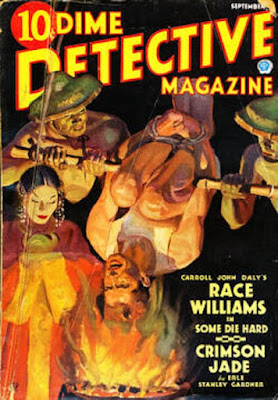
Sunday Morning Bonus Pulp: Dime Detective, September 1935


That's a pretty gruesome but certainly effective cover by Walter Baumhofer on this issue of DIME DETECTIVE. And as usual, the lineup of writers inside can't be beat: Carroll John Daly (with a Race Williams novella), Erle Stanley Gardner, Norvell W. Page, Cornell Woolrich, and O.B. Myers, best remembered these days for his stories in the aviation pulps but also a prolific author of detective yarns.

Friday, September 10, 2021

Fright - Cornell Woolrich


(This post originally appeared in somewhat different form on September 22, 2007.)

I’ve been a Cornell Woolrich fan ever since I encountered reprints of some of his pulp stories in EQMM and THE SAINT MYSTERY MAGAZINE during the Sixties. I’ve read many of his short stories and novelettes and enjoyed them all, but only a couple of his novels, the justly-famous THE BRIDE WORE BLACK and DEADLINE AT DAWN, which I also enjoyed. Until now. I’ve just read the recent Hard Case Crime reprint of Woolrich’s novel FRIGHT, originally published in 1950 under the pseudonym George Hopley.


FRIGHT is one of Woolrich’s historical suspense novels, set in 1915 and 1916, and he does a fine job of recreating that era without going overboard on the historical details. The very strait-laced attitudes of the time period play a part in the plot, too, helping to drive the protagonist to do the things he does. It’s difficult to go into detail about that plot without giving away too much, but let’s just say there’s blackmail, murder, paranoia, more murder, doomed love, more murder, and tragedy galore. Pretty much the essence of noir, in other words, and all told in smooth, if slightly old-fashioned prose that keeps the reader turning the pages. Yes, the coincidences and lapses in logic that Woolrich is notorious for can be found in FRIGHT, but as usual the writing and the raw emotional torment he inflicts on his characters more than make up for any flaws. There are passages in this book that I found genuinely disturbing, and I’m usually not easily disturbed by fiction. FRIGHT is one of the bleakest books I’ve read in a long time.

It’s also one of the best, and I have a feeling that it just might start me on a Woolrich binge. I don’t know if my heart can take it, though.

(Update: There was no Woolrich binge. In the almost fourteen years since this post first appeared, I've read one of Woolrich's novels, THE BLACK ANGEL, and a few of his short stories. That's it. I still really like his work and plan to read more of it, but you know how it is. Road to hell, good intentions, etc., etc. . . .)

Sunday, January 26, 2020

Sunday Morning Bonus Pulp: Dime Detective, November 15, 1934


That may not be the most politically correct cover you'll ever see, but dang, it catches the eye, as do the names of the writers inside. DIME DETECTIVE always had strong lineups during this era, and this issue is a good example: Frederick Nebel, Cornell Woolrich, Max Brand, and T.T. Flynn, along with the lesser-known Eric Taylor and Sam Powell. The cover is by John Newton Howitt, who did many of the covers for THE SPIDER and the Popular Publications Weird Menace titles.

Sunday, February 03, 2019

Sunday Morning Bonus Pulp: Detective Fiction Weekly, August 18, 1934


I'll bet Fred MacIsaac's serial (Part 1 of 5 in this issue) isn't as funny as STRIP FOR MURDER, the similarly themed Shell Scott novel by Richard S. Prather, but the title is still intriguing. Just the idea seems unusually racy for DETECTIVE FICTION WEEKLY. Elsewhere in this issue are stories by Cornell Woolrich, J. Allan Dunn, Laurence Donovan, Richard Howells Watkins, and John H. Knox, so it looks pretty good.

Sunday, February 25, 2018

Sunday Morning Bonus Pulp: Dime Detective, April 1, 1935


What a great cover by Walter Baumhofer on this issue of DIME DETECTIVE. Inside are stories by some of the top pulpsters: T.T. Flynn, Hugh B. Cave, Cornell Woolrich, John K. Butler, and Edward Parrish Ware. DIME DETECTIVE deserves its reputation as one of the very best pulps.

Sunday, December 17, 2017

Sunday Morning Bonus Pulp: Argosy, November 7, 1936


"A Novel of Strange Adventure" says the cover blurb about the lead novel in this issue of ARGOSY, and it's got a strange but effective cover to go with it. The mid-Thirties was the best era for ARGOSY, in my opinion. This issue features stories by Donald Barr Chidsey, Cornell Woolrich, Richard Wormser, L. Ron Hubbard, Murray Leinster, and George Bruce. Martin McCall, the by-line on "The Last Crusade", was a house-name. E. Hoffmann Price used the name on the Matala series published in RED STAR ADVENTURES a few years later, but I believe that was the only time. So as far as I know, the real author of this serial is unknown.

Sunday, September 10, 2017

Sunday Morning Bonus Pulp: Dime Detective, September 1935


Some days Norman Saunders is my favorite pulp cover artist; some days it's Walter Baumhofer. Today is a Baumhofer day. That's a really striking, evocative cover, and the authors inside this issue ain't bad, either: Carroll John Daly (with a Race Williams story), Erle Stanley Gardner, Norvell Page (a Ken Carter story), and Cornell Woolrich. As I've said many times before, just another day at the newsstand during the pulp era.

Sunday, September 06, 2015

Sunday Morning Bonus Pulp: Double Detective, November 1937


I'm often amazed at the table of contents in some of these pulps. Like this one: stories by Leslie Charteris (a Saint yarn), Max Brand, Cornell Woolrich, Richard Sale, Cleve F. Adams, Roger Torrey, Dale Clark, and Walter Ripperger. That's all. Just a normal issue in those days.

Monday, February 10, 2014

Monday Morning Digest Magazine: Manhunt, January 1953


This is the first issue of the iconic crime fiction magazine, and it's also an issue I used to own. I read it about twenty years ago. And what an issue it is, with part one of a serial by Mickey Spillane and stories by William Irish (Cornell Woolrich), Kenneth Millar (better known as Ross Macdonald), a Shell Scott story by Richard S. Prather, Evan Hunter, and Frank Kane. Oddly enough, considering that all-star line-up, the story I remember liking the best was a novelette by the now largely forgotten Floyd Mahannah. But here's what really interests me about this issue now: there's another story, and it's by none other than Charles Beckman Jr., also known as Charles Boeckman, still alive, still writing, and a pulp legend I'm proud to call my friend, something that never would have entered my mind when I read this issue all those years ago.

Friday, April 05, 2013

Forgotten Books: The Black Angel - Cornell Woolrich

This post originally appeared in slightly different form on November 10, 2007.

THE BLACK ANGEL is part of Cornell Woolrich's famous “Black” series. They all have the world “Black” in the title, beginning with THE BRIDE WORE BLACK, but other than that they’re not connected.

THE BLACK ANGEL is narrated by Alberta Murray, a young woman whose husband Kirk always calls her Angel Face. Alberta thinks everything in her life is going along just fine (always a warning sign) until she suddenly discovers that her husband is having an affair. Worse yet, he’s planning to leave her and run off with the other woman. Alberta goes to the woman’s apartment to confront her, and yep, you guessed it, her husband’s mistress is dead, smothered with a pillow. Worse still, the cops arrest Kirk and charge him with the murder. In short order, he’s convicted and sentenced to death, and Alberta has less than three months until her husband’s execution to find the real killer and clear his name. Luckily, she just happens to have an address book she picked up in the murdered woman’s apartment, and a match book with the letter M engraved on it, pointing to the real killer. All she has to do is investigate everybody in the address book whose last name starts with M to find out who really killed her husband’s mistress and save him from the electric chair.

Yes, this book has its share of the coincidences and far-fetched plot developments that Woolrich’s work is famous for, but it also generates a considerable amount of suspense as Alberta searches for the murderer. Its structure is rather episodic, as she investigates each of the suspects in turn and the plot gets more and more complicated. Woolrich springs a nice reverse at the end that you’ll probably see coming. I did, but I enjoyed it anyway. And the final scene of the story has a sting of its own.

You could spend all day pointing out the flaws in Woolrich’s plotting, and his writing can be breathless and melodramatic at times. But nobody is better at using the emotions of his characters to capture the readers and sweep them along in a story. He’s also one of the best at utilizing the backdrop of seedy hotels and sleazy nightclubs and making that setting almost as much a character in his stories and novels as his human protagonists are. THE BLACK ANGEL is especially strong in that area. It’s a fine novel, and highly recommended by me. (I love that cover from '68 Ace edition, too.)