Sunday, April 30, 2017
Sunday Morning Bonus Pulp: F.B.I. Detective Stories, June 1949
Another great Norman Saunders cover graces this issue of F.B.I. DETECTIVE STORIES, a very late G-Man pulp. Inside are stories by some well-known authors: John D. MacDonald, Bruce Cassiday, Paul W. Fairman, Roe Richmond, Hank Searls, and Tedd Thomey. Richmond was best known for Westerns, of course. I don't think I've read anything by him in any other genre. Hank Searls was a bestseller for a while with mainstream novels like THE CROWDED SKY and THE PILGRIM PROJECT. Tedd Thomey wrote some celebrity biographies as well as a few hardboiled crime novels for Gold Medal, Signet, and Ace. I think it's safe to say Paul Fairman is best known for editing and writing science fiction, but probably his most successful novels in terms of sales were the historical romances he wrote late in life as Paula Fairman. (He died after doing a couple of these, but the pseudonym lived on in a bunch of books ghostwritten by a friend of mine.) Cassidy wrote for the mystery digests and did some paperbacks. Then there's John D. MacDonald, and I think we all know what he went on to do after the pulp market dried up. That's a pretty impressive line-up all the way around.
Saturday, April 29, 2017
Saturday Morning Western Pulp: All Western, June 1942
This is a pulp I own and read recently. I've read only a few
issues of ALL WESTERN, Dell's main entry into the Western field, but they's all
been good. The July 1942 issue is no exception.
It gets underway with a novella by Ed Earl Repp, "Too Tough to Kill". Repp was notorious for farming out his work to other writers (find a copy of the essay "Tarzana Nights" by Frank Bonham if you don't believe me), so there's no telling who wrote at least the first draft of this one. Repp supposedly revised those ghosted tales to varying degrees, and this story sounds to me like what I think of as a typical Ed Earl Repp yarn. The plot is an old one: a youngster raised by a gang of outlaws, all the while unaware that the boss owlhoot is responsible for the murder of the rest of his family. There's a slightly unusual aspect to the plot in that one character winds up with amnesia. And there's a character unfortunately named Lobo Maverick, which is too over-the-top and corny even for an Ed Earl Repp story. The prose is really purple in the action scenes and the resolution borders on maudlin. But here's the thing (and you knew I was getting around to this), I still had a great time reading this story. For some reason, Repp can always make me buy into all that gun-blazing melodrama. The late Jon Tuska speculated that Repp never actually wrote anything, that all his stories were ghosted. I can't bring myself to believe that. I think he had a hand in most, if not all, of them, because they demonstrate a consistent sincerity that I don't think would be there if they were solely the work of ghost writers. Repp's stories, if you stop and think about them, are mostly ridiculous, but he believed in them, by God, and that feeling makes me believe in—and enjoy—them, too.
Fredric Sinclair is an author who's unfamiliar to me. A check of the Fictionmags Index reveals that he published a couple of dozen stories in the Western and detective pulps from the late Thirties to the late Forties. His short story "Night Boat" in this issue is a riverboat yarn, about a gambler who encounters the son of an old friend who is out for vengeance and has to choose whether to help him or mind his own business. This is a good story with some emotional complexity to it. No real action, but that's okay now and then. I'd read more stories by Sinclair if I came across them.
Frank Carl Young is as unknown to me as Fredric Sinclair, but he appears to have published dozens of Westerns stories in many different pulps during the Thirties, Forties, and early Fifties. "No Man Escapes" is also a vengeance yarn, of sorts, as a gunsmith who was fast on the draw in his early days goes looking for a marshal to clean up a lawless town and encounters something he didn't expect. Although there's a bit of action at the end, for the most part this is a character-driven story. It's well written but decidedly low-key.
"Silver Dust Assay" is a rather bland title for what is a pretty good story. The protagonist is an assayer, an offbeat job for a Western pulp hero. When there's a silver strike near the town where he does business, it looks good for him, but there's more to the strike than meets the eye, and discovering the truth may put the assayer in deadly danger. This is a well written yarn with some nice action, and I also enjoyed it because it's by one of the few pulp authors I've met, David Lavender, who was at the Western Writers of America convention in Oklahoma City in 1991. Unfortunately, at that time I knew him only as an award-winning historian and had no idea he had written for the pulps, or else I might have been bending his ear about those days for the entire convention.
Next up is a novella by a very familiar author, Philip Ketchum, who was a prolific pulpster, turning out Westerns, mysteries, and historical yarns, and then followed that up with a long career writing paperback original Westerns. "Stampede on Spanish Valley" suffers a little from having a very stereotypical plot—bad guy trying to take over all the land in a valley for some mysterious reason (that turns out not to be mysterious at all to anybody who's read many Westerns)—but Ketchum's excellent prose lifts it above average, as do his well-rounded and emotionally complex characters: a gunman out for revenge on his former partner, a gambler and his unfaithful wife, a woman married to her brother's murderer, and others who make this tale seem fresher than it had any right to be. Not in the top rank of Ketchum's work but still very entertaining.
I haven't read much by George Cory Franklin, but he seems to be a pretty good writer. "Smoky Goes to War" has an animal as the protagonist, a type of story I usually don't like much, but this yarn won me over. It's also a contemporary Western, set in the early days of World War II. Smoky is a mule owned by a cowboy on a ranch in the Southwest which is near an army training camp. The cowboy, unable to enlist because of his physical condition, offers Smoky in his place to help the war effort. The mule is used for practice in packing supplies at the training camp, but along the way he sniffs out a Fifth Columnist bent on murder and sabotage. This is a really entertaining and well-written story.
Quite a few pulp authors wrote fictionalizations of the Battle of the Little Big Horn, usually by adding fictional characters who go along with Custer and the Seventh Cavalry. Wes Fargo does that in the novella "The Glory Trail", but while Custer does play a part early on, the massacre itself takes place off-screen while the action follows Dave Howell, a former riverboat pilot/trapper/army scout who is framed for running guns to the Indians. He winds up with Reno and Benteen and then on the steamer Far West, the first riverboat to reach the scene of the battle. Wes Fargo was really E.B. Mann, a prolific and well-regarded pulpster, and it's easy to see why he was popular. His writing is very smooth and effective, and he seems to get his historical details right in this one. This is only the second story I've read by Mann, but I liked both of them quite a bit and need to read some of his novels.
C. William Harrison wrote more than a hundred stories for the Western pulps (and some detective pulps as well) from the mid-Thirties to the mid-Fifties, then went on to a career as a paperback Western author under the names Will Hickok and Coe Williams. Oddly enough, he wrote one novel each in the Jim Hatfield, Rio Kid, Masked Rider, and Range Riders series. I've read quite a bit of his work and usually liked it. His prose has a nice hardboiled tone. That's true in "When Wolves Fall Out", which finds two outlaws vying for the leadership of a gang following a raid on a town and the kidnapping of a young woman. There's also a third mysterious owlhoot horning in on things. This reminded me of a Walt Coburn yarn because it has a lot of back-story and secrets to be revealed. I found it very entertaining.
John C. Colohan was a stalwart of the Western pulps from the late Twenties through the mid-Fifties. He was especially prolific for the Popular Publications pulps but his work appeared in many magazines from other publishers. His story "The Man on the Yellow Horse" wraps up this issue of ALL WESTERN. The rancher protagonist, who is in town picking up supplies, catches an outlaw fleeing from a botched robbery and a shooting, but when he takes off the fugitive's mask, he gets a surprise that causes him to turn detective and risk his life catching a killer. It's not much of a mystery, but Colohan tries and his writing is nice and smooth. There's a good supporting character, too, a hired gun who would probably be played by Jack Elam if this was a movie.
Overall, there's not a bad story in the bunch. No real stand-outs, but they're all good to very good, just solid pulp stories that make for some fine reading. As usual when I can manage it, the scan is from the actual issue I read, complete with some writing on it by a previous owner.

It gets underway with a novella by Ed Earl Repp, "Too Tough to Kill". Repp was notorious for farming out his work to other writers (find a copy of the essay "Tarzana Nights" by Frank Bonham if you don't believe me), so there's no telling who wrote at least the first draft of this one. Repp supposedly revised those ghosted tales to varying degrees, and this story sounds to me like what I think of as a typical Ed Earl Repp yarn. The plot is an old one: a youngster raised by a gang of outlaws, all the while unaware that the boss owlhoot is responsible for the murder of the rest of his family. There's a slightly unusual aspect to the plot in that one character winds up with amnesia. And there's a character unfortunately named Lobo Maverick, which is too over-the-top and corny even for an Ed Earl Repp story. The prose is really purple in the action scenes and the resolution borders on maudlin. But here's the thing (and you knew I was getting around to this), I still had a great time reading this story. For some reason, Repp can always make me buy into all that gun-blazing melodrama. The late Jon Tuska speculated that Repp never actually wrote anything, that all his stories were ghosted. I can't bring myself to believe that. I think he had a hand in most, if not all, of them, because they demonstrate a consistent sincerity that I don't think would be there if they were solely the work of ghost writers. Repp's stories, if you stop and think about them, are mostly ridiculous, but he believed in them, by God, and that feeling makes me believe in—and enjoy—them, too.
Fredric Sinclair is an author who's unfamiliar to me. A check of the Fictionmags Index reveals that he published a couple of dozen stories in the Western and detective pulps from the late Thirties to the late Forties. His short story "Night Boat" in this issue is a riverboat yarn, about a gambler who encounters the son of an old friend who is out for vengeance and has to choose whether to help him or mind his own business. This is a good story with some emotional complexity to it. No real action, but that's okay now and then. I'd read more stories by Sinclair if I came across them.
Frank Carl Young is as unknown to me as Fredric Sinclair, but he appears to have published dozens of Westerns stories in many different pulps during the Thirties, Forties, and early Fifties. "No Man Escapes" is also a vengeance yarn, of sorts, as a gunsmith who was fast on the draw in his early days goes looking for a marshal to clean up a lawless town and encounters something he didn't expect. Although there's a bit of action at the end, for the most part this is a character-driven story. It's well written but decidedly low-key.
"Silver Dust Assay" is a rather bland title for what is a pretty good story. The protagonist is an assayer, an offbeat job for a Western pulp hero. When there's a silver strike near the town where he does business, it looks good for him, but there's more to the strike than meets the eye, and discovering the truth may put the assayer in deadly danger. This is a well written yarn with some nice action, and I also enjoyed it because it's by one of the few pulp authors I've met, David Lavender, who was at the Western Writers of America convention in Oklahoma City in 1991. Unfortunately, at that time I knew him only as an award-winning historian and had no idea he had written for the pulps, or else I might have been bending his ear about those days for the entire convention.
Next up is a novella by a very familiar author, Philip Ketchum, who was a prolific pulpster, turning out Westerns, mysteries, and historical yarns, and then followed that up with a long career writing paperback original Westerns. "Stampede on Spanish Valley" suffers a little from having a very stereotypical plot—bad guy trying to take over all the land in a valley for some mysterious reason (that turns out not to be mysterious at all to anybody who's read many Westerns)—but Ketchum's excellent prose lifts it above average, as do his well-rounded and emotionally complex characters: a gunman out for revenge on his former partner, a gambler and his unfaithful wife, a woman married to her brother's murderer, and others who make this tale seem fresher than it had any right to be. Not in the top rank of Ketchum's work but still very entertaining.
I haven't read much by George Cory Franklin, but he seems to be a pretty good writer. "Smoky Goes to War" has an animal as the protagonist, a type of story I usually don't like much, but this yarn won me over. It's also a contemporary Western, set in the early days of World War II. Smoky is a mule owned by a cowboy on a ranch in the Southwest which is near an army training camp. The cowboy, unable to enlist because of his physical condition, offers Smoky in his place to help the war effort. The mule is used for practice in packing supplies at the training camp, but along the way he sniffs out a Fifth Columnist bent on murder and sabotage. This is a really entertaining and well-written story.
Quite a few pulp authors wrote fictionalizations of the Battle of the Little Big Horn, usually by adding fictional characters who go along with Custer and the Seventh Cavalry. Wes Fargo does that in the novella "The Glory Trail", but while Custer does play a part early on, the massacre itself takes place off-screen while the action follows Dave Howell, a former riverboat pilot/trapper/army scout who is framed for running guns to the Indians. He winds up with Reno and Benteen and then on the steamer Far West, the first riverboat to reach the scene of the battle. Wes Fargo was really E.B. Mann, a prolific and well-regarded pulpster, and it's easy to see why he was popular. His writing is very smooth and effective, and he seems to get his historical details right in this one. This is only the second story I've read by Mann, but I liked both of them quite a bit and need to read some of his novels.
C. William Harrison wrote more than a hundred stories for the Western pulps (and some detective pulps as well) from the mid-Thirties to the mid-Fifties, then went on to a career as a paperback Western author under the names Will Hickok and Coe Williams. Oddly enough, he wrote one novel each in the Jim Hatfield, Rio Kid, Masked Rider, and Range Riders series. I've read quite a bit of his work and usually liked it. His prose has a nice hardboiled tone. That's true in "When Wolves Fall Out", which finds two outlaws vying for the leadership of a gang following a raid on a town and the kidnapping of a young woman. There's also a third mysterious owlhoot horning in on things. This reminded me of a Walt Coburn yarn because it has a lot of back-story and secrets to be revealed. I found it very entertaining.
John C. Colohan was a stalwart of the Western pulps from the late Twenties through the mid-Fifties. He was especially prolific for the Popular Publications pulps but his work appeared in many magazines from other publishers. His story "The Man on the Yellow Horse" wraps up this issue of ALL WESTERN. The rancher protagonist, who is in town picking up supplies, catches an outlaw fleeing from a botched robbery and a shooting, but when he takes off the fugitive's mask, he gets a surprise that causes him to turn detective and risk his life catching a killer. It's not much of a mystery, but Colohan tries and his writing is nice and smooth. There's a good supporting character, too, a hired gun who would probably be played by Jack Elam if this was a movie.
Overall, there's not a bad story in the bunch. No real stand-outs, but they're all good to very good, just solid pulp stories that make for some fine reading. As usual when I can manage it, the scan is from the actual issue I read, complete with some writing on it by a previous owner.
Friday, April 28, 2017
Forgotten Books: Horde of Hated Men - Phil Richards
Good guy outlaws Kid Calvert and Calvert's Horde are
back in the pages of WESTERN ACES with the February 1935 issue, in the novel
(more like a novella) "Horde of Hated Men". There's a new author as
well, with a little-known pulpster named Phil Richards replacing Lawrence A.
Keating, who wrote the first Kid Calvert novel published the previous November. This installment opens with the Horde racing to rescue one of their
own, gambler Dandy McLain, who has been framed for murder and is about to be
strung up by a lynch mob. Needless to say, the Kid and his friends are able to
save Dandy, and then they plunge into trying to solve the mystery of who is
killing miners in the boomtown of Beaver Creek. While this is going on, the Kid
also has to deal with his doomed romance with Terry Reynolds, the beautiful
young woman who has taken over as sheriff from her late father.
This is about as slam-bang a Western pulp yarn as you'd ever want to read, full of shootouts, fistfights, narrow escapes, and races with death. There's also a fairly clever murder method. I spotted the real killer, but it took me a while. Richards, who wrote a couple of hundred Western, detective, and sports stories for the pulps between the mid-Twenties and the mid-Fifties without ever attracting much notice, has a really breathless, breakneck style that reminded me a little of Leslie Scott's work, although not as heavily descriptive.
The Masked Rider was sometimes referred to as The Robin Hood Outlaw, but that description actually fits Kid Calvert quite a bit better. The Masked Rider had only his Yaqui sidekick Blue Hawk. The Kid's got his whole Horde, a band of Old West merry men that includes Giant Anderson (aptly named since he's a really big guy), dour gunslinger Nate Willstock, the above-mentioned Dandy McClain, soft-spoken oldster Grama Sinton, and boozehound cook Peel Rogers. Characterization never goes much beyond those shorthand descriptions, but they're all likable galoots.
All five novels in the Kid Calvert series have been reprinted in a single volume by Altus Press, and if you're a fan of the Western pulps, especially the more action-packed variety, I think they're worth reading. At least the first two have been, and I'll be getting to the others in due time as well.
By the way, the great cover on that issue of WESTERN ACES is by Rafael DeSoto.
This is about as slam-bang a Western pulp yarn as you'd ever want to read, full of shootouts, fistfights, narrow escapes, and races with death. There's also a fairly clever murder method. I spotted the real killer, but it took me a while. Richards, who wrote a couple of hundred Western, detective, and sports stories for the pulps between the mid-Twenties and the mid-Fifties without ever attracting much notice, has a really breathless, breakneck style that reminded me a little of Leslie Scott's work, although not as heavily descriptive.
The Masked Rider was sometimes referred to as The Robin Hood Outlaw, but that description actually fits Kid Calvert quite a bit better. The Masked Rider had only his Yaqui sidekick Blue Hawk. The Kid's got his whole Horde, a band of Old West merry men that includes Giant Anderson (aptly named since he's a really big guy), dour gunslinger Nate Willstock, the above-mentioned Dandy McClain, soft-spoken oldster Grama Sinton, and boozehound cook Peel Rogers. Characterization never goes much beyond those shorthand descriptions, but they're all likable galoots.
All five novels in the Kid Calvert series have been reprinted in a single volume by Altus Press, and if you're a fan of the Western pulps, especially the more action-packed variety, I think they're worth reading. At least the first two have been, and I'll be getting to the others in due time as well.
By the way, the great cover on that issue of WESTERN ACES is by Rafael DeSoto.
Wednesday, April 26, 2017
Now Available for Pre-Order: Blaze! Copper Mountain Kill - Brian Drake
Acclaimed thriller author Brian Drake (THE TERMINATION PROTOCOL) joins the Blaze! team with a novel packed with excitement and mile-a-minute action. COPPER MOUNTAIN KILL is Western adventure at its finest.
Tuesday, April 25, 2017
Overlooked Movies: Lady on a Train (1945)
I guess I've heard of Deanna Durbin about as far back
as I can remember, but I've never seen one of her movies until now. It's not a
musical like most of the other films she made, although there are several
musical numbers since part of the story is set in a nightclub. Rather, it's a
mystery comedy, with Durbin playing a rich young woman from San Francisco who's
come to New York to visit her aunt over the Christmas holiday. While her train
is stopped on the outskirts of the city, she happens to witness what appears to
be a murder in a building alongside the tracks. She's also a fan of mystery
novels and is reading one called THE CASE OF THE HEADLESS BLONDE (sounds like a
Perry Mason novel to me).
But no, the book is actually by a writer named Wayne Morgan (played by David Bruce), who happens to live in New York City, and when the body disappears and the cops don't believe Durbin, she hunts him up and demands that he help her solve the crime. Then she realizes the man she saw murdered is really a wealthy shipping magnate, and a clandestine visit to his estate in the country results in Durbin being mistaken for the man's mistress, a nightclub singer involved with gangsters, and during that same excursion she also meets the members of the murdered man's family, which include the sinister Dan Duryea and ever stalwart and boring Ralph Bellamy. She keeps investigating, continues to pose as the nightclub singer, and makes life miserable but interesting for the mystery novelist before they work together, fall in love, and uncover the murderer's identity. (It probably won't come as much of a surprise to most of you.)
This is lightweight fluff, but boy, is it entertaining lightweight fluff! The script hardly ever slows down to take a breath, and since one of the characters is a writer, there are some funny bits about the publishing business. Leslie Charteris provided the original story, and it has his usual breeziness to it. The supporting cast, which includes William Frawley, Edward Everett Horton, Allen Jenkins, and George Couloris, is very good. Durbin is cute as can be as the spoiled but spunky society gal who's determined to solve a murder. We have a couple more of her movies and I'm sure we'll watch them fairly soon.
By the way, this movie is set at Christmas, as I mentioned above, but other than a quick glimpse of a Christmas tree here and there, the holiday doesn't play any real part in what's going on. Otherwise I might have saved this post for December.
But no, the book is actually by a writer named Wayne Morgan (played by David Bruce), who happens to live in New York City, and when the body disappears and the cops don't believe Durbin, she hunts him up and demands that he help her solve the crime. Then she realizes the man she saw murdered is really a wealthy shipping magnate, and a clandestine visit to his estate in the country results in Durbin being mistaken for the man's mistress, a nightclub singer involved with gangsters, and during that same excursion she also meets the members of the murdered man's family, which include the sinister Dan Duryea and ever stalwart and boring Ralph Bellamy. She keeps investigating, continues to pose as the nightclub singer, and makes life miserable but interesting for the mystery novelist before they work together, fall in love, and uncover the murderer's identity. (It probably won't come as much of a surprise to most of you.)
This is lightweight fluff, but boy, is it entertaining lightweight fluff! The script hardly ever slows down to take a breath, and since one of the characters is a writer, there are some funny bits about the publishing business. Leslie Charteris provided the original story, and it has his usual breeziness to it. The supporting cast, which includes William Frawley, Edward Everett Horton, Allen Jenkins, and George Couloris, is very good. Durbin is cute as can be as the spoiled but spunky society gal who's determined to solve a murder. We have a couple more of her movies and I'm sure we'll watch them fairly soon.
By the way, this movie is set at Christmas, as I mentioned above, but other than a quick glimpse of a Christmas tree here and there, the holiday doesn't play any real part in what's going on. Otherwise I might have saved this post for December.
Monday, April 24, 2017
Edge of the City - S.A. Bailey
S.A. Bailey's debut novel AND THE RAIN CAME DOWN was
as good a traditional private eye yarn as I've read in recent years, and the
second book in the Jeb Shaw series, THE LINES WE CROSS, was just as strong. Now
Jeb is back in EDGE OF THE CITY, which blends the hardboiled detective elements
with pure action/adventure to create an epic tale of corruption and violence.
Jeb is hired to find out who's trying to kill a Dallas politician who has a long history of graft, infidelity, and racial rabble-rousing. This ties in a young gang member Jeb was forced to shoot during an armed robbery, a politically powerful mega-church, a couple of former professional football players, a kidnapping, a rape, an international business deal gone bad, and assorted other motives for murder and mayhem. Jeb sorts through it all in fine private eye style, but then the final section of book deals with his efforts—along with some friends and associates—to deliver a witness who will break the case wide open to the Feds, even though they're outnumbered by enemies who are willing to turn Dallas into a war zone.
The plot of EDGE OF THE CITY is complex and well put together, and the action scenes have a gritty authenticity that elevates them from standard shootouts. Bailey really nails the political and criminal landscape of Dallas, as well. But what sets this book apart, as it did the others in the series, is Jeb himself and the distinctive voice that Bailey gives him as narrator and protagonist. Jeb has his flaws and plenty of them, but he also manages to be thoroughly sympathetic, a guy you can't help but root for even while he's messing up his life. And there's certainly no one else better to have on your side if you're in trouble. EDGE OF THE CITY is bloody, profane, tragic, and all kinds of politically incorrect. But it's also smart and funny and poignant when it needs to be. Highly recommended.
Jeb is hired to find out who's trying to kill a Dallas politician who has a long history of graft, infidelity, and racial rabble-rousing. This ties in a young gang member Jeb was forced to shoot during an armed robbery, a politically powerful mega-church, a couple of former professional football players, a kidnapping, a rape, an international business deal gone bad, and assorted other motives for murder and mayhem. Jeb sorts through it all in fine private eye style, but then the final section of book deals with his efforts—along with some friends and associates—to deliver a witness who will break the case wide open to the Feds, even though they're outnumbered by enemies who are willing to turn Dallas into a war zone.
The plot of EDGE OF THE CITY is complex and well put together, and the action scenes have a gritty authenticity that elevates them from standard shootouts. Bailey really nails the political and criminal landscape of Dallas, as well. But what sets this book apart, as it did the others in the series, is Jeb himself and the distinctive voice that Bailey gives him as narrator and protagonist. Jeb has his flaws and plenty of them, but he also manages to be thoroughly sympathetic, a guy you can't help but root for even while he's messing up his life. And there's certainly no one else better to have on your side if you're in trouble. EDGE OF THE CITY is bloody, profane, tragic, and all kinds of politically incorrect. But it's also smart and funny and poignant when it needs to be. Highly recommended.
Sunday, April 23, 2017
Sunday Morning Bonus Pulp: Alibi, March 1934
Walker Martin mentioned this short-lived pulp in the comments on last Sunday's post, so I thought, why not feature the cover he was talking about, another that features a decapitated head? It is indeed a gruesome cover, and none of the authors in this issue are familiar to me except for Franklin H. Martin. The covers of the other issues of ALIBI aren't all that appealing, either. I can see why the magazine didn't last very long. But it's still an interesting oddity.
Saturday, April 22, 2017
Saturday Morning Western Pulp: Star Western, January 1950
The last few
years of its existence, STAR WESTERN rather blatantly went after the RANCH
ROMANCES readers. Not only do all the covers prominently feature female
characters, most of the story titles do, too, such as this issue from January
1950. You've got "The Strip's Too Hot for Blondes!" by Leslie
Ernenwein, "Girl Strike in Jubilee" by Joseph Chadwick, "Bride
of the Killer Legion" by Talmage Powell, "The Queen, the Wench, and
the Devil" by Ray Townsend, "Two Roses for Dead Man's Range" by
Dean Owen (Dudley Dean McGaughey), "Girl for a Fighting Man" by
Everett M. Webber, and "Brand Her Señorita Killer!" by John Jo
Carpenter (John Reese). With those authors, I'll bet most of those stories are
pretty good!
Friday, April 21, 2017
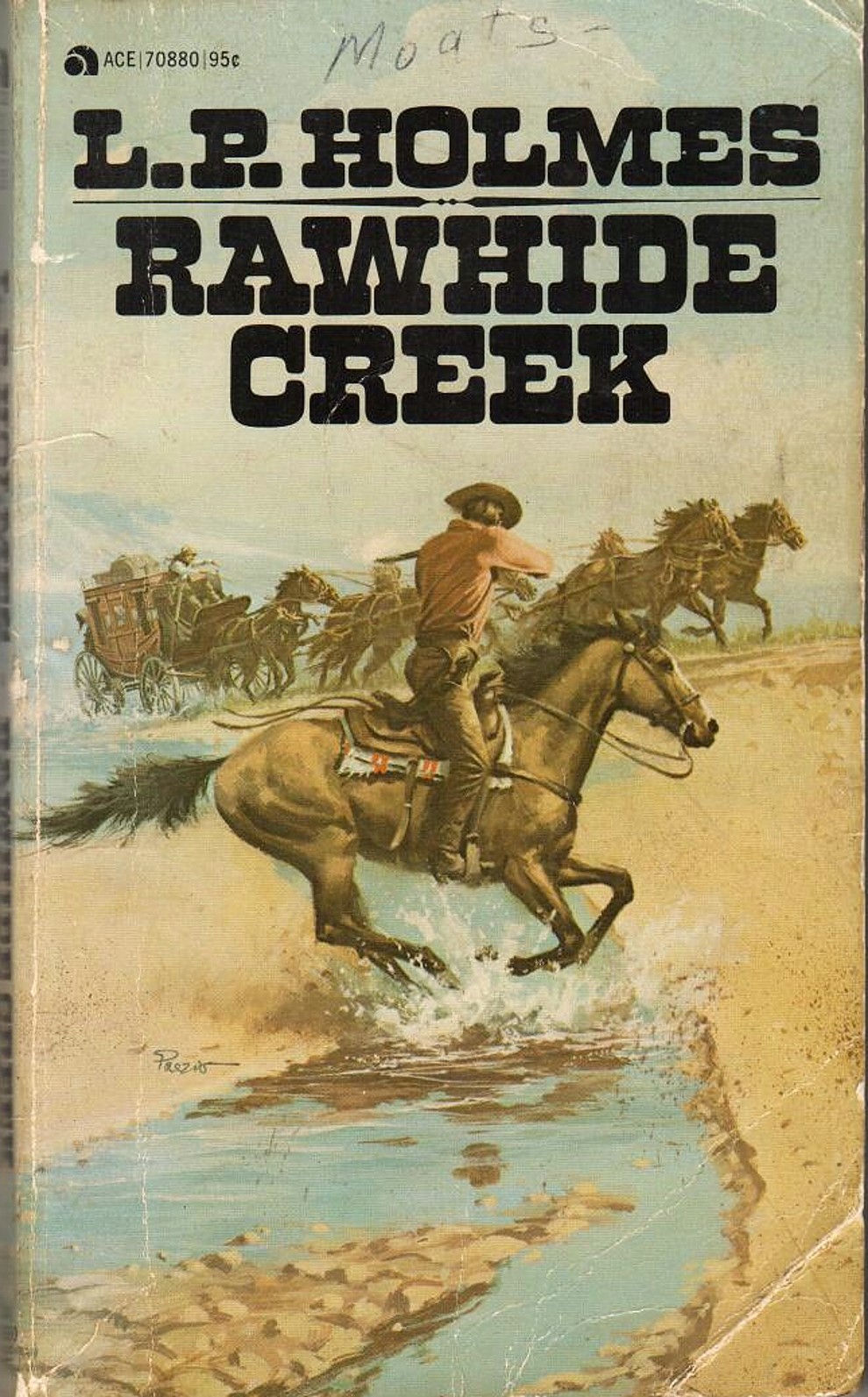
Forgotten Books: Rawhide Creek - L.P. Holmes
RAWHIDE CREEK,
published as a paperback original by Ace Books in 1975, appears to have been
the final novel in L.P. Holmes' fifty year career. It's certainly not a bad way
to go out. The protagonist, Cleve Ellerson, is a down-on-his-luck hired gun who
wants to put that way of life behind him. Recuperating from a wound suffered in
a gunfight with a crooked gambler, he heads for the mining boomtown of Rawhide
Creek, figuring it might be a good place to start over. An accident leaves the
stagecoach without a driver, so Ellerson takes over the reins, meets a
good-looking young woman who's also on her way to Rawhide Creek, and comes upon
another stagecoach, headed the other way, that's been held up. Driver and
shotgun guard are both dead.
When he gets to the settlement, Ellerson winds up taking a job with the stage line and discovers that Rawhide Creek is teeming with claim jumpers and gunmen, all of them working for saloon owner Duke Ackerman. Ellerson sticks up for the honest folks of the town, which sets up an inevitable violent showdown between the forces of good and evil.
You've probably guessed by now that there's nothing in RAWHIDE CREEK that hasn't been done hundreds of times before, by Holmes and many other Western authors who were prolific pulpsters and then moved into novels with the demise of the pulps. And if you're a regular reader of this blog, you also know that I don't care. Holmes was such a good writer that he made these old plots fresh and entertaining, at least as far as I'm concerned. Cleve Ellerson is a very likable hero, his new friends (the stage line owner and an old drunk) provide fine support, the villains are numerous and suitably despicable, and the low-key romance between Ellerson and the girl from the stage (the sister of the local café owner) is sweet without being syrupy. There are a few continuity glitches that a good editor should have fixed, but other than that RAWHIDE CREEK is the same sort of top-notch work Holmes did for five decades. I had a very good time reading it. (And the scan above is the copy I read, apparently owned at some point in its life by somebody named Moats.)
When he gets to the settlement, Ellerson winds up taking a job with the stage line and discovers that Rawhide Creek is teeming with claim jumpers and gunmen, all of them working for saloon owner Duke Ackerman. Ellerson sticks up for the honest folks of the town, which sets up an inevitable violent showdown between the forces of good and evil.
You've probably guessed by now that there's nothing in RAWHIDE CREEK that hasn't been done hundreds of times before, by Holmes and many other Western authors who were prolific pulpsters and then moved into novels with the demise of the pulps. And if you're a regular reader of this blog, you also know that I don't care. Holmes was such a good writer that he made these old plots fresh and entertaining, at least as far as I'm concerned. Cleve Ellerson is a very likable hero, his new friends (the stage line owner and an old drunk) provide fine support, the villains are numerous and suitably despicable, and the low-key romance between Ellerson and the girl from the stage (the sister of the local café owner) is sweet without being syrupy. There are a few continuity glitches that a good editor should have fixed, but other than that RAWHIDE CREEK is the same sort of top-notch work Holmes did for five decades. I had a very good time reading it. (And the scan above is the copy I read, apparently owned at some point in its life by somebody named Moats.)
Tuesday, April 18, 2017
Overlooked Movies: The Shakiest Gun in the West (1968)
After Don Knotts left THE ANDY GRIFFITH SHOW (which we never
missed in my house, by the way), he made several movies that I saw at the local
drive-in, like THE GHOST AND MR. CHICKEN and THE INCREDIBLE MR. LIMPET. But
somehow I never saw THE SHAKIEST GUN IN THE WEST, which is a remake of the Bob
Hope movie THE PALEFACE (which I have seen and liked). Watching THE SHAKIEST
GUN IN THE WEST for the first time now is kind of an odd experience. We've
watched quite a few episodes of THE ANDY GRIFFITH SHOW on MeTV lately, and
Knotts is really good as Barney Fife, especially when the scripts give him
something to do other than bluster. On the other hand, he's the second banana
in that show, which is a lot different from having to carry a movie. In other
words, a little of that typical Don Knotts schtick goes a long way.
However, there's more to THE SHAKIEST GUN IN THE WEST than that, and Knotts is good in the more restrained moments. It also has statuesque redhead Barbara Rhoades in it, and while she might not have been a great actress, she was one hell of a statuesque redhead. Elsewhere in the cast, Don "Red" Barry and Jackie Coogan are the villains running guns to the Indians, who are supposed to be Comanches but look more like Heckawi to me. (Bonus points if you remember the Heckawi Indians.) Several other Sixties sitcom supporting actors are on hand, and in fact the whole movie has a very sitcom-ish feel, not surprising considering that the script is by two of the regular writers from THE ANDY GRIFFITH SHOW and the movie was directed by Alan Rafkin, who directed a ton of sitcom episodes. Also showing up briefly is poor old Ed Faulkner, who appeared what seems like hundreds of Westerns, usually getting killed after two or three minutes of screen time and half a dozen lines of dialogue.
Clearly, Don Knotts is no Bob Hope and THE SHAKIEST GUN IN THE WEST is nowhere near as good as THE PALEFACE, but I still had fun watching it and am glad I finally saw it. I probably would have enjoyed it more, though, if I'd seen it at the Eagle Drive-In in 1968.
However, there's more to THE SHAKIEST GUN IN THE WEST than that, and Knotts is good in the more restrained moments. It also has statuesque redhead Barbara Rhoades in it, and while she might not have been a great actress, she was one hell of a statuesque redhead. Elsewhere in the cast, Don "Red" Barry and Jackie Coogan are the villains running guns to the Indians, who are supposed to be Comanches but look more like Heckawi to me. (Bonus points if you remember the Heckawi Indians.) Several other Sixties sitcom supporting actors are on hand, and in fact the whole movie has a very sitcom-ish feel, not surprising considering that the script is by two of the regular writers from THE ANDY GRIFFITH SHOW and the movie was directed by Alan Rafkin, who directed a ton of sitcom episodes. Also showing up briefly is poor old Ed Faulkner, who appeared what seems like hundreds of Westerns, usually getting killed after two or three minutes of screen time and half a dozen lines of dialogue.
Clearly, Don Knotts is no Bob Hope and THE SHAKIEST GUN IN THE WEST is nowhere near as good as THE PALEFACE, but I still had fun watching it and am glad I finally saw it. I probably would have enjoyed it more, though, if I'd seen it at the Eagle Drive-In in 1968.
Subscribe to:
Posts (Atom)