Friday, February 17, 2023

Murder in Music - Cary Moran (Edwin Truett Long)


In a career that lasted approximately ten years, from the mid-Thirties until his death in 1945, Edwin Truett Long wrote hundreds of stories under more than a dozen pseudonyms, mostly for the Spicy pulps. Most of them were stand-alones, but he did a few series as well, including eight stories about Jarnegan, a sheriff’s office detective in a mid-sized city who investigates only homicides. Seven of the stories appeared under the name Cary Moran, while one, for no apparent reason, was published under the name Clint Morgan. MURDER IN MUSIC is a Black Dog Books chapbook from 2006 that reprints four of the Jarnegan stories.

Art by H.L. Parkhurst

“Fatal Facial” is from the September 1936 issue of SPICY DETECTIVE STORIES. The president of one of the local banks has absconded with a fortune in negotiable bonds, and the town is in a tizzy, of course. Jarnegan doesn’t want to investigate the case because he specializes in murders, but he gets a corpse soon enough and it doesn’t take him long to realize that the man’s body—beaten beyond recognition—is connected to the missing bank president. And of course, since this is a story for SPICY DETECTIVE, there are several beautiful babes in various stages of undress mixed up in the business, too.

Art by Delos Palmer

“Murder in Music” (SPICY DETECTIVE STORIES, November 1936) finds Jarnegan investigating the death of a drummer from a jazz band visiting the city. It appears that the man was frightened to death by voodoo. But all is not as it appears, of course, and another band member soon turns up dead, giving Jarnegan two murders to solve.
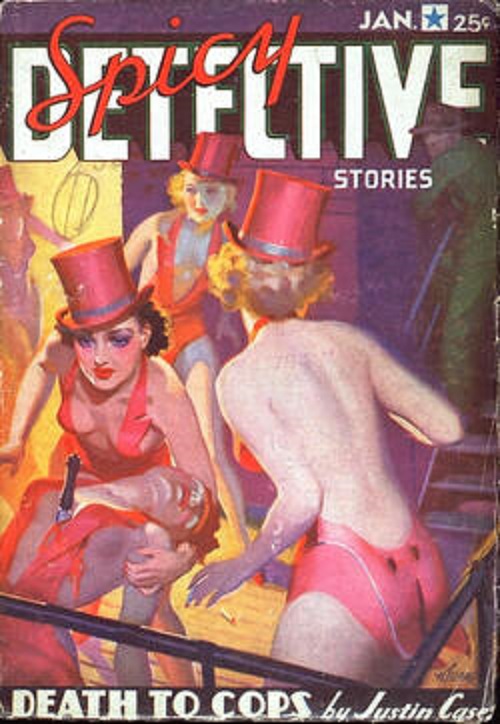
Art by H.J. Ward

From the January 1937 issue of SPICY DETECTIVE STORIES, “Murder in the Sheriff’s Office” centers around a beautiful redheaded taxi dancer who manages to get herself bumped off in, you guessed it, the sheriff’s office when she comes there to say that she fears for her life. With good reason, obviously. And soon there’s a second murder for Jarnegan to investigate, as well. Long managed to pack quite a few homicides in these short stories.

Art by H.J. Ward

“Case of the Limber Corpse”, from the May 1937 issue of SPICY DETECTIVE STORIES, is the final story in the Jarnegan series. In this one, Jarnegan’s investigation into the murder of a munitions magnate is complicated by an angry hillbilly father who wants to force Jarnegan into a shotgun wedding with his daughter . . . and then use that shotgun to blow Jarnegan’s head off. As with the other stories, it’s a fairly complex plot that features another murder and various beautiful, semi-dressed women.

These aren’t fair play mystery stories. With the third person objective style, the reader is seldom if ever privy to Jarnegan’s thoughts and Long blatantly conceals some of the clues. Other clues are introduced and then promptly forgotten, probably a result of the speed with which Long wrote these yarns. However, none of that detracts from the snappy patter, the hardboiled characters and plots, and the headlong pace of the action. I thoroughly enjoyed this collection and wouldn’t mind reading the rest of the stories in the series. Long was an inconsistent writer, but more often than not, I find his stories to be a lot of fun. In looking up his listing on the Fictionmags Index, I noticed that he passed away in 1945, when he was only 41 years old. I’m curious as to why he died so young, and it’s a shame we lost the stories he might have written if he’d lived.

Wednesday, February 15, 2023

Last Stand Mesa - L.L. Foreman


LAST STAND MESA was first published in the February 1951 issue of ZANE GREY’S WESTERN MAGAZINE and then reprinted by Ace Books in 1969 as half of an Ace Double Western, on the other side of Philip Ketchum’s MAD MORGAN’S HOARD, which I read and reviewed last week. Steve Holland lends his iconic visage to the paperback cover by Sol Korby. This is the edition I read, not the magazine version, but as short as the Ace edition is (110 pages), I doubt if Foreman had to expand it much, if any.

The protagonist of this novel is Mike McLean, an outlaw on the dodge after a failed bank robbery. Mike may be an owlhoot, but he’s a decent hombre at heart and he often finds himself in danger because he can’t resist helping folks who are in trouble. In this case, as he’s fleeing a posse in New Mexico Territory, he pauses to rescue an eccentric old tinhorn gambler from a shootout. Throwing in together, they run from trouble . . . but wind up riding right into the middle of a three-cornered range war.

The Triangle T, run by Amery Roone and his gunhawk minions, Roose’s Regulators, wants to force out all the smaller ranchers in the area. Those spreads are targeted by the outlaw gang led by Bloodywire Brokus, as well. Mike McLean sticks up for the underdog, as usual, and tries to help the small ranchers, but the situation is complicated by the fact that the boss outlaw, Brokus, has a beautiful daughter known as the Cheyenne Flame, and Mike falls for her right away.

This is one of those novels where things don’t turn out exactly as you expect them to. Just when it seems like Foreman is setting things up a certain way, the situation reverses. These twists allow Foreman to pack a lot of plot into this book, as well as some good action and excellent characterization. Foreman’s work is usually a tad more eloquent than most pulp Westerns, and LAST STAND MESA is no exception. It’s a very well-written traditional Western that I really enjoyed.

If you want to know more about Foreman, here's an excellent article about him on the Pulp Flakes website. By the way, I wasn’t familiar with cover artist Sol Korby, but looking into his background led me to this interview with him conducted by Michael Stradford. I give both of these high recommendations, as well.

Art by Nicholas S. Firfires


Monday, February 13, 2023

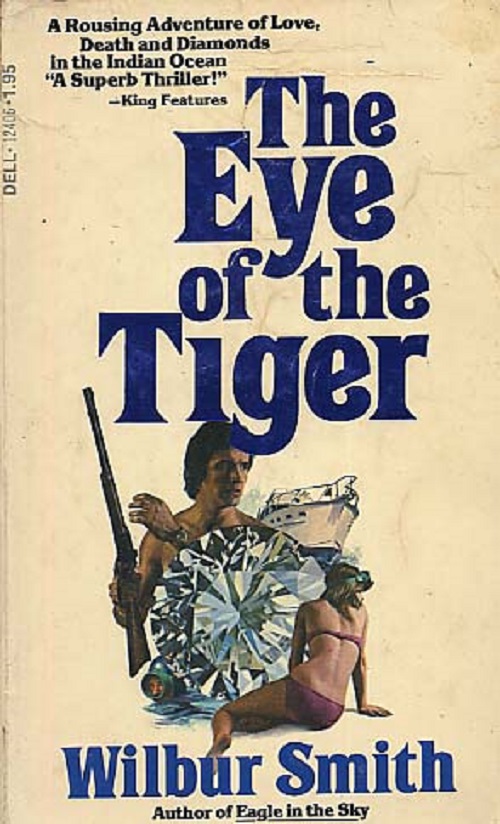
The Eye of the Tiger - Wilbur Smith


I’ve read many good things about Wilbur Smith’s work over the years and have seen a couple of the movies based on his novels, so I decided it was finally time to read something by him. He’s written several connected series, but I happened to have one of his stand-alone novels, THE EYE OF THE TIGER (his ninth novel, originally published in 1975), on my shelves, so I dived into it.

And that’s an apt choice of words, because there are quite a few underwater scenes in this book. The narrator and protagonist, Harry Fletcher (not his real name, as we find out fairly soon), is a charter boat skipper based on an island off the east coast of Africa, where he takes wealthy tourists on deep sea fishing expeditions. He’s hired by a couple of men for a different sort of job. They have a young scuba diver working for them as well, and Harry’s job is to ferry the group around the islands while they search for some mysterious something that’s sunk somewhere in the area. This is a pretty common sort of plot, going all the way back to the Gold Medal era, so it’s not surprising when things turn sinister and dangerous.

It’s hard to talk too much about what goes on in this book without giving away too much. The story has plenty of twists and turns, and quite a few of the characters turn out not to be what they seem at first. At fairly regular intervals, a harrowing action scene erupts, and they’re superbly written. During some of them, I completely lost track of time because I was so intent on turning the pages to find out what was going to happen. Let’s just say that despite its length (and it’s considerably longer than most of the books I read), THE EYE OF THE TIGER kept me engaged from start to finish and wound up being thoroughly satisfying. It’s one of the best books I’ve read so far this year, in fact.

That said, as long as it is, it’s still considerably shorter than some of Smith’s other novels. With my attention span the way it is these days, I’m not sure how many of them I want to tackle. But I do want to read something else by him and I hope I get around to it relatively soon. In the meantime, I really enjoyed THE EYE OF THE TIGER, and if you’re an action/adventure fan, I give it a high recommendation. It’s available in an e-book edition and has been reprinted in paperback many times.

Sunday, February 12, 2023

Sunday Morning Bonus Pulp: Amazing Stories, August 1942


A nice, colorful, eye-catching cover by H.W. McCauley on this issue of AMAZING STORIES. G.H. Irwin, the author of the lead novel, was actually editor Raymond A. Palmer. I don't believe I've ever read any of RAP's fiction. There are some good authors in this issue, including Henry Kuttner, Nelson S. Bond, Ziff-Davis stalwarts Leroy Yerxa and David Wright O'Brien (writing as John York Cabot), old-timer Miles J. Breuer ("The Sheriff of Thorium Gulch"? Really?), John Russell Fearn, Festus Pragnell, and a couple I've never heard of, Jep Powell and Richard O. Lewis. Probably no classics here, but I'll bet it's an entertaining issue. 

Saturday, February 11, 2023

Saturday Morning Western Pulp: Western Trails, April 1946


That's a nice cover by Albert Drake on this issue of WESTERN TRAILS. This issue has the usual two stories by J. Edward Leithead, one under his own name and one under his regular pseudonym Wilson L. Covert. Other authors on hand are Wayne D. Overholser, Gunnison Steele (Bennie Gardner), Cliff Walters, Ralph Yergen, and an author better known for his science fiction, Emil Petaja. The Leithead stories always made WESTERN TRAILS worth reading as far as I'm concerned.

Friday, February 10, 2023

Mad Morgan's Hoard - Philip Ketchum


For thirty years, from the late Twenties to the late Fifties, Philip Ketchum was a very prolific pulpster, turning out hundreds of Western, detective, and adventure yarns for a wide variety of pulps under his own name and several pseudonyms, most common among them Carl McK. Saunders. Overlapping his career as a pulp writer, during the Fifties and Sixties Ketchum was also very busy writing dozens of well-regarded paperback original Westerns and a few novelizations of Western movies.

MAD MORGAN’S HOARD was published as half of an Ace Double Western (with a nice cover by John Leone, by the way) in 1969, the same year that Ketchum died. I don’t know if it was his final novel, but it may well have been. If so, it’s a pretty good one to go out on. Drifting cowpoke Brad Collier, who was a successful rancher until his wife died and he suffered some financial reverses, is riding through what seems to be southern New Mexico Territory (Ketchum isn’t real clear on that) when he’s ambushed and suffers a minor head wound. But he manages to kill the man who bushwhacked him.

Seeking medical help in the small town he passed through earlier, he discovers that the ambusher worked for the local cattle baron. Brad is locked up and seemingly bound for a hanging when a mysterious stranger rescues him and entangles him in a search for $50,000 in missing bank loot. It seems that Mad Morgan, an eccentric old codger who has a small ranch in the area, may know where the loot is hidden. If he doesn’t, his beautiful wildcat of a granddaughter probably does.

Not surprisingly, several different factions are after the missing gold, and most of them don’t care whom they have to hurt to get it. Brad tries to navigate through this tangled mess and gets shot a couple more times for his trouble. Brad has quite a capacity for punishment. I don’t think it’s giving away too much to say that eventually everything gets sorted out satisfactorily.

Ketchum writes well in a spare, hardboiled style and gives the reader well-developed characters and a good plot. Brad Collier is a tough, stubborn, yet likable protagonist. MAD MORGAN’S HOARD has two romantic subplots, and both of them are handled very well. My only complaint about the book is that the ending isn’t quite as effective and dramatic as it could have been. I seem to have had a run of books like that in my reading lately. I enjoyed this one anyway, and if you’re a fan of traditional Westerns, it’s worth your time, as are all of Philip Ketchum’s books that I’ve run across.

Monday, February 06, 2023

Ghost Hills - H. Bedford-Jones


GHOST HILLS, originally serialized in four issues of THE CAVALIER in July and August 1913, is one of H. Bedford-Jones’s earliest novels. The fact that it’s featured on the cover of the issue containing the first installment is an indication that even this early in his career, Bedford-Jones was a popular author and was considered a draw for the readers.

This yarn is a Northern, set in the Canadian wilderness close to the Arctic Circle where the landscape is covered with snow and ice year ‘round and during the summer, when this novel is set, the skies are ablaze with the Northern Lights around the clock. Most of the action takes place in a desolate wilderness known as the Empty Places, which is haunted by the Silent Ones, and to get there, you have to travel through the forbidding Ghost Hills of the title.

This setting gives Bedford-Jones plenty of opportunities for vivid, eerie descriptive passages. His protagonist, footloose American Barr Radison, has come to Canada and thrown in with Tom “Take-a-Chance” Macklin, an agent of the Hudson’s Bay Company who ventured into the far north to find out the source of some rare black and silver fox pelts. They run into a jovial (but still sinister), seemingly half-mad giant Scotsman, Macferris Montenay, who’s in love with the beautiful daughter of a man who runs an isolated trading post. Of course, Radison falls for her, too, which gives Montenay one more reason to hate him. Montenay already thinks Radison is a threat to his plans because he believes the American to be descended from old Pierre Radisson, a famous explorer who vanished somewhere in the Empty Places two hundred years earlier. (This story is set in the early Twentieth Century, roughly the same time as Bedford-Jones wrote it.) According to an old prophecy, one of Radisson’s descendants will show up and claim the empire that Montenay is trying to build.

That’s a lot going on, and Bedford-Jones mixes in a feud between two Indian tribes as well. Naturally, each tribe takes sides in the rivalry between Radison and Montenay. And then there’s an evil half-breed with his own agenda.

Despite all that plot, GHOST HILLS has some pacing problems, as too many pages in the first three-quarters of the book are spent tramping around the snowy wilderness. It’s very well-written in places but doesn’t really get us anywhere. The final quarter of the book is mostly terrific, though, as all the strands of the story come together in a series of suspenseful action scenes culminating in an explosive battle. I say mostly terrific because the ending is something of a letdown again with too much of the action taking place off-screen.

This early in his career, Bedford-Jones’s prose is more old-fashioned and not as smooth as it would be at the peak of his career in the Thirties and Forties. Even so, GHOST HILLS is an entertaining yarn with some good characters and some really creepy, well-done scenes. I guessed the secret of the Silent Ones pretty early on, but that revelation late in the book is still very effective. If you’ve never read Bedford-Jones, this probably wouldn’t be a good one to start with, but if you’re already a fan like I am, I think it’s well worth reading. You can find various e-book editions of it on-line, as a stand-alone book and as part of Bedford-Jones collections, and it’s also available as a handsome trade paperback from Altus Press, part of the H. Bedford-Jones Library.


Sunday, February 05, 2023

Sunday Morning Bonus Pulp: G-Men, October 1935


I’ve read quite a few Dan Fowler novels by various authors over the years, but “Snatch!” goes back to the series’ origin, appearing in the very first issue of the pulp G-MEN, cover-dated October 1935. Dan Fowler is an agent of the Division of Investigation, a name still used by author George Fielding Eliot even though the DOI’s name was changed officially to the Federal Bureau of Investigation in July of that same year. It’s likely Eliot wrote the story before that name change went into effect.

But that’s just a minor point of interest and doesn’t really matter. Although he’s never referred to by name, the chief of the DOI is clearly J. Edgar Hoover, and he assigns Fowler and his sidekick, Agent Larry Kendal, to break up the notorious Gray Gang and bring its leader Ray Norshire, the top name on the Most Wanted list, to justice. Norshire and his gang have been robbing banks all over the Midwest, and they’ve just gone into the kidnapping racket as well, having abducted the infant daughter of a bank president. Fowler gets the assignment because he’s from one of those Midwest states (Eliot doesn’t specify which one) and his father is still a county sheriff there.

Fowler and Kendal take off for the Midwest, and when they reach Fowler’s hometown, he meets up with an old flame, telephone operator Sally Vane, whose father is also a lawman, a detective on the local police force. But Fowler soon becomes suspicious that the elder Vane may be mixed up with the Gray Gang, an unexpected and unwanted complication.

Despite the title, the kidnapping angle of this novel is wrapped up in the first half of the yarn, and the rest of it is devoted to running down Ray Norshire and his minions and uncovering the real mastermind behind the gang. (The mastermind’s identity won’t come as much of a surprise to regular pulp readers.) It’s a fast-moving blend of investigative procedure and wild shootouts, chases, captures, and escapes. Given everything that’s gone before, the ending maybe isn’t as dramatic as it could have been, but it’s still satisfying.

It's been quite a while since I read anything by George Fielding Eliot, a prolific contributor to the detective, adventure, and war pulps, but for some reason, I had it in mind that his writing was a little stodgy. Not so in this story, anyway. At times it reminded me a little of Norvell Page’s crazed, over-the-top Spider novels. Which is a good thing, mind you. Now I’m eager to read more by Eliot. After the pulp era, he went on to a career writing military and historical non-fiction, so maybe that’s where I got the idea. I’m glad to be proven wrong.

It's also interesting to see the first appearance of Sally Vane, who is Fowler’s long-running romantic interest in the series and an FBI agent. I didn’t know she started out working as something else.

I read an e-book reprint of the lead novel and don’t own the original pulp, but the three backup stories are by Howard R. Marsh, Westmoreland Grey, and none other than an old favorite of mine, Leslie Scott writing under his A. Leslie pseudonym. Scott is best remembered as a Western writer, of course, but he wrote in other genres as well.

With “Snatch!”, the Dan Fowler series gets off to a great start. I’ll be reading more of them in the near future. (As I may have mentioned, I’ll be writing a Dan Fowler story for an anthology later this year, so I’m trying to get in as much of the proper mindset as possible.)

Saturday, February 04, 2023

Saturday Morning Western Pulp: Thrilling Ranch Stories, March 1936


Although THRILLING RANCH STORIES was considered to be a Western romance pulp, the covers often featured gun-blazing action like this one, which I think may be by Richard Lyon. The authors inside are Western pulp action aces, too: Leslie Scott (as A. Leslie), Stephen Payne, Lee Bond, Syl MacDowell, Bruce Douglas, Eugene A. Clancy, and house-name Jackson Cole, who could be any of those guys (but if I had to bet, I'd say in this case it was probably Lee Bond, for some reason). I've never read an issue of THRILLING RANCH STORIES. I'm not sure I own any. I need to check on that.

Friday, February 03, 2023

Object of Lust - Mark West (Charles Runyon)


Charles Runyon is one of those writers who isn’t very well-known, but his work is quite well-regarded by those who have read it. I think Ed Gorman is the first person I recall who told me how good Runyon’s novels are. Runyon wrote mostly crime and mystery fiction (including ghosting three non-series novels under the Ellery Queen name) and science fiction. In the early Sixties, he also wrote three soft-core novels for Softcover Library (the successor to Beacon Books) under the name Mark West.

The third and final of those novels is OBJECT OF LUST, originally published in 1962 and just reprinted by Black Gat Books for the first time since then. Like many of the soft-core novels from that era, it’s actually a crime/suspense yarn. Set at a lake resort where well-to-do families have vacation cabins, it seems at first that the protagonist of this novel is Lewis Leland, a young ex-GI who teaches waterskiing to the wives and teenage daughters of those wealthy families. He saves one of those wives, beautiful Marian Morgan, from drowning one day and falls for her. He sets out to seduce her and almost succeeds, but they’re caught in the woods by a couple of kids before they can complete the act. Marian panics and won’t have anything more to do with Lewis.

That’s when we realize that Lewis is actually crazy, a sociopath who has killed before—and will again as he starts stalking Marian, determined to have her for his own even if he has to kidnap and rape her.

While this is going on, we also get a look at the affairs of various unhappily married couples, including Marian and her lawyer husband Dee. The people who are staying around the lake are a pretty degenerate bunch in some ways, indulging in plenty of drinking and adultery, but Runyon pulls off the neat trick of getting the reader to sympathize with them. Despite the sordidness of the situations, some of them actually come off as pretty likeable.

Not Lewis Leland, though. He’s easily one of the creepiest villains I’ve encountered in fiction, and that makes the last fifty pages or so of this book race by in breakneck fashion. I couldn’t turn those pages fast enough. OBJECT OF LUST is a slow burn most of the way, except for an occasional shockingly abrupt outbreak of violence, but when it finally takes off, it really takes off.


It occurs to me that what Runyon is doing here is taking a standard Gold Medal type of plot and turning it on its head in many ways. Lewis Leland would be the protagonist of a Gold Medal novel, and Marian Morgan would be the femme fatale. He does a great job of this reversal, too. His writing is top-notch, with excellent characterizations and observations on life reminiscent of John D. MacDonald. Some of it is genuinely unpleasant to read because of how evil Lewis is, but that just raises the stakes. The sex scenes are a little more graphic than in most books from that era but still pretty mild by the standards of what came later. Overall, OBJECT OF LUST is a really good book, a well-written page-turner that deserves a new lease on life. I’m glad Black Gat is reprinting it. You can order the paperback on Amazon.