Monday, August 19, 2024

The Savage Sword of Conan #3 - Frank Tieri, Patrick Zircher, John C. Hocking, et al.


THE SAVAGE SWORD OF CONAN #3 opens with a long Conan story called “Wolves of the Tundra” written by Frank Tieri and drawn by Cary Nord. I’ve seen Nord’s work before and liked it, and his black-and-white art in this tale, while not as lush as his color work, is quite good and very effective. However, after reading a few pages of the story, Tieri’s script takes a turn that came really close to making me say, “Nope,” and not finishing it. In order for the plot to work, the reader has to accept something that I just couldn’t. To say more would be to venture too far into spoiler territory. Despite that, I actually did read the whole story, and while it never worked for me, I have to admit that the ending did give me a little chuckle. I didn’t care for this story, but as they say, your mileage may vary.

Next up is an excerpt from John C. Hocking’s CONAN: CITY OF THE DEAD, followed by an excellent autobiographical essay by Hocking detailing the background of the two novels in that collection. I’ll read anything Hocking wants to write featuring Conan, or anything else, for that matter. His work is always top-notch.

There’s a nice Howardian poem by Jim Zub with a good illustration, then the conclusion of Patrick Zircher’s three-part Solomon Kane story. The wrap-up of this yarn is just as good as the previous two installments. It’s a very satisfying conclusion to a fine tale.

A short, wordless Conan yarn with story and art by Alan Quah concludes this issue. The art is good, the story wry and entertaining. I don’t know anything about Quah, but he’s done a pretty good job with this one and I’d read more by him.

Despite my complaints about the main story, I enjoyed reading this issue of THE SAVAGE SWORD OF CONAN and I think most Howard fans would, too. I’m looking forward to the next issue.

Sunday, August 18, 2024

Sunday Morning Bonus Pulp: The Underworld Magazine, June 1929


This cover by W.C. Brigham is eye-catching for a couple of reasons: the sheer brutality of the scene depicted, plus the use of a swastika in the logo well before it gained notoriety for other reasons. THE UNDERWORLD MAGAZINE was an early gang pulp published by Harold Hersey, and if I recall correctly, a lot of Hersey's pulps used a swastika in their logos. There are some good authors in this issue including James P. Olsen and Galen C. Colin (both probably best remembered for their Westerns), Henry Leverage (one of the stars of the gang pulps, and he appears twice in this issue, once as himself and once under the name Carl Henry), Armitage Trail (the author of SCARFACE), veteran pulpsters Anatole Feldman and Harold Ward, and a couple of one-shot authors, Mack Ozark and W. Jeremiah Evans. Mack Ozark especially sounds like a pseudonym to me. I've read almost nothing from the gang pulps, and I really think I should explore them more. Just a matter of finding the time.

Saturday, August 17, 2024

Saturday Morning Western Pulp: Texas Rangers, July 1949


This is a pulp that I own and read recently. That’s my copy in the scan. The cover art is by Sam Cherry and illustrates, although not with complete accuracy, a scene from the Jim Hatfield novel featured in this issue.

The last Hatfield novel by A. Leslie Scott that I read, “The Wasteland Empire”, was a mining story, with barely a mention of ranches and cattle. The one in this issue, “The Spoilers’ Trail”, is also a little unusual because it’s a railroad yarn through and through. Scott put his mining experience to good use in the previous tale, and the time he spent as a railroader gives this one an undeniable air of authenticity.

In “The Spoilers’ Trail”, Jim Hatfield, ace of the Texas Rangers, is sent in to discover who’s behind the sabotage and outright attacks plaguing the construction of a railroad line through West Texas. The C&P Railroad is run by an old friend of Hatfield’s, James G. “Jaggers” Dunn, who appears in numerous stories by Scott, sometimes as the protagonist of stories published in RAILROAD STORIES, often as a supporting character in Jim Hatfield novels. Dunn doesn’t show up until late in this one, but he’s the reason Hatfield is on the case to start with. Hatfield starts out working undercover as a railroad guard but winds up bossing most of the construction project, since in addition to being a Ranger he’s also an expert engineer.

There’s a subgenre of pulp adventure stories centered around construction projects, and this one actually fits more in that category than it does as a Western, although there are some ambushes and shootouts. Much of the plot is concerned with engineering problems, and that culminates in a long, suspenseful scene in which Hatfield and some of the workers battle to save a partially completed bridge during a flood. At one point, Hatfield and some companions are trapped underground by a cave-in (never go to the opera with Ellery Queen, or into a mine or a railroad tunnel with Jim Hatfield) and saves the day with an unusual and dramatic way of breaking out.

Scott is in top form in “The Spoilers’ Trail” even though it’s not very representative of the Hatfield series as a whole. It’s a fast-paced yarn with an interesting background, and I thoroughly enjoyed it.

The first of three back-up short stories in this issue is “A Badman’s Dog” by Dupree Poe. A vicious outlaw murders the lawman who discovers his hideout, but he adopts a puppy that the sheriff had with him at the time of the killing. This isn’t the heart-warming tale you might expect but rather a story of justice and retribution. It also seems to be lacking a plot twist that might have made it more effective. Even so, it’s a fairly entertaining story, and I’ll venture far enough into spoiler territory to say that the dog does not die.

“The Return of Dave Kilbane” is by Walt Morey, an author I don’t recall reading before. Something about his style was a little off-putting to me at first, but I got used to it and wound up enjoying this tale of a young ex-convict returning to his hometown and his lawman father, just in time to help back his dad’s play in a showdown with three killers. The question is, will he, since his father is the one who sent him to prison? It’s an interesting moral dilemma solved by some well-done action. This isn’t a good enough story to make me run out and look for more by the author, but I liked it well enough.

I’ve been a fan of Lee Bond’s Long Sam Littlejohn stories for more than thirty years now. The one in this issue, “Long Sam Jumps the Devil”, finds the good-guy outlaw sticking his nose into someone else’s trouble, as usual, and winding up in a run-in with Deputy U.S. Marshal Joe Fry, the dogged lawman who is constantly pursuing Long Sam. In this case, Long Sam battles a notorious outlaw called El Diabolo Blanco, who dresses all in white, including a hood that conceals his identity, and saves the ranch belonging to an old friend. It occurred to me while reading this story that in some ways, the Long Sam Littlejohn series isn’t very well-written. The plots are extremely formulaic, and the characters have a habit of standing around and discussing things they already know, just so the reader will be filled in on what’s going on. Those flaws aside, though, I still really like this series and I’ve never read one that I didn’t enjoy. Long Sam is a great character, and Bond has a sure hand with the action scenes. Every time I read one, I’m tempted to write a Long Sam Littlejohn story of my own. Maybe one of these days.

Overall, this is another very solid issue of TEXAS RANGERS, and I’m glad I took it down from the shelf to read it.

Friday, August 16, 2024

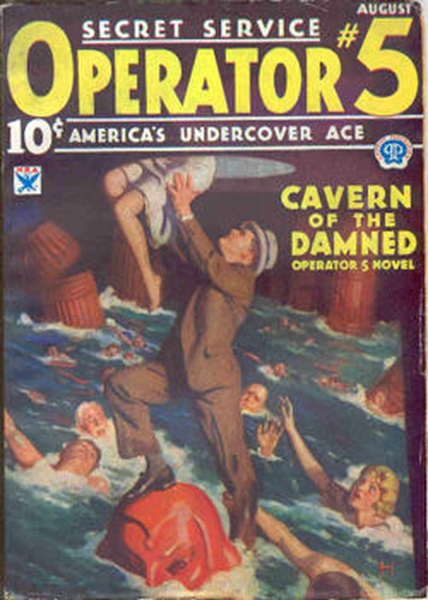
Operator 5 #5: Cavern of the Damned - Curtis Steele (Frederick C. Davis)


The temple of a sinister cult hidden in the middle of Manhattan! A vicious Tibetan prince whipping a beautiful girl almost to death! Influential figures falling under the sway of plotters who want to take over the country! Who can possibly deal with this terrible menace? You know the answer to that as well as I do: Jimmy Christoper, also known as Operator 5, the ace of the American Intelligence Service. Only Operator 5 can possibly thwart this impending catastrophe aimed at the destruction of all regular religions and the takeover of the United States.

But what’s that? Operator 5 is accused of treason and stripped of his standing in the Intelligence Service. All the other operators are tasked with finding and arresting him, and if he puts up a fight, Jimmy Christopher will be gunned down like any other criminal!

Yep, things look pretty bad in “Cavern of the Damned”, the fifth Operator 5 novel that was published originally in the August 1934 issue of the iconic pulp OPERATOR #5. Every issue, author Frederick C. Davis, writing under the house-name Curtis Steele, came up with a new menace to threaten the entire country that only Operator 5 could defeat. This time, the threat posed by the Cult of Zavaa has definite Weird Menace overtones with its hidden temples, robed and turbaned priests and acolytes, and brutal whippings. Davis wrote for numerous different pulps, including the Weird Menace titles, so he certainly knew his way around that genre and utilizes those elements to good effect in this novel.

All the other trademarks of the Operator 5 series are here: Jimmy Christopher has an able assistant in the stalwart Irish lad Tim Donovan. He even takes a break to demonstrate a magic trick for Tim, as he usually does. Beautiful reporter Diane Elliott gets captured by the villains. Jimmy Christopher’s beautiful twin sister Nan is on hand but doesn’t have much to do in this one. Jimmy Christopher’s semi-invalid, retired intelligence agent father lends him a hand, too. The climaxes of Davis’s Operator 5 novels often border on the apocalyptic, and while he reins in that tendency a little this time, the final showdown features plenty of blood and thunder (and lepers).

I love this series because Davis was a fine writer and usually followed my motto when writing about Jimmy Christopher’s adventures: “If you’re going over the top anyway, you might as well go ‘way over.” That said, while I had a very good time reading this novel, I didn’t find it quite as appealing as some of the others in the series. I think I prefer the ones where there’s some sort of super-scientific weapon and a hidden mastermind threatening the nation, rather than a bunch of mostly nameless, faceless guys in robes and turbans who slink around getting folks hooked on hashish, which Davis nearly always refers to as “bhang!”, with the exclamation mark. After a while, I was glad I wasn’t playing a drinking game that involved references to bhang! I’d have been drunk for sure.

If you’ve never tried this series, “Cavern of the Damned” probably isn’t one you’d want to start with. If you’re already an Operator 5 fan and haven’t read this one, don’t let anything I’ve said here influence you not to read it. It’s great fun. Doing Operator 5 as a Weird Menace yarn is just a slight misstep, that’s all. It’s been reprinted several times over the years and is available currently in a very nice trade paperback edition from Altus Press.

Wednesday, August 14, 2024

Raider of the Spaceways - Henry Kuttner


“Raider of the Spaceways” is a novelette by Henry Kuttner that appeared originally in the July 1937 issue of WEIRD TALES, which published the occasional straight-up science fiction yarn along with horror fiction and sword and sorcery. It’s a fairly early story by Kuttner, in that he’d only been publishing fiction for about a year and a half when it came out, but by that time he had published 20 stories, so he wasn’t exactly a neophyte, either. The prose is already as smoothly polished as you’d expect from Kuttner.

The protagonist is Dal Kenworth, a young man who’s growing a crop of elysia plants on Venus, a plant that’s the source of a very powerful and valuable drug. Kuttner kind of throws in the fact that Kenworth is the son of the President of the Americas back on earth. He clashes with a notorious space pirate known as the Raider, and he and a beautiful girl from a neighboring elysia farm have to flee to Venus’s Night Side, the side of the planet that never faces the sun, which is unexplored and full of unknown dangers. What they encounter there is pretty horrible, enough so that the story does sort of fit in WEIRD TALES despite being pure SF.

Whenever I read science fiction from this era, the good stories always make me feel like I’m back in high school, sitting in a lawn chair on my parents’ front porch on a summer morning, getting some reading done before the heat builds up and I have to retreat into the air conditioning. “Raider of the Spaceways” is definitely a front porch yarn. Space pirates! Ray guns! A monster and a beautiful girl! This is my meat, let me tell you. And Kuttner puts the whole thing together with great skill, including a twist ending that I should have seen coming but didn’t.

I suspect most modern readers wouldn’t be so fond of this story (well, some of you reading this probably would be), but I loved it and had a great time reading it. In addition to its original appearance in WEIRD TALES, it was reprinted in the beautiful Haffner Press collection THUNDER IN THE VOID. It’s also available as a stand-alone e-book, and if you’d rather read it in the original, that issue of WEIRD TALES can be found on-line here and here. If you’re a fan of old-fashioned adventure science fiction like me, I give it a high recommendation.


Monday, August 12, 2024

High Country - Peter Dawson (Jonathan Glidden)


Jim Sherill is a rancher who plans to sell a herd of horses and then marry the beautiful daughter of a wealthy businessman who owns a riverboat that travels up and down the Missouri River to Montana. The plan is for Jim to take over the riverboat enterprise. But then his horse herd is rustled and in his efforts to locate the thieves and recover the herd, he’s drawn into a dangerous plot that threatens the life of a young woman who’s inherited a ranch from her father.

HIGH COUNTRY is a novel by Peter Dawson, the pseudonym used by Jonathan Glidden, a successful Western pulpster in the Thirties and Forties who became well-known as a novelist in the Forties and Fifties. His brother Frederick Glidden was even more popular with his stories and novels under the name Luke Short, but I don’t recall ever reading about any particular rivalry between the brothers. Both did very well for themselves.


HIGH COUNTRY was serialized in the pulp SHORT STORIES in March and April 1947 and published simultaneously in hardcover by Dodd, Mead, Jon Glidden’s regular publisher. It was reprinted in paperback by Lion Books in 1949 under the title CANYON HELL (with a cover by Robert Stanley) and then reprinted by Bantam, as were most of the Peter Dawson novels, in 1955. There were other Bantam editions over the years. I read the one from September 1966, and that’s my copy in the scan at the top of this post. I don't know the artist. The font on the author’s name and the title reminds me a little of the Doc Savage logo on Bantam’s reprints of that series. I don’t know if that was deliberate or not, but those Doc reprints were really, really popular during that era.

As for the novel itself, it’s a good one. Jon Glidden’s work was more low-key and realistic than that of many of the Western pulpsters. There’s some gritty, well-done action here and there, but it never goes over the top and the prose is restrained, not the least bit purple. To be honest, the book maybe could have used a tad bit more blood and thunder. But the characters are complex, Jim Sherill is an admirable, sympathetic protagonist, the villains are suitably despicable, and the romantic triangle, although it doesn’t occupy a lot of space, is handled well. Once things really take off in the final third of the book, it races right along and comes to a satisfying conclusion.

Like every other Peter Dawson novel I’ve read, HIGH COUNTRY is a solid traditional Western yarn. I found it to be well worth reading, and if you’re a Western fan, there’s a good chance you would, too.


Sunday, August 11, 2024

Sunday Morning Bonus Pulp: Thrilling Adventures, November 1943


This was the final issue of THRILLING ADVENTURES. The magazine went out with a good one, starting with that action-packed cover. There's an artist's signature on it, but I can't read it. Rafael DeSoto, maybe? I'm sure somebody who's better at such things than I am can supply the correct answer. Inside are stories by Louis L'Amour (a Ponga Jim Mayo yarn), Henry Kuttner (twice, once as himself and once as Charles Stoddard), Carl Jacobi, Tom Curry, Carter Sprague (really my old editor and mentor Sam Merwin Jr.), Verne Chute, and Bertram B. Fowler. And even though I've mentioned it many times before, I have to say how cool it is that in the early days of my career, I got to work with an old pulpster like Sam Merwin. I'm proud of that to this day.

Saturday, August 10, 2024

Saturday Morning Western Pulp: Leading Western, June 1946


I feel like I should know who did the cover on this issue of LEADING WESTERN. Somebody here or on Facebook will tell me, and I'll update the post. Meanwhile, there's a strong lineup of Western pulpsters in this one: Philip Ketchum, Laurence Donovan, Giff Cheshire, John Reese (as John Jo Carpenter), and Jhan Robbins, along with house-name Randolph Barr. Looks like a solid issue. 

Friday, August 09, 2024

Sundance #6: The Bronco Trail - John Benteen (Ben Haas)


I recently read a couple of books that weren’t terrible, but ultimately, they were disappointing and I wished I had the time back that I spent reading them. With that bad taste in my mouth, I wanted to read something that I was absolutely certain would entertain me and make me glad that I’d read it.

Enter Ben Haas.

Over the years I’ve read most of the books in the Fargo series that Haas wrote under the name John Benteen, but there are still quite a few of his Sundance series that I never got around to. The next one I hadn’t read was #6 THE BRONCO TRAIL. This one opens with Jim Sundance, the half-British, half-Cheyenne professional fighting man, hunting down an outlaw gang in Utah and dealing with them in an explosive confrontation. When Sundance reports to the Mormon leader who hired him, he finds an old friend waiting for him: General George Crook. Sundance has worked for the army before, and now Crook wants him to find out who’s trying to stir up a new war between the Apaches and the settlers in Arizona. And while he’s at it, if he can convince Geronimo and his followers, who have fled to the mountains in Mexico, to surrender and make peace, that would be great, too.

It’s a job that puts Sundance smack-dab in the middle of danger from several different sources: the criminal ring smuggling ammunition and whiskey to the Apaches, the Mexican army, and Geronimo his own self. In addition to Geronimo and General Crook, actual historical figures who play a part in the story include scouts Al Sieber and Tom Horn. As Haas explains in an afterword, nearly everything in the book except Sundance’s involvement is based on documented history. It’s interesting and very effective.

Of course, the biggest appeal of these novels is the action, and I’m convinced that except for Robert E. Howard, nobody was ever better at writing close combat action scenes than Ben Haas. Whether it’s a brutal fistfight, a deadly battle with knives, or a close-quarters shootout, Haas’s skill at describing these scenes is breathtaking. The story races along at a breakneck pace, the settings are vividly (but not long-windedly) described, and Sundance is a great protagonist, if a bit dour.

So I went into THE BRONCO TRAIL wanting a book that I would enjoy reading, and that’s exactly what I got. Copies of the original paperback (with a cover by Mel Crair) can be found on-line, and an e-book edition is available from Piccadilly Publishing. I give this one a high recommendation.  

Wednesday, August 07, 2024

The Savage Sword of Conan #2 - Jim Zub, Richard Pace, Patrick Zircher


For a while there, I was reading all the new Conan comics from Titan, as well as the new prose stories, and I read and enjoyed the first issue of the new SAVAGE SWORD OF CONAN. Then I kind of just stopped. Not intentionally. I just wandered away as I have a tendency of doing. But it’s time to get caught up on them again, so I started with the second issue of THE SAVAGE SWORD OF CONAN.

Most of the pages are taken up by a long Conan yarn called “Leaving the Garden” written by Jim Zub with artwork by Richard Pace. It begins with a badly wounded Conan waking up after having been buried alive following a battle. Naturally, he doesn’t stay underground. A flashback establishes that he was traveling with a merchant caravan ambushed by inhuman attackers. The rest of the story deals with him recovering and seeking vengeance for what happened to his companions.

This is a good story with plenty of action broken up by the occasional poignant moment. I’ve enjoyed everything I’ve read by Jim Zub so far. My only complaint about this script is that “Leaving the Garden”, while it fits, isn’t the sort of dramatic title I’ve come to expect on a Conan story. I also have to say that the artwork isn’t to my taste at all. I suspect it’s the kind of art that either resonates with a reader or it doesn’t. It didn’t in my case.

This issue also features the second installment of a Solomon Kane serial written and drawn by Patrick Zircher, an adventure that finds Kane battling a supernatural menace in his native England. Art and script are superb on this story. So far it’s one of the best Solomon Kane comics stories I’ve read.

Despite the reservations mentioned above, there’s enough to like about this issue of THE SAVAGE SWORD OF CONAN that I don’t hesitate to give it a strong recommendation for Conan and Robert E. Howard fans. It’s available in both print and digital editions.