Friday, March 10, 2023

Murderer At Large - W.A. Ballinger


MURDERER AT LARGE is a 1965 entry in the Sexton Blake series after it moved 
from digest-sized novels to mass-market paperbacks. That title is the name of a low-budget true crime TV show in England that focuses on unsolved homicides—cold cases, although I don’t think that term was used that early—in which the killer appears to have gotten away with it.

One of the cases that the show will cover in an upcoming episode is the Primrose Ballet Murder, which occurred three years earlier when a 15-year-old dancer was strangled. The show has two researchers, one a former cop and the other a journalist, and when one of them is murdered, probably because he got too close to the identity of the Primrose Ballet Killer, private detective Sexton Blake is drawn into the case. Not surprisingly, another killing occurs, so ultimately Blake has to solve three murders and pick out the killer from a very large cast of characters that includes writers, producers, casting directors, and aristocrats from the upper levels of society and finance.

Not only are there a lot of suspects to sort through, but many of the series regulars also appear, including Blake’s assistant Edward Carter (aka Tinker), his beautiful secretary Paula Dane, his likewise beautiful receptionist Marian Lang, his journalist friend Arthur “Splash” Kirby, and even his faithful dog Pedro.

The plot of MURDERER AT LARGE is a little on the thin side, which may explain the large number of characters involved. Even with so many people running around, the author still needs to fill some pages with humorous digressions such as this one early on:

The writers’ office was small, shabby, and tucked away on the most remote corridor of the top floor of ATN House [the production company that makes the series]. This was usual for no large entertainment organisation loves writers. When they can be replaced with electronic machines they will be replaced. [Shades of ChatGPT!]

Machines suffer from none of the disabilities of writers, such as unpunctuality, debts or intoxication. Machines do not pinch the bottom of the managing director’s secretary or borrow ten shillings from the doorkeeper. Machines do not, above all, regard their employers with anarchistic contempt between spells of obsequiousness when pay-checks are due to come round.

But until machines are made the organisations have to make do with writers, faults and all.

Whoever wrote that knows writers, that’s for sure! Sure sarcastic asides run all through the book, poking a lot of fun at the TV business. When Blake finally exposes the killer and the murderer tries to flee, the action becomes pure slapstick, and it’s pretty darned funny despite a rather grim ending. This whole book is a slightly unsettling blend of bleak and hilarious, but I really enjoyed it.

Which brings us to the question of the author’s identity. The book is bylined W.A. Ballinger, a pseudonym normally used by W. Howard Baker, the author/editor/packager who was in charge of the Sexton Blake series for many years. Baker often had uncredited collaborators doing first drafts for him, so his actual contribution could range from plot/light edits to plot and heavy revisions. In addition, other editors sometimes revised manuscripts. A friend of mine who’s familiar with the series and authors suggests that Wilfred McNeilly might have had something to do with this one, but that’s far from certain. I have a couple of Blake paperbacks credited to McNeilly and intend to read them soon to see if I can pick up any similarity in styles.

None of this really matters, of course, no matter how interesting I find it. What's important is whether or not a book is entertaining, and MURDERER AT LARGE certainly is. By the way, I apologize for the quality of the cover scan. I read the novel as a PDF file, and this is the only cover image I could find on-line.

Sunday, March 05, 2023

Sunday Morning Bonus Pulp: Argosy, May 25, 1940


Rudolph Belarski contributes a nice, action-packed cover to this issue of ARGOSY. As usual, there's an excellent line-up of authors inside, too: Walt Coburn, Carroll John Daly, Jim Kjelgaard, Budd Schulberg, William Du Bois, and Charles T. Jackson. And only two of those pesky serials in this issue (Coburn and Jackson).

Saturday, March 04, 2023

Saturday Morning Western Pulp: Exciting Western, June 1945


This is a pulp I own and read recently. That’s my somewhat beat-up copy in the scan, with a rather whimsical cover by the incredibly prolific Sam Cherry.

The lead feature in EXCITING WESTERN for most of its run was the Tombstone and Speedy series by one of my favorite Western authors, W.C. Tuttle. Like Tuttle’s justly more famous Hashknife Hartley and Sleepy Stevens, Tombstone Jones and Speedy Smith are range detectives working for the Cattleman’s Association. They’re generally thought of as being pretty dumb and usually solve their cases through pure luck, with considerable snappy banter and some slapstick humor along the way. From time to time, though, Tuttle drops hints that the two of them aren’t nearly as dumb as they act. In fact, in this issue’s novelette, “Gunsmoke in Oro Rojo”, they unravel a fairly complicated mystery involving rustled beef and high-graded ore and seem to be fully aware of what they’re doing as they “bumble” their way to a solution and justice for the bad guys. This is a very good entry in a consistently entertaining series.

The Navajo Tom Raine, Arizona Ranger series ran in EXCITING WESTERN for several dozen stories, always by-lined with the house name Jackson Cole except for one story published under the name C. William Harrison, the real name of an author who may well have written some of the other stories, too. But prolific Western pulpster Lee Bond has also been linked to the series. “Indian Killer”, the Navajo Tom Raine story in this issue, reads to me like it might be Bond’s work. Raine, a white man raised by the Navajo after his lawman father was murdered, is sent to quell an uprising by the Papago tribe, which is being blamed for a series of stagecoach and freight wagon holdups. Raine quickly figures out that the Indians are being framed and uncovers the real culprit. The blurb on the first page of the story gives this away, so it’s not much of a spoiler. I think most Western pulp readers would know what was going on anyway. Despite the very predictable plot, Raine is an appealing protagonist and the writing is smooth and fast-paced, leading to a satisfactory conclusion. I’ve never read a Navajo Raine story that was great, but I’ve never read one that failed to entertain me, either.

Writer/editor T.W. Ford was another very prolific pulpster, mostly in the Western and sports pulps. I’ve found his work to be inconsistent but generally pretty good. His novelette “Lead for a Donovan” in this issue is a Romeo and Juliet yarn, with a young couple from two feuding families running off to get married and the lengths to which the patriarchs of those families will go to prevent the wedding. Everything plays out about like you’d expect, but there’s plenty of action along the way and I found this to be a very enjoyable story.

In something of a rarity for a Western pulp, the cover painting from this issue is redone as a black and white interior illustration for the short story “Lynching Lawman” by an author I’m not familiar with, Bud Wilks. He published only eight stories, five in 1945 and three in 1948, all in Thrilling Group Western pulps. I have a hunch that was the author’s real name, but who knows? Might have been a house name. “Lynching Lawman” is a short but effective tale of two lawmen who have a falling out, and then one tries to frame the other for horse stealing and murder. I thought it was pretty good. Another unusual aspect is that the cover and interior illo accurately illustrate a scene from the story, meaning that artist Sam Cherry either read it or (more likely) the editor told him what to paint.

Another long-running series in the pages of EXCITING WESTERN featured the adventures of Alamo Paige, Pony Express rider. These were published under the house name Reeve Walker. Walker A. Tompkins, Charles N. Heckelmann, and Chuck Martin have all been linked to this series, and other authors may have contributed to it as well. I don’t know who wrote “Ten Days to California”, the Alamo Paige story in this issue, but it’s a good one in which Paige pursues a wanted outlaw and killer who tries to escape justice by riding the Pony Express route and stealing fresh mounts at each way station. That’s really all there is to the plot, but the story moves right along and has some nice action scenes.

That wraps it up for the June 1945 issue of this pulp, and it’s a really solid one with the five stories ranging from good to excellent. If you have this issue of EXCITING WESTERN and haven’t read it, I think it’s well worth pulling down from the shelf.

Friday, March 03, 2023

Night Riders - Giff Cheshire


I had read and enjoyed some of Giff Cheshire’s pulp stories, but I’d never read one of his novels until NIGHT RIDERS, originally serialized in RANCH ROMANCES in June and July of 1951 and reprinted in hardback by Five Star in 2006 and in paperback by Leisure in 2007. I read the e-book of the Leisure edition, which is still available from Amazon.

Horse wrangler Tully Gale is bent on romance when he drifts into the malpais country. He met a girl on the stagecoach who is on her way home to take over the ranch she’s inherited. But almost right away, Tully runs into trouble from a shady, brutal mustang hunter and then finds himself finagled into the middle of a range war over water rights. He also finds himself in a romantic triangle with the ranch girl and the beautiful widow who owns the hotel in the nearby settlement. Things get more complicated when some of Tully’s allies seem to turn into enemies.


I really have a mixed reaction to this one. The romantic angle is handled well, with a frank attitude about sex that’s unusual to find in a Western from this era. (Cheshire also wrote a number of softcore novels for Beacon Books under the name Carlton Gibbs.) There are some good action scenes here and there, including a very well-done fistfight. The water issues, while not uncommon in Westerns, aren’t as overused as some other plot elements.

But man, for long stretches, this is one dull book. Tully rides here and thinks about this, then rides there and thinks about that. Slam-bang action scenes that seem about to erupt never materialize. Cheshire’s prose just slogs along. I wouldn’t go so far as to say I hated NIGHT RIDERS, but I was considerably disappointed.


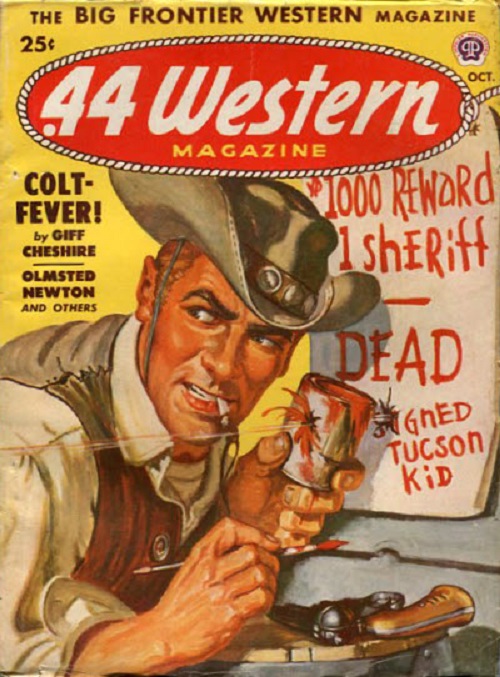
The book features a bonus story in the novelette “Blood Oath”, which was published originally under the title “Colt Fever!” in the October 1949 issue of .44 WESTERN. The protagonist, Quincey Caine, isn’t a typical Western pulp hero. He’s a lawyer who came west to practice, but as the story opens, he’s a gun-shy drifter whose nerves are wrecked because the stagecoach he and his young wife were on was attacked by Indians and she was killed. He can still use his fists, though, as he proves when he’s attacked by a bully and defends himself. This lands him in the middle of a battle over some railroad right-of-way that will be valuable when a spur line runs to the area.

There’s plenty of action in this one and some good characters, especially a 12-year-old orphan who befriends Caine and proves to be tougher and more competent than most of the adult characters. I really liked the way Cheshire kept things moving right along. As disappointed as I was in NIGHT RIDERS, I was impressed by “Blood Oath”. Maybe Cheshire was just one of those authors who was better at shorter lengths, or maybe NIGHT RIDERS isn’t one of his better novels (why reprint it if that’s the case?), or maybe I just wasn’t in the mood for it.

The question is, do I read more by Giff Cheshire? I think I do. I have one of his novels written under the name Chad Merriman sitting a couple of feet away from me as I type this, in fact. I’ll definitely give it a try. But not in the near future, I expect.

Sunday, February 26, 2023

Sunday Morning Bonus Pulp: Planet Stories, Winter 1947


This is a pulp that I own and read recently. That’s my copy in the scan, store stamp and all. I’ll put a better scan from the Fictionmags Index at the bottom of this post. The cover art, as usual for Fiction House, is by Allen Anderson, and it’s excellent, also as usual. Everything in it comes from the lead novella, “Black Priestess of Varda” by Erik Fennel.

Who the heck is Erik Fennel, you ask? I dunno. Apparently neither does anyone else, since I can’t find anything about him on-line except that he published a dozen stories in PLANET STORIES, THRILLING WONDER STORIES, and BLUE BOOK between the mid-Forties and the mid-Fifties. “Black Priestess of Varda” is a fairly typical sword-and-planet/other dimension yarn with a nice twist or two. The protagonist is a scientist named Eldon Carmichael, who lost his left arm and left eye in a laboratory accident. Or was it an accident? The assistant who may have caused it wound up with the girl Eldon intended to marry, after all. Then another mishap sends all three of them through a dimensional rift to a world called Varda, where the beautiful High Priestess Sin (that’s her on the cover) is trying to open a dimensional rift (there are dimensional rifts galore in this story) so she can bring the evil entity known as Sasso through to Varda and finish taking over the place. Swashbuckling action and psychic warfare ensue, along with quite a few excuses for beautiful Vardan babes to lose their clothes. (Not quite to the Spicy pulp level, but close.)

I thoroughly expected that traveling between dimensions would restore our hero’s missing eye and arm and bulk him up with muscle, but no, Fennel makes the interesting choice to leave him like he is on Earth, for the most part, and it works well. There’s a little alien sidekick (he’s on the cover, perched on Sin’s shoulder) that’s very likable and plays a fairly important part in the plot. The action races right along to a spectacular finish, all the way to a satisfying last line. The whole thing reads as if Fennel was inspired by Henry Kuttner and C.L. Moore, which is not a bad thing. “Black Priestess of Varda” isn’t a classic of the science-fantasy genre like some yarns from PLANET STORIES, but it’s entertaining.

Next up is a short story by Kenneth Putnam, who was really Philip Klass, much better known under his pseudonym William Tenn. “My, Myself, and I” is a humorous story involving a mad scientist, a hobo, and a time travel machine. It’s mildly amusing, is decently written, but doesn’t amount to much.

At that, it’s much better than “Failure on Titan” by Robert Abernathy, a writer I’m not familiar with at all. This one involves a race of telepathic, Abominable Snowman-like aliens working in the mines on the moon Titan under human supervision. I felt like there might have been something there, but I didn’t care for the writing at all and abandoned it after a few pages.

“The Running of the Zar” is by Vaseleos Garson (actually William J. Garson). It’s a crime yarn of sorts about a couple of guys trying to steal a rare and incredibly valuable element from the native race on Pluto. This may be science fiction, but Garson gives us the same sort of bleak ending that often shows up in noir crime stories. An okay story, at best.

Basil Wells wrote for the detective pulps as well as his science fiction stories. “Among the Scented Ones” is about a fugitive from Earth hiding out on a planet overrun by vicious wildlife and has a stampede of saurian described much like a buffalo stampede would have been in a Western pulp. That was the best thing about this one, which I didn’t like at all.

I vaguely recognize Henry Guth’s name. He also wrote detective yarns in addition to his SF. His story “Earthbound” is about a couple of kids on Mars who build a rocket ship in their backyard to go to Earth. It’s cute and readable, although it plays a little like an episode of a Fifties TV sitcom.

“Earth is Missing!”, a novelette by Carl Selwyn, has some decent world-building in it. 7000 years from now, Earth is covered with ice, a frozen ball in space, but civilization still thrives in underground cities including New York, where everybody talks and acts like it’s still, well, 1947. Hardboiled police detective Johnny Steel is frustrated by the law’s failure to catch The Bear, the leader of a gang that’s been robbing banks and businesses, so he turns in his badge and becomes a private detective so he can go after The Bear without having to worry about all the rules and regulations. You see, Johnny blames The Bear for the death of a childhood friend of his who went bad and turned crook. An oily corporate executive and a beautiful blond femme fatale are also involved. Johnny’s search for The Bear takes him to the frozen surface, where he has a big surprise waiting for him in a plot twist that most readers probably will see coming. This is such a goofy, over-the-top story that I couldn’t help but enjoy it. It’s my favorite in the issue, and I wouldn’t hesitate to read something else by Selwyn.

The final story is “Duel in Black”, by another author I don’t know, John Foster West. It’s a pretty blatant example of a Western plot transplanted to a science fiction setting, as a miner on the Moon is bushwhacked by a no-good claim jumper, who even speaks in Western pulp dialect. West’s writing isn’t bad, though, and I had no trouble making it to the end, which is more than I can say for a couple of other stories in this issue.

Rounding things out is The Vizigraph, a letters column full of long, enthusiastic letters. As is common, some familiar names crop up: the first letter is by Chad Oliver, and there are also letters from Lin Carter and Larry Shaw. Then as now, SF fandom was a real breeding ground for future pro writers.

Overall, this is the weakest issue of PLANET STORIES I’ve read, with a couple of not bad stories and the rest either pretty forgettable or ones that I didn’t like. Anderson’s cover may well be the best thing about it. But despite that, I’m glad I read it. I don’t consider reading any pulp a waste of time because I really like visiting that era. If you want to check it out yourself, the entire issue can be found online here.


Saturday, February 25, 2023

Saturday Morning Western Pulp: Thrilling Western, Fall 1953


This is a pulp that I own and read recently. That’s my copy in the scan. I’m not sure who did the cover painting. Sam Cherry and Kirk Wilson both did a lot of covers for Thrilling Group Western pulps during this era, but to me that doesn’t quite look like the work of either of them. But I could certainly be wrong about that. What’s a little unusual is that the cover actually illustrates a scene from the lead novella, “Sundown Basin” by Ray Townsend. That could just be a coincidence, since a hanging is a pretty generic scene for a Western. But maybe not. Either way, it worked out well.

I don’t know anything about Ray Townsend except that he wrote almost 80 stories for various Western pulps in a career that lasted only six years from 1948 to 1954. He also published half a dozen Western novels, all from Popular Library (also owned by Ned Pines, who owned the Thrilling Group pulps), including SUNDOWN BASIN (1955), expanded from the novella of the same name in this issue of THRILLING WESTERN.

The protagonist of this yarn is Will Roman, a transplanted Texan who’s the foreman of a Montana ranch started by an old rancher from the Lone Star State. Will and his two best friends have a Three Musketeers (or Mesquiteers) sort of friendship until one of them up and gets engaged to the old rancher’s beautiful adopted daughter, who Will intended to marry when the time came. Adding to that tension is the fact that rustlers have been scavenging the range, and the leading suspect, who almost gets strung up at the beginning of the story, is married to a beautiful blonde Will also has feelings for. Townsend does an excellent job with this romantic rectangle, although at times it does seem to make this story more of a candidate for RANCH ROMANCES. “Sundown Basin” is a little light on action, but it’s suspenseful, the characterizations are very good, and Will Roman is a likable protagonist. I enjoyed this one a lot.

I don’t know anything about Fred Delano except that he published eight short stories in various Western pulps in 1952 and ’53. “The Fears and Albie North” is a coming-of-age story about a down-on-his-luck young man who falls in with bad company. It’s pretty lightweight but certainly a readable yarn.

I’ve seen Rod Patterson’s name on many Western pulp TOCs and on several Ace Double Western novels. Between the late Thirties and the late Fifties, he published a couple of hundred stories in the pulps, nearly all of them Westerns, the early stories in collaboration with longtime pulpster Kenneth Fowler. I don’t recall ever reading anything by him until now. “Tiger on the Range” is listed as a novelette, but it’s almost as long as Townsend’s “full-length novel”, so it’s actually more of a novella. The plot is a pretty common one for both Westerns and hardboiled novels: an ex-con, sent to prison for a crime he didn’t commit (in this case, gunning down his own brother, his rival for the girl both loved) returns home determined to stir up trouble and find out who really killed his brother. In something of a rarity for a Western pulp, at least in my experience, Patterson includes a lengthy flashback giving the details of this back-story. There’s also some rustling going on. Isn’t there always? This story sags a little in the middle as the protagonist spends a lot of time just riding around, chasing and being chased, but then there’s a nice plot twist and a satisfactory ending. Patterson has a nice terse style, and I think I probably need to dig out one of the Ace Doubles by him that I have around here somewhere.

Ben Smith is another writer who did a few Ace Double Western novels, but other than that I don’t know anything about him. His short-short “The Trail to Rocca Flat” is about some outlaws who have a falling out over the loot from their last job. It’s okay, readable but nothing special.

Finally we have “Lawman Without a Badge” by an obscure author named Vic Whitman. According to the Fictionmags Index, Vic Whitman wrote more than sixty sports and detective yarns, many of them in the pulp TOP-NOTCH, between the mid-Twenties and the mid-Thirties. Then there are no more Vic Whitman stories until two Westerns in the mid-Fifties. Same guy? I don’t know. But this story, about a young man who becomes a temporary deputy and takes the job more seriously than anybody expects, is pretty darned good.

There are also a few features and articles I didn’t read. I usually glance at them to see if there’s anything particularly interesting, but really, I’m just there for the fiction. And it’s worth reading in this issue of THRILLING WESTERN, not a bad story in the bunch. Not a great one, either, but that’s okay. Still fun to read.

Friday, February 24, 2023

Rita - Ray Gaulden


Ray Gaulden (1916-1984) was once a fairly well-known Western writer, turning out approximately 125 stories for various Western pulps between 1945 and 1960. He also wrote more than a dozen Western novels, including a few under the pseudonym Wesley Ray. One of his novels, GLORY GULCH, was adapted into the movie FIVE CARD STUD. He was born down the road from me in Fort Worth, something I didn’t know about him until I started looking up information for this post.

His only non-Western novel, as far as I know, is RITA, published by Zenith Books in 1959. That’s my somewhat beaten up copy in the scan above. I don’t know the artist, but it’s a pretty effective cover.

The plot is standard 1950s hardboiled. Our protagonist, Joe Duncan (not his real name, as Gaulden quickly makes clear) is on the run with a suitcase full of money he stole from his partner in running a casino in Reno, Nevada. Joe’s wife and the partner were fooling around, so Joe figures he has a right to the money. But he knows he needs to hide out until the heat dies down, so he heads for a little fishing town in the Pacific Northwest where his family visited when he was a kid. He intends to settle down there with his new name and the stolen hundred grand.

Then, wouldn’t you know it, just before he gets there he almost runs over Rita Gale, a beautiful young babe who throws herself in front of his car. She lives in the little town that’s Joe’s destination. One of her brothers is the local chief of police. The other is a brutal, ruthless “special deputy”. Once they figure out Joe is on the lam and may have a lot of loot with him, they’re determined to get their hands on it, even if that means torture and murder.

All the action in RITA takes place in about 24 hours, which is good because I like books that have compressed time frames like that. Gaulden weaves a couple of other strands into the plot, including the local doctor and the doctor’s beautiful wife, but mostly the book is about Joe surviving his various encounters with the vicious Gale brothers. He takes a lot of punishment, too, and isn’t the most effective or likable protagonist, although the Gales are so despicable you can’t help but root for him.

Other than being featured in the title and on the cover and starting the action off, Rita is really a fairly minor supporting character for most of the book. The doctor and the doctor’s wife are more important and are good characters. Gaulden keeps things moving along in the same sort of nice, hardboiled prose you find in his Westerns, and the plot has some clever twists in it. I enjoyed this book enough that I’m sorry Gaulden didn’t write more in the hardboiled crime genre.

Zenith Books, by the way, was a short-lived (1958-60, with only 44 books published) paperback house owned by Martin Goodman, a name familiar to many of you because Goodman had a pulp line in the Thirties and Forties, published Lion Books in the early Fifties, put out many of the leading men’s adventure magazines in the Fifties and Sixties, and was the owner of Timely/Atlas/Marvel Comics for many years. There’s some evidence that Goodman’s brother Abraham actually ran Zenith Books day to day. The line had good covers and published some excellent authors, among them Harry Whittington, Day Keene, Gil Brewer, Tom Roan, Ed Lacy, Henry Kane, William Campbell Gault, and Richard Deming. The fact that it didn’t last long probably had more to do with distribution problems and crowded newsstands than anything else. The few Zenith books I’ve read were all very good, so if you ever run across any of them, odds are they’re worth reading. RITA certainly is.


Monday, February 20, 2023

Spillane: King of Pulp Fiction - Max Allan Collins and James L. Traylor


The first Mickey Spillane novel I ever read was THE DEEP, a hardback I checked out from the library when I was 12 years old and in the sixth grade. By that time I was already volunteering at the local library and could check books out to myself without anybody saying, “Hey, kid, are you sure you’re old enough to read that?”

My second Spillane novel, and my introduction to Mike Hammer, was KISS ME, DEADLY, another library hardcover I took with me and read while my family was visiting my aunt in Blanket, Texas. I still remember reading it in the big brown armchair that was my favorite reading spot in her house.

Just like I remember reading the Signet paperback of THE SNAKE in the repurposed World War II barracks building that served as the high school study hall, or, best of all, reading ONE LONELY NIGHT in a chair on the porch of my sister’s house one summer day, blown away by the great opening, the even better ending, and all the stuff in between.

Which is my long-winded, nostalgia-wallowing way of saying that I love Mickey Spillane’s books. I read them all, I reread one now and then over the years, and I read and enjoyed many of the Spillane novels that Max Allan Collins completed from various fragments and outlines and notes. Mike Hammer is one of my all-time favorite fictional private eyes and Mickey Spillane one of my favorite writers. One of the things I’m most proud of from my tenure as the editor of Rough Edges Press is that I got to work on the great Spillane collection STAND UP AND DIE!

So for a while now, I’ve been looking forward to SPILLANE: KING OF PULP FICTION, the first in-depth biography of Spillane by that same Max Allan Collins and his excellent collaborator James L. Traylor. Spillane is long overdue for such a volume, and Collins and Traylor have done a magnificent job of delivering it.

I learned a lot about Spillane’s childhood, adolescence, and young adulthood than I ever knew before, and the book is illustrated with photos I’d never seen. Spillane really comes alive in the biographical sections, a driven but affable guy, true to his blue collar roots, never pretentious, but treating his work a lot more seriously than the impression his self-deprecating attitude might convey. Spillane, clearly, was able to take the job of putting words on paper with great seriousness while recognizing the absurdities of much of the publishing business and all the trappings that go with it. My kind of guy, in other words.

Woven through the biography is a critical discussion and appreciation of each of Spillane’s novels. As Collins and Traylor point out, you can’t really talk about Spillane’s novels without talking about the endings, so spoilers abound and anyone who hasn’t read the books should consider themselves warned. The thing of it is, even when you know the endings, the books still hold fabulously on rereading. Some of them I enjoyed even more, because knowing what was coming, I could appreciate how cleverly Spillane set everything up. One of the great joys of writing is planting a seed that doesn’t come to fruition until much later on.

Collins and Traylor also cover the various moves, TV shows, radio shows, comic strips, and comic books based on Spillane’s work, as well as his early comic book scripting and his possible sales to the pulps and the slicks. (For the record, I’m absolutely convinced that Spillane sold hardboiled detective yarns to various pulps under the name “Frank Morris” . . . and I hope to see a collection of those stories someday.)

There are helpful listings of Spillane’s novels and collections in publication order, and also a chronological listing of all the Mike Hammer novels including the ones Collins completed for Spillane. This is very helpful because for a while now I’ve been toying with the idea of reading/rereading the Hammer series in order, including the Collins titles. Whether anything will come of this, I don’t know—I have lots of great ideas I never get around to—but in case I do, this list will be very valuable.

I really enjoyed SPILLANE: KING OF PULP FICTION. It’s entertaining, informative, and very nostalgic, but above all, just plain fun to read. It’s the best book I’ve read so far this year and is a lock for my top ten list at the end of the year. It's available in print, e-book, and audio editions. If you’re a Spillane fan, you’ve probably already bought it. If you’re thinking about it but haven’t pulled the trigger yet, go ahead.

Mike Hammer would. And then tell you it was easy.

Sunday, February 19, 2023

Sunday Morning Bonus Pulp: Detective Action Stories, October/November 1937


That's a pretty dramatic cover on the final issue of a fairly short-lived detective pulp, DETECTIVE ACTION STORIES. I don't know the artist, but he came up with an eye-catching scene there. Inside are stories by Richard Wormser, Anthony M. Rud, Raymond S. Spears, and a couple of authors I haven't heard of, B.B. Fowler and Oscar Graeve. That's not really a sterling line-up, although Wormser and Rud were pretty darned good. Might explain why DETECTIVE ACTION STORIES didn't last all that long. 

Saturday, February 18, 2023

Saturday Morning Western Pulp: Western Novel and Short Stories, December 1934


A poker game interrupted by gunplay and a good-looking, gun-toting redhead . . . Yep, that's got to be a Western pulp cover. The artist is probably Sidney Riesenberg. This issue of WESTERN NOVEL AND SHORT STORIES lives up to its name, as most of the pages are occupied by Clarence E. Mulford's novel HOPALONG CASSIDY RETURNS (actually a reprint from a 1923 issue of ARGOSY ALLSTORY WEEKLY). Backing up Hoppy are a couple of stories by Lloyd Eric Reeve and Samuel Taylor. I've read that Mulford novel in book form, but it's been so long ago I don't remember a thing about it.