This is actually a fairly sedate cover by Allen Anderson on this issue of PLANET STORIES. There's a good group of writers inside, too, including Ray Bradbury (with a reprint from MACLEAN'S), Damon Knight, Alfred Coppel, Henry Hasse, Basil Wells, Stanley Mullen, and the less well-known (at least to me) Robert Abernathy and George Whitley. I don't own this issue, but it's available on-line here if any of you want to check it out. (With all the pulps that I own and all the ones that are on-line, I swear I could sit and read pulps all day, every day, and never even come close to reading all the ones I'd like to. It's a frustrating state of affairs, but what're you gonna do?)
Sunday, September 14, 2025
Sunday Morning Bonus Pulp: Planet Stories, Spring 1949
This is actually a fairly sedate cover by Allen Anderson on this issue of PLANET STORIES. There's a good group of writers inside, too, including Ray Bradbury (with a reprint from MACLEAN'S), Damon Knight, Alfred Coppel, Henry Hasse, Basil Wells, Stanley Mullen, and the less well-known (at least to me) Robert Abernathy and George Whitley. I don't own this issue, but it's available on-line here if any of you want to check it out. (With all the pulps that I own and all the ones that are on-line, I swear I could sit and read pulps all day, every day, and never even come close to reading all the ones I'd like to. It's a frustrating state of affairs, but what're you gonna do?)
Sunday, April 09, 2023
Sunday Morning Bonus Pulp: Smashing Detective Stories, May 1955
This is an issue from late in the pulp era that I own and read recently. That’s my copy in the scan. I think the cover art is okay, not great but effective enough. I don’t know who the artist is.
This is also a momentous issue, although you wouldn’t necessarily think that an
issue of SMASHING DETECTIVE STORIES, a low-budget, last gasp pulp from Columbia
Publications, would ever fall into that category. But it contains the final
Race Williams story by Carroll John Daly. That’s right, 32 years after the
character made his debut in “Knights of the Open Palm” in the June 1, 1923
issue of BLACK MASK, the series comes to an end with “Head Over Homicide” in
this issue.
I’d never read any of the later Race Williams stories, even though I have the
Black Dog Books collection RACE WILLIAMS’ DOUBLE DATE and the massive complete
stories collections from Altus Press. The only ones I’ve read come from the
Twenties and Thirties. So I found “Head Over Homicide” pretty interesting. The
story opens with Race rescuing the beautiful, kidnapped daughter of an oil
tycoon. But when he returns her to her family, he quickly realizes that not
everything is as it seems, and it’s not long until murder rears its ugly head.
Or does it?
The writing is a little smoother and more polished than in the early stories
but still unmistakably Daly. Nobody else’s writing ever sounded like his. And
honestly, it seemed a little out of place to me in a story obviously set in the
Fifties with several references to television. But I still enjoy Daly’s voice.
This is a cleverly plotted yarn, too, going back and forth on what’s true and
what’s not, and Daly keeps a nice final twist on reserve for very late in the
story. It could have used more action—there’s hardly any—but all in all, for a
final story in the series it’s hardly an embarrassment. I rather enjoyed it.
I was familiar with Arnold Drake as a comic book writer—how can you be a comics
fan and not know the guy who co-created The Doom Patrol, Deadman, and the
Guardians of the Galaxy?—but didn’t realize he turned out a few pulp stories as
well, including “The Lady and the Lawyer” in this one. It’s a private eye yarn,
with the detective narrator hired by a lawyer to shadow a beautiful young
socialite who he insists is homicidal. The story moves along well, has just
enough twists in the plot to be intriguing, but then the ending is completely
limp and lacking in drama, a surprise from somebody with Drake’s talent.
Betty Brooks turned out only a handful of stories, all for Columbia detective
pulps. Her story in this issue, “The Cocky Robbins Kill”, is about a murder in
a small-town hotel during a blizzard. There are a lot of characters, but the
plot is well-handled and she did a good job with the hotel setting. This one’s
nothing special but well-written enough that I enjoyed it.
I read a science fiction story by Basil Wells a while back that I didn’t care
for. His story in this issue, “Red is the Tower”, is about murder on a farm
(the tower in the title is a silo), and while it was better than the SF yarn, I
still didn’t like it much and found it overly literary and pretentious. Wells
may be one of those writers whose work just doesn’t resonate with me. That’s
not really his fault.
“He Had To Be Tough” is about a young, scientific-minded police detective
trying to convince the grizzled veterans he works with that they ought to give
up their strongarm tactics. Then something happens that makes him rethink that,
and it’s furious action the rest of the way in this yarn. This is a good,
entertaining story despite a late twist that may come from a little too far out
in left field. The author is J.J. Matthews, who wrote approximately 120
Western, detective, and sports stories during the Fifties, all of them
appearing in various Columbia pulps. Even though this isn’t an acknowledged
house name, I have a strong hunch that it is.
If not for a few sales to Fiction House’s JUNGLE STORIES, I would think that
Francis C. Battle was a Columbia house name, too. Nearly all of his several
dozen detective and Western stories appeared in Columbia pulps. “Ju-Ju for the White
Man” is a jungle story, too, as well as an “Off-Trail Crime Story”, as the
blurb says. A big game hunter schemes to use witchcraft to get rid of a rival.
The ending, while predictable, is effective, and it’s not a bad little yarn.
Mat Rand is a well-known and widely used house name, so there’s no telling who
actually wrote “Jailbreak”. It’s about a convicted murderer trying to come up
with an escape plan before he’s executed. Like the previous story, the ending
is pretty obvious, but again, it’s well-written and reasonably entertaining.
Despite the presence of Race Williams, nobody is ever going to mistake SMASHING
DETECTIVE STORIES for BLACK MASK or DIME DETECTIVE (where Race also appeared),
but I had a pretty good time reading this issue. The Arnold Drake story is
disappointing because of the ending and I didn’t like the Basil Wells story,
but all the others kept me turning the pages and entertained me. If I come
across any more issues, I wouldn’t hesitate to give them a try.
Sunday, February 26, 2023
Sunday Morning Bonus Pulp: Planet Stories, Winter 1947
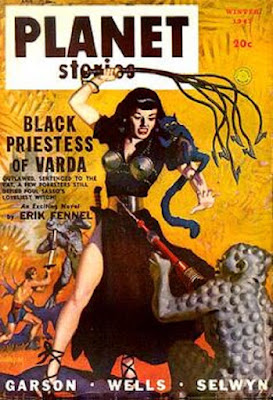
This is a pulp that I own and read recently. That’s my copy in the scan, store stamp and all. I’ll put a better scan from the Fictionmags Index at the bottom of this post. The cover art, as usual for Fiction House, is by Allen Anderson, and it’s excellent, also as usual. Everything in it comes from the lead novella, “Black Priestess of Varda” by Erik Fennel.
Who the heck is Erik Fennel, you ask? I dunno. Apparently neither does anyone
else, since I can’t find anything about him on-line except that he published a
dozen stories in PLANET STORIES, THRILLING WONDER STORIES, and BLUE BOOK
between the mid-Forties and the mid-Fifties. “Black Priestess of Varda” is a
fairly typical sword-and-planet/other dimension yarn with a nice twist or two.
The protagonist is a scientist named Eldon Carmichael, who lost his left arm
and left eye in a laboratory accident. Or was it an accident? The assistant who
may have caused it wound up with the girl Eldon intended to marry, after all.
Then another mishap sends all three of them through a dimensional rift to a
world called Varda, where the beautiful High Priestess Sin (that’s her on the
cover) is trying to open a dimensional rift (there are dimensional rifts galore
in this story) so she can bring the evil entity known as Sasso through to Varda
and finish taking over the place. Swashbuckling action and psychic warfare
ensue, along with quite a few excuses for beautiful Vardan babes to lose their
clothes. (Not quite to the Spicy pulp level, but close.)
I thoroughly expected that traveling between dimensions would restore our
hero’s missing eye and arm and bulk him up with muscle, but no, Fennel makes
the interesting choice to leave him like he is on Earth, for the most part, and
it works well. There’s a little alien sidekick (he’s on the cover, perched on
Sin’s shoulder) that’s very likable and plays a fairly important part in the
plot. The action races right along to a spectacular finish, all the way to a
satisfying last line. The whole thing reads as if Fennel was inspired by Henry
Kuttner and C.L. Moore, which is not a bad thing. “Black Priestess of Varda”
isn’t a classic of the science-fantasy genre like some yarns from PLANET
STORIES, but it’s entertaining.
Next up is a short story by Kenneth Putnam, who was really
Philip Klass, much better known under his pseudonym William Tenn. “My, Myself,
and I” is a humorous story involving a mad scientist, a hobo, and a time travel
machine. It’s mildly amusing, is decently written, but doesn’t amount to much.
At that, it’s much better than “Failure on Titan” by Robert Abernathy, a writer
I’m not familiar with at all. This one involves a race of telepathic,
Abominable Snowman-like aliens working in the mines on the moon Titan under
human supervision. I felt like there might have been something there, but I
didn’t care for the writing at all and abandoned it after a few pages.
“The Running of the Zar” is by Vaseleos Garson (actually William J.
Garson). It’s a crime yarn of sorts about a couple of guys trying to steal a
rare and incredibly valuable element from the native race on Pluto. This may be
science fiction, but Garson gives us the same sort of bleak ending that often
shows up in noir crime stories. An okay story, at best.
Basil Wells wrote for the detective pulps as well as his science fiction
stories. “Among the Scented Ones” is about a fugitive from Earth hiding out on
a planet overrun by vicious wildlife and has a stampede of saurian described
much like a buffalo stampede would have been in a Western pulp. That was the best
thing about this one, which I didn’t like at all.
I vaguely recognize Henry Guth’s name. He also wrote detective yarns in
addition to his SF. His story “Earthbound” is about a couple of kids on Mars
who build a rocket ship in their backyard to go to Earth. It’s cute and
readable, although it plays a little like an episode of a Fifties TV sitcom.
“Earth is Missing!”, a novelette by Carl Selwyn, has some decent world-building
in it. 7000 years from now, Earth is covered with ice, a frozen ball in space,
but civilization still thrives in underground cities including New York, where
everybody talks and acts like it’s still, well, 1947. Hardboiled police
detective Johnny Steel is frustrated by the law’s failure to catch The Bear,
the leader of a gang that’s been robbing banks and businesses, so he turns in
his badge and becomes a private detective so he can go after The Bear without
having to worry about all the rules and regulations. You see, Johnny blames The
Bear for the death of a childhood friend of his who went bad and turned crook.
An oily corporate executive and a beautiful blond femme fatale are also
involved. Johnny’s search for The Bear takes him to the frozen surface, where
he has a big surprise waiting for him in a plot twist that most readers
probably will see coming. This is such a goofy, over-the-top story that I
couldn’t help but enjoy it. It’s my favorite in the issue, and I wouldn’t
hesitate to read something else by Selwyn.
The final story is “Duel in Black”, by another author I don’t know, John Foster
West. It’s a pretty blatant example of a Western plot transplanted to a science
fiction setting, as a miner on the Moon is bushwhacked by a no-good claim
jumper, who even speaks in Western pulp dialect. West’s writing isn’t bad,
though, and I had no trouble making it to the end, which is more than I can say
for a couple of other stories in this issue.
Rounding things out is The Vizigraph, a letters column full of long, enthusiastic
letters. As is common, some familiar names crop up: the first letter is by Chad
Oliver, and there are also letters from Lin Carter and Larry Shaw. Then as now,
SF fandom was a real breeding ground for future pro writers.
Overall, this is the weakest issue of PLANET STORIES I’ve read, with a couple
of not bad stories and the rest either pretty forgettable or ones that I didn’t
like. Anderson’s cover may well be the best thing about it. But despite that, I’m
glad I read it. I don’t consider reading any pulp a waste of time because I
really like visiting that era. If you want to check it out yourself, the entire
issue can be found online here.
Saturday, April 10, 2021
Saturday Morning Bonus Pulp: Double Action Western, November 1944
What did I tell you about those Old West barber shops? It just wasn't safe going into those places, as the cover on this issue of DOUBLE ACTION WESTERN proves. This issue has only three stories in it, a novel by Galen C. Colin, an author I've never read, and short stories by Chuck Martin, whose work I've read and enjoyed in the past, and Basil Wells, an author I'd never even heard of. But a quick check of the Fictionmags Index reveals that Wells broke into the pulps in 1940 and as still writing stories for small press magazines as late as the Nineties! There weren't very many pulpsters still active at that point.