Sunday, April 17, 2022

Sunday Morning Bonus Pulp: Thrilling Wonder Stories, August 1936


This is the first issue of THRILLING WONDER STORIES after Ned Pines bought WONDER STORIES from Hugo Gernsback and changed the title. That's certainly an eye-catching cover. I don't know the artist. Equally eye-catching is the lineup of authors in this issue: A. Merritt, Ray Cummings, Stanley G. Weinbaum, Otis Adelbert Kline, Paul Ernst, Eando Binder (Earl and Otto Binder), Arthur Leo Zagat, and Mort Weisinger, who also happened to be the editor. That's just an excellent group of writers. You can read this issue on-line here, along with a lot of other issues of THRILLING WONDER STORIES. You know, between the issues I own and all the issues that are available on-line, I could just about spend the rest of my life reading pulps of all kinds. And when I retire, I might just do that.

Saturday, April 16, 2022

Saturday Morning Western Pulp: Star Western, September 1948


One of Popular Publications' flagship Western pulps, along with DIME WESTERN, STAR WESTERN was still going strong in the late Forties, with this issue being a prime example. Behind that dramatic Robert Stanley cover are stories by a really fine group of writers: T.T. Flynn, Tom W. Blackburn, Frank Bonham, Van Cort (Wyatt Blassingame), John Jo Carpenter (John Reese), Kenneth Perkins, and writer/editor Art Lawson with two stories, one under his name and one as by William Fargo.

Friday, April 15, 2022

Killer -- Robert Silverberg


Many of the soft-core novels published by William Hamling in the late Fifties and on through the Sixties were crime novels, not surprising when you consider that some of the pseudonymous authors were writers such as Lawrence Block and Donald E. Westlake, who went on to be big names in the mystery/crime/suspense field. But Hamling had writers from other genres working for him, too. Robert Silverberg, already a well-known, award-winning author of science fiction, supplemented his income by turning out well over a hundred soft-core novels as Don Elliott. And many of them were crime stories at heart, too.

A number of these have been reprinted, and the latest comes from the always excellent Black Gat Books line: KILLER, originally published under the Don Elliott name as PASSION KILLER, Sundown Reader SR534 in 1965. As you might expect from that title, this is a hitman novel. Businessman Howard Gorman hires cold-blooded killer Lee Floyd to murder his wife so that he can marry his beautiful redheaded mistress, Marie Caldwell. But then Marie decides she can come out ahead by seducing Floyd and getting him to kill his own client, too . . . but only after Gorman has changed his will to leave everything to her. Throw in a beautiful lesbian call girl and a hotshot airline pilot to complicate things. At least one of these players is going to get double-crossed. The question is who and how . . . and who’s going to make it out of this novel alive.

KILLER reads much like a Gold Medal novel, only instead of fading to black as things are about to get too racy, it keeps going. There’s a lot of sex of several different varieties in this book, and by the mid-Sixties, when it was first published, those scenes are a little more graphic than they were earlier in Silverberg’s career as Don Elliott. However, he never loses sight of the crime plot, and that’s what really drives this novel forward at a very enjoyable pace. Also, as many of these books do, KILLER vividly captures the era in which it takes place. Genre novels are better time capsules than most historical non-fiction, I’ve found over the years. Reading this made me feel like I was back there in the mid-Sixties.

Of course, I never would have been able to read this novel then, because I was in junior high and such stuff was off-limits. (Hey, I had enough trouble smuggling Nick Carter books and Robert McGinnis covers past my mother!) So I’m very glad that many of them are being reprinted these days. KILLER is a very worthy addition to that group. I had a great time reading it and give it a high recommendation. It’s available in both paperback and ebook editions.


Monday, April 11, 2022

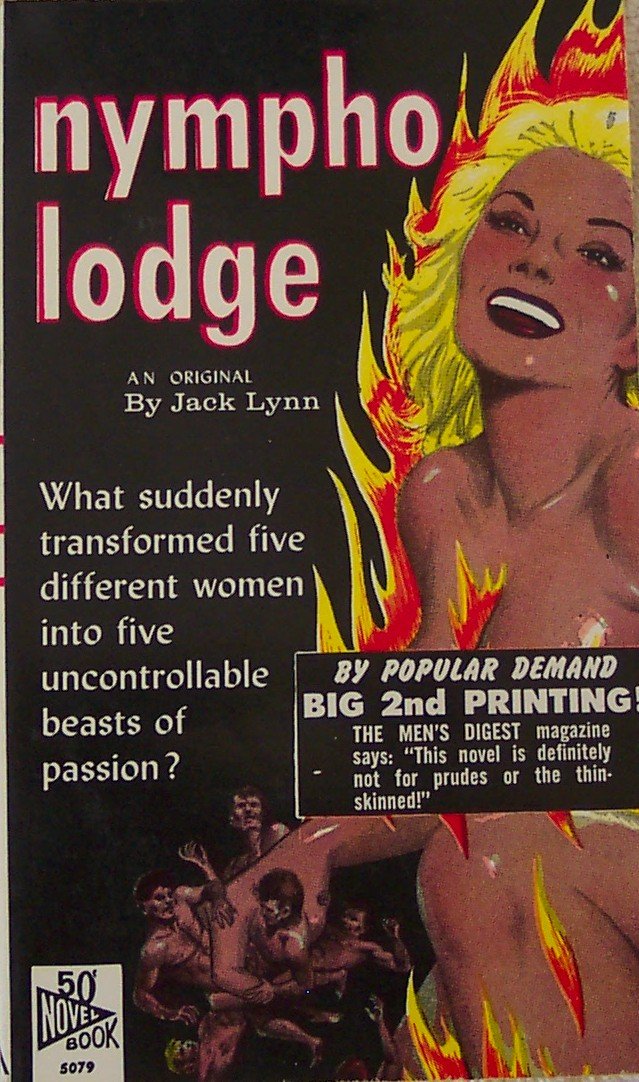
Nympho Lodge - Jack Lynn (Max van derVeer)


Tokey Wedge is one of the great character names in private eye fiction. The star of a number of novels by “Jack Lynn” (actually Max van derVeer) published by Novel Books in the late Fifties and early Sixties, Tokey is a mixture of Shell Scott and Mike Hammer (mostly Scott, but some undeniable Hammer influence in there, too). He’s plenty tough, despite being only 5’4” (or 5’6”, depending on the book) and is irresistible to the dames, of course, as quickly becomes obvious in his first recorded case, NYMPHO LODGE, published by Novel Books in 1959. He’s hired as a bodyguard by a beautiful blonde who’s mired in a messy divorce. Both she and her husband want to wind up with the fancy resort of the title. The blonde has received a vaguely threatening letter and believes that her husband may try to have her killed. She hires Tokey to come with her to the lodge and keep her safe.

As you’d expect, Tokey runs into a bunch of other beautiful women at the lodge, including the husband’s mistress, the girl who works at the check-in desk, the husband’s secretary who really runs things, and an older (but still beautiful) guest, all of whom seem eager to jump into bed with Tokey. Also on hand are a guy who’s suspected to being an arsonist-for-hire and a bartender who may or may not be trustworthy. It actually takes a while to get everything set up with the plot and characters, so it’s the halfway point of the book before the first murder takes place. But once the bodies start to fall, they’re dropping left and right, which brings in the local sheriff and his none-too-bright deputy. Between bedding the various female characters and trying to figure out who the killer is, Tokey really has his hands full.

Despite all the banter, wisecracks, and racy shenanigans, NYMPHO LODGE has a fairly complex plot and you can tell that van derVeer tried to play fair with the readers for the most part, providing a number of clues to what’s really going on. I’m not sure all the revelations at the end completely make sense, but close enough as far as I’m concerned. The real appeal of this novel lies in Tokey’s breezy narration, his cheerful eagerness to both make time with the ladies and uncover a killer, and the hedonistic atmosphere of the era. I had a fine time reading it.

A publisher called Grizzly Pulp is reprinting the Tokey Wedge series, beginning with this one. The new edition has a very good cover by Jim Silke. The second book in the series, MAD FOR KICKS, will be out soon, and you can order both of them here. If you’re a fan of humorous, sexy private eye novels from the Fifties and Sixties, I give Tokey Wedge a high recommendation. Pure fun, as far as I’m concerned.


Sunday, April 10, 2022

Sunday Morning Bonus Pulp: Ten Detective Aces, December 1943


Well, that's probably the best-looking gas jockey I've ever seen. Jerome Rozen did the cover for this issue of TEN DETECTIVE ACES. Any pulp that leads off with a W.T. Ballard yarn is probably going to be worth reading. Also on hand in this issue are solid pros Robert Turner, C. William Harrison, Joe Archibald, and Ralph Berard (Victor H. White), among others. The heyday of TEN DETECTIVE ACES was in the Thirties, but it was still a pretty good detective pulp in the Forties.

Saturday, April 09, 2022

Saturday Morning Western Pulp: Leading Western, April 1950


Joseph Szokoli did quite a few covers for Trojan Publishing Corporation, including many on LEADING WESTERN, like this one which I think is very eye-catching. Unlike some Trojan pulps, house-names don't dominate in the table of contents for LEADING WESTERN. This issue includes stories by Clee Woods, De Witt Newbury, and Frank Castle, all real names. There's one by Reese Wade, who was also apparently not a house-name. But there a couple of retitled, unacknowledged reprints under house-names John Kane and Fred Maurel of stories originally published as by Giff Cheshire and Cliff M. Bisbee, the authors' real names. Trojan did this quite a bit.

Friday, April 08, 2022

Criss-Cross -- Don Tracy


Bill Crider recommended Don Tracy’s second hardboiled novel CRISS-CROSS to me many years ago, and based on that, I hunted up a copy, put it on my shelves . . . and there it sat until the fire of ’08 got it, along with the rest of my books. Since then, I’ve thought many times about replacing it and, you know, actually reading it, but I hadn’t done so.

Until Staccato Crime, the Jazz Age Noir Classics imprint of Stark House, reprinted it in a double volume along with Tracy’s first novel ROUND TRIP, which I reviewed a couple of weeks ago. I took that as a sign than I should go ahead and read CRISS-CROSS, and I’m glad I did.

Original Hardback Edition

This is probably Tracy’s most famous novel, no doubt because it was adapted into a well-regarded movie starring Burt Lancaster. I’ve never seen the film, but I might watch it sometime. Lancaster seems miscast to me as the novel’s narrator/protagonist Johnny Thompson, a former boxer who works as a guard on an armored car that carries payroll shipments in Baltimore. Johnny is in love with beautiful blonde Anna, who marries local shady character Slim but carries on an affair with Johnny, anyway. As if that’s not enough on Johnny’s plate, he has to take care of his mother and his younger brother, who has a speech impediment and is regarded as pretty dim-witted because of it, even though he’s actually not.

Tracy sets all this up in the same flat, ultra-hardboiled prose he uses in ROUND TRIP, and the style is just as effective here. Things heat up when Slim recruits Johnny to be the inside man on a robbery of the armored car . . . but is Slim actually setting him up to be knocked off because he’s discovered Johnny’s affair with Anna?

Retitled Lion Books Paperback Reprint

Naturally, all kind of complications arise when the stick-up actually takes place, as CRISS-CROSS is very much the model for the sort of noirish crime novel that Gold Medal would publish twenty years later. Nothing is black and white in this novel, it’s all shades of gray, and none of the characters are all that likable, either, although you can’t help but root for Johnny despite the fact that he’s pretty dense. Tracy’s style makes it all work, and the action scenes are really good. I don’t think I’m quite as fond of this novel as most reviewers, but I did like it and consider it well worth reading, both in its own right and as a precursor of so many noir crime novels that came along later. It’s available in both ebook and paperback editions and is a fine addition to the Staccato Crime line.

Sunday, April 03, 2022

Sunday Morning Bonus Pulp: Famous Detective Stories, August 1951


Never trust a guy in a gas mask, that's my motto. This blonde certainly shouldn't have. I don't know the artist on this cover, but I like it. Arthur J. Burks is probably the biggest name in this issue, followed by T.W. Ford, Seven Anderton, and Thomas Thursday. Columbia house-name Mat Rand is also on hand, along with a bunch of writers I've never heard of, such as Betty Brooks and D.A. Kyle. I'm not sure if anybody in this issue of FAMOUS DETECTIVE STORIES deserves the FAMOUS label, but that doesn't mean the stories aren't good. (Burks, Ford, and Thursday still have work in print.)

Saturday, April 02, 2022

Saturday Morning Western Pulp: Complete Cowboy Novel Magazine, October 1947


That's a nice dramatic cover on this issue of COMPLETE COWBOY NOVEL MAGAZINE. I don't know who the artist is, but the cover certainly caught my eye. "Will Watson", the author of the lead novel, was really Lee Floren, who also has one of his Buckshot McKee stories in this issue under his real name. The only other author in the issue is Tom Dowling Jr., a complete unknown to me. WOLF DOG RANGE, the novel version, was published in hardback by Wells, Gardner, Darton & Co. (never heard of 'em) in 1949, and reprinted in paperback by Lion Books in 1951, both editions still under the Will Watson name. I like the pulp cover enough that I'm tempted to see if I can find a copy of the novel, even though I'm not really a fan of Lee Floren's work.

Friday, April 01, 2022

Wyoming Way - Roe Richmond


Young Dan Ruylander is the son of a wealthy rancher in Wyoming and is given the job of going to Oregon, buying a herd of cattle there, and driving them back to Wyoming. Several members of his father’s crew accompany him on this journey.

All is not as straightforward as it seems, however. The ranch in Oregon where Dan is going to get the cattle belongs to the son and daughter of Dan’s father’s old partner, who double-crossed him and stole the woman he loved thirty years earlier. Dan’s father has hatched an elaborate scheme to get revenge, even though his former partner is dead and the plot targets the man’s grown children. Dan doesn’t like the idea, and he likes it even less when he gets to Oregon and falls in love with the daughter of his father’s old enemy, but he feels like he has to go through with it out of loyalty to his father. Throw in a romantic triangle involving a beautiful redheaded saloon girl, a gambler/gunman with a grudge against Dan, and two crews of cowboys that hate each other, and the long drive back to Wyoming seems likely to be filled with danger.

That’s the plot, and a semi-complicated one it is, of WYOMING WAY, a 1958 novel by Roe Richmond published by Avalon Books and reprinted a couple of times in large print later on. I read the original Avalon edition.

I’ll be honest: I’ve never been much of a Roe Richmond fan, even though in a convoluted way he unknowingly helped my career (you can find that story here). But I haven’t read much by him, either, mostly some of the Jim Hatfield novels he wrote for the pulp TEXAS RANGERS under the house-name Jackson Cole. My complaint about his Hatfield novels is that he just didn’t “get” the character. You don’t take a stalwart protagonist known as the Lone Wolf and surround him with a gaggle of lame sidekicks, but that’s exactly what Richmond did in his Hatfields. The novels worked somewhat better when Richmond rewrote them into a series of paperback original novels, with Hatfield replaced by Lash Lashtrow, but I still didn’t care much for the two or three of those I read.

However, Richmond wrote quite a few other stories for the Western pulps and a number of Western novels, including a tie-in novel based on the TV show THE DEPUTY, starring Henry Fonda, that was later republished under the title THE SAGA OF SIMON FRY. His work seems to be fairly well-regarded by those who remember him, so I figured it might be worthwhile to give one of those stand-alone novels a try.

WYOMING WAY is pretty good, well-written in a nice hardboiled style, with good descriptions of the settings, some emotional depth to the characters, and a number of excellent action scenes. The big gun battle at the end is top-notch. The book didn’t turn me into a Roe Richmond fan, but it’s certainly entertaining enough that I would read more by him.

Also, the saga of the Beemer Public Library continues. Like Curtis Bishop’s RIO GRANDE, which I reviewed a few weeks ago, my copy’s original owner was the library in Beemer, Nebraska, where it entered the collection as book #2974 on November 1, 1958. It was a little more popular than RIO GRANDE, having been checked out 27 times. RIO GRANDE had 19 check-outs. Comparing the book cards, I see that many of the same people read both books. Unfortunately, I think these are the only two Beemer Public Library books that I have.

Also as with RIO GRANDE, my copy of WYOMING WAY has no dust jacket and there’s no image of one on-line, so I’ve used a stock photo of one of the large print editions instead.