Sunday, March 10, 2019

Sunday Morning Bonus Pulp: Dime Mystery Magazine, March 1947


DIME MYSTERY was long past its Weird Menace phase by the time this issue came out in 1947, but that cover almost looks like it could have been from that earlier era, especially if it had been a little more lurid. And "Death Dance of the Broken Dolls" certainly sounds like a Weird Menace title. It's even by Arthur Leo Zagat, one of the masters of the genre. I believe I have a copy of that story somewhere. I'll have to read it. The rest of this issue's contents appear to be typical late Forties semi-hardboiled detective pulp, although by authors who were good at that: Talmage Powell, Robert Turner, Dale Clark, Cyril Plunkett, and Wilbur S. Peacock.

Saturday, March 09, 2019

Saturday Morning Western Pulp: All Western Magazine, August 1936


This is a pulp I own and read recently. The scan is from the copy I read. Arthur Mitchell, who was a pretty prolific pulp cover artist, mostly in the Thirties, painted the cover. ALL WESTERN MAGAZINE, from what I’ve read of it, was a pretty good Western pulp.

It opens with the novella “Deuce of Diamonds” by Charles M. Martin, who also wrote a great deal for the pulps under the name Chuck Martin. This one features drifting cowpoke and gunman “Roaming” Reynolds, as well as his sidekick, young Texas Joe. There are three stories in this short-lived series, all appearing in ALL WESTERN, and this is the middle one. Reynolds and Texas Joe find themselves helping out a couple of old ranchers (one of whom has a beautiful daughter, of course) who are being plagued by rustlers. Reynolds suspects that local cattle baron Griff Tyson, owner of the Deuce of Diamonds spread, is behind the trouble. Tyson is quite a gunfighter himself and likes to shoot playing cards out of the air, his favorite being the two of diamonds, hence the name.

This story is very heavy on the “yuh mangy polecat” dialect, and there’s nothing in the plot or characters you haven’t seen many, many times in Western pulps, but Martin, like Walt Coburn, was an actual cowboy and the background details of his stories always ring true now matter how standard the plots are. Also, he writes in a very terse, clipped style that I like quite a bit. Martin was something of an eccentric and had a “cemetery” in his back yard where he planted miniature tombstones bearing the names of the villains he killed in his stories. And also like Coburn, he came to a bad end, committing suicide when he had played out his string as a writer. I enjoy his work because of his distinctive style, but I wouldn’t put him in the top rank of Western pulpsters. I never hesitate to read one of this stories, though.

Sam H. Nickels was the author of the Hungry and Rusty series that ran in WILD WEST WEEKLY. I haven’t read any of those, but I suspect, based on the characters’ names, that they’re humorous yarns. The protagonist of Nickels’ story in this issue of ALL WESTERN, “Mud in Mooney’s Eye” is Mournful Mooney, and while it’s not full-fledged slapstick and has some decent action, it’s definitely on the lighter side. Mooney is a sad-sack character who always attracts bullies, but actually he’s a dangerous gunman and a whirlwind with his fists, as he proves in this story when he’s hired to pin on a lawman’s star and clean up the border town of Vacaton. This story is okay, readable but nothing special.

“Empty Shells” by Harry F. Olmsted is definitely a cut above that. This is a tense, well-written yarn that finds a killer known as the Montana Kid searching for a young man who has left the owlhoot trail behind him and returned home to try to reclaim his late father’s ranch. There’s an air of brooding vengeance about this one that shows why Olmsted is one of my favorite Western pulp authors.

I enjoy S. Omar Barker’s cowboy poetry and Western non-fiction, but his short stories usually don’t appeal to me. I’ve mentioned many times that with few exceptions, I’m not a fan of comedy Westerns, and the blurb on the Table of Contents for “All Ears”, Barker’s story in this issue is “A Boosty Peckleberry Laugh Riot”. (I think the editor misspelled “Laff”.) This is one of a series of tall tales spun by the old cowpoke Boosty Peckleberry to entertain the other cowboys in the bunkhouse. It concerns a mule that created the Grand Canyon. I didn’t care for it.

J.E. Grinstead wasn’t a cowboy himself, but he came from pioneer stock and was a newspaperman in Oklahoma and Texas not long after those places were still the frontier. After retiring from newspaper work, he became a prolific Western author, and his fiction has the same air of authenticity as that of Coburn and Martin. His story in this issue, “Six-Gun Music”, is about a tramp who comes stumbling from the desert into the wild border town of San Tomas and finds himself in the middle of some sinister goings-on. It’s a tough, well-written yarn and I really enjoyed it. I think I need to read some of Grinstead’s novels. I read one, WHEN TEXANS RIDE, many years ago but none since, although I’ve read some of his pulp stories.

The final story in the issue is “Death Takes the Trail” by Galen C. Colin, a vengeance tale in which a young cowboy tries to track down the men responsible for killing his foster father. It has some nice action and moves right along, but the plot is pretty thin and seemed to need at least one more twist.

Overall, this is a good but not great issue of ALL WESTERN. The stories by Olmsted and Grinstead are excellent, with the novella by Martin worth reading if not quite up to the level of those other stories. None of the others really impressed me. But still, good enough that I won’t hesitate to read another issue sometime.

Friday, March 08, 2019

Forgotten Books: The Derelict of Skull Shoal - Kenneth Robeson (Lester Dent)


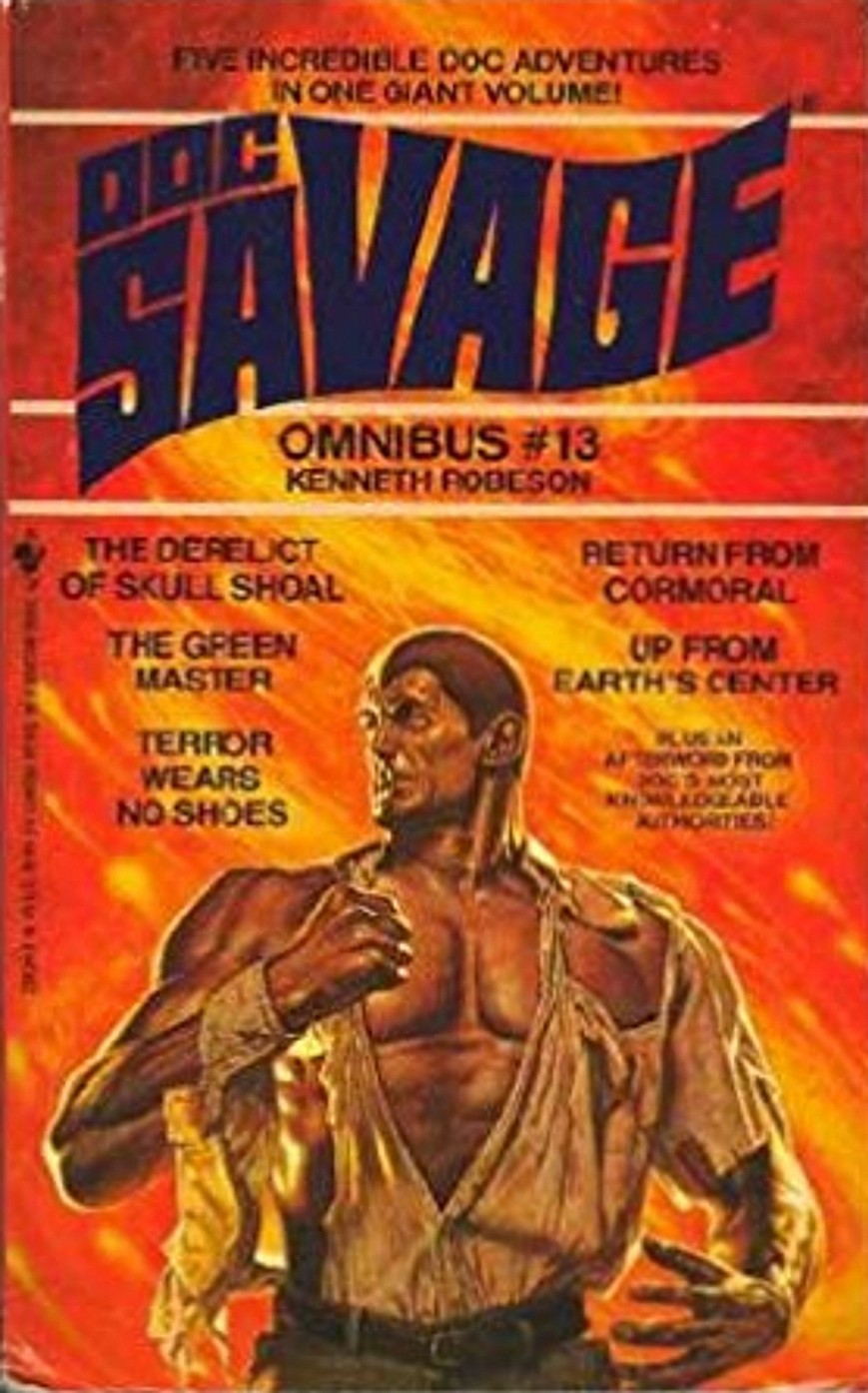
During a recent discussion on Facebook, I mentioned that I’d never read the final Doc Savage novel by Lester Dent, UP FROM EARTH’S CENTER. Well, that got me looking at my copy of DOC SAVAGE OMNIBUS #13, the Bantam paperback that includes that novel, and I realized I hadn’t read any of the five novels in that collection. So I decided it was time to do that, and when I’m finished with them, I’m going to read the Doc Savage novels by Will Murray that I haven’t read yet (there are still a few of them), and then maybe I’ll go back and reread some of my favorites from Dent’s first few years on the series, from 1933 to 1937 or ’38, the era I consider the high point of the series. This will take a year or more, because I usually don’t read books from the same series back to back. So you can expect to see quite a few Doc Savage posts for a while.


To start out with, I read one of the most infamous of all of Dent’s Doc Savages: THE DERELICT OF SKULL SHOAL, originally published in the March 1944 issue of the magazine, which was being published as a digest by this time. A couple of things set this one apart. First of all, it’s the only one in the series that was published in its original appearance under Lester Dent’s real name instead of the Kenneth Robeson house-name, because someone at Street & Smith made a mistake and forgot to put the right by-line on the story. Let me digress for a moment and mention that the very first Doc Savage novel, THE MAN OF BRONZE, appeared in the pulp under the pseudonym Kenneth Roberts, but someone at S&S quickly realized there was a currently popular historical novelist actually named Kenneth Roberts, the fellow who wrote NORTHWEST PASSAGE, ARUNDEL, and many other historical sagas. After that S&S always used the Kenneth Robeson name on the Doc Savages, except for THE DERELICT OF SKULL SHOAL. And when that novel was reprinted, the Bantam paperback collection had the Robeson name on it, too.

To get to the actual novel, the other thing that makes this one notorious is that it’s the story where Doc Savage suffers a serious head injury early on in the action, resulting in a concussion or perhaps even a fractured skull. Fans of the series have noted that Doc’s personality changes somewhat after this story and have theorized that the change was a result of the head injury. That makes sense to me. Whether Lester Dent intended it that way or not, we’ll probably never know for sure.

As Dent often does, he drops us down right in the middle of the action to start the book. Doc and his aides Monk, Ham, and Renny are in disguise, serving as crewmen on the ocean liner Farland, which has been taken over by the U.S. Navy and pressed into service as a military vessel during World War II. The Farland is steaming across the South Atlantic when it’s torpedoed and the order to abandon ship is given. Doc was warned that something was going to happen, and that’s why he and his aides are there, but he doesn’t know what sort of villainy is in the works.

It’s during this chaos that something strikes Doc in the head and renders him unconscious. When he comes to, he finds that he and his friends are still aboard the abandoned ship, but not everything is as it seems, and they’re not alone, either. There’s also a beautiful blonde on hand, Theresa Ruth “Trigger” Riggert, a tough, hardboiled dame of the same sort who often figures in these Doc Savage yarns. (Dent’s female characters always remind me of the female characters in movies directed by Howard Hawks.) If that’s not enough, there are also some guys who want to kill them, of course, and then Ham and Renny disappear under mysterious circumstances, and a submarine shows up, as well as a sinister yacht, and we’re off and galloping again.

This adventure takes Doc and his friends farther south in the Atlantic and winds up at Skull Shoal, a truly eerie setting where the action-packed and satisfying conclusion takes place. While the overall plot struck me as being a little too small in scale (I prefer the early, so-called “supersagas”), Lester Dent’s writing is really top-notch in this novel, with plenty of good dialogue, vivid descriptions, and hardboiled action. The early scenes aboard the Farland, after the attack, reminded me of some of Alistair Maclean’s nautical adventures such as H.M.S. ULYSSES and made me think it’s a shame Dent never wrote an actual war novel. It would have been a good one.

Overall, I really enjoyed this yarn, and reading it makes me look forward to this Doc Savage project on which I’m embarking.


Wednesday, March 06, 2019

The Odds Are Against Us - Oren Litwin, ed.


When victory seems impossible……Heroism is the only option. To survive on the battlefield, you must go far beyond what you ever imagined possible. From a Marine in Vietnam trying to get back home, to Roman soldiers facing an Iceni rebellion; from cynical mercenaries in the harsh Chadian desert, to a Yazidi girl fighting for her freedom; from Soviet conscripts trying to survive war in Afghanistan, to American bomber pilots lost at sea. Experience the triumph of the human spirit even in the face of death. Includes eight short stories of military fiction from from skilled authors, some of whom are veterans themselves.

I backed the Kickstarter for this anthology, and now that it's been published and I've read it, I'm glad I did. It's an excellent collection of military fiction, some with contemporary settings, some historical. I've always liked war stories, and these are very well done. My favorites are "A Place More Kind Than Home" by Ron Farina, a tale of a Marine coming home from Vietnam that does a perfect job of capturing the mid-Sixties era; "Titus, My Brother" by Frank Scalise, about Roman soldiers of the IXth Legion in Britain; and Jim Wilsky's "Dead Reckoning", which alternates between the present day and a flight of American bombers on a training mission shortly after World War II. You may guess the twist in Wilsky's story, but it's so well written and poignant that doesn't matter. All the other stories are very good, too, and one of them might by your favorite if you read THE ODDS ARE AGAINST US, which I recommend if you enjoy military fiction.

Tuesday, March 05, 2019

Overlooked Movies: Bad Times at the El Royale (2018)


Most of you have probably already seen this wonderfully weird movie written and directed by Drew Goddard, but I’m just now catching up with it. BAD TIMES AT THE EL ROYALE is about the sinister goings-on during one night in the early Seventies at a somewhat seedy resort hotel near Lake Tahoe, smack-dab on the border between California and Nevada. A priest, a singer, a vacuum cleaner salesman, and a mysterious young woman are the only guests, and the clerk who appears to be the only employee is definitely on the shady side. We know that some sort of crime is going to be involved because of a violent prologue set ten years earlier, but what it’s going to be takes a lot of unraveling and filling in of back-stories among these characters.

I love a yarn where nothing is what it seems to be, and that’s the case with BAD TIMES AT THE EL ROYALE, which means I can’t talk too much about the plot without ruining things. Well-written, with a great soundtrack and a cast that includes Jeff Bridges, Jon Hamm, Chris Hemsworth, and Nick Offerman (him again, but blink and you’ll miss him), this is the best movie I’ve seen in quite a while. Highly recommended.

Monday, March 04, 2019

Now Available: Faraday: The Iron Horse - James Reasoner


The race is on to span the continent with steel rails—and someone is willing to do anything to stop it, even if it means spilling rivers of innocent blood!

Matthew Faraday is president of the Faraday Security Service, a detective agency specializing in work for the ever-expanding railroad empires. Hired to find out who is stirring up the Sioux and sabotaging the Kansas Pacific line as it builds westward, Faraday sends tough young agent Daniel Britten to the railhead, where he finds himself embroiled with surveyors, track layers, buffalo hunters, and a pair of beautiful young women. But there’s a killer stalking the railhead as well, and not only the fate of the railroad but also Britten’s very life depends on him uncovering the truth.

The original version of this epic Western adventure by legendary author James Reasoner has been out of print for decades. Newly revised and expanded, it’s now available again with all the historical sweep and gun-blazing action readers have come to expect from James Reasoner.

Sunday, March 03, 2019

Sunday Morning Bonus Pulp: Mystery Novels and Short Stories, December 1939


I don't know who did the cover for this issue of MYSTERY NOVELS AND SHORT STORIES, but that's some inspired lunacy right there, right down to the tattoos on the whip-wielding dwarf's arms. And the fact that you can use the term "whip-wielding dwarf" in describing this cover tells you a lot about the magazine. Despite being called MYSTERY NOVELS AND SHORT STORIES, this is clearly a Weird Menace pulp. The authors, however, aren't really known for that genre although some of them are fairly big names. Arthur J. Burks, of course, wrote almost everything, so he doesn't really count, but I think of Frank Belknap Long more as a Weird Fiction author (and that's not the same thing as Weird Menace) and G.T. Fleming-Roberts is an actual mystery and action writer. And wait, who's this I see on the Table of Contents? None other than Norman A. Fox, one of the stalwarts of the Western pulps. That's one thing I love about the pulp era: if there was a paycheck to be had, guys chased it. I've always been the same way.

Saturday, March 02, 2019

Saturday Morning Western Pulp: Big-Book Western Magazine, January 1940


I'm used to the stories in Popular Publications' Western pulps having great titles, but "When It's Roundup Time in Hell" is particularly awesome, although the author, Rolle R. Rand, is unfamiliar to me. The FictionMags index lists thirteen stories by him, all in various Popular Publications Western pulps, in a period of a little more than a year in 1939 and early 1940. He has one more story in an Armed Services edition anthology in 1944, then a gap of more than forty years before his by-line appears on a single story in MIKE SHAYNE MYSTERY MAGAZINE in 1985, followed by one story in ESPIONAGE in 1986, then one final story in something called WHISPERING WILLOW MYSTERIES (evidently a small press publication) in 1997. That's an odd career, and I can't find anything about him on-line. Elsewhere in this issue of BIG-BOOK WESTERN are some much more familiar names, such as Harry F. Olmsted, Ed Earl Repp, and John G. Pearsol. There's even an appearance on the cover by the Angry Gun-Totin' Redhead, although the guy with her is a lawman, not the Stalwart Cowboy, and there's no sign of the Old Geezer with the Bandaged Head.

Friday, March 01, 2019

News From the Lowestoft Chronicle


Latest Issue #37: The Spring edition of Lowestoft Chronicle features stories by Christie B. Cochrell, Rob Dinsmoor and Don Noel, poetry by Cat Dixon, Valerie Nieman, James Sale and Lee Clark Zumpe, and creative nonfiction by Lori Barrett, Scott Dominic Carpenter, Mary Donaldson-Evans and Olga Pavlinova Olenich.
Read it at www.lowestoftchronicle.com


Steadfast Trekkers
A Lowestoft Chronicle Anthology: The latest anthology, published in September, includes a foreword by author Rob Dinsmoor and interviews with Dietrich Kalteis and Sheldon Russell. Get your copy while stocks last. One place to order it is here.


What's in Season @ Lowestoft Chronicle?

Check out the latest issue of Lowestoft Chronicle, the free online magazine featuring fiction, poetry, creative non-fiction, and interviews.

This Spring at Lowestoft Chronicle:
Romance blossoms and a marriage withers as globetrotting friends outstay their welcome in Italy, and on a sightseeing trip in Norway, a gregarious American helps thaw frosty relations between a quarrelsome British couple. In France, an American professor grapples with the local's love of facts and figures and historical minutia, and a pair of expats in Belgium try to ignore embarrassing nightly noises.

We proudly present the work of Lori Barrett, Scott Dominic Carpenter, Christie B. Cochrell, Rob Dinsmoor, Cat Dixon, Mary Donaldson-Evans, Valerie Nieman, Don Noel, Olga Pavlinova Olenich, James Sale, and Lee Clark Zumpe.

Our thanks to all contributors, as well as everyone who submitted work to us. We are currently accepting submissions for Issue #38 (due on June 1st). Preference is given to humorous submissions with an emphasis on travel. See our submissions page for guidelines.

The Latest News...
Lowestoft Chronicle Editor's Syndicated Book Reviews
A regular writer for the Colorado Review and the UK media group Johnston Press, the LC editor's book reviews are published weekly on the websites of 25 newspapers across the UK. You can read his various recent articles at the venues below:
Colorado Review, Lancashire Post, St. Helens Reporter, Burnley Express, Blackpool Gazette, Wigan Observer, Lancaster Guardian, The Garstang Courier, Fleetwood Weekly News, and elsewhere.

Book News by Lowestoft Chronicle Friends and Contributors
Borrow the Night / The Fifth Caller by Helen Nielsen (Introduction by Nicholas Litchfield)

Stories in the Key of Me by Michael C. Keith

When Hell Struck Twelve (A Billy Boyle WWII Mystery) by James R. Benn

To the Bones by Valerie Nieman

Cocktails with a Dead Man by Joe Albanese

Drone Strike by Joe Giordano

Kind regards,
Lowestoft Chronicle

Forgotten Books: The Corpse in the Corner Saloon - Hampton Stone (Aaron Marc Stein)


When I was younger I read a lot of traditional mysteries, and a series I always enjoyed was the one featuring Inspector Schmidt, written by Aaron Marc Stein under the pseudonym George Bagby. The gimmick of the series was that George Bagby was also a character, a writer who accompanied Schmitty (as he was called) on his cases and wrote them up into books where he served as the narrator.

Well, Stein wrote another long-running mystery series under the name Hampton Stone, this one featuring former cop and currently New York City assistant district attorney Jeremiah X. Gibson as the detective. In these books, Gibby (as he’s called) is accompanied on his cases by another ADA, referred to in this book only as Mac, who narrates the story and then writes it up as a novel. I guess Stein figured if it worked in one series, it would work in another. (He wrote yet another series about two-fisted, globe-trotting engineer/adventure Matt Erridge, but as I recall from the few of those I read, there’s no narrator/sidekick in them.)


I don't believe I had read any of the Gibby and Mac books until now. I picked up a few of them recently and read the first one in the series, THE CORPSE IN THE CORNER SALOON, published originally in 1948 by Simon & Shuster. It was reprinted in 1950 as a Dell Mapback and then in 1971 by Paperback Library as part of a numbered series of Hampton Stone books, with cover art that makes Gibby look like Steve McQueen, much like Milo March looked just like James Coburn in the reprints of those books by M.E. Chaber (Kendell Foster Crossen) being published at approximately the same time. The Paperback Library edition is the one I read, and that’s my copy in the scan at the top of this post. By the way, the numbers on the Paperback Library reprints make no sense at all. Like I said, this is the first book in the series, not the tenth.

So is THE CORPSE IN THE CORNER SALOON any good? Well, I enjoyed it, even though I can’t say I was tremendously impressed by it. The mystery involves a woman of rather dubious reputation found choked to death in her apartment with the word “Bitch” written in lipstick on her bare back. Her lover, who would have been the main suspect in her murder, is discovered a short time later sitting in the corner saloon of the title. Problem is, he’s dead from cyanide poisoning, and since numerous witnesses saw him entering and leaving the dead woman’s apartment building around the time of her murder, the whole thing comes very close to being written off by the authorities as a murder/suicide.

But Gibby doesn’t buy that and starts investigating, accompanied by the faithful Mac, of course, and soon discovers that the identifications of the suspect hinge on the distinctive coat he was wearing, and since there are half a dozen or more other people who might have had a reason for wanting the woman dead, Gibby has to get to the bottom of things.

As you might suspect from that set-up, this is a very talky book. There’s no action to speak of. Gibby and Mac go here and talk to one person, then go there and talk to another person, around and around until Gibby has all the clues he needs to have a gathering of the suspects and reveal the killer. The thing that saves this book from being deadly dull is that Stein was a pretty slick writer and there are some good lines of dialogue and welcome bits of dry humor. Gibby and Mac are very likable main characters, too, Gibby especially being willing to cut some legal corners to get to the truth despite his profession, much like Perry Mason, and the working out of the killer’s identity is fairly interesting. It’s also pretty racy in places for 1948, too.

I enjoyed THE CORPSE IN THE CORNER SALOON enough to recommend it if you’re a fan of vintage traditional mysteries. I don’t read a steady diet of them, but I probably will read some more of the Hampton Stone novels.