Tuesday, February 28, 2017

Forgotten Movies: Mystery, Alaska (1999)

Since I've become something of an ice hockey fan, I've started watching some hockey movies I never saw when they first came out, like this one. MYSTERY, ALASKA is set in one of those colorful, eccentric small towns that show up in movies and TV shows. The young men there play ice hockey on a frozen pond and are very good at it. A writer who grew up in the town sells a story about it to SPORTS ILLUSTRATED, and he comes up with the idea of having the New York Rangers play an exhibition game against the local team. The NHL thinks this would be good publicity and goes along with it. Complications ensue, mostly humorous, a few more serious.

This is a pretty good film. A little on the raunchy side, but that seems to go with hockey movies, at least the non-Disney ones. A young Russell Crowe plays the local sheriff, who's also the oldest member of the local team. Burt Reynolds, proving that he was a pretty good actor when he was interested, is the crusty local judge, a retired player who winds up coaching. Hank Azaria is the guy who left town and became a writer. The supporting cast is good, as are the production values, and the hockey scenes are staged so you can tell what's going on.

MYSTERY, ALASKA was written by prolific TV writer David E. Kelley, whose work I either like (PICKET FENCES and the first few seasons of THE PRACTICE) or hate (pretty much everything else he's done). This movie is funny and well-written, though, and I think even non-hockey fans might enjoy it.

Monday, February 27, 2017

The Eyes of a Wolf - James LePore


THE EYES OF A WOLF is James LePore's second thriller novella about Zevon Evans, an Iraq War vet with brain damage, a metal plate in his head, and enhanced skills that mostly involve killing. But it's actually a prequel to the first book, so you can start with it and follow things just fine. That's actually what I did.

In this one, Zev gets a call from the doctor who put him back together after he was wounded. She's in trouble, so he doesn't hesitate to fly across country to San Diego to help her—only by the time he gets there, she's missing. Zev has resources to help him, though, and recruits others, and soon he's on the trail of some dangerous conspirators engaged in a deadly scheme that reaches across the border.

Zev is a very likable narrator/protagonist, despite his penchant for violence, and LePore manages to combine leisurely digressions into his character with terse, slam-bang action scenes. It's an approach that probably shouldn't work, but in the hands of an excellent writer like LePore, it does. I enjoyed this yarn enough that I immediately went and bought the first one. THE EYES OF A WOLF is a good, modern-day thriller that's not bloated and overwritten like so many these days. Recommended.


Sunday, February 26, 2017

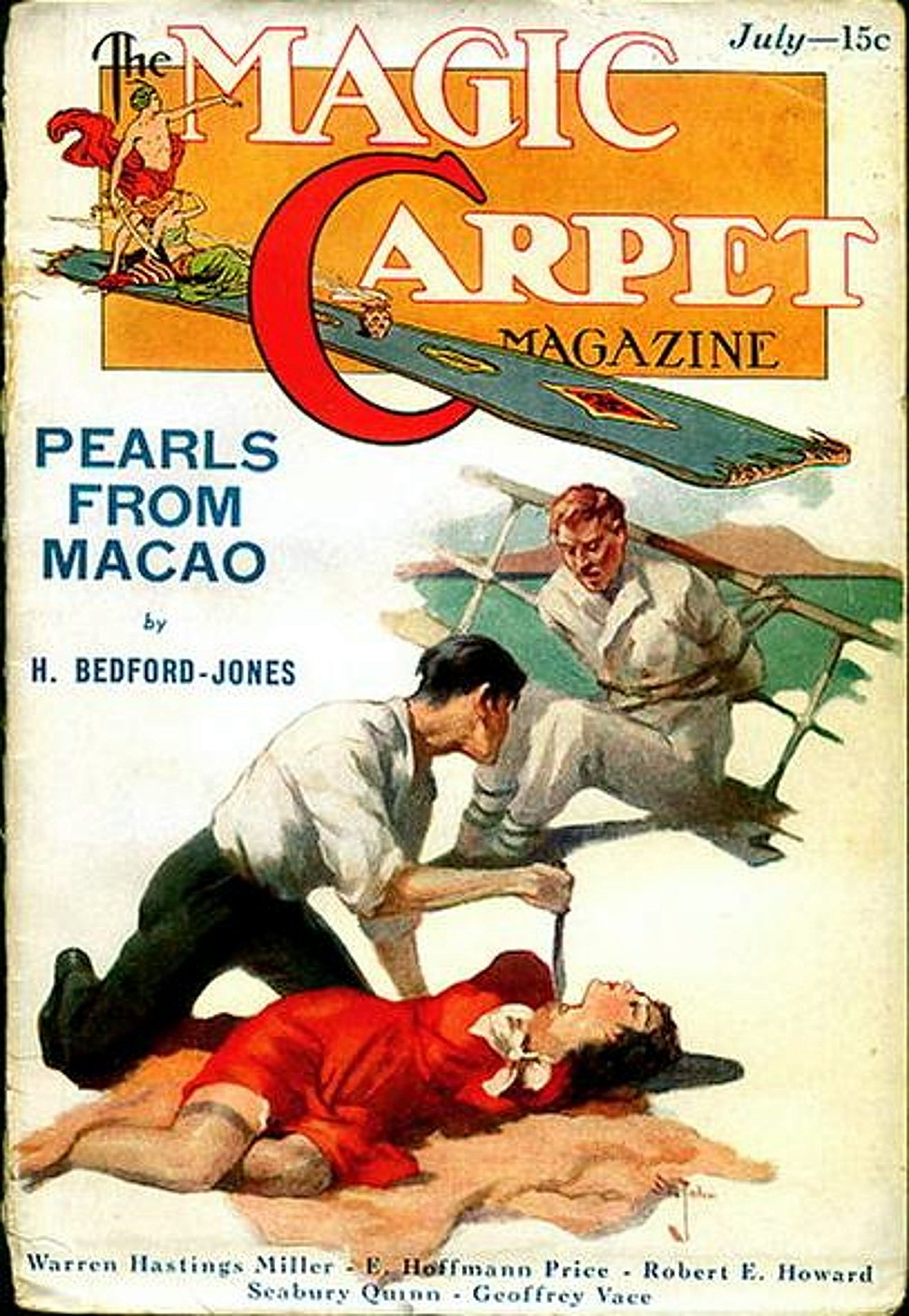
Sunday Morning Bonus Pulp: The Magic Carpet Magazine, July 1933


THE MAGIC CARPET MAGAZINE and its predecessor, ORIENTAL STORIES, didn't last very long--15 issues total--but they sure published some great stuff while they were around. The July 1933 issue of THE MAGIC CARPET MAGAZINE features a cover by J. Allen St. John and stories by H. Bedford-Jones, Robert E. Howard, E. Hoffmann Price, Geoffrey Vace (who was actually Hugh Cave's brother Geoffrey . . . or sometimes Hugh Cave . . . or sometimes both of them--I don't know who actually wrote this particular story), Clark Ashton Smith, and Warren Hastings Miller. What a fantastic bunch of authors! I've read the Bedford-Jones story in a Black Dog Books chapbook reprint, as well as the REH story, but none of the others. I'll bet they're all good, though.

Saturday, February 25, 2017

Saturday Morning Western Pulp: Fifteen Western Tales, February 1943


That lawman better look out behind the door. Or maybe he could just go read this issue of FIFTEEN WESTERN TALES, which features stories by L.P. Holmes, Frank Bonham, Philip Ketchum, and William Heuman, among others. One thing to remember about FIFTEEN WESTERN TALES is that its definition of "Tales" includes columns and articles, too, not just fiction. I'm not sure I consider that quite on the up and up, but as long as the stories are good I don't mind cutting them a little slack.

Friday, February 24, 2017

Forgotten Books: Riders of the Night - Eugene Cunningham


RIDERS OF THE NIGHT, from 1932, was Eugene Cunningham's second published novel, although some of the ones that came out later actually predate it since they were fix-ups of linked novellas originally appearing in various pulps. As far as I can tell, RIDERS OF THE NIGHT was written as a novel. It's the story of young Burk Yates, who returns from college in the East to the Texas ranch where he grew up. The ranch was started by Burk's father and his partner Duke Yarborough, both of whom are now dead. Ownership of the ranch is shared between Burk and Yarborough's beautiful daughter Myra, who has fallen for neighboring rancher Lance Gregg. A bunch of outlaws known as the One Gang has been rustling stock from the ranch as well as holding up stagecoaches and trains and generally raising hell throughout the area. In fact, the novel opens with a very sinister and atmospheric scene in which the gang lynches two men, leaving them dangling from a corral gate.

Anyone who's read or watched very many Westerns will have a pretty good idea of everything that's going to happen in this novel, although the final showdown between Burk Yates and the "mysterious" mastermind behind the One Gang plays out differently than I expected. The predictability of the plot does hurt RIDERS OF THE NIGHT a little, but it's still worth reading because of Cunningham's distinctive hardboiled style, the great action scenes, the introduction of Mexican/Navajo gunfighter Chihuahua Joe, a recurring character in Cunningham's work who serves as sidekick to a number of different heroes, and a raft of other colorful characters including, yes, a saloon girl with a heart of gold. I had a fine time reading it.

By the way, someone has tallied the number of killings in this book and come up with 75. I've read that in some of Cunningham's novels there are as many as 300 deaths. His reputation as one of the most violent of the early Western authors appears to be well-deserved.


Thursday, February 23, 2017

A Kickstarter of Interest: The Odds Are Against Us: A Military Fiction Anthology

My friend Jim Wilsky is going to have a story in a new anthology of military fiction called THE ODDS ARE AGAINST US, and the publisher is looking for more stories as well as funding through a Kickstarter project. This isn't really a market for military science fiction, although near-future (in the next decade) SF is acceptable. You can read about the Kickstarter here, and if you're interested in writing a story for the book, you can find all that information here. I'm backing this project and look forward to reading the book.

Monday, February 20, 2017

AR-I-E'CH AND THE SPELL OF CTHULHU: AN INFORMAL GUIDE TO R.E. HOWARD'S LOVECRAFTIAN FICTION - Fred Blosser


I first encountered the work of Fred Blosser in the pages of Marvel's black-and-white magazine THE SAVAGE SWORD OF CONAN when I was reading it regularly back in the Seventies. Blosser wrote a fine series of articles and essays about Robert E. Howard's stories and characters for that magazine. Later I read more of his articles in other journals devoted to Howard scholarship and met Blosser one year in Cross Plains during the annual Robert E. Howard Days get-together. And then I wound up publishing his great historical adventure novel THE SAVAGE PACK as part of my Rough Edges Press line.

AR-I-E'CH AND THE SPELL OF CTHULHU: AN INFORMAL GUIDE TO R.E. HOWARD'S LOVECRAFTIAN FICTION is Blosser's latest publication. This book-length study of all of Howard's stories that are part of, either directly or indirectly, or influenced by H.P. Lovecraft's Cthulhu Mythos, is both entertaining and informative reading for Howard fans. In my case, I haven't read a lot of Lovecraft's work and am about as far from a Lovecraft scholar as anybody could get. But Blosser's clear prose, meticulous research, and enthusiasm for his subject made it easy even for me to learn things and get a better grasp on the relationship between Howard and Lovecraft and the connections between their work. Over the years I've already read all the stories Blosser discusses, but this volume makes me want to read them again, this time with a greater understanding of them. One word of warning: Blosser discusses the plots in detail, so anyone who hasn't read the stories might want to do that first.

Blosser has more guides to other areas of Howard's fiction planned, and I'm very much looking forward to reading them. In the meantime, if you're a Howard fan, don't miss this one.


Sunday, February 19, 2017

Sunday Morning Bonus Pulp: Soldiers of Fortune, October 1931


The first issue of a short-lived pulp devoted to adventure fiction. It appears there were only four issues of SOLDIERS OF FORTUNE before it went down for the count with the rest of the Clayton magazine line. But the four stories in these pages were from top-notch authors of pulp adventure fare: F.V.W. Mason, Victor Rousseau, S.B.H. Hurst, and Malcolm Wheeler-Nicholson. The cover art is by Jerry Delano, who did the covers for all four issues.

Saturday, February 18, 2017

Saturday Morning Western Pulp: Wild West Weekly, March 3, 1934


A nice cover by H.W. Scott on this issue of WILD WEST WEEKLY, and a very nice line-up of authors inside: Paul S. Powers. Allan R. Bosworth, Stephen Payne, Samuel H. Nickels, J. Allan Dunn (a Whistlin' Kid yarn as by Emery Jackson), Lee Bond (writing as Philip F. Deere), and Norman W. Hay (a Circle J story as Cleve Endicott). I've never read an issue of WILD WEST WEEKLY that I didn't enjoy, and I'm sure if I had a copy of this one, I'd have a great time reading it, too. 

Friday, February 17, 2017

Forgotten Books: The Twisted Thing - Mickey Spillane


Spoilers below, sort of.

THE TWISTED THING came out in 1966, Mickey Spillane's ninth Mike Hammer novel, but I believe I've read that it's actually the second book Spillane wrote, back around 1950. There are a few lines that make it sound as if that could be the case, including what might be a reference to the famous ending of I, THE JURY. The book doesn't have any topical references, either, other than a few mentions of "the war". However, I didn't have any idea about that when I first read the novel all those years ago, and the things I noticed now went right past me then. All I knew was that while I liked the book, I didn't think it was as good as the other Mike Hammer novels I'd read up to that point.

It's sort of an odd duck, to be honest. The setting is a small town somewhere in New York, rather than Hammer's usual haunts in New York City. Most of the action takes place on a country estate belonging to wealthy scientist Rudolph York, who hires Hammer to find his kidnapped son Ruston. Ruston York is a prodigy, raised by his father to be a genius, a little reminiscent of Doc Savage only without the physical development. Also at the country house are an assortment of relatives and employees, most of them with secrets and agendas. More than once I thought, "Wait a minute, shouldn't this be a Hercule Poirot novel?"

But no, it's definitely a Mike Hammer yarn. Maybe not as much shooting and punching as some in the series, but there's still plenty. The voice of Carroll John Daly's Race Williams definitely echoes in some of Hammer's musings. He actually solves the kidnapping and rescues the kid pretty early in the book, but then there's a particularly grisly murder and the case becomes a lot more complicated. Ruston York doesn't turn out to be quite the innocent victim Hammer believed him to be at first. Eventually Hammer sorts everything out, and there's a long scene at the end where it's all explained before the traditional jarring Spillane ending.

After rereading this book fifty years later, I still wouldn't place THE TWISTED THING in the top ranks of the Mike Hammer series. I wasn't sure I completely bought the ending even back in '66, and I don't now, either. However, the action scenes are great and I just love Spillane's voice and the sheer pace of the storytelling. I suspect many of you read this book a long time ago, like I did, but if you haven't, it's worthwhile, just probably not the best place to start with Spillane's work.


For what it's worth, the first Spillane novel I read was the non-series book THE DEEP. I started the Hammer series with KISS ME, DEADLY and quickly read all the others that had come out by then, which I believe took the series up through THE SNAKE. That's one I have fond memories of reading in the old barracks building that served as our high school's study hall, so maybe I ought to reread it one of these days. If I do, I'll be sure to let you know what I think.