Wanted posters show up a lot on Western pulp covers. Usually, the outlaw depicted on the poster is standing there either shooting or about to shoot. You can't really tell if the fellow on the cover of this issue of FIFTEEN WESTERN TALES is also the one on the reward dodger, but there's a good chance he is. There are stories by some fine Western pulpsters in this issue: Philip Ketchum, William Heuman, Thomas Thompson, and Frank Bonham. Other well-known authors in this one include Joe Austell Small, R.S. Lerch, John Wilstach (better known for his adventure yarns in ARGOSY and elsewhere), Carl G. Hodges (best remembered for his mystery stories and novels), and Edwin K. Sloat. Then there are the ones I'm not familiar with--P.J. Delanoye, Roy B. Angell, and W.W. Montgomery--and house names Ray P. Shotwell and Lance Kermit. I'm going to name the hero in a Western novel Lance Kermit one of these days. I'm sure this is a good issue since the Popular Publications Western pulps were consistently top-notch.
Saturday, July 13, 2024
Saturday Morning Western Pulp: Fifteen Western Tales, October 1942
Wanted posters show up a lot on Western pulp covers. Usually, the outlaw depicted on the poster is standing there either shooting or about to shoot. You can't really tell if the fellow on the cover of this issue of FIFTEEN WESTERN TALES is also the one on the reward dodger, but there's a good chance he is. There are stories by some fine Western pulpsters in this issue: Philip Ketchum, William Heuman, Thomas Thompson, and Frank Bonham. Other well-known authors in this one include Joe Austell Small, R.S. Lerch, John Wilstach (better known for his adventure yarns in ARGOSY and elsewhere), Carl G. Hodges (best remembered for his mystery stories and novels), and Edwin K. Sloat. Then there are the ones I'm not familiar with--P.J. Delanoye, Roy B. Angell, and W.W. Montgomery--and house names Ray P. Shotwell and Lance Kermit. I'm going to name the hero in a Western novel Lance Kermit one of these days. I'm sure this is a good issue since the Popular Publications Western pulps were consistently top-notch.
Friday, July 12, 2024
Hell-Bent for Hollywood - Fred Olen Ray
I haven’t seen all that many of Fred Olen Ray’s movies, but I’ve enjoyed everything I’ve seen that he wrote and/or directed. I first became aware of his work in the mid-Eighties when I worked at Fort Worth Books & Video and rented out his action film ARMED RESPONSE (starring David Carradine and Lee Van Cleef) many, many times. It was a popular movie for us.
Ray has just published his autobiography, HELL-BENT FOR HOLLYWOOD. I always
enjoy reading about creative people, so I gave it a try. He doesn’t pull many
punches in telling about his life, from his hardscrabble upbringing in Florida
to his early desire to be a filmmaker to the many detours along the way to
achieving his dream. It’s a compelling tale that Ray spins in straightforward,
no-nonsense prose.
I especially enjoyed the sections where Ray talks about our mutual friend
Terrell Lee Lankford, who wrote the scripts for several of Ray’s movies over
the years. Lankford was a regular commenter here in the early days of this blog
and is the author of several excellent crime novels including EARTHQUAKE
WEATHER, BLONDE LIGHTNING, and ANGRY MOON. If you haven’t read his books, you
really should.
But to get back to Ray, HELL-BENT FOR HOLLYWOOD is a wonderful book. I had a
very hard time putting it down. If you want insights into filmmaking and
fascinating, behind-the-scenes stories about many legendary Hollywood figures,
you’ll find plenty of that in the book, along with the inspiring narrative of
Ray’s own life. I have a feeling he might scoff at hearing himself described as
inspiring, but that’s the way it seems to me. HELL-BENT FOR HOLLYWOOD is one of
the best books I’ve read this year, and I give it a high recommendation. It's available in trade paperback and e-book editions.
Wednesday, July 10, 2024
Manville Moon #6: Five O'Clock Shroud - Richard Deming
“Five O’Clock Shroud” is the sixth novella about Richard Deming’s one-legged private detective Manville Moon. It appeared originally in the November 1950 issue of BLACK MASK DETECTIVE and was featured on the usual fine cover by Norman Saunders.
This one has a bit more complicated plot than the previous story in the series.
Moon is hired by a wealthy supporter of a politician who is running for mayor
as a reform candidate. Unfortunately, it appears that the so-called reformer is
actually the big boss of the ring controlling the city’s gambling. Moon even
turns up proof of that. And then the murders start, and Moon finds himself
targeted for death, as well as being the target of some advances from a beautiful
married woman.
Deming does a good job with the political intrigue even though it’s not that
difficult to figure out what’s really going on. I’ve become quite fond of Manville
Moon as a character. There’s a superb scene in which he’s taken for a ride by
three killers, and even though the reader knows he’s going to survive, Deming’s
writing generates some genuine suspense. Moon’s escape is pretty clever, too.
If you’re a fan of hardboiled private eye tales, this is a very entertaining
series. “Five O’Clock Shroud” is available on Amazon as an inexpensive e-book.
I had a fine time reading it and it gets a solid recommendation from me.
Monday, July 08, 2024
Elak of Atlantis - Henry Kuttner
I’ve been meaning to read Henry Kuttner’s Elak of Atlantis stories for a long time now, and I’m getting to the age where I’m feeling a bit more urgency about getting around to the things I want to do. Also, there are collections of new Elak stories by Adrian Cole coming out, and I want to give them a try, but I thought I ought to read the originals first. Also, I’m a sucker for Atlantis stories, and Kuttner appears to have done a pretty good job of world-building in this four story series, originally published in the iconic pulp WEIRD TALES.
The saga gets underway with the novella “Thunder in the Dawn”, the longest of Kuttner’s Elak stories that was serialized in the May and June 1938 issues of WEIRD TALES. It introduces us to Elak, a lean adventurer who favors a rapier rather than a broadsword, and his rotund sidekick/comedy relief Lycon. Elak is actually the stepson of the former rule of one of Atlantis’s northern kingdoms who killed his stepfather in a duel and fled, leaving his stepbrother to take over the throne. Elak and Lycon encounter a druid priest named Dalan, who brings the news that Elak’s stepbrother has been imprisoned by an evil wizard and Vikings are besieging his homeland. Who better to travel north, unite the feuding tribes, battle the Vikings, and rescue the imprisoned king than Elak?
Nobody, of course. With a little reluctance, Elak takes up the quest. Along the way wait adventures and beautiful women and epic battles against enemies both human and sorcerous. Kuttner really packs a lot of plot and incident into this yarn, a novel’s worth despite its novella length, and it’s all very fast-paced and well-written. This is an exciting and very satisfying debut for the series.
The short story “Spawn of Dagon” appears the very next month in the July 1938 issue of WEIRD TALES and even makes the cover. There’s very little reference to the preceding story and Dalan the Druid doesn’t appear. Elak and Lycon are back to being drifting adventurers. They get involved in some political intrigue and are hired to kill a wizard and destroy the source of his power. Of course, the situation doesn’t turn out to be exactly what our two heroes believe it is. Even though I’m not the biggest fan of H.P. Lovecraft’s work, I recognized the name Dagon right away, and sure enough, the boys encounter some of HPL’s fish-people and there’s talk of the Elder Gods. This story has a good deal of well-written action, but after the epic scale and grand, colorful concepts of the debut novella, I found it a little disappointing. Not bad, mind you, but a very standard sword and sorcery adventure yarn enlivened a bit by the presence of the fish-people.
“Beyond the Phoenix”, from the October 1938 issue of WEIRD TALES, once again finds Elak and Lycon involved in political intrigue, but this time they’re trying to protect a king from a deadly rival, and when they fail in that, the dying monarch charges them with the job of saving his daughter and delivering his body to the god he worships. This involves a trip on an underground river reminiscent of the second novel in Edgar Rice Burroughs’ Barsoom series, THE GODS OF MARS. I have to wonder if Kuttner read Burroughs. It certainly seems possible. I also wonder if C.L. Moore had a hand in this story, as well as the previous one. By 1938, Kuttner and Moore knew each other and had even collaborated on one story, “Quest of the Starstone” in the November 1937 issue of WEIRD TALES. If the Elak stories had come out after they were married and collaborating on a regular basis, I would have been confident that Moore wrote all the colorful, vividly descriptive passages. But since I’ve never seen any speculation about her involvement, at least as far as I recall, I’ll just assume that being a fan of her work had an influence on Kuttner as he was writing these yarns. At any rate, “Beyond the Phoenix” is a good story with plenty of action.
The fourth and final Elak story by Kuttner is the novelette “Dragon Moon” from the January 1941 issue of WEIRD TALES. This one is very reminiscent of “Thunder in the Dawn”, the tale that launched the series. Once again Elak and Lycon are summoned northward to Cyrena, Elak’s homeland, by Dalan the Druid, who tells them that Elak’s stepbrother the king was possessed by some sort of evil entity and killed himself rather than give in to it. That mystical being has now possessed the king of a neighboring country and plans to conquer Cyrena by force. Being without a king, the realm has no chance of defeating its enemies. Elak is the only one who can save the day, and he can only do that by reclaiming the birthright he doesn’t want. This is another epic yarn with several adventures along the way before the final showdown, which is a huge, very well-written battle. I’ve seen comparisons between this story and Robert E. Howard’s THE HOUR OF THE DRAGON, and maybe Kuttner was inspired by Howard’s only novel-length adventure of Conan, but they’re very different stories because Conan and Elak are very different characters. “Dragon Moon” isn’t the equal of THE HOUR OF THE DRAGON, but I enjoyed it very much anyway. It’s my favorite story of the four about Elak written by Kuttner.
Overall, I really like this collection. The writing is excellent, it’s full of colorful settings and intriguing concepts, and the action is great. If you’re a sword and sorcery fan, I give ELAK OF ATLANTIS a very high recommendation. And the world Kuttner creates in these stories is interesting enough that I’m looking forward to seeing what Adrian Cole does with the series.
Sunday, July 07, 2024
Sunday Morning Bonus Pulp: Argosy, April 20, 1940
A dramatic cover by Rudolph Belarski graces this issue of ARGOSY. I may be wrong about this, but it seems to me that snakes show up fairly often in Belarski's covers. I may have to investigate this. As always, there are some excellent writers in this issue: Theodore Roscoe, Charles Marquis Warren, Jack Byrne, Chandler Whipple, Kenneth Perkins, and one I'm not familiar with, Robert W. Cochran. Although the serials can drive a reader crazy, ARGOSY was certainly one of the great pulps.
Saturday, July 06, 2024
Saturday Morning Western Pulp: Real Western Stories, August 1953
This is a pulp that I own and read recently. That’s my copy in the scan. I don’t know who did the cover. The background looks like A. Leslie Ross’s work to me, but the figures don’t. Whoever painted it, I think it’s a fairly effective cover. Since it was a Columbia pulp, REAL WESTERN STORIES had a reputation as a low-budget production, but editor Robert W. Lowndes regularly turned out enjoyable magazines, and I was eager to find out if this issue was one of them.
A friend of mine is a fan of Seven Anderton’s work, and based on his
recommendation I’ve read several of Anderton’s stories over the years. His
novella “Cyclone in Petticoats” leads off this issue. It opens with a
determined young woman named Ruth Horn arriving from the East in the Western
town where her uncle owns the bank. He’s her last living relative, or so she
thinks. Actually, the bank was robbed and her uncle was killed a short time
before she got there. During the journey, she’s made the acquaintance of
veterinarian “Bones” Egan, who fills her in on the troubles in the area brought
on a corrupt banker and a crooked cattleman, and Ruth decides to stick around,
run the bank, and break the hold that the two villains have on the town and the
basin where it’s located.
This is a very well-written story with lots of good dialogue, interesting
characters, and a well-handled romance between Ruth and Egan. Anderton keeps
things moving along at a nice pace. What there’s a shortage of is action. The
story is almost over before anybody burns any powder. The big showdown/battle
is pretty good, mind you. I enjoyed “Cyclone in Petticoats” mostly because of
Anderton’s excellent prose.
If you’ve never read any of Lon Williams’ stories about Deputy Lee Winters . .
. well, there’s really nothing else in the Western pulps like this lengthy
series. Winters is always running into bizarre situations, often with a hint,
or more than a hint, of the supernatural. Sometimes, as in “A Desert
Hippocrates”, the story in this issue, the threat facing Winters is just weird.
The plot involves a pair of British doctors in the Old West performing some rather odd surgeries. Williams’ work has a very distinctive voice, which I
like, but I’ve found the Lee Winters series to be hit and miss for me, and
probably more misses than hits. This one is an average entry, mildly
entertaining, but somehow it doesn’t quite work.
Lee Floren makes his first of two appearances in this issue with the short
story “A Trap for a Skunk”, under the pseudonym Lew Smith. I’m not a big fan of
Floren’s work, but his stories usually move along at a nice clip and this one
is no exception. The plot concerns a couple of old-timers who have to take
drastic action to save a young friend of theirs from the cattle baron who’s
plotting to kill him. This isn’t a bad yarn, but I thought it was sorely
lacking one final twist that it needed. The ending is really flat.
A.A. Baker worked for Grayhound Bus Lines and wrote Western novels and short
stories on the side, publishing steadily but never achieving much fame in the
genre. I don’t recall ever reading anything by him before, but his short story
in this issue, “Abel Cain Strikes Back”, is pretty good. Abel Cain is a
frontier judge keeping law and order in a California mining boomtown. In this
yarn, a mob storms the jail not to lynch a prisoner but to free him so that he
can lead his rescuers to a new gold strike. Baker throws a nice twist into the
mix and comes up with an entertaining story featuring good characters and some
nice action. Baker wrote more than thirty Abel Cain stories between 1948 and
1959, and I wouldn’t mind reading more of them.
Richard Brister wrote hundreds of Western, detective, and sports stories for
the pulps as well as a dozen or so Western novels. His short story in this
issue, “Learn and Live”, concerns an encounter between a notorious outlaw and
the consumptive doctor who patches up a bullet wound for him. It’s well-written
and clever, a pretty good yarn.
“Boothill Double-Cross” is by Crag Martin, an author about whom I know
absolutely nothing except that he published nine stories in various Western
pulps in the early Fifties. This one is about a young sheriff trying to clear
the name of a friend of his who has been accused of robbing the local bank. It’s
a very predictable story with nothing that stands out about the writing or the
plot. Average at best, partially redeemed by some decent action at the end.
“The Lie” is by Fred Landreth, his only credit in the Fictionmags Index. That
always makes me wonder if the name was a one-time pseudonym. I don’t know about
that, but this short-short about a youngster visiting the camp of two notorious
outlaws, bent on taking up a career as an owlhoot himself, is well-written.
There’s not much to it, but I enjoyed it.
I’ve mentioned before that I’m not a big fan of Lee Floren’s work, mostly
because it’s so inconsistent. I think his early novels about drifting
adventurers Buck McKee and Tortilla Joe are my favorites of what I’ve read by
him. Floren wrote another long-running series about two-fisted jurist Judge Lemanuel
Bates and his sidekick, postmaster Tobacco Jones. More than two dozen of these
yarns were published in various pulps. Floren’s novelette in this issue, “Loco
Lead”, is the next to last Judge Bates story in the pulps, although he would
continue to write novels about the character throughout the Sixties. This is a
pretty good one featuring a would-be killer employing an unusual method in an
attempt to commit murder. The plot is solid, there’s some nice action, and I
found Judge Bates and Tobacco Jones to be likable protagonists. The only sign
of Floren’s frequent carelessness is that one of the characters changes names
almost paragraph to paragraph, sometimes called Bart Smith and sometimes Luke
Smith. I suppose Stan Lee would have explained that by saying that his full
name is Barton Lucas Smith. Also, Lowndes should have caught that, but I doubt
that he did much diligent line editing on these stories. I don’t recall ever
reading any of the stories in this series before, but based on “Loco Lead”, I
wouldn’t hesitate to try another one. I might even check and see if I have any
of Floren’s Judges Bates novels on my shelves.
Overall, I’d say this is a very average issue of REAL WESTERN STORIES. The best
story is Seven Anderton’s novella, which is very good although I thought it
could be better. Lee Floren surprised me by contributing my second-favorite
story in this issue with “Loco Lead”, followed by A.A. Baker with a tale about
another frontier judge, Abel Cain. The other stories are all readable with
varying degrees of entertainment value. If you’re inclined to check out any of
these stories for yourself, you can find the entire issue on-line here.

Friday, July 05, 2024
One Good Deed - David Baldacci
Aloysius Archer is a combat veteran of World War II and also an ex-con who was sent to prison for a crime he was tricked into. When he’s released on parole in 1949, he winds up in Poca City, a small city in an unidentified Western state that’s probably Colorado, based on geographic clues in David Baldacci’s novel ONE GOOD DEED. Although Archer is supposed to stay out of trouble, he soon finds himself working for a rich local businessman, hired to collect a debt from the guy’s mortal enemy. Not only that, but Archer gets involved with the rich man’s beautiful mistress, who just happens to be the daughter of the man who owes the debt. Add a beautiful female parole officer with a deadly background of her own into the mix, and then a murder where it looks like Archer has been set up to be the fall guy, and you have the makings of a tough, terse Gold Medal-type novel, which is exactly what I think perennial bestseller Baldacci was trying to write in ONE GOOD DEED.
This trend continues with more murders, convoluted criminal schemes, the
spectre of past crimes haunting the present, and some excellent action scenes.
The problem is that Harry Whittington or Day Keene or Charles Williams would
have spun this same yarn in 160 or 144 or even 128 pages, and David Baldacci takes
464 pages to tell his story.
I suspect there are two reasons for this: Baldacci’s publishers would have balked
if he’d turned in a 40,000-50,000 word manuscript, and Baldacci, who has been
writing fat contemporary thrillers for more than two decades (and very
successfully, I might add) just doesn’t know how to write shorter books. This
one could have been trimmed considerably by just not describing in detail every
item of clothing and every piece of furniture, sometimes more than once.
But other than the length, which I really shouldn’t be complaining about
because I knew it was that long when I started it—and it’s really not fair to
judge books written today by the standards of books written 70 or more years
ago (and vice versa)—how was it? Well, I read the whole thing and didn’t
consider stopping (skimming did enter my mind a time or two, but I didn’t do it),
so I’d have to say I liked it fairly well. Yes, it’s too long. Yes, there are
some anachronisms. No, Baldacci doesn’t even come close to playing fair with
the reader where the solution to the mystery is concerned. But the plot is
interesting, the characters are good, and Archer is a great protagonist, smart
and tough enough to untangle everything but far from a superman like Jack
Reacher. I really liked the guy. Everything wraps up in a long, effective
courtroom scene a little reminiscent of a Perry Mason novel.
There are two more novels, so far, about Aloysius Archer. Did I enjoy ONE GOOD
DEED enough to read them, too? The jury is still out on that (no pun intended),
but honestly, I’m leaning toward giving the second one a try. If I do, I’m sure
you’ll read about it here.
Thursday, July 04, 2024
Happy Fourth of July
This is a bit of a somber cover by Robert Fuqua, but modern life has gotten a bit somber, hasn't it? On the other hand, I'm a firm believer in carrying on, since we can't really do anything else. I do hope it's an enjoyable day for those of you celebrating in the United States. My own low-key plans include getting some writing done and maybe watching a few fireworks from our front porch tonight, if the mosquitoes aren't too bad. By the way, "Frank Patton", the author of that cover story, was a house-name. Authorship of this one has been attributed to AMAZING STORIES editor Raymond A. Palmer.
Wednesday, July 03, 2024
20 Years of Rough Edges
On Saturday, July 3, 2004, I published my first post on this blog. Here's how I started it:
Following the example of my friends Bill Crider and Ed Gorman, I've decided to start a blog. I may not post every day, and what gets posted here may be pretty haphazard sometimes, but I intend to talk mostly about what I'm reading and sometimes writing, as well as the events in my life I don't deem too boring. (Whether the readers find it too boring is, of course, up to them.) Don't expect anything about politics or religion.
We've lost Bill and Ed since then, of course, Ed in 2016 and Bill in 2018, and I still catch myself thinking now and then that I'm going to tell them about something I read or ask them about some book or author. I've never known two finer men than those two, and their inspiring me to start this blog is only one of the very, very many things for which I'm thankful to them.
Over the years, Rough Edges has become primarily a book review blog, although my own writing sneaks in now and then, as well as some real-life stuff. But still no politics or religion.
Here's how I ended that first post:
For those of you who don't know, I'm a professional writer and have been since 1976. Yesterday I finished my 165th novel, so I'm sort of between projects at the moment. I have to do some research and come up with a proposal for a historical novel, and then the next thing on the schedule is a house-name Western novel. I have work lined up through the spring of '05, which in the world of freelance fiction writing is considered pretty good job security. Of course, it could all come to a crashing halt after that.
That's enough to start this off. Feel free to comment if the mood strikes you.
The writing didn't come to a crashing halt. I'm currently working on my 425th novel. That means I've written 260 novels (or 61% of my novel output) since starting this blog. I don't think there's any connection, but I like playing with numbers. I have house-name work lined up through the end of 2025 and plan to continue writing some under my own name, too, assuming I stay sane enough to do it. And this blog will continue, too. As I said about the WesternPulps group a few months ago, it's a labor of love and I intend to keep on with it as long as I'm capable of doing so, even if it gets to the point where I'm just posting to myself.
My sincere thanks to all of you who have visited, whether you're new here or have been reading since 2004, and everything in between. Your comments and emails and just knowing that you're out there have meant a great deal to me.
Monday, July 01, 2024
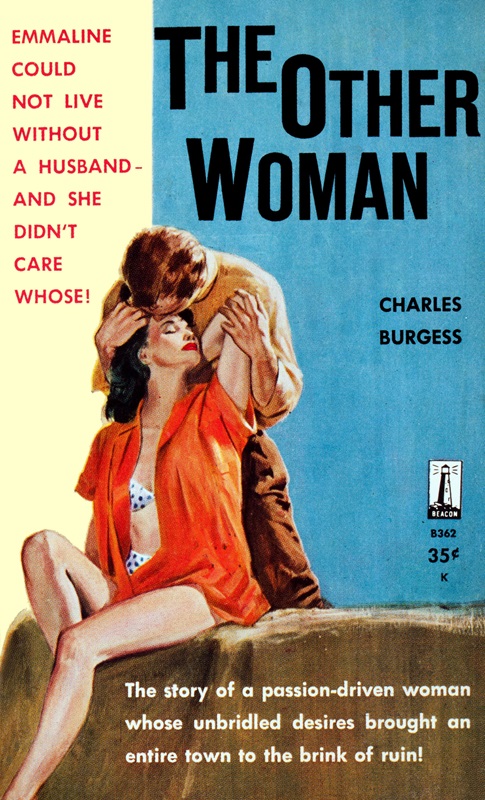
The Other Woman - Charles Burgess
As we all know, many of the soft-core sex novels published in the Fifties and Sixties were actually crime or mystery novels in disguise. That’s certainly true of Charles Burgess’s THE OTHER WOMAN, published originally by Beacon Books in 1960 and about to be reprinted by Black Gat Books.
The narrator/protagonist of this one is Neil Cowan, a real estate agent in a
small city on the west coast of Florida. Neil gets involved in a deal to sell a
large piece of land to a wealthy developer who’s going to put houses all over
it. In the process of arranging this, Neil meets the developer’s wife Emmaline,
a blonde who is the most beautiful woman Neil has ever seen. He’s happily
married with a nice sexy wife and a small child, but he falls for Emmaline
despite that and soon they’re having a torrid affair, which continues until, in
true noir novel fashion, Emmaline suggests what a good life they’d have if her
husband, who’s considerably older than her, was dead. And who better to hurry
him along off this mortal coil than Neil?
From this point on, THE OTHER WOMAN veers off into something a bit less like a
Gold Medal novel. Even though he’s obsessed with Emmaline, Neil isn’t just
about to commit murder for her. Unfortunately, her husband winds up dead
anyway, and Neil is the only potential suspect who doesn’t have a solid alibi.
When one of the local police detectives learns of the affair between Neil and
Emmaline, he’s convinced that Neil is the killer and goes after him doggedly,
looking for proof—proof that the actual murderer is willing to provide to pull
the frame tighter around Neil. In order to save himself, he’ll have to uncover
the real killer.
I’d never heard of Charles Burgess, but the Florida setting and the excellent writing had me suspecting that Burgess was a previously unknown pseudonym for Day Keene or Harry Whittington or Talmage Powell. The book doesn’t really read like the work of any of those authors, however, and a bit of subsequent investigation turns up the fact that Burgess wrote another hardboiled novel called BACKFIRE, apparently published only in Australia. I don’t think he was Australian, though. He had at least one story in MANHUNT in the late Fifties, and he wrote a number of true crime stories for various detective magazines. If I had to guess, I’d say that’s probably his real name, and he might well have been a reporter since many of them wrote those true crime yarns as a sideline. But that’s purely guesswork on my part.
As for THE OTHER WOMAN, I enjoyed it quite a bit. Although the affair between Neil and Emmaline is what the whole plot hinges on, there’s really not much sex in the book, only a few scenes that don’t go on very long. I’m a little surprised Beacon published it. It’s more of a solid mystery novel with a reasonably clever solution. It reads very much as if Burgess wrote it intending to try to sell it to Gold Medal or Ace, and when it didn’t click at one of those houses, he sexed it up a little and sent it to Beacon. We’ll never know if that’s true, of course, but you can tell from that description what sort of book this is. I liked it, and if you’re a fan of noirish, hardboiled mysteries, I think THE OTHER WOMAN is well worth reading.