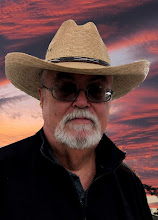


Stan Lynde has a blog.
For those of you not familiar with the name, Stan Lynde was the creator, author, and artist of the long-running Western comic strip RICK O'SHAY. Despite the humorous name, the strip mixed comedy and traditional Western action in a blend that was very appealing to me when I was growing up. His benevolent (but still very deadly) gunfighter character Hipshot Percussion is one of the iconic comic strip characters as far as I'm concerned, and I always loved the Easter Sunday strips in which Hipshot was featured.
After Lynde was forced out of his own strip by the syndicate that owned it, he went on to create another Western adventure strip, LATIGO, which spawned a series of four tie-in novels by Dean Owen. I read and enjoyed LATIGO, even if it never rose to the heights of RICK O'SHAY for me. In the last twenty years Lynde has turned to writing Western novels, in addition to a memoir. I've never gotten around to reading them, but I think I'm going to have to remedy that.
Saturday, September 10, 2011

Saturday Morning Western Pulp: Complete Cowboy, Spring 1945

Friday, September 09, 2011
Forgotten Books: The Creature From Beyond Infinity - Henry Kuttner

Henry Kuttner is one of my favorite authors from the Golden Age of Science Fiction. He wrote a lot, in several different styles, but his work was nearly always fast-paced, full of action, and either humorous or creepy, depending on what was called for. His novel THE CREATURE FROM BEYOND INFINITY has some of all of that, and more.
Originally published in its entirety in the November 1940 issue of the pulp STARTLING STORIES under the title "A Million Years to Conquer", this novel starts out far, far back in Earth's pre-history with the crash-landing of a spaceship from an advanced civilization. A couple of the aliens, Ardath and Theron, are the only survivors, and Theron, who is the commander of the expedition, is mortally injured and lives just long enough to order Ardath to complete their mission, which is to find a suitable planet where their doomed civilization can relocate.

This is going to be difficult since Ardath is the only survivor and the spaceship is damaged enough that it can't achieve interstellar travel anymore. It can, however, make it back into earth orbit, and since the equipment used to put its crew into stasis is still working, Ardath decides to put himself to sleep and wake up every few thousand years to check on how Earth is developing. He has a machine that will detect super-intellects, and he figures that if he can find enough of them, he can breed them and recreate his own advanced civilization on Earth.
Kuttner zooms through all this back-story in just a few pages, then jumps to 1924, when Stephen Court, one of those super-intellects Ardath is searching for, is eight years old and already aware that he's a genius. The little boy runs away from his parents, takes up with a hobo, and sets about making himself the world's leading scientist.
Back into pre-history Kuttner goes, switching storylines as Ardath wakes up and captures a barbarian named Thordred, who is smart enough that Ardath can transfer some of his knowledge to him through one of the alien machines. Then back to 1941, where Stephen Court
Keeping up? Good, because all of this hopping back and forth in time that Kuttner does will tie together eventually and wind up with our scientist hero Court going head-to-head against the evil Thordred, who bears more than a passing resemblance to the character Vandal Savage, who came along in 1943 to be one of DC's longest-lasting villains in comic books. Did the writer who came up with Vandal Savage (another SF author, Alfred Bester) read Kuttner's novel in STARTLING STORIES? Who knows, but there are definitely similarities.
It's amazing that Kuttner could cram all of this kitchen-sink plot (I didn't even mention the trip to Atlantis) into a novel that's probably around 40,000 words and still make an exciting, coherent story out of it. Like most SF from that era, THE CREATURE FROM BEYOND INFINITY is pretty dated at times, but it also has the cosmic sweep and sense of wonder that used to be common in science fiction. (I'm not saying you can't find that in today's SF, but I think it's harder to do so.) It's also a lot of fun as Kuttner keeps things racing along, pausing only occasionally for a moment that's either eerie or poignant, and very effectively so. And yes, the scene depicted in that great Frazetta cover on the paperback reprint does take place in the novel, and it's a dandy.
I wouldn't recommend THE CREATURE FROM BEYOND INFINITY to everyone who reads science fiction, but if you're an old geezer like me or a younger reader who can put yourself in the right frame of mind (just imagine it's 1940), I think there's a good chance you'll enjoy it, and copies of the paperback are plentiful and inexpensive on-line.
(And if you can read that title and not hear Buzz Lightyear saying it in your head, you're better than I am.)
Thursday, September 08, 2011
Unknown
The plot of the movie UNKNOWN is like something out of a Cornell Woolrich pulp yarn: a guy gets in a car accident, spends four days in a coma, then wakes up and finds out that he has no identification, his wife claims she never saw him before and says she's really married to some other guy with the same name, and nobody believes our hero's story. To make things worse, he's in a strange city, and mysterious assassins are trying to kill him. Paranoia abounds.
Well, there are a lot more complications before everything gets straightened out, and to be honest, this is one of those movies where I was never sure if the plot completely made sense. But if you don't think about it too hard, UNKNOWN is fairly suspenseful and entertaining. I saw a lot of the twists coming, but not all of them. Liam Neeson has become a fairly effective, if a little bit stodgy, action hero, and the chases and fight scenes in this one are well-staged, so you can tell what's happening most of the time. That's pretty refreshing in this day and age. This isn't a great movie, but it's an enjoyable one.
Wednesday, September 07, 2011
Promissory Payback - Laurel Dewey
Jane Perry is a tough homicide cop in Denver, and as Laurel Dewey's latest novel about her opens, she's been called to the scene of a bizarre murder: a well-to-do, middle-aged woman has been hogtied and suffocated by having her mouth and nose sealed up with duct tape. The investigation uncovers the fact that the victim's mouth is stuffed full of shredded promissory notes (hence the title).
It doesn't take long for Jane to realize that there is no shortage of suspects in this case. The dead woman was a swindler, running a ponzi scheme on a number of people who couldn't afford to lose their investments. The trick is going to be untangling the mess and figuring out which one killed her.
PROMISSORY PAYBACK is a solid, well-plotted police procedural, the third in a series featuring Jane Perry (I haven't read the first two). Dewey keeps the pace moving along briskly, which I always like. The real appeal in this book for me, though, is Jane herself, who manages to be both tough and politically incorrect while still having a certain air of vulnerability about her. She's a very appealing protagonist, and I think I'm going to have to go back and read the first two books about her. In the meantime, this novel is available in paperback from The Story Plant, and I recommend it for fans of hardboiled cop yarns.
Tuesday, September 06, 2011
Tuesday's Overlooked Movies: Nickelodeon
For the next few weeks, I'm going to be writing about movies I watched during the Seventies that were either box-office bombs, critical failures, or just slipped off the radar for some reason . . . but I liked them anyway. It's been more than twenty years since I saw any of these films, though, so if you watch them now and they don't hold up, my apologies.
First up is Peter Bogdanovich's NICKELODEON. Bogdanovich had a great run in the early to mid-Seventies with THE LAST PICTURE SHOW, WHAT'S UP DOC, and PAPER MOON. Then he had a string of movies that flopped: DAISY MILLER, AT LONG LAST LOVE, and NICKELODEON. I didn't care for DAISY MILLER, thought AT LONG LAST LOVE wasn't terrible but wasn't very good, either, but I liked NICKELODEON quite a bit. Of course, I'm a sucker for books and movies about the early days of movie-making. Sometime I'm going to reread Harold Robbins' THE DREAM MERCHANTS and write about it as a Forgotten Book. So it makes sense that I'd like NICKELODEON. It's about a young attorney, played by Ryan O'Neal, who, pretty much by accident, becomes a successful writer and director of early silent movies in California
The cast certainly helps. Tatum O'Neal is in the movie along with her dad, plus Burt Reynolds, Brian Keith, John Hillerman, Stella Stevens, and John Ritter, who gets to utter the line, "Any jerk can direct." And although I'm no huge expert on the early days of the movies or anything, I know enough about the time period to know that the script by Bogdanovich and W.D. Richter gets things right most of the time. If you're interested in the subject matter and haven't seen NICKELODEON because you've either never heard of it or because it's supposed to be a dud, I think you ought to give it a try. I plan to watch it again myself, one of these days.
Monday, September 05, 2011
Hard Cold Whisper - Michael Hemmingson
According to the back cover copy on this book, Michael Hemmingson wrote it during last year's Labor Day weekend as part of the 2010 3 Day Novel Challenge, a competition I hadn't heard of until now. So it seems appropriate to be talking about it this Labor Day.
HARD COLD WHISPER is pure noir, a deliberate attempt by Hemmingson to capture the crazed magic of the sort of Gold Medal novel written by Gil Brewer, among others. The narrator is David Kellgren, a San Diego
This is a fine book with plenty of raw energy, a pace that never slows down, and an unrelenting noir tone. Even though you know things aren't going to work out well for the narrator, you can't help but root for him. Hemmingson has the Gold Medal voice down very well. If you think they don't write 'em like this anymore, well, they don't, not often enough for my taste anyway. I enjoyed HARD COLD WHISPER a lot, and fans of crime fiction should check it out.
Sunday, September 04, 2011
Being Human
So, a vampire, a werewolf, and a ghost decide to rent a house in Bristol , England
Saturday, September 03, 2011
Saturday Morning Western Pulp: Exciting Western, July 1950

This is a pulp that I own and happened to read recently. Western pulp cover artists loved red shirts and yellow shirts, and this cover has both. It doesn't hurt anything that it's a good-looking blonde who's wearing the red shirt, either. And behind that cover is a pretty good mix of stories.
W.C. Tuttle is one of my favorite Western authors, as I've mentioned before. For EXCITING WESTERN he did a series of novelettes about a pair of range detectives named Tombstone Jones and Speedy Smith. Now, if you're thinking that they might be similar to Tuttle's other range detective characters Hashknife Hartley and Sleepy Stevens, you'd be right. The difference is that while Hashknife is actually a brilliant detective and Sleepy is a very competent sidekick, Tombstone and Speedy are, shall we say, less bright and tend to solve their cases more through slapstick-tinged luck than actual detective work. However, their adventures are consistently entertaining, and "Horse-Shoe Luck" is no exception. In this one, Tombstone Tombstone
"The Legend of Early Bill" by Dan Kirby (an author I'm not familiar with) takes a legendary lawman much like Wild Bill Hickok and has him turn outlaw. It's a nice twist, and while the rest of the story is pretty predictable, it's well-written and I enjoyed it. "Busy Day For Rustlers" by Dane Zale (never heard of him) is a forgettable yarn about a lawman tracking down some wideloopers. Chuck Martin is an author I've read before, and his story about a stagecoach holdup and its aftermath, "Dead Ringer", is also predictable but entertaining because Martin wrote in a very colorful, fast-paced style. This one does have a pretty good-sized hole in the plot, though. "The Go-Between" by William J. O'Sullivan is a range war story involving water rights and is the weakest story in the issue because the identity of the villain is too obvious right from the start. I didn't really care for O'Sullivan's style, either. The final short story is "Have a Harp, Ranger!", an entry in the long-running series featuring an Arizona Ranger known as Navajo Tom Raine. The plot is fairly weak, but there's plenty of well-written action in this tale of Raine hunting down a gang of stagecoach robbers. I don't know who wrote the Navajo Raine stories under the house-name Jackson Cole, but I enjoy them most of the time.
I've mentioned before that I don't care for Syl MacDowell's stories about a pair of cowboys named Swap and Whopper that ran in THRILLING WESTERN. For this issue of EXCITING WESTERN, he contributes a non-series novelette called "Wheels Without Hoofs", about immigrants traveling west using handcarts instead of the more traditional covered wagons. This is a much grittier yarn than the comedic Swap and Whopper stories, and I liked it quite a bit.
Overall, this is a good issue. There are no real stand-out stories, but it's hard to go wrong with W.C. Tuttle as the lead author in a Western pulp, and all the backup stories with the exception of "The Go-Between" are competent and fairly entertaining. I enjoyed it, and it's really got me in the mood to read more Western pulps.
Friday, September 02, 2011
Twice as Deadly -- Another New Book From Livia
Livia has just released TWICE AS DEADLY, an e-book collection of two novellas she wrote back in the Eighties about a Dallas private investigator named Laura Bailey. The first one was published in the anthology/collaborative novel THE BLACK MOON, and the second has never been published until now because the publisher went out of business before the second volume in the series came out. These are excellent hardboiled mysteries with a very likable protagonist, and I'm glad to see them available.
Subscribe to:
Posts (Atom)