 Here's hoping it's a wonderful holiday for all of you.
Let me join with others in expressing my admiration and gratitude to Graham Powell for his great Crimespot website. It's a regular stop for me, and it's introduced me to a number of blogs that I now read every day. Also, Graham and I live in the same neck of the woods, so I hope to run into him in person one of these days.
So far I've read several of the stories in the David Goodis collection, BLACK FRIDAY, but a couple of them really stand out."The Case of the Laughing Queen", a novelette that originally appeared under the pseudonym Lance Kermit in the October 1942 issue of the pulp 10 STORY MYSTERY, begins with the death of a man wearing a king's crown whose body is found on a barge towed into New York from the Atlantic. In the ice coating the barge's deck is scratched the dying message, "The queen was smiling." Then a former prizefighter dressed like a priest is found murdered on the steps of Grant's Tomb. The murder weapon is a 500-year-old spear that once belonged to a Spanish conquistador. Put in charge of solving these murders is Ricco Pasquale Maguire, an Italian/Irish millionaire playboy who's also a homicide cop. (Shades of Amos Burke!) Then . . . things get weird.This story is as crazed and over-the-top as it sounds, and not like anything else by David Goodis that I've ever read. The plot never makes a whole lot of sense, but that doesn't really matter. It's still highly entertaining."Caravan to Tarim", although written for a slick (COLLIER'S, October 26, 1943), is very reminiscent of the sort of straight-ahead adventure story that usually appeared in, well, ADVENTURE. Or ARGOSY or BLUE BOOK or one of the other general fiction pulps. The hero is a two-fisted American who works for an Arab merchant bringing caravans of trade goods across desert wastes where Bedouin raiders are always a danger. There are double- and triple-crosses, gun battles, camels, and sand dunes. What else do you need in a story like this? Not much, when it's told in such a smooth, hardboiled style as Goodis employs here.
We were watching the DVD of Ron Howard's live-action HOW THE GRINCH STOLE CHRISTMAS (or is it just called THE GRINCH? No matter.) I've seen this several times before. All of us in the Reasoner household agree that while Jim Carrey seems to be trying to imitate Boris Karloff's voice from the original cartoon, what comes out sounds exactly like Sean Connery's voice instead. Are we the only ones who feel this way?The blog that Charles Gramlich mentions in his comment on the previous post can be found here. It has some excellent posts on writing and plotting.
When this blog goes silent, as it has for the past week, you know I haven't been doing much of anything except sitting in a room and typing. The current project is going along fairly well, although the past couple of days I'm starting to sense that I've overcomplicated the plot, something that's a recurring problem with me. I tend to throw in too many twists and sometimes have to prune some of them as I go along. I'm working from a very short outline this time, and that usually makes the problem worse. But I'm confident that I'll be able to hammer it all into shape.I've also been in one of my reading funks (which, oddly enough, often seem to coincide with my blogging funks) and don't have the patience right now to read novels, even though I have a ton of them on hand that I want to get to. And considering how much books weigh, I may not be exaggerating with that "ton" reference. Anyway, thank goodness for short stories. I've been alternating between three different volumes: THE WEIRD DETECTIVE ADVENTURES OF WADE HAMMOND by Paul Chadwick, a small-press collection of stories from a series that originally appeared in the pulps Detective Dragnet and Ten Detective Aces; BLACK FRIDAY & SELECTED STORIES by David Goodis, a Serpent's Tail collection of the novel BLACK FRIDAY and a dozen stories from various detective pulps (I'm just reading the short stories and saving the novel until later); and 100 CROOKED LITTLE CRIME STORIES, one of those Barnes & Noble anthologies edited by Marty Greenberg, Stefan Dziemianowicz, and Bob Weinberg that I've been working my way through for at least a year now. If I finish these off and still don't feel like reading novels, I have plenty of other collections and anthologies and digest magazines on hand.The only other thing I have to report is that I got to watch the film based on my short story "Graveyard Shift", which I mentioned in the previous post. I liked it a lot and thought the actor who played the lead character was just about perfect in the role. Patrick Wager, the writer/director, did a fine job of adapting the story. And to answer the question Juri asked in a comment, Patrick is not related to the writer Walter Wager, although his father is named Walter.
A while back a short film was made based on one of my old stories, "Graveyard Shift", which originally appeared in MIKE SHAYNE MYSTERY MAGAZINE and has since been anthologized a couple of times. The writer and director, Patrick Wager, has posted the film on YouTube and it can be seen here. With my steam-powered computer and tin-can-and-string Internet connection, I'm not going to try to download it, but I've asked my daughter to get it for me, so I'll probably see it in a few days. In the meantime, if you're interested it only runs about seven minutes, I think.
By the way, those comments I made yesterday about inaccuracies in Dave Barry's pop culture references . . . Never mind. He's right, I'm wrong.
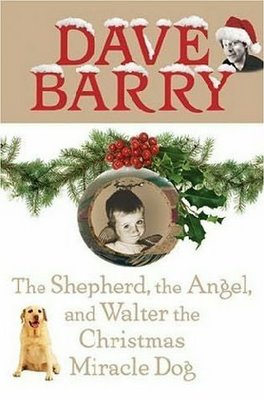 I'm a big fan of Dave Barry's work, so I had to read this new Christmas novella. It's set in 1960, in a little town in New York, and the narrator's name is Doug Barnes. Not surprisingly, it's pretty autobiographical, or at least it seems that way. There's no telling how much of the story really happened, although I think it's a safe bet that the bizarre climax didn't occur in real life. Anyone familiar with Barry's writing probably won't be expecting a nice, straightforward, linear narrative, so the lack of same won't be a surprise, either. What you get is an entertaining yarn that sort of sprawls around like real life, with all sorts of digressions and jumping back and forth in time. The main storyline concerns the Christmas pageant being put on at the church Doug and his family attend. Doug and a couple of his friends play shepherds; Doug's little brother and sister are angels. As for Walter the Christmas Miracle Dog, he plays an important part in the story, too.This reads a little like an updated version of a Jean Shepherd story (which is a good thing since Shepherd is one of my favorite authors). It's pretty lightweight compared to Shepherd's work, and my other complaint is that if you're going to go to the trouble to establish a specific year as your setting, you really need to get your pop culture references right, too. I know mistakes like that don't bother a lot of readers, but they annoy me. I'm willing to forgive them in such a good-hearted book as this one, though. This is good nostalgic fun with a few laugh-out-loud scenes.
 I've been hunkered down writing lately, which explains why this blog has been quiet. I've managed to watch the first four episodes of COMBAT! on DVD, though.COMBAT! was one of my favorite TV shows as a kid. I watched it nearly every week during its original run in the Sixties. Then during the Eighties I saw some of the episodes again in syndicated reruns and still enjoyed them. Now, I'm glad to report that the series still holds up pretty well. The production values are high, the black-and-white photography is really good, and the acting, writing, and direction are all top-notch. Vic Morrow, who usually played villains (and was good at it, too), is excellent here as the stalwart Sergeant Chip Saunders. Rick Jason as Lieutenant Hanley is kind of a stiff (Jason was intended to be the star of the series, but Morrow eclipsed him within a few episodes), but I don't mind him too much. The supporting cast, playing the GIs in Saunders's squad, are all great, although the best of the bunch, Jack Hogan as Kirby and Dick Peabody as Littlejohn, are barely visible in the early episodes I just watched.In fact, that's the problem with the early episodes, many of which were directed by Robert Altman. They tend to concentrate on one or two characters, and I enjoy the later episodes more because they're more of an ensemble effort. I really like the interaction of the various squad members. But some of the early ones are still really good, like the second episode, "Any Second Now", which was directed by Altman and features Hanley trapped in a French church with an unexploded German bomb and a shaky British bomb disposal officer who's losing his nerve. This is a fine episode. I hadn't seen it since it was first broadcast in 1963, but I still remembered it after nearly 43 years.I don't know when or if I'll get around to watching any more of these, but I'm glad to know that a show I liked a lot back then was actually pretty good. (That hasn't been the case with all of my old favorites.)
In his comment on the previous post, John Hocking (a fine author of heroic fantasy himself) asks about my outlining practices. I've written books with no outline at all, just a vague idea of what I wanted to do (a recipe for disaster -- I'm lucky I've never had to scrap a sizable portion of a book and have always been able to figure out how to save it), and I've written books from a highly detailed 60 - 70 page outline that was pretty much a condensed version of the novel (that was what the publisher wanted, but I never liked writing those mammoth outlines and gradually whittled them down to 20 - 30 pages).These days, most of my outlines range from about half a page to three pages. If I'm working with a particularly complicated plot, the outline might grow to six or eight pages, just so I can be sure I've got everything lined up so that it'll all hold together. Sometimes I have the beginning, middle, and end, and sometimes I just have the first part of the book figured out and work out the rest as I go along. In other words, I'm all over the map when it comes to outlining, but I nearly always have one, such as it is.I went to the TCU Press signing this evening and had a good time as usual. The crowd wasn't as large as it sometimes is, but I still signed quite a few books. Got to talk to old friends and met a few new ones. This is the last signing I'll be doing for a while . . . unless, of course, somebody else asks me.