Showing posts with label Steeger Books. Show all posts

Sunday, February 16, 2025

Sunday Morning Bonus Pulp: Super-Detective, January 1943


I don’t own this issue, or, for that matter, any issues of SUPER-DETECTIVE. They’re not that easy to find, and they’re usually pretty expensive when you do come across one. But when Radio Archives recently published an e-book edition of this issue, I picked it up because I wanted to read the Jim Anthony novel in it. The by-line on that novel is John Grange, but that was a house-name, and in this case, I knew that two excellent authors collaborated on the story: Robert Leslie Bellem and W.T. Ballard.

For those of you unfamiliar with Jim Anthony, here’s a little background. His father was an Irish adventurer, his mother a Comanche princess. He’s a millionaire industrialist with business interests all over the world, an amateur criminologist, a brilliant scientist, and a world-class athlete. He’s Doc Savage, Bruce Wayne, and Jim Thorpe rolled into one. Veteran pulpster Victor Rousseau wrote the first dozen Jim Anthony novels in SUPER-DETECTIVE, Edwin Truett Long did the next three, and then friends and sometime writing partners Bellem and Ballard wrote ten more novels to finish off the series. “Murder Between Shifts” in this issue is the fourth entry by Bellem and Ballard. In Rousseau’s stories, he portrayed Jim Anthony as more of a globe-trotting adventurer, the Doc Savage part of the character. I’d read that Bellem and Ballard’s novels had more of a mystery angle, concentrating on Jim Anthony’s efforts as a criminologist. I was eager to read one and find out.

“Murder Between Shifts” finds Jim visiting Los Angeles with his pilot and sidekick Tom Gentry. Jim owns an aircraft plant there that’s doing vital work for the war effort, but there are rumors of trouble he’s checking out, and sure enough, when he tracks down the plant manager to a nightclub that caters to the swing shift workers, the man is murdered right in front of Jim’s eyes by one of the other plant executives. The thing is, the guy who pulled the trigger claims he’s innocent! Jim investigates, of course, which leads to attempts on his own life along with sensuous encounters with several beautiful babes. (SUPER-DETECTIVE was published by the same company that put out the Spicy pulps, so it’s a little more risque than some, although mild by our current standards.) Even though Jim is still the same tycoon/scientist/criminologist he is in the earlier novels by Victor Rousseau, “Murder Between Shifts” does read much more like a typical hardboiled detective yarn than Rousseau’s novels do. It’s well-written, clever enough, and I enjoyed it quite a bit. It also features a cameo appearance by police lieutenant Dave Donaldson, from Bellem’s Dan Turner series, which put a grin on my face.

William B. Rainey, author of the short story “Don’t Get Killed Tonight”, was really Wyatt Blassingame, best remembered probably for his Weird Menace stories although he was a prolific pulpster who wrote a little bit of everything and wrote it well. “Don’t Get Killed Tonight” is part of his series about private detective Eddie Harveth, who works as a troubleshooter for nightclub and restaurant owners in New Orleans. It’s a good story in which Eddie gets framed for the murder of a beautiful dancer and has to go on the run from the cops as he tracks down the real killer. There’s nothing unusual or special about this story, but it’s competently written and moves right along. A tad on the forgettable side, though.

Randolph Barr was a house-name, and the real author of “The Shape of Death” is unknown, which is a shame because it really is a top-notch story featuring some fine hardboiled writing. A beautiful blonde living in a Florida trailer camp finds a dead man on her doorstep. Unfortunately, he’d made a pass at her a short time earlier in a nearby tavern, and she was heard to threaten him. The cops believe he followed her back to her trailer and she killed him, possibly in self-defense. The only one who believes she’s innocent is a young reporter who falls for her. The plot of this one is pretty traditional and even predictable, but it races along with plenty of good dialogue and excellent descriptions. I liked it a lot and wish I knew who wrote it.

The other stories in this issue are all unacknowledged reprints, a practice for which the publisher was notorious, beginning with “Carte Blanche for Murder” by Travis Lee Stokes, which was published originally as “Blonde Madness” in the September 1934 issue of SPICY DETECTIVE STORIES under the name Arthur Humbolt, which was also a pseudonym. The real author was Robert C. Blackmon, who wrote a bunch of detective yarns for various pulps, under numerous different names. It opens with its newspaper reporter protagonist discovering the murdered body of a beautiful blonde with her arms chopped off. Naturally, this ties in with the case of another blonde who was killed and had her legs chopped off. And our hero’s girlfriend is a beautiful blonde and has a connection with one of the suspects! As you can tell, this story is lurid and over the top and you know exactly what’s going on almost right from the start, but Blackmon delivers it in such breathless, enthusiastic prose that it’s enjoyable despite that.

Norman A. Daniels is the actual author of “Murder Stays at Home”, published in this issue under the name Max Neilson. It was published originally as “Murder at Lake Iroquois” by Charles Maxwell in the September 1934 issue of SPICY DETECTIVE STORIES. This one finds a bunch of theater folks and artists partying at the island mansion of a wealthy producer, and of course one of them winds up dead, seemingly an open-and-shut case of a beautiful actress murdering a rival beautiful actress. That’s not how it turns out, and the murder method is actually pretty clever. Daniels was dependable and this story is good entertainment without being outstanding.

“Post Mortem” by Walton Grey was published originally in the August 1934 issue of SPICY DETECTIVE STORIES as “Where is the Body?”, under the author’s real name, C. Samuel Campbell. It’s even more lurid and over-the-top than “Carte Blanche for Murder” as we have two police detectives running around a stereotypical old dark house complete with secret passages and a hulking monster who’s breaking people’s necks. This one is almost too silly for me to accept it, but it has its effective moments and I wound up reading the whole thing.

Looking back on the issue as a whole, it’s certainly entertaining. The Jim Anthony story and “The Shape of Death” by “Randolph Barr” are the highlights. I definitely want to read more of Bellem and Ballard’s Jim Anthony stories. Several of them, including “Murder Between Shifts”, are reprinted in SUPER-DETECTIVE JIM ANTHONY, THE COMPLETE SERIES: VOLUME 5 from Steeger Books. Not surprisingly, I’ve already ordered a copy. But if you want to sample the series, this e-book from Radio Archives isn’t a bad place to start.

Wednesday, June 26, 2024

Hands Beyond the Grave - Henry Treat Sperry


I’ve gotten interested in the obscure pulp author Henry Treat Sperry, probably because when I looked him up on the Fictionmags Index, I noticed something odd. His first published story was “Hands Beyond the Grave” in the September 1934 issue of TERROR TALES, the first issue of that iconic Weird Menace pulp. Sperry’s second story, though, was “Posies for the Widdy” in the First December Number, 1934, of RANCH ROMANCES. Anybody who can go directly from TERROR TALES to RANCH ROMANCES is my kind of writer!

I don’t have that issue of RANCH ROMANCES, but I do have the facsimile reprint edition of that TERROR TALES published by Steeger Books, so I went ahead and read Sperry's story. It starts off as if Sperry was influenced to a certain extent by H.P. Lovecraft. The narrator of the story is a well-to-do young New Englander named Robert Mercer, who awakens one night to find a sinister, amorphous shape lurking at the foot of his bed. There’s lot of “nameless dread”, “unspeakable terror”, and “too horrified to move”. But then, unlike most of Lovecraft’s protagonists, Sperry has his hero bound out of bed, grab an ornamental javelin off the wall, and attack the lurking presence. It doesn’t do much good, of course: the thing vanishes with an explosion that leaves Mercer senseless. He calls a buddy of his, a doctor who’s also a psychical researcher, and with the help of an elderly female medium, they set out to find out what it is that’s haunting Mercer and why.

That early battle is the high point of the action in this story, which goes back to brooding and being scared, as well as a murder and finally an explanation of sorts. Honestly, I thought this yarn cried out for one more twist that never came, but for a debut story, it’s well-written and flows well, even though you wouldn’t exactly call it fast-paced. More action and dialogue than HPL, though.

I haven’t been able to find out much about Henry Treat Sperry. He was born in 1903 and died in 1938 at age 35. He was married and worked as an assistant editor at Popular Publications, helping with several of the pulps to which he sold stories. His writing career lasted only four years, but during that time he published almost 70 stories, most of them Weird Menace but with a scattering of detective and G-Man yarns, a few Western romances, and even an air-war story or two. One of his Western romances was called “Locoed Cowgirl” (RANCH ROMANCES, First February Number, 1938). I’m sure it was innocent enough, but I can’t help but think that would be a good title for a Weird Menace/Western romance crossover about a seemingly demonically possessed cowgirl. I’d read that.

In the meantime, the other stories in the first issue of TERROR TALES look great, and I plan to read them, too. That facsimile reprint is available on Amazon or directly from the Steeger Books website.


Friday, January 28, 2022

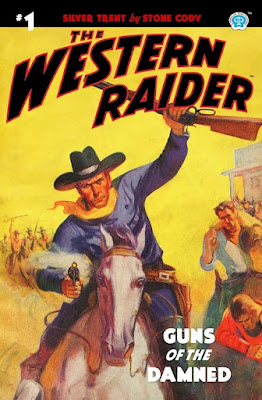
Guns of the Damned - Stone Cody (Thomas E. Mount)


THE WESTERN RAIDER was a short-lived Western hero pulp that ran for three issues in 1938 and ’39. It featured the adventures of Silver Trent, a heroic outlaw sometimes known as the Hawk of the Sierras or the Rio Robin Hood. And like the Robin Hood of legend, Silver Trent has a band of colorful followers and fellow adventurers who ride with him, known as Hell’s Hawks. After the three short novels that were published in THE WESTERN RAIDER, Silver Trent returned in ten short stories and novelettes that appeared in STAR WESTERN from 1939 through 1942. I recently read the first Silver Trent novel, “Guns of the Damned”, from the August/September 1938 issue of THE WESTERN RAIDER.

This yarn opens with two Texas cowboys who have crossed the border into Mexico to look for a friend of theirs who disappeared. The friend was trying to find out who’s behind a series of rustling raids, and he’s sent word back that he suspects an outlaw named Silver Trent. His two pards who are searching for him are about to get gun-trapped in a cantina when a mysterious stranger rescues them. No bonus points for guessing that the mysterious stranger turns out to be Silver Trent his own self, and he’s no rustler. In fact, his mortal enemy, a rich but evil Mexican rancher known as El Diablo, is actually behind the raids across the border into Texas, and the two cowpokes are drawn into Silver Trent’s on-going war against El Diablo.

That’s about as complicated as the plot of this novel gets. It’s basically just a series of shootouts, captures, escapes, and epic battles, pausing occasionally to introduce more supporting characters from Silver’s friends, which include a priest with a hard right hook, a melancholy Mexican gunman tortured by religious guilt, a drunken doctor, a fast-gun gambler, an old geezer, and, of course, a beautiful girl.

Silver Trent himself is a bigger-than-life character, the sort of mythical figure who can out-shoot, out-fight, and out-ride anybody that shows up so often in Frederick Faust’s work. In fact, he reminds me quite a bit of Faust’s Silvertip, and while I have no way of knowing, it wouldn’t surprise me if the similarity in names wasn’t entirely a coincidence. Silver needs to be as competent as he is, because he’s evenly matched with El Diablo, about as despicable a villain as I’ve run across in a pulp Western.

Keeping everything moving at a breakneck pace is author Stone Cody, who was really Thomas Mount, a bit of a colorful character himself who I wrote about a while back in my review of his novel THE GUN WITH THE WAITING NOTCH. I really enjoy Mount’s over-the-top prose, such as this bit from late in the book:

The battle cry of Silver’s men!

In brazen-clanging Spanish and hard-bitten American—a sound like a trumpet call, that the desert knew and quivered to, that the mountains had flung back triumphantly in a hundred slashing whirling fights, that echoed still, fearfully, in the dreams of men who listened to it and lived to tell the tale.

“To Silver! Hell’s Hawks for Trent!” And now the sudden, staccato thunder of the guns!


Great literature, maybe it ain’t. But great literature generally doesn’t make me literally pump a fist in the air like I did when I read that line about the thunder of the guns. And that goes a long way toward explaining why I write like I do.

Altus Press/Steeger Books has reprinted the entire Silver Trent series, and I own all six volumes. I’ll be reading the rest of them soon. If you love Western pulp adventure as much as I do, I give them a very high recommendation. I love this stuff.

Friday, December 31, 2021

The Price of a Dime: The Complete Black Mask Cases of Ben Shaley - Norbert Davis


The first Norbert Davis story I ever read was “Don’t Give Your Right Name”, a Max Latin yarn included in the iconic anthology THE HARDBOILED DICKS. That was the first time I’d heard of Davis, but I loved the story and in the years since have read dozens of other pulp stories by him. They’ve never disappointed me.

Davis is best remembered for stories that were both humorous and hardboiled, but he could do straight tough guy tales, too, which he did early in his career. THE PRICE OF A DIME, a new Davis collection from Black Mask/Steeger Books, features five of those early hardboiled stories, two starring private detective Ben Shaley.

“Red Goose” is the first of the Shaley stories, from the February 1934 issue of BLACK MASK. It was reprinted in Joseph T. Shaw’s THE HARD-BOILED OMNIBUS, so I know I’ve read it before, but I didn’t have any recollection of it when I sat down to read this volume. Not surprisingly, it’s a very entertaining story in which Shaley is hired to recover a valuable painting stolen from a museum. There are a lot of twists and turns in a relatively short story, and it takes some explaining from Shaley at the end to straighten everything out, and even then, Davis has a final twist lined up.

Shaley’s second, and final recorded, case is “The Price of a Dime” (April 1934). This involves a hotel bellhop who receives a dime as a tip, an incident that leads to murder, blackmail, and a shootout on the Western lot at a movie studio. Shaley reminds me a little of Mike Shayne, because his thinking always seems to be two steps ahead of everybody else in the story and three steps ahead of the reader. With its movie studio background, this yarn also reminds me of Robert Leslie Bellem’s Dan Turner series, and it has something in common with one of Fred MacIsaac’s Rambler stories I read recently. A very entertaining tale, all around.

Davis’s first appearance in BLACK MASK was in the June 1932 issue, with a story called “Reform Racket”. This is a pretty straightforward story in which the protagonist returns to his hometown and finds himself in the middle of some dangerous political intrigue involving his sister, gangsters, and a candidate vowing to clean up the town. With its very terse prose, ultra-hardboiled protagonist, and understated but brutal violence, this made me think of some of Paul Cain’s stories. It’s an auspicious beginning for Davis.

“Kansas City Flash” was published in the March 1933 issue of BLACK MASK, and despite the title, it’s another Bellem-like yarn about a Hollywood troubleshooter, a former stuntman named Mark Hull. Given that, it’s also reminiscent of W.T. Ballard’s Bill Lennox stories, which also ran in BLACK MASK. I enjoyed this one, and it would have been fine with me if Davis had written more stories about Mark Hull, but this is the only one.

This volume wraps up with “Hit and Run”, from the April 1935 issue of BLACK MASK. It’s a tale of another one-shot private eye, Jake Tait, who goes in search of a hit-and-run victim and finds himself neck deep in a case involving bank robbery and murder. It’s surprising just how much plot Davis could work into these novelettes. Tait’s another tough but likable protagonist, able to absorb a lot of punishment but dish it out, too.

All these stories are very good and well worth reading if you’re a fan of hardboiled detective fiction. My Norbert Davis streak continues: he’s never disappointed me. I give this collection a high recommendation.


Monday, April 19, 2021

Classic Pulp Thrillers: The Complete Cases of Val Easton - T.T. Flynn


T.T. Flynn is one of my favorite Western authors. I’ve read most of his novels and many of his Western pulp stories. But he also wrote quite a bit for the detective pulps, and I’ve never read any of those yarns until now. THE COMPLETE CASES OF VAL EASTON is a new collection from Steeger Books of five novellas originally published in DIME DETECTIVE, featuring American intelligence operative Valentine Easton. I figured this would be a good way for me to sample some of Flynn’s non-Western work.

Art by William Reusswig

The first story in the series, “The Black Doctor”, was published in the December 1932 issue of DIME DETECTIVE. As it opens, we find Val Easton on an ocean liner bound from England to America. A coded message puts him in contact with a couple of female secret agents on board the same ship, and when a couple of murders take place, he finds himself helping with their investigation. By the time the ship reaches New York, they haven’t solved the case, but there are more murders, our heroes get captured by the bad guys, and eventually they discover that their adversary is none other than the notorious Black Doctor, a freelance spy who’s vaguely eastern European, not the sinister Oriental who’s on the cover of this book. (I suspect he’ll be along later, though.) Flynn writes really well and keeps the action moving along nicely in this story, but it’s hurt by the fact that Val Easton himself is a really flat, bland character, almost a cipher. I almost found myself wishing he’d stop during the action to perform a magic trick and then explain how it’s done. (Bonus points to those of you who get that reference, which I suspect will be many of you.)

Art by William Reusswig

I have a hunch that when Flynn wrote “The Black Doctor”, he didn’t intend for it to be the first story in a series. The second story, “Torture Tavern”, doesn’t show up until nearly a year later, in the September 15, 1933 issue of DIME DETECTIVE. It’s a direct sequel, too, starting only a few days after the previous story ended. At the conclusion of that one, Carl Zaken, the Black Doctor, appears to be dead and everything wrapped up, but when “Torture Tavern” begins, Zaken is recuperating in a Washington D.C. hospital and Val Easton is drawn into a nefarious plot hatched by Zaken’s partner, Chang Ch’ien. (Ah, there’s the sinister Oriental!) Clichés aside, though, Chang Ch’ien is a great character, more like a Chinese Doc Savage, albeit an evil one, rather than a Fu Manchu clone. His beautiful sister, Tai Shan, is a Dragon Lady sort who may be trustworthy but probably isn’t. Val himself is a little more likable and fleshed-out in this one, and the struggle over a deadly chemical formula is full of action that seldom lets up. This story is a nice step up from the first one.

Art by William Reusswig

“The Jade Joss”, from the November 15, 1933 issue of DIME DETECTIVE, finds Val, along with his beautiful blond fellow agent Nancy Fraser, once again battling Carl Zaken and Chang Ch’ien, this time over possession of the jade death mask of an ancient Chinese emperor, because as legend has it, whoever wears the mask is destined to take over China and lead it to world domination. Chang Ch’ien figures he’s just the guy to do that, of course. His beautiful sister Tai Shan is mixed up in the dangerous affair, too, of course. This is a really fast-paced tale, with most of the action taking place in a short period of time during one evening, and I enjoyed it. There’s a Chinese American intelligence agent introduced who’s an excellent supporting character.

Art by John Howitt

Exactly a year passes (in our world, anyway) before Val Easton reappears in the November 15, 1934 issue of DIME DETECTIVE to once again battle the same diabolical duo in “The Evil Brand”. This time Val discovers that Carl Zaken and Chang Ch’ien have some sinister interest in a Chinese emissary on his way to the U.S. to visit the State Department, and that leads to a fast-moving fracas in San Francisco, including a brush with death when Val and a fellow agent are captured and taken for a boat ride by killers who intend to dump them in the bay. This one’s pretty melodramatic (you can tell that by looking at the cover), but it works well and is a lot of fun.

Art by Walter Baumhofer

The series comes to an end with “The Dragons of Chang Ch’ien”, from the April 15, 1935 issue of DIME DETECTIVE. It’s a direct sequel to the previous yarn, as Easton and Nancy Fraser uncover a connection between that mysterious Chinese diplomat and a wealthy American munitions manufacturer who’s engaged to marry an equally mysterious European countess. Most of the action takes place at the magnate’s palatial New Jersey estate before shifting to a dingy factory with a dangerous secret. This is a very fast-moving story with plenty of action. It doesn’t read as if it’s designed to be the series’ concluding installment, but that’s the way it worked out. I suppose Flynn was just too busy writing Westerns to continue with it. Every story was featured on the cover of the issue in which it appeared, though, so Val Easton must have been popular with DIME DETECTIVE’s readers.

I certainly enjoyed this collection. I think Flynn probably was better at Westerns than at mysteries and thrillers, but he was a fine writer no matter what the genre, and I look forward to reading much more by him. In the meantime, I give THE COMPLETE CASES OF VAL EASTON a high recommendation.

Thursday, August 20, 2020

Classic Hardboiled Pulp: Dead Evidence: The Complete BLACK MASK Cases of Harrigan - Ed Lybeck


Ed Lybeck’s name was vaguely familiar to me, and when I read Will Murray’s excellent introduction to this collection of Lybeck’s stories published in BLACK MASK, I realized why: Joseph T. Shaw included one of Lybeck’s stories in the iconic anthology THE HARD-BOILED OMNIBUS, which I read about fifty years ago. I have no memory of Lybeck’s story in that book, however, and after rereading it in this one, I still have no memory of it from back then. Which proves nothing except that I didn’t always recognize greatness when I came across it, because these yarns are absolutely fantastic.

Lybeck had only four stories published in BLACK MASK, all of them novella or novelette length, and they all feature the same protagonist, tough guy reporter Francis St. Xavier Harrigan, who covers the crime beat for the New York Leader and who, Lybeck implies, was once a crook and a gunman himself. Lybeck doesn’t seem sure whether abandoning gangdom for journalism is a step up or down for Harrigan.

In the first story, “Leaded Ink” (BLACK MASK, December 1931), Harrigan goes after the mobsters who murdered a young reporter who was his protégé. The second story, “Kick-Back” (January 1932) finds him clashing with a corrupt politician running on a reform ticket and the gangster backing the politician. This is the story that appeared in THE HARD-BOILED OMNIBUS. “Dead Evidence” (March 1932) is a direct sequel to “Kick-Back”, with Harrigan framed for a killing and fighting to clear his name. The final Harrigan story, “Silent Heat”, didn’t appear until February 1934. In this one, Harrigan takes on a white slavery ring.

These are all action yarns and don’t have much actual detection in them, but as fast-moving tales of crime-busting, they’re some of the best I’ve ever read. Lybeck’s style is a joy to read, a mixture of tough violence, snappy patter, and unexpectedly breezy humor. I laughed out loud a number of times reading these stories. Harrigan’s a great character, able to absorb a tremendous amount of punishment and still keep slugging away at his enemies. I probably never would have been able to read these stories if Steeger Books hadn’t reprinted them in the new Black Mask line, so I really appreciate the opportunity. Based on only four stories, you can’t put Lybeck in the same rank as Hammett, Chandler, Nebel, and the other giants from BLACK MASK, but he was mighty good anyway and I had a great time reading this collection. If you love hardboiled pulp like I do, it gets my highest recommendation.