Wednesday, March 31, 2010

Robert E. Howard Movie News


Sometimes you just have to shake your head and ask yourself, "What were they thinking?"

(By the way, if you're a Howard fan and aren't reading the REH: Two Gun Raconteur blog, you should be.)

Tuesday, March 30, 2010

Ten Influential Books

Well, you knew I’d have to do this, and you knew it would be a weird list. But here goes, in no order and without overthinking it:

THIS IS IT, MICHAEL SHAYNE by Brett Halliday (Davis Dresser). This made me a fan of the Shayne series, which I continued to read for years. That came in handy later on. Also, it was the first hardboiled private eye novel I ever read, before Hammett, Chandler, Ross Macdonald, Richard S. Prather, and a host of other authors.

HOPALONG CASSIDY by Clarence E. Mulford. The first real Western novel I ever read.

HAVE SPACESUIT WILL TRAVEL by Robert A. Heinlein. The first real science-fiction novel I ever read.

FANTASTIC FOUR #16 by Stan Lee and Jack Kirby. I’ve told the story before about how a couple of my cousins gave me a stack of comics they didn’t want on Christmas Day, 1963. I loved them all, but this was my favorite, the issue that turned me from a comics reader into a full-fledged comics fan.

BABYSITTER’S GUIDE BY DENNIS THE MENACE by Hank Ketcham. The first paperback book I ever bought, in the pharmacy of the old Medical Arts Building in Fort Worth, sometime in 1961.

BIGGER THAN TEXAS by William R. Cox. The first adult paperback I ever bought, in a drugstore in Goldsmith, Texas, in the summer of 1963. (There’ll be a Forgotten Books post coming up about this one in the relatively near future.)

THE SUN ALSO RISES by Ernest Hemingway. One of the few books I’ve read multiple times.

THE ROCKET’S SHADOW by John Blaine (Hal Goodwin). The first Rick Brant novel. I’ve posted about it before.

CONAN THE USURPER by Robert E. Howard and L. Sprague de Camp. The Lancer edition that I bought brand-new in Barber’s Bookstore in downtown Fort Worth. When I read de Camp’s introduction and realized that a real author came from the same part of the country where I lived, it helped convince me that I could write books, too.

LONGARM by Tabor Evans (Lou Cameron). To bring this full circle, like THIS IS IT, MICHAEL SHAYNE, LONGARM turned me into a fan of a series that has been very important to me. As in, more than two and a half million words important.

I could come up with others, but some of these would remain constant no matter how much the rest of the list changed.

Monday, March 29, 2010

A Well-Deserved Honor

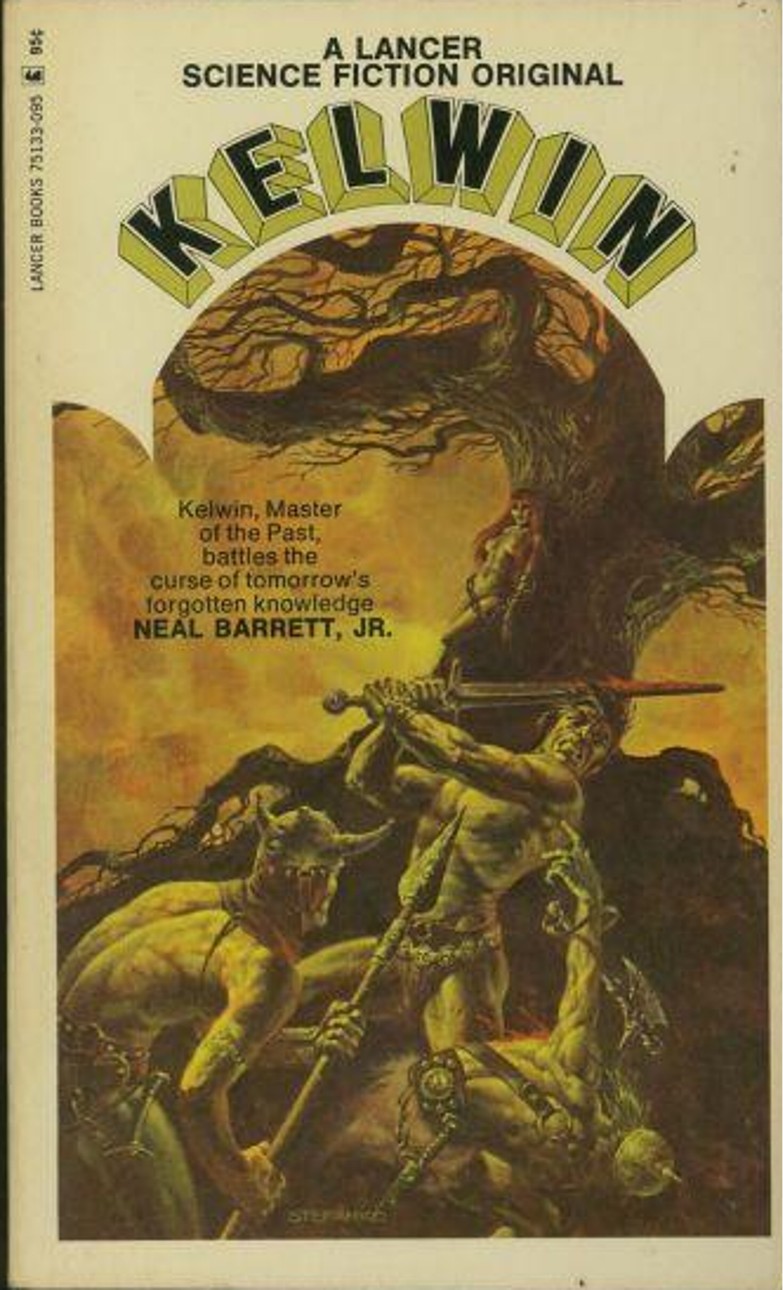
Neal Barrett, Jr., is a great writer and an even better man. Check out this news about him here. (Thanks to Scott Cupp for the heads-up.)

Classic Marvel Super Heroes - Peter Sanderson

Unlike most comics-related trade paperbacks I read these days, CLASSIC MARVEL SUPER HEROES isn’t a reprint collection of stories I first read ‘way back when. Instead, it’s an examination of four iconic Marvel characters: Captain America, Spider-Man, The Hulk, and Wolverine. Author Peter Sanderson summarizes the origin of each character and also tells the back-story of how the character came to be created, including material on the writers and artists involved. It’s heavily illustrated with panels from the original comics, of course, nearly all of which I remember reading when they were new or almost new. (The exception being the Captain America stories from the Forties, before I was born, but even those I read in reprints in the Sixties and Seventies.)

From there Sanderson follows the fictional careers of all four characters up until 2005, when this book was published. Even though it was produced by Marvel for Barnes & Noble Books and written by a Marvel staffer, it’s not wholly a puff piece. Sanderson doesn’t shy away from discussing some of the creative missteps taken along the way by various writers (and there were a bunch of them in the Nineties, in this curmudgeon’s opinion, enough to drive me away from comics for a long time).

I didn’t really learn anything new in this book, but it was a lot of fun revisiting the early days of these characters. I don’t know if there have been similar books done about some of Marvel’s other characters, but it wouldn’t be a bad idea. If you’re a long-time comics fan like me, you’d probably enjoy this one.

Sunday, March 28, 2010

Dark City

Somehow this movie came and went a dozen years ago without me ever hearing of it. It starts out like a Forties film noir: a guy (British actor Rufus Sewell) wakes up in a sleazy hotel room with no memory and a dead hooker. Even not knowing who he is or what happened, he’s smart enough to figure that he needs to get out of there, so he escapes just ahead of several creepy, sinister guys in trenchcoats. Then he gets involved with a mad doctor (Kiefer Sutherland, of all people, who at times seems to be doing a Peter Lorre impression). There’s a sultry torch singer (Jennifer Connelly, as always yowza!) who may or may not be the amnesiac’s wife. The fugitive is also being pursued by a dogged police detective played by William Hurt, who believes that Sewell’s character is a serial killer responsible for murdering half a dozen prostitutes. The whole thing takes place at night, hence the dark city of the title, where the streets are always wet and everything has a sort of bizarre art deco look.

Then things start to get weird.

This is one of those movies where you really can’t discuss the plot without giving away too much for people who haven’t seen it. About halfway through I was thinking that the filmmakers should have just stuck with a straight film noir homage, the way it starts out, but by the end the rest of it had won me over. DARK CITY is a good film that ultimately makes sense, even though for a while you’ll probably wonder. The version I watched was the expanded director’s cut. Since I never saw the theatrical release, I don’t have anything to compare it with. But I liked it, and if you haven’t seen it and have a fondness for oddball movies and film noir, you ought to give it a try.

Saturday, March 27, 2010

Post Grad

Here's what I learned from watching this movie:

A. Alexis Bledel is cute as all get-out.

B. Michael Keaton got old.

C. Jane Lynch is in everything.


Seriously, this is a fairly amusing little romantic comedy with enough oddball moments to make it interesting. The fact that Jane Lynch plays one of the most normal characters in the movie ought to tell you something.

Friday, March 26, 2010

Forgotten Books: Island of Kings - Blaine Stevens (Harry Whittington)

Late in his career, Harry Whittington wrote several historical novels under the pseudonym Blaine Stevens. ISLAND OF KINGS is the final book to appear under that name, and in fact, it may be the last book that Whittington wrote. I believe it was the final new Whittington novel to be published, but if I’m wrong about any of that, I hope someone will speak up in the comments.

At any rate, whether or not it possesses the historical significance of being the last Whittington novel, ISLAND OF KINGS is worth reading. It’s set in Hawaii in the 1770s and is a fictionalization of the young prince Kamehameha’s efforts to avenge his brother’s murder, unite all the Hawaiian islands, and establish himself as the king. Kamehameha’s rise of power is complicated by the arrival of the British explorer Captain James Cook and the two ships under his command. This is the first time the islanders have ever encountered anyone from the outside world.

The other protagonist in this novel is a roguish young British officer on one of the ships who falls in love with an island girl, deserts the ships, and goes native, eventually winding up involved in Kamehameha’s plan to unite the islands.

As usual in a Whittington novel, the story is fast-paced, colorful, and filled with sex and violence. Not all the characters turn out the way you’d expect, either, and such surprises are always nice. Never having studied Kamehameha or Captain Cook, I don’t know how historically accurate the book is, but it’s definitely a good yarn, which is all I was looking for.

The only real flaw in ISLAND OF KINGS is the head-scratcher of an ending, which reads like Whittington ran out of time, energy, or both. Despite that, it’s an entertaining, fast-moving novel, and worth reading despite being a definite notch or two below Whittington’s great suspense novels and Westerns. (I couldn't find a better cover scan on-line, so that's the actual beat up, cover-clipped copy I read.)

Thursday, March 25, 2010

Rome

A while back Livia and I watched the first season of the HBO series ROME on DVD. We just finished watching the second and final season, and overall I liked it quite a bit. I can just imagine the pitch meeting for the series: "It's like DEADWOOD, only in ancient Rome!" There's certainly plenty of sex, violence, and cussin' in ROME. And most of the characters have British accents, so you know they're real ancient Romans.

We've been a fan of this sort of stuff since we watched I, CLAUDIUS on PBS back in the Seventies. (That's a series we ought to revisit on DVD, if we could find the time.) We even wrote a mystery story with Claudius as the detective. ("The Singer at Dawn", in the October 1980 issue of MIKE SHAYNE MYSTERY MAGAZINE.) ROME isn't all that accurate historically, but it tells compelling stories nonetheless and is very well-acted, especially by Kevin McKidd and Ray Stevenson as a couple of Roman soldiers who wind up being on hand for most of the historical events and even playing pivotal parts in some of them. Also like DEADWOOD, there's plenty of purely fictional soap opera to go with the pseudo-history.


I enjoyed ROME and was sorry to see it end after only two seasons. I've heard that the new series SPARTACUS is a lot like it, only with more sex and violence (hard to imagine). I'm sure we'll give it a try, too, when it comes out on DVD.

Wednesday, March 24, 2010

The Mail I Get (with apologies to Lee Goldberg for stealing that title)

The other day I went to the post office and found a thick envelope in the box, with a return address of someone I didn't know. When I opened it, I found a 21-page handwritten outline for a Longarm novel, plus a 12-page handwritten letter explaining the background of the story. That's as far as I read. I set the package aside immediately and haven't looked at it since. I don't intend to.

This isn't the first time I've had someone try to give me a story idea, but it hasn't happened in quite a while. I know the fellow who wrote it had the best of intentions. He's a fan of the series, he came up with what he thought was a good idea, and he went to the trouble of writing it down, as well as finding out that I'm one of the authors. For those reasons, I feel kind of bad that I've been ignoring it and will continue to do so.

Because I just can't afford to allow even the appearance of having swiped something from somebody. It could get me in trouble legally, and it could get me in trouble with my publisher, and I don't want either of those things to happen. On top of that, I like coming up with ideas for my books. That's part of the fun of it. Don't get me wrong, Livia gives me plots all the time and I'm very grateful for that, and if a fellow pro I've known for years were to say to me, "Hey, you ought to do a book about so-and-so," I might do it if the idea appealed to me. I think those are very different situations from someone I don't know sending me an unsolicited book outline. If that sounds elitist, I'm sorry, but that's the way I feel and I'll bet a lot of other professional writers do, too.

So if the person who sent me that Longarm outline is reading this, I appreciate the effort you put into it, but I won't be reading it. Maybe you should try to write a Western novel of your own. It won't be easy to sell in today's market, but you never know what might happen. That's one of the great things about being a writer.

Tuesday, March 23, 2010

Blog Therapy

Remember when I posted a few weeks ago about my frequent nightmares? Well, since posting that I've woken up yelling only twice, which is a vast improvement and probably the best such stretch I've had in years. Now, I don't seriously believe that posting about it on the blog cured me, but I have to wonder . . . Now, Doctor, let me tell you about my other problems . . .