Showing posts with label Stone Cody. Show all posts

Saturday, June 20, 2026

Saturday Morning Western Pulp: New Western Magazine, November 1952


This is a pulp that I own and read recently. That’s my copy in the scan. Like all the Western pulps from Popular Publications, NEW WESTERN MAGAZINE consistently delivered good authors and stories, and most of the covers were pretty good, too. I have no idea who painted this one. It’s not one of my favorites, but it’s certainly not bad.

I’m not sure why I haven’t read more by George C. Appell. Every story I’ve read by him was very good. I own several of his novels but haven’t gotten around to any of them. His novelette “Hired Gun!” leads off this issue, and it starts off as a very standard story about a gunfighter, in this case a Texan named Hayes Hockaday, going to work for a corrupt saloon owner/cattle baron but having second thoughts about it when he starts falling for a girl who works in the local mercantile. Appell has a very effective twist up his sleeve in this story, though, and he enlivens the plot with some gritty action scenes and some good descriptive writing. This is a top-notch yarn.

Leonard Huish published only three stories, according to the Fictionmags Index, and I don’t know a thing about him. “The Terror of El Toro Blanco” in this issue is a humorous story about a widow with an axe destroying the various saloons where her late husband quenched his thirst for tequila. El Toro Blanco is one of those saloons, located in a Texas border town. There’s also a bet between a couple of Mexicans with murder as the stakes. My tolerance for comedy Westerns is pretty low, as I’ve said many times, but this one isn’t bad. The author avoids goofy slapstick for the most part and even manages to strike a poignant note or two. This story surprised me by being worth reading.

When you see a story in a Western pulp bylined “Doc Winchester”, your first thought is that the name has to be a pseudonym or house-name. Mine certainly was. But that turns out not to be the case. The author of the novelette “Pit of the Living Dead” in this issue is actually Charles Ward “Doc” Winchester, born in Nebraska in 1888, who appears to have spent most of his life in Wyoming and then died in New Mexico in 1954. Other than that, I don’t know anything about him. Was he actually a doctor, or was that just a name he or someone else hung on him? If anyone knows I’d be happy to learn more. As for the story itself, which is the first one I’ve read by Doc Winchester, it’s about a couple of men doing some scouting, surveying, and mapping for the government who run into an archeologist and his beautiful daughter who claim to have found Cibola, the fabled lost city of gold. It’s an interesting plot, and there’s even a Lost Race to liven things up (I love me some Lost Race yarns), but the whole story is rather muddled and the prose just isn’t very good. I wanted to like this story just because it’s by somebody called Doc Winchester, but unfortunately, I didn’t.

Hascal Giles was a long-time newspaperman in Tennessee who wrote more than 60 stories for various Western pulps in the Forties and Fifties, including several Masked Rider and Range Riders novels. After retiring from newspaper work, he wrote several more novels published as paperback originals in the Nineties. I haven’t read much by him. His story in this issue, “Reunion in Blackjack”, finds two ex-cons, recently released from Yuma Prison, heading back to the town where they have a grudge against the sheriff. They have very different plans on how to proceed once they get there, however. This is a well-written story, and I admire the way Giles tries to give its resolution a fresh angle, but I’m not sure it really works. I really ought to read one or two of his novels, though.

Bruce Cassiday wrote dozens of Western and detective stories for the pulps in the Forties and Fifties, but I know him mainly for the many paperbacks he turned out later in his career. He wrote some of the Nick Carter, Killmaster novels, entries in the Phantom and Flash Gordon paperback series under the name Carson Bingham, and quite a few softcore novels, also under the Bingham name. His novelette in this issue “The Bigger They Are—” is interesting in its approach. For once, the point-of-view character is the bad guy, a cattle baron/town boss who brings in a town-taming lawman to enforce his will, only to have things not go the way he’s expecting. It’s kind of a gamble to tell a Western pulp story like this, but Cassiday makes it work for the most part with interesting characters and top-notch writing. I read some of his Carson Bingham books years ago and enjoyed them. He’s a mostly forgotten writer, but I think his work is worth reading. (Bold Venture Press has reprinted some of his mystery novels, and I really need to read them.)

“Nobody’s Pardner” by Stone Cody (Thomas E. Mount) is a reprint of a story published originally as “A Maverick Fights for a Brand” in the July 1937 issue of STAR WESTERN. Mount was a top-notch Western author who has become one of my favorites in recent years. This story is about a young tinhorn gambler who has to decide whether he wants to continue his shady ways or reform and make something of himself, even though the process is definitely a reluctant and unpleasant one. While not as good as Mount’s Silver Trent or Five Mavericks stories, this is a fine yarn that I really enjoyed.

This issue wraps up with a novelette, “Last of the Llano Kid!”, from another favorite, C. William Harrison. In this story, a bloody Texas feud reaches out with its violence all the way to Arizona, and as a result, an Arizona lawman trails a killer back to the Lone Star State for a showdown and gets involved with the fugitive’s beautiful sister along the way. This is a very good story marred only by an ending that’s not as dramatic as it could be.

In fact, several stories in this issue featured endings that were a bit of a letdown. I don’t know if this was something the editors at Popular Publications wanted in order to increase the realism of the stories, but if so, I’m not sure it worked. These are Western pulps! I want leather to be slapped and powder to be burned. Despite that, this is a decent issue of NEW WESTERN MAGAZINE. Not one to seek out, maybe, but worth reading if you have a copy.

Saturday, May 23, 2026

Saturday Morning Western Pulp: .44 Western Magazine, February 1941


This fine cover by Albin Henning is another prime example of how you couldn't sit down to enjoy a game of poker in the Old West without a gunfight breaking out. The hombre swinging in on a rope with his gun blazing is a nice twist, though. Some good authors are on hand in this issue of .44 WESTERN MAGAZINE: Stone Cody (Thomas E. Mount), John G. Pearsol, Eli Colter, J.E. Grinstead, Ralph Berard (Victor H. White), and the lesser known Archie Giddings and Jay A. Constant, whose story in this issue is his only credit in the Fictionmags Index.

Saturday, October 11, 2025

Saturday Morning Western Pulp: New Western Magazine, March 1954


This is a pulp that I own and read recently. That’s my copy in the scan. I’m not sure who did the cover. It might be A. Leslie Ross. The hats look like his work, and so does the sketchiness of some of the details. But I’m not completely convinced it’s by Ross. As always, I’d love to hear what some of you think. NEW WESTERN MAGAZINE lasted only two more issues after this one, so it was on its last legs, but that doesn’t mean it wasn’t still a good Western pulp.

I’ve come to realize that Roe Richmond was a pretty good hardboiled Western author despite my dislike for his Jim Hatfield novels in TEXAS RANGERS. His novelette “Bullets Speak My Name!” leads off this issue. The first half of this story is mostly domestic drama as Marshal Jim Elrod tries to reform his wastrel best friend Tucker Brody. Jim and Tuck grew up together, but then Tuck married the girl Jim might have. Now Tuck neglects his family to gamble and carouse with the bad element in town. A murder for which Tuck is blamed raises the stakes even more and leads to several gritty action scenes. Richmond keeps things moving along at a reasonably fast clip and wraps things up in a satisfying way. This is a solid story, nothing special but definitely entertaining.

Will Cook has a solid reputation as a Western writer, but I haven’t been impressed by what I’ve read from him. His story “The Devil’s Double” resembles Richmond’s novelette in that it’s mostly domestic drama. Instead of best friends, we have brothers clashing in this yarn. One is stalwart, the other a ne’er-do-well. The action is sparse, nobody in the story is particularly sympathetic, and I didn’t care for it. So it didn’t change my opinion of Will Cook’s work. Maybe the next one I encounter will.

“Death Rides My Guns!” is the cover story by Richard Ferber. It’s almost entirely very gritty action as a young man fights to reclaim the ranch that’s been stolen from him by his three half-brothers. I’m not sure if it was intentional, but this is the second story in a row in this issue in which the conflict is between brothers. I liked Ferber’s story considerably more than Will Cook’s.

H.A. DeRosso is well-known for the emotional, and sometimes physical, torment he heaps on his characters. In “Two Bullets to Hell”, railroad troubleshooter Sam Lane returns to his home to seek revenge on the man he blames for the murder of his brother-in-law, while at the same time keeping the ranch going that his widowed sister now owns. It’s a very well-written yarn, as you’d expect from DeRosso, and has several twists and turns in the plot. The only real problem with it is that none of the characters are the least bit likable, even the ones you’d think would be sympathetic. It’s a bleak, bitter story. I admire the writing, but I didn’t find it particularly enjoyable.

William Heuman is one of my favorite Western authors, but I don’t think I’ve ever read a cavalry vs. Indians story by him. He generally wrote about lawmen, outlaws, and gunfighters. His story in this issue, “Dead Man’s Pass”, is a cavalry story with a slight twist. It’s set in Oregon instead of somewhere in the Southwest, as such stories usually are, and the Indians are Modocs, not Apaches or Comanches. A group of cavalrymen are pinned down and outnumbered, and the only way for them to escape involves a daring plan almost certain to result in the death of the officer who leads it. However, one of the lieutenants who would normally lead such a breakout is the son of the major in command of the troops. It’s a compelling moral dilemma, and Heuman comes up with an interesting way to solve it. The writing is excellent. I thought the ending might have been a bit too abrupt, but overall “Dead Man’s Pass” is a very good story.

Stone Cody’s novelette “The Kid From Hell” was published originally under the title “The Lost Gunman” in the November 1937 issue of STAR WESTERN. Cody was actually Thomas E. Mount, who also wrote under the pseudonym Oliver King. Mount is one of my favorite Western pulpsters and was also a pretty interesting character in real life. You can read more about his background here in my review of his novel THE GUN WITH THE WAITING NOTCH. “The Kid From Hell” is an amnesia story, something that you come across now and then in the pulps. Young Dave Walker and the old-timer who raised him are gunned down by hired killers working for the range hog who wants their ranch. The old-timer is killed, and Dave is thrown into an empty boxcar on a passing train. The gunmen figure he’ll be dead by the time he’s found. But he survives, of course, except he doesn’t remember who he is or how he got shot. And when he recovers, he falls in with a gang of outlaws . . .

Mount packs enough plot into this novelette for a novella or possibly even a novel. In fact, I think it would have been even better at a longer length since he has to cover quite a bit of ground in a hurry at times. But it’s still a very, very good yarn. I really like the way Mount writes. The characters are interesting, the dialogue is good, the action is plentiful, and even his shorter stories have an epic feel to them. I definitely intend to read more by him.

The stories by Mount and Heuman are certainly the highlights of this issue, but Richmond and Ferber turn in pretty good stories, too. The DeRosso was slightly disappointing but still readable, and the one by Will Cook was the only story I didn’t like. So I’d say this is a good issue of NEW WESTERN MAGAZINE, worth reading if you have it on your shelves.

Saturday, May 20, 2023

Saturday Morning Western Pulp: New Western Magazine, July 1951


This is a pulp that I own and read recently. That’s my copy in the scan. I’m not sure who the cover artist is. Possibly Robert Stanley. But it’s a good cover no matter who painted it.

As always with a Popular Publications pulp, this issue of NEW WESTERN has some good authors in it. The author of the lead story, John Prescott, is a familiar name to me, although I’m not sure if I’ve ever read anything by him until now. The “Man-Sized Novel” as it’s referred to on the Table of Contents page, “Bad Trouble in Lincoln County”, is more of a novelette, taking up a mere 15 pages in the magazine. But it’s a darned good yarn about a fictional clash taking place on the periphery of the historical Lincoln County War. His family wiped out in a raid on their ranch, the young protagonist sets out for vengeance but finds some unexpected enemies and allies. Prescott has a little more literary style than some of the Western pulpsters but doesn’t skimp on the hardboiled action, either. I need to read more by him.

Edward S. Fox wrote scores of Western and sports stories in a career that lasted from the early Thirties to the mid-Fifties. “A Man’s Land Is His Own!”, despite the exclamation mark, is a low-key tale about a young rancher battling a drought. It’s very well-written, and between that and the subject matter, it reminded me a little of Elmer Kelton’s work. I have to say I hated the ending, though.

I read a decent story by Marvin De Vries in another pulp recently. His story “Loot-Starved!” in this issue of NEW WESTERN falls into the same range. Set in Death Valley, it’s about how the search for a lost mine turns into a quest of another sort. It’s okay, certainly readable enough, but not very memorable.

The other “Man-Sized Novel” in this issue is “Sons of the Gunsmoke Breed” by Walt Coburn, which is a little longer than Prescott’s story but still basically a novelette. By this stage of his career, Coburn’s work was pretty hit-and-miss, but this is definitely a hit. It’s the story of two step-brothers, one an honest cowboy, the other an outlaw’s son who inherited his father’s gun and dishonest tendencies, who travel with a trail drive from Texas to Montana and stay to make a name for themselves in different ways. In Coburn’s best work, there’s an epic feel, and that comes through in this one as it builds to a very satisfying conclusion.

I generally enjoy Tom Roan’s work, but from time to time he wrote animal protagonist stories, and although I read and liked a bunch of those when I was a kid (Jim Kjelgaard’s dog stories were some of my favorites), I have a hard time with them now. Roan’s “Fangs of the Brave” in this issue features an old wolf, and although I tried, I didn’t make it all the way to the end.

I usually enjoy Frank Castle’s stories, too, and I’m happy to report that “Born Bad” in this issue is a good one. It’s from fairly early in Castle’s career, and he hadn’t yet developed the oddball style that marked much of his later work. It’s a more straightforward yarn about a rancher waiting for his ne’er-do-well brother to arrive on a train. The rancher has vengeance in his heart because his brother stole his girl from him a few years earlier and they ran off together. The girl came to a bad end. Now our protagonist plans to gun down his brother as soon as he steps off the train. But, not unexpectedly, things don’t quite play out that way. This one has some good action and a nice hardboiled tone. I enjoyed it quite a bit.

The issue wraps up with the novelette “Don’t Brand Him Yellow!” by Stone Cody, who was actually Thomas E. Mount. It’s a reprint from 1936, but there’s a bit of a mystery that goes with that. There’s no story by that title in Mount’s listing in the Fictionmags Index except this appearance in NEW WESTERN. So either its original appearance was a pulp that hasn’t been indexed yet, or it appeared under some other title, perhaps under Mount’s other pseudonym Oliver King. Whatever its origins, “Don’t Brand Him Yellow!” is a terrific story, with a professional gambler as the protagonist for once, rather than one of the villains. Bret Carew is an honest gambler and a fast gun, although he refuses to fight when accused of cheating because after a saloon shootout he promised his late wife that he would never kill another man. Carew’s beautiful daughter Pat travels with him, and when they run into trouble in a town run by a brutal saloon owner, it looks like luck has gone bad for both of them. Mount was great with action, and there’s plenty of it in this story. There’s also a late twist that’s somewhat predictable, but it still results in a great ending. This is my favorite story in this issue, and Mount is becoming one of my favorite Western writers.

This is a really strong issue of NEW WESTERN considering how late it came in the pulp era. The Coburn and Mount stories are excellent, and the ones by Prescott and Castle aren’t far behind them. If you have a copy of this one, it’s well worth pulling off the shelves and reading, especially those four stories.

Saturday, January 21, 2023

Saturday Morning Western Pulp: Ace-High Western Magazine, February 1937


This issue of ACE-HIGH WESTERN MAGAZINE sports a very nice Tom Lovell cover and the usual assortment of top-notch Western pulpsters we've come to expect from Popular Publications: Walt Coburn, Harry F. Olmsted, Ray Nafziger, Cliff Farrell, Stone Cody (Thomas Mount), Robert E. Mahaffey, and Norrell Gregory. That's pretty close to an all-star lineup.

Saturday, January 07, 2023

Saturday Morning Western Pulp: Star Western, March 1942


I don't know who painted this STAR WESTERN cover, but it's quite effective and dramatic. Those "Six Complete Novels" are actually novelettes, of course, but why quibble over terminology when you've got authors like Tom Roan and Thomas Mount (writing as Stone Cody with one of the Silver Trent stories), plus dependable Western pulpsters John Colohan, Robert E. Mahaffey, Norrell Gregory, and Charles W. Tyler? 

Saturday, August 06, 2022

Saturday Morning Western Pulp: Star Western, February 1942


What a great cover on this issue of STAR WESTERN! I don't know the artist, but he did a fine job. Not only do I want to read a story with that scene in it, I want to write one. Maybe I will. Meanwhile, the lineup of authors in this issue is very good, too: Harry F. Olmsted, Tom Roan, Stone Cody (Thomas Mount), W. Ryerson Johnson (with a Len Siringo story), William R. Cox, and John G. Pearsol. That's a really solid bunch of Western pulpsters.

Friday, July 08, 2022

The Hawk Rides Back From Death - Stone Cody (Thomas E. Mount)


A while back, I read GUNS OF THE DAMNED, the first novel by Stone Cody (Thomas E. Mount) featuring Silver Trent, known variously as El Halcon de la Sierras and the Rio Robin Hood. Trent, you may recall, is a good-guy outlaw operating mostly in northern Mexico, where he and his band of noble owlhoots battle their arch-nemesis Esteban Varro, also known as El Diablo. I really liked that first yarn. It was over the top, sure, but it was full of blood and thunder and stirring prose and great action scenes.

Now I’ve read THE HAWK RIDES BACK FROM DEATH, the second novel in the series, which appeared in the Popular Publications Western pulp THE WESTERN RAIDER (October/November 1938).  Trent and his men—old codger Magpie Myers, giant Lars Johannson, two-fisted priest Padre Pete, alcoholic sawbones Doc Brimstone, gambler Beau Buchanan, and an assortment of others—are still battling Esteban Varro, who has gotten ambitious enough to raise an army and try to overthrow the Mexican government. Trent vows to stop him, but the campaign is complicated by the presence of the girl he loves, beautiful young Gracia Cary.

That’s all the plot there is to speak of in this novel. It’s just a framework on which to hang 40,000 or so words of action scenes, a series of ambushes, captures, escapes, running battles, and a final epic showdown. Trent and his men are shot to pieces and take enough punishment to kill a normal man . . . but, ah, Silver Trent and his Hell Hawks are not normal men. In Mount’s hands, they’re the stuff of myth and legend, much like their models, Robin Hood and His Merry Men.

I thoroughly enjoyed THE HAWK RIDES BACK FROM DEATH. The action scenes are just great, the characters are good, and Gracia, bless her heart, is no pale flower to be rescued but instead fights right alongside Trent just like Helene does with Ki-Gor. But the thinness of the story bothered me a little this time around. I’m kind of ready for Silver to settle things once and for all with Esteban Varro. Maybe he will in the next book, which I hope to get around to more quickly than I did this one. All of the Silver Trent stories are available in very nice trade paperback reprint editions from Steeger Books.

Friday, January 28, 2022

Guns of the Damned - Stone Cody (Thomas E. Mount)


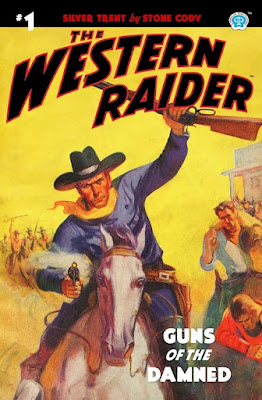
THE WESTERN RAIDER was a short-lived Western hero pulp that ran for three issues in 1938 and ’39. It featured the adventures of Silver Trent, a heroic outlaw sometimes known as the Hawk of the Sierras or the Rio Robin Hood. And like the Robin Hood of legend, Silver Trent has a band of colorful followers and fellow adventurers who ride with him, known as Hell’s Hawks. After the three short novels that were published in THE WESTERN RAIDER, Silver Trent returned in ten short stories and novelettes that appeared in STAR WESTERN from 1939 through 1942. I recently read the first Silver Trent novel, “Guns of the Damned”, from the August/September 1938 issue of THE WESTERN RAIDER.

This yarn opens with two Texas cowboys who have crossed the border into Mexico to look for a friend of theirs who disappeared. The friend was trying to find out who’s behind a series of rustling raids, and he’s sent word back that he suspects an outlaw named Silver Trent. His two pards who are searching for him are about to get gun-trapped in a cantina when a mysterious stranger rescues them. No bonus points for guessing that the mysterious stranger turns out to be Silver Trent his own self, and he’s no rustler. In fact, his mortal enemy, a rich but evil Mexican rancher known as El Diablo, is actually behind the raids across the border into Texas, and the two cowpokes are drawn into Silver Trent’s on-going war against El Diablo.

That’s about as complicated as the plot of this novel gets. It’s basically just a series of shootouts, captures, escapes, and epic battles, pausing occasionally to introduce more supporting characters from Silver’s friends, which include a priest with a hard right hook, a melancholy Mexican gunman tortured by religious guilt, a drunken doctor, a fast-gun gambler, an old geezer, and, of course, a beautiful girl.

Silver Trent himself is a bigger-than-life character, the sort of mythical figure who can out-shoot, out-fight, and out-ride anybody that shows up so often in Frederick Faust’s work. In fact, he reminds me quite a bit of Faust’s Silvertip, and while I have no way of knowing, it wouldn’t surprise me if the similarity in names wasn’t entirely a coincidence. Silver needs to be as competent as he is, because he’s evenly matched with El Diablo, about as despicable a villain as I’ve run across in a pulp Western.

Keeping everything moving at a breakneck pace is author Stone Cody, who was really Thomas Mount, a bit of a colorful character himself who I wrote about a while back in my review of his novel THE GUN WITH THE WAITING NOTCH. I really enjoy Mount’s over-the-top prose, such as this bit from late in the book:

The battle cry of Silver’s men!

In brazen-clanging Spanish and hard-bitten American—a sound like a trumpet call, that the desert knew and quivered to, that the mountains had flung back triumphantly in a hundred slashing whirling fights, that echoed still, fearfully, in the dreams of men who listened to it and lived to tell the tale.

“To Silver! Hell’s Hawks for Trent!” And now the sudden, staccato thunder of the guns!


Great literature, maybe it ain’t. But great literature generally doesn’t make me literally pump a fist in the air like I did when I read that line about the thunder of the guns. And that goes a long way toward explaining why I write like I do.

Altus Press/Steeger Books has reprinted the entire Silver Trent series, and I own all six volumes. I’ll be reading the rest of them soon. If you love Western pulp adventure as much as I do, I give them a very high recommendation. I love this stuff.

Friday, November 19, 2021

The Gun With the Waiting Notch - Stone Cody (Thomas Mount)


Jed Carson is a drifting cowpoke who comes to the Texas border country on a mission: He’s searching for the man who murdered his father. He carries an ivory-handled Colt with a notch already carved in the butt, just waiting for Jed to catch up to the killer and dispense hot-lead justice.

But no sooner does Jed mosey onto this range than he finds himself rescuing a rancher’s beautiful daughter from a menacing gunman. He quickly discovers that this region is plagued by rustlers and decides to help the girl and her crippled father fight off the outlaws. But is it possible that this might dovetail nicely with Jed’s original mission and afford him the opportunity to finally settle the score with his father’s murderer after years of searching? I think you probably know the answer to that question just as well as I do.

Predictable or not, THE GUN WITH THE WAITING NOTCH is a very entertaining Western. The author (more about him later) spends about a fourth of the book setting up the various characters and factions warring along the border and giving us the hero’s back-story, and then the rustlers raid the Circle T round-up and set off a series of furious action scenes that continue almost without pause to the end of the book. Battle follows chase follows shoot-out with only very short respites for the characters to catch their breath. Some of the clashes reach almost epic proportions before a very satisfying final showdown and some last-minute revelations worthy of Walt Coburn. There’s nothing here you haven’t read many times before, but it’s very well done and I had a great time reading it.

THE GUN WITH THE WAITING NOTCH was published in September 1933 by William Morrow, had a cheap hardback reprint from A.L. Burt later that year, and was reprinted in England by Cassell in 1934 under the title CAROL OF CIRCLE T. It was reprinted, again in England, by Ward Lock in 1952 under that same title, and then in 1958, Jefferson House brought it out in hardback under its original as part of its Triple-A Western Classics line, with an introduction by Erle Stanley Gardner. That edition carries a 1938 original copyright date, but that’s incorrect. The Morrow edition was definitely published in September 1933. Kirkus reviewed it the same month and said, “A new Western writer, and a promising one. This has all the proper ingredients, well blended. Not particularly original in plot, but the telling has punch.” Yeah, pretty much what I said.

The by-line on this novel is Stone Cody, but behind that pseudonym is a pretty interesting Western novelist and pulpster. “Stone Cody” was really Thomas Ernest Mount (1898-1976), a former advertising man who, according to the copyright registration, lived in Woodstock, New York, at the time this book came out. As far as I’ve been able to determine, THE GUN WITH THE WAITING NOTCH is Mount’s second novel. His first, MUSTANG TRAIL, was published earlier in 1933 under the name “Oliver King”, a pseudonym he used for some of his later pulp stories. I don’t have a copy of MUSTANG TRAIL, but Kirkus said of it, “Lots of shooting and a bit of humor in a Western which departs somewhat from the conventional pattern. Card sharping and horse thieving, etc.” The next year, 1934, saw him begin a prolific career of writing for the Western pulps that lasted twenty years. He used both King and Cody pseudonyms and published several more novels under the Cody name, but it appears they were all reprints of the Five Mavericks pulp novels that were published originally under the name Kent Thorn. (The Mavericks novels are still in print from Altus Press/Steeger Books, by the way.)

Mount’s story has more to it than his Western writing, though. He was working at an advertising agency in New York in 1923 when he met a young copywriter named Laura Zemetkin. They moved in together and lived as husband and wife for several years but never actually married because Mount was already married to somebody else. After their relationship ended, Laura married publishing executive Thayer Hobson in 1930. Hobson bought the company he worked for, William Morrow, and decided to write a Western novel that his newly-bought company would publish. He came up with the characters and plot, and he and Laura collaborated on the book itself, writing alternating chapters, before Hobson edited the final draft. That book was OUTLAWS THREE, the first book in the very successful Powder Valley series that would run for thirty years, written by various Western authors under the house-name Peter Field. Thayer and Laura Hobson wrote the first two or three novels in the series before turning it over to other authors. They divorced in 1935.

Laura Hobson published her first short story in 1932 under the name Laura Mount. After her divorce from Thayer Hobson, she and Thomas Mount became friends again, although not in a romantic way. There are some indications that Laura Hobson may have collaborated with Mount on some of his Western stories, but at this late date we’ll probably never know for sure about that. However, we do know that under the name Laura Z. Hobson, she went on to become a bestselling novelist, with her most famous work being the novel GENTLEMAN’S AGREEMENT. I have no idea whether her early relationship with Thomas Mount had anything to do with her becoming a writer, but I like to think that it did.

THE GUN WITH THE WAITING NOTCH is the second novel by Thomas Mount that I’ve read. Many years ago, I read a hardback reprint of FIVE AGAINST THE LAW, the first of the Five Mavericks novels, but I don’t recall anything about it except that I enjoyed it. I liked this one enough that I want to read more by Thomas Mount. If you’re a fan of action-packed traditional Westerns, I give THE GUN WITH THE WAITING NOTCH a high recommendation.

(Note: My copy of this is just a plain brown hardcover with no dust jacket, and I can’t find any images of either edition on-line, so I’m using an image I found of one of the British reprints. The title and cover make the book look like a Western romance, which it definitely isn't.)

Saturday, September 18, 2021

Saturday Morning Western Pulp: Big-Book Western Magazine, April 1947


Injury to a hat alert! And considering where that bullet is headed, it might just put a hole in the BIG-BOOK WESTERN MAGAZINE logo, too. This issue has the usual sterling line-up of authors often found in a Popular Publications Western pulp: Harry F. Olmsted, Stone Cody (Thomas Mount), D.B. Newton, Tom Roan, Roe Richmond, James P. Olsen, W.F. Bragg, and Lee E. Wells. Prolific and well-regarded pulpsters, all. 

Saturday, April 03, 2021

Saturday Morning Western Pulp: Star Western, December 1940


Ah reckon thar's about tuh be trouble betwixt these two rannies. Best hunt cover, hombres! I don't know the artist on this STAR WESTERN cover, but it's a good one. The usual great collection of authors can be found inside, too, including Harry F. Olmsted, Cliff Farrell, Philip Ketchum, Stone Cody (Thomas Mount) with a Silver Trent story, Dee Linford, Norrell Gregory, and M. Howard Lane. Looks like another fine Popular Publications Western pulp.

Saturday, December 16, 2017

Saturday Morning Western Pulp: Dime Western, August 1939


You could always count on Popular Publications for top-notch Western pulps, and DIME WESTERN was the flagship of their line. This issue has a great bunch of writers in its pages: Walt Coburn, Harry F. Olmsted (under his own name and possibly as by Bart Cassidy, the latter being a Tensleep Maxon story), Cliff Farrell, and Thomas Mount twice (as Stone Cody and Oliver King).

Saturday, November 04, 2017

Saturday Morning Western Pulp: Ace-High Magazine, October 1939


There's the stalwart cowboy in the red shirt and the gun-totin' redhead, but where's the old geezer? Maybe they're on their way to rescue him, provided, of course, they get away from the rannies shooting at them. Even though it wasn't officially part of the title, you can tell from the "Western Stories" emblazoned on the cover that by this time ACE-HIGH MAGAZINE was completely a Western pulp, despite having begun life as a general adventure fiction magazine. And an excellent Western pulp it is, too, with this issue featuring stories by Harry F. Olmsted, Cliff Farrell, Thomas Mount writing as Stone Cody, Art Lawson, and Kenneth A. Fowler. One of the lesser known authors--in fact, his story in this issue is the only one in the Fictionmags Index (the source of this scan)--is Dade Bartell. Now, I know absolutely nothing about Dade Bartell. Could be a pseudonym, could be a house-name, could be a real guy. But the name sounds like the main gunslinging henchman for the criminal mastermind behind all the rustling and land-grabbing. I may have to borrow that one of these days.

Saturday, June 10, 2017

Saturday Morning Western Pulp: Star Western, July 1940


I don't know about you, but I want to read the story that cover illustrates. It looks great! The line-up of authors in this issue of STAR WESTERN isn't as strong as some but still pretty good. Inside are stories by Harry F. Olmsted, W. Ryerson Johnson (billed on the cover as William Ryerson Johnson, which I don't recall seeing before), Stone Cody (Thomas Mount), John G. Pearsol, Dee Linford, Charles W. Tyler, and Kenneth Fowler. Great cover, good authors, and over-the-top story titles . . . Yep, that's a Popular Publications Western pulp.

Saturday, December 31, 2016

Saturday Morning Western Pulp: New Western, November 1951


I don't believe I'd ever read an issue of NEW WESTERN until now, but this is an issue I own and read recently. Most of the Western pulps from Popular Publications are pretty much interchangeable. Their two flagship titles, DIME WESTERN and STAR WESTERN, ran more novellas, especially STAR WESTERN, but other than that the same authors appeared in all the titles across the line and the magazines featured good, solid hardboiled Westerns, for the most part.

This issue gets off to a good start with "First Stage to Sundown", a novelette by George C. Appell, whose work appeared frequently in a variety of pulps during the late Forties through the Fifties. This story uses a fairly standard plot: a stagecoach has to make a long, dangerous run in a set period of time in order to secure a government mail contract. Along the way, the coach and another wagon that accompanies it are plagued by a gang of outlaws. Appell throws in a couple of decent twists and there are several tough action scenes, along with some nice descriptive writing in places. Appell was never in the top rank of Western writers, but he seems to have produced some pretty good work. I've enjoyed the few stories I've read by him.

Next up is "Cactus-Eatin' Lady" by Robert Trimnell, an author whose name I've seen, but I don't know anything else about him. This is a humorous tale about a couple of cowpokes and a camel. It read like it might be part of a series, but I don't know for sure about that. As I've said before, with a few major exceptions, comedy Westerns just don't work for me. This is not one of those exceptions. I didn't care much for this story.

James B. Hendryx's Halfaday Creek series, featuring the good-hearted outlaw Black John Smith and Corporal Downey of the RCMP, ran for many years, mostly in the iconic pulp SHORT STORIES. "Black John—Claim Jumper" is a late entry in the series. How it wound up in NEW WESTERN, I don't know, but it's a good yarn about Black John helping out a young couple who get caught up in a mining swindle. This story could have used a little more action, but it's very well-written. This is actually the first Halfaday Creek story I've read, but I'm going to have to try some more of them.

"The Drifter Stops Off" is by James Charles Lynch, an author I know nothing about except that I think I've read somewhere he ghosted some for Ed Earl Repp. This is a pretty good story about a hobo and former printer who runs afoul of the most powerful man in town and takes measures to settle the score with him in unusual ways.

"Gun-Fighter's Brand" by John C. Colohan is a reprint from the August 1934 issue of DIME WESTERN. I've probably read a few stories by Colohan—he was a prolific contributor to the Popular Publications Western pulps—but nothing that I recall. This yarn is about a wounded lawman who has to couple of people who have a grudge against him, one a killer and the other a beautiful young woman. It's fairly well-written and has a nice twist ending I didn't see coming.

Bill Colson was actually Verne Athanas, who was more well-known under his real name. As Colson, he wrote a series about stagecoach driver and teamster Seven-Foot Sanders and his sidekick Shorty Shamrock. This sounds like a comedy series, but the entry in this issue, "Seven-Foot Sanders' Private War", is a fairly straightforward tale about trying to get a stagecoach and then a freight wagon full of supplies through Apache country. The tone is a little light in places, but there are also some gritty action scenes. I enjoyed this one enough that I'd read more in the series.

"The Hoodoo Trail Drive" by Stone Cody is another reprint, originally appearing under the title "Signed On With Satan" in the May 1937 issue of STAR WESTERN. It features a thinly disguised version of real-life cattleman Shanghai Pierce, here called Shanghai Pearson, and is about a danger-filled, seemingly cursed trail drive from Texas to Kansas. It's an excellent yarn and achieves an almost epic feel, which is hard to do in a novelette. I enjoyed it a lot, more than any of the other stories in this issue, in fact. Stone Cody was really Thomas Mount, the first husband (if I recall correctly) of bestselling author Laura Z. Hobson. I'm sure I've read his work before, but I'll be keeping a better eye out for his stories in the future after reading this one.

There's one other thing of interest in this issue of NEW WESTERN: a little house ad for the then-current issue of Popular Publications stablemate DIME WESTERN that includes the line A Riproarious "Tensleep" Story by Harry F. Olmsted. Well, other than the word "Riproarious", which I like, the interesting thing about this is that all the Tensleep Maxon stories (and there were scores of them) were published under the name Bart Cassidy. Only in the last year or so has Harry Olmsted's name been linked with that pseudonym, but here's another indication of it. Cassidy may have been used as a house-name at times, but I'm starting to believe that Olmsted was responsible for most of the stories published under that name. (Something similar happened to me many years ago, when the November 1978 issue of MIKE SHAYNE MYSTERY MAGAZINE had a house ad in it listing the next issue's Mike Shayne story: "Death in Xanadu" by James M. Reasoner. When they were making up the issue, they obviously got my name off the manuscript and forgot to replace it with the usual Brett Halliday pseudonym. As far as I know that's the only time a prose Shayne story was credited to someone other than Halliday.)

Overall, a decent issue of NEW WESTERN, with several good stories, several readable ones, and only one that I didn't finish. The scan, as usual with this sort of post, is of the copy I read, and it's a pretty good cover.