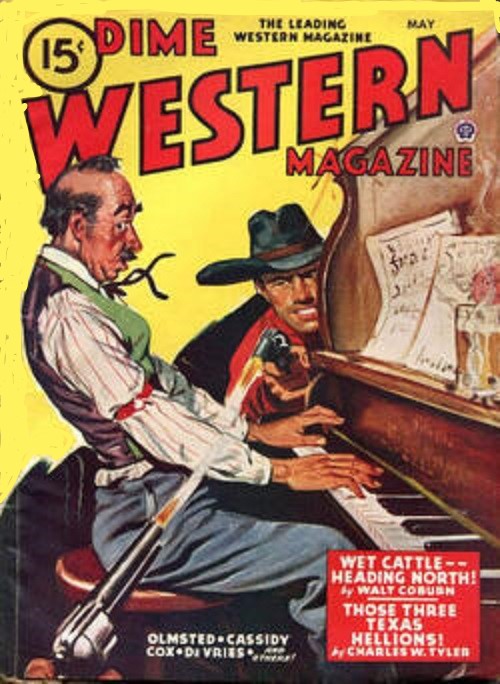


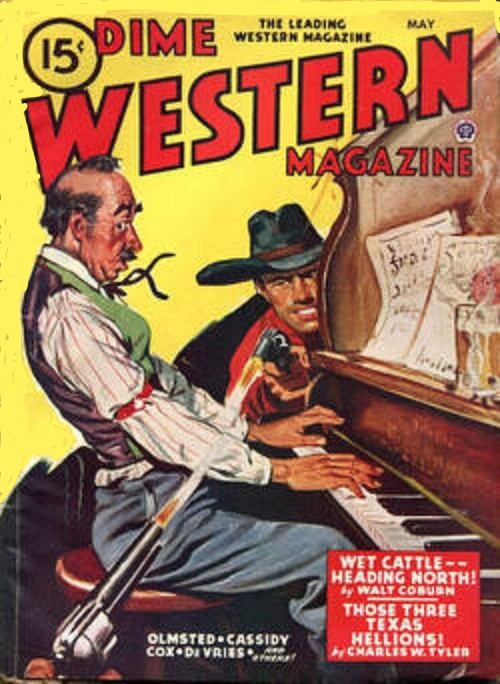
I’ve featured this issue before, but a friend sent me a copy of the actual pulp and I read it this week. Thanks, Ryan! Here’s how I opened that previous post: “We already know that it wasn't safe to play poker or go to the barber shop in the Old West, but now we realize that you couldn't even sit down to tickle the ivories without winding up in the middle of a gunfight, thanks to this cover on DIME WESTERN, Popular Publications' leading Western pulp.” I’m unsure of the artist on this cover. It might be Robert Stanley; he was doing a lot of covers for DIME WESTERN during this era.
The first story is by an author whose name is somewhat familiar to me, but I
don’t believe I’ve ever read anything by him until now: Charles W. Tyler. Although
billed as a novel, “Those Three Texas Hellions!” is fairly short, closer to
novelette length. The three Texas Hellions in question are a couple of old-timers
called Dewlap and Wattles and a gun-fast youngster known as the Hairpin Kid.
You might guess from those names that this is a humorous Western, and if you’ve
been paying attention you know that I generally don’t like those much unless
they’re by Robert E. Howard or W.C. Tuttle. Well, Tyler is not in the same league
as those two, but this story isn’t bad. One of the old codgers gets his hands
on a map that’s supposed to lead to the Lost San Saba Mine, and in their search
for it they cross trails with a gang of outlaws and a Texas Ranger. The humor
doesn’t descend too far into slapstick, there’s plenty of action, and the
characters are more likable than I expected them to be. Based on this story, I’d
read more by Tyler.
By the way, despite the Table of Contents page claiming “All Stories New—No Reprints!”,
a story by Charles W. Tyler entitled “Those Three Texas Hellions!” also
appeared in the June 1943 issue of STAR WESTERN. Whether this is the same
story, or whether Tyler just reused the title, I don’t know. I’d have to compare
both issues, and I don’t own that STAR WESTERN. Not that it really matters.
Next up is “Manhunt at Gillams”, a tense story about a man catching up to the
outlaw who robbed him at an isolated way station. The authors are Everett and
Olga Webber, who wrote several historical novels together. Everett Webber
contributed around 70 Western and detective stories to various pulps and slicks
during the Thirties, Forties, and Fifties, sometimes in collaboration with his
wife Olga. This is a low-key, well-written yarn that reminded me a little of
Ernest Haycox’s work.
Also featured on the cover is Walt Coburn’s novelette “Wet Cattle—Heading North!”
Despite the title, the story has a lot more to do with stealing horses rather
than cattle. By this point in his career, Coburn’s drinking problem was bad enough
that the editors at Popular Publications supposedly had to rewrite his
manuscripts to make them publishable. I don’t know if that’s true or not. This
one, like most of Coburn’s stories from this era, is so weighted down with
back-story that it takes a long time for the actual plot to get going. I’m a
big fan of Coburn’s work, but this is a pretty weak entry. There are a few bits
of description that really ring true and authentic, and the action scenes are
well-done, but mostly it just muddles along, hard to follow. If this was
someone’s first Coburn story, they’d probably have a difficult time understanding
why he was so popular.
Harry F. Olmsted’s longest-running series, written under the pseudonym Bart
Cassidy, featured drifting good-guy outlaw Tensleep Maxon in more than 120
stories between 1933 and 1951. “Tensleep—Wedding Buster” in this issue is
typical of the series: in colorful first-person narration, Tensleep finds
himself in the middle of trouble at a Mormon wedding. I’ve read a few of the
stories in this series, and while I love Olmsted’s work overall, I’m not a big
fan of the Tensleep stories. This one’s not bad, certainly readable and
entertaining, but it’ll never be one of my favorite series.
It's always cool when I read a pulp and come across a story by an author I’ve
actually met. Thomas Thompson was the long-time story editor on the TV show
BONANZA, but before that he had a successful career as a Western pulpster and
novelist. He was also at the Western Writers of America convention in Fort
Worth in 1986, where I met him and got to talk to him briefly. His story in
this issue, “The Killer and the Lady”, is a low-key tale about a woman whose
old suitor returns, but unfortunately, he's become an outlaw. This is a
well-written story, and with its emotion and characterization, it also reminds
me of Ernest Haycox.
Old pro William R. Cox contributes the novelette “A Range to Die For!” This is
a cattleman vs. nesters story, but Cox gives it a nice twist that brings about
a very satisfying resolution. I enjoyed this one a lot.
“War Smoke on Black Hill” is by another author whose name is vaguely familiar
to me, Marvin De Vries. It’s about an army scout trying to solve the mystery of
who betrayed a patrol and led them into an Indian ambush. Not a bad story, although
it’s very obvious where the plot is going.
“As a Man Fights—” by Harold R. Stoakes is a decent little action yarn about an
unlikely subject: the clash between a riverboat captain with a load of sugar
and the owner of a sorghum mill who’s making molasses. No range war here or
water rights battle in this one. It’s a sweetener war, instead. I don’t know
anything about Stoakes except that he wrote several dozen Western stories in
the Forties and Fifties. This one is off-beat enough that I liked it.
Another series by Harry F. Olmsted that appeared regularly in DIME WESTERN under
Olmsted’s name featured Friar Robusto, an adventurer in Spanish California. Robusto
isn’t an actual priest, he only pretends to be one, and he has a masked secret
identity as a Robin Hood outlaw known as the Phantom Highwayman. Any
resemblance to Johnston McCulley’s Zorro series probably isn’t coincidental.
These are more historical swashbucklers than traditional Westerns, but I love
them. Every one I’ve read has been great, including “Friar Robusto at the Devil’s
Deadline” in this issue. This is the 23rd and final story in the
series, and it finds Robusto caught up in political upheaval between the King
of Spain and the Viceroy of Spanish California. Lots of blood-and-thunder
action, including several sword fights, and Robusto is a great character. If
you’re a fan of the serial ZORRO’S FIGHTING LEGION, like I am, you’ll find a
lot of the same feeling in Olmsted’s Friar Robusto stories. This series would
be a good candidate for reprinting, and with only 23 novelettes, it could be
done in three or four volumes.
Overall, this is a very solid issue of a consistently good Western pulp. The
stories range from good to excellent, with the best being the Friar Robusto
yarn and the weakest the one from Walt Coburn, and it’s not terrible, just not
up to the standards of his best work. I had a very good time reading this
issue.