Showing posts with label Thomas Thompson. Show all posts

Saturday, July 13, 2024

Saturday Morning Western Pulp: Fifteen Western Tales, October 1942


Wanted posters show up a lot on Western pulp covers. Usually, the outlaw depicted on the poster is standing there either shooting or about to shoot. You can't really tell if the fellow on the cover of this issue of FIFTEEN WESTERN TALES is also the one on the reward dodger, but there's a good chance he is. There are stories by some fine Western pulpsters in this issue: Philip Ketchum, William Heuman, Thomas Thompson, and Frank Bonham. Other well-known authors in this one include Joe Austell Small, R.S. Lerch, John Wilstach (better known for his adventure yarns in ARGOSY and elsewhere), Carl G. Hodges (best remembered for his mystery stories and novels), and Edwin K. Sloat. Then there are the ones I'm not familiar with--P.J. Delanoye, Roy B. Angell, and W.W. Montgomery--and house names Ray P. Shotwell and Lance Kermit. I'm going to name the hero in a Western novel Lance Kermit one of these days. I'm sure this is a good issue since the Popular Publications Western pulps were consistently top-notch.

UPDATE: As Paul Herman points out in the comments, this hombre is wearing a lawman's star, so he's not the outlaw on the wanted poster. And since there's powdersmoke coming from the barrel of his gun, I reckon we can figure he just ventilated the owlhoot in question. Dadgum it, I don't know how I missed that! Thanks, Paul.

Saturday, April 15, 2023

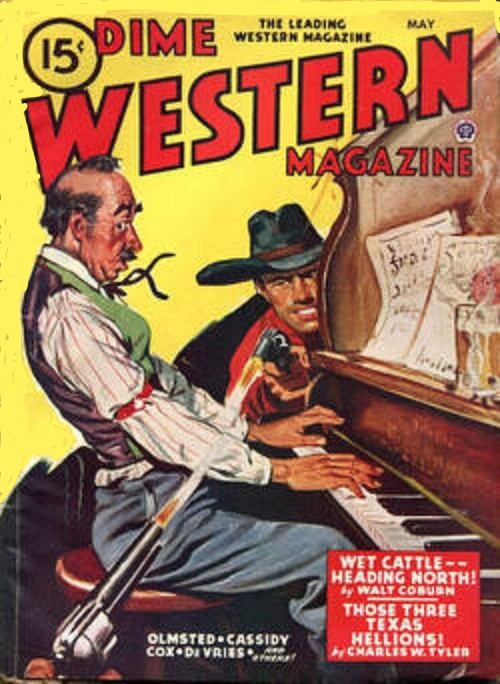
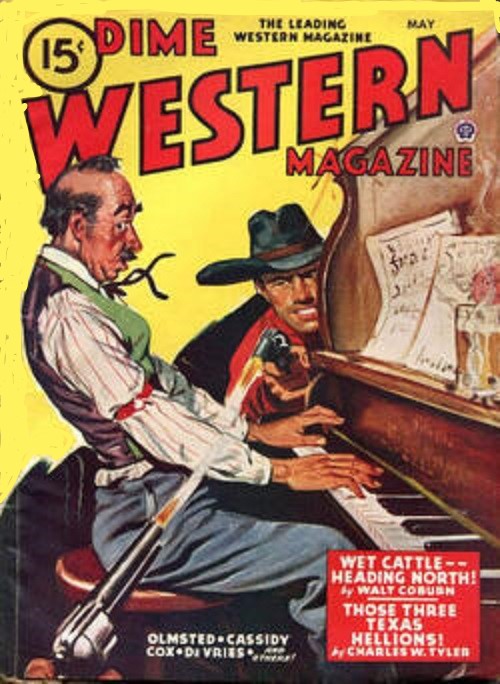
Saturday Morning Western Pulp Revisited: Dime Western, May 1946


I’ve featured this issue before, but a friend sent me a copy of the actual pulp and I read it this week. Thanks, Ryan! Here’s how I opened that previous post: “We already know that it wasn't safe to play poker or go to the barber shop in the Old West, but now we realize that you couldn't even sit down to tickle the ivories without winding up in the middle of a gunfight, thanks to this cover on DIME WESTERN, Popular Publications' leading Western pulp.” I’m unsure of the artist on this cover. It might be Robert Stanley; he was doing a lot of covers for DIME WESTERN during this era.


The first story is by an author whose name is somewhat familiar to me, but I don’t believe I’ve ever read anything by him until now: Charles W. Tyler. Although billed as a novel, “Those Three Texas Hellions!” is fairly short, closer to novelette length. The three Texas Hellions in question are a couple of old-timers called Dewlap and Wattles and a gun-fast youngster known as the Hairpin Kid. You might guess from those names that this is a humorous Western, and if you’ve been paying attention you know that I generally don’t like those much unless they’re by Robert E. Howard or W.C. Tuttle. Well, Tyler is not in the same league as those two, but this story isn’t bad. One of the old codgers gets his hands on a map that’s supposed to lead to the Lost San Saba Mine, and in their search for it they cross trails with a gang of outlaws and a Texas Ranger. The humor doesn’t descend too far into slapstick, there’s plenty of action, and the characters are more likable than I expected them to be. Based on this story, I’d read more by Tyler.

By the way, despite the Table of Contents page claiming “All Stories New—No Reprints!”, a story by Charles W. Tyler entitled “Those Three Texas Hellions!” also appeared in the June 1943 issue of STAR WESTERN. Whether this is the same story, or whether Tyler just reused the title, I don’t know. I’d have to compare both issues, and I don’t own that STAR WESTERN. Not that it really matters.

Next up is “Manhunt at Gillams”, a tense story about a man catching up to the outlaw who robbed him at an isolated way station. The authors are Everett and Olga Webber, who wrote several historical novels together. Everett Webber contributed around 70 Western and detective stories to various pulps and slicks during the Thirties, Forties, and Fifties, sometimes in collaboration with his wife Olga. This is a low-key, well-written yarn that reminded me a little of Ernest Haycox’s work.

Also featured on the cover is Walt Coburn’s novelette “Wet Cattle—Heading North!” Despite the title, the story has a lot more to do with stealing horses rather than cattle. By this point in his career, Coburn’s drinking problem was bad enough that the editors at Popular Publications supposedly had to rewrite his manuscripts to make them publishable. I don’t know if that’s true or not. This one, like most of Coburn’s stories from this era, is so weighted down with back-story that it takes a long time for the actual plot to get going. I’m a big fan of Coburn’s work, but this is a pretty weak entry. There are a few bits of description that really ring true and authentic, and the action scenes are well-done, but mostly it just muddles along, hard to follow. If this was someone’s first Coburn story, they’d probably have a difficult time understanding why he was so popular.

Harry F. Olmsted’s longest-running series, written under the pseudonym Bart Cassidy, featured drifting good-guy outlaw Tensleep Maxon in more than 120 stories between 1933 and 1951. “Tensleep—Wedding Buster” in this issue is typical of the series: in colorful first-person narration, Tensleep finds himself in the middle of trouble at a Mormon wedding. I’ve read a few of the stories in this series, and while I love Olmsted’s work overall, I’m not a big fan of the Tensleep stories. This one’s not bad, certainly readable and entertaining, but it’ll never be one of my favorite series.

It's always cool when I read a pulp and come across a story by an author I’ve actually met. Thomas Thompson was the long-time story editor on the TV show BONANZA, but before that he had a successful career as a Western pulpster and novelist. He was also at the Western Writers of America convention in Fort Worth in 1986, where I met him and got to talk to him briefly. His story in this issue, “The Killer and the Lady”, is a low-key tale about a woman whose old suitor returns, but unfortunately, he's become an outlaw. This is a well-written story, and with its emotion and characterization, it also reminds me of Ernest Haycox.

Old pro William R. Cox contributes the novelette “A Range to Die For!” This is a cattleman vs. nesters story, but Cox gives it a nice twist that brings about a very satisfying resolution. I enjoyed this one a lot.

“War Smoke on Black Hill” is by another author whose name is vaguely familiar to me, Marvin De Vries. It’s about an army scout trying to solve the mystery of who betrayed a patrol and led them into an Indian ambush. Not a bad story, although it’s very obvious where the plot is going.

“As a Man Fights—” by Harold R. Stoakes is a decent little action yarn about an unlikely subject: the clash between a riverboat captain with a load of sugar and the owner of a sorghum mill who’s making molasses. No range war here or water rights battle in this one. It’s a sweetener war, instead. I don’t know anything about Stoakes except that he wrote several dozen Western stories in the Forties and Fifties. This one is off-beat enough that I liked it.

Another series by Harry F. Olmsted that appeared regularly in DIME WESTERN under Olmsted’s name featured Friar Robusto, an adventurer in Spanish California. Robusto isn’t an actual priest, he only pretends to be one, and he has a masked secret identity as a Robin Hood outlaw known as the Phantom Highwayman. Any resemblance to Johnston McCulley’s Zorro series probably isn’t coincidental. These are more historical swashbucklers than traditional Westerns, but I love them. Every one I’ve read has been great, including “Friar Robusto at the Devil’s Deadline” in this issue. This is the 23rd and final story in the series, and it finds Robusto caught up in political upheaval between the King of Spain and the Viceroy of Spanish California. Lots of blood-and-thunder action, including several sword fights, and Robusto is a great character. If you’re a fan of the serial ZORRO’S FIGHTING LEGION, like I am, you’ll find a lot of the same feeling in Olmsted’s Friar Robusto stories. This series would be a good candidate for reprinting, and with only 23 novelettes, it could be done in three or four volumes.

Overall, this is a very solid issue of a consistently good Western pulp. The stories range from good to excellent, with the best being the Friar Robusto yarn and the weakest the one from Walt Coburn, and it’s not terrible, just not up to the standards of his best work. I had a very good time reading this issue.

Saturday, December 10, 2022

Saturday Morning Western Pulp: Ace-High Western Stories, May 1945


Another dramatic, action-packed cover on this issue of ACE-HIGH WESTERN STORIES. I don't know the artist. As always with Western pulps from Popular Publications, the lineup of authors is a good one and the story titles are great. On hard are prolific Western pulpsters Thomas Thompson, Wayne D. Overholser, Archie Joscelyn, and M. Howard Lane, but the lead-off story in this issue is by science fiction legend Clifford D. Simak. Simak was a solid enough Western writer that I think he could have made a bigger name for himself in that genre if he'd wanted to, but of course his main interests lay elsewhere.

Saturday, May 28, 2022

Saturday Morning Western Pulp: Dime Western, May 1946


We already know that it wasn't safe to play poker or go to the barber shop in the Old West, but now we realize that you couldn't even sit down to tickle the ivories without winding up in the middle of a gunfight, thanks to this cover on DIME WESTERN, Popular Publications' leading Western pulp. This issue features a couple of the magazine's most prolific authors, Harry F. Olmsted (twice, once with a Friar Robusto story under his own name and again with a Tensleep Maxon story as by Bart Cassidy) and Walt Coburn. Also on hand are Thomas Thompson (famous for being the story editor on BONANZA for many years), William R. Cox, Harold De Vries, and Charles W. Tyler. The only thing I can play on the piano is "Chopsticks", and I'm not sure I could manage that with bullets whistling around me.

Saturday, October 30, 2021

Saturday Morning Western Pulp: New Western, March 1948


Another action-packed cover that I think may be by Robert Stanley. Maybe someone better at artist IDs than I am can confirm or deny that. There's no denying that there are plenty of good writers in this issue of NEW WESTERN, though. There are stories by Walt Coburn, Thomas Thompson, Tom Roan, Dee Linford, Bill Gulick, and the lesser-known J. Walton Doyle, who wrote a series about a couple of characters called Hashhouse and Dumbo. I may be jumping to conclusions here, but those names remind me of Syl McDowell's Swap and Whopper and Alfred Garry's Ham and Eggs, and I don't like those series at all. On the other hand, we have W.C. Tuttle's Tombstone and Speedy (to say nothing of his Hashknife and Sleepy, one of my all-time favorite series), so maybe Hashhouse and Dumbo are okay.

Saturday, May 04, 2019

Saturday Morning Western Pulp: Big-Book Western Magazine, March 1949


I love the expression on this cowboy's face. Somebody's gonna pay for that spilled drink! There are also some excellent authors in this issue of BIG-BOOK WESTERN MAGAZINE, starting with a couple of my favorites, Walt Coburn and Harry F. Olmsted. Also on hand are top-notch Western writers Thomas Thompson, Tom W. Blackburn, Tom Roan, and Bryce Walton. This looks like a fine issue.

Saturday, July 21, 2018

Saturday Morning Western Pulp: New Western, September 1945


As I've said before, no poker games ever ended peacefully in the Old West, at least according to the Western pulps. This issue of NEW WESTERN is another example. Although violence hasn't broken out yet, you just know it's about to. So while the brawl's going on, you can read stories by Wayne D. Overholser ("Gun-Cure for Lava City" is a great title), D.B. Newton, C. William Harrison, Thomas Thompson, M. Howard Lane, Ralph Yergen, Theodore J. Roemer, and Charles Hammill, an author I've never heard of. Any Western pulp with Overholser, Newton, Harrison, and Thompson is going to be worth reading. 

Saturday, June 30, 2018

Saturday Morning Western Pulp: Ace-High Western Stories, August 1946


With its red, white, and blue color scheme and prominently featured star, the cover of this issue of ACE-HIGH WESTERN STORIES seemed appropriate to post today, since the Fourth of July is coming up next week. Not only is the cover striking visually, the contents inside include stories by Walker A. Tompkins, Wayne D. Overholser, Thomas Thompson, Lee E. Well, Brett Austin (who was really Lee Floren), and Bob Obets. A good solid line-up of Western pulpsters, in other words.

Saturday, November 11, 2017

Saturday Morning Western Pulp: Six-Gun Western, March 1946


SIX-GUN WESTERN was one of the Speed pulps, the slightly toned-down successor to the Spicy pulps. This is the first issue, and along with that nice cover, it has stories by Thomas Thompson, William Heuman, Joseph Chadwick, and old-time pulpster Victor Rousseau writing as Lew Merrill. That's a pretty good line-up of authors. 

Saturday, March 05, 2016

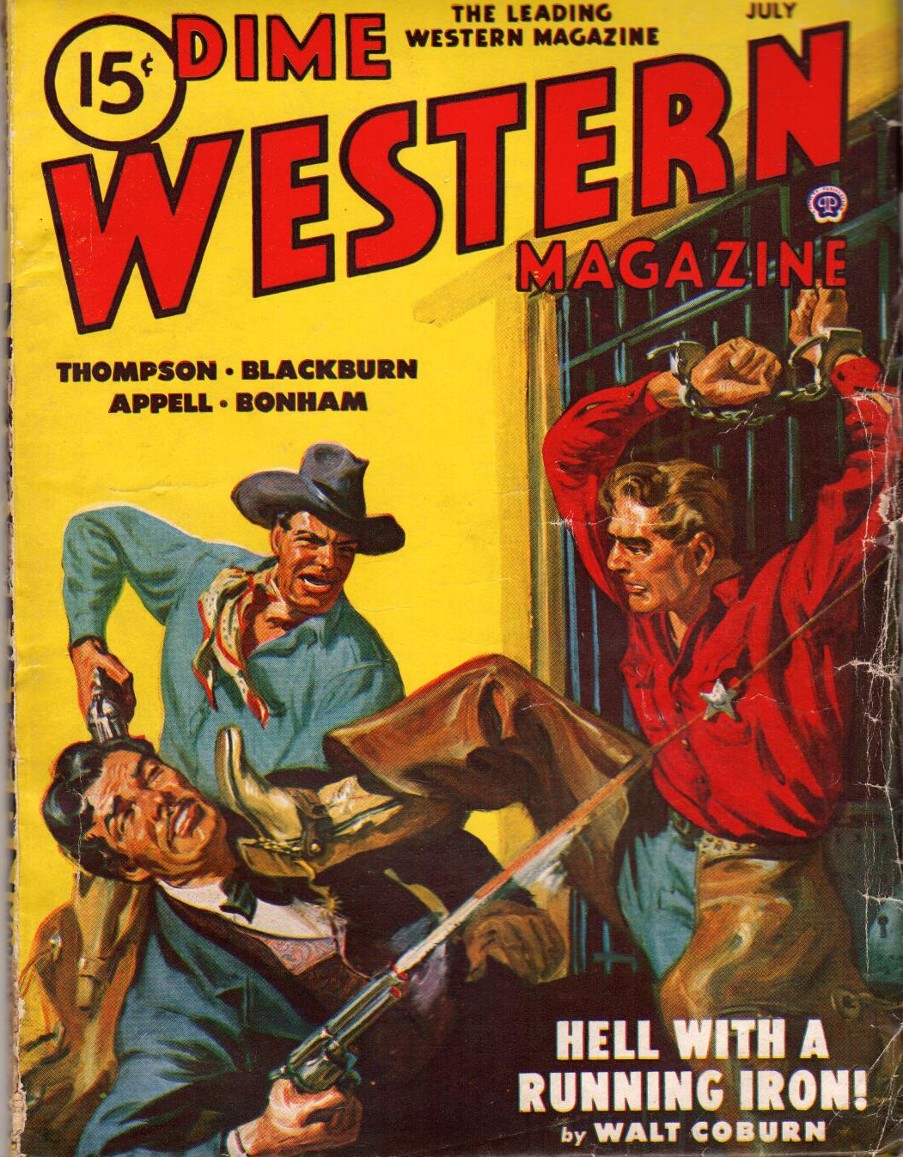
Saturday Morning Western Pulp: Dime Western, July 1948


This is a pulp that I own and read recently, and as usual in those cases, the scan is from the actual issue I read. DIME WESTERN, like all the Popular Publications Western pulps, was a consistently entertaining magazine, and this issue is no exception.

Tom W. Blackburn was one of the heroes of my childhood, although I didn’t know that at the time. I say that because he wrote the scripts for the Davy Crockett episodes of THE WONDERFUL WORLD OF DISNEY that featured Fess Parker. There was no bigger fan of Davy Crockett in the early Sixties, when those shows were being rerun on a regular basis, than I was. I sang the theme song all the time, too, and Blackburn wrote those iconic lyrics. In recent years I’ve read some of his pulp stories and liked them. His novelette that leads off this issue, “Quest of the Thirty Dead”, is an excellent hardboiled Western yarn about a bounty hunter tracking down the members of an outlaw gang who raided a town and burned down a hotel as a distraction while they looted the banks, resulting in thirty fatalities. There are a few plot twists and plenty of action in this one, and it comes to a very satisfying conclusion.

J.H. Holland is an author I’m not familiar with. His short story, “Get Up and Fight Again!” is next in this issue. It’s set right after the Civil War and concerns a former Union soldier who goes west to find the sister of a friend who died in the Andersonville prison camp. Naturally enough, the sister is having trouble with the local range hog, and the ex-soldier takes up her cause. Holland seems to have been a real person but didn’t publish much. This is the first story of his listed in the Fictionmags Index. It’s fairly well written but never generates much suspense, and the ending seems rushed, as if Holland was too inexperienced to know how to develop the situation. It has some nice bits of action and description, though.

Dean Owen’s stories are always good. “A Brave Man Dies But Once”, set in Virginia City, Nevada, during the silver boom, is narrated by traveling cigar salesman Sam Kincaid, who is more than he seems. A crisis forces him to make a choice about which way his life is going to go, and not surprisingly, it all leads to the satisfying conclusion of an excellent tale.

By this point in Walt Coburn’s career as a writer and a two-fisted drinker, rumor has it that his manuscripts were heavily rewritten by editors, so it’s impossible to say how much of the novella “Hell With a Running Iron!” is Coburn’s work and how much came from some Popular Publications staffer. Most of it, however, reads like Coburn to me. The plot is fairly simple for one of his yarns—big ranching syndicate frames a small rancher for rustling so it can gobble up his spread—but as usual Coburn has a large cast of characters with a lot of back-story. Sometimes Coburn throws in so many elements his stories don’t really have a chance of making sense, but thankfully that’s not the case here. It’s a good story with some nice action and the undeniable sense of authenticity that you find in most of Coburn’s work. Not in the top rank of his efforts, but for the late Forties, not bad at all.

George C. Appell had a nice career writing for the pulps, slicks, and digests from the mid-Forties on through the Sixties, as well as producing a number of novels. His story “Last Roll Call” concerns the aftermath of the Battle of the Little Big Horn and a couple of soldiers from the 7th Cavalry who may have survived the massacre. It’s a good plot, and Appell writes very well. I’ve seen a lot of his work around but haven’t read much of it. Based on this story, I probably should.

I started reading Frank Bonham’s juvenile novels when I was a kid, with no knowledge of his career as a writer for the Western pulps. He did a lot of stories with unusual protagonists, and “Payment Past Due” is one of them. The hero is a doctor from the East with a dark secret in his past who heads west to make a new start. Eventually, of course, that secret will come out and the doctor will have to find out if he’s as good with a six-gun as he is with a scalpel. Bonham is another writer whose work is just about always good, and I enjoyed this story quite a bit.

Every so often I run across a pulp story written by someone I’ve actually met. That’s the case with Thomas Thompson’s “The Hangin’ Plague Hits Tonto Basin”. Thompson was at the WWA convention in Fort Worth in 1986 and I got to say hello to him there. I don’t remember much about it except that he was pleasant enough and looked a lot like the actor Al Lewis, who played Grandpa Munster. He was the story editor on BONANZA for many years, so I was a fan of his work there, but I’m not sure I’ve ever read any of his pulp stories before this one. I’ll definitely be looking for them from now on, though, because “The Hangin’ Plague Hits Tonto Basin” is maybe the best story in this issue of DIME WESTERN. It’s a variation on the old sheepmen-versus-local-cattle-baron plot, with an ex-con caught in the middle, but it’s very well written with a great hardboiled tone and plenty of action. I really enjoyed it and want to read more by Thompson, soon.

That wraps up this issue of DIME WESTERN, and it’s a very good one, with only one weak story (and it’s not terrible) and the others ranging from good to excellent. That’s not surprising, given DIME WESTERN’s consistent quality. If you have any issues or come across some, chances are they’ll be well worth reading.