RED SEAL WESTERN is a little-remembered Western pulp these days, but it had some good covers and good authors, too. I think this cover is by Tom Lovell. The cowboy looks like his work, and so does the redhead. Inside this issue are stories by Harry Sinclair Drago, Claude Rister, Dean Owens (almost certainly a typo for Dean Owen/Dudley Dean McGaughey), Cibolo Ford (with his name misspelled on the table of contents), Mel Pitzer, and Wilfred McCormick, one of my favorite authors as a kid for his juvenile sports novels and dog stories. This certainly looks like an enjoyable Western pulp to me.
Saturday, November 01, 2025
Saturday Morning Western Pulp: Red Seal Western, August 1937
RED SEAL WESTERN is a little-remembered Western pulp these days, but it had some good covers and good authors, too. I think this cover is by Tom Lovell. The cowboy looks like his work, and so does the redhead. Inside this issue are stories by Harry Sinclair Drago, Claude Rister, Dean Owens (almost certainly a typo for Dean Owen/Dudley Dean McGaughey), Cibolo Ford (with his name misspelled on the table of contents), Mel Pitzer, and Wilfred McCormick, one of my favorite authors as a kid for his juvenile sports novels and dog stories. This certainly looks like an enjoyable Western pulp to me.
Saturday, March 22, 2025
Saturday Morning Western Pulp: Wild West Weekly, August 27, 1938
I own a couple dozen issues of WILD WEST WEEKLY, but the August 27, 1938 issue isn’t among them. It’s available on the Internet Archive, though, and I picked it to read for a reason which I’ll get around to. The cover is by the legendary Norman Saunders, and it’s a good one illustrating the lead novella, “The Cougar’s Claws”.
That novella features Pete Rice, and that’s the reason I read this one. A
little background for those of you unfamiliar with the character: Inspired by
the success of THE SHADOW and DOC SAVAGE, in 1933 the good folks at Street
& Smith decided to launch a Western hero pulp. The result was PETE RICE
MAGAZINE. The title character is the two-fisted, fast-shootin’ sheriff of
Trinchera County, Arizona, who's assisted by two deputies, scrawny little
Misery Hicks (who does double duty as the barber of Buffalo Gap, the county
seat) and Teeny Butler, who, in keeping with the nicknaming tradition of pulp
characters, is well over six feet tall and weighs 300 pounds. The gimmick of
the series, if you can call it that, is that while it has all the Western
trappings, it’s set in the modern day, putting it in firmly in the same camp as
the Western B-movies of the times starring Gene Autry and others. These Pete
Rice novels, and they were full-length novels, were written by veteran pulpster
Ben Conlon under the pseudonym Austin Gridley.
Well, PETE RICE MAGAZINE was not a raging success. It ran for 31 issues,
approximately two and a half years. I read one of the novels years ago and
don’t remember much about it except that I wasn’t impressed and didn’t seek out
any more of the series. But . . . after Pete’s own magazine was cancelled, the
character moved to WILD WEST WEEKLY, where he starred in 21 more novellas and
novelettes. Or did he? You see, the stories in WILD WEST WEEKLY are no longer
set in the modern day but take place in the Old West, which prompted a recent
discussion between me and a friend about the idea that the Pete Rice in the
WILD WEST WEEKLY stories is actually the father or grandfather of the Pete Rice
who starred in his own magazine. That seems feasible, other than the fact that
in WILD WEST WEEKLY, Misery and Teeny are still Pete’s deputies, and claiming
that those characters are also an earlier generation seems like quite a stretch
to me. I suspect that in real life, nobody at Street & Smith ever gave the
change in time period a second thought other than maybe instructing Conlon to
make the stories actual Westerns in hopes that they would help sell WILD WEST
WEEKLY. It’s a safe bet that none of the pulp writers and editors dreamed
anybody would still be talking about this stuff nearly a century down the road!
Anyway, another difference in the characters in PETE RICE MAGAZINE and WILD
WEST WEEKLY is that in the later incarnation, Austin Gridley became a
house-name. Ben Conlon continued to write some of the stories, but other
authors contributed Pete Rice yarns, too, including Paul S. Powers, who teamed
Pete with his popular character Sonny Tabor, leading to a joint byline of
Austin Gridley and Ward Stevens (Powers’ pseudonym); Ronald Oliphant, who
penned a crossover between Pete and Billy West of the Circle J, under the names
Austin Gridley and Cleve Endicott (the house-name on the Circle J series); Lee
Bond; and the extremely prolific Laurence Donovan, who also ghosted some Doc
Savage novels for Street & Smith. The Pete Rice story in this issue of WILD
WEST WEEKLY I just read, “The Cougar’s Claws”, is Donovan’s first Pete Rice
story.
And after my lukewarm at best reaction to the other Pete Rice yarn I read, I
was pleasantly surprised to discover that I really enjoyed this one. The Cougar
is the leader of an outlaw gang plaguing Trinchera County and has come up with
a really grisly way of disposing of his enemies: he wraps them in green
bullhide and then lets the sun dry it out so that it shrinks and crushes the
victims to death. Pete and his deputies clash several times with the Cougar and
his gang, escape from some death traps, and finally expose the real mastermind
behind all the villainy. There are some clever twists and Donovan was always
really good with action, of which there is plenty. I found Pete and his
deputies likable and had a fine time reading this novella. I’ll be on the
lookout for more of the Pete Rice issues of WILD WEST WEEKLY.
I think the novelette “Gunsmoke Tornado” is the earliest story I’ve ever read
by Dudley Dean McGaughey, the real name of Dean Owen, who gets the credit for
this one. I’ve read quite a few of McGaughey’s pulp novels from the Forties and
a bunch of paperbacks from the Fifties and Sixties, but “Gunsmoke Tornado” was
only his ninth published story. It’s a good one, too, about a drifting young
cowhand who signs on with a ranch crew where he faces some hazing. That might
have been a story in itself, but there’s more going on than that, and before
you know it, our young hero finds himself in danger up to his neck because of a
feud between rival ranches. McGaughey’s work has a nice hardboiled tone to it
and this story is no exception. Plenty
of tough action makes this one a winner.
I’m familiar with Lee Bond mostly from the long-running Long Sam Littlejohn
series he wrote as backup stories in TEXAS RANGERS, but he did several series
for WILD WEST WEEKLY, including one featuring drifting cowpokes Calamity Boggs
and Shorty Stevens. Shorty is, well, short and feisty, just as you’d expect.
Calamity is tall and husky and full of doom and gloom, an extreme pessimist who
always believes the worst is about to happen, which is, I’m sure, how he got
his nickname. Bond doesn’t explain that in “Calamity Hubs a Frame-Up” in this
issue, but it doesn’t really matter. It’s easy enough to just jump right into
this yarn in which our two rambling heroes find a recently abandoned line
shack, decide to spend the night there, and wake up the next morning to find
themselves the prisoners of a posse out to hang them for murder and rustling.
As you might suppose, eventually they sort things out and everything gets
resolved in a big gunfight, as things usually do in a Lee Bond story. Bond
moves things along well and was always excellent when it comes to the action
scenes. This is the third very good story in a row in this issue.
I’ve written here before about how Elmer Kelton and I enjoyed talking about
Western pulps whenever we’d get together. I think I may have been the only one
of his friends who was a pulp fan. He told me several times that WILD WEST
WEEKLY was his favorite pulp when he was a kid growing up on a ranch in West
Texas, and Sonny Tabor was his favorite character. Paul S. Powers wrote the
Sonny Tabor series under the pseudonym Ward M. Stevens. More than 130 novelettes
and novellas between 1930 and 1943 is quite a run. Some of those stories were
crossovers featuring Sonny Tabor meeting up with other series characters from
WILD WEST WEEKLY, including Kid Wolf (also a Paul S. Powers creation), Pete
Rice, and Billy West and the Circle J outfit.
But who was Sonny Tabor? He was a good-guy outlaw, falsely accused of some
crime (I don’t know the details) and on the run from the law, blamed for every
bit of outlawry that occurs any time he’s around, and sometimes even when he’s
not. The novelette in this issue, “A Murder Brand for Sonny Tabor”, is actually
the first one I’ve read. The youngest of three brothers who own a ranch
together is gunned down, shot in the back, and the name Tabor is carved into
his forehead. The dead man’s brothers and the local law blame Sonny, of course,
and he has to uncover the real killer to clear his name of this charge, anyway,
although he’ll still be wanted for dozens of others. This is a really well-written
story and I found myself liking Sonny and rooting for him right away. I have
quite a few more issues with Sonny Tabor stories in them and I’m glad of that
because I really enjoyed this one.
I was familiar with Allan R. Bosworth as the author of several excellent
Western novels, but I’ve discovered in recent years that he also wrote scores
of stories in WILD WEST WEEKLY under house-names, as well as contributing to
the magazine under his own name. He used it on his long-running series about
freight wagon driver Shorty Masters and his sidekick Willie Wetherbee, also
known as the gunfightin’ Sonora Kid. In “A Hangin’ on Live Oak Creek”, all
Shorty and Willie want to do is run a trotline and catch themselves a mess of
catfish for fryin’ up. Instead, they find a fella who’s been lynched, but
luckily they come across him before he’s choked to death. Rescuing him puts our
heroes smack-dab in the middle of a fight between ranchers and rustlers. There’s
a nice twist in this one. I saw it coming, but that didn’t make it any less
satisfying. Also, I like the way Shorty names the mules in his team after
classical music composers. That’s a nice touch I wasn’t expecting. Another
really good story.
One of WILD WEST WEEKLY’s specialties was the series of linked novellas that
could then be combined and published as a fix-up novel. Walker A. Tompkins was
the master of this format, writing many of them for the pulp. His story in this
issue published under the house-name Philip F. Deere, “Death Rides Tombstone Trail”, is the third of six to feature a Wyoming
cowboy named Lon Cole who is in Texas working as a trail boss and also getting
mixed up in various adventures. In this one, he’s between trail drives and
takes a job as a special guard for a stagecoach carrying a shipment of gold. Of
course, the stagecoach is held up. Lon is grazed by an outlaw bullet and
knocked out so they think he’s dead and ride off leaving him there. He goes
after the varmints, of course, and discovers they’re a gang known as the Secret
Six and are led by a mysterious mastermind known as The Chief. This is nothing we
haven’t all seen before, but Tompkins is good at it. Even though the story has
a beginning, middle, and end, it’s weakened slightly by being part of a bigger whole,
but I had a good time reading it anyway. The six Lon Cole stories were combined into the novel THUNDERGUST TRAIL, published under Tompkins' real name by Phoenix Press in 1942. I own a copy of that book but haven't read it. When I get around to it, I'll have already read a chunk out of the middle of it, but I don't think that'll bother me too much.
Overall, this is one of the best Western pulps I’ve read in a long time. Every
story in this issue is very good to excellent, and several of them really make
me want to read more about the characters. If you’ve never read an issue of
WILD WEST WEEKLY, it would make a good introduction to the magazine, I think.
If you’re a long-time fan like me, it’s well worth downloading and reading.

Saturday, April 27, 2024
Saturday Morning Western Pulp: Complete Western Book Magazine, February 1952
I don't own this pulp, but it looks like a fine issue of COMPLETE WESTERN BOOK MAGAZINE, starting with the usual excellent cover by Norman Saunders. Inside are stories by a really strong group of authors: D.B. Newton (twice, once as himself and once under the house-name Ken Jason), Philip Ketchum, Dean Owen, H.A. DeRosso, Frank Castle, and Kenneth Fowler. An issue that's almost certainly worth reading if you're fortunate enough to have a copy.
Saturday, November 18, 2023
Saturday Morning Western Pulp: Western Trails, May 1941
That's a great, action-packed cover by Norman Saunders on this issue of WESTERN TRAILS. Dean Owen is probably the best-remembered of the authors inside. Other pulpsters on hand in this issue are Cliff Walters, Jay Karth, Art Kercheval, Jack Sterrett, Duane Yarnell (who went on to write a couple of good hardboiled novels for Gold Medal in the Fifties), and one I haven't heard of, P.H. Branford. I'm sure it was an entertaining issue.
Saturday, September 24, 2022
Saturday Morning Western Pulp: West, October 1946
A nice action-packed cover by Sam Cherry graces this issue of WEST, and there's a good line-up of authors inside, too: Dean Owen with a long novella, Johnston McCulley with a Zorro yarn, and stories by Allan K. Echols, Harold F. Cruickshank, and house-name Tom Parsons. This is another good example of how Western pulp art directors loved the colors red and yellow.
Saturday, July 23, 2022
Saturday Morning Western Pulp: Ranch Romances, Second March Number, 1953
Kirk Wilson did only a handful of covers for RANCH ROMANCES, but the ones he did are all excellent, like this one. This appears to be a pretty good issue as far as the authors with stories in it, too: Dean Owen, Wayne D. Overholser, Frank Castle, Robert Aldrich (not the movie director), Harrison Colt, Cy Kees, Robert Moore Williams, and Clark Gray. The others could be hit and miss, but Owen, Overholser, and Castle are enough to make an issue like this worth reading.
Saturday, December 11, 2021
Saturday Morning Western Pulp: West, September 1943
I find the cover on this issue of WEST interesting for a couple of reasons. First of all, the guy reminds me of Alfred E. Neuman of MAD MAGAZINE fame. Secondly, compare this cover to the cover from the January 1951 issue of MAMMOTH WESTERN painted by Robert Gibson Jones (below). It's not a direct swipe, but when I saw this WEST cover, I was reminded immediately of the MAMMOTH WESTERN cover. Had Jones seen the earlier cover and remembered it? Pure coincidence? I have no way of knowing, of course, but I find the similarity interesting. I'm sure the stories in this issue of WEST are pretty interesting, too. The authors on hand are all prolific pulpsters: Larry Harris, Dean Owen, Bill Gulick, Kenneth Fowler, and John A. Thompson. I met Gulick a couple of times. He continued writing and publishing into the 1990s, far past the end of the pulp era.
Saturday, June 26, 2021
Saturday Morning Western Pulp: Pioneer Western, December 1950
This is the first and apparently only issue of this Western pulp published by Avon and edited by Donald A. Wollheim. There was an earlier PIONEER WESTERN, a few issues of which were published by Popular Publications in the Thirties, but the two magazines aren't connected other than by title. I don't know why this version of PIONEER WESTERN lasted only one issue, but it couldn't have been because of the authors: William Hopson, Dean Owen, Will C. Brown (C.S. Boyles, the other author from Cross Plains, Texas), Roe Richmond, C. William Harrison, Walt Sheldon, and Robert Moore Williams. That's a really solid line-up of pulpsters. I like the cover, too. I thought at first the art might be by Norman Saunders, but this issue isn't listed on his website. Whoever painted it, I like it. There's also a comic strip story inside with art by the great Joe Maneely.
Friday, March 05, 2021
Forgotten Books: Sage Tower - Dean Owen (Dudley Dean McGaughey)
(This post originally appeared in somewhat different form on April 25, 2007.)
The title of this short novel isn’t a geographical reference, as I thought it might be when I first picked it up. Instead it’s the name of the hero. Published as half of an Ace Double Western (with Ray Hogan’s KILLER ON THE WARBUCKET on the other side), it has some of the best blurb page copy I’ve read.
an eight-sided goldpiece;
a dying Mexican woman;
a message reading: there are no flowers on Emilio’s grave.
Saturday, October 31, 2020
Saturday Morning Western Pulp: Western Short Stories, August 1942
Not many Western pulps had Halloween covers, at least that I've been able to find, and I think I've used all of them in past years. So this year I'm just going to fall back on an old favorite, Norman Saunders, with this cover for WESTERN SHORT STORIES. "All-Star Stories", it says, and based on the authors inside, that's a pretty solid claim. In this issue, you'll find stories by D.B. Newton, Dean Owen, H.A. DeRosso, Tom W. Blackburn, Gunnison Steele (Bennie Gardner), James P. Olsen, Hapsburg Liebe, Ralph Berard (Victor White), James C. Lynch, and Raymond W. Porter. Those are all prolific, well-regarded pulpsters.
Saturday, September 19, 2020
Saturday Morning Western Pulp: Wild West Weekly, April 1, 1939
The April 1, 1939 issue of WILD WEST WEEKLY sports a very atmospheric, excellent cover by the great H.W. Scott that features a skull. I like this one a lot. There's a fine bunch of writers in this issue, too: T.W. Ford (with a Silver Kid story), J. Allan Dunn (with a Bud Jones story), Walker A. Tompkins (with a Firebrand story), William F. Bragg (with a Smoky Joe story), and Dean Owen (with a non-series story). Now, I'll admit I haven't heard of Firebrand or Smoky Joe, but I'm sure I'd enjoy reading about them.
Saturday, February 15, 2020
Saturday Morning Western Pulp: Wild West Weekly, November 26, 1938
Waal, this ranny shore has plenty uh problems. Not only is he bein' shot at, he's about to fall off thet durned cliff right behind him, and them buzzards are jist a-circlin', waitin' to feast on his carcass an' peel the meat right off'n his bones!
You think I couldn't have sold to WILD WEST WEEKLY? All week long and twice on Saturday!
But I've wandered off into the weeds here. To get back to business, that cover, which I like a lot, is by the prolific and dependable H.W. Scott. Inside this issue are some prolific and dependable authors, as well: Walker A. Tompkins with an Arizona Thunderbolt story (I'm not familiar with the Arizona Thunderbolt, but what a great name for a Western pulp character), T.W. Ford with a Silver Kid yarn, C. William Harrison (a Devil's Deputy story), Samuel H. Nickels (a Hungry and Rusty story), and non-series stories from Chuck Martin and Dean Owen. No serials! That sounds like a really good issue to me.
Saturday, September 07, 2019
Saturday Morning Western Pulp: Best Western Novels, January 1949
I think the expression on that girl's face may be more dangerous than the six-shooter in the cowboy's hand. This is another great cover from Norman Saunders. There are only three stories in this issue of BEST WESTERN NOVELS, two from top-notch authors Dean Owen and William Heuman and one from Lee Floren, a writer I've come to appreciate more in recent years even though I still wouldn't call him a favorite. I love novella-length Western yarns, so I'm sure I'd enjoy this issue.
Saturday, June 16, 2018
Saturday Morning Western Pulp: Western Novels and Short Stories, September 1951
That's a colorful, eye-catching cover on this issue of the long-running WESTERN NOVELS AND SHORT STORIES. Once you get past that action-packed scene, there are stories by Walker A. Tompkins, Joseph Chadwick, Dean Owen, Ray Townsend, and a few other lesser-known writers. WESTERN NOVELS AND SHORT STORIES was considered a third-string Western pulp, at best, but most of the time it had pretty good writers in its pages.
Saturday, April 22, 2017
Saturday Morning Western Pulp: Star Western, January 1950
Saturday, March 05, 2016
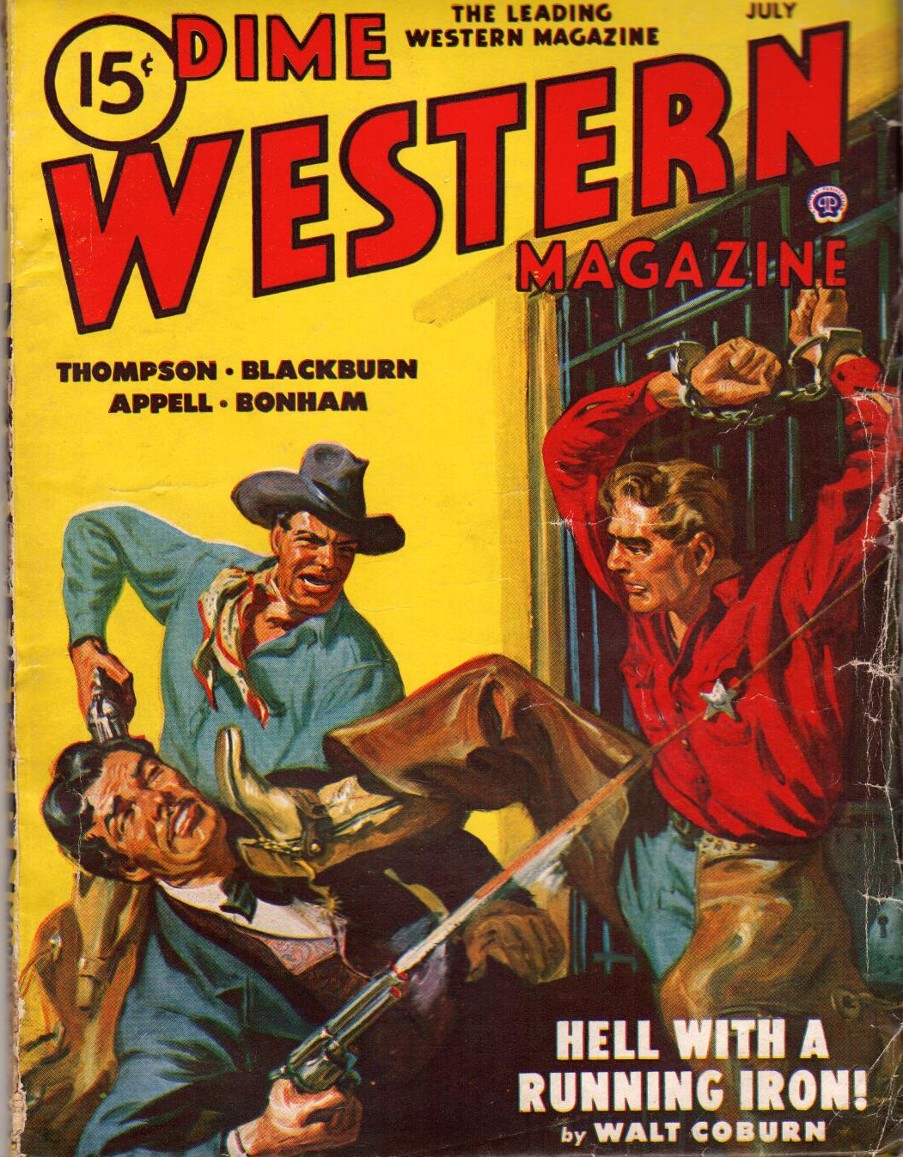
Saturday Morning Western Pulp: Dime Western, July 1948
Tom W. Blackburn was one of the heroes of my childhood, although I didn’t know that at the time. I say that because he wrote the scripts for the Davy Crockett episodes of THE WONDERFUL WORLD OF DISNEY that featured Fess Parker. There was no bigger fan of Davy Crockett in the early Sixties, when those shows were being rerun on a regular basis, than I was. I sang the theme song all the time, too, and Blackburn wrote those iconic lyrics. In recent years I’ve read some of his pulp stories and liked them. His novelette that leads off this issue, “Quest of the Thirty Dead”, is an excellent hardboiled Western yarn about a bounty hunter tracking down the members of an outlaw gang who raided a town and burned down a hotel as a distraction while they looted the banks, resulting in thirty fatalities. There are a few plot twists and plenty of action in this one, and it comes to a very satisfying conclusion.
J.H. Holland is an author I’m not familiar with. His short story, “Get Up and Fight Again!” is next in this issue. It’s set right after the Civil War and concerns a former Union soldier who goes west to find the sister of a friend who died in the Andersonville prison camp. Naturally enough, the sister is having trouble with the local range hog, and the ex-soldier takes up her cause. Holland seems to have been a real person but didn’t publish much. This is the first story of his listed in the Fictionmags Index. It’s fairly well written but never generates much suspense, and the ending seems rushed, as if Holland was too inexperienced to know how to develop the situation. It has some nice bits of action and description, though.
Dean Owen’s stories are always good. “A Brave Man Dies But Once”, set in Virginia City, Nevada, during the silver boom, is narrated by traveling cigar salesman Sam Kincaid, who is more than he seems. A crisis forces him to make a choice about which way his life is going to go, and not surprisingly, it all leads to the satisfying conclusion of an excellent tale.
By this point in Walt Coburn’s career as a writer and a two-fisted drinker, rumor has it that his manuscripts were heavily rewritten by editors, so it’s impossible to say how much of the novella “Hell With a Running Iron!” is Coburn’s work and how much came from some Popular Publications staffer. Most of it, however, reads like Coburn to me. The plot is fairly simple for one of his yarns—big ranching syndicate frames a small rancher for rustling so it can gobble up his spread—but as usual Coburn has a large cast of characters with a lot of back-story. Sometimes Coburn throws in so many elements his stories don’t really have a chance of making sense, but thankfully that’s not the case here. It’s a good story with some nice action and the undeniable sense of authenticity that you find in most of Coburn’s work. Not in the top rank of his efforts, but for the late Forties, not bad at all.
George C. Appell had a nice career writing for the pulps, slicks, and digests from the mid-Forties on through the Sixties, as well as producing a number of novels. His story “Last Roll Call” concerns the aftermath of the Battle of the Little Big Horn and a couple of soldiers from the 7th Cavalry who may have survived the massacre. It’s a good plot, and Appell writes very well. I’ve seen a lot of his work around but haven’t read much of it. Based on this story, I probably should.
I started reading Frank Bonham’s juvenile novels when I was a kid, with no knowledge of his career as a writer for the Western pulps. He did a lot of stories with unusual protagonists, and “Payment Past Due” is one of them. The hero is a doctor from the East with a dark secret in his past who heads west to make a new start. Eventually, of course, that secret will come out and the doctor will have to find out if he’s as good with a six-gun as he is with a scalpel. Bonham is another writer whose work is just about always good, and I enjoyed this story quite a bit.
Every so often I run across a pulp story written by someone I’ve actually met. That’s the case with Thomas Thompson’s “The Hangin’ Plague Hits Tonto Basin”. Thompson was at the WWA convention in Fort Worth in 1986 and I got to say hello to him there. I don’t remember much about it except that he was pleasant enough and looked a lot like the actor Al Lewis, who played Grandpa Munster. He was the story editor on BONANZA for many years, so I was a fan of his work there, but I’m not sure I’ve ever read any of his pulp stories before this one. I’ll definitely be looking for them from now on, though, because “The Hangin’ Plague Hits Tonto Basin” is maybe the best story in this issue of DIME WESTERN. It’s a variation on the old sheepmen-versus-local-cattle-baron plot, with an ex-con caught in the middle, but it’s very well written with a great hardboiled tone and plenty of action. I really enjoyed it and want to read more by Thompson, soon.
That wraps up this issue of DIME WESTERN, and it’s a very good one, with only one weak story (and it’s not terrible) and the others ranging from good to excellent. That’s not surprising, given DIME WESTERN’s consistent quality. If you have any issues or come across some, chances are they’ll be well worth reading.


.jpg)