 It was bound to happen sooner or later. Earlier this week, someone on another blog reviewed the Forgotten Book I was going to post about today. But I liked it enough that I’m going to write this post anyway. As a wise woman once told me, you can’t say enough about a good book.
William P. McGivern is one of those authors whose work I’ve been aware of for decades without ever reading much of it. I read his World War II novel, SOLDIERS OF ’44, which is part war novel (which works pretty well) and part military/legal thriller (which didn’t work, as far as I’m concerned). A few years ago I read his private eye novel BLONDES DIE HARD, written under the pseudonym Bill Peters, which I liked. You can read my comments on it here.
Now I’ve read his novel ROGUE COP, and it’s easily the best McGivern I’ve read so far. Philadelphia police detective Mike Carmody is the rogue cop of the title, up to his neck in graft and corruption. His younger brother Eddie is also a cop, but of the honest variety, and when Eddie winds up with the local mob after him, Mike has to take sides and choose whether to protect himself or his brother.
There’s probably not a lot in this book that will surprise the veteran reader of hardboiled thrillers, but boy, the pace really rockets along. McGivern’s prose is just as smooth as it can be, and he does a great job of creating rounded, morally conflicted characters, chief among them Mike Carmody himself. There are plenty of tough action scenes, and a great line near the end. I’ll definitely be seeking out more McGivern novels, and if you haven’t read ROGUE COP, it gets a high recommendation from me.
I don’t know what it is about October. Last year, as some of you may remember, Livia and I spent the whole month in Rockport, on the Texas coast, and had a great time. Our toughest decisions were whether to eat at Charlotte Plummer’s or the Big Fisherman, or whether it was too windy to go fishing. I also set a personal record while we were there, writing more in that month than I ever had before in a month’s time. Well, this October, I spent at home, keeping up with kids, in-laws, and everything that’s going on with the new house . . . and I broke the record again, writing more than I ever have in a month. Must be something in the air this time of year besides the ragweed.
Yesterday was a busy day, with the plumber, the electrician, and the foam insulation guys all working in the new house at the same time, plus new appliances being delivered. Livia and I were kept hopping, making decisions and running to Lowe’s and Home Depot to pick stuff up.
In the midst of all that, I was emailing back and forth with one of my editors concerning a new series I’m going to be writing. I was under the impression that the three books would be written next year, but as it turns out, the publisher needs the first two ASAP, with the third one to follow fairly quickly after that. I’m about a fourth of the way through another book, luckily for the same editor, so he asked me to put that one aside, write the first two books in the new series, and then finish the one I was working on now, followed by the third book in the new series and then the next book in yet another series. Me being me, I said sure, no problem.
And it really shouldn’t be. I have a pretty good outline on the current book, and I’m at a point in the story where it should be easy to suspend things and then pick it up again in a few months. All this really does is tighten up the lead time between manuscript delivery and publication date for several of these books, and that’s more of a problem on the publisher’s end than on mine. Still, there’s not much leeway for anybody involved in these projects, so we’re all going to have to be pretty efficient, starting with me. I think I’m up to it (he said hopefully).
Proving once again that I'm on the cutting edge of this new-fangled Internet gizmo, I now have a Twitter account. Problem is, I'm not savvy enough to tell you how to go find my updates on their website. But if you know and have absolutely nothing better to do, you can check out these little posts to find out how my day is going. It'll be a thrill a minute, I'm sure.
 I was a big Superman fan when I was a little kid, probably because some of the first comic books I ever read had Superman in them. Then, for a long time, I didn’t have much interest in the character. Now, though, I kind of like old Supes again.
The trade paperback THE THIRD KRYPTONIAN reprints a three-issue story arc and a couple of stand-alone stories from last year, and they’re pretty darned good. I’m not really up to speed on current continuity, so a few things took me by surprise (Clark and Lois have a foster son now? First I’ve heard of it!), but I didn’t have any trouble following the stories. I kind of like the kid, too. He’s a Kryptonian, from either the bottle city of Kandor or the Phantom Zone, I don’t remember which, but he’s not the Third Kryptonian of the title. That’s a whole other character who gets Superman involved in a fairly complicated yarn about deserters from the Kryptonian navy, space pirates, wholesale destruction of worlds, cosmic vengeance, and assorted good stuff like that. There’s plenty of action in this story arc. As if to balance that out, the two stand-alones are much quieter and reflective, and I liked them quite a bit, too.
I’m not surprised I enjoyed the stories, because the primary writer on them is Kurt Busiek, one of my favorite writers working in comics today. If you like comics and haven’t tried his work, you need to run out and find copies of MARVELS and the various ASTRO CITY books. Wonderful stuff, especially for long-time comics fans (*cough* geezers *cough*) like me.
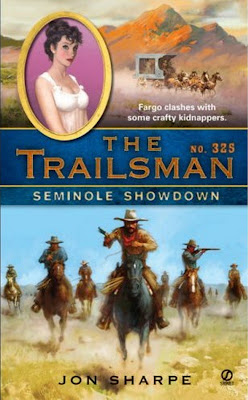 This book should be out this week, if it's not already. I have a soft spot in my heart for it, because it's the last book that was written in my old studio. I had started another one before the fire and written about 200 pages of it, but I lost that and had to start over. (That book will be out this week, too, but it's one of those ghost jobs I can't talk about.) I remember that the first book I wrote in the studio was COSSACK THREE PONIES, but I have no idea how many there were between it and SEMINOLE SHOWDOWN. Quite a few, though. It was the best place I ever had to work. I'm hoping that my office in the new house will be even better.
 On the heels of the news about Bill Knott’s death comes belated word that award-winning Western author Fred Grove passed away in September. He began writing for the Western pulps in the Fifties and went on to produce numerous novels in the Sixties, Seventies, and Eighties, often for Doubleday and often concerning horses and horse racing in the Old West. I don’t believe I’ve ever read any of his novels, but I have read some of his short stories (many of which have been reprinted in paperback collections from Leisure Books in recent years) and enjoyed them.
Fred is another author I met once at a Western Writers of America convention. In this case it was San Angelo in 1990. I sat next to him at a barbecue dinner that was held on a ranch west of town. I tell you, there are a lot worse ways to spend a few hours than sitting at a picnic table under some trees next to a creek, eating good barbecue and talking to Fred Grove. I had a fine time, and I’m sorry that he’s gone.
I finished my 225th novel today. I don't post much about writing anymore, but it seemed like that was a worthy enough milestone to mention. And tomorrow morning I'll start #226.
 I heard the sad news today that author Bill Knott has passed away. His books were usually bylined Will C. Knott or published under a house-name. He was best known as a Western writer and contributed to three long-running series – Longarm, the Trailsman, and Slocum – as well as working on other series and writing stand-alone traditional Western novels under his own name. He also wrote several mystery novels, some house-name men’s adventure yarns, and a number of mystery and sports books for the young adult market. I don’t know how many books he wrote in his career, but more than 200, certainly.
I met Bill Knott only once, at a Western Writers of America convention in Arkansas, and didn’t know him well at all. We had a number of mutual friends, though, and I’ve read and enjoyed many, many of his books over the years. He was one of the original authors on the Longarm series (along with Mel Marshall and the series’ creator, Lou Cameron), and I had read a lot of his entries before I ever started writing for the series myself. He was also a regular contributor to the Stagecoach Station series under the house-name Hank Mitchum, just before I started writing for that series. In fact, although we wrote for many of the same series, I don’t think our tenures ever quite overlapped. (I haven’t tried to look this up, so I could well be wrong.) He was the president of WWA at one time, an important figure in the history of the Adult Western field, and a fine writer. I’m sorry to hear that he’s gone.
 I’ve never been a big fan of naval historical fiction. I’ve read some of the Horatio Hornblower novels by C.S. Forester and the occasional stand-alone. I’ve even written some fairly extensive naval sequences in various historical novels, but it took a lot of research because I’m not a sailor. I am a paperback junkie, however, so when I was in Half Price Books recently and saw that they had all eleven books in the Fox series, published by Pinnacle in the mid-Seventies, for a very reasonable price . . . Well, you know what I did. I bought them. I used to own this series but never got around to reading any of the books.
Now I’ve read the first one, THE PRESS GANG, and I enjoyed it quite a bit. George Abercrombie Fox is not your typical clean-cut naval adventure hero. A product of London’s slums, he started out as a powder monkey when he was just a boy and has risen in the ranks until he’s the second lieutenant on the British frigate Tigress in 1800, fighting the French. Fox is a morally conflicted anti-hero, capable of brutality and violence but still possessing a certain amount of sympathy for the men who serve below-decks in the British navy. He also has an odd physical quirk: in moments of high stress, he goes blind in one eye.
The plot of this novel meanders along. The Tigress gets in battles with French ships, and then lands an English spy on the coast of France in the dark of night, and then Fox has to help put down a mutiny . . . but then part of the way through, the story takes a twist I hadn’t expected and the pace picks up. The action scenes are well-done, although some of them include so much sailing jargon that they’re almost gibberish to me. There’s plenty of cutlass-swinging and decks awash with blood when the action takes place in closer quarters, though. The main appeal is the character of George Abercrombie Fox, who somehow comes across as likable despite his often unsympathetic actions. He’s hell on wheels in a fight, that’s for sure.
The author, Adam Hardy, was really veteran British paperbacker Kenneth Bulmer, who is best known for his numerous science fiction novels dating back to the early Fifties. He wrote many historical novels as well, under various pseudonyms. His career was roughly contemporary with those of the Piccadilly Cowboys, a group of British authors who wrote scores of Western novels during the Sixties and Seventies, and Bulmer, in fact, wrote one Western, an entry in the Jubal Cade series under the house-name Charles R. Pike. Fox reminds me very much of the anti-heroes so common in the British Westerns, the same sort of variation on the typical naval adventure hero that, say, Edge was on the traditional Western hero. I wouldn’t say that THE PRESS GANG is for everybody, but I enjoyed it, and I’m glad I have the rest of the books in the series. I may even read them. (One historical note: the Fox series was published originally by New English Library, and there are fourteen volumes as published by NEL. Pinnacle Books published only eleven of them in the U.S. As to whether I’ll seek out the books published only in England . . . well, I’ll have to wait until I’ve read the others and see how well I like them, I guess.)


 It was bound to happen sooner or later. Earlier this week, someone on another blog reviewed the Forgotten Book I was going to post about today. But I liked it enough that I’m going to write this post anyway. As a wise woman once told me, you can’t say enough about a good book.


