Showing posts with label noir. Show all posts

Monday, June 08, 2026

Review: A Rage of Desire - Clayton Matthews


We’ve all encountered guys like Mitch Sutton in noir novels before, but there are some important differences in Mitch’s character, too. He doesn’t have a great job—he’s a used car salesman in Los Angeles—but he’s good at it and enjoys the work. He’s not exactly trapped in a loveless marriage—he genuinely cares for his wife and their twins—but there’s definitely a spark that’s missing, too. One day, when Mitch drops into a neighborhood bar for his usual beer on the way home from work, that lack prompts him to take a drink of hard liquor instead—and Mitch can’t handle the hard stuff. He knows that, but he gets drunk anyway and picks up a woman at the bar who turns out to be a high-class prostitute. Things don’t work out between them, though, because Mitch is too drunk.

He would have been luckier if things had stayed that way.

But no, the woman winds up marrying Mitch’s boss, but Mitch falls hard for her anyway, leading to a torrid affair that, sure enough, winds up with somebody dead and a murder charge hanging over Mitch’s head.


A RAGE OF DESIRE is the latest reprint from Black Gat Books. Originally published as a paperback original by Monarch Books in 1960, with a cover by Harry Barton, it’s the first novel by Clayton Matthews, who went on to a career as a prolific paperbacker over the next three decades. I’ve read a couple of other novels by Matthews, and this one is very similar, utilizing the sort of crime and noir elements we’ve seen in scores of novels but changing things up enough that the books also work as domestic dramas. Matthews was a very good writer and had that paperbacker’s knack of keeping the reader turning the pages.

Over the years, Matthews wrote Westerns, family sagas, romantic suspense, and traditional mysteries. In the early Seventies, he married author Patty Brisco, and together they produced a bunch of bestselling historical romance novels under the name Patricia Matthews. This is hearsay, or gossip, if you will, but I was told by a mutual writer friend that Clayton Matthews did nearly all the writing on those romance novels published under his wife’s name, in addition to the ones that were credited collaborations. I don’t know if that’s true or not, but the person who told me that was in a position to know.

And speaking of mutual friends, Clayton Matthews was also the cousin of my long-time friend Tom Johnson, who was one of the leading figures in pulp fandom for many years. He always referred to Matthews as “Matt” and told me that some of Matthews’ family sagas set in Texas were based on actual people and incidents. Again, I don’t know if that’s true, but it’s certainly plausible enough.

A RAGE OF DESIRE may have been Matthews’ first novel, but it’s a polished debut, no doubt about that. It’s not as hardboiled as some, but it has a gritty edge and I thoroughly enjoyed it. This novel is available on Amazon in paperback and e-book editions, and I think it’s well worth reading.

Monday, March 02, 2026

Review: Stripper! - John Dexter (Robert Silverberg)


I’ve probably read more soft-core novels by Robert Silverberg than by any other author except Orrie Hitt, so I’m glad Stark House keeps reprinting them. Their latest double volume is STRIPPER!/NEVER AN EVEN BREAK, and I’ve just read the first of that pair.

STRIPPER! is one of Silverberg’s soft-core novels originally published under the house-name John Dexter rather than his usual Don Elliott pseudonym. The Nightstand Books edition came out in 1960. A revised version was reprinted in 1973 under the title ONE BED TOO MANY and the pseudonym Jeremy Dunn. This was one of the so-called Reed Nightstand editions where the sex scenes were rewritten by some unknown editor to be even more graphic than the originals while leaving the rest of the story alone. The Reed Nightstands are okay if you can’t find the originals, but in the ones I’ve compared (which doesn’t include this one), the first versions were better.

Okay, with that bibliographic digression out of the way, STRIPPER! is the story of Diana DeLisle, the stage name of Donna Hallinger, a young woman from a small town in Maryland. She’s a beautiful redhead in her early twenties who has just been promoted to doing a solo act in one of a chain of strip clubs owned by notorious gambler/gangster Johnny Lukas. Her boss at the club is Mack Gardner. And one of the regular customers is clean-cut young Ned Fawcett. Diana, who is also the narrator of this book, winds up sexually involved with all three of those men and also has actual romantic feelings for both Johnny and Ned. But since this is a book full of crime and criminals, it’s no surprise that she also winds up in a dangerous web of scheming being spun by the evil and ambitious Mack Gardner.


Silverberg tells this tale in his usual smooth, fast-moving prose that’s a great blend of dialogue and action, interspersed with a few flashbacks to give us something of Diana’s history. The sex scenes are plentiful and fairly graphic, but Silverberg does a fine job of integrating them into the plot. Let’s face it, those scenes are a large part of why these books existed, but most of the authors made something more of them, and Silverberg was one of the best.

STRIPPER! does have a late twist that’s pretty easy to predict, and I didn’t find the ending quite as satisfying as in some of the other soft-core books by Silverberg that I’ve read, but I still raced through the novel and had a fine time reading it. Silverberg is one of the most consistently entertaining authors I’ve found, and I’m always happy to read anything he’s written. This double volume is available on Amazon in e-book and paperback editions, and if you’re a fan of these wonderful examples of mid-century erotica (I forget if it was Silverberg or Lawrence Block, another prolific author in the genre, who called them that), I recommend it.

Friday, January 30, 2026

A Rough Edges Rerun Review: The Wounded and the Slain - David Goodis


Some critics have said that David Goodis’s novels read like book-length suicide notes. That’s certainly an apt description of THE WOUNDED AND THE SLAIN, originally published by Gold Medal in 1955 and recently reprinted by Hard Case Crime [in 2007]. This one even opens with the protagonist, James Bevan, contemplating doing away with himself, even though he’s on vacation at a luxurious Jamaican resort with his beautiful young wife. Bevan’s wife is his problem, though, since their marriage is one of the most corrosive you’re likely to encounter in fiction. Like other Goodis characters, Bevan seeks refuge from that unhappiness in booze, which leads him into an encounter with violence and death.

Then, yep, you guessed it, Things Get Worse.


THE WOUNDED AND THE SLAIN is somewhat unusual among Goodis’s novels, in that it takes place in Jamaica rather than Philadelphia or some other large American city. It veers away from the noir stereotype in another way as well, with many of the scenes taking place in hot, bright sunshine rather than dark alleyways. The interior of James Bevan’s mind is plenty dark on its own, though, and ultimately the streets of Kingston, Jamaica, are just as mean as those of Philadelphia or New York. The motivations of some of the characters may seem a little clichéd today, but Goodis’s writing still makes them ring true. The headlong pace carries the reader along to a very satisfying conclusion. All in all, and not surprisingly, this is an excellent novel and comes with a high recommendation from me.

(This post originally appeared on June 20, 2007. The Hard Case Crime reprint mentioned above is out of print, and you can actually find copies of the original Gold Medal edition for about half the price of the HCC edition. Either way, this book is well worth reading. Goodis, however, remains one of those authors I like a lot and want to read more of, but I don't seem to get around to it.)

Friday, January 16, 2026

A Rough Edges Rerun Review: Queenpin - Megan Abbott


QUEENPIN, Megan Abbott’s third novel, is the story of a young woman (whose real name we never learn, unless I just missed it somehow), who’s working as a bookkeeper in a sleazy, mob-connected strip joint when she becomes the protégé of an older woman who has spent twenty years working for organized crime as a courier and money launderer. Our narrator takes to the work with a minimum of fuss or mental anguish and becomes good at it, but then, wouldn’t you know it, she meets the wrong guy – a handsome gambler who always seems to be just one bet away from the big score – and Things Go to Hell.

When you just read the bare bones of that plot, it’s easy to say that QUEENPIN is something of a gimmick book: taking a standard, Gold Medal-type noir plot and inverting it so that the protagonist is female instead of male. Funny thing is, when you actually read the book you don’t really get that sense at all because Abbott is so good at creating characters and dragging you along with them as things get worse and worse. The setting of this one isn’t quite as well defined as it is in her other two novels; maybe it’s set in the Fifties, like DIE A LITTLE and THE SONG IS YOU, or maybe it’s the early Sixties, but either way it’s emphatically Not Now. The world of race tracks and night clubs through which the narrator moves is vividly rendered, and the dialogue that could have sounded like a parody of that era comes across as real and natural.

What it comes down to is that Megan Abbott is just a fine writer. Short, fast, and mean, like good noir fiction is supposed to be, QUEENPIN is her best book yet, and it’s easily one of the best novels I’ve read this year. And as usual with her books, it has a great cover by Richie Fahey.

(This post originally appeared in a somewhat different form on December 28, 2007. In it I mention Megan Abbott's first two novels. Her fourth novel was BURY ME DEEP, inspired by the infamous Winnie Ruth Judd trunk murders, and I really liked it, as well. As far as I know, those are her only historical crime novels, and I give all of them high recommendations. They're all still in print and well worth your time. And QUEENPIN is one of my favorite books of the past twenty years.)

Tuesday, December 23, 2025

Review: Night Never Ends - Frederick Lorenz (Lorenz Heller)


Lorenz Heller’s NIGHT NEVER ENDS uses the classic noir novel set-up: down on his luck photographer Luke Fogarty takes a job at a struggling photography studio run by George and Belle Buckner. George and Belle are not happily married. George drinks too much, is a terrible photographer, and is gradually running the business into the ground. Belle is his beautiful, long-suffering wife, and when Luke goes to work for them, sparks fly immediately between the two of them. Most of the time, you’d think you knew where this story was going, and most of the time you’d be right.

But not in this case. NIGHT NEVER ENDS, which was published originally as a paperback original by Lion Books in 1954 under the pseudonym Frederick Lorenz, takes a different tack. There are some lurid secrets in the background of these characters, and Heller reveals them pretty early on, which ratchets up the tension between them. Although several crimes take place in this book, it’s not really a crime novel. It’s more of a mainstream domestic drama, but it’s so well-written it kept me up later than usual, flipping the pages to find out what was going to happen.


Stark House has just reprinted this one as half of a double volume with Heller’s THREE MUST DIE!, which I read and reviewed a couple of weeks ago. I think I liked NIGHT NEVER ENDS even more. Heller’s characters are always well-developed and interesting, and he had a great touch with memorable lines that do a fine job of capturing the setting and the era. This latest double volume from Stark House gets a high recommendation from me. You can find it on Amazon in e-book and paperback editions.

Wednesday, November 05, 2025

Review: Run, Killer, Run - Lionel White


Before there was Richard Stark (Donald E. Westlake) and his famous protagonist Parker, there was Lionel White, the first real master of the heist novel. White didn’t write about a series character, but many of the protagonists of his novels bear a resemblance to Parker, including Rand Coleman, the lead character in White’s first novel, RUN, KILLER, RUN. The original version of this novel was published as a digest novel by Rainbow Books in 1952 under the title SEVEN HUNGRY MEN. White revised it and Avon published it as a paperback original in 1959 under its current title. Then Black Gat Books reprinted that version in a very nice paperback edition that comes out today. (You can see the covers of the two previous editions below. I don't know who did the art on the Avon edition of RUN, KILLER, RUN, but the cover on the Rainbow Books edition of SEVEN HUNGRY MEN is by the great George Gross.)

Rand Coleman is a professional criminal serving time for robbery when a corrupt lawyer manages to secure his release and recruits him to pull off a big job: an armored car robbery that will net a cool two million dollars. In telling his story, White employs the classic structure of the heist novel. Coleman assembles his team and we get to know them: a couple of veteran mobsters, a hotheaded young punk, a washed-up boat skipper, a sullen first mate. A couple of beautiful girls wind up involved in the proceedings. The plan for the robbery is laid out, and then we get the execution of it.


Do things go wrong? Of course, they do! But Coleman and his team get their hands on the loot, and now all they have to do is make their getaway to Florida, and from there, who knows? Cuba? South America? Unfortunately, treachery, greed, lust, and violence are along for the ride, too.

RUN, KILLER, RUN may not have much in it that we haven’t seen before, but this is a very early example of this sort of noir crime novel. And White spins the yarn with such skill that I was totally caught up in it, eagerly turning the pages to find out what was going to happen. The twists and turns that White introduces in his plot never disappointed me, either. RUN, KILLER, RUN is a terrific novel, fast-paced and well-written and very entertaining. If you enjoy heist novels, I give it a very high recommendation.


Monday, September 22, 2025

Review: Shield for Murder - William P. McGivern


A couple of weeks ago when I reran my review of William P. McGivern’s novel ROGUE COP, my friend Jim Doherty suggested that I read McGivern’s SHIELD FOR MURDER, a novel about a cop with even less of a moral compass than the protagonist of ROGUE COP. It was an excellent suggestion, and I appreciate the recommendation.

SHIELD FOR MURDER gets down to business right away. It opens with Philadelphia police detective Barny Nolan murdering bookmaker Dave Fiest and stealing $25,000 that the bookie had on him. This is considerably more than Nolan expected to get from the killing and robbery, but unfortunately for him, the 25 grand was intended to pay off a bet made by a local gangster, and the guy wants his money back.

Nolan’s life is also complicated by young newspaper reporter Mark Brewster, who senses that there’s something fishy about Nolan’s story. Then there’s Linda Wade, the beautiful nightclub singer Nolan’s in love with. His stormy relationship with her is also a constant distraction. And Nolan, like a lot of guys who get in over their heads in noir novels, isn’t the brightest fellow in the world. Combine that with his hair-trigger temper, and it’s inevitable that his troubles start to pile up.


SHIELD FOR MURDER is a slow burn of a novel, alternating between Brewster’s investigation into the bookie’s murder and Nolan’s violent background, and Nolan’s efforts to navigate through the walls that seem to be closing in around him. Not all that much actually happens until late in the book, but McGivern’s writing is so good that it doesn’t really matter. It’s hard to say who’s the protagonist in this book, Nolan or Brewster, and to be honest, neither of them is very likable. At the same time, you can’t help but sympathize with them, at least a little.

I will say that there were times when I felt McGivern’s low-key, realistic prose could have used a bit more drama, and I wasn’t that fond of the ending. However, I raced through the book and that’s always a good thing. The police procedural bits reminded me of the 87th Precinct novels, and I can’t help but wonder if Evan Hunter ever read this. Dodd, Mead published it in hardcover in 1951, several years before the first of the 87th Precinct books. Pocket Books did a paperback reprint in 1952, there was a movie version starring Edmond O’Brien, well-cast as Barny Nolan, in 1954, and Berkley did another paperback reprint in 1988, the edition I read.

SHIELD FOR MURDER is out of print, but copies of both paperback reprints are available for reasonable prices on the Internet. Despite a few misgivings, I think it’s a very good novel and well worth reading if you’re a fan of noir crime fiction.


Friday, September 19, 2025

A Rough Edges Rerun Review: Climb a Broken Ladder - Robert Novak


I had never heard of this novel or the author before reading it. There’s a political columnist by the name of Robert Novak, but I have my doubts he’s the same guy who wrote CLIMB A BROKEN LADDER and B-GIRL, both published in 1956 by Ace and as far as I’ve been able to determine, the only two books by this author.

CLIMB A BROKEN LADDER is a low-life novel, I guess you’d call it, a story about the drunks, beggars, and prostitutes who live along Seattle’s skid row, characters with colorful names like the Bohunk, Big Phil, Newsy Nellie, and Pushover Patty. Though not as well-written, it reminded me of what I’ve read by Charles Bukowski, since a lot of the book finds the characters just wandering around in an alcoholic haze. This makes for a pretty meandering plot, but the story does have a coherent thread running through it, that being the budding romance between the Bohunk and Newsy Nellie. The book picks up steam in the final third with a twist or two that I didn’t see coming. It never quite becomes the noir crime novel that I thought it might, but it’s dark enough to please most readers of noir.

One thing I really liked about the book is its Seattle setting. I expect most skid row novels to be set in New York or San Francisco or some place like that. Novak also does a good job of working in the back-stories of the various characters, and then at the very end throws in a final plot twist that left me going, “Huh,” even though I wouldn’t go quite so far as to call it jaw-dropping. This is a pretty stark book that impressed me enough I may have to try to find a copy of Novak’s other novel, B-GIRL.

(This post originally appeared on November 14, 2008. I never found a copy of B-GIRL, and looking it up now, the copies that are for sale on-line are too pricey for me. If I ever happen to run across it in the wild for a decent price, I'll grab it, I'm sure, but I'm not going to hold my breath waiting for that to happen, as they say.)

Wednesday, July 16, 2025

Review: The Face of Evil - John McPartland


John McPartland died young and wasn’t very prolific, only a dozen novels during the Fifties, a couple of them published posthumously. But his work was well-regarded and movies were made from several of his books. The fine folks at Black Gat Books have just reprinted his novel THE FACE OF EVIL, originally published by Gold Medal in 1954 with a cover by Ray Johnson, a great cover artist but not one I particularly associate with Gold Medal. I’d read and enjoyed several of McPartland’s novels, so I was eager to give this one a try.


The narrator/protagonist is Bill Oxford, a former newspaperman who works for a public relations agency in Los Angeles. However, Bill’s real job is as a fixer, a guy you can call on to get you out of a jam—or get one of your enemies into one. His specialty is framing political or business figures for some sort of crime and then blackmailing them into doing what his employers want. As this novel opens, he’s been sent to Newport Beach to stop a crusading lawyer from revealing damaging information about a candidate for public office. McPartland never delves deeply into the specifics of any of this, and he doesn’t need to. It’s enough for us to know that Bill is a pretty shady guy who’ll stoop to just about any dirty trick to accomplish his ends.

Unfortunately for Bill, he still has a tiny shred of decency in him, and it’s about to be tested when he falls in love with the widow of his target’s ex-law partner and also has to deal with the reappearance in his life of a young woman he did dirty several years earlier.


The action in this book takes place in about twenty-four hours, and it’s roughly divided between Bill wrestling with his conscience, dealing with various hitches in his plan, trying to figure out the romantic triangle in which he finds himself, getting mixed up in brutal fistfights, and going on the run from the law. It’s all very well-written, and McPartland spins his yarn at a breakneck pace that really had me flipping the pages. And I honestly didn’t know how he was going to resolve Bill’s various dilemmas, which is always nice.

Speaking of resolutions, I have to admit there are a couple of late plot developments that strike me as deus ex machina, which slightly lessens the impact of this novel. But it’s still very, very good despite that, with great characters, a vividly realized setting (Newport Beach during what’s now known as Spring Break, although McPartland never uses that term), and plenty of action and drama. I had a great time reading THE FACE OF EVIL, and if you’re a fan of hardboiled fiction from the Fifties, I give it a high recommendation. It's available from Amazon in print and e-book editions. There’s a lot in this one I feel like I’m going to remember for a while.

Friday, April 11, 2025

A Rough Edges Rerun Review: One By One - Fan Nichols


Here are the opening paragraphs from this book:

He slouched through the squalid gaudy Mexican Quarter. He could feel the bulge of the gun butt against his flat belly, held there, beneath his coat, by his belt.

I’m going to kill her, he thought. I won’t turn yellow this time. This time I’ll do it. I’ll kill her. I mustn’t get caught. I can run fast. I’ve got good legs. I can run like hell.

If you’re like me, there’s no way you’re going to read a classic noir opening like that and not keep reading.

Not surprisingly, after the first chapter ONE BY ONE flashes back to tell the story of how the protagonist, telephone lineman Jerry Ryan, gets in such a bad predicament that he’s considering murder. It was a woman, of course. Jerry is in Los Angeles, separated from his loving wife Verna by work (it’s the fall of 1932 as the book begins, in the middle of the Depression), when he makes the mistake of helping an attractive young woman who’s being thrown out of a dime-a-dance joint. The woman, who calls herself Dolly Dawn because she’s trying to break into the movies, latches onto Jerry with the desperation of a drowning man grabbing a life preserver. She convinces him to give her a lift to Las Vegas, where he’s headed for a new job. Jerry is basically a good, decent guy, but he rationalizes himself into bed with Dolly and that turns out to be a huge mistake. Since he took her across a state line and then had sex with her, she tells him that she’ll turn him in to the cops for violating the Mann Act unless he continues to take care of her and pretends to be her husband.

After the noirish beginning, ONE BY ONE turns into less of a crime novel and more of a lurid, soap-operatic melodrama, as Jerry continues trying to get out of Dolly’s blackmailing clutches only to be thwarted by her again and again. That doesn’t keep it from being compelling reading, though. This novel was originally published in 1951 but reads like it was actually written during the Depression, as Nichols paints a vivid picture of shabby desperation among the cheap hotels, boarding houses, freight yards, and gin mills of small towns in California, Washington, and Oregon. Jerry is one of those likable, not-too-bright schnooks who populate novels like this, and you can’t help but root for him even though you know he’s going to do the wrong thing nine times out of ten. All of it leads up to a somewhat odd ending that I’m not sure if I like or not.

This is the first novel by Fan Nichols that I’ve read. I don’t know anything about her except that she wrote a lot of what would have to be considered hardboiled sleaze, even though she started in the Thirties before that genre really existed. ONE BY ONE was originally published by Arco Publishing, a hardcover house that put out books a lot like the ones that Beacon would be doing as paperback originals a few years later. Nichols continued to write through the early Sixties, including books for Beacon and Monarch. I liked this one enough that I’ll continue to keep an eye out for her books, although I probably won’t go on-line and order a big stack of them like I have with some authors. I certainly plan to read more by her, though, and if you run across a copy of ONE BY ONE for a reasonable price (I paid three bucks for mine at Half Price Books), my recommendation is to grab it.

(Despite the good intentions expressed in this post, it'll come as no surprise that I haven't read any more Fan Nichols novels since this was published on April 9, 2010. But several of them are available as e-books and I picked them up, so maybe I will. Among the e-book editions is a Beacon Books reprint of ONE BY ONE under the title DOLLY. If you'd like to check it out, you can find it here. Also, I've learned more about Nichols, whose real name was Frances Nichols Hanna. She was a concert pianist and model before becoming a writer. If I remember right, Roger Torrey was also a piano player. And of course, one of David Goodis's novels was filmed as SHOOT THE PIANO PLAYER, although that wasn't the book's original title. I believe that was DOWN THERE. I guess there's just something noirish about playing the piano. All I was ever able to play was "Chopsticks", so I guess I'm safe on that score.)


Friday, January 31, 2025

A Rough Edges Rerun Review: Home is the Sailor - Day Keene


HOME IS THE SAILOR is perhaps the quintessential Gold Medal novel. It has all the elements: the tough, somewhat dim hero who stays drunk for much of the story; the beautiful girl who may or may not be what she seems; the dead body that has to be disposed of; and finally the hero on the lam from the cops, charged with something that he didn’t do. Just when poor Swede Nelson thinks his situation can’t get worse, Things Get Really Bad. It all adds up to a fast-paced, maybe not entirely believable novel that’s a heck of a lot of fun to read. If anybody was ever to ask you, “What were those old Gold Medals like, anyway?”, you could do a lot worse than handing them a copy of HOME IS THE SAILOR.

(This post originally appeared in a somewhat different form on March 26, 2005, making it one of the earliest reviews that I've rerun. As you can see, my reviews were shorter and punchier back in those days! When I posted it, the Hard Case Crime reprint of HOME IS THE SAILOR had been published recently, and that was the edition I read, not the classic Gold Medal pictured above with the great blurb: "And Swede's troubles began." Now, as far as I can tell, the Hard Case Crime edition is also out of print, but copies of both versions can still be found for sale on-line for fairly reasonable prices. This is one of my favorite Day Keene novels, so if you haven't read it before, I think it's well worth your time.)


Friday, December 13, 2024

A Rough Edges Rerun Review: Roadside Night - Erwin N. Nistler and Gerry P. Broderick


In forty-plus years of reading and collecting books like this, I’d never heard of this novel or its authors, Erwin N. Nistler and Gerry P. Broderick. As far as I’ve been able to discover, this is the only book they ever published.

When you see the phrase “strange love” on a paperback from this era (1951), it’s usually code for a lesbian novel. Not in this case. The relationships here are strictly heterosexual. The narrator, Buck Randall, is an ex-G.I., a World War II vet who fought on Guadalcanal. He owns a tavern and a small motel on the Pacific coast in California. He’s having a minor romance with the beautiful teenage daughter of the man who owns a restaurant down the coast highway from the motel. He’s not particularly ambitious.

Then a gorgeous blonde in an expensive car stops at the tavern for a drink as she’s passing through the area, and Buck falls hard for her. He pines away until she comes back by. They start getting to know each other. She’s interested in him, too, and after they begin sleeping together, he finds out that she’s not as well-to-do as he thought at first. In fact, she’s in sort of a desperate situation, but she knows a way out, if only she can find somebody to help her . . .

Yep, you’ve read it before, starting with James M. Cain and going right on through the Fifties in the work of dozens of paperbackers like Charles Williams, Day Keene, Gil Brewer, and Orrie Hitt. The femme fatale, the likable but not-too-bright hero, the scheme that will make them both rich if only nothing goes wrong . . . but it always does. The first half of ROADSIDE NIGHT doesn’t blaze any new ground, but at least it’s a fairly early example of that standard plot. What makes it worth reading is the prose, which is bleak and fast-paced, and the sweaty air of doom and desperation that hangs over the book like fog rolling in from the sea.

Then the second half of the novel throws in just enough plot twists so that everything doesn’t work out quite the way you might expect it, and ROADSIDE NIGHT turns into a really nice little noir novel. I think the ending could have been stronger – Nistler and Broderick pull back just a little when maybe they shouldn’t have – but it’s still very effective. This isn’t some lost masterpiece of crime fiction, but it’s well worth reading and would make a good candidate for reprinting. It’s too short for Hard Case Crime, probably not much more than 35,000 words, but it would work just fine in, say, a Stark House collection with a couple of other short novels. I’m really glad I ran across it, and if you happen to do likewise, I think you should grab it and read it.

(As far as I know, this book still hasn't been reprinted since this post originally appeared in a somewhat different form on December 4, 2009, but used copies are available on Amazon that are reasonably inexpensive. More than likely, you can find some at other on-line booksellers, too.)

Friday, August 30, 2024

Review: Wild - Gil Brewer


WILD is actually the first Gil Brewer novel I ever read, approximately 40 years ago. I had heard of Brewer but didn’t know anything about him or his books except that my buddies Bill Crider and Ed Gorman said they were good. That was enough of a recommendation for me. When a copy of the original Fawcett Crest edition from 1958 came in at the used bookstore I managed, I grabbed it for myself and read it. All these years later, with Black Gat Books reprinting this novel recently, it seemed like a perfect time for one of my rare rereads.

Lee Baron is one of the few private eye protagonists in Gil Brewer’s fiction. Lee, who has been working as a private detective in California, returns to his hometown of Tampa, Florida, to take over the agency of his late father, who has just passed away. For his first case, he’s hired by an old flame to talk to her husband, from whom she’s estranged, and try to set up a reconciliation. This seems like an odd assignment for a private detective, but Lee takes the case and, wouldn’t you know it, discovers a dead body almost right away. The corpse has been mutilated, so it’s hard to tell who the dead man is. Is it the old flame’s husband? Is it one of the guys who was involved in a recent bank robbery that netted the thieves almost half a million bucks? Loot which is still missing, by the way. Or maybe the dead man was tied in with whoever hired the hulking, out-of-town thug to hand Lee a beating and scare him off the case, or kill him if he won’t scare. Let’s not forget the second murder, or the old flame’s beautiful but slutty sister, who Lee was also involved with in the old days.

And all of this is just in the first twelve hours after Lee takes the case.


WILD is a real whirlwind of a novel. Gil Brewer is known for the propulsive nature of his plots and writing, and that quality is in full force in this one. I had no clue what was going to happen next, and Lee Baron sure as hell doesn’t. But something is going to happen, you can be sure of that, and it’ll probably be bad.

I have a confession to make. When I first read WILD back in the Eighties, I didn’t care much for it. It didn’t make me a Gil Brewer fan, and I didn’t read anything else by him for quite a while. But then I read the Hard Case Crime reprint of his novel THE VENGEFUL VIRGIN (which just happens to be the next novel Brewer published after WILD) and thought it was terrific, one of the best hardboiled/noir novels I’d read in a long time. I’ve gone on to read many more of his novels and have enjoyed every one of them.

So what did I think of WILD when I reread it? I’m happy to report that I liked it much better this time around. The plot is suitably twisty, the characterization is vivid, and Brewer’s writing is quite poignant, almost poetic in places. At the same time, it still manages to capture the white-hot desperation of the people involved in this swamp of lust and greed. If you’re already a Gil Brewer fan and haven’t read WILD, you’ll definitely want to check it out. If you haven’t read Brewer, as I hadn’t all those years ago, you might want to start with one of his classics like 13 FRENCH STREET, SATAN IS A WOMAN, or THE VENGEFUL VIRGIN, as mentioned above. But WILD is well worth reading, make no mistake about that. It’s available in paperback and e-book editions. 


Monday, July 22, 2024

Witchery Plus: A Weird Tales Trilogy - Keith Chapman


Several years ago my friend Keith Chapman published a pair of stories--a fantasy in the mold of Clark Ashton Smith and a sword and sorcery yarn--in a double volume. He's redone that book, added a third story, this time a modern-day horror yarn set in Australia, and published it as WITCHERY PLUS: A WEIRD TALES TRILOGY, which is available in both e-book and print editions on Amazon.

"Night Howl" is the new story in this volume. Chapman sold a number of comic book scripts to Charlton for their horror titles, and the original version of this story was one of them, but it went unpublished when Charlton switched over to mostly reprints. Converted to prose, it appeared first on the BEAT TO A PULP website and now is in print for the first time. It's about a pair of lovers on the run from a murder charge, and in that respect, it works very well as a noir crime yarn. But there's also a possibly supernatural element involving an old Gothic paperback featuring a heroine with the same name as one of the characters in this story. Are the bizarre events of that old paperback replaying themselves in real life? Chapman uses that question as the springboard for a very well-written tale that generates suspense all the way to the end.

Now here's what I had to say (slightly edited) about the other two stories when I reviewed them back in 2013:

"After an interesting introduction that addresses the genesis of these tales, Chapman produces a fine Clark Ashton Smith pastiche set in Smith's evil-haunted French province Averoigne, "Black Art in Yvones". A young protagonist, a beautiful blonde, and a sinister femme fetale even give this tale a slight noirish feel. In the second novelette in this collection, Chapman ventures into sword-and-sorcery territory with "Wildblood and the Witch Wife", featuring a very likable pair of adventurers reminiscent of Fritz Leiber's Fafhrd and the Gray Mouser. It's set in historical England rather than a fantasy world, but there's still plenty of sorcery and action."

Although probably best known for his Westerns, Keith Chapman is one of those authors who can write just about anything and do a good job of it. He's a fine storyteller, as these stories amply demonstrate. If you've never sampled his work before, WITCHERY PLUS would be a very good place to start. 

Monday, July 01, 2024

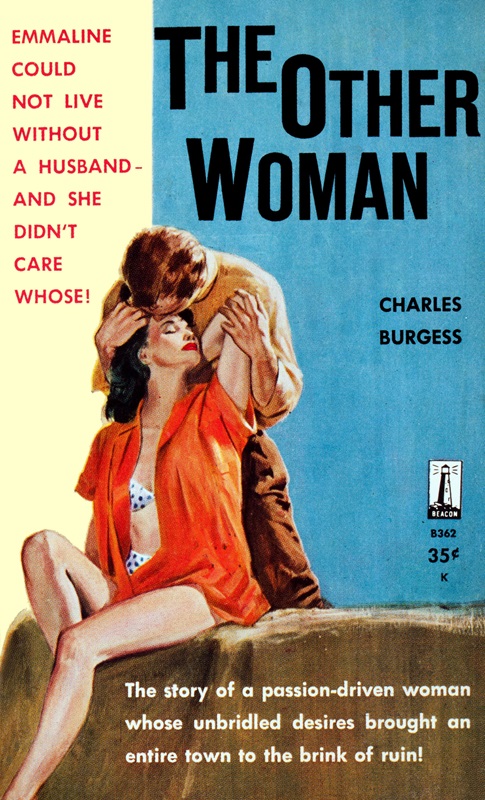
The Other Woman - Charles Burgess


As we all know, many of the soft-core sex novels published in the Fifties and Sixties were actually crime or mystery novels in disguise. That’s certainly true of Charles Burgess’s THE OTHER WOMAN, published originally by Beacon Books in 1960 and about to be reprinted by Black Gat Books.

The narrator/protagonist of this one is Neil Cowan, a real estate agent in a small city on the west coast of Florida. Neil gets involved in a deal to sell a large piece of land to a wealthy developer who’s going to put houses all over it. In the process of arranging this, Neil meets the developer’s wife Emmaline, a blonde who is the most beautiful woman Neil has ever seen. He’s happily married with a nice sexy wife and a small child, but he falls for Emmaline despite that and soon they’re having a torrid affair, which continues until, in true noir novel fashion, Emmaline suggests what a good life they’d have if her husband, who’s considerably older than her, was dead. And who better to hurry him along off this mortal coil than Neil?

From this point on, THE OTHER WOMAN veers off into something a bit less like a Gold Medal novel. Even though he’s obsessed with Emmaline, Neil isn’t just about to commit murder for her. Unfortunately, her husband winds up dead anyway, and Neil is the only potential suspect who doesn’t have a solid alibi. When one of the local police detectives learns of the affair between Neil and Emmaline, he’s convinced that Neil is the killer and goes after him doggedly, looking for proof—proof that the actual murderer is willing to provide to pull the frame tighter around Neil. In order to save himself, he’ll have to uncover the real killer.


I’d never heard of Charles Burgess, but the Florida setting and the excellent writing had me suspecting that Burgess was a previously unknown pseudonym for Day Keene or Harry Whittington or Talmage Powell. The book doesn’t really read like the work of any of those authors, however, and a bit of subsequent investigation turns up the fact that Burgess wrote another hardboiled novel called BACKFIRE, apparently published only in Australia. I don’t think he was Australian, though. He had at least one story in MANHUNT in the late Fifties, and he wrote a number of true crime stories for various detective magazines. If I had to guess, I’d say that’s probably his real name, and he might well have been a reporter since many of them wrote those true crime yarns as a sideline. But that’s purely guesswork on my part.

As for THE OTHER WOMAN, I enjoyed it quite a bit. Although the affair between Neil and Emmaline is what the whole plot hinges on, there’s really not much sex in the book, only a few scenes that don’t go on very long. I’m a little surprised Beacon published it. It’s more of a solid mystery novel with a reasonably clever solution. It reads very much as if Burgess wrote it intending to try to sell it to Gold Medal or Ace, and when it didn’t click at one of those houses, he sexed it up a little and sent it to Beacon. We’ll never know if that’s true, of course, but you can tell from that description what sort of book this is. I liked it, and if you’re a fan of noirish, hardboiled mysteries, I think THE OTHER WOMAN is well worth reading.

Wednesday, April 10, 2024

It Rhymes With Lust - Arnold Drake, Leslie Waller, and Matt Baker


Last week after I reviewed Arnold Drake’s novel THE STEEL NOOSE, a friend reminded me that Drake also co-authored what is considered by some the first graphic novel, IT RHYMES WITH LUST, published in 1950 as a digest-sized paperback by the comic book publisher Archer St. John. Drake co-wrote the script with Leslie Waller under the pseudonym Drake Waller. The black-and-white art is by Matt Baker (pencils) and Ray Osrin (inks). This book has been reprinted in both paperback and e-book editions, so I picked up a copy of the e-book to check it out.

IT RHYMES WITH LUST is set in Copper City, somewhere in a Western state. If you want to figure it’s loosely based on Butte, Montana, that works for me. Buck Masson is the kingpin who runs everything in Copper City from the criminal underworld to the mines. But when Buck dies, control of his empire falls to his beautiful, cunning, and ruthless wife Rust (whose name rhymes with lust, get it?) who brings in an old flame of hers, newspaperman Hal Weber, to edit the local paper that supposedly is opposed to the Masson criminal empire. Weber is supposed to be a crusading journalist who’s out to reform things, but he’s really just a tool for Rust to use to undermine Marcus Jeffers, her late husband’s second-in-command who now figures he’s going to take over. Weber wants to play things straight, especially after he meets and falls for Audrey Masson, old Buck’s beautiful blond daughter by his first wife. But can Weber escape from Rust’s clutches?

This lurid, hardboiled crime/melodrama is very reminiscent of the type of yarn Gold Medal published all through the Fifties, only IT RHYMES WITH LUST was published just as the Gold Medal line was getting started. The main influence on Drake and Waller’s script was probably the noir movies of the late Forties. It works very well in graphic novel format. The script has the rat-a-tat-tat pace you’d expect. The art is easy to follow and very effective.

I talked about Drake in the last post about him. Leslie Waller wasn’t nearly as prolific, but he wrote some well-regarded thrillers under his own name as well as some popular movie novelizations. Matt Baker was a well-known comic book artist in the Forties and Fifties. Ray Osrin worked as an artist and inker in comic books and later became an editorial cartoonist. All of them do excellent work in IT RHYMES WITH LUST.

Archer St. John followed this publication with another mystery graphic novel, THE CASE OF THE WINKING BUDDHA, written by Manning Lee Stokes with art by Charles Raab. This one seems to be a lot harder to find than IT RHYMES WITH LUST. Neither sold well, and that was the end of the experiment as far as St. John was concerned. Since IT RHYMES WITH LUST is readily available, I don’t hesitate to recommend it to fans of hardboiled crime fiction. I really enjoyed it.

Thursday, February 08, 2024

Freakshow Fallout


Last week I reviewed FREAKSHOW, the novel by Jacquin Sanders recently reprinted by Black Gat Books. As I sometimes do when I remember, I copied the review over onto Amazon and submitted it. It didn’t show up on FREAKSHOW’s page, which came as no surprise. About half the time when I submit a review to Amazon, it never appears, as if I had sent it into a black hole.

However, this time I actually got a response from Amazon, saying that they couldn’t publish my review because it didn’t meet their guidelines for one or more of these reasons:

Profanity

Harassment

Hate speech

Sexual content

Illegal activity

Private information

Of course, they didn’t tell me which of those things they found in the review. Personally, I don’t think the review contains any of those things, but you can read it for yourself, if you haven’t already, and see what you think.

Amazon also invited me to edit my review and resubmit it. I don’t think I’ll be doing that. If you’d like to pick up a copy of FREAKSHOW (it’s a very good novel), you can buy it directly from the good folks at Stark House Press/Black Gat Books.

Friday, February 02, 2024

Freakshow - Jacquin Sanders


I like carny books, so I was predisposed to enjoy FREAKSHOW, a novel by Jacquin Sanders that was published in hardback in 1954 by Little, Brown, reprinted in paperback by Popular Library in 1956 under the title STRIP THE HEART, and has just been reprinted again by Black Gat Books with an introduction by Jeff Vorzimmer, the edition that I read.

Bat Fidler is a young drifter who can’t seem to fit in anywhere, but when he goes to work as a wrestler for a carnival, it looks like he may have finally found a place where he can feel like he belongs. He begins an on-again, off-again romance with a slutty young dancer, but the one he’s really drawn to is the Fish Girl, a beautiful young woman born with underdeveloped arms who’s married to the carnival’s owner, a man with a similar condition who’s billed as the Fish Boy. Naturally, drama develops, and as it does, Sanders gives the reader plenty of colorful scenes and inside dope featuring the carnival’s eccentric inhabitants.

It becomes obvious pretty quickly that the performers in the freakshow aren’t the only freaks in this novel. In fact, even though Bat isn’t the most likable protagonist, the reader can’t help but root for him because he’s surrounded by an even more unsympathetic cast of characters. The only one in this book who isn’t a pretty sorry specimen of humanity is the Fish Girl.

There’s a murder and a trial, but FREAKSHOW isn’t really a crime novel or a legal thriller, although it does manage to generate quite a bit of suspense in its later stages. It’s more of a mainstream novel with a noirish tone and reminds me a little of Orrie Hitt’s work, full of characters who get a variety of raw deals but still try desperately to grab on to some sliver of happiness. Sanders makes things so rough on his characters that I wasn’t sure he would be able to pull it all together in any sort of satisfying ending, but that’s what he does. With its small town Texas and midwestern settings, it also reminds me of William Inge and Larry McMurtry.

Overall, FREAKSHOW is compelling reading from beginning to end. It’s deliberately paced, but I read it quickly anyway because of the fine writing and the intriguing characters. As usual, the folks at Black Gat Books deserve our thanks for bringing back an excellent novel that deserves to be read. It's available in paperback and e-book editions. Highly recommended.


Thursday, October 19, 2023

A Mystery, Crime & Noir Notebook - Gary Lovisi


I’ve known Gary Lovisi for more years than I like to think about and have been a fan of his work, both fiction and non-fiction, for all that time. His magazine PAPERBACK PARADE has been an indispensable resource for fans of genre fiction for decades, and his Gryphon Books imprint has published a lot of top-notch novels and collections in the mystery and science fiction fields.

His latest collection from Stark House, A MYSTERY, CRIME & NOIR NOTEBOOK, brings together approximately 50 articles and essays covering those title subjects. Originally published in a variety of magazines, anthologies, and collections, they concentrate mostly on vintage hardboiled paperbacks but discuss some newer books, too. (In this case, newer generally means 20 years old, instead of 50 or 60.) There are articles about specific publishers and many about particular authors. And lots and lots of beautiful cover reproductions, of course.

This is a wonderful book, perfect for dipping in and out of, although to be honest, I was so engrossed I went through most of it pretty quickly. It’s the sort of book where as I read it, I kept saying to myself “I have that one!” or “I read that one when I was a kid!” or “Oh, I have to find a copy of that one and read it!” I have a hunch most of you know exactly what I mean and would really enjoy A MYSTERY, CRIME & NOIR NOTEBOOK. It’s available on Amazon now. I give it a very high recommendation. It’s really a lot of fun.

Friday, October 13, 2023

The Grave's in the Meadow - Manning Lee Stokes


Our narrator Dick Ludwell is a small-time reporter in Lake City (obviously based on Chicago but not Chicago, as that city is mentioned as well). Dick is an ambitious guy without an abundance of scruples, so he doesn’t see anything wrong with slipping a little info to the city’s mobsters now and then. But then one night he witnesses a hit on a boxer who refused to take a dive, and he knows his underworld connections won’t help him a bit. He’s marked for death, and he has to get out of town and hide out in a hurry.

The place he chooses for sanctuary is an abandoned farm that belonged to the late brother of Dick’s editor, who is also his best friend from childhood. Once he gets out in that rural environment, Dick encounters a variety of colorful characters, some of whom are not what they appear to be and all of whom have hidden agendas of their own.

Now, you’d think that would be enough for a book by itself, wouldn’t you? But Manning Lee Stokes, the author of THE GRAVE’S IN THE MEADOW, has other things in mind. It’s like he started writing this novel with the intention of springing a major plot twist every twenty or thirty pages. One of those twists about the middle of the book is so shocking that it had me turning back a page and going, “Wait . . . what?” And he keeps that up all the way to the end in this tale of murder, blackmail, bank robbery, and double-cross after double-cross. And the most amazing thing is that he makes all of it work. Everything hangs together, and the whole crazy yarn is spun in such smooth prose that I gulped it down in big chunks. THE GRAVE’S IN THE MEADOW is truly a page-turner, all the way to the satisfying ending.

I’ve seen books like this referred to as “one damn thing after another”, and that’s a pretty good description. In our house, when we’re watching some movie or TV show and there’s a wild, over-the-top, almost ludicrous plot twist, we always say, “Sure, why not?” Well, THE GRAVE’S IN THE MEADOW is a “Sure, why not?” book. But as I said, Stokes makes it work, and ultimately, that’s all that counts.

Stokes had a decent career in the Forties and Fifties writing mysteries, Westerns, and soft-core sleaze novels under his own name and as Kermit Welles, Kirk Westley, and Ford Worth. THE GRAVE’S IN THE MEADOW was published in hardcover in 1959 by Arcadia House and reprinted in paperback in 1961 by Dell. Arcadia House was primarily a library publisher, and because of that there’s no sex or bad language in this novel, but it manages to be pretty sordid anyway. A few years after it was published, Stokes went to work for book packager Lyle Kenyon Engel and became one of Engel’s regular writers, turning out books in a number of different house-name series, including Nick Carter, Killmaster; John Eagle, Expeditor; the Aquanauts; and Richard Blade. I read all of Stokes’ Nick Carter books back in high school and enjoyed them, although at the time I had no idea he was the actual author, of course. He passed away in 1976.

I’d read so many good reviews of THE GRAVE’S IN THE MEADOW that I really thought it would be difficult for the book to live up to its reputation. But this is one of those rare cases where it actually does. This is a great suspense novel, one of the best books I’ve read this year, and would be a fine candidate for a reprint edition.