Showing posts with label graphic novels. Show all posts

Monday, April 06, 2026

Review: Tex: Cinnamon Wells - Chuck Dixon and Mario Alberti


This is the second volume I’ve read from the set of six Tex Willer graphic novels I backed on Kickstarter. Chuck Dixon is one of my all-time favorite comic book authors, and ever since I found out he wrote some Tex stories, I’ve been curious about them.

CINNAMON WELLS, which has artwork by Mario Alberti, opens with a violent bank robbery in the town of the title. The local lawman is organizing a posse to go after the outlaws when Tex, who is a Texas Ranger, rides in. He joins the posse, of course, and off they go after the bank robbers.

Posse stories are one of my favorite Western sub-genres, and Dixon does some unexpected and enjoyable things in this one, rather than sticking with the standard plot. Eventually it’s just Tex and one prisoner on the trail of the gang. That prisoner becomes a reluctant ally when they encounter an unrelated threat. That leads up to a classic showdown and an epilogue that’s also unexpected but quite satisfying.

This volume has some interesting angles besides the story and art. As I was reading it, some of the dialogue seemed, well, unDixon-like. Curious about that, I went to the source, and Chuck confirmed that his script was written in English, translated into Italian for this story’s original appearance, and then translated back into English for this volume by someone else. So it’s Dixon’s plot all the way, but the words are only sort of his. Despite the occasional awkwardness, the script moves along briskly, and Alberti’s art works well for me, too. CINNAMON WELLS is a fast, entertaining read.

Chuck also told me this story was inspired by the many hardboiled Western movies starring Randolph Scott, a mutual favorite of yours, and the outlaw who’s both ally and enemy to Tex is modeled on actor Henry Silva, who played one of the villains in the Scott film THE TALL T. I love finding out this kind of background info, and my thanks to Chuck for answering my questions and allowing me to pass it along here.

Wednesday, March 18, 2026

Review: Tex: Challenge at the Old Mission - Pasquale Ruju, Sergio Tisselli, Luca Barbieri, Walter Venturi


Tex Willer is the hero of a very long-running Italian comic book series that debuted in 1948. The creation of writer Gian Luigi Bonelli and artist Aurelio Galloppini, Tex is both a Texas Ranger and an adopted member of the Navajo tribe, of which he becomes a chief known as Night Eagle. Neither of those things keeps him from gallivanting all over the West and having all sorts of adventures that have been chronicled by dozens of Italian comics creators and an occasional American, too.

Recently I backed a Kickstarter for a collection of hardcover Tex Willer graphic novels translated into English. The boxed set of six volumes is beautiful. I’ve just read the first one, TEX: CHALLENGE AT THE OLD MISSION, written by Pasquale Ruju with art by Sergio Tisselli. In this story, Tex and his sidekick Kit Carson (who is also a Texas Ranger; historical accuracy is not something with which this series greatly concerns itself) are in Arizona to rescue a white woman named Patricia Graves from the Apaches who have taken her captive. Patricia is the wife of an army colonel who broke a treaty with the Apaches, and the chief, Octavio, kidnapped her as a means of taking revenge on the colonel.

However, there’s more to the story than that, as there usually is, and although Tex and Kit succeed in freeing Patricia after a stand-off at the old mission of the title, that’s not the end. Things do come to a satisfying conclusion, though.

Tisselli’s impressionistic artwork isn’t the sort that usually appeals to me, but I have to admit, I like it. It has a strong sense of storytelling and dramatic action. Ruju’s terse, understated script is effective. The combination makes for an enjoyable Western yarn.

This volume includes a bonus short story entitled “A Rag Horse”, written by Luca Barbieri with art by Walter Venturi. I liked this one even better. It’s a simple tale about Tex tracking down the killers of a family of settlers in New Mexico. Venturi’s artwork is much more traditional than Tisselli’s, and Barbieri’s script is even leaner than Ruju’s, with many wordless panels. The poignant story works very well.

I guess you could call these Spaghetti Western comics. The tone is certainly similar to Spaghetti Western movies. I happen to like those, so it’s no surprise I enjoyed this book and look forward to reading the others in the set. It appears that backing the Kickstarter was the only way to get these limited editions, but other Tex graphic novels are available on the website of the publisher, Epicenter Comics.

Monday, December 30, 2024

Manhunter: The Deluxe Edition - Archie Goodwin and Walter Simonson


In the summer of 1973, I drove up to Denton, Texas, to look for an apartment because I was attending what was then North Texas State University and didn’t want to live in the dorm again when the fall semester started. While I was there, I stopped by Fultz News Agency on the square downtown to check out the comic books and paperbacks. One of the comics I picked up was an issue of DETECTIVE COMICS with a new back-up feature: MANHUNTER, a revival of an old Golden Age character brought to the current day and enmeshed in a thriller/espionage plotline. It was written by Archie Goodwin, a writer whose work I enjoyed, with art by Walter Simonson, a relative newcomer.

I became a fan immediately, and since I was already buying DETECTIVE on a regular basis to read the Batman stories in it, I followed the Manhunter story as well and thoroughly enjoyed it. But it was designed to be a limited storyline, and after half a dozen backup stories and a full-length crossover with Batman, that was it. The whole thing came to an end, and while I remembered it fondly, I never reread it in the more than five decades since then.

However, recently I noticed that the digital version of the collected edition was on sale, so I picked it up and read the whole thing again. Sometimes that proves to be a mistake. A while back on Kindle Unlimited I noticed another series I’d read 50+ years ago that was written and drawn by one of my favorite comics creators (who shall remain nameless), so I revisited it. I read part of the first issue, said to myself, “This makes no sense at all”, and returned it. Sometimes you just had to be there when it was new.

Thankfully, that’s not the case with MANHUNTER. I still thought it was great. I love the way Goodwin and Simonson tied it in with the original Golden Age character. The plot is maybe a tad bit thin, but the scripts move right along and Simonson’s art is excellent. The crossover with Batman is handled well. There’s an epilogue by Simonson published after Goodwin passed away, a silent story with no dialogue but using the plot Goodwin and Simonson worked out, and it’s quite good, too. I was glad I gave this one another try. If you read it back then, maybe you should revisit it, too. If you’ve never read it but enjoy Silver Age DC, it’s well worth checking out.

By the way, I did find an apartment on that trip to Denton. It was a crappy little place on Normal Street, for those of you familiar with Denton. I lived there for a year, which was the only time of my life I could say with any justification that I lived on Normal Street. I didn't care for apartment living and commuted for the rest of my college career, even though it was a pretty long drive. I do have a few good memories from that year to go with the noisy neighbors and lousy plumbing.

Monday, November 25, 2024

Review: Convict Commandos: Frenzy of Fear (Commando #4571) - Alan Hebden


With the exception of Private "Jelly" Jakes -- the unit's resident coward -- the Convict Commandos were among the most fearless fighters in the British Forces. So why were they running in terror from a unit of Germans leaving their quaking comrade behind in their haste? Something was badly awry, something had happened to throw the Convict Commandos into a Frenzy Of Fear.

A few years ago I read a bunch of digital issues of COMMANDO, the long-running British war comic, and some of my favorites were in a series called Convict Commandos, created and written by legendary comics author Alan Hebden with art by Manuel Benet. As you might guess from the series title, these stories chronicle the exploits of three criminals recruited to be commandos -- strongman Titch Mooney, knife expert Smiler Dawson, and burglar and explosives expert Jelly Jakes -- and the officer who leads them on their mission, Lt. Guy Tenby. I've decided to pick up where I left off and read the rest of the series, starting with this one from 2013, which is still available on Amazon. It's a fine yarn with a particularly good plot, as the Convict Commandos set out to destroy a Nazi radar jamming operation in occupied Greece, only to encounter a menace that forces them to act nothing like their usual selves. It's a clever, very entertaining tale, and if you're a fan of war comics, I give it a strong recommendation.

Thursday, September 19, 2024

Review: Conan the Barbarian: Thrice Marked for Death - Jim Zub and Doug Braithwaite


When the latest incarnation of the Conan comic book series began being published, I decided to read the individual issues as they came out, just like I did in the old days—the difference being that I read them digitally instead of on cheap newsprint. (For the record, I prefer cheap newsprint over digital, but I prefer digital over slick paper.) After finishing the first story arc, however, I decided to wait for the collected edition of the next arc. It just seemed simpler that way, plus I get to read the stories one right after the other.

CONAN THE BARBARIAN: THRICE MARKED FOR DEATH reprints issues #5-8 of the series and deepens Conan’s involvement with the mysterious and deadly Black Stone. It’s written by Jim Zub and the art is by Doug Braithwaite. The story begins with Conan in the city of Shadizar, mourning the death of Belit, the pirate queen and great love of his life, who Conan met in Robert E. Howard’s classic story “Queen of the Black Coast”. Short flashbacks to Conan’s time with Belit run throughout these stories. The main storyline, however, involves Conan being hired along with several other thieves to steal an artifact from one of the local temples. Things go wrong. Evil ensues. Lot of people die. And Conan is left in a heap of trouble.

Despite the dreaded “To Be Continued” at the end of this book, I enjoyed THRICE MARKED FOR DEATH quite a bit. Jim Zub’s script is fast-paced and packed with action, and more importantly, he writes a version of Conan that is recognizably REH’s character. Really, that’s what you’re looking for in a Conan pastiche. Doug Braithwaite’s art is excellent, with good storytelling and a gritty quality that really works well with the story.

All of this is leading up to a big crossover event featuring numerous Howard characters besides Conan. I’m not that fond of the idea of doing that, but given Zub’s track record, I’m cautiously optimistic that he can pull it off. I certainly intend to continue reading in order to find out. In the meantime, THRICE MARKED FOR DEATH is an entertaining yarn and is available in e-book and trade paperback editions.

Wednesday, August 07, 2024

The Savage Sword of Conan #2 - Jim Zub, Richard Pace, Patrick Zircher


For a while there, I was reading all the new Conan comics from Titan, as well as the new prose stories, and I read and enjoyed the first issue of the new SAVAGE SWORD OF CONAN. Then I kind of just stopped. Not intentionally. I just wandered away as I have a tendency of doing. But it’s time to get caught up on them again, so I started with the second issue of THE SAVAGE SWORD OF CONAN.

Most of the pages are taken up by a long Conan yarn called “Leaving the Garden” written by Jim Zub with artwork by Richard Pace. It begins with a badly wounded Conan waking up after having been buried alive following a battle. Naturally, he doesn’t stay underground. A flashback establishes that he was traveling with a merchant caravan ambushed by inhuman attackers. The rest of the story deals with him recovering and seeking vengeance for what happened to his companions.

This is a good story with plenty of action broken up by the occasional poignant moment. I’ve enjoyed everything I’ve read by Jim Zub so far. My only complaint about this script is that “Leaving the Garden”, while it fits, isn’t the sort of dramatic title I’ve come to expect on a Conan story. I also have to say that the artwork isn’t to my taste at all. I suspect it’s the kind of art that either resonates with a reader or it doesn’t. It didn’t in my case.

This issue also features the second installment of a Solomon Kane serial written and drawn by Patrick Zircher, an adventure that finds Kane battling a supernatural menace in his native England. Art and script are superb on this story. So far it’s one of the best Solomon Kane comics stories I’ve read.

Despite the reservations mentioned above, there’s enough to like about this issue of THE SAVAGE SWORD OF CONAN that I don’t hesitate to give it a strong recommendation for Conan and Robert E. Howard fans. It’s available in both print and digital editions.

Wednesday, April 17, 2024

Mansion of Evil - Joseph Millard and George Evans


Having read and enjoyed IT RHYMES WITH LUST, I decided to try this other early graphic novel with a crime plot, MANSION OF EVIL, published by Gold Medal in 1950. It was written by veteran pulp and paperback author Joseph. Millard, who years later as Joe Millard wrote the Man With No Name paperbacks for Award Books, novelizations and original novels based on the Clint Eastwood movies. Those were my introduction to his work. I don’t think the art on MANSION OF EVIL has ever been credited officially to anyone, but the consensus of opinion seems to be that it’s by George Evans.

A newspaperman plays a major part in MANSION OF EVIL, just like in IT RHYMES WITH LUST. In this case, it’s reporter Larry Brennan, who’s engaged to beautiful young Beth Halliday. Beth works at an art gallery that’s about to put on an exhibition of paintings by reclusive artist Maxwell Haimes. When Beth meets Haimes, he kind of goes nuts, thinks her name is Laura, kidnaps her, and takes her to his isolated mansion (which comes complete with sinister housekeeper). It becomes obvious pretty quickly that Haimes isn’t completely insane and has some devious plan in mind that includes murder.

Meanwhile, Larry is convinced that something has happened to Beth and is searching desperately for her despite the fact that nobody else seems to take him seriously. The whole situation, which includes a race against time scenario, reminds me of stories by Cornell Woolrich that I’ve read. It also seems to me that there’s some Bruno Fischer influence at work here, too. Whether or not Millard was familiar with those writers, I don’t know, but in MANSION OF EVIL, he’s crafted a story that has similarities to their work.

The artwork isn’t as good as Matt Baker’s in IT RHYMES WITH LUST, but it gets the job done. So does Millard’s lurid, breathless script, although it sometimes reads like it was adapted from a radio serial. It’s over the top and often driven by coincidences, but I still enjoyed it quite a bit. Scans of the book are available in various places on the Internet, or you can pick up an actual e-book version on Amazon.

Wednesday, April 10, 2024

It Rhymes With Lust - Arnold Drake, Leslie Waller, and Matt Baker


Last week after I reviewed Arnold Drake’s novel THE STEEL NOOSE, a friend reminded me that Drake also co-authored what is considered by some the first graphic novel, IT RHYMES WITH LUST, published in 1950 as a digest-sized paperback by the comic book publisher Archer St. John. Drake co-wrote the script with Leslie Waller under the pseudonym Drake Waller. The black-and-white art is by Matt Baker (pencils) and Ray Osrin (inks). This book has been reprinted in both paperback and e-book editions, so I picked up a copy of the e-book to check it out.

IT RHYMES WITH LUST is set in Copper City, somewhere in a Western state. If you want to figure it’s loosely based on Butte, Montana, that works for me. Buck Masson is the kingpin who runs everything in Copper City from the criminal underworld to the mines. But when Buck dies, control of his empire falls to his beautiful, cunning, and ruthless wife Rust (whose name rhymes with lust, get it?) who brings in an old flame of hers, newspaperman Hal Weber, to edit the local paper that supposedly is opposed to the Masson criminal empire. Weber is supposed to be a crusading journalist who’s out to reform things, but he’s really just a tool for Rust to use to undermine Marcus Jeffers, her late husband’s second-in-command who now figures he’s going to take over. Weber wants to play things straight, especially after he meets and falls for Audrey Masson, old Buck’s beautiful blond daughter by his first wife. But can Weber escape from Rust’s clutches?

This lurid, hardboiled crime/melodrama is very reminiscent of the type of yarn Gold Medal published all through the Fifties, only IT RHYMES WITH LUST was published just as the Gold Medal line was getting started. The main influence on Drake and Waller’s script was probably the noir movies of the late Forties. It works very well in graphic novel format. The script has the rat-a-tat-tat pace you’d expect. The art is easy to follow and very effective.

I talked about Drake in the last post about him. Leslie Waller wasn’t nearly as prolific, but he wrote some well-regarded thrillers under his own name as well as some popular movie novelizations. Matt Baker was a well-known comic book artist in the Forties and Fifties. Ray Osrin worked as an artist and inker in comic books and later became an editorial cartoonist. All of them do excellent work in IT RHYMES WITH LUST.

Archer St. John followed this publication with another mystery graphic novel, THE CASE OF THE WINKING BUDDHA, written by Manning Lee Stokes with art by Charles Raab. This one seems to be a lot harder to find than IT RHYMES WITH LUST. Neither sold well, and that was the end of the experiment as far as St. John was concerned. Since IT RHYMES WITH LUST is readily available, I don’t hesitate to recommend it to fans of hardboiled crime fiction. I really enjoyed it.

Friday, September 08, 2023

Tex: The Lonesome Rider - Claudio Nizzi and Joe Kubert


Joe Kubert was one of the first comic book artists whose style I could recognize immediately, based on my reading of his Sgt. Rock stories in OUR ARMY AT WAR and then a little later the Enemy Ace stories in various DC war comics. I loved his work in those comics and then later when DC began publishing TARZAN and Kubert both wrote and drew the stories.

A recent discussion on the WesternPulps email group about Western comics published in Europe reminded me that about twenty years ago, Kubert illustrated a long graphic novel about Tex Willer, a Western hero who’s been appearing in Italian comics for more than fifty years. TEX: THE LONESOME RIDER is one of the few Tex Willer stories that’s available in English, and I’d been meaning to read it, so I found an affordable copy on-line and ordered it.

Tex is both a Texas Ranger and an honorary chief of the Navajo tribe, but that’s really all I know about him. In this book, he’s out of his usual bailiwick since he’s going to visit some old friends of his, a married couple with a beautiful daughter. But when Tex arrives at their ranch, he discovers that the whole family has been murdered by four hardcase drifters. He sets off on their trail after burying his friends and vowing to avenge them.

The script by veteran TEX writer Claudio Nizzi plays very much like a Spaghetti Western movie (well, duh) or a Piccadilly Cowboys paperback from the Seventies. Tex trails one of the killers to a town run by the outlaw’s brother and a corrupt sheriff. Another section of the book takes Tex to a showdown in a ghost town, and then he ventures into an Apache village where he winds up fighting for his life against another of his quarry. There’s nothing in this story that Western readers haven’t seen many, many times before, but of course, how well it’s executed means everything.

And this is where Kubert comes in. His art is extraordinary and lifts a competent script into an excellent Western graphic novel. TEX: THE LONESOME RIDER is printed in black and white, which allows Kubert to make very effective use of light and shadow and contrast. His storytelling is fantastic, which you’d expect from someone with many decades of experience in the comics business. With some comics artists, I have to look at a page multiple times and ask myself what’s happening there, but not with Kubert. The action flows clearly and effortlessly from panel to panel. His close-ups, especially in scenes where Tex steps out of the shadows to confront his enemies, are very effective. I expected to like the art in this book, and I certainly wasn’t disappointed.

I suspect that as an introduction to Tex Willer, THE LONESOME RIDER isn’t very typical of the character, but I enjoyed it very much and think it’s well worth reading for Western comics fans. I already have several more English-language collections from the Italian comics and I’m looking forward to reading them so that I can get a sample of Tex’s regular adventures.

Wednesday, August 30, 2023

Red Sonja: The Ballad of the Red Goddess - Roy Thomas, Esteban Maroto, and Santi Casas


Back in my comic book reading days, I was never a big fan of the character Red Sonja. Not really a Robert E. Howard character but more Howard-adjacent, let's say, she was very loosely based on the character Red Sonya in Howard's historical adventure yarn "The Shadow of the Vulture". So in reality she was actually created by scripter Roy Thomas and artist Barry Windsor-Smith, with her visual appearance being revamped early on by artist Esteban Maroto. Mind you, these are not bad things. Roy Thomas is one of my all-time favorite comics writers, and Maroto and Windsor-Smith are top-notch artists. But when Red Sonja got her own book, I read it only sporadically, and although I had copies of all six novels by David C. Smith and Richard Tierney that featured the character, I never got around to reading them before they were lost in the Fire of '08. These days copies of the novels tend to be pretty expensive, so I've never replaced them.

All that said, when I came across a digital version of the graphic novel RED SONJA: THE BALLAD OF THE RED GODDESS available on Kindle Unlimited, I didn't hesitate to download and read it. Maybe it was time to reevaluate the character, I told myself. And with a script by Roy Thomas and art by Esteban Maroto, the two guys who basically came up with the character, it seemed like a good bet whether it turned me into a Red Sonja fan or not.

The jury is still out on that, but I really enjoyed this graphic novel done originally for a Spanish publisher several years ago. Thomas's script is an origin story with a framing sequence. It covers ground that has been covered to a certain extent in previous stories but fleshes it out in an enjoyable fashion. The tale even provides a reasonable explanation for the infamous chain-mail bikini the character wears, over and above the idea of appealing to horny male comic book readers in the Seventies. (Hey! I resemble that remark!) The action is good, Sonja is a likable character, and while this doesn't break any new ground, it's a perfectly acceptable sword-and-sorcery yarn that entertained me quite a bit. Maroto's art is very good (I've always liked his work) and the art in the framing sequence by Santi Casas is good as well.

There are e-book editions of other Red Sonja collections that reprint the original comics run from the Seventies. Might be time to check them out, too.

Wednesday, March 22, 2023

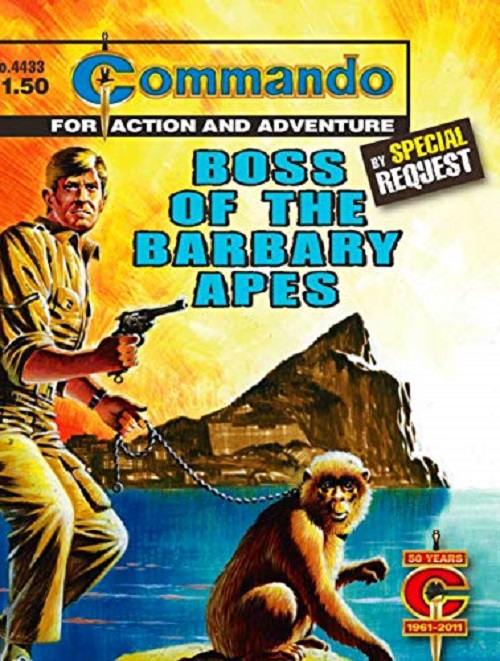
Commando #4433: Boss of the Barbary Apes - Eric Hebden


Since 1713 the mighty Rock of Gibraltar has been British, a massive stone fortress guarding the Mediterranean. But in World War Two, the Nazis had plans for capturing the Rock and knocking out the garrison by using deadly nerve gas. And all that stood in the way of the Germans was one lance-corporal and one small Barbary ape.

A couple of years ago I read a bunch of issues of COMMANDO, the long-running British war comic, especially while I was writing a column about them for BATTLING BRITONS, the excellent fanzine published by Justin Marriott. I guess I burned myself out on them, because I hadn't read one for a while. But I was in the mood for one this morning, and man, "Boss of the Barbary Apes" really hit the spot. A great script by the always dependable Eric Hebden, a fine cover by Ian Kennedy, and superb interior art by Cam Kennedy. The 64 pages flew by. This story was published originally in COMMANDO #568 back in July 1971 and then reprinted in COMMANDO #4433 in September 2019. The e-book edition (which is what I read) is still available on Amazon. If you want a tense, well-written World War II adventure yarn that can be read quickly, I give this one a high recommendation. I still have a ton of unread issues of COMMANDO on my Kindle. Might be time to get back to them and maybe pick up some new ones.

Monday, September 12, 2022

Rio: The Complete Saga - Doug Wildey


I was eleven when JONNY QUEST premiered in 1964, about the right age to start wondering if I was too old to be watching cartoons. Now I know, of course, that you’re never too old to watch cartoons if you enjoy them. Back in those days, it didn’t take me long to realize that JONNY QUEST was one cartoon I certainly needed to watch, because I thought it was great. Jonny’s globe-trotting adventures reminded me of the Rick Brant novels, my all-time favorite series of boys’ adventure books. At the time, I had no idea that the series was created and developed by a writer/artist named Doug Wildey.

In time I became aware of Wildey’s involvement in the series and learned that he had a significant career in comic books and comic strips as well as animation. But if I ever knew he produced a Western comic book called RIO for various publishers in the Eighties and Nineties, I’d forgotten it, until a friend mentioned on Facebook that he was reading a complete collection of Wildey’s Rio stories. That sent me in search of a copy, which proved to be surprisingly easy to obtain since there’s an ebook edition that’s available on Kindle Unlimited. Since I’ve come to enjoy reading comics digitally (yeah, that surprised me, too), I grabbed it immediately.

Rio is a former outlaw and gunfighter who has gone to work as a troubleshooter for President Ulysses S. Grant. He’s been promised a pardon if he carries out the missions Grant assigns to him. The first one involves taking on a cruel railroad baron and his hired guns in “The Hide Butchers”. That’s the first part of a three-part story that continues in “Satan’s Doorstep”, in which Rio clashes with the U.S. cavalry, and “Robber’s Roost”, in which he ventures into a Mexican village that’s been taken over by outlaws.

In another long, three-part story, “Mr. Howard’s Son”, Wildey fills in more of Rio’s background and reveals that he once rode with Frank and Jesse James and their gang. Rio encounters Jesse again, as Old West outlaw history buffs will realize pretty early on, and the events in this story foreshadow the famous owlhoot’s real-life fate later on.

Rio encounters another old friend, Doc Holliday, in “Hot Lead for Jonny Hardluck”, as a trail that begins with a botched stagecoach robbery ultimately leads Rio to San Francisco. From there, still in company with Doc Holliday, Rio pays a visit to Tombstone in “Red Dust in Tombstone”, a tale that also involves Wyatt and Virgil Earp and Buckskin Frank Leslie. Finally, the volume concludes with “Reprisal”, an unfinished story Wildey was working on at the time of his death, in which Rio tangles with Mexican revolutionaries who are after a load of gunpowder smuggled over the border.

I really enjoyed reading RIO: THE COMPLETE SAGA. Wildey’s artwork is superb all the way through, and his scripts have a gritty tone to them reminiscent of Spaghetti Westerns and the novels written by the Piccadilly Cowboys in the Seventies. The historical aspects seem reasonably accurate, and I think fans of traditional Westerns would enjoy these stories, as well. It’s an excellent collection, a lot of fun to read, and I give it a high recommendation.

Friday, July 15, 2022

From the Files of . . . Mike Hammer - Mickey Spillane and Ed Robbins


As a Mickey Spillane and Mike Hammer fan for more than fifty years, I was surprised that I didn’t even know this book existed until recently. Published by Hermes Press in 2013, FROM THE FILES OF . . . MIKE HAMMER reprints the Mike Hammer comic strip that ran for less than two years in 1952 and ’53 and is still available in both print and digital editions.

Editor Max Allan Collins provides the usual fine introduction, covering the background for the strip and information on who did what. The art is by Ed Robbins, an artist I’m not really familiar with, but he does a great job all the way through, with superb storytelling and a version of Hammer that just looks right. Mickey Spillane provided plots and contributed to some of the scripts, and Robbins handled much of the writing as well as the art. Veteran comics scripter Joe Gill worked on the strip early on but didn’t last long.

Although the strips ran in the usual daily and Sunday form, with different storylines in each format, this volume collects them in different sequences. In the first daily continuity, “Half-Blonde”, Mike Hammer, always the champion of the underdog, investigates the murder of a bum. Not surprisingly, the case turns out to have a much larger scope than that. While in the hospital recuperating from injuries suffered during that case, Mike finds himself involved in the mystery of “The Bandaged Lady”. In “The Child”, he’s hired to rescue the kidnapped child of a mob boss.

The title of the next daily continuity, “Another Lonely Night”, harkens back to what many, including myself, consider Spillane’s best novel, ONE LONELY NIGHT. In this one, Mike is targeted for death by mob killers after he witnesses a gangland execution. “Christmas Story” is a minor but predictably heart-warming tale in which Mike, feeling like Scrooge, corrals a shoplifter dressed as Santa Claus. Finally, in “Adam and Kane”, Mike has an actual client for once, an elderly criminal who hires him to locate his long-estranged son.

The title of the first Sunday storyline is “Comes Murder”, which, as Collins explains in his introduction, is designed to fit with the strip’s overall title: “From the Files of Mike Hammer . . . Comes Murder”. It’s likely that Spillane scripted this story himself. It certainly reads like his work. Mike protects a young couple from a vindictive gambling kingpin, but there’s more to it than a bad debt. He gets a hand in this case from a beautiful blond Amazon who may or may not be trustworthy.

Another beautiful blonde figures prominently in the plot of “The Sudden Trap”. Mike is passing through a small town when he spots a Hollywood starlet who’s out of place there . . . especially since she was believed to have been killed in a car wreck two years earlier. Mike’s curiosity won’t allow him to move on until he’s solved the mystery of her true identity.

The third and final Sunday continuity is the aptly named “Dark City”, in which Mike gets mixed up in the dangerous affairs of a beautiful redhead and her shell-shocked Korean War vet brother. Several panels in this story are considerably more suggestive than most comic strips were in those days, and it’s thought that may have contributed to the strip’s cancellation. I’m just glad Spillane and Robbins were able to finish the storyline. It wraps everything up in a downbeat but effective manner.

I really had a fine time reading this book. It brought back a lot of memories of racing through Mike Hammer novels in study hall at school, on my parents’ front porch, and at my sister’s house. The art is good, the scripts are top-notch, and I can’t imagine any Spillane fan not enjoying this collection. FROM THE FILES OF . . . MIKE HAMMER gets a very high recommendation from me.

Friday, June 10, 2022

The Shadow 1941: Hitler's Astrologer - Denny O'Neil and Michael Kaluta


Regular readers of this blog know that I’m a big fan of The Shadow (mostly the pulp version) and have been for more than fifty years now. So it’s not surprising that I picked up a hardcover of this graphic novel when it first came out in 1988. THE SHADOW 1941: HITLER’S ASTROLOGER is by the writer/artist team of Denny O’Neil and Michael Kaluta, who produced quite a few excellent issues of The Shadow comic book series in the Seventies.

It's also not too surprising that I never got around to reading that copy I bought back then. I have the attention span of a six-week-old puppy, after all. However, I discovered a while back that Dynamite Comics has reissued HITLER’S ASTROLOGER in hardback, and there’s even an ebook edition that’s available on Kindle Unlimited. (Back in 1988 when the book first came out, none of that would have made any sense at all.) Anyway, I figured it was finally time for me to read it.

I’m glad I did. The script by O’Neil and Kaluta, which has The Shadow and his agents manipulating real-world events involving the Nazi Bund, Rudolf Hess, Joseph Goebbels, Operation Barbarossa, and Adolph Hitler himself, of course, is action-packed, intriguing, and moves along very nicely. It doesn’t quite capture the same feeling as Walter B. Gibson’s magnificent pulp creation, but as pastiche goes, it’s pretty darned good. Kaluta’s art, though, with inks by Russ Heath (a comic book legend in his own right) is just outstanding, a superb job of creating a blend between precarious events in the real world and the breakneck machinations of The Shadow and his crew of helpers. I had a great time reading this graphic novel, which, ultimately, is the most important thing to me. In the unlikely event that you’re a fan of The Shadow but haven’t read it, like me until recently, I give it a high recommendation.

Tuesday, March 15, 2022

War Picture Library: Battle of Britain - Ian Kennedy


Famed British comics artist Ian Kennedy passed away a few weeks ago. I’ve seen many excellent covers  by Kennedy on issues of COMMANDO, but I haven’t read many stories that used his interior art. The volume WAR PICTURE LIBRARY: BATTLE OF BRITAIN reprints two such stories, “Steel Bats” and “’Never Say Die’ Wapiti” (both of which actually first appeared in the comic AIR ACE PICTURE LIBRARY in 1961 and 1964). As you’d expect from the collection’s title, both stories deal with the RAF’s efforts to combat the Germans’ intensive bombing raids on England during the early days of World War II.

“Steel Bats” follows the often used storyline of a younger, more impulsive pilot clashing with an older, more by-the-book superior officer. It plays out against a fascinating background, though, that of the British pilots struggling to shoot down German bombers they can’t see simply because the nights are too dark. In order to do that, the pilots have to come up with new ways of attacking the enemy, and who better to do that than our brash young protagonist? There’s plenty of action and drama before the odds begin to turn in the RAF’s favor in a climax that seems a tad bit rushed in its resolution of the story’s emotional conflict. That doesn’t detract from the story’s overall enjoyment, however.

The protagonist of “’Never Say Die’ Wapiti” is a young pilot dogged by bad luck. After several brushes with catastrophe, he’s assigned as the commanding officer of an air field where obsolete planes are stored as part of an effort to make it look like a functioning base to German reconnaissance planes. However, our hero and another young officer at the base decide to fix up one of the planes and get it in flying shape again. They decide to use this plane, a decrepit Westland Wapiti, to launch an unauthorized bombing raid on a German installation on the French coast. Well, we all know that’s not going to go smoothly, and sure enough, even though they get the Wapiti in the air, that sets off a complicated and action-packed chain of events. This is a superb story with a lot of twists and a satisfying ending.

The authors of these stories are unknown, but Ian Kennedy provides outstanding artwork on both of them. Kennedy was a great storyteller with his art and makes even aerial dogfights easy to follow, as well as giving the characters a lot of personality. I really enjoyed both of these stories, and if you’re a fan of British war comics, WAR PICTURE LIBRARY: BATTLE OF BRITAIN is worth seeking out. It's available in a Kindle edition or as a paperback.

Tuesday, January 25, 2022

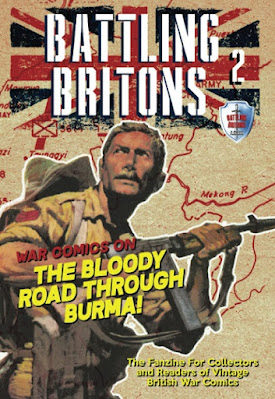
Battling Britons 2 - Justin Marriott, ed.


Justin Marriott is back with BATTLING BRITONS 2, the fine journal he edits and publishes devoted to British war comics, which is good news indeed for comics fans.

The cover features by Justin Marriott and Paul Trimble focus on war comics set in Burma, but as always, there’s a wide variety of subject matter in this issue. Jim O’Brien takes a look at stories set during the conflict between the U.K. and Argentina over the Falkland Islands, and Justin Marriott contributes an article about Hellman of Hammer Force, one of the best-known German protagonists in war comics, along with an overview of other “good Germans” who starred in their own stories. Two real highlights are an article/interview with Gary Dobbs, one of the current COMMANDO scripters, and an interview with Keith Richardson and Oliver Pickles, the editors of a series of reprints called the Treasury of British Comics (published by Rebellion, the company that currently holds the rights to a lot of great material).

Dobbs is also the author of an excellent article about “Charley’s War”, regarded by many as the best British war comic ever published. I haven’t read that one, and since the whole run by the original writer and artist (Pat Mills and Joe Colquhoun) has been reprinted, I really ought to. But there are also plenty of other reviews and features that make me want to search for reprints or see if digital editions are available. As always, this issue of BATTLING BRITONS is going to make me add to my collection!

I wrote another column in this one in which I have short reviews of a dozen issues of COMMANDO, the long-running (since 1961!) digest comic for which several of my friends have written scripts over the years. Unfortunately, this is my final column in BATTLING BRITONS, as the press of both writing and editorial work has become too time-consuming to keep it up. I’ve really enjoyed working on these and plan to continue reading COMMANDO on a regular basis (all the new editions are available as ebooks on Amazon, which sure makes it easier for those of us stateside), as well as the reprints I’ve already picked up. And I look forward to forthcoming editions of BATTLING BRITONS. This issue and the previous ones all get very high recommendations from me.

Monday, January 03, 2022

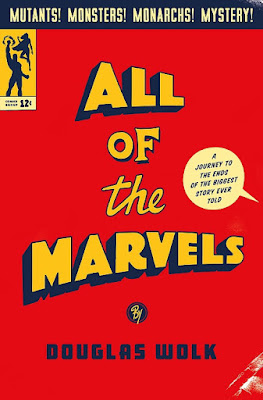
All of the Marvels - Douglas Wolk


Douglas Wolk had a really great idea for a book: read all of the superhero comics published by Marvel since FANTASTIC FOUR #1 was published in 1961 (approximately 27,000 comic books through 2017) and then write an overview of them, considering them all to form one single, self-contained story, the largest work of fiction ever published. It’s exactly the sort of thing that a long-time (since Christmas Day, 1963) Marvel Comics fan like me would find fascinating.

The execution of that really great idea? Well, that’s something else again.

Good news first. ALL OF THE MARVELS is about 90% of a great book. When he’s actually writing about the comics, Wolk is top-notch, summarizing them well and doing an excellent job of fitting everything together. He fills in the historical background well and is affectionate and even-handed in his treatment of the creators of those comics. It doesn’t hurt that he devotes an entire chapter, and a long one, at that, to MASTER OF KUNG FU, my favorite comic from the Seventies. He gives a lot of love to FANTASTIC FOUR, my all-time favorite comic book, and also to THE AMAZING SPIDER-MAN, which is also very high on my list. Best of all, when he’s writing about the Sixties and Seventies, the book makes me feel like I’m there again, walking across the highway to Lester’s Drugstore to pick up the new issues every week.

Unfortunately, before he gets to that point, Wolk spends a lot of time early on lecturing the reader and making it clear that he dislikes long-time comics fans (you know, the ones who plunked down their nickels and dimes and quarters every week for years so that there would still be a Marvel Comics for him to write about) and considers any of us who don’t care for Marvel’s current comics to be horrible people. He comes across as smug, arrogant, and very morally superior to anybody who disagrees with him.

Luckily, as I said, most of this is very early on. If you’re a long-time fan and/or have no interest in what Marvel is publishing these days, I’d advise skimming the first two chapters and skipping Chapter 3 completely. Heck, if you’re a long-time fan, you can probably just start with Chapter 4, which focuses on, appropriately enough, the Fantastic Four. There are a few brief shots at older fans later on, but they’re easy enough to ignore.

Don’t get me wrong. Overall, I enjoyed ALL OF THE MARVELS quite a bit and consider it well worth reading. Yeah, there were a few times when I felt like throwing the book against the wall, but mostly I raced through it, flipping the pages eagerly, having a great time reliving some fifty- and sixty-year-old memories. Just know what you’re getting into if you were there at or near the beginning, like I was.

Monday, September 06, 2021

Trent #2: The Kid - Rodolphe and Leo


I enjoyed the first Trent graphic novel, THE DEAD MAN, and I'm still a fan of Mountie stories, so I recently read the second volume in the series, THE KID.

This one finds Sergeant Trent of the RCMP and his faithful companion Dog on the trail of The Kid, an American outlaw who has crossed the border into Canada after a botched bank robbery that cost the outlaw the life of his girlfriend, who had been traveling and robbing banks with him. The Kid has killed numerous men during this spree, and Trent expects him to be a brutal, callous, hardened criminal.

Well, as it turns out, he kind of is, but he's also an actual kid, still a teenager, and something of a sensitive soul who reads Rimbaud's poetry and writes passages from it on the walls of buildings as he flees across Canada. There's never much doubt in the reader's mind that Trent will catch up to him, but everything doesn't play out as might be expected.

I liked this one even more than THE DEAD MAN. THE KID has a lot more action, along with a good script by Rodolphe and excellent art by Leo. Trent is a fine protagonist with layers that are only slowly being uncovered. I plan to read the rest of this series and probably will do so in fairly short order.

Tuesday, August 31, 2021

Trent #1: The Dead Man - Rodolphe and Leo


If you’ve been reading this blog for very long, you know I enjoy Mountie stories. A friend of mine on Facebook recently mentioned a series of graphic novels about a Mountie sergeant named Trent, so I had to check them out. Written by French author Rodolphe Jacquette, with art by Brazilian artist Leo (Luiz Eduardo de Oliviera), they’ve been translated into English and are available on Amazon and as part of Kindle Unlimited.

The first volume, THE DEAD MAN, finds Sergeant Trent and his canine companion, known only as Dog, on the trail of a wanted murderer. In the snowy wasteland, they come across a lone traveler who turns out to be a beautiful young woman on a mission of her own. Trent saves her from a blizzard and reluctantly agrees to help her on her quest before returning to his own assignment.

The big plot twist in this one is pretty obvious, and there’s a lot of brooding and not much action, but danged if I didn’t get caught up in the story and enjoy it a lot anyway. The art is great, Sergeant Trent is a good protagonist, and I think there’s a lot of potential in this series. Originally published during the Nineties, there are eight volumes in all, and I definitely plan to read the others. This isn’t the sort of two-fisted, action-packed Mountie yarn that I love so much in the pulps, but I give THE DEAD MAN a high recommendation anyway.

Monday, June 14, 2021

Chronos Commandos: Dawn Patrol - Stuart Jennett


A friend of mine mentioned this the other day and compared it to the old DC Comics series The War That Time Forgot, so I had to check it out. I'm definitely the target audience when it comes to anything about World War II G.I.s fighting dinosaurs.

I was pleased to find that this five-issue comic book series is pretty good. It's been reprinted in trade paperback and as an e-book and is worth reading. The concept is that a combined scientific and military force called The Watchmakers, led by Albert Einstein, is tasked with traveling through time to foil the plots of Nazi time travelers. The leader of one of the field teams is a tough non-com called only The Sarge, who, along with his men, is in prehistoric times with his men as this yarn opens.

Through some bad luck, The Sarge and one other soldier are the only ones who make it back to the present (well, the middle of World War II, which is the present as far as this series is concerned) only to find that things are in even worse shape there. Nazi agents have infiltrated the Watchmakers, wrecked their headquarters, and stolen a vital component of their time traveling equipment, escaping into prehistoric times with it. The Sarge and a new squad are sent to recover it and prevent the Nazis from changing the course of history.

All of that is set up in the first issue, and the rest of the series is nearly non-stop action. If you enjoy G.I. vs. dinosaur battles, Albert Einstein with a tommy gun fighting Nazi agents, and mind-bending time travel paradoxes, CHRONOS COMMANDOS is for you. Stuart Jennett's script is excellent. I'm not as big a fan of his art, but he's a decent storyteller and the art, by today's standards, is not bad at all. Taken together, Jennett delivers a very enjoyable yarn that I enjoyed quite a bit. Recommended.