This cover is by H.W. Wessolowski, best remembered for his science fiction pulp covers, usually billed as Wesso or H.W. Wesso. But he did a number of covers for pulps in other genres, such as this issue of CLUES. Oddly enough, a number of the authors in this issue are probably best known as Western writers: T.T. Flynn, Tom Curry, Edward Parrish Ware, Oscar Schisgall, and Johnston McCulley. Although to be fair, all of those guys were very prolific in the detective pulps as well. Also on hand are John Wilstach, Richard Howells Watkins, Eric Taylor, and Lemuel de Bra, none of whom I actually think of as mystery writers. But they were good writers, and being good pulpsters, they could do a lot of different things in order to make a sale. Which makes me think this would be an entertaining issue.
Sunday, November 27, 2022
Sunday Morning Bonus Pulp: Clues, November 1931
This cover is by H.W. Wessolowski, best remembered for his science fiction pulp covers, usually billed as Wesso or H.W. Wesso. But he did a number of covers for pulps in other genres, such as this issue of CLUES. Oddly enough, a number of the authors in this issue are probably best known as Western writers: T.T. Flynn, Tom Curry, Edward Parrish Ware, Oscar Schisgall, and Johnston McCulley. Although to be fair, all of those guys were very prolific in the detective pulps as well. Also on hand are John Wilstach, Richard Howells Watkins, Eric Taylor, and Lemuel de Bra, none of whom I actually think of as mystery writers. But they were good writers, and being good pulpsters, they could do a lot of different things in order to make a sale. Which makes me think this would be an entertaining issue.
Saturday, November 26, 2022
Saturday Morning Western Pulp: Western Novel and Short Stories, August 1934
Here's a Sidney Riesenberg cover I like a little more than the one on last Saturday's Western pulp. This issue of WESTERN NOVEL AND SHORT STORIES lives up to its name. Most of the pages are occupied by Clarence E. Mulford's Hopalong Cassidy novel "Black Buttes". I don't know if it was abridged for this pulp appearance. Even at 98 pages of double-columned small print, it probably was. Backing it up are two stories, one by Raymond W. Porter (who I've heard of but never read, as far as I recall) and James Corson (who I've never heard of).
Friday, November 25, 2022
The Deadly Pay-Off - William H. Duhart
I had a copy of the original Gold Medal edition of THE DEADLY PAY-OFF by William H. Duhart on my shelves for more than 30 years and never got around to reading it. That copy was lost in the Fire of ’08, and I never replaced it. But Black Gat Books is about to reprint the novel next month and I was fortunate enough to get an ARC. I know when the universe is telling me to read something. And I’m very glad I did.
The protagonist of THE DEADLY PAY-OFF is professional gambler Tank Tabor, whose
younger brother Bill is a private detective. Bill is poking around in a case
and annoys Arky Calahan, the crime boss of Milwaukee, where this novel takes
place. Calahan puts pressure on Tank to get his brother to back off, and when
Bill refuses to do so, Tank finds himself framed for several crimes, including
hooking an underage girl on drugs. Bill still refuses to drop the case and
winds up dead. And Tank is framed for that killing, too, and has to go on the
run to clear his name, solve several other murders, and keep himself and his
friends alive.
Boiled down, this is a pretty standard hardboiled crime novel plot, but Duhart puts a number of interesting and unexpected spins on it. He also keeps things moving at a good clip, provides some swift and effective dialogue, and really heaps problem after problem on his hero. I had no idea how Tabor was going to get out from under the sheer weight of everything stacked against him. THE DEADLY PAY-OFF is a good book, not the same level as those from Gold Medal stalwarts such as Harry Whittington, Day Keene, Charles Williams, and John D. MacDonald, but for a first novel it’s really solid and very much worth reading.
And the author is just about as interesting as the book, as we discover from the fine introduction to the Black Gat edition by Bill Kelly. William H. Duhart was a black ex-convict with literary ambitions who started this novel in prison and finished it while attending a prestigious writer’s colony in Illinois. You can’t tell that from the writing. Like Frank Yerby and John B. West, Duhart seems to have been a black author writing for a primarily white audience. However, probably the most sympathetic character in the book is Jock Adams, a black former numbers runner who’s had a falling out with the crime boss. He meets Tabor while both are in jail and teams up with him to bring Arky Calahan down. Jock is an excellent character, and I wish Duhart had given us some novels featuring him as the protagonist.
However, after his debut with THE DEADLY PAY-OFF, Duhart published only 11 short stories in the lower-rung crime fiction digests of the late Fifties and early Sixties, and then the novel RAVISHING SEDUCTRESS, which came out from Merit Books in 1962. That seems to be the end of his writing career, although he didn’t pass away until 2003. There are some great titles among the short stories: “Fear Stacks the Deck!”, “Lust of the Damned!”, “Never Con a Killer!”, “Passion Swamp!”, and more. I realize it would really be a niche market item, but a reprint of RAVISHING SEDUCTRESS, along with those short stories, would be a great thing to have. I know I’d want a copy. Maybe one of these days.
In the meantime, the Black Cat edition of THE DEADLY PAY-OFF will be out in a couple of weeks, and you can pre-order it on Amazon. I had a fine time reading it, and if you’re a hardboiled crime fiction fan, you should check it out.
Thursday, November 24, 2022
Monday, November 21, 2022
Riders of Fortune - Walt Coburn
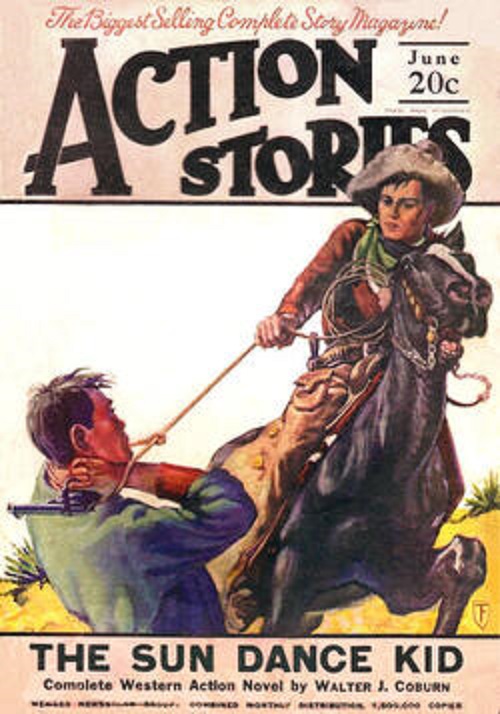
Walt Coburn remains one of my favorite Western authors. RIDERS OF FORTUNE, published by Five Star in 2007, reprints two of Coburn’s novellas and one of his novelettes from the pulp ACTION STORIES that originally appeared in 1925, during an era in which Coburn was writing exclusively for Fiction House.
The first novella, “Ride ‘Im, Cowboy”, is from the January 1925 issue of ACTION STORIES. Young cowboy Tom Rawlins, who rides for the Circle C ranch in Montana (a spread owned by Coburn’s father in real life, and where he grew up), gets word that he’s inherited a ranch in Arizona from a long-estranged uncle. Tom heads south to claim that legacy, but along the way he’s drugged and robbed of the papers that prove his identity, and then later, when the train he’s riding on is held up, he’s taken for one of the robbers and winds up in jail in the town near the ranch he means to claim. As it turns out, somebody claiming to be Tom Rawlins has already shown up to take over the ranch. Tom’s uncle was murdered, there’s a lynch mob figuring to string Tom up, and his only ally is the sheriff’s beautiful redheaded daughter . . .
That’s a pretty standard plot, but remember, this story was first published almost a hundred years ago. Coburn does an excellent job of juggling all the elements, there are several villains and they’re all suitably despicable, and as usual, the heroine is a strong character. Coburn based most of his female leads on his wife Pat, in both appearance and personality. This yarn is a little more straightforward than some of Coburn’s work, which often relies heavily on the characters’ back-stories and features some psychological angst to go along with the ridin’ and shootin’ and fightin’.
Next up is the novelette “The Sun Dance Kid”, from the July 1925 issue of ACTION STORIES, which finds the title character, a hot-headed, fast-shootin’ young cowboy, fleeing from Arizona across the border into Mexico after he robs a crooked gambler who cheated him. Once there, he’s captured by a gang of Mexican revolutionaries and by a twist of fate becomes their leader, eventually known as Colonel Sun Dance Kid. Evidently he was demoted by the time the story was reprinted under the title “Captain Gringo” in the Fall 1940 issue of FRONTIER STORIES. I have to wonder if Lou Cameron read that version of the story and remembered the name, using it as the name of the protagonist in his long-running paperback series RENEGADE, published by Warner Books under the pseudonym Ramsey Thorne.
But to get back to the story, Coburn soon introduces another character, an American showgirl stranded below the border, and despite the action that breaks out occasionally, “The Sun Dance Kid” becomes a screwball romantic comedy. It works pretty well, too, with a lot of fast-paced, slangy dialogue that’s reminiscent of Ben Hecht and Howard Hawks. The thing is, Coburn’s yarn predates the movies for which those two are famous, so this was just Coburn being Coburn. I’ve found the same sort of dialogue in his more traditional action Westerns, too. Comedy, romance, and action all come together in “The Sun Dance Kid” to make it one of the best stories I’ve read by him so far.
The title story of this volume, “Riders of Fortune”, is from the September 1928 issue of ACTION STORIES. Like the other two stories, it’s set along and on both sides of the Arizona/Mexico border and concerns a line of rugged, desolate hills called the Devil’s Bend that serves as a hideout for a horde of American and Mexican outlaws. Coburn really packs a lot into this short novel. There’s a fortune in gold and gems hidden by a Mexican revolutionary, a mysterious, badly scarred rancher, a millionaire who’s also a secret agent (shades of Amos Burke, for those of you with long memories!), a couple of Border Patrol agents, a beautiful girl who sings in a cantina, and a band of dastardly villains including a German, an Italian, and a Russian Cossack! Many of these characters aren’t who they seem to be at first. Most of them have secrets (finally, this is a Coburn yarn with one of his trademarks: tons and tons of back-story).
In fact, with all these characters and sub-plots, “Riders of Fortune” winds up being a little too busy and muddled. It all makes sense, but it takes time and a lot of explaining to untangle everything. Because of that, I found it to be the weakest of the three tales in this collection. But the fast-paced dialogue, the epic action scenes, and the vivid setting are all great, as usual, so I still found it fun to read.
In addition to the border setting, all three of these stories are also contemporary Westerns, or at least contemporary to the time Coburn wrote them, meaning that there are cars around and several of the characters in “Riders of Fortune” fought together in World War I. Having grown up on Roy Rogers and Gene Autry movies, I have a real fondness for this sort of tale.
Overall, I found RIDERS OF FORTUNE well worth reading and it maintains Coburn’s standing as one of my favorite Western writers. My copy is a discard from the Rochester Public Library in Rochester, New Hampshire. I’m glad it found its way to Texas so I could read it.
Sunday, November 20, 2022
Sunday Morning Bonus Pulp: Adventure, May 1934
Here's another pith helmet cover, this one by Duncan McMillan. I like the colors on this one. This issue of ADVENTURE has some excellent writers in it, including Gordon MacCreagh with a Kingi Bwana story. Also on hand are W.C. Tuttle, Albert Richard Wetjen, Gordon Young (with a serial installment), and a couple of lesser-known writers, Andrew McCaffrey and James Stevens.
Saturday, November 19, 2022
Saturday Morning Western Pulp: Frontier Stories, Winter 1944
I'm not crazy about this Sidney Riesenberg cover, but inside this issue of FRONTIER STORIES are yarns by Dan Cushman, Les Savage Jr., Tom W. Blackburn, Curtis Bishop, and Harold Preece. That's an excellent bunch of writers, so I'll bet this is an entertaining issue.
Friday, November 18, 2022
The Angel of Terror - Edgar Wallace
Over the past few days, I’ve been discussing various aspects of British thriller fiction with a friend of mine, which made me think about the fact that I’d never read anything by Edgar Wallace, despite being aware of his work for at least 50 years. Since I have several e-book editions of his novels, I decided to remedy that and picked one at random to read: THE ANGEL OF TERROR, originally published in 1922.
Set in London and on the French Riviera, this is the story of a beautiful young
heiress, the lawyer who wants to protect her, the retired British soldier hired
to be her bodyguard, and the despicable villains who want to murder her so they
can inherit a fortune. Plus a few assorted con artists and an escaped lunatic.
This isn’t a mystery at all; the reader is fully aware the whole time of who
the villains are and is privy to all their sinister plans, which get really sinister
at times, including a plot to infect the poor girl with smallpox. Despite the grisly
nature of some of the goings-on, the writing is, for the most part, fairly
genteel and restrained. Thankfully, there are a few welcome moments of blood
and thunder.
My reaction to this one was really mixed. A lot is going on, and the book
is well-paced. There’s a nice sense of “one damned thing after another”. The dialogue
is top-notch. The villains are thoroughly evil, the hero stalwart.
But the heiress is annoyingly dense, even for 1922. Even though there’s no real
mystery, there is a big plot twist near the end, but unfortunately, it was
obvious as soon as Wallace laid the groundwork for it early on. And the ending
is, well, pretty unsatisfying, to the point that I looked at the Kindle and
said, “Wait. What?”
All that said, I actually did enjoy the book and found myself wanting to get
back to it to find out what was going to happen. There’s something to be said
for sheer storytelling ability, and Wallace seems to have had it. I have no
idea how THE ANGEL OF TERROR is regarded among his body of work, but I liked it
enough that I want to read more. I hope whichever book I try next will be a
little better, though.
Since I read an e-book version, I looked online for a cover scan. The one
above is the best I found. Most were pretty sedate or didn’t fit the book at
all.

Wednesday, November 16, 2022
Hell on the Bottom - Carl Jacobi
Carl Jacobi is best remembered as an author of weird fiction, of course, but he also wrote a lot of straight adventure yarns for the pulps. HELL ON THE BOTTOM is a 2001 chapbook from Black Dog Books that reprints two of those adventure stories and features the first-ever publication of another one that went unsold when Jacobi wrote it in the late Thirties.
The first of these, a novelette called “Captain Jinx”, appeared in the August 1940 issue of RED STAR ADVENTURES. It was bought by the Frank Munsey Company for ARGOSY but wound up in another Munsey pulp, as sometimes happens. The protagonist is a down-on-his-luck sea captain (the South Seas and the Far East were just full of down-on-their-luck sea captains during the pulp era) who is hired to take command of a ship owned by a rather disreputable line, and in addition to the regular cargo, he's supposed to deliver six bottles of heliotrope perfume to a certain lady. (Jacobi’s original title for the story was “Heliotrope Cruise”.) Could there possibly be something shady about this deal? Our hero thinks so, especially when somebody tries to kill him and a beautiful blonde shows up on a Chinese junk . . . and she wants the perfume, even though she’s not the lady for which it was intended. This is a well-written, really enjoyable story. The plot twists are pretty predictable, but that doesn’t take away from its entertainment value.
“The Caves of Malo-Oa” is the never-before-published story, sent by Jacobi’s agent Lurton Blassingame to the pulp SOUTH SEAS STORIES, which promptly lost it for several months before finding the manuscript, only to reject it. A great treasure is hidden on an uncharted island in the caves of the title, and after it are a beautiful girl, a ship’s captain who can’t be trusted, and a down-on-his-luck wireless operator (this during a time when being a ship’s wireless operator was still a romantic, two-fisted occupation). Honestly, I don’t know why this story didn’t sell to some adventure pulp. It’s well-written, moves right along, has interesting characters, and I had a good time reading it.
The third story, “Hell on the Bottom”, appeared originally as “Drowned Destiny” in the May 1939 issue of the Ace pulp 12 ADVENTURE STORIES. This is a deep sea diving yarn set in the Caribbean, as the protagonist attempts to recover from a sunken ship half a million dollars in gold that was intended to finance a Central American revolution. But since Jacobi wrote this intending to sell it to THRILLING MYSTERY, it’s actually a Weird Menace story and the treasure is supposed to be protected by monsters and evil spirits. The explanation for all the apparently supernatural menaces is rushed and pretty lame (as often happened in Weird Menace stories), which may explain why Margulies rejected it and it wound up over at Ace. But the actual deep sea diving scenes are excellent and the story is still fun.
I don’t know how many of these Black Dog Books chapbooks there were, but I bought most of them directly from the publisher, Tom Roberts, and really enjoyed them. Tom went on to do many beautiful trade paperback pulp collections under the Black Dog Books imprint, but I have a special fondness for these early chapbooks. They have a lot of charm and reprinted some great material. I’m glad I've finally gotten around to reading this one. I have EAST OF SAMARINDA, the other collection of Jacobi’s pulp adventure stories, and plan to get around to it fairly soon. It would be all right with me if someone reprinted even more of them.
Monday, November 14, 2022
The Shadowed Circle #4 - Steve Donoso, ed.
THE SHADOWED CIRCLE #4 is out and is available from the publisher and Amazon. This publication continues to be a very welcome return to the classic days of pulp fanzines. The issue starts out strongly with a great Rozen-like cover with art by Kevin Duncan and color and design by Steve Novak. This is my favorite cover so far and perfectly captures the feel of The Shadow.
Editor Steve Donoso has put together an exceptional array of articles, leading
off with the first installment of a three-part article by long-time pulp fan
Dick Myers, who passed away in 2005. This never-before-published article,
written probably in the early Seventies, was found among his papers and deals
with just how The Shadow went about financing his vast organization of agents
and assistants. It’s clear that Myers put a lot of thought into this and the
article makes for fascinating reading.
Will Murray muses about mysteries concerning The Shadow to which Walter B.
Gibson never revealed the answers. Tim King tackles one of those mysteries with
some very interesting speculation and makes a strong case for his conclusion,
as far as I’m concerned. Todd D. Severin begins a series covering The Shadow’s
appearances in comic books and concentrates on the Forties in this part. Since
that’s an area of The Shadow's history which I’ve seldom read about in detail, I
learned a lot and really enjoyed this article, as I did the following article
by Daryl Morrisey that covers the comic book meetings between The Shadow and
Doc Savage. John Olsen, the only person I can think of who’s read every single
Shadow pulp novel, writes about the radio show this time around, in particular
the final broadcast, and his article is both informative and poignant.
This issue also features the second part of a lengthy interview with writer and
producer Michael Uslan, who has written several comic book stories and graphic
novels featuring The Shadow. Uslan discusses several mini-series I’d never even
heard of, so of course I had to go to Amazon and pick up copies of them. I’m
looking forward to reading them.
The back cover features the two novels written by Will Murray that feature
meetings between Doc Savage and The Shadow, THE SINISTER SHADOW and EMPIRE OF
DOOM, with beautiful artwork by Joe DeVito. It’s a fitting wrap-up for what is,
in my opinion, the finest issue of THE SHADOWED CIRCLE so far. If you’re a fan
of the character, I give it my highest recommendation . . . and I suspect the
next issue will continue that trajectory.


.jpg)

.jpg)