Nothing like a Norman Saunders cover on an issue of NORTH-WEST ROMANCES. The two go together perfectly. This issue features a story by one of my favorite authors, Frederick Nebel (a reprint from a 1932 issue of ACTION STORIES), as well as yarns by William Byron Mowery, Ralph R. Perry, Owen Finbar (who was really A. DeHerries Smith, who wrote a lot of stories for the Northerns under his own name), Dan O'Rourke (who was also A. DeHerries Smith), Reg Dinsmore, Evan M. Post, and house-name John Starr (quite possibly A. DeHerries Smith, too). I love Northerns and ought to read more of them.
Sunday, May 24, 2026
Sunday Morning Bonus Pulp: North-West Romances, Summer 1941
Nothing like a Norman Saunders cover on an issue of NORTH-WEST ROMANCES. The two go together perfectly. This issue features a story by one of my favorite authors, Frederick Nebel (a reprint from a 1932 issue of ACTION STORIES), as well as yarns by William Byron Mowery, Ralph R. Perry, Owen Finbar (who was really A. DeHerries Smith, who wrote a lot of stories for the Northerns under his own name), Dan O'Rourke (who was also A. DeHerries Smith), Reg Dinsmore, Evan M. Post, and house-name John Starr (quite possibly A. DeHerries Smith, too). I love Northerns and ought to read more of them.
Saturday, March 29, 2025
Saturday Morning Western Pulp: Frontier Stories, Summer 1945
I don't own this issue of FRONTIER STORIES, so I haven't read it. But it has a dramatic cover by Richard Case and a fine group of writers inside. The lead story by Les Savage Jr., "The Lone Star Camel Corps", may have been cannibalized for Savage for his novel ONCE A FIGHTER. It was reprinted in one of the Les Savage Jr. collections packaged by Jon Tuska and I have a copy of that book on order. I'm looking forward to reading the story. Also on hand in this issue of FRONTIER STORIES are William Heuman, Tom W. Blackburn, William R. Cox, R.S. Lerch, Fairfax Downey, and the lesser-known Ben T. Young and Raymond L. Hill. Lots of good reading there, I have no doubt about that.
Saturday, September 16, 2023
Saturday Morning Western Pulp: 2 Western-Action Books, Winter 1951
Double covers are usually pretty good. There's still enough room for a decent scene, while the triple covers (such as on the Thrilling Group's TRIPLE WESTERN) are often too small to be very effective. I like this double cover on the Winter 1951 issue of 2 WESTERN-ACTION BOOKS. I don't know the artist(s). I believe this is a Fiction House pulp, although officially it was published by Fight Stories Inc. As you'd expect from the title, there are only two stories in it, both novellas. One is by Lee Floren, not a favorite author of mine but one capable of decent work. The other is by Dave Ricks, and it's his only credit in the Fictionmags Index. My sneaking suspicion is that the name is a pseudonym, possibly for Lee Floren since he has the other story in this issue. But I don't know and would be happy to learn more about him, if any of you have any info.
Sunday, July 30, 2023
Sunday Morning Bonus Pulp: All-Adventure Action Novels, Spring 1939
ALL-ADVENTURE ACTION NOVELS was a Fiction House pulp and ran for only three issues in 1937, ’38, and ’39, not finding success even though it had good covers and some fine authors appeared in its pages. I don’t own any of the issues and have never even seen any copies, but I do own the Adventure House facsimile reprint of the third and final issue from Spring 1939. I read that reprint recently and really enjoyed it.
Although all five stories in this issue are listed as novels in the Table of
Contents, we know what that means. They’re actually novelettes and novellas.
The first one is “Drums of the Desert” by Thomas J. Cooke. It’s about an
American adventurer in Egypt who has gotten his hands on the sacred flag of the
Mahdi, which is worth a fortune. A schemer who knows about the flag forces a
beautiful French girl to lure the hero into a trap, which winds up with him
being the prisoner of a Taureg band. A deserter from the French Foreign Legion
figures in the plot, too. It’s a well-written yarn with enough action to be
satisfying. I don’t know anything about Cooke, except that he wrote eight
stories which appeared in various Fiction House pulps. I have a hunch it might
have been a pseudonym, but I have nothing on which to base that except a gut
feeling.
A couple of brief discussions here on the blog and on Facebook made me realize
I don’t think I’ve ever read anything by George Bruce, even though he was a
major pulp author for a long time. He’s best remembered as a writer of aviation
and air war yarns. His novella in this issue, “The Iron Man of Devil’s Island”,
has an aviation element to its plot, but it’s also a prison tale, as you’d
expect from the title. The two storylines—an American airliner forced by bad
weather to land in the South American jungle and a former French flying ace
from World War I escaping from Devil’s Island—run in parallel for a while
before coming together. When they merge, it’s with a predictable twist that’s
still very effective. Not as effective as the ending, though, which, as Maynard
G. Krebs used to say, made me get all misty-eyed. It took me a little while to
warm up to this story. Bruce’s style isn’t exactly long-winded, but he does
tend to go on, and while I think a lot of modern writers take the whole “show,
don’t tell” thing too far, Bruce goes to the other extreme at times. Overall,
though, I really enjoyed “The Iron Man of Devil’s Island”. It drew me in and
had me turning the pages and makes me look forward to reading something else by
George Bruce.
Albert Richard Wetjen wrote South Seas stories about several different
characters including Stinger Seave (who I teamed with G-Man Dan Fowler for a
story in a recent anthology, DOUBLE TROUBLE), Shark Gotch (one of the great
names of pulp fiction, as far as I’m concerned), and Typhoon Bradley. “Red
Typhoon”, the Wetjen novelette in this issue, is actually an unacknowledged reprint
of the first story in the series, “Captain Typhoon”, which appeared originally
in the September 1931 issue of ACTION STORIES. It reads like the first story in
a series, too, introducing us to Captain Typhoon Bradley, his brother Bob, and
their search for a mysterious island that’s not on any of the charts. They have
to team up with some shady characters in order to find what they’re looking
for, and of course double crosses and action ensue. Bradley gets his ”Typhoon”
nickname, another indication this is actually the first story in the series.
One thing I really like about Wetjen’s work is that all his series are
connected. Supporting characters from one, and even sometimes protagonists,
will show up in a different series. He never seems to have done much with the
concept, but it’s still a nice touch.
John Starr was a Fiction House house name. He’s credited with the French
Foreign Legion yarn, “Riders of the Burning Sands”, in this issue. Based on the
idea that a house name was often used to keep an author from having two stories
in the same issue, I’d say the most likely suspect in this case is Victor
Rousseau. George Bruce was a big name; you wouldn’t waste one of his stories by
putting a house name on it. The Wetjen story is a reprint. Cooke is a possibility,
too. But having read “Riders of the Burning Sands”, I’m convinced it’s by
Rousseau. Stylistically, it reads just like him. It’s a good story, too, about
an American who winds up in the Foreign Legion because of a misunderstanding
and a murder, and how he has to survive not only a brutal sergeant but an
attack by natives as well. Lots of good action in this one and a satisfying
resolution.
Victor Rousseau appears under his own name with “Ruby of Revolt”, a story of
political intrigue set in India. Rousseau, one of the early practitioners of
science fiction before it was even called that, wrote tons of adventure stories
for the Spicy pulps under several different names, and he was a top-notch
storyteller. This involves an American working for the British Secret Service
in India, trying to track down a magnificent ruby known as the Eye of Kali,
which will determine who rules one of the country’s provinces and whether or
not there’s a bloody uprising. There’s a beautiful, mysterious dancer involved,
too. I don’t know if Rousseau ever read Talbot Mundy or Robert E. Howard, but
starting out, this story reminded me of Jimgrim and El Borak. Then, halfway
through, it takes a sudden, bizarre twist that brings in a science fiction/horror
angle to the plot. It’s goofy, but Rosseau makes it work, probably because the
whole thing races along at such a fast pace. Rousseau was no Mundy or REH, but
this is a very entertaining story.
In fact, every story in this issue is entertaining, either very good or
excellent, and I was impressed with ALL-ADVENTURE ACTION NOVELS. The reprint is
still available on Amazon if you’re a fan of pulp adventure fiction and want to
check it out.

Monday, November 21, 2022
Riders of Fortune - Walt Coburn
Walt Coburn remains one of my favorite Western authors. RIDERS OF FORTUNE, published by Five Star in 2007, reprints two of Coburn’s novellas and one of his novelettes from the pulp ACTION STORIES that originally appeared in 1925, during an era in which Coburn was writing exclusively for Fiction House.
The first novella, “Ride ‘Im, Cowboy”, is from the January 1925 issue of ACTION STORIES. Young cowboy Tom Rawlins, who rides for the Circle C ranch in Montana (a spread owned by Coburn’s father in real life, and where he grew up), gets word that he’s inherited a ranch in Arizona from a long-estranged uncle. Tom heads south to claim that legacy, but along the way he’s drugged and robbed of the papers that prove his identity, and then later, when the train he’s riding on is held up, he’s taken for one of the robbers and winds up in jail in the town near the ranch he means to claim. As it turns out, somebody claiming to be Tom Rawlins has already shown up to take over the ranch. Tom’s uncle was murdered, there’s a lynch mob figuring to string Tom up, and his only ally is the sheriff’s beautiful redheaded daughter . . .
That’s a pretty standard plot, but remember, this story was first published almost a hundred years ago. Coburn does an excellent job of juggling all the elements, there are several villains and they’re all suitably despicable, and as usual, the heroine is a strong character. Coburn based most of his female leads on his wife Pat, in both appearance and personality. This yarn is a little more straightforward than some of Coburn’s work, which often relies heavily on the characters’ back-stories and features some psychological angst to go along with the ridin’ and shootin’ and fightin’.
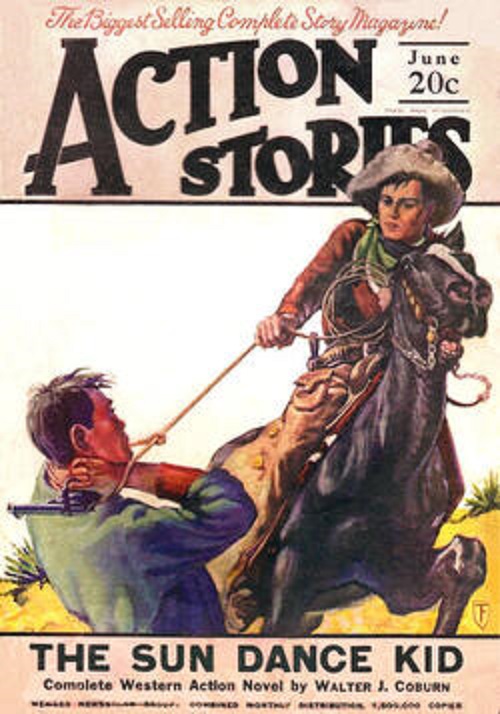
Next up is the novelette “The Sun Dance Kid”, from the July 1925 issue of ACTION STORIES, which finds the title character, a hot-headed, fast-shootin’ young cowboy, fleeing from Arizona across the border into Mexico after he robs a crooked gambler who cheated him. Once there, he’s captured by a gang of Mexican revolutionaries and by a twist of fate becomes their leader, eventually known as Colonel Sun Dance Kid. Evidently he was demoted by the time the story was reprinted under the title “Captain Gringo” in the Fall 1940 issue of FRONTIER STORIES. I have to wonder if Lou Cameron read that version of the story and remembered the name, using it as the name of the protagonist in his long-running paperback series RENEGADE, published by Warner Books under the pseudonym Ramsey Thorne.
But to get back to the story, Coburn soon introduces another character, an American showgirl stranded below the border, and despite the action that breaks out occasionally, “The Sun Dance Kid” becomes a screwball romantic comedy. It works pretty well, too, with a lot of fast-paced, slangy dialogue that’s reminiscent of Ben Hecht and Howard Hawks. The thing is, Coburn’s yarn predates the movies for which those two are famous, so this was just Coburn being Coburn. I’ve found the same sort of dialogue in his more traditional action Westerns, too. Comedy, romance, and action all come together in “The Sun Dance Kid” to make it one of the best stories I’ve read by him so far.
The title story of this volume, “Riders of Fortune”, is from the September 1928 issue of ACTION STORIES. Like the other two stories, it’s set along and on both sides of the Arizona/Mexico border and concerns a line of rugged, desolate hills called the Devil’s Bend that serves as a hideout for a horde of American and Mexican outlaws. Coburn really packs a lot into this short novel. There’s a fortune in gold and gems hidden by a Mexican revolutionary, a mysterious, badly scarred rancher, a millionaire who’s also a secret agent (shades of Amos Burke, for those of you with long memories!), a couple of Border Patrol agents, a beautiful girl who sings in a cantina, and a band of dastardly villains including a German, an Italian, and a Russian Cossack! Many of these characters aren’t who they seem to be at first. Most of them have secrets (finally, this is a Coburn yarn with one of his trademarks: tons and tons of back-story).
In fact, with all these characters and sub-plots, “Riders of Fortune” winds up being a little too busy and muddled. It all makes sense, but it takes time and a lot of explaining to untangle everything. Because of that, I found it to be the weakest of the three tales in this collection. But the fast-paced dialogue, the epic action scenes, and the vivid setting are all great, as usual, so I still found it fun to read.
In addition to the border setting, all three of these stories are also contemporary Westerns, or at least contemporary to the time Coburn wrote them, meaning that there are cars around and several of the characters in “Riders of Fortune” fought together in World War I. Having grown up on Roy Rogers and Gene Autry movies, I have a real fondness for this sort of tale.
Overall, I found RIDERS OF FORTUNE well worth reading and it maintains Coburn’s standing as one of my favorite Western writers. My copy is a discard from the Rochester Public Library in Rochester, New Hampshire. I’m glad it found its way to Texas so I could read it.


.jpg)