Showing posts with label Dan Cushman. Show all posts

Saturday, March 14, 2026

Saturday Morning Western Pulp: Frontier Stories, Winter 1944


I featured this issue of FRONTIER STORIES several years ago, but I’ve since acquired a copy and just read it. Unfortunately, that copy is completely coverless, including the spine, but I’m not a fan of that Sidney Reisenberg cover anyway and all the pages are complete and easily readable, so I’m all right with that. Once again, the scan is from the Fictionmags Index, but my comments below are new.

Les Savage Jr. is one of my favorite Western writers. His mountain man novella “Queen of the Long Rifles” leads off this issue. That title is somewhat deceptive, and I suspect editor Malcolm Reiss may have come up with it. The story features a strong female character in Mira Phillips, the daughter of a trading post owner in the Big Horn Mountains during the fur trapping era. The actual protagonist is Batteau Severn, a French-Canadian trapper who clashes with a ruthless New Englander trying to take over the fur trade. This winds up as an out-and-out war between the two factions, which provides Savage with the opportunity for plenty of big, sweeping action scenes, as well as some brutal fistfights and one-on-one showdowns. This is a terrific story, full of excitement and a vividly portrayed, historically accurate setting. Batteau is a tough and very likable hero, Mira is a fine heroine, there are several top-notch sidekicks, some thoroughly despicable villains, and several surprisingly poignant moments. Savage could just write the heck out of a yarn like this. I loved it.

Tom W. Blackburn was also a consistently excellent Western author. His novelette “Devil’s Cache” starts with a freighter following the trail of whoever stole four of his horses. Not very far along, though, the story takes an abrupt turn and appears momentarily that it’s about to turn into a lost race yarn. That’s not how things play out, but the plot is still fairly off-beat for a Western pulp tale. This one is very well-written and I enjoyed it a lot, too.

Sometimes reading a pulp is educational. “Red Reckoning” is about a stagecoach trying to make it across the country to San Francisco before a ship can sail around South America and reach the same destination. An enormous wager is riding on the outcome. The protagonist is a frontier scout hired to help the stagecoach make the journey safely. Naturally, there’s a lot of trouble and treachery along the way, as well as romance with the daughter of the stagecoach line owner who made the bet. It’s a well-written yarn that moves along at a nice pace. I had never heard of the authors, Frankie-Lee Weed and Kelly Masters, so I did a little research on them, and that’s where the educational part comes in. My first thought was that they might be a husband-and-wife writing team, but nope, turns out they were just occasional writing partners who had much more prolific careers on their own. Kelly Masters published a few stories under his real name, but most of his work, which consisted mainly of slick magazine stories and boys’ adventure novels, was published under the pseudonym Zachary Ball. A couple of his novels were adapted as episodes of the original Walt Disney TV show. Frankie-Lee Weed published quite a few stories in the Western romance and love pulps under her real name, as well as the pseudonym Saliee O’Brien. Under the O’Brien name she went on to publish numerous historical romance novels in the Sixties, Seventies, and Eighties. I remember seeing those books when they were new. So both authors went on to bigger (not necessarily better) things but got their start in the pulps.

Curtis Bishop was a Texas newspaper reporter who followed the rodeo circuit while also writing scores of Western and sports stories for various pulps, along with a number of juvenile sports novels and some well-regarded Western novels. I haven’t read much by him, but everything I’ve read has been very good. So I expected to enjoy “Turning Trails”, his novelette in this issue set in Texas during the days right after the Civil War. It starts off strong with a former Confederate officer having left his home and headed west after the war, as many actually did. He arrives in San Antonio and gets mixed up in the clash between the beautiful blond owner of a nearby ranch and the brutal, corrupt Reconstruction authorities who run things in Texas at this point. Then it becomes a trail drive story as the protagonist tries to help the young woman get a herd of cattle across the Red River into Indian Territory before the crooked sheriff can seize them. Bishop writes with a nice sense of time and place, but this story goes off the rails in the second half as he makes a number of geographical errors (I mean, I understand dramatic license, but that only goes so far, especially when you’re a Texan writing about Texas), and the plot twist that fuels the story’s resolution stretches willing suspension of disbelief ’way past the breaking point. I just didn’t accept that things could ever happen that way—and I’m a guy who has no problem with, say, Jim Hatfield’s almost super heroics. So this story, despite having some good stuff in it, wound up being a major disappointment.

This issue wraps up with the novella “The Conestoga Pirate” by another of my favorite authors, Dan Cushman. It’s an important story in Cushman’s career because it introduces his series character, the good guy outlaw Comanche John, although in this story and the next one in the series, he’s called Dutch John. This story was reprinted in the Leisure Books collection NO GOLD ON BOOTHILL, but since I have the original pulp version, that’s what I read. I hadn’t read any of the Dutch/Comanche John stories until now, although I think I own them all in one form or another.

Something about “The Conestoga Pirate” struck me as familiar right away, and a glance at the story intro in NO GOLD ON BOOTHILL explained why. Cushman used parts of this novella in his later novel NORTH FORK TO HELL, which I read several years ago, although he dropped Dutch John from that version. In this one, Dutch John is more of a supporting character, although an important one. The protagonist is young Wils Fleming, who, along with the old-timer Bogey and the disreputable gunfighter/outlaw Dutch John, encounter a wagon train full of immigrants being duped by a group of villains pretending to be guides and scouts. This leads to drama, gunplay, ambushes, and attempted lynchings. It’s a good, fast-moving story, with a little bit of an off-kilter tone, as many of Cushman’s stories have. He wrote a lot of Western and adventure stories for the pulps that were firmly in those traditions yet just a little different at the same time. It took me a while to understand that and appreciate his work, but as I said above, he’s now one of my favorites. I guess I need to read the rest of the Comanche John stories and novels.

There are also two Western history articles in this issue, one about the outlaw Black Jack Ketchum by Harold Preece and one about the Bannock War by Fairfax Downey. As usual, I just skimmed these. I like Western history and have read a bunch of it, but when it comes to pulps, I’m there for the fiction. And despite my ultimate disappointment in Curtis Bishop’s novella, this is an excellent issue of FRONTIER STORIES overall, with outstanding yarns from Savage, Cushman, and Blackburn. If you have a copy, it’s well worth reading.

Friday, July 18, 2025

A Rough Edges Rerun Review: Tongking! - Dan Cushman


Dan Cushman wrote extensively for the Western pulps and in fact was responsible for creating the last Western hero pulp, THE PECOS KID. Cushman wrote five Pecos Kid novellas for the magazine, all of which were reprinted by Leisure in paperback. He also wrote original paperbacks for Gold Medal and Dell and was still turning out hardback Western novels for Walker during the Eighties. But he's equally well-remembered for adventure novels set in Africa, the South Seas, and the Far East, including this one.

TONGKING! was published in 1954 as half of an Ace Double (with a great cover by Rafael deSoto) and is very much of its time. The protagonist is down-on-his-luck American soldier of fortune Rocky Forbes, who finds himself broke in Bangkok, not a good situation. He falls in with an old ally/enemy, the smuggler Fatto Kolski (who seems to be modeled pretty blatantly on Sydney Greenstreet). Kolski has a plan to smuggle some guns to anti-communist guerrillas in China, but in order to pull off the scheme, he needs Forbes to pretend to be a dead man.

This is just the beginning of a very twisty plot that involves American spies, British spies, Chinese spies, a beautiful Spanish torch singer, a beautiful American missionary, double crosses, triple crosses, murder, tramp steamers, and shootouts with Thompson submachine guns. If all those plot elements don’t perk your interest, I don’t know what would. The pace never lets up for very long, the local color is very well-done, and Rocky Forbes manages to be a likable hero while at the same time remaining an unrepentant heel. TONGKING! is an updated version of the sort of pulpish international intrigue and adventure stories that were published in BLUE BOOK during the Thirties.

In an interview with George Tuttle that was first published in PAPERBACK PARADE and recently reprinted in SEEKERS OF THE GLITTERING FETISH, the first collection of Cushman’s Armless O’Neil stories that originally appeared in the pulps JUNGLE STORIES and ACTION STORIES, Cushman himself offers a fairly low opinion of TONGKING! I hate to disagree with the author, but I found this novel very entertaining, definitely enough so to make me want to read more of Cushman’s adventure novels. If you have it on your shelves but have never read it, you should take it down and give it a try. If you run across a copy of the Ace Double for a reasonable price, as I did, grab it. That great cover alone is worth something.

(This post originally appeared on July 9, 2010, in a somewhat different form. TONGKING! doesn't appear to be in print, but used copies are out there on the Internet and are only moderately expensive. As for some of the other Cushman yarns mentioned above, all five of the Pecos Kid pulp novels are available on Amazon in three volumes: THE PECOS KID (e-book, paperback), THE PECOS KID RETURNS (e-book, paperback), and NO GOLD ON BOOTHILL (e-book, paperback). Altus Press published a second volume of Cushman's Armless O'Neill pulp stories, completing the series. It's called SWAMP FETISH, you can pick it up on Amazon, and the introduction is by none other than yours truly. The first Armless O'Neill collection, SEEKERS OF THE GLITTERING FETISH, is still available as well. Cushman continues to be one of my favorite authors, and I need to read something else by him soon.)

(UPDATE: Actually, TONGKING! has been reprinted in a trade paperback edition that's available on Amazon. Many thanks to the reader who pointed this out!)


Sunday, June 08, 2025

Sunday Morning Bonus Pulp: Adventure, October 1948


A pegleg, a pith helmet, a pistol, a dagger, and a dead body! You don't get much more adventure pulp than this cover by Peter Stevens on, what else, ADVENTURE. This issue is also of interest because it contains the novella "Jewel of the Java Sea" by Dan Cushman, which I assume he expanded into the novel of the same title that Gold Medal published a few years later. Also on hand are Georges Surdez, Jim Kjelgaard, Max Kesler, and William Fuller, along with lesser-known authors Robinson McLean, Ian Lasry, and Richard S. Porteous, who wrote under the odd pseudonym "Standby". I don't own this issue, but if I did, Cushman and Surdez would be enough to prompt me to read it.

Saturday, March 15, 2025

Saturday Morning Western Pulp: .44 Western Magazine, February 1948


I don't own this issue, so the information about it and the cover scan come from the invaluable Fictionmags Index. .44 WESTERN MAGAZINE, like all the other Popular Publications Western pulps, had good covers and good authors filling its pages. Robert Stanley did the excellent art on this cover (thanks to Robert R. Barrett for the artist ID), and I think it's the first one I've come across where a pocket watch gets shot, instead of some hombre's hat. Inside this issue are stories by William Heuman, Harry F. Olmsted, Dan Cushman, Tom Roan, Lee E. Wells, Clee Woods, Ben Frank, James Shaffer, and Harrison Colt. I'm not a fan of Ben Frank's work and don't really know anything about Shaffer or Colt, but the others are all dependable Western pulpsters. 

Sunday, July 28, 2024

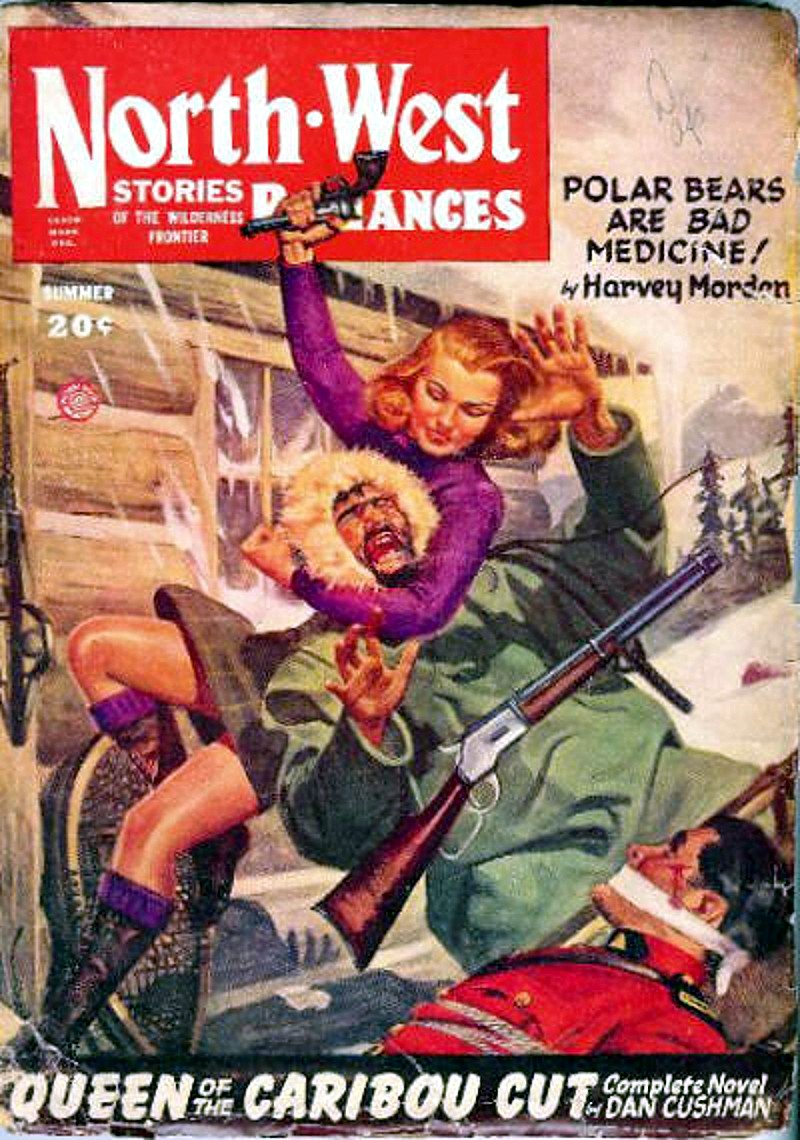
Sunday Morning Bonus Pulp: North*West Romances, Fall 1945


I like posting snowy covers of Northern pulps during the summer when the weather is hot. This one is by the always-excellent George Gross. This issue of NORTH*WEST ROMANCES also has some fine authors in its pages, most notably Dan Cushman, Les Savage Jr., and William Heuman. Those three are enough to make any pulp issue worthwhile by themselves. Also on hand are R.S. Lerch, Kenneth P. Wood, Larry McLane, R.A. Emberg, Paul Selonke, and Michael Oblinger. I like listing the authors' names, even the ones I've never heard of, because every so often somebody will be searching on-line for mentions of a relative, and then they email that So-and-So was their grandfather or great-uncle or something, and they're excited to see the name in a post. That always makes me feel good.  

Sunday, April 28, 2024

Sunday Morning Bonus Pulp: Adventure, June 1947


This is a pulp that I own and recently read most of. That’s my copy in the scan. The cover art is by Peter Stevens, who did quite a few covers for ADVENTURE during this era.

This issue starts off with the initial installment of an espionage serial set in post-war China entitled “He Who Rides the Tiger” by James Norman. As I usually do with serials if I don’t have all the installments on hand, I skipped this one. It may be an excellent yarn, but I don’t see any point in starting a story I can’t finish. Some of the other installments can be found in issues posted online. Maybe I’ll get around to reading it someday. To be honest, though, that’s not very likely.

Next up is a Western short story by the always dependable Frank Bonham. “Last Drive” is about the final run of a stagecoach. The former driver who is almost completely blind goes along as a passenger, and wouldn’t you know it, he’s forced into taking over the reins when Apaches attack the stagecoach. This is a well-written story with a nice final twist.

It's unusual to find a Dan Cushman story in a pulp that’s not published by Fiction House. He was a regular contributor to LARIAT STORY, ACTION STORIES, and JUNGLE STORIES. His long novella in this issue of ADVENTURE, “The Cask of Khabar”, which is set in the Congo, would have been right at home in JUNGLE STORIES, and again to be honest, it’s the main reason I picked this issue to read. Because of his resemblance to a dead man, American trader and self-professed “jungle tramp” Craig Thebes finds himself mixed up with a gang of ruthless criminals. A couple of beautiful women are involved in the scheme, too, of course. At times in this story, it seems like Cushman is trying to do a jungle version of THE MALTESE FALCON. Thebes is certainly hardboiled, and his banter with the evil Sir Roger Humphries reads like Sam Spade and Casper Gutman trading veiled quips. I think the ending is a bit less dramatic than it could have been, but that’s the only drawback in an otherwise superb pulp yarn that just makes me eager to read more by Cushman.

Samuel W. Taylor wrote a lot of Western, detective, and adventure stories for a wide variety of pulps. His story in this issue is called “Do Not Molest the Miracles” and is billed as an “Off the Trail” story. That fits it pretty well. It’s a whimsical tale of elves building houses for needy veterans during the post-war housing crisis, only to run afoul of government red tape. As a general rule, whimsy isn’t something I really enjoy, but this story is well-written and mildly amusing. It would have made a good, lighter-than-usual episode of THE TWILIGHT ZONE.

Steve Hail wrote Westerns and nautical adventures. His story story “Doghole Circuit” in this issue definitely fits into the latter category. It uses the old “disgraced skipper is forced by a catastrophe to redeem himself and pull of a daring stunt” plot. In this case, the catastrophe is an erupting volcano and a passenger liner that’s run aground just off the Big Island of Hawaii. To a confirmed landlubber like me, this plot probably doesn’t resonate as much as it would with somebody who likes and knows something about ships. But I still thought it was a pretty good story anyway.

Being an Oklahoman, Clifton Adams knew the oilfields pretty well and could spin a good yarn using that setting. “The Crazy Kind” is about a prizefight between two oilfield workers with a rich new lease as the stakes. This is a lighter-weight, more humorous story than most of Adams’ work, but it’s still well-written and very entertaining. I never worked in the patch, but I had relatives who did and have been around that world some, so I’ve always had a fondness for novels and stories set there.

I’ll sometimes make an exception to my policy of not reading serial installments. If it’s the final installment, or by an author I particularly like, and the story wasn’t published later as a novel that I might read someday, I’ll give one a try. The final installment (of three) of “Salmon Sweepstakes” by Robert E. Pinkerton wraps up this issue. Pinkerton wrote a lot of stories and serials for the adventure fiction pulps, but I don’t recall ever reading anything by him before. This story is about the rivalry between salmon fishermen in the Pacific Northwest following World War I. I started it but couldn’t get interested in it, so I wound up setting it aside. If I’d been able to read the whole thing, I might have liked it better.

The stories by Cushman, Bonham, and Adams are good enough that I have to consider this a pretty solid issue of ADVENTURE. None of the other stories are bad, and I can't count off for serials because they're just the nature of the beast, so to speak. So I'd say that if you have a copy of this one, it's worth pulling off the shelf and giving it a shot.

Monday, December 19, 2022

The Dan Cushman Reader - Brent D. McCann


Yesterday’s post mentioned that Dan Cushman’s first story, “Girl of the Golden Lode”, was published in the Winter 1943 issue of the pulp NORTH-WEST ROMANCES. Today’s post is about Cushman as well. With a title like THE DAN CUSHMAN READER, you’d think this was a collection of his stories, right? Well, it’s not. Instead, THE DAN CUSHMAN READER is a book-length master’s thesis about Cushman and his work, written in 2001 by Brent D. McCann, a graduate student at the University of Montana who was able to interview Cushman numerous times before the author passed away. It's posted online here. I downloaded it several years ago and finally got around to reading it.


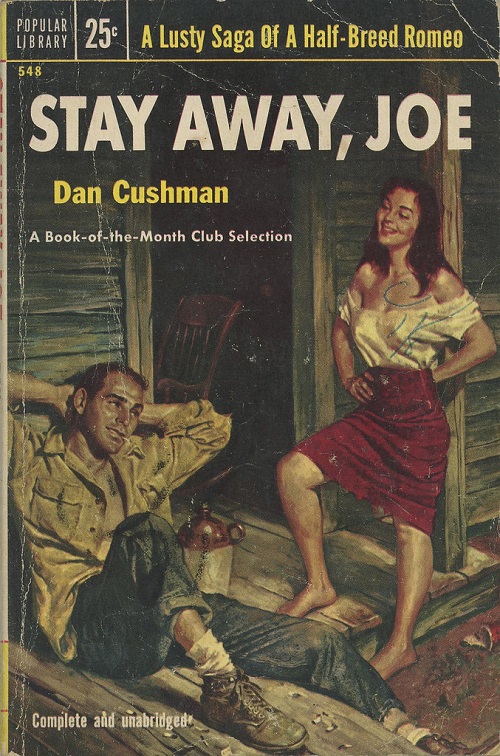
Despite being written as an academic paper, complete with footnotes and a bibliography, THE DAN CUSHMAN READER is very readable and entertaining. McCann does an excellent job with the biographical information, providing a clear, interesting overview of Cushman’s life. He covers Cushman’s career as a writer in-depth, too, and provides a detailed analysis of several of Cushman’s novels, most notably STAY AWAY, JOE, a controversial novel about life on an Indian reservation that was adapted into a Broadway play and then later into a movie starring Elvis Presley.


McCann seems to think, understandably so, that any lasting reputation Cushman has will be because of STAY AWAY, JOE. But despite its early popularity and success, over the ensuing years the novel has been criticized and memory-holed because of the controversy around it, and it doesn’t appear to be in print today, although used copies of it are readily available. On the other hand, at least eight volumes of Cushman’s pulp and paperback work are in print, and used copies of his other books are just as easily found as STAY AWAY, JOE. My personal favorites of his work are his Armless O’Neil stories from JUNGLE STORIES and ACTION STORIES, but his pulp Westerns and Northerns are consistently very good, too. (In the spirit of full disclosure, I haven’t read STAY AWAY, JOE, and I wrote the introduction to one of the volumes of collected Armless O’Neil stories published by Altus Press.)


I’ve mentioned before that it took me a while to warm up to Cushman’s style, but once I did, he became one of my favorite pulp writers. Because of that, I really enjoyed THE DAN CUSHMAN READER. I don’t have any idea what became of its author, Brent McCann, but I appreciate the work he did on this. If you’re a Cushman fan or a fan of pulp and paperback fiction in general, it’s well worth reading.  
Sunday, December 18, 2022

Sunday Morning Bonus Pulp: North-West Romances, Winter 1943


RODEO ROMANCES yesterday, NORTH-WEST ROMANCES today. This is actually a fairly significant issue of the iconic "Northern" pulp because it features Dan Cushman's first published story, "Girl of the Golden Lode". And it's featured prominently on the cover, to boot. Also on hand in this issue are Tom W. Blackburn, Victor Rousseau, Chart Pitt, and lesser-known writers Ralph Cunningham, Glenn Vernam, and Douglas Durkin.

Saturday, November 19, 2022

Saturday Morning Western Pulp: Frontier Stories, Winter 1944


I'm not crazy about this Sidney Riesenberg cover, but inside this issue of FRONTIER STORIES are yarns by Dan Cushman, Les Savage Jr., Tom W. Blackburn, Curtis Bishop, and Harold Preece. That's an excellent bunch of writers, so I'll bet this is an entertaining issue.

Friday, January 08, 2021

Forgotten Books: North Fork to Hell - Dan Cushman


Remember those great, gritty 1950s Western movies starring James Stewart and directed by Anthony Mann? Well, that’s what Dan Cushman’s 1964 novel NORTH FORK TO HELL reminds me of. As the book opens, protagonist Morgan McCoy and his friend Doc Tiller are on the run from a gang of vigilantes after helping steal back some gold from the vigilantes, who stole it in the first place. They run afoul of some Indians and McCoy is wounded in the fight, but they’re taken in by the members of a wagon train heading north for a new town that’s supposed to be founded by their leader, the charismatic Major Garside.

There are several problems with this plan, starting with the fact that winter is coming on, and the wagons may not make it before they’re trapped by the snow. On top of that, Garside is a tyrant, driven half-crazy by ambition and lust, and he and McCoy are both interested in the same beautiful Mormon girl. Some of the pilgrims want to split off and head for the gold fields in Montana, but Garside is determined to keep the group together, even if it means killing those who want to leave. Throw in blizzards, starvation, and more Indian trouble, and it starts to look as if they’ll be lucky to have any of the bunch survive.


Cushman got his start writing Westerns, Northerns, and jungle yarns for the pulps, and he’s very good at handling setting and action. However, in this original paperback, he gets a little too long-winded and literary for his own good. Morgan McCoy isn’t a very likable protagonist, either. The irredeemably evil Major Garside is a pretty interesting character, though, and after meandering around for a while, NORTH FORK TO HELL does develop some nice momentum and suspense in its second half. Cushman has used the theme of the group wanting to split up but being held together by the villain in at least two earlier novels. That gives the book a moral complexity that you don’t find in all Westerns.

From what I’ve read of his work, I prefer Cushman’s pulp stories to his later novels, mostly because he concentrates on the action in them. But I’ve found that his books are always worth reading. He has a distinctive style that takes a little getting used to, but once you do, it’s very effective. Despite my criticisms above, NORTH FORK TO HELL is a pretty good book, especially if you enjoy traditional Westerns that are a little offbeat at the same time. I’ll certainly be reading more of Dan Cushman’s novels and stories.

Saturday, December 19, 2020

Saturday Morning Western Pulp: Frontier Stories, Spring 1947


I don't know who the artist is, but I like the cover on this issue of FRONTIER STORIES. There's plenty to like about the authors in this issue, too, including L.P. Holmes, Dan Cushman, Joseph Chadwick, Lee E. Wells, and M. Howard Lane. I've seen white horses with that same design on them in red paint on other FRONTIER STORIES covers, so that artist must have liked the image.
 

Sunday, October 04, 2020

Sunday Morning Bonus Pulp: Short Stories, October 25, 1946


This is a cute cover by A.R. Tilburne, but I'm not sure how well it fits a magazine of two-fisted adventure yarns. However, there are some fine authors, including some of my favorites, in this issue of SHORT STORIES: Dan Cushman, Donald Barr Chidsey, James B. Hendryx (with a Halfaday Creek story), Jim Kjelgaard, Gordon Young, Paul Annixter, and Edward Parrish Ware. The famous "red sun" is barely visible on this one but still there.

Friday, December 20, 2019

Forgotten Books: Burned With the Coyote Brand - Dan Cushman


Dan Cushman is slowly but surely becoming one of my favorite Western pulp writers. After many years of thinking his work was just okay, I’ve developed an appreciation for his pacing, his sometimes over-the-top plots, and his hardboiled tone. BURNED WITH THE COYOTE BRAND reprints three of his novellas from the pulps, and they’re good ones.

“She-Wolf of the Rio Grande” had me at the title and that great LARIAT STORY MAGAZINE cover from March 1949. There’s this beautiful masked Mexican girl called The Angel who leads a gang of bandidos as they wage war against a cattle baron whose ranch is just north of the Rio Grande, and there’s a rival bandit leader, a big hulking brute known as El Gallo, and there’s a stalwart Texas Ranger and a couple of cold-eyed gunfighters and . . . and . . . you get the idea. This is my meat. It’s a great yarn, long enough to have been published as an Ace Double Western novel, and I’m surprised Cushman didn’t try to sell it there, the same way he recycled some of his other pulp stories. Or maybe he did, I don’t know. But I had a wonderful time reading this tale, which I found very well-written except for a couple of action scenes that were a little hard to follow (something that crops up now and then in Cushman’s work).

“Two Queens for Skidway Empire” may have been published in STAR WESTERN (the July 1950 issue), but it’s a Northern all the way, set in the British Columbia timber country in 1908. It’s a logging yarn, in which Buzz Leary returns to the Caribou country to rebuild his family’s failed timber empire. But to do so, he’ll have to throw in with a beautiful, feisty redhead who’s the last member of the family that destroyed Buzz’s family’s business. The other “queen” of the title is a sultry saloon singer, and it’s a toss-up which of the two will betray and/or shoot Buzz first. This is a great yarn with plenty of action. It would have made a top-notch late period Republic Pictures movie with John Wayne as the hero (although I have a little trouble imagining John Wayne playing somebody named “Buzz”).

“Burned With the Coyote Brand” (LARIAT STORY MAGAZINE, July 1947) reminds me of the type of story that Ernest Haycox wrote. It’s a tale of two men clashing over a woman and two half-brothers settling their differences. It’s not as over-the-top as the other two novellas and has a grittier, more realistic tone. There are some good shootouts and fistfights to go with the domestic drama, though, and Cushman does a great job with this slightly more restrained storytelling. The ending is very satisfying.

All three of these novellas are different but they’re also top-notch. Excellent traditional Western tales. And the collection is a late but strong contender for my list of favorite books of the year that’ll be coming up in a few weeks. If you’re a Western fan, BURNED WITH THE COYOTE BRAND gets a very high recommendation from me.


Friday, September 20, 2019

Forgotten Books: Stampede - Yukon Miles (Dan Cushman)


A little background is in order on this one before I talk about the book itself. I generally pick up any vintage Gold Medals I don’t have when I run across them and the price isn’t too high. So when I found this one in a used bookstore for three bucks, I didn’t hesitate to buy it even though I’d never heard of the author. At the very least, it has a nice A. Leslie Ross cover.

Then, a while after I’d bought it, I got to looking at it and read that back cover copy: “A novel of the daring men who grow only in the Great Northwest, by Yukon Miles, an author who lives there himself.”

My first thought was there was no way the author’s name was really “Yukon Miles”. That just screamed pseudonym to me. Something about the combination of the title, the name, the cover, and the 1951 publication date made me think, “Hmm, that’s about the time Dan Cushman started selling novels to Gold Medal, and Cushman wrote a lot of Northerns for the Fiction House pulps . . . and I know he expanded at least one of his Armless O’Neil novellas for JUNGLE STORIES into a novel for Gold Medal . . . I wonder if STAMPEDE could be an expansion of one of his Northerns!”

A little Internet research led me to a site claiming that “Yukon Miles” was indeed Dan Cushman, but there was no information about the genesis of this particular novel (which seemed to be the only one ever published under that by-line). There was only one site making that Miles/Cushman connection that I could find, however, so I wasn’t completely convinced. So I took the next logical step.

I read the book.

Which is what I should have done in the first place, because all the answers fell into my lap on the very first page. As soon as I read about how three drifting cowboys—Jonathan Calhoun Colter, better known as Johnny Colt; Big Bill Spooner; and José Julio Santiago Perez Garcia y Bolivar Murphy, called Josie—rode into the cowtown of Maverly, I knew beyond a doubt that Yukon Miles was really Dan Cushman, as well as where this particular novel came from.

I should back up a little more. Dan Cushman was a prolific contributor to the Fiction House pulps in the Forties and early Fifties, a star writer for LARIAT STORY, NORTHWEST ROMANCES, FRONTIER STORIES, ACTION STORIES, and JUNGLE STORIES. As the Fifties went on, he became a very successful novelist for Gold Medal, Dell, and Ace, turning out mostly adventure yarns set in Africa or the Far East, as well as the occasional Western. He wrote STAY AWAY, JOE, a hardback mainstream novel about life on the Indian reservations in Montana that netted him a movie sale (with Elvis Presley in the title role) and the enmity of certain political factions in his home state. He produced some historical non-fiction and then sort of faded out of the publishing scene for many years, before making a comeback in the Eighties and Nineties with some well-received Western and Northern novels for Walker and Five Star. He died in 2001.

Now that you know that, I can talk some more about STAMPEDE and its origins. That line on the cover “An Original Novel—Not a Reprint”? Well, not really. You see, in 1950 Popular Publications, one of Fiction House’s rivals, hired Cushman to create and write a series of short novels for a new Western pulp called THE PECOS KID WESTERN. The magazine would feature the adventures of a trio of trouble-seeking, gunswift hombres in the Old West: William Calhoun Warren, better known as the Pecos Kid; Big Jim Swing; and Hernandez Pedro Gonzales y Fuente Jesus Maria Flanagan, called Butch.

I trust you see where I’m going with this?


THE PECOS KID WESTERN ran for only five issues before succumbing to poor sales, but decades later all five Pecos Kid novels were reprinted by Leisure Books, two per paperback volume, except for the final one which appeared along with two stories featuring another of Cushman’s series characters, the road agent known as Comanche John. I had read the first four Pecos Kids and knew immediately that STAMPEDE was a rewrite/expansion of one of them, with the names of the three protagonists changed and the story beefed up a little. It took looking at the reprints to determine which pulp novel supplied the source material. Turns out it was “Three for the Deadwood Drive”, from the September 1950 issue of THE PECOS KID WESTERN. It’s not even much of an expansion. A lot of it is word-for-word except for the character names.

Once I’d determined all this, I almost put STAMPEDE aside without finishing it. After all, I’d read the original version, and to be honest, I wasn’t a big fan of those Pecos Kid stories. They weren’t bad, they just didn’t grip me the way I want a pulp yarn to. But it had been more than a decade since I’d read “Three for the Deadwood Drive” (which was reprinted under the shorter title “The Deadwood Drive”), so I thought why not? and stuck with STAMPEDE.

And I’m glad I did. It’s really odd, but I liked this version a lot better. The characters are more appealing, the action is better, and the pace flows along just fine as Johnny Colt and his pards try to help out an old friend by driving nine hundred head of cattle to Deadwood through Indian country. The problem is, those nine hundred head are part of a combined herd and the hard-nosed Texas cattleman who’s heading up the drive is determined to own all of the cows, no matter what brand is on them, by the time the drive is over. It’s a simple story without any plot twists, really, but well told with some excellent gunfights and, yes, a few stampedes along the way.

Since this book came out in 1951, Cushman must have done the rewrite almost as soon as he was finished with the original. I’m not sure why he didn’t start with the first Pecos Kid story unless he just liked this one better. For all I know, he planned to turn all of them into “Yukon Miles” books. Why there’s only one is a mystery. It’s possible that someone at Popular Publications got wind of what he was doing and told him to stop. They owned the copyright on the original version, after all. Or Cushman could have abandoned the idea himself when his other books for Gold Medal (including that Armless O’Neil rewrite) sold extremely well. He may have wanted to devote his energies to them rather than rewriting more Pecos Kids.

Either way, we’re left with STAMPEDE, which is a pretty darned good book. I enjoyed reading it, and I like uncovering a little bit of pulp and paperback history. Seems to me that it was well worth the three bucks. And if you happen to have a copy of STAMPEDE on your shelves and are a Western fan, it’s worth reading, whether you know its history or not.

Which, I guess, you do if you’ve read this far. I hope I didn’t ruin it for you.


(Note: All five of the original Pecos Kid novels are available as inexpensive e-books. NO GOLD ON BOOTHILL contains the fifth Pecos Kid novel plus two Comanche John stories, as mentioned above.)


Sunday, August 12, 2018

Sunday Morning Bonus Pulp: North-West Romances, Spring 1944


Here's another good Mountie cover on this issue of NORTH-WEST ROMANCES. I don't know who the artist is, but I know there are some fine authors with stories in this issue, with the biggest name probably being Dan Cushman. Two authors better known for Westerns rather than Northerns are also on hand, William Heuman and Archie Joscelyn, both of them writers I like quite a bit. Fiction House regular R.S. Lerch contributes a story, as well. Looks like a good issue of the leading Northern pulp.

Saturday, May 26, 2018

Saturday Morning Western Pulp: Lariat Story Magazine, July 1947


I keep posting about issues of LARIAT STORY MAGAZINE because I love the covers, the authors, and the story titles. This cover scan, like most featured here, comes from the Fictionmags Index. The lead story in this issue is by one of the most prominent authors in the Fiction House Western pulps of this era, Les Savage Jr., and the title, "Six-Gun Bride of the Teton Bunch" is pure greatness as far as I'm concerned. It was also the title story in the Barricade Books collection of stories by Savage that was published in the Nineties. Other top authors featured in this issue include L.P. Holmes, D.B. Newton, Dan Cushman (also a Fiction House top-liner), and Ray Gaulden. That's a pretty impressive line-up.

Sunday, May 14, 2017

Sunday Morning Bonus Pulp: North-West Romances, Summer 1946


I like the George Gross cover on this issue of NORTH-WEST ROMANCES. Inside are stories by Dan Cushman, one of the stars of the Fiction House line, Tom O'Neill, who wrote some other stories I liked, long-time Western pulpster and paperbacker Lee Floren, the prolific house-name John Starr, and a couple of authors I'm not familiar with, Curtis Bishop and Stuart Friedman. Just another day in Canada, obviously.

Saturday, February 11, 2017

Saturday Morning Western Pulp: Six-Gun Western, June 1946


In the mid-to-late Forties, the Western pulps from Trojan Publications had a number of minimalist but effective covers like the one on this issue of SIX-GUN WESTERN. There are some fine writers in these pages, too, including Dan Cushman, Cliff Farrell, Giff Cheshire, Wayne D. Overholster, and R.S. Lerch. That's a solid line-up.

Saturday, October 01, 2016

Saturday Morning Western Pulp: Lariat Story Magazine, November 1946


Almost every time I see a cover from LARIAT STORY, I think, "I want to write that story!" This one is no exception. Someone beat me to it, of course. Authors in this issue include Dan Cushman, Lee E. Wells, Rollin Brown, Ben Frank, Richard Brister, and John A. Saxon.

Sunday, July 03, 2016

Sunday Morning Bonus Pulp: Jungle Stories, Summer 1947


I've got to read some more of the Ki-Gor novels one of these days. In the meantime, I'll just look at this eye-catching George Gross cover for a while. I don't know who wrote the lead novel under the John Peter Drummond house-name, but there are also stories by Fiction House regulars Dan Cushman, Bryce Walton, and Emmett McDowell.