Showing posts with label Tom Curry. Show all posts

Saturday, July 04, 2026

Saturday Morning Western Pulp: Texas Rangers, December 1945


This is a pulp that I own and read recently. That’s my brittle, battered, and tattered copy in the scan. The dramatic, eye-catching cover, as usual, is by Sam Cherry, who never painted a bad cover as far as I’m concerned, although of course I like some better than others.

The Jim Hatfield novel in this issue, “The Timber War”, has been attributed to Tom Curry, but I believe that’s incorrect. I’m convinced this one is actually by Leslie Scott. The terms “skalleyhooting” and “big skookum he-wolf”, common in his work, are used numerous times. There are quite a few vivid descriptive passages, although maybe not as many as you often find in a Scott novel. My theory is that Scott could always fill a few pages with description when he needed to, but also that whenever an editor needed to cut a few pages, those lengthy portraits of the landscape would be his first target. The plot, which finds a hidden criminal pitting two opposing forces—in this case, loggers and cowboys—against each other for his own benefit, is also classic Scott. To be fair, that’s a common Western plot no matter who the author is. I’ve written a few loggers vs. cowboys yarns myself. But this one, including the villain’s identity and the motivation for his scheming, is pure Scott and easy to see coming if you’ve read as many of his novels as I have. As further evidence, most of Curry’s Hatfield novels feature a proxy hero who winds up with the pretty girl. That happens in “The Timber War”, too, but it’s pretty much an afterthought, not a major part of the plot like it usually is with Curry. That’s my reasoning, but basically it boils down to knowing a Scott novel when I read one, and that’s what I think this is.

But is “The Timber War” any good, you ask? Oh, heck, yeah. Hatfield is sent to get to the bottom of the trouble brewing between Justin Flint’s logging crew and Clyde Cranley’s Double C ranch outfit. Sabotage has taken place on both sides. Tensions are running high and threaten to break out into open warfare. Hatfield gets ambushed a few times, helps out both sides, and figures out what’s really going on. There’s plenty of well-written action, and the pace never lets up for long. It’s formulaic, but nobody ever worked that formula better than Scott. I had a great time reading this, as I nearly always do with his work.

“Tenor on Horseback” is the only credit in the Fictionmags Index for Matt Sprague. Was that a pseudonym, or just the only story that Matt Sprague managed to sell? I don’t know, but I can say that this story about a couple of ranchers getting mixed up with an opera company touring the West is pretty polished and entertaining. It’s a humorous yarn without ever descending into slapstick, and there’s a nice twist at the end. I liked this one more than I expected to.

The issue wraps up with a story by an author I always expect to enjoy, Johnston McCulley. “Merry Christmas, Ranger” is about a Texas Ranger’s encounter with two outlaws when all he wants to do is make it home for Christmas so he can propose to the girl he wants to marry and then resign from the Rangers. The plot is pretty simple, but McCulley executes it very well and his fast-moving prose is always fun to read. The holiday is just a minor plot device; the story could have been written just as effectively without it. But the whole thing is enjoyable, and I’d say it’s another winner for McCulley.

This whole issue is a winner, in fact. All three stories are top-notch, and I greatly enjoyed reading this pulp. It’s well worth your time if you have a copy.

Wednesday, May 14, 2025

Review: The Guns of Fort Griffin - James J. Griffin


For more than twenty years, James J. Griffin has been turning out top-notch traditional Western novels and contemporary Western thrillers, often featuring Texas Rangers. I’ve always enjoyed his books, so I didn’t hesitate to pick up his latest novel, the first in a new series. Instead of a Texas Ranger, THE GUNS OF FORT GRIFFIN features a new character, Deputy United States Marshal Vic Verdugo, who enforces the law in Texas during the late Reconstruction Era, just before the Rangers were reformed and became the premier law enforcement organization in the Lone Star State.


Verdugo is sent by his boss, a federal district judge, to the lawless frontier settlement of Fort Griffin with orders to tame the town. The U.S. Army is establishing a fort of the same name near the settlement, but Verdugo can’t expect any help from the commanding officer. In fact, the man wants to declare martial law and place the town under federal jurisdiction. With Reconstruction coming to an end, Verdugo wants to prevent the army from taking over, knowing that would just cause more trouble from the resentful Texans in the long run.

It’s a good thing that Verdugo is fast on the draw and skilled with his fists, because he finds himself surrounded by enemies as he tries to bring about law and order. The owners of the saloons and gambling dens and whorehouses all oppose him, of course, and so do the wild cowboys from the trail herds that travel through the area and the buffalo hunters who make Fort Griffin their headquarters. As if all that wasn’t enough, three newcomers show up in town and are looking for trouble. Their names: Wyatt Earp, Doc Holliday, and Bat Masterson.

The action never lets up for long in this yarn, and Griffin does a fine job of making the fists and bullets fly. Vic Verdugo is a tough, likable protagonist and faces plenty of vicious enemies. There’s also a real sense of authenticity in the setting and historical characters. Griffin knows his stuff. I think this is one of his best novels and recommend it for fans of traditional Westerns. It’s available on Amazon from Dusty Saddle Publishing in e-book and paperback editions.

As an aside, Fort Griffin was a real place and it’s just a coincidence that the author has the same name. But the title, THE GUNS OF FORT GRIFFIN, isn’t really a coincidence because Jim Griffin is, like me, a long-time fan of the Western pulp TEXAS RANGERS. In fact, at one point he had a complete collection before donating it to the Texas Ranger Museum in Waco, Texas. And the November 1949 issue of TEXAS RANGERS features a Jim Hatfield novel by Tom Curry writing as Jackson Cole entitled (you guessed it) “Guns of Fort Griffin”. So now you know, as Paul Harvey used to say, the rest of the story.

Saturday, September 07, 2024

Saturday Morning Western Pulp: Thrilling Ranch Stories, March 1937


This issue of THRILLING RANCH STORIES, which I don't own, sports a nice action-packed cover. I don't know the artist. There are stories inside by some very solid Western pulpsters including Tom Curry, Lee Bond, Larry A. Harris, Edward Parrish Ware, and Dabney Otis Collins. Rounding out the TOC are lesser-known William Dixon Bell, William Bruner, and U. Stanley Aultman. I had hoped to continue my streak of posting about pulps that I own and have read, but I ran out of time this week. 

Sunday, August 11, 2024

Sunday Morning Bonus Pulp: Thrilling Adventures, November 1943


This was the final issue of THRILLING ADVENTURES. The magazine went out with a good one, starting with that action-packed cover. There's an artist's signature on it, but I can't read it. Rafael DeSoto, maybe? I'm sure somebody who's better at such things than I am can supply the correct answer. Inside are stories by Louis L'Amour (a Ponga Jim Mayo yarn), Henry Kuttner (twice, once as himself and once as Charles Stoddard), Carl Jacobi, Tom Curry, Carter Sprague (really my old editor and mentor Sam Merwin Jr.), Verne Chute, and Bertram B. Fowler. And even though I've mentioned it many times before, I have to say how cool it is that in the early days of my career, I got to work with an old pulpster like Sam Merwin. I'm proud of that to this day.

Saturday, June 08, 2024

Saturday Morning Western Pulp: Texas Rangers, June 1945


This is a pulp that I own and read recently. That’s my copy in the scan. I think the cover may be by George Rozen, but I’m far from sure about that. Sam Cherry was doing most of the covers for TEXAS RANGERS by this point, but that just doesn’t look like Cherry’s work to me.

I’m much more certain about who wrote the Jim Hatfield novel in this issue—but we’ll get to that. “Gun Governor” is set in the Texas Panhandle and concerns the efforts of a gang of carpetbagger politicians and owlhoots to hang on to power as Reconstruction ends and Texans control their own destinies again. Some of those Texans have banded together and planted wheat rather than trying to rebuild the cattle business. The above-mentioned gang of robed and hooded marauders terrorizes them and tries to run them out of business. Enter Texas Ranger Jim Hatfield, sent from Austin to restore law and order and bring the leaders of the gang to justice.

Hatfield starts out by working undercover, as he often does. He manages to infiltrate the gang, but he has to abandon his masquerade to save the life of the leader of the wheat farmers. This leads to an epic cattle in which Hatfield is almost trapped in a burning building, and once his true identity is exposed, it’s all-out war between the Texas Ranger and the carpetbagger gun-wolves as Hatfield battles a scheme that threatens not only the Panhandle but the entire state of Texas.

“Gun Governor” is a well-written, very entertaining yarn with plenty of fast-paced action. The Reconstruction references place it in 1870, which is just one of the reasons I believe it was written by Tom Curry under the Jackson Cole house-name, rather than A. Leslie Scott, to whom it’s attributed in the Fictionmags Index. Curry wrote at least one other Hatfield novel with a Reconstruction background, “The Black Hat Riders” (TEXAS RANGERS, December 1942). Most of Curry’s Hatfield novels seem to take place in the 1870. They don’t all have such specific references as this one, but when they do, that’s the era in which they take place.

Leslie Scott’s Hatfield novels, on the other hand, take place in the 1890s, based on their frequent mentions of the oil business and the spread of railroads across the state. This creates a bit of a time paradox since Hatfield is approximately the same age no matter who the writer is, but evidently the pulp readers didn’t worry about such things and neither do I.

“Gun Governor” bears several other hallmarks of Curry’s work. It has a couple of introductory chapters in which the situation is developed, the villains and their victims are introduced, and so is a proxy hero, in this case wheat farmer Ken Toll, who is a Yankee but befriends the Texans anyway. Hatfield doesn’t show up until the third chapter. The descriptive passages are much shorter and lack Scott’s highly detailed and dramatic (some might say melodramatic) prose. None of Scott’s usual catch-phrases appear. Nobody gets “a surroundin’ of chuck”. While pursuing bad guys, Hatfield never shouts to his horse, “Trail, Goldy, trail!” In the final showdown with the outlaw mastermind (whose identity is never in doubt, by the way), Hatfield’s powerful voice doesn’t ring out “Elevate! In the name of the State of Texas!” Curry’s Hatfield gets down to business in a much more prosaic fashion. Nobody even raises hell and shoves a chunk under the corner!

One final bit of evidence: this novel was reprinted in the Sixties by Popular Library under the title SHOOTOUT TRAIL. Most of the Hatfield novels Popular Library picked to reprint were by Tom Curry. Of course, there were books by other authors in the Popular Library series, including a few by Scott, so that’s not definitive proof, just a little more weight on the side of the conclusions I’ve drawn from the story itself.

All this speculation aside, is “Gun Governor” worth reading? I’d say so without hesitation. The wheat farming angle is a little offbeat, the villains are properly despicable, and Hatfield is his usual stalwart self. I had a very good time reading this yarn.

There are three back-up stories in this issue, which is fairly thin due to wartime paper restrictions. I’m sure it’s a matter of coincidence, but all three have young protagonists.

“Voice From Boothill” by Gunnison Steele is about a young man trying to avenge his brother’s killing. Bennie Gardner, who is best remembered under the Gunnison Steele pseudonym, was a fine Western pulp novelist. His three Jim Hatfield novels under the Jackson Cole name are excellent, some of the best entries in the whole series. But he also wrote a lot of short-short stories like this one, which pack action and interesting plots, usually with some twist, into 1500-2000 words. I picked up on the twist in “Voice From Boothill” before it arrived, but it’s still very effective and I enjoyed the story.

“Salvage of the Box M” is by J.R. Jackson, an author about whom I know nothing except that he published a dozen or so stories in various Western pulps in the Forties. In this story, in order to save his ranch, a young man tries to get a job as a deputy and goes after an outlaw to prove he’s worthy of a badge. This is another well-written, entertaining tale.

“A Pard for Pedro” is by Cliff Walters, a prolific but almost completely forgotten contributor to the Western pulps. It mixes Mexican sheepherders, fly fishing, and murder in an unlikely combination, but it’s well-done and I thorougly enjoyed it.

Overall, this is a really solid issue of TEXAS RANGERS with a top-notch Hatfield novel and good back-up stories. If you have a copy on your shelves and are in the mood for a few hours of good reading, I recommend it. Likewise if you have a copy of the paperback reprint, SHOOTOUT TRAIL, although you won’t get the other stories with it.

Saturday, April 06, 2024

Saturday Morning Western Pulp: Street & Smith's Western Story Magazine, April 15, 1939


This issue of the iconic Western pulp WESTERN STORY sports a particularly striking cover by Norman Saunders. And it's an all-star issue as far as the authors represented in its pages, too: T.T. Flynn, Harry F. Olmsted, Ray Nafziger, Cliff Farrell, Tom Roan, Tom Curry, and Frank Richardson Pierce. Man, that's a strong line-up! The Flynn story is "Death Marks Time in Trampas", which was the title story in a collection published by Five Star in 1998 that was my introduction to his work. I've read a bunch of his novels and stories since then and enjoyed them all.

Sunday, March 10, 2024

Sunday Morning Bonus Pulp: Thrilling Adventures, May 1937


Okay, did our stalwart hero have that six-gun with him in the diving suit, or was it waiting for him when he climbed back aboard the boat? We don't know, but either way, this is a fine cover by Rudolph Belarski. This issue of THRILLING ADVENTURES features stories by some good authors including Tom Curry, Oscar Schisgall, Carl Jacobi, and William Merriam Rouse. In a field where ADVENTURE, ARGOSY, SHORT STORIES, and BLUE BOOK were the top of the line, THRILLING ADVENTURES occupied a lower rank, but it always had vivid, action-packed covers and dependably entertaining writers.

Saturday, October 21, 2023

Saturday Morning Western Pulp: Texas Rangers, August 1951


This is a pulp that I own and read recently. That’s my copy in the scan. The cover is by Sam Cherry, of course.

The Jim Hatfield story in this issue, “Rustlers Ride”, has been attributed to A. Leslie Scott, but when I started reading it, I said, “Wait a minute. This has to be a Tom Curry story.” The first two chapters have all the hallmarks of a Hatfield yarn by Curry, including several scenes setting up the plot before Hatfield is ever introduced and a proxy hero in the person of stalwart young rancher Arch Haley. The prose is the straightforward storytelling of Curry, as well, lacking any of the descriptions and catch phrases you always find in Scott’s work.

Then, in Chapter 3, everything changes. The writing is definitely Scott’s, and that continues to the end of the novel. There are a number of plot twists that don’t turn out the way they seem to be set up in the first two chapters. If I had to guess, I’d say Tom Curry started this novel, and then for some unknown reason Scott took over with the third chapter. I could be ’way off on that theory, of course. This is pure speculation on my part. But it comes from reading a bunch of both authors’ work over the past 60 years.

Anyway, regardless of who wrote what, is “Rustlers Ride” a good Jim Hatfield novel? Yes, it is. Despite the title, rustling plays almost no part in this story. Instead, it’s about a gold strike in West Texas and the gang of outlaws preying on the mines and the nearby town. Hatfield foils numerous of the gang’s plans before finally figuring out who the mastermind is, and even though the big boss’s identity is pretty obvious, it still involves one of those nice twists mentioned above. The breakneck pace and the action scenes are good, as always. There’s nothing here Hatfield fans haven’t read many times before, but it’s done well and I had a really good time reading this story.

Moving on, Leslie Ernenwein’s short story “Outlaw Hunch” is about a former owlhoot gone straight and turned livery stable owner who has to consider a return to outlawry, but for noble reasons. This is a fairly lightweight, almost humorous story until it turns deadly serious near the end. I really like the way Ernenwein writes, and this is a very good story, reprinted from the March 1946 issue of THE RIO KID WESTERN. I need to read more of Ernenwein’s novels.

Wayne D. Overholser’s novelette “Traitors’ Blood is Red” originally appeared in the April 1947 issue of THRILLING WESTERN. Like much of Overholser’s work, it’s set in the Pacific Northwest. This story involves espionage and a conspiracy during the Civil War which, if it succeeds, will not only alter the course of the war but change the entire country as well. It’s an odd plot—you don’t often think of the Pacific Northwest in terms of being important to the Civil War, or at least I don’t—but Overholser makes it work. The writing is a little bland, but I find that to be true of most of Overholser’s stories.

Tom Curry appears under his own name with a short story original to this issue, “Stranger in Town”. A drifting gambler is blamed for a murder he didn’t commit and has to uncover the truth. It’s a fairly common plot, but Curry, always a dependable writer, does a good job with it.

I don’t know anything about Cibolo Ford except that he published several dozen stories in various Western pulps in the Thirties, Forties, and Fifties. The name has always sounded like a pseudonym to me, but I don’t know that it is. His story story “Widelooper Luck”, also original to this issue, features cowpokes Stony Lonesome and Stingaree Stanton helping their friend Gooble Nutter save his ranch from the evil scheming of lawyer J. Tubelo Zero. Those names were almost enough to make me skip this one, but I stuck with it and it’s actually okay. Mildly humorous, and I found myself liking the characters, which I didn’t expect to.

Barry Scobee is the only pulp writer to have a mountain named after him. It’s in the Davis Mountains in West Texas, near the town of Fort Davis. In addition to writing for the pulps, Scobee was a journalist and newspaper publisher and was instrumental in getting old Fort Davis, an abandoned military outpost from frontier days, restored and turned into a tourist attraction. His story in this issue, “Always Wanting Something”, is a reprint from the January 1946 issue of THE RIO KID WESTERN. It’s about a young cowboy at a turning point in his life, trying to figure out which direction to go, and is well written enough but never really very involving.

Best remembered for his Western poetry, S. Omar Barker turned out quite a bit of fiction as well. His story “Rowdy Romance”, as you’d expect from that title, is a humorous tale about a cowboy who sets aside his wild, devil-may-care ways in order to try to win a girl, only to have things turn out differently than he expects. Barker had an appealing way with words and the story is entertaining without ever really amounting to much. It’s a reprint from the December 1936 issue of THRILLING WESTERN.

There are also interior illustrations by H.L. Parkhurst and Nick Eggenhoffer, among other, unsigned illustrations.

I enjoyed this issue because “Rustlers Ride” is a slightly above-average Jim Hatfield novel and the short story by Leslie Ernenwein is pretty good. The other stories are highly forgettable. But I’m glad I read the Hatfield yarn.

Saturday, June 17, 2023

Saturday Morning Western Pulp: Texas Rangers, April 1939


This is a pulp that I own and read recently. I don’t have access to a scanner at the moment, so I took a picture of my copy instead, and that’s it above. The cover is by Carl Reiter, and all I know about him is that he did a few pulp covers. As you know if you’re a regular reader of this blog, I’m a long-time fan of the pulp TEXAS RANGERS and have been reading the Jim Hatfield novels published in it for more than 50 years, since I discovered them in paperback reprints in the Sixties.

This issue is from fairly early in the series’ run, when most of the Hatfield novels were written by either Leslie Scott, the series creator, or Tom Curry. “Vaquero Guns” is one of Curry’s entries, and as usual in his novels, it features a secondary hero. In this case, it’s drifting cowboy Jerry Farmon, who starts the action off by searching for a missing friend of his, a deputy sheriff who disappeared while on the trail of an escaped killer. But Hatfield, a Texas Ranger who’s known as the Lone Wolf, is soon involved, being sent by his boss, Captain “Roarin’” Bill McDowell, to West Texas to break up a gang of masked marauders that has been raiding settlements along the border.

When Hatfield arrives on the scene, he quickly discovers that there’s a violent feud going on between the biggest ranch in the area, the Square A, and everybody else in the region. The Square A’s crew is composed of vaqueros imported from Mexico, and they’re the ones who have been raiding the settlements. Or are they? Could something else actually be going on, something more sinister behind the scenes?

After a long series of gunfights, fistfights, captures, and escapes, Hatfield uncovers the truth and exposes the criminal mastermind who will have been obvious to most readers from very early on in the novel. That’s the main problem with this one. Even for a pulp yarn, everything is just too predictable.

Even so, there are some things to like about “Vaquero Guns”. The opening scene, which features a nighttime escape from a train, is very evocative and well-written. The action scenes are always good in a Curry novel, and the big battles have a nice epic feel. There are clever callbacks to previous Hatfield novels written by Curry. And Hatfield himself is a great character as always, mostly superhuman but still likable and believable. I wouldn’t recommend this to anyone who hasn’t read a Hatfield novel before, because it really is one of the series’ weaker entries, but as an old-timer, I found it enjoyable reading.

Moving on to the back-up stories, “White Hat for an Outlaw” is by Robert E. Obets, who, under that name and as Bob Obets, wrote scores of stories for various Western pulps between the mid-Thirties and the mid-Fifties. Almost completely forgotten now, he was a solid writer, and his story in this issue is very good. It’s about a young outlaw infiltrating a company of Texas Rangers to lead them into a trap, then having to decide whether he wants to continue on the owlhoot trail or go over to the side of law and order. I liked it quite a bit.

“Gun-Gang Plot” is by an even more forgotten writer, Anson Hard. It’s about a saloon swamper who witnesses a confrontation between a gang of stagecoach robbers and a stranger who might be a Texas Ranger. This one has a twist ending I should have seen coming but didn’t, and again, I enjoyed it.

Syl MacDowell is best remembered for his humorous Swap and Whopper series and the Sheriff Blue Steele series he wrote under the pseudonym Tom Gunn. But he wrote plenty of traditional, stand-alone Western tales, too, including “West of the Pecos” in this issue, which finds a young Ranger trying to rescue the sister of a dead pal from a life of shame and degradation as a soiled dove, although MacDowell is never quite that blunt about what’s going on. This one is well-written and also has a twist ending that’s a little more of a stretch but still effective. I don’t care for Swap and Whopper but have enjoyed everything else I’ve read by MacDowell, including this one.

Given that the Hatfield novel isn’t one of the best and it takes up most of the pages, this is probably a below-average issue of TEXAS RANGERS. Of course, I’m still glad that I read it. If you’re a long-time Hatfield fan like me, you’d probably enjoy it, too.

Sunday, May 21, 2023

Sunday Morning Bonus Pulp: Argosy, July 25, 1936


This is an issue of ARGOSY that I've read (well, probably not the serial installments), but it was so many years ago I don't remember anything about it except that the Nick Fisher/Eddie Savoy story by Donald Barr Chidsey was excellent. Other authors with stand-alone stories are Tom Curry, William Merriam Rouse, Foster-Harris, and William Edward Hayes. The serials are by Frederick Faust writing as George Challis ("The Golden Knight", a novel that as far as I know hasn't been reprinted), Ralph R. Perry, and Patrick Lee. The cover is by John A. Coughlin. 

Sunday, November 27, 2022

Sunday Morning Bonus Pulp: Clues, November 1931


This cover is by H.W. Wessolowski, best remembered for his science fiction pulp covers, usually billed as Wesso or H.W. Wesso. But he did a number of covers for pulps in other genres, such as this issue of CLUES. Oddly enough, a number of the authors in this issue are probably best known as Western writers: T.T. Flynn, Tom Curry, Edward Parrish Ware, Oscar Schisgall, and Johnston McCulley. Although to be fair, all of those guys were very prolific in the detective pulps as well. Also on hand are John Wilstach, Richard Howells Watkins, Eric Taylor, and Lemuel de Bra, none of whom I actually think of as mystery writers. But they were good writers, and being good pulpsters, they could do a lot of different things in order to make a sale. Which makes me think this would be an entertaining issue.

Saturday, November 12, 2022

Saturday Morning Western Pulp: Thrilling Ranch Stories, May 1950


I'm pretty sure I've never read an issue of THRILLING RANCH STORIES. It generally had pretty good covers, though, like this one, which I want to say is by Kirk Wilson, although it might be Sam Cherry's work. Some solid authors in this issue, as well, including Johnston McCulley (writing as Raley Brian), Tom Curry, Ray Townsend, Cliff Walters, and Harold F. Cruickshank (not a favorite of mine, but a lot of readers liked his work).

Saturday, October 29, 2022

Saturday Morning Western Pulp: Popular Western, September 1936


A great cover by A. Leslie Ross on this issue of POPULAR WESTERN, and by coincidence, the lead novel is by A. Leslie Scott, writing under his A. Leslie pseudonym. Other authors on hand in this issue are Syl MacDowell (as himself and as Tom Gunn with a Sheriff Blue Steele novelette), Tom Curry, Galen C. Colin, Miles Overholt, Gunnison Steele (Bennie Gardner), Frank Carl Young, Eugene A. Clancy, Dabney Otis Collins, Claude Rister (as Buck Billings), Charles D. Richardson Jr., and house-names Jackson Cole, Buck Benson, and Sam Brant. Not an all-star lineup, maybe, but with Scott, Curry, Gardner, Overholt, and MacDowell, probably pretty good reading.

Sunday, June 26, 2022

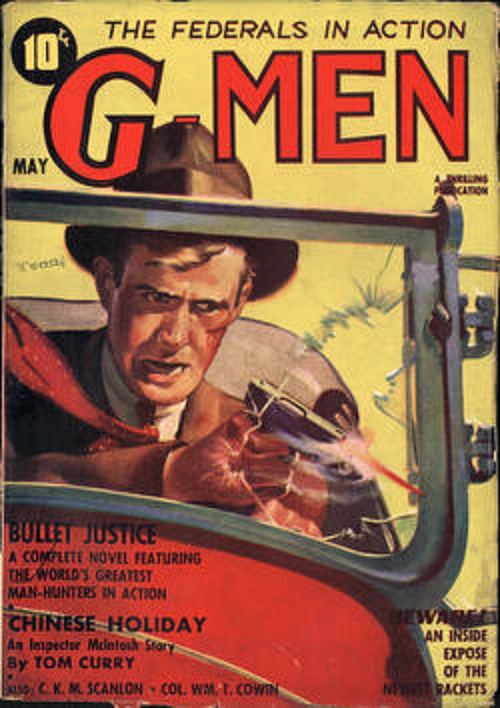
Sunday Morning Bonus Pulp: G-Men, May 1937


The red and yellow color scheme that was so common on Western pulps made it onto covers in other pulp genres as well, for example this issue of G-MEN. I don't know the artist, but I want to say it might be Richard Lyon. I've really enjoyed the Dan Fowler stories I've read over the years and ought to read more of them. The one in this issue of probably by Charles Greenberg, who wrote some Phantom Detective novels that I liked. Tom Curry, Steve Fisher, and Westmoreland Gray have short stories in this issue. Curry's Westerns are long-time favorites of mine.

Sunday, November 21, 2021

Sunday Morning Bonus Pulp: Thrilling Adventures, August 1936


I don't know the artist (Richard Lyon, maybe?), but this is an eye-catching cover on this issue of THRILLING ADVENTURES. Nor am I familiar with Crawford Sullivan, evidently the real name of the author who wrote the featured story. But I know the work of the other authors in this one: Tom Curry, Frederick C. Painton, Jack D'Arcy (D.L. Champion), Chart Pitt, S. Gordon Gurwit, and William Merriam Rouse. An adventurous bunch, indeed!

Saturday, October 02, 2021

Saturday Morning Western Pulp: Thrilling Western, July 1938


Looks like roulette was just as dangerous in the Old West as playing poker, at least according to the cover on this issue of THRILLING WESTERN. I don't know who did the art. The line-up of authors in this issue is solid: Philip Ketchum, J. Allan Dunn, and Tom Curry are the big names, accompanied by Mojave Lloyd (almost surely a pseudonym, but the author's real identity has never been determined, as far as I know), Frank Carl Young, house-name John M. Easterly, and Fridtjof Michelson, not a name you'd think of as belonging to a Western writer, but he wrote for several Western pulps and did some detective yarns, as well.

Saturday, April 24, 2021

Saturday Morning Western Pulp: The Rio Kid Western, Winter 1944/45


I wrote about the paperback reprint of the lead novel in this pulp for my Forgotten Books post yesterday, so here's the cover of the original pulp itself. I don't know who did the cover. In addition to the Rio Kid novel, this issue contains stories by prolific pulpster (and later editor of Monarch Books) Charles N. Heckelmann, Wayne Purcell, who wrote a few stories for the Western pulps in the mid-Forties, and a couple of house-names, Jackson Cole and Reeve Walker.

Friday, April 23, 2021

Forgotten Books: Wagons to California - Tom Curry


Today is the 22nd anniversary of the founding of the WesternPulps email group (more about that later), so I wanted to feature a novel published originally in a Western pulp. I turned to one of my favorite series, the Rio Kid. WAGONS TO CALIFORNIA was published in the Winter 1944/45 issue of THE RIO KID WESTERN, which ran from December 1939 to May 1953. I’ve read probably three-fourths of all the Rio Kid novels, but WAGONS TO CALIFORNIA is one I hadn’t gotten around to yet. It was reprinted in paperback by Curtis Books in 1972, an edition that seems to be pretty rare these days. That’s my copy in the scan, complete with cheap price sticker. (I didn’t pay 25 cents for it, but it was only two bucks in Half Price Books’ nostalgia section when I bought it several years ago, which, it turns out, is not a bad deal.)

At any rate, for those of you unfamiliar with the Rio Kid series, it had a gimmick: its protagonists, former army scout and cavalry officer Captain Bob Pryor and his sidekick Celestino Mireles, always interact with historical characters and sometimes take part in actual historical incidents. In this novel, Pryor and Celestino, along with legendary frontiersman Jim Bridger, are working for General Grenville Dodge and scouting possible routes for the transcontinental railroad along the Humboldt River in Nevada. That’s pretty much it for the historical connections in this one. Our intrepid trio encounter a wagon train that’s in trouble, having been attacked by Indians and now the immigrants are in danger of dying from thirst and starvation. The Rio Kid and his companions help them out, and the pilgrims wind up having to winter in an isolated valley where, wouldn’t you know it, they find gold. There’s also a group of Mormon Avenging Angels on the hunt for the murderer of an LDS bishop, and a Mormon rancher and his sons who may or may not be trustworthy.

Tom Curry, who created the Rio Kid series and wrote more of the novels than anyone else, started his career writing hardboiled yarns for BLACK MASK and other detective pulps, but he became one of the leading Western pulpsters, turning out not only Rio Kid novels like this one under his own name but also dozens of the Jim Hatfield novels in TEXAS RANGERS under the Jackson Cole house-name. His stories are solidly constructed, fast-moving, and always have plenty of action. WAGONS TO CALIFORNIA is no exception. Curry also does a great job with the wasteland setting in this one. I wouldn’t put it in the very top rank of Rio Kid novels, but I enjoyed it a great deal and am glad I got around to reading it. I need to read more of the Rio Kids.

Now, as for the WesternPulps group, when I founded it in 1999, I had no idea it would still be around 22 years later. It began on a platform called OneList, which became E-groups (or was it the other way around, I never can remember), which was swallowed up by Yahoo Groups, and is now on groups.io, where I moved it a few years ago when I saw the writing on the wall and realized Yahoo Groups would be going away. It was either my first or second foray into social media. I may have subscribed to the original Rara-Avis list before that, or I may not have. (Rara-Avis, which Bill Crider told me about, lo, those many years ago, is still around and still active, as well.) Email groups have gone the way of the dinosaurs, for the most part, but as I’ve said before, WesternPulps will be around as long as there’s a platform to host it and I have the mental ability to keep up with it. (No wagering on which of those will go away first!) It’s a low-traffic list, although spirited discussions break out from time to time and it’s the best place to ask any questions someone might have about the Western pulps. There’s also a wealth of bibliographic information and cover scans in the files section, much of it added in the early days when the list was more active and salvaged when I moved things over to groups.io. If any of you would care to join, if only to rummage through the archives, you’re more than welcome and can do so here

Friday, September 14, 2018

Forgotten Books: Pulpwood Days, Volume 2: Lives of the Pulp Writers - John Locke, ed.


I always like reading about authors, especially pulp authors, so PULPWOOD DAYS, VOLUME 2: LIVES OF THE PULP WRITERS is targeted right at me. Edited by John Locke and published by Off-Trail Publications in 2013, I’m just now catching up with it.

This is a collection of twenty articles by pulp authors published in various writer’s magazines such as WRITER’S DIGEST and THE AUTHOR AND JOURNALIST, from the Twenties to the Fifties. Included are articles by a number of Western pulpsters whose work I’m very familiar with: Chuck Martin, Hapsburg Liebe, Tom W. Blackburn, Frank H. Bennett (who wrote Westerns as Ben Frank), and Tom Curry, whose 12,000+ word memoir is the centerpiece of the volume as far as I’m concerned. There are other big names as well: Arthur J. Burks, Steve Fisher, Eustace L. Adams, Thomas Thursday, Harold Q. Masur, and Jean Francis Webb. Then there are the writers I know little or nothing at all about, such as Walter J. Norton, Ludwig S. Landmichl, and Paul E. Triem. All of them have interesting things to say, though.

I’m fascinated by how writers work and the stories behind the stories, so to speak, and there’s plenty of that here. As you’d expect since they’re all by yarnspinners, even articles like these are well-written and entertaining. I really enjoyed this book. There’s a companion volume, PULPWOOD DAYS, VOLUME 1: EDITORS YOU WANT TO KNOW, as well as an earlier collection of writer’s magazine articles by assorted pulpsters, PULP FICTIONEERS. I’ve already ordered copies of both of them. In the meantime, if you’re a fan of the pulps or writing in general, I give this one a high recommendation.

Saturday, September 08, 2018

Saturday Morning Western Pulp: Masked Rider Western, September 1942


This is the pulp in which "Ghost Mine Gold", the Masked Rider novel featured in yesterday's Forgotten Books post, first appeared. It has a decent cover, and that's actually pretty close to how I visualize the Masked Rider when I read the books. Other authors featured in this issue are Tom Curry (who wrote a few Masked Riders himself), the prolific and well-regarded Stephen Payne, Wilton West (an author I know nothing about), and the house-name Jackson Cole.