Sunday, April 30, 2023

Sunday Morning Bonus Pulp: Fantastic Adventures, January 1952


This is a pulp I own and read recently. That’s my copy in the scan. FANTASTIC ADVENTURES was an odd mix of different kinds of fantasy stories with a science fiction yarn sneaking in occasionally. At this point in its run, it was edited by Howard Browne, a good editor and an excellent author in his own right. The cover of this issue is by an artist I associate more with science fiction, Ed Valigursky. He did a lot of covers for the Ace Double science fiction line, I believe.

One thing the Ziff-Davis pulps did that was different from other pulp publishers was to put the word count of each story on the Table of Contents. Those counts probably weren’t completely accurate, but they still give a good approximation of each story’s length. The lead novel in this issue, “Rest In Agony”, comes in at 32,000 words. That’s long enough to call it a novel, as far as I’m concerned. The author, Ivar Jorgensen, was actually Paul W. Fairman in this case. Fairman was a regular in the Ziff-Davis stable, both as a writer and an editor. He doesn’t have a very high reputation in either role, but I’ve always found his work to be enjoyable for the most part. The narrator of “Rest In Agony” is clean-cut young college student Hal Brent. Hal’s Uncle Ambrose dies, but then, after the funeral, Hal gets a phone call from him, begging for help. It seems that Ambrose was involved with a Satanic cult and wrote a book about their activities, and now the members of the cult will do anything to get their hands on that volume, including menacing the lives of Hal and his beautiful teenage sister.

This is an odd story, at times leisurely paced and poetic, almost dream-like, reminding me a little of A. Merritt. Then at other times it’s lurid and over the top like a Weird Menace yarn. There’s some very good writing in it in places, and in other places the prose is rather clumsy. I’ll say this for it, though: it kept me turning the pages. This story is available in an e-book edition as a stand-alone novel under Fairman’s real name, if you’re interested in checking it out yourself and don’t have a copy of this pulp. I enjoyed it while still being aware that it’s hardly a great story. Kind of like most of Fairman’s work that I’ve read.

Geoff St. Reynard was really Robert W. Krepps, best remembered today, aside from his science fiction, as the author of numerous movie novelizations and several well-regarded novels about Africa. His story in this issue, under the St. Reynard pseudonym, is a novelette called “Wrestlers Are Revolting!” Since it was written and published in the Fifties, this story comes from a time when most science fiction writers and readers still considered a centralized, heavy-handed, oppressive government to be a bad thing, so the villains are the political rulers of the Federated Americas. They’ve banned all professional sports except wrestling, since that’s the one where it’s easiest to control the outcome of the matches, and the government-sponsored wrestler known as The Chimera is unbeatable, not only defeating every challenger with his signature move, the Siberian Death Lock, but also killing them in the ring, which is permitted in this era. As always happens in cases of political oppression, an underground has developed, dedicated to overthrowing the Federated Americas, and the movement’s leaders are all wrestlers, including the story’s protagonist Johnny Bell, who wants to be a writer but is forced into wrestling by the government.

Clearly, this is a pretty goofy concept for a story. But it’s so well-written that Krepps makes it easy for the reader to suspend disbelief and just roll with it. It’s very funny in places, too, especially if you’re a wrestling fan. The names, the gimmicks, the way the matches are staged, all that stuff is very familiar to anybody who ever watched much professional wrestling. The Chimera is a classic heel, and Johnny Bell, who competes under the name Bellerophon the Great, is pure babyface. In an accidental prediction, there’s even a wrestler-turned-referee named Paul Bearer! The wrestling part is amusing, the political background is prophetic (especially since the story is set in the early 2020s), and Krepps’ talent elevates what should have been silliness into a very entertaining yarn.

Paul W. Fairman returns under his own name with a short story called “The Secret of Gallows Hill”, which features some nice illustrations by Virgil Finlay. This is a ghost story—or is it?—with its roots stretching back to the Revolutionary War. Fairman springs a pretty nice twist ending in this one, making it one of the better things I’ve read by him.

I don’t know anything about Francis G. Rayer except that he was a fairly prolific but almost completely forgotten British science fiction author. His story in this issue, “When Greed Steps In”, is about a couple of miners competing for a rare, valuable metal on a newly discovered planet. It’s a pretty mild story and also has a twist ending which gives it a little more punch than it might have had otherwise. But it’s hardly memorable.

The issue wraps up with the novelette “Satellite of Destruction” by Ziff-Davis regular Berkely Livingston writing under the pseudonym Burt B. Liston. This is an alien invasion yarn, but rather than the attackers coming to Earth in rocket ships, they arrive in a mobile asteroid that they put into the planet’s orbit as a second moon. This is a fairly intriguing idea, but Livingston doesn’t do much with it, delivering instead a World War II commando yarn with SF trappings. I made it to the end of this story, but just barely. It just didn’t resonate with me.

FANTASTIC ADVENTURES doesn’t have a great reputation as a science fiction/fantasy pulp, and this issue is a good example of why not. One really good (but not great) story by Krepps, two pretty good stories by Fairman, and the other two are readable but not much more. Still, I’ve found something to like in every issue of FANTASTIC ADVENTURES I’ve read, so I’m sure I’ll be picking up another one sometime in the future.

Saturday, April 29, 2023

Saturday Morning Western Pulp: West, January 1949


A simple but very effective cover by Sam Cherry on this issue of the Western pulp with the simplest name: WEST. And of course there's plenty of red and yellow on there, too. The lineup of authors inside includes one of my favorites, Leslie Scott, with a novella, plus the always dependable Johnston McCulley, Larry Harris, and Steuart Emery. Nothing fancy, just good solid Western entertainment, I'll bet.

Friday, April 28, 2023

Gunfighter's Return - Leslie Ernenwein


Leslie Ernenwein was a prolific contributor to the Western pulps from the late Thirties to the end of the pulp era. He also wrote several dozen Western novels and had a successful career as a journalist. I read a couple of his novels many years ago and remember enjoying them, and recently I’ve read a few of his pulp stories and liked them as well. So I figured it was time to read another novel by him and picked up GUNFIGHTER’S RETURN, published originally by Gold Medal in 1950. That’s my copy in the scan. I feel like I should know the artist who did the cover, but I don’t, and there’s no signature that I can see.

This book has a terrific opening paragraph:

Durango died at noon. He didn’t say a word. Didn’t even grunt. He just lay down and died.

I don’t know about you, but something that terse and hardboiled sure makes me want to keep reading. The Durango referred to is the leader of a revolutionary movement in Mexico who was betrayed to the federales by a cantina dancer. He and American gunfighter/soldier of fortune Jim Rimbaud are the only ones who escape an ambush by federal troops, and when Durango dies, Rimbaud is left on his own to make it back across the border to Arizona if he can.

It's no spoiler to say that he does so. The book’s title is GUNFIGHTER’S RETURN, after all. He finds himself back in the cowtown where he recuperated from a gunshot wound a couple of years earlier. There’s a girl there he’s interested in, a pretty redhead who runs a café. After his narrow escape, Rimbaud thinks maybe it’s time for him to give up helling around and settle down.

Yeah, we all know how well that always works out in Western novels, don’t we?

A range war is brewing, and in a nice twist, it’s connected to that failed revolution in Mexico. The man who saved Rimbaud’s life two years earlier is now on the run from the law, framed as a rustler. Rimbaud owes him and is the type who always pays his debts . . . and it doesn’t matter that the hombre he’s indebted to is also engaged to the girl Rimbaud wants for himself.

From this setup, Ernenwein spins an excellent hardboiled Western yarn with plenty of gritty action and a frankness about sexual matters that’s unusual for the era. There’s a large, well-developed cast of characters, a nice sense of time and place, and a pace that never lets up for very long. Jim Rimbaud is a tough but hardly superhuman protagonist. He suffers a lot of punishment in this book but manages to keep slugging away at his enemies.

This is one of the better Westerns I’ve read recently and really makes me want to read more by Ernenwein. Luckily, I have several of his books on my shelves and e-books of several more on my Kindle. If you’re a fan of traditional Westerns, I give GUNFIGHTER’S RETURN a high recommendation.

Monday, April 24, 2023

The Autobiography of Matthew Scudder - Lawrence Block


Is the autobiography of a fictional character still fiction? I think that’s what you’d have to call it. Not that it really matters in this case. Whatever else it is, THE AUTOBIOGRAPHY OF MATTHEW SCUDDER is a very good book.

Those of you who follow Lawrence Block’s career know that he’s been in a contemplative mood the past few years, publishing several books that serve as a look back and summing up not only of his life as a professional writer but also the lives of some of the characters he’s created. A quote from early in this book addresses that: "One reaches an age when the past is as interesting as the present, and a bit less difficult to make sense of."

This tendency can be seen in his most recent novel, THE BURGLAR WHO MET FREDRIC BROWN and in the Matt Scudder collection THE NIGHT AND THE MUSIC and the Scudder novella A TIME TO SCATTER STONES. Block brings this trend to its logical conclusion by letting Scudder tell the story of his life up to the point where Block began chronicling his cases with THE SINS OF THE FATHER. As he has Scudder say in the book, "And what the hell am I writing now? I suppose it's the part between the books, the part you'd skip."

Yes, this concept is pretty meta, as they say. But it works. Since Scudder is the narrator of all the previous novels and stories about him, the voice is the same. Scudder the character takes a few gentle shots at Block the author for changing things in the fiction, such as his birthday. And he fills in the background on events that happened in some of the novels. But for the most part, this is a straightforward telling of Matt Scudder’s life and how he got to the point where the novels take up the story. It’s a tale that is, in many ways, compelling in its ordinariness. Scudder is no superhero, no eccentric genius of a detective, just a fairly ordinary guy with instincts that made him a good cop and unlicensed private detective, a guy with a lot of admirable qualities and a few deep flaws that threaten those better qualities but never quite overwhelm them. You just can’t help liking him, which of course is one of the appeals of the long-running series about him.

THE AUTOBIOGRAPHY OF MATTHEW SCUDDER isn’t a mystery and I’m not sure you can even call it a novel. But it’s a very well-written book that kept me turning the pages and thoroughly entertained me. It’ll be out in June, and you can pre-order the e-book already. I’m not sure what the plans are for print editions, but I know there’ll be some. This is one of the best books I’ve read so far this year, and I give it a very high recommendation.

Sunday, April 23, 2023

Sunday Morning Bonus Pulp: Exciting Mystery, Winter 1943


That's a pretty lurid cover. I don't know the artist. This is the second issue of a very short-lived pulp. EXCITING MYSTERY lasted only three issues. There are some good authors in this issue, including Norman A. Daniels (twice, once as himself and once as Lew Martin), my old mentor Sam Merwin Jr., Dixon Wells (actually writer/editor Samuel Mines), and house name Robert Wallace, who could have been any of those three or somebody else entirely. I'm not sure why EXCITING MYSTERY wasn't as successful as the other Thrilling Group pulps. Looks like good reading to me.

Saturday, April 22, 2023

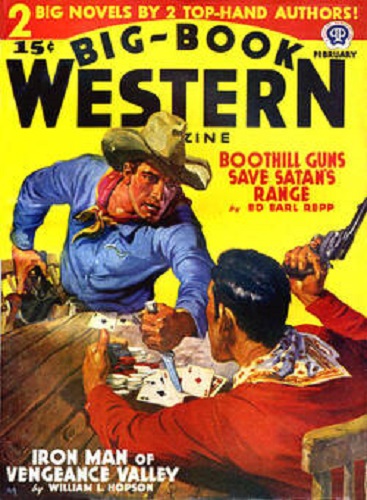
Saturday Morning Western Pulp: Big-Book Western Magazine, February 1941


Yet another example of what should have been a friendly poker game interrupted by gunplay on this issue of BIG-BOOK WESTERN MAGAZINE. Those "2 Big Novels" are actually novellas, of course, but I can't disagree with the "2 Top-Hand Authors" part of that blurb. Given Ed Earl Repp's tendency to use ghostwriters, there's no telling who actually wrote "Boothill Guns Save Satan's Range", but here's the thing: Repp helped plot the ghosted stories and often revised them as well (according to Frank Bonham's famous essay "Tarzana Nights", and as bitter as Bonham was toward Repp, I don't see any reason for him to lie about that), and the ones I've read have all been pretty good no matter who the actual author was. And William L. Hopson, author of "Iron Man of Vengeance Valley" is a long-time favorite of mine. Also on hand in this issue are Tom W. Blackburn, Dee Linford, Jim Kjelgaard, Cliff M. Bisbee, and Le Roy Boyd.

Friday, April 21, 2023

Trailer Tramp - Orrie Hitt


TRAILER TRAMPS, the new triple-decker collection from Stark House, has to have an Orrie Hitt novel in it, of course, and what better one than the similarly named TRAILER TRAMP? Published originally by Beacon Books in 1957, TRAILER TRAMP is Orrie Hitt near the top of his game, although there are some differences in it from his usual books, too.

For one thing, the protagonist of this novel, Joan Baker, isn’t trapped in a hardscrabble existence like many of Hitt’s protagonists. Instead, she’s a smart, hard-working young woman who runs a successful trailer camp established by her parents, who are now taking an extended vacation and have left Joan in charge. So money isn’t a worry as it so often is in a Hitt novel.

Which doesn’t mean that Joan is carefree. She has her personal demons to deal with. She was in love with a young man but after he tried to pressure her into sex and she refused (she’s a virgin), he turned to another girl to get what he wanted. But she still has feelings for the guy, and it doesn’t help when he starts working at the trailer camp.

Then a construction crew putting in a pipeline shows up and the boss of the job, Big Mike Summers, moves his trailer into the camp and Joan is immediately drawn to him. When she gives in to her feelings, she worries that she’s becoming a tramp. (Well, it’s right there in the title, although to be honest, Joan never comes across as particularly trampish.)

Other complications crop up, and although a lot of the book is domestic drama, it becomes a crime yarn as Hitt pulls off several nice twists, leaving the reader unsure of what’s going to happen almost right up to the end of the book.

I know Hitt worked as the manager of a hunting camp, but I don’t recall if he ever had any connection to trailer camps. He must have, because he does a great job with the setting in this book. As in so much of his work, the details of middle-class and lower-class life really have the ring of authenticity. His writing is sharp and the pace moves along at a nice clip. This is fine storytelling.

TRAILER TRAMP is in the top rank of the Orrie Hitt novels I’ve read. Along with TRAILER CAMP WOMAN by Doug Duperrault, it makes this new Stark House collection a solid two-for-two so far. That leaves LOVE CAMP ON WHEELS by Tom Harland, which I’ll be getting to soon. TRAILER TRAMPS is available in both e-book and print editions.


Wednesday, April 19, 2023

The Blazing Land - Hal G. Evarts


There were two Western writers named Hal G. Evarts, father and son. The father was a successful author during the first three decades of the 20th Century. His son was even more prolific during the Fifties, Sixties, and Seventies. THE BLAZING LAND is by Evarts Jr. and is the first thing I’ve read by either of them.

This novel, published as a paperback original by Dell in 1960 and reprinted in 1966 (the edition I read) is set in California and Arizona during the early days of the Civil War. It opens in the sleepy little town of Los Angeles, where rancher Will Colladay is looking for his ne’er-do-well brother Andy. Andy has really gotten himself in trouble this time. Thrown in jail by the army for expressing sentiments in support of the Confederacy, Andy has broken out and killed a soldier in the process. The woman he’s engaged to marry, a beautiful redheaded faro dealer, convinces Will to help his brother escape his pursuers. In order to do that, Will makes a deal with a shady character that puts his ranch at risk, but he succeeds in getting Andy away from Los Angeles and together with the redhead, who insists on coming along, they head for Mexico with the intention of eventually getting back to Texas and joining in the fight on the side of the South.

But to get there, they have to take a roundabout route through the Mojave Desert, which means they’ll have to survive the elements, hostile Indians, treacherous whites, and pursuit from the military, not to mention clashes with each other.

THE BLAZING LAND is a little slow to get started, but once it does, it becomes more hardboiled and suspenseful. Evarts does a great job with the setting and the characters are all well-developed and interesting, with some really despicable villains. (Some of you may have noticed that I like books with really despicable villains.) The outcome is maybe a little bit predictable and the book could have used a few more action scenes, but overall, I think it’s a really solid traditional Western. I definitely plan to read more by Evarts Jr. I have a few books by Evarts Sr., too, and I may even get around to them one of these days.


Monday, April 17, 2023

Peril at End House - Agatha Christie


I read a bunch of Agatha Christie novels when I was in junior high and high school, beginning with THE BODY IN THE LIBRARY, which I checked out of the school library when I was in the sixth grade. (Just for the record, that’s the same year I read GOLDFINGER by Ian Fleming and THE DEEP by Mickey Spillane. My reading tastes were nothing if not varied.) At any rate, my favorites of Christie’s work have always been the Hercule Poirot novels. There are a number of them I’ve never read, so I pick one up now and then and revisit an old friend.

Which brings us to PERIL AT END HOUSE, originally published in 1932. It’s the sixth novel in the series, and as it opens, Poirot is already talking about being retired. He and Captain Hastings, his friend/Watson/narrator, are vacationing at a resort hotel on the southern coast of England. Visible from the hotel’s terrace is a big, old house set on a point of land that juts out into the sea. That’s the End House of the title, of course. On a pleasant afternoon, Poirot and Hastings are sitting on the terrace when they see an attractive young woman cutting through the garden between the hotel and End House. Then somebody takes a shot at her, narrowly missing her. She doesn’t even realize how close she has come to death, but Poirot does, and when he questions her, he discovers that this is the fourth attempt on her life in as many days.


Well, Poirot can’t stand to see such villainy right under his mustaches, of course, so he sets out to discover who wants the young woman dead. That leads him and Hastings into a complex plot involving drugs, a missing will, fireworks, poisoned chocolates, a secret chamber, a large fortune, a séance, and, naturally, murder.

Christie is famous for her plotting, and justly so, but I’ll be honest, I figured out all but a few details in this one well before the end, including the murderer’s identity. That didn’t really detract from my enjoyment of the book, though. Christie writes really well, with good characterizations, some sharp social commentary (her books are usually considerably darker than what you think of when you think about cozy mysteries), and a really fast pace, especially when you consider the fact that the books consist mainly of people standing around talking to each other. (There’s a little action, and some books have more of it than others.) The banter between Poirot and Hastings always leaves me feeling a little sorry for Hastings, but at the same time you get a sense of the deep friendship between the two of them.

I had a really good time reading PERIL AT END HOUSE. It took me back to those long-ago days when I was devouring Christie novels. I may just read more of them. The past is looking more and more appealing to me.


Sunday, April 16, 2023

Sunday Morning Bonus Pulp: Ten Detective Aces, November 1942


For some reason, I've always liked those TEN DETECTIVE ACES covers with the red borders around them. It's a nice distinctive look. And I always love Norman Saunders covers. This one is no exception. Great action and details and that's a really good-looking woman. The stories inside are by some authors who ain't half-bad, either: Frederick C. Davis, Walker A. Tompkins, Norman A. Daniels, Harold Q. Masur, Joe Archibald, Lee E. Well, Stuart Friedman, plus a couple I hadn't heard of, Ken Kessler and Jimmy O'Brien, plus house name Guy Fleming. A couple of those authors, Tompkins and Wells, are best known as Western writers, but Davis and Archibald wrote quite a few Westerns, too, and Daniels did a few.