Showing posts with label Ed Earl Repp. Show all posts

Saturday, September 12, 2026

Saturday Morning Western Pulp: Top-Notch Western, August 1938


This issue of TOP-NOTCH WESTERN has a decent cover by H.W. Scott. The lead novella is by Norton L. James. I've read speculation that that's a pseudonym for Ray Nafziger, but it's never been confirmed and probably never will be. We do know for sure that Brad Buckner, who also has a story in this issue, was actually Ed Earl Repp. Repp doesn't have a story under his real name in this one, so I'm not sure why he used the Buckner pen-name. Also on hand are Rolland Lynch, a prolific Western pulpster who's forgotten these days, the even more obscure James W. Egan and Frank H. Richey, and house-name John Cannon. Not a top of the line Western pulp despite its name, but probably worth reading. I don't believe I've ever seen an actual issue of TOP-NOTCH WESTERN.

Saturday, May 02, 2026

Saturday Morning Western Pulp: Western Short Stories, September 1938


J.W. Scott liked to use blondes on his Western pulp covers instead of redheads, but he teams them with the usual Stalwart, Red-Shirted Cowboy and Wounded Old Geezer, as on this issue of WESTERN SHORT STORIES. Ed Earl Repp is the author with the biggest name in this one, and he's on hand twice, once as himself and once as Brad Buckner. Other authors include the distinctively named Carmony Gove, Jack Sterrett, Rolland Lynch, Nels Leroy Jorgensen, Harold F. Cruickshank, Luke Tyler (who sounds like a house-name but apparently wasn't), and Ken Jason and John Cannon, who were house-names. I don't own this issue or any other issues of this pulp, as far as I remember, but it looks pretty good. For a lower-rung Western pulp, WESTERN SHORT STORIES ran a long time, from December 1936 to January 1957.

Saturday, December 20, 2025

Saturday Morning Western Pulp: Western Novel and Short Stories, March 1939


I really like the dramatic cover on this issue of WESTERN NOVEL AND SHORT STORIES. I think it's by J.W. Scott, but as always when it comes to art, I could be wrong about that. I'm not familiar with the author of the lead novel, James Dorn, but he appears to have been very prolific over a two-year span from 1939 to 1941, turning out two dozen stories, mostly novellas and novelettes, during that period. Then nothing. Such things always make me wonder what happened to cut short what appeared to be a promising career. Or was James Dorn a house-name? Likely we'll never know. Ken Jason, definitely a house-name, also appears in this issue, as do Ed Earl Repp and Mojave Lloyd. I don't own this issue, and the copy in the scan from the Fictionmags Index has some water damage, but it looks like a mighty fine Western pulp anyway.

Saturday, August 02, 2025

Saturday Morning Western Pulp: All Western Magazine, August 1936


This is a pulp that I own and read recently. That’s my copy in the scan, with a cover by Arthur Mitchell, an almost forgotten but consistently pretty good artist who did most of the covers for ALL WESTERN MAGAZINE. This was Dell’s flagship Western pulp (maybe its only Western pulp, I don’t really know), and although I haven’t read many issues, they’ve all been good so far.

This issue leads off with the novella “Deuce of Diamonds”, the second in a short-lived series by Charles M. Martin about a drifting cowboy and troubleshooter known as Roaming Reynolds. There are three stories in the series. I don’t have the first one, but I do have the third one in addition to this one and will be getting to it soon, I expect. In this one, Reynolds and his sidekick, a 16-year-old cowpoke called Texas Joe, drift their way into a range war when they interrupt a setup by two hardcases intended to result in the death of a rancher’s son. This leads to a bunch of action in the next twenty-four-hour span, including ambushes, fistfights, the discovery of a rustled herd, and a stampede.

Martin, who also wrote a lot for the pulps as Chuck Martin, has a distinctive style that I enjoy, although he does get pretty heavy-handed with the “Yuh mangy polecat” dialect. And his plots are very traditional, nothing that Western pulp readers haven’t encountered many times before. But he spins his yarns with such enthusiasm that I can’t help but enjoy them. Martin was a colorful character who supposedly made little grave markers for the villains he killed off in his stories and planted them in his backyard. I like his work, but reading it is always a slightly bittersweet experience for me because, like Walt Coburn, he eventually committed suicide. Making a living in the pulps definitely took a toll on some writers.

Sam H. Nickels was another Western pulp author who turned out hundreds of stories, many of them in a long-running series in WILD WEST WEEKLY about a couple of cowboys nicknamed Hungry and Rusty. He also wrote many stand-alone stories under the house-names common in that pulp. Now and then he published a story under his own name in a different pulp, such as “Mud in Mooney’s Eye” in this issue of ALL WESTERN MAGAZINE. The protagonist is known as Mournful Mooney because of his sad disposition, which is caused by his habit of running afoul of the law. Mooney, despite not looking like much, is hell on wheels when it comes to shooting and fighting. He seems like he ought to be a series character, too, but as far as I know, this is his only appearance. In it, he’s hired as a lawman to tame a wild town. The results are entertaining, if not particularly memorable. Nickels was a decent writer.

Harry F. Olmsted is one of my favorite Western pulp writers. He’s almost completely forgotten because he never wrote any novels, but he turned out more than 1200 pieces of shorter fiction. His story in this issue, “Empty Shells”, is about a sinister gunfighter who turns up in a frontier town looking for the son of a local rancher who has just taken over the spread after his father passed away. Clearly, the gunman is there to settle a score with the young man, who was something of a shady character himself, running with outlaws, before coming home and trying to settle down. Of course, Olmsted is too good a writer not to put a twist on what seems apparent. The prose is spare and clean, the dialogue isn’t overloaded with dialect (although there is a little), and the suspense builds steadily throughout this one. “Empty Shells” is an excellent story and a good example of why I enjoy Olmsted’s work so much.

Carson Mowre is better remembered as a pulp editor rather than a writer, but he turned his hand to fiction, too, now and then, and published several dozen stories, most of them Westerns. He contributes a novelette, “One Night in Ten Sleep”, to this issue. As the title indicates, all the action takes place in one night in the frontier settlement of Ten Sleep, where a stranger called Tennessee Parker rides into town and finds himself in the middle of a war between a crooked judge on one side and a crooked sheriff and deputy on the other. Parker plays the two sides against each other (I was reminded a little of Hammett’s RED HARVEST) because he has an agenda of his own that doesn’t become clear until the end of the story. This one features some of the most brutal and graphic violence I’ve encountered in a Western pulp yarn. It has interesting characters, the pace is swift and never really lets up, and I really enjoyed it. I’ll have to keep an eye out for more of Mowre’s fiction.

I normally don’t read the non-fiction features in Western pulps, but one in this issue caught my attention. It’s “The Blond Cossack” by Ed Earl Repp, whose work I usually enjoy. This is an interesting article about an outlaw known as Russian Bill, who was part of the Cowboy faction in Tombstone along with the Clantons and Johnny Ringo. Russian Bill claimed to be the son of a princess and told people he was forced to flee from Russia for political reasons after being a Cossack there. Whether there was any truth to that story remains unknown, but Repp’s recounting of it is vivid and interesting. Repp was known to use ghostwriters and the prose in this is a little toned down from his fiction, so another writer may have had a hand in it, but the Cossack parts of it read like Repp’s work to me.

I love S. Omar Barker’s cowboy poetry and the non-fiction columns he wrote for RANCH ROMANCES and TEXAS RANGERS, but his fiction usually isn’t to my taste. For ALL WESTERN MAGAZINE, he wrote a series of humorous stories about a yarn-spinning old cowboy named Boosty Peckleberry. In this issue’s “All Ears”, Boosty is telling his bunkhouse mates about an alcoholic mule named Napolean. I’m sorry to say that I didn’t make it all the way through this one. This sort of stuff just doesn’t resonate with me, but I’m sure plenty of readers found it funny and charming because Barker was very popular for a long time.

Like Charles M. Martin, J.E. Grinstead was an actual cowboy at one time in his life, and his stories have a ring of authenticity. “Six-Gun Music” begins with a violent encounter in a saloon between a down-on-his-luck stranger and a local gunman/bully, and that leads to rustling and ambushes. I’ve enjoyed what I’ve read by Grinstead in the past, and this is one of his best stories.

Galen C. Colin is another very prolific pulpster who’s mostly forgotten today. His story “Death Takes the Trail” is actually a dying message mystery, although not a very complicated or clever one. It leads to a good action scene, though. While I’ve read better by Colin, this is an okay yarn.

Overall, this issue of ALL WESTERN MAGAZINE is a solidly entertaining Western pulp. The stories by Olmsted, Mowre, and Grinstead are the best, and the others are all enjoyable with the exception of the S. Omar Barker tall tale, and other readers might like that a lot better than I did. I have several more issues of ALL WESTERN on hand and will be getting to them soon, I hope.

Saturday, July 26, 2025

Saturday Morning Western Pulp: Western Fiction Magazine, August 1938


I don't know who did the cover artwork on this issue of WESTERN FICTION MAGAZINE. There's a signature on the painting, but I can't make it out. As always, if anyone can identify the artist, I'll greatly appreciate it. But what I do know is that it's yet another appearance of our favorite Western pulp cover trio: the Stalwart Cowboy, the Angry Redhead (she's not totin' a gun in this one, but she is showing a nice amount of leg in that saddle), and the Wounded Old Geezer. Inside this issue are stories by the always dependable Ed Earl Repp (aided, perhaps, by an unknown ghost) and Orlando Rigoni, plus house-name Rex Evans, and another pulpster unknown to me, Dick Robson, who was reasonably prolific for a while, turning out two dozen stories in a short-lived career from 1937 to 1940.

Saturday, June 14, 2025

Saturday Morning Western Pulp: Gun-Swift Western, September 1938


This is a pretty obscure Western pulp. I don't know how many issues there were, since only one has been indexed on the Fictionmags Index. This is Volume 1, Number 5. Nor do I know who painted the cover. But the group of authors inside is a decent one: Ed Earl Repp, J.E. Grinstead, Hapsburg Liebe, Carmony Gove, and Clem Yore. Those hombres generally knew what they were writing about.

UPDATE: On Facebook, John Locke provided some information from the magazine AUTHORS & JOURNALISTS about GUN-SWIFT WESTERN and its editor/publisher (?) Z.S. Sklar. From the October 1939 issue:

Who Is Z.S. Sklar?

Col. John J. Boniface, who writes under the pseudonym of Wilton West and various others for the adventure magazines, sends us a heavy sheaf of correspondence which he defines as a serial entitled, "The Mystery of Z.S. Sklar."

The opening installments of this engrossing serial relate to the call of a magazine entitled Gun-Swift Western, of 19 Avon Place, Springfield, Mass., for manuscripts. The call brought a manuscript last spring from Col. Boniface under one of his pennames, Gordon Strong. Not hearing from the manuscript, the author wrote several letters of inquiry, which were never answered, although the letters were not returned. The Railway Express Agency, in whose hands the matter then was placed, had no better luck, reporting: “Unable to contact the party.”

THE AUTHOR & JOURNALIST, writing in behalf of the author, had a little better luck. In response to its inquiry, came a brief typewritten note: “Magazine has been discontinued.--Z.S. Sklar.”

Acting on this information, the author put the matter into the hands of the post office department. Though declining to take action, the inspector at Boston, Mass., informed him that other writers had complained, and reported that their manuscripts were later returned by the Double-Action Publishing Co., of New York. But Cliff Campbell of the D-A group reported when queried that he had no record of the yarn.

Final appeal was made to the police department of Springfield--and here the mystery not merely persisted, but deepened. Quoting from the letter of John L. Maloney, chief of police:

“While I have caused a thorough investigation to be made, I am unable to locate Z.S Sklar or the Gun-Swift Western magazine at 19 Avon Place, this city. Inquiries were made of the janitor of the above-mentioned address, which is an apartment block in the residential section, who informed our investigating officer that Sklar or this magazine company which you mention has never been located at that address. Inquiries were also made of the letter carrier who delivers mail in this district, who states that he has never delivered mail to Sklar at 19 Avon Place. He is not receiving mail at our local post office. His name does not appear in our city or telephone directory.”

Evidently it all never happened--but others who are in like position must join the author in wondering how come that the magazine did receive manuscripts at that address, return some, and contrive that others were returned through the Double-Action group. We hate to see a masterly and persistent job of sleuthing for a lost manuscript, such as that conducted by Col. Boniface, end up in a blind trail.
 
From the November 1939 AUTHOR & JOURNALIST:
 
Responding to the editorial in our last issue, relating to the mystery of Gunswift Western and Z.S. Sklar, Louis H. Silberkleit, president of Winford Publications, Inc., writes: “Gunswift Western was not connected in any way with the Double Action Group. It so happens that when the magazine was discontinued, the editor, who certainly did run his business from 19 Avon Place, Springfield, Mass., approached us for a job, and was hired. He asked if we would permit him to have his mail forwarded from Springfield to this office. We said yes. That's all we know about the situation.”

I'm always fascinated by stuff like this, and many thanks to John Locke for providing it.

Saturday, February 08, 2025

Saturday Morning Western Pulp: Western Yarns, March 1943


This is a fairly short-lived Western pulp from Columbia Publications, edited, as usual, by Robert W. Lowndes. I don't own this issue or, for that matter, any issues of WESTERN YARNS. But the cover caught my eye. It's by Sam Cherry and is one of Cherry's earliest Western pulp covers. A pretty good job, too, if you ask me. All the authors inside are well-known Western pulpsters: Ed Earl Repp, Archie Joscelyn, Lee Floren, Chuck Martin, and Ralph Berard. Maybe not the same level as the usual authors in WESTERN STORY or DIME WESTERN, but still some enjoyable yarn-spinners there.

Sunday, December 15, 2024

Sunday Morning Bonus Pulp: Amazing Stories, January 1944


I really like the cover by Robert Fuqua on this issue of AMAZING STORIES. It's certainly dramatic. William P. McGivern is the dominant author in this one with three stories: the lead novella under his own name, a novelette as P.F. Costello, and a short story as Gerald Vance. Also on hand are the always-dependable Ross Rocklynne, the always-interesting Ed Earl Repp, and Berkeley Livingston, an author whose work I haven't read enough of to form an opinion. If you want to check out this issue for yourself, PDFS of it and a lot of other issues of AMAZING STORIES can be found here.

Saturday, April 22, 2023

Saturday Morning Western Pulp: Big-Book Western Magazine, February 1941


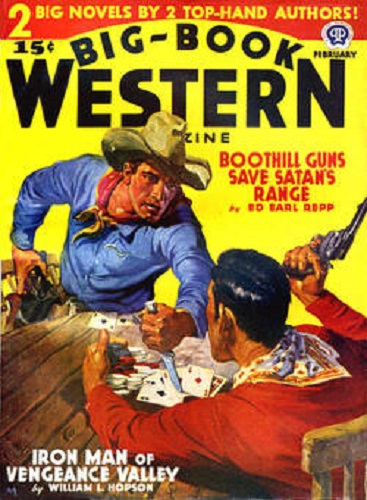
Yet another example of what should have been a friendly poker game interrupted by gunplay on this issue of BIG-BOOK WESTERN MAGAZINE. Those "2 Big Novels" are actually novellas, of course, but I can't disagree with the "2 Top-Hand Authors" part of that blurb. Given Ed Earl Repp's tendency to use ghostwriters, there's no telling who actually wrote "Boothill Guns Save Satan's Range", but here's the thing: Repp helped plot the ghosted stories and often revised them as well (according to Frank Bonham's famous essay "Tarzana Nights", and as bitter as Bonham was toward Repp, I don't see any reason for him to lie about that), and the ones I've read have all been pretty good no matter who the actual author was. And William L. Hopson, author of "Iron Man of Vengeance Valley" is a long-time favorite of mine. Also on hand in this issue are Tom W. Blackburn, Dee Linford, Jim Kjelgaard, Cliff M. Bisbee, and Le Roy Boyd.

Saturday, September 17, 2022

Saturday Morning Western Pulp: .44 Western Magazine, October 1940


Well, there's a cover that's coming right at you. I don't know the artist. I thought that little squiggle by the left stirrup might be a signature, but if it is, I can't make it out. Whoever painted it did a good job. .44 WESTERN MAGAZINE, like all the Popular Publications Western pulps, had good covers, good authors, and great story titles. Authors in this issue include Ed Earl Repp, Lee Floren, John G. Pearsol, Jay Karth, Le Roy Boyd, Jack Sterrett, and Eugene R. Dutcher. Maybe not an all-star lineup but probably worth reading.

Saturday, August 28, 2021

Saturday Morning Western Pulp: Western Novel and Short Stories, October 1938


We have three characters in the J.W. Scott cover on this issue of WESTERN NOVEL AND SHORT STORIES, but it's not the usual trio of Stalwart Cowboy, Wounded Old-timer, and Angry, Gun-Totin' Redhead. Even so, this is a pretty effective cover. I like the jodhpurs on the blonde. Inside are stories by Ed Earl Repp, as himself and as Brad Buckner, Rolland Lynch, Carmony Gove, and Ken Jason, a house-name used by, among others, D.B. Newton, Jonathan Glidden (better known as Peter Dawson), Bennie Gardner (better known as Gunnison Steele), Victor H. White, and editor Robert O. Erisman. So there's really no telling who wrote the Ken Jason story in this issue. I like the story's title, though: "Gun Raiders of Silver City". "Last Notch in a Killer's Colt" and "Satan's Gun-Ghost" are also good titles.

Saturday, July 17, 2021

Saturday Morning Western Pulp: Western Adventures, August 1941


WESTERN ADVENTURES was Street & Smith's third-string Western pulp after WESTERN STORY and WILD WEST WEEKLY, but it had plenty of good authors and stories in it. This issue features yarns from Brad Buckner (really Ed Earl Repp) and Rolland C. Lynch (rumored to have ghosted for Ed Earl Repp), plus William R. Cox, Nels Leroy Jorgensen, Jim Kjelgaard, M. Howard Lane, and Kenneth L. Sinclair, none of whom have anything to do with Ed Earl Repp, as far as I know.

Saturday, November 07, 2020

Saturday Morning Western Pulp: .44 Western Magazine, October 1946


Something of a rarity on this issue of .44 WESTERN, a cover by Sam Cherry on a pulp not published by the Thrilling Group. But as usual with a Western pulp published by Popular Publications, there are some great authors and titles. For example, "A Hundred Wagons, Rolling to Hell!" by Tom Roan and "Gun-Brothers of the Brimstone Border" by Ed Earl Repp. You don't get more Popular Publications Western pulp than that. Other authors on hand are Joseph Chadwick, Lee E. Wells, M. Howard Lane, and Harry Van Demark, as himself and as Jared Kingsley.

Saturday, April 25, 2020

Saturday Morning Western Pulp: Western Short Stories, December 1938


We have an Angry, Gun-Totin' Blonde on the cover of this issue of WESTERN SHORT STORIES, but the Stalwart, Red-Shirted Cowboy and the Wounded Old Geezer are right there with her. Inside is a very solid line-up of Western pulpsters including Harry Sinclair Drago, W.T. Ballard, Ed Earl Repp, Nels Leroy Jorgensen, and Rolland Lynch. This isn't really a well-known Western pulp, but it looks pretty good to me.

Saturday, July 27, 2019

Saturday Morning Western Pulp: 10 Story Western Magazine, August 1941


I really like the action-packed cover on this issue of 10 STORY WESTERN MAGAZINE. I don't know who the artist is, but he did a fine job of coming up with a dynamic cover. The authors inside are no slouches, either: Harry F. Olmsted, Tom W. Blackburn, Cliff Farrell, Ed Earl Repp, David X. Manners, Dave Sands (a house name) and Rutherford Montgomery (who went on to write a bunch of popular juvenile novels about animals) are the best known names.

Saturday, July 06, 2019

Saturday Morning Western Pulp: Action-Packed Western, December 1938


Based on the cover by A. Leslie Ross, this probably is an action-packed issue of ACTION-PACKED WESTERN. As usual with this publisher, Chesterfield Publications (later Columbia), we get some stories by house-name authors Cliff Campbell and Mat Rand, but the prolific Ed Earl Repp (or one of his ghosts) and S. Omar Barker are on hand, too, so I'll bet there's some good reading to be had here. Heck, I've liked most of the stuff I've read by "Campbell" and "Rand".

Saturday, March 02, 2019

Saturday Morning Western Pulp: Big-Book Western Magazine, January 1940


I'm used to the stories in Popular Publications' Western pulps having great titles, but "When It's Roundup Time in Hell" is particularly awesome, although the author, Rolle R. Rand, is unfamiliar to me. The FictionMags index lists thirteen stories by him, all in various Popular Publications Western pulps, in a period of a little more than a year in 1939 and early 1940. He has one more story in an Armed Services edition anthology in 1944, then a gap of more than forty years before his by-line appears on a single story in MIKE SHAYNE MYSTERY MAGAZINE in 1985, followed by one story in ESPIONAGE in 1986, then one final story in something called WHISPERING WILLOW MYSTERIES (evidently a small press publication) in 1997. That's an odd career, and I can't find anything about him on-line. Elsewhere in this issue of BIG-BOOK WESTERN are some much more familiar names, such as Harry F. Olmsted, Ed Earl Repp, and John G. Pearsol. There's even an appearance on the cover by the Angry Gun-Totin' Redhead, although the guy with her is a lawman, not the Stalwart Cowboy, and there's no sign of the Old Geezer with the Bandaged Head.

Saturday, December 15, 2018

Saturday Morning Western Pulp: Ace-High Western Stories, September 1941


I don't think the art is great on this issue of ACE-HIGH WESTERN STORIES, but the scene has a really dynamic feel to it that I like. And since this is a Popular Publications pulp, you know there'll be some good authors inside and some memorable story titles (most of them come up with by the editor, no doubt). The authors in this issue include Ed Earl Repp, Barry Cord (Peter Germano), Gunnison Steele (Bennie Gardner), Jim Kjelgaard (of juvenile dog novel fame; one of my favorite writers when I was a kid), Rolland Lynch, Dabney Otis Collins, Ralph Berard (Victor White), and Jack Bloodhart. As for titles, you've got "Steel Tracks Through Hell", "The Gun-Cub's Turn to Howl", and "That Die-Hard Texan!", among others. I'd read those.

Saturday, September 01, 2018

Saturday Morning Western Pulp: Western Novel and Short Stories, October 1938


There's a lot of red on this cover by J.W. Scott, but I think it works. It's pretty eye-catching, which was the whole idea. The author of the featured novella, Ken Jason, was actually a house-name, so there's not much telling who really wrote it. Other authors in this issue of WESTERN NOVEL AND SHORT STORIES are Ed Earl Repp (twice, once as himself and once as Brad Buckner--and of course, one or both stories may have been farmed out), Rolland Lynch, and Carmony Gove.

Sunday, May 06, 2018

Sunday Morning Bonus Pulp: Double-Action Gang, February 1937


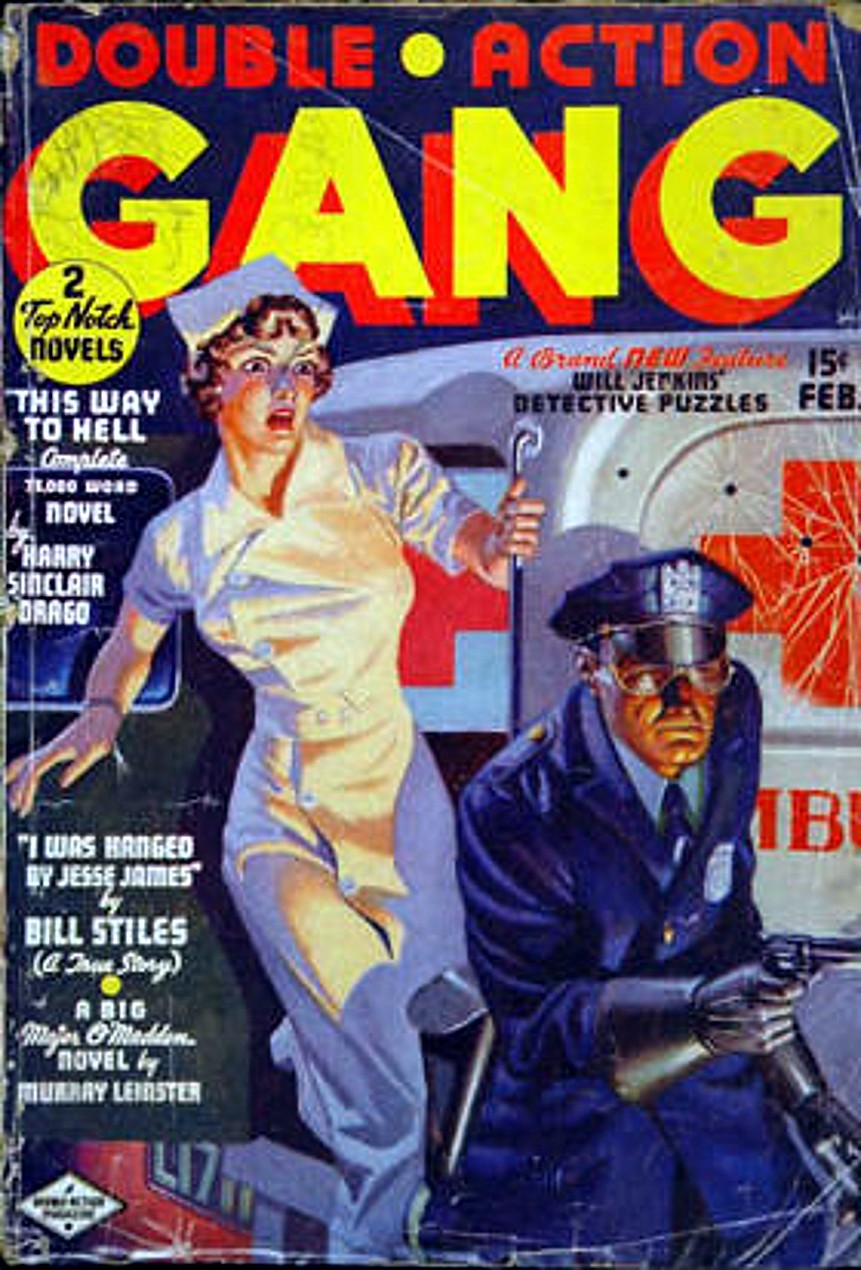
I've never read much from the gang pulps, but this issue of DOUBLE-ACTION GANG looks like a pretty good one, and a bit unusual, too, because most of what's inside it was written by a pair of authors much better known for their Westerns. The featured novel "This Way to Hell", which fills up about two-thirds of the issue, is by Harry Sinclair Drago, who had a long, prolific career as a Western novelist and pulpster under his own name and the pseudonyms Bliss Lomax and Will Ermine. The supposedly true story about the Jesse James gang attributed to Bill Stiles is actually by Ed Earl Repp. And there are two stories by Will F. Jenkins, one under his own name and one under his much more famous pseudonym Murray Leinster. While Jenkins/Leinster isn't really famous as a Western author, he wrote quite a few of them. On top of all that, I like the cover. If I actually owned a copy of this pulp, I'd read it, you can count on that.