Saturday, November 12, 2022

Saturday Morning Western Pulp: Thrilling Ranch Stories, May 1950


I'm pretty sure I've never read an issue of THRILLING RANCH STORIES. It generally had pretty good covers, though, like this one, which I want to say is by Kirk Wilson, although it might be Sam Cherry's work. Some solid authors in this issue, as well, including Johnston McCulley (writing as Raley Brian), Tom Curry, Ray Townsend, Cliff Walters, and Harold F. Cruickshank (not a favorite of mine, but a lot of readers liked his work).

Friday, November 11, 2022

Sexton Blake: Dark Mambo - W. Howard Baker


The only Sexton Blake stories I’ve read have been from the early 20th Century when he’s a Sherlock Holmes-like “consulting detective”. But later in the character’s career, he’s more of a regular private eye type. I recently read my first Blake novel from that era, DARK MAMBO by W. Howard Baker, published in July 1956 as Sexton Blake Library, Series 4, Number 361 . I read it on the Comic Book Plus website, which has more than 250 Sexton Blake novels and stories scanned, ranging from 1919 to 1958.

This one opens on a rainy Sunday afternoon in London. Blake is in his office alone, wrapping up a report on a case, when the telephone rings. It's a potential client wanting Blake to come see him at once. He doesn’t explain what it’s about, but Blake is intrigued by the man’s seeming sense of desperation and agrees to pay him a visit.

When he gets there, he finds that the caller is a wealthy man whose mistress, a beautiful blond nightclub singer, is lying on a rug in his study with her throat cut. She’s been blackmailing him, so he knows he’ll be the prime suspect in her murder. He hires Blake to find the real killer. Before long, another woman is killed the same way.

Aided in his investigation by his beautiful blond secretary Paula Dane (there are several beautiful blondes in this book) and following a trail that leads to Madrid, Blake uncovers connections between the victims and a couple of shady nightclub owners, a handsome young bullfighter, and the beautiful widow of a high-ranking Nazi officer. Unraveling the whole thing puts both Blake and Paula in danger.

As I was reading this, something about it struck me as familiar. I knew that I hadn’t read it before, but eventually I realized that it reminded me of the sort of Mike Shayne story that showed up a lot in MIKE SHAYNE MYSTERY MAGAZINE. Move the opening scene from London to Miami and it would work just fine. There’s even an antagonistic cop and a friendly cop, like Peter Painter and Will Gentry in the Shayne stories. Blake gets knocked out and taken for a ride by the bad guys, and that’s certainly a scene I’ve read (and written) before. Paula Dane even serves as a Lucy Hamilton sort of character.

I’m not saying there’s any connection between Blake and Shayne. Not at all. It’s more a matter of just remarking on the similarities that crop up in the genre. And for all I know, W. Howard Baker may well have read some of the original Mike Shayne novels. Baker was a prolific British paperbacker who’s probably best known in the United States for writing some of the tie-in novels based on the Patrick McGoohan TV series SECRET AGENT. Macfadden-Bartell published several of them in paperback in the U.S. His prose in DARK MAMBO is functional, pretty meat-and-potatoes most of the time, but you can tell that he’s at least attempting to be more poetic in a noirish way now and then. He does a decent job of it, too.

I enjoyed DARK MAMBO quite a bit. I plan to read more of those Sexton Blake, Private Eye yarns. Short, fast-moving, and fun really fits the bill of what I’m looking for most of the time these days.

Sunday, November 06, 2022

Sunday Morning Bonus Pulp: Argosy, July 6, 1940


"Three Big Serials Every Week!" boasts this ARGOSY cover, and that's exactly what makes this one of the most frustrating pulps. ARGOSY published a ton of great stories and novels, but if you're like me, you like to have all the installments of a serial at hand before you start reading it. Which means that for a lot of issues, I read the short stories and novelettes but never got around to the serials. I'm pretty sure I owned a copy of this issue many years ago, but I don't think I ever got around to reading any of it. I like this cover by Marshall Frantz, who did relatively few pulp covers but was a prolific interior illustrator. There are plenty of good writers in this issue: Richard Sale, Jack Byrne, John Myers Myers, Robert Arthur, Kurt Steel, and Louis C. Goldsmith. ARGOSY was at its best in the Thirties but remained pretty strong on into the Forties.

Saturday, November 05, 2022

Saturday Morning Western Pulp: Cowboy Stories, July 1935


That's a nice dramatic cover on this issue of COWBOY STORIES. I don't know the artist, but he did a good job. Other than James P. Olsen and S. Omar Barker, this issue doesn't have many well-known authors on hand. The other stories are by Jay Kalez, William E. Brandon, Eben Garrett, Victor Kaufman, Paul R. Morrison, Butler Van Steenbergh, Carl F. Happel, and house-name Ken Martin. It's understandable if you're saying "Who?" in response to most of those. Doesn't mean the stories aren't enjoyable, though.

UPDATE: This cover is by Tom Lovell. Thanks to those who identified it as his work.

Friday, November 04, 2022

The Case of the Buried Clock - Erle Stanley Gardner


As I’ve mentioned before, the short Pocket Books editions with Robert McGinnis covers are the classic Perry Mason editions as far as I’m concerned. They’re the ones I saw on spinner racks and in used bookstores when I was growing up in the Sixties. (I’m also fond of the Triangle Books cheap hardback reprints published by Blakiston, many of which I checked out from our local library, but that’s probably the subject of another post.)

This Mason novel was published originally by William Morrow in 1943. The copy I read, which is the scan above, is the ninth Pocket Books printing from November 1962. So it’s sixty years old this month and in great shape for its age, square and uncreased and with only lightly tanned pages. But is it any good, you ask? Well, it’s a Perry Mason novel. Of course it’s enjoyable . . . but with a few reservations.

Most of the Mason novels start with a potential client showing up at Perry’s office and being announced by Della Street. This is one of the rare entries where Erle Stanley Gardner introduces most of the major characters and sets up the situation before Perry, Della, and Paul Drake ever appear. We have a mountain cabin belonging to a wealthy banker, the banker’s beautiful unmarried daughter, the banker’s other, somewhat less attractive daughter who’s married to a cad and a bounder, a stalwart GI who’s been wounded in action, discharged, and sent home to recuperate, a beautiful widow who runs a nearby ranch, an artist/wildlife photographer (who seems perfectly healthy; why isn’t he off fighting in the war?), yet another beautiful young woman and her brother, an abandoned mine, and the buried clock of the title, which is set for the wrong time.

Naturally, there’s a murder at the cabin, Perry is hired to defend the person put on trial for the crime, and the final third of the novel is a series of courtroom scenes with Perry sparring against a new opponent, an assistant district attorney named McNair, before the prosecution brings in poor old Hamilton Burger to deliver the knockout punch and finally convict one of Perry’s clients. Yeah, right.

The plot is the usual complicated stew of motives and deceptions, and the large cast of characters (some of whom are just names and never actually appear in the book) make the story hard to follow at times. The clock seems to be forgotten for most of the book before it plays a major part at the end, and the killer’s motive really seems to come from farther out in left field than usual in these books. Because of that, I can’t put THE CASE OF THE BURIED CLOCK in the top rank of Perry Mason novels, but it’s still quite a bit of fun to read anyway. At this point in the series, Perry is farther away from his pulp roots, but he’s still a little rough around the edges and doesn’t hesitate to bend the law on behalf of his client. And the banter between Perry, Della, and Paul is top-notch and pretty funny in places. Gardner’s writing seems a little more descriptive at times, too, and he does a fine job with the setting. If you’ve never read a Perry Mason novel before, this probably wouldn’t be a great one to start with. If you’re a long-time fan like me, you’ll probably find enough to like to make reading it worthwhile.

Wednesday, November 02, 2022

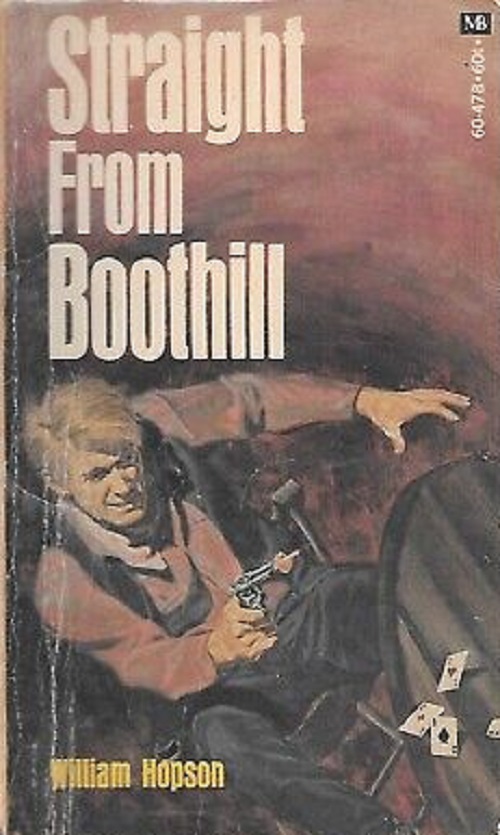
The Ranch Cat (Straight from Boothill) - William Hopson


I’ll admit, I bought this book partially because of the great Mitchell Hooks wrap-around cover, which you can see below in an image found on the Internet. The scan at the top of this post is of my copy. I also bought it partially because I’ve found William Hopson to be a good to very good and occasionally excellent Western author, and because it’s a Lion Book, a short-lived but influential paperback house that published a lot of great authors in the early Fifties. I’m always glad to add another Lion Book to my collection.


THE RANCH CAT was published originally in hardback under the title STRAIGHT FROM BOOTHILL by lending library publisher Phoenix Press in 1947. This retitled reprint from Lion Books came out in 1951. Later, the novel was reprinted in paperback under its original title by Avon (with Steve Holland on the cover!), Macfadden-Bartell, and Leisure Books, at least. There was also a large print edition from Chivers Press. There may be other paperback editions I’m not aware of. But with those bibliographic details out of the way, you may be asking, is it any good?

Oh, yes. This is the best book by William Hopson that I’ve read so far, and one of the best books I’ve read this year, to boot.


Rather than the lurid tale promised by the Hooks cover, the title, and the copy on THE RANCH CAT, or the traditional shoot-em-up indicated by the original title and the other reprint covers, this novel is a low-key, somewhat realistic portrait of ranch life in Montana in the 1890s. It covers several years in time (not counting a modern-day framing sequence) and is narrated by Jim Devers, the son of the ranch owner who, in the course of the book, goes from a gangling teenage boy to a grown man who runs the spread. His sister is the title character in the Lion reprint, a flirtatious beauty who stirs up a great deal of trouble among the crew.


There are some fistfights and a couple of shootings in this book, along with a crooked gambler and a hanging, but none of it is presented in any sort of melodramatic fashion. When violence does break out, it’s sudden and shocking and tragic. A lot of the book is a slow, deliberate ratcheting up of tension among the characters.

And then there’s Quong, a mysterious Chinese cowboy with some secrets in his past. He’s a great character who has a big part to play in the unfolding of life on the Devers ranch. It takes a skilled author to pull off such an oddball plot element without it seeming goofy, and Hopson does a great job of it.


THE RANCH CAT/STRAIGHT FROM BOOTHILL is a hard book to describe but a joy to read. Fairly inexpensive copies of the various editions under the original title are available on Amazon. If you want the Lion edition, it’ll cost you a little more, but still not all that much for a great, forgotten Western novel. I think I’ll remember this one for a long time.

William Hopson


Tuesday, November 01, 2022

Editing and Writing Update


Effective today, I’m retired as the editor of Rough Edges Press. I sold the original REP to Wolfpack Publishing a little more than a year ago and stayed on to run the line. After much thought, I’ve decided that I need to get back to writing full-time for a few more years. I really enjoyed working for Wolfpack, and I’m proud of the books we published there. I want to thank Mike Bray, Jake Bray, Paul Bishop, Laura Sarrafan, Kristin Yahner, all the fine authors I worked with, and especially the amazing Patience Bramlett, who did all the heavy lifting and made it possible for Rough Edges Press to function. I’m leaving the line in her capable hands, and I know there’ll be some great books coming from REP in the future.

On the writing front, my production for the year is right around 750,000 words, so with only two months left in 2022, I think it’s safe to say that my million-words-a-year streak really is ending this time. I’ll probably finish somewhere between 850K and 900K, which is still pretty productive. I’m committed to doing around half a million words in my regular ghosting job next year, and I hope to do a few books of my own, too. 750K is a good pace. I did that for almost 20 years before bumping it up to a million. I’d like to ease back even more than that. But I’m sure that as long as I’m capable of stringing words together coherently, no matter how long it takes, I’ll be writing something.

Monday, October 31, 2022

Dark Harvest - Norman Partridge


(This post originally appeared in slightly different form on October 31, 2011, also a Monday.)

Since today is Halloween, it seemed appropriate to post about a Halloween novel. I decided to read Norman Partridge's DARK HARVEST for two reasons: he has a reputation as a very good writer, and it was handy, sitting in a stack just a couple of feet from my computer. It was a good choice.

DARK HARVEST is one of those novels that takes place in only a few hours of time, something I always like. Set in 1963 in a quiet Midwestern town, it's about a strange ritual called the Run. It seems that every Halloween, a pumpkin-headed monster known as the October Boy rise from the cornfields outside of town and for reasons unknown tries to reach the church in the middle of town. Opposing him are all the boys from the ages of sixteen to nineteen, who compete to see who can kill the October Boy (or Sawtooth Jack or Ol' Hacksaw Face, as the monster is sometimes called).

To be honest, I wasn't too impressed with that setup. It seemed like something out of a low-budget horror movie (not that there's anything wrong with that). But Partridge turns it into something else with a number of nice plot twists and some excellent writing. I usually don't care much for books written in present tense, but if an author can make it work, I don't mind, and Partridge does. A little more sense of the time period might have been nice, but the story hurtles along so well, that's not a real problem.

DARK HARVEST is well worth reading, and if you're in the mood for a Halloween novel tonight and have a copy on your shelves, you should definitely give it a try.

Sunday, October 30, 2022

Sunday Morning Bonus Pulp: Blue Book, May 1939


As far as I'm concerned, BLUE BOOK was at its peak in the mid-to-late Thirties, although it remained at a pretty high level on into the Forties. But that's the era when it had great authors and a long run of consistently excellent covers by Herbert Morton Stoops. Here's one of them, illustrating a story from H. Bedford-Jones' series "Trumpets From Oblivion". Bedford-Jones had two other stories in this issue, an installment of "Ships and Men" (a "collaboration" between him and the fictional Captain L.B. Williams) and one under his Gordon Keyne pseudonym. Other authors in this issue are Will Jenkins (better known under his pseudonym Murray Leinster), Georges Surdez, Karl Detzer, and Fulton T. Grant. That's a great bunch of pulpsters.

Saturday, October 29, 2022

Saturday Morning Western Pulp: Popular Western, September 1936


A great cover by A. Leslie Ross on this issue of POPULAR WESTERN, and by coincidence, the lead novel is by A. Leslie Scott, writing under his A. Leslie pseudonym. Other authors on hand in this issue are Syl MacDowell (as himself and as Tom Gunn with a Sheriff Blue Steele novelette), Tom Curry, Galen C. Colin, Miles Overholt, Gunnison Steele (Bennie Gardner), Frank Carl Young, Eugene A. Clancy, Dabney Otis Collins, Claude Rister (as Buck Billings), Charles D. Richardson Jr., and house-names Jackson Cole, Buck Benson, and Sam Brant. Not an all-star lineup, maybe, but with Scott, Curry, Gardner, Overholt, and MacDowell, probably pretty good reading.