Showing posts with label Sexton Blake. Show all posts

Monday, March 25, 2024

Sexton Blake: The Green Jester - Donald Stuart


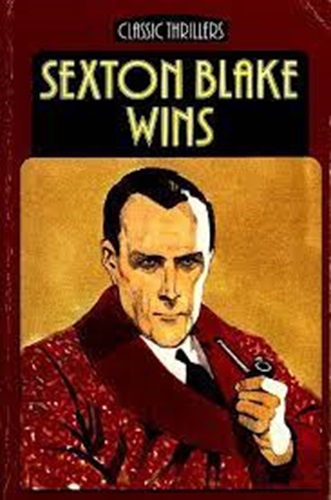
“The Green Jester”, a Sexton Blake novella by Donald Stuart, appeared originally in UNION JACK #1379, March 22, 1930, and was reprinted in the collection SEXTON BLAKE WINS, which is where I read it. It’s a very entertaining yarn in which a mysterious killer sends warning limericks to his intended victims on cards that bear a drawing of a sinister jester dressed in green. Not surprisingly, it doesn’t take long for the press to dub this unknown murderer The Green Jester. The great detective Sexton Blake and his friend Inspector Coutts are soon on the case as well, trying to discover a connection between the seemingly unrelated victims. They’re almost in time to prevent one of the murders, arriving at the country estate of a retired doctor who has received one of the grim warnings, but The Green Jester has beaten them to the punch and has left behind more grisly handiwork. The chase isn’t over, though, as Blake continues trying to untangle this deadly scheme.

This is one of those proverbial ripping yarns, as Stuart keeps the story moving along at a fast pace with storms, midnight chases, and plenty of action. In his introductory comments, Jack Adrian, the editor of SEXTON BLAKE WINS, mentions that Donald Stuart was heavily influenced by the work of Edgar Wallace. Now, I’m very, very far from an expert on Wallace, having read exactly one of his novels, but even so, “The Green Jester” sounds like a Wallace title to me, so I’m sure Adrian is right. That just makes me want to read even more by Stuart, and Wallace, because I sure enjoyed this one.

In the spirit of full disclosure, this is also one of the rare occasions where I was ahead of Blake on figuring out who The Green Jester was, although there was one angle I didn’t have nailed down. Still, I felt pretty good about my deductions.

The cover image above is from Mark Hodder’s invaluable website Blakiana. If you’re a Sexton Blake fan and haven’t visited there, you should check it out right away.

I’ve enjoyed every story so far in SEXTON BLAKE WINS. It’s a fine collection.

Monday, January 29, 2024

Sexton Blake: The Man I Killed - Rex Hardinge


Continuing to read my way through the anthology SEXTON BLAKE WINS, the next story is the novella “The Man I Killed” by Rex Hardinge. That’s a familiar name to Blake fans, but it’s the first thing I’ve read by Hardinge and I really liked it.

Originally published in the July 8, 1933 issue of DETECTIVE WEEKLY, “The Man I Killed” is the first Blake story I’ve encountered that’s written in first person. It’s certainly the first one I’ve read from the point of view of the killer! So this is, of necessity, an inverted mystery where the reader knows the identity of the murderer all along, and the appeal lies in watching how Sexton Blake figures it out.

But after Hardinge shows us how sports journalist Matt King murders a wealthy toymaker named Brandt and then sets up an alibi using his old friend Sexton Blake himself, the story takes some unexpected twists. In fact, considerably more is going on than Hardinge reveals to us at first. As the story races on with several excellent action scenes and plenty of suspense, more and more layers of the plot are peeled away until the final outcome was satisfyingly different from what I thought it might be.

A couple of minor quibbles: At one point, a character impersonates Sexton Blake with a degree of success that’s much too great to be believed. And some of the late twists, while effective, come from pretty far out in left field. However, without them the story’s impact would be lessened, and hey, miraculous disguises are accepted plot devices in popular fiction, right?

Neither of those things keep “The Man I Killed” from being the best story I’ve read so far in this anthology, as well as one of the best Sexton Blake stories I’ve read, period. I’ll definitely read more by Hardinge.

Note: The scan above is from Mark Hodder's invaluable website Blakiana. If you're a Sexton Blake fan and haven't checked it out, you need to immediately. But be prepared to be immersed there for hours because it's compulsive reading.

Friday, January 12, 2024

Under Sexton Blake's Orders - John Hunter


“Under Sexton Blake’s Orders” is a novelette by prolific British author John Hunter that first appeared in the 1942 edition of SEXTON BLAKE ANNUAL. It was reprinted in the anthology SEXTON BLAKE WINS, which is where I read it. After enjoying but being slightly disappointed in the anthology’s previous entry by G.H. Teed, I was looking forward to seeing what Hunter would do with Sexton Blake.

This story features a character created by Hunter and used only in his stories, as far as I know. Two-fisted sea captain James Dack is a bit of a shady character, sometimes on the side of the law, sometimes not. In this yarn, he finds himself mixed up in something that’s too nefarious even for his somewhat flexible morals, involving a high-ranking Nazi prisoner who has been captured and brought to England for interrogation. Unfortunately, he’s escaped and is trying to get out of the country. Luckily, Sexton Blake is also on the case, and he and Captain Dack (who have clashed in the past) have to team up as wary allies to foil the scheme.

For the most part, Hunter keeps things perking along nicely in this tale, and there’s some excellent battle action at sea. The story seemed a bit rushed at times, leading me to think this plot might have worked better as a novella, but “Under Sexton Blake’s Orders” is an entertaining yarn. As far as I recall, it’s the first thing I’ve read by John Hunter. I’m going to have to try one of his full-length Sexton Blake novels or maybe one of his Westerns.

Monday, December 18, 2023

Sexton Blake: The Treasure of Tortoise Island - G.H. Teed


The novella “The Treasure of Tortoise Island” by G.H. Teed first appeared in the January 17, 1925 issue of UNION JACK and was reprinted in the collection SEXTON BLAKE WINS, where I read it. I found the UNION JACK image online. In this one, Blake is asked by the beautiful Lady Richmond to help her husband, who is suffering from some mysterious disease he picked up in the East Indies. Teed implies that some years past, Blake had a romantic interest in the lady, presumably before she was married, but he doesn’t provide any details, at least not in this story.

As it turns out, the only person who can help Lord Richmond is Dr. Huxton Rymer, the brilliant physician who abandoned medicine for a life of crime, becoming one of Sexton Blake’s archenemies in the process. Blake and Rymer agree to a truce, and Rymer goes off with Lord Richmond to the West Indies, where he can find the spices and herbs he needs to effect a cure. But Rymer can’t long ignore his criminal nature and soon teams up with Marie Galante, the beautiful octaroon who commands Kingston, Jamaica’s criminal underworld, on a new scheme involving his patient . . . which, of course, puts him at odds with Sexton Blake once more.

I may annoy, or even anger, some readers here, but I found this story to be something of a disappointment. The basic setup is all right, but Teed never does much with it, and with the exception of an early shootout and a big battle that wraps things up, there’s no action and a lot of the story’s events take place off-screen so that most of the time Teed seems to be summarizing things, rather than spinning an exciting yarn. Even that big battle at the end comes to a rather limp conclusion. This is the first story by Teed that I’ve read, and having seen him acclaimed as one of the best Sexton Blake writers, I’m left scratching my head. Is this just not one of his better entries, or am I missing something? That’s always possible with me.

I have a number of other Blake stories by Teed and certainly will read more by him. There are some nice bits in this one, just not enough of them, and I’m curious to see if I like some of this other yarns better.


Friday, November 17, 2023

Sexton Blake: The House of the Hanging Sword - Gwyn Evans


It had been a while since I read a Sexton Blake yarn. I realized that while I’d read stories from early in Blake’s history and also late entries from the so-called New Era, I’d never read anything from what’s considered the Golden Age for the character, the Twenties and Thirties. So I picked up a collection called SEXTON BLAKE WINS, which reprints six novellas and three short stories from that period. The first novella is “The House of the Hanging Sword”, from the February 10, 1934 issue of DETECTIVE WEEKLY, and is by Gwyn Evans, one of the most popular Blake authors. A series of mysterious, apparently unrelated disappearances draws Blake into a dangerous case that involves an isolated house in the English countryside, robed and cowled villains, and plenty of blood and thunder. Great fun that gallops right along.

Friday, March 31, 2023

Caribbean Crisis - Desmond Reid (Michael Moorcock)


In 1962, Michael Moorcock was an assistant editor on the Sexton Blake series, then published in digest-sized paperbacks. He also wrote one of the novels, CARIBBEAN CRISIS, which was revised somewhat by editor W. Howard Baker and published under the house name Desmond Reid. Moorcock was somewhat less than pleased by Baker’s revisions and departed his editorial position soon after. Now, more than 60 years later, he and Blake expert Mark Hodder have reconstructed and expanded the original version by approximately 10,000 words. The new version will be published next fall, in a double volume along with a completely new Sexton Blake novel by Moorcock and Hodder. I definitely plan to read both novels.

But in the meantime, what about the version of CARIBBEAN CRISIS published in 1962 as by Desmond Reid? Well, for a long time, it’s been one of the most sought-after Blake novels because of Moorcock’s involvement. Through the help of a friend, I was able to read the novel, which I did now so there’ll be a long enough gap before I read the revised version later this year. I’m happy to report that it’s a pretty entertaining yarn.

It has a great opening in which two men venture into a deep trench in the Caribbean in an experimental bathysphere that’s lowered from a research ship. They run into trouble that causes one of the men to scream in terror and plead for them to be brought back up. But the cable attached to the bathysphere breaks and the thing sinks in water too deep for it to ever be recovered.

Only it doesn’t. It happens to land on a ledge that’s still close enough to the surface that a man in a diving suit can get down to it. When he does, he looks through the bathysphere’s window and makes a startling discovery: One of the men inside has been murdered, stabbed in the back. The other is missing. That’s right, it’s a locked bathysphere mystery . . . and who better to solve it than Sexton Blake?

Luckily, Blake is headed for the nearby island nation of Maliba (a fictional but real-sounding country, to quote WHAT’S UP, TIGER LILY) where a revolution is brewing as rebel reformers try to overthrow the oppressive government. However, British Intelligence believes that the reform movement has been infiltrated by Communist agents, and since Blake has done some favors for the British spymasters in the past, he’s tasked with locating a list of Communist infiltrators, as well as finding the missing son of a wealthy British sugar cane plantation owner. Hmm, could all three of these cases somehow be connected?

CARIBBEAN CRISIS is a lot of fun. The setting is vividly rendered, and the action races by. Blake does a good job of untangling everything, acting on his own this time. Paula Dane and Marion Lang appear briefly, Tinker is mentioned, and there’s no sign at all of good old Pedro. The impossible crime aspect of the plot gets set aside for much of the book in favor of political maneuvering and various double-crosses, but when Blake does get around to solving it, the solution is both believable and satisfying, if not as extraordinarily complex as what you get in the typical John Dickson Carr novel.

I’m looking forward to reading the restored and expanded version by Moorcock and Hodder, which should be a lot closer to Moorcock’s original intentions. However, I enjoyed this original published version, too, and am glad I got a chance to read it.

Monday, March 20, 2023

Wanted for Questioning - Wilfred McNeilly


This is another Sexton Blake paperback from 1965. That’s my cover-creased copy in the scan. It answers a question I had, but I’ll get to that later. In a clever opening that shows Blake isn’t infallible, he’s tricked into shooting a potential client. There’s no question that Blake pulled the trigger and killed the man. But who’s the real murderer, Blake or the villain who set up the situation? Despite being Blake’s friend, Detective Superintendent Grimwald feels compelled to arrest him. However, Blake talks Grimwald into giving him 24 hours to carry out his own investigation. 24 hours to save himself from a murder charge, in other words.

This novel is from the era when Blake is running a good-sized private detective agency in London, so that means the usual group of supporting characters is on hand: assistant Edward Carter, also known as Tinker; beautiful secretary and part-time detective Paula Dane; receptionist Marion Lang, also beautiful and a part-time detective; reporter Arthur “Splash” Kirby; and Blake’s faithful bloodhound Pedro.

Their only possible approach is to investigate the victim and hope that will lead to the killer. The victim is a former music hall comedian, part of a duo that’s roughly the British equivalent of Laurel and Hardy. He’s risen above those humble beginnings and become a wealthy showbiz entrepreneur. He became connected with Blake in the first place because he suspected that someone was embezzling money from his various enterprises. Blake and his helpers turn up several suspects. Somebody tries killing Blake, indicating they’re on the right trail. Paula and Marion also wind up in danger. Eventually everything gets sorted out, of course, but not before Blake gets arrested.

The plot maybe relies a little too much on coincidence, but the solution is a clever one. I figured it out, but not until pretty late in the game. The pacing is very good. I flew through the book quickly and enjoyed every minute of it.

A few weeks ago when I read and reviewed another Blake novel from this era, MURDERER AT LARGE, I speculated about who might have been behind the W.A. Ballinger house-name on that one. My friend Keith Chapman suggested, based on what I wrote about the book, that it might have been Wilfred McNeilly, so I deliberately picked a McNeilly novel for my next Sexton Blake. WANTED FOR QUESTIONING has some definite similarities to MURDERER AT LARGE: a show business setting, a considerable amount of humor, and an occasional philosophical digression. The style is so much the same that I’m confident McNeilly also wrote at least the first draft of MURDERER AT LARGE. I plan to read more of McNeilly’s work for further evidence, though. I have two or three more of them around here.

In the meantime, I’m really enjoying the stories from this era of Blake’s career. WANTED FOR QUESTIONING is a good one, and if you’re a Sexton Blake fan, too, I give it a solid recommendation.

Friday, March 10, 2023

Murderer At Large - W.A. Ballinger


MURDERER AT LARGE is a 1965 entry in the Sexton Blake series after it moved 
from digest-sized novels to mass-market paperbacks. That title is the name of a low-budget true crime TV show in England that focuses on unsolved homicides—cold cases, although I don’t think that term was used that early—in which the killer appears to have gotten away with it.

One of the cases that the show will cover in an upcoming episode is the Primrose Ballet Murder, which occurred three years earlier when a 15-year-old dancer was strangled. The show has two researchers, one a former cop and the other a journalist, and when one of them is murdered, probably because he got too close to the identity of the Primrose Ballet Killer, private detective Sexton Blake is drawn into the case. Not surprisingly, another killing occurs, so ultimately Blake has to solve three murders and pick out the killer from a very large cast of characters that includes writers, producers, casting directors, and aristocrats from the upper levels of society and finance.

Not only are there a lot of suspects to sort through, but many of the series regulars also appear, including Blake’s assistant Edward Carter (aka Tinker), his beautiful secretary Paula Dane, his likewise beautiful receptionist Marian Lang, his journalist friend Arthur “Splash” Kirby, and even his faithful dog Pedro.

The plot of MURDERER AT LARGE is a little on the thin side, which may explain the large number of characters involved. Even with so many people running around, the author still needs to fill some pages with humorous digressions such as this one early on:

The writers’ office was small, shabby, and tucked away on the most remote corridor of the top floor of ATN House [the production company that makes the series]. This was usual for no large entertainment organisation loves writers. When they can be replaced with electronic machines they will be replaced. [Shades of ChatGPT!]

Machines suffer from none of the disabilities of writers, such as unpunctuality, debts or intoxication. Machines do not pinch the bottom of the managing director’s secretary or borrow ten shillings from the doorkeeper. Machines do not, above all, regard their employers with anarchistic contempt between spells of obsequiousness when pay-checks are due to come round.

But until machines are made the organisations have to make do with writers, faults and all.

Whoever wrote that knows writers, that’s for sure! Sure sarcastic asides run all through the book, poking a lot of fun at the TV business. When Blake finally exposes the killer and the murderer tries to flee, the action becomes pure slapstick, and it’s pretty darned funny despite a rather grim ending. This whole book is a slightly unsettling blend of bleak and hilarious, but I really enjoyed it.

Which brings us to the question of the author’s identity. The book is bylined W.A. Ballinger, a pseudonym normally used by W. Howard Baker, the author/editor/packager who was in charge of the Sexton Blake series for many years. Baker often had uncredited collaborators doing first drafts for him, so his actual contribution could range from plot/light edits to plot and heavy revisions. In addition, other editors sometimes revised manuscripts. A friend of mine who’s familiar with the series and authors suggests that Wilfred McNeilly might have had something to do with this one, but that’s far from certain. I have a couple of Blake paperbacks credited to McNeilly and intend to read them soon to see if I can pick up any similarity in styles.

None of this really matters, of course, no matter how interesting I find it. What's important is whether or not a book is entertaining, and MURDERER AT LARGE certainly is. By the way, I apologize for the quality of the cover scan. I read the novel as a PDF file, and this is the only cover image I could find on-line.

Monday, December 05, 2022

Sexton Blake: The Devil to Pay - Rex Dolphin


This is the first Sexton Blake novel I’ve been privileged to read in its original form, a slim, digest-sized paperback published in January 1961. Not only does it have an excellent cover, but the story inside is also probably the best Blake yarn I’ve read so far.

THE DEVIL TO PAY (Sexton Blake Library 4th Series, Number 467) is from the era when Blake is a private detective, complete with a beautiful blond secretary in Paula Dane. As it opens, Blake is meeting with movie writer/director Sam Waxman, who wants Blake to find the leading lady of the film he’s currently making in England. Sandra Kennedy is an English actress who moved to the States and found stardom in American films, but she’s gone missing from Waxman’s latest project. He thinks her disappearance has something to do with Sandra’s twin sister, who was murdered five years earlier in a castle-like tower on an isolated English estate, due to her involvement with a cult of wealthy devil worshippers, most of whom were killed in a fiery car crash while being pursued by a policeman after the ritualistic murder is discovered. But some of the cultists get away, including—maybe—the leader and owner of the estate, who’s descended from another aristocrat of the same name, who led a similar devil cult two hundred years earlier.

Got all that? Author Rex Dolphin really throws in the plot elements at a furious pace. Most of the previous paragraph is just back-story that gets Blake and Paula to sinister Deville Manor in the middle of the night, where a dangerous wild dog roams the grounds (it’s a German Shepherd, not a hound, in case you were wondering). Before you know it, there’s another murder, this one of the locked room variety, secret passages, corpses crumbling to dust, business and financial shenanigans, a hardboiled cop who also believes in ghosts, and a considerable amount of chasing around the estate and Blake getting knocked out.

I had a wonderful time reading this novel. Rex Dolphin (and that’s his real name, not a pseudonym or a house-name) could really spin a fast-moving tale, and the plot, while complicated, all ties together nicely. As with the last Blake novel from this era I read, DARK MAMBO, move the setting from England to Florida and this would have made an excellent Mike Shayne caper in MIKE SHAYNE MYSTERY MAGAZINE. This story has never been reprinted or scanned and posted online, so you’re not likely to come across a copy, but if you ever do, it’s well worth reading.

Friday, November 11, 2022

Sexton Blake: Dark Mambo - W. Howard Baker


The only Sexton Blake stories I’ve read have been from the early 20th Century when he’s a Sherlock Holmes-like “consulting detective”. But later in the character’s career, he’s more of a regular private eye type. I recently read my first Blake novel from that era, DARK MAMBO by W. Howard Baker, published in July 1956 as Sexton Blake Library, Series 4, Number 361 . I read it on the Comic Book Plus website, which has more than 250 Sexton Blake novels and stories scanned, ranging from 1919 to 1958.

This one opens on a rainy Sunday afternoon in London. Blake is in his office alone, wrapping up a report on a case, when the telephone rings. It's a potential client wanting Blake to come see him at once. He doesn’t explain what it’s about, but Blake is intrigued by the man’s seeming sense of desperation and agrees to pay him a visit.

When he gets there, he finds that the caller is a wealthy man whose mistress, a beautiful blond nightclub singer, is lying on a rug in his study with her throat cut. She’s been blackmailing him, so he knows he’ll be the prime suspect in her murder. He hires Blake to find the real killer. Before long, another woman is killed the same way.

Aided in his investigation by his beautiful blond secretary Paula Dane (there are several beautiful blondes in this book) and following a trail that leads to Madrid, Blake uncovers connections between the victims and a couple of shady nightclub owners, a handsome young bullfighter, and the beautiful widow of a high-ranking Nazi officer. Unraveling the whole thing puts both Blake and Paula in danger.

As I was reading this, something about it struck me as familiar. I knew that I hadn’t read it before, but eventually I realized that it reminded me of the sort of Mike Shayne story that showed up a lot in MIKE SHAYNE MYSTERY MAGAZINE. Move the opening scene from London to Miami and it would work just fine. There’s even an antagonistic cop and a friendly cop, like Peter Painter and Will Gentry in the Shayne stories. Blake gets knocked out and taken for a ride by the bad guys, and that’s certainly a scene I’ve read (and written) before. Paula Dane even serves as a Lucy Hamilton sort of character.

I’m not saying there’s any connection between Blake and Shayne. Not at all. It’s more a matter of just remarking on the similarities that crop up in the genre. And for all I know, W. Howard Baker may well have read some of the original Mike Shayne novels. Baker was a prolific British paperbacker who’s probably best known in the United States for writing some of the tie-in novels based on the Patrick McGoohan TV series SECRET AGENT. Macfadden-Bartell published several of them in paperback in the U.S. His prose in DARK MAMBO is functional, pretty meat-and-potatoes most of the time, but you can tell that he’s at least attempting to be more poetic in a noirish way now and then. He does a decent job of it, too.

I enjoyed DARK MAMBO quite a bit. I plan to read more of those Sexton Blake, Private Eye yarns. Short, fast-moving, and fun really fits the bill of what I’m looking for most of the time these days.

Wednesday, May 05, 2021

Classic British Thrillers: Sexton Blake and the Great War - Mark Hodder, editor


I’ve been aware of the character Sexton Blake for many, many years, having first seen the name on paperbacks during the Sixties, none of which I ever owned or read. Over time I learned more about him: inspired by the success of Sherlock Holmes, Blake is another British Great Detective (he even lives in Baker Street) who solved cases in hundreds of stories and novels by dozens of authors, published in story papers and magazines from the 1890s through the 1960s. He has a young assistant, Tinker, and a faithful bloodhound, Pedro, and they had all sorts of adventures ranging from traditional mysteries to high adventure to espionage thrillers.

In recent years, a lot of Sexton Blake stories have been reprinted, and I’ve picked up quite a few of them but haven’t read any until now. I started with SEXTON BLAKE AND THE GREAT WAR, a collection of three novellas set before and during World War I.

This volume begins with “The Case of the Naval Manoeuvres”, written by Norman Goddard and published originally in the story paper UNION JACK #253 in 1908. The British navy is engaged in some top-secret practice in the North Sea, but the Prime Minister thinks that some foreign power may be spying on them, so he enlists Sexton Blake’s help and sends the Great Detective to the Shetland Islands to find out what’s what. Pedro the bloodhound doesn’t appear in this story, although he’s mentioned, but Tinker is on hand and so is Inspector Spearing of Scotland Yard, who also helps out Blake from time to time. It doesn’t take Blake long to discover that not only is Germany behind the spying, but Wilhelm II, Kaiser Bill his own self, is on hand to boss the operation, which involves a zeppelin and a secret air base in the Shetlands.

That’s probably enough for a novella by itself, but Goddard actually disposes of the threat fairly quickly and instead sets up a chase through England as Blake and his allies try to capture the Kaiser and deliver him to London so that a diplomatic solution to the mess can be worked out without the necessity of having to go to war. Not only are German agents trying to rescue their leader, but other groups with their own agendas try to get their hands on the Kaiser.

The plot in this yarn is driven almost entirely by coincidence, and for a Great Detective, Blake sure does some dumb stuff now and then when the writer needs him to in order to keep things moving. But move they do, as Goddard delivers a surprisingly fast-paced and exciting tale in prose that doesn’t often read as if it were written more than 110 years ago. Blake is pretty likable, and there are a couple of great action scenes, so overall, despite its stodgy title, I enjoyed “The Case of the Naval Manoeuvres” quite a bit.

England was actually at war with Germany by the time the next novella in this collection was published. “On War Service; or, Sexton Blake’s Secret Mission” is from UNION JACK #645, published in 1916. The author is Cecil Hayter, who, according to editor Mark Hodder, is best remembered for chronicling some of Blake’s adventures that take place in Africa. The setting in this one is far from the Dark Continent, however. It’s very much a wartime espionage yarn, as Sexton Blake and Tinker are sent to Holland, where they’re supposed to slip into German-occupied Belgium and deliver an important document to someone there who’s working for the British. They have some harrowing adventures just reaching their contact, and when they get there, he’s on the verge of death, having just been attacked by German agents who’ve discovered his identity. He lives long enough to tell Blake and Tinker where the message is supposed to go, and they’re off again, knowing that even if they manage to get the document into the right hands, they’ll still face an incredible amount of danger getting back out of Belgium.

As before, there’s quite a bit of coincidence and deus ex machina in this plot, but Hayter keeps things moving along at a very nice pace. His version of Blake is a little more hardboiled than Goddard’s, and the story is grittier, not as much high adventure. I didn’t like it quite as much as the first one, but it’s still very enjoyable.

The final novella in this collection backtracks a year to 1915. William Murray Graydon’s “Private Tinker—A.S.C.” was published originally in UNION JACK #589. Through a series of odd circumstances, Tinker winds up enlisting in the army under another young man’s name and is sent to the front to fight the Germans. Sexton Blake, upset over Tinker’s disappearance, gets drawn into an assignment that takes him to the front. Naturally, they’re both going to have adventures and then run into each other, which is exactly what happens. Yet again, we get a plot that’s driven by coincidence, but along the way, we also get some decent action and a spectacular scene where Tinker and another young soldier take over a German supply train. Graydon does a great job in this section.

Overall, I enjoyed SEXTON BLAKE AND THE GREAT WAR quite a bit. Blake is a good character, and I want to see him in action again. As editor Mark Hodder points out in his introduction and story notes, after World War I, the villains in the series become more colorful and bizarre and the stakes become higher. I look forward to reading some of those yarns.