Tuesday, August 31, 2021

Trent #1: The Dead Man - Rodolphe and Leo


If you’ve been reading this blog for very long, you know I enjoy Mountie stories. A friend of mine on Facebook recently mentioned a series of graphic novels about a Mountie sergeant named Trent, so I had to check them out. Written by French author Rodolphe Jacquette, with art by Brazilian artist Leo (Luiz Eduardo de Oliviera), they’ve been translated into English and are available on Amazon and as part of Kindle Unlimited.

The first volume, THE DEAD MAN, finds Sergeant Trent and his canine companion, known only as Dog, on the trail of a wanted murderer. In the snowy wasteland, they come across a lone traveler who turns out to be a beautiful young woman on a mission of her own. Trent saves her from a blizzard and reluctantly agrees to help her on her quest before returning to his own assignment.

The big plot twist in this one is pretty obvious, and there’s a lot of brooding and not much action, but danged if I didn’t get caught up in the story and enjoy it a lot anyway. The art is great, Sergeant Trent is a good protagonist, and I think there’s a lot of potential in this series. Originally published during the Nineties, there are eight volumes in all, and I definitely plan to read the others. This isn’t the sort of two-fisted, action-packed Mountie yarn that I love so much in the pulps, but I give THE DEAD MAN a high recommendation anyway.

Monday, August 30, 2021

The Shadowed Circle #1 - Steve Donoso, ed.


Regular readers of this blog know that I’m a long-time fan of The Shadow and have reviewed a number of the pulp novels over the years. I recently had a chance to read THE SHADOWED CIRCLE #1, an old-fashioned fanzine devoted to the character, and I had a great time with it.

Edited and published by Steve Donoso, with art and design by John Sies and assistance from deputy editor Rebecca Robinson, THE SHADOWED CIRCLE #1 is an impressive publication, starting off with a fine cover by John Jamilkowski. The contents include an essay by Will Murray about some of the female villains faced by The Shadow; this piece was squeezed out of the reprints from Sanctum Publications by a lack of space, and it’s great to have it available. As the leading expert on The Shadow, Murray’s work is always informative and entertaining.

John L. French takes a look at the Shadow novels by Bruce Elliott, who replaced longtime author Walter B. Gibson for a while late in the pulp’s run. These stories by Elliott are almost universally reviled, with a common criticism being that the character doesn’t even seem like himself. French comes up with an intriguing theory to explain that. I’ve never read one of Elliott’s Shadow novels, and I really ought to. I’ve read some of his other mystery novels that I liked quite a bit.

Craig McDonald contributes an article about the only villains who faced The Shadow in four separate novels, Shiwan Khan (created by Walter B. Gibson) and Benedict Stark (created by Theodore Tinsley, who backed up Gibson on the series for several years). I’ve read at least one of the Shiwan Khan novels, but I don’t think I’ve read all of them. I’ve never read any of the novels featuring Benedict Stark, and McDonald’s excellent article makes me think I need to do that, too. Ah, if only there was more time in the day!

There’s also an interview with James Patterson, co-author of the recent Shadow novel that puts a whole new spin on the character, and a lengthy review of that book by Henry Lopez. I’ve never met Patterson, although I’m acquainted with some of his co-authors, but everyone I know who has met him seems to think he’s a wonderful guy. That’s certainly the way he comes across in this interview, very affable, whether I agree with his take on The Shadow or not. (Brief personal story: I have been in the same room with Patterson several times without actually meeting him. At a mystery convention a few years ago, I happened to be in the hotel lobby at six o’clock in the morning, and there he was, sitting in a chair by himself reading a newspaper. I started to go up and introduce myself to him, but then I thought, no, he looked so grateful to be just sitting there with nobody bothering him, I couldn’t bring myself to do it. So I went on my way.)

Rounding out this issue are articles about Gibson’s work on a Batman story (his last published work), being a young fan of a pulp hero, short films featuring The Shadow from the early Thirties (I’d never even heard of these!), cover artwork from the pulp, and zombies in the radio show. It’s a very nice variety of material and all well-written and interesting.

Fanzines such as this have really fallen by the wayside with the rise of the Internet, but I read a bunch of them over the years, especially during the Seventies, Eighties, and Nineties. Reading THE SHADOWED CIRCLE #1 was a wonderful reminder of that time, as well as being an excellent publication in its own right. I had an absolutely wonderful time with it. It’s available on Amazon, or you can subscribe to it. All the details are available on the magazine’s Facebook page. If you’re a Shadow fan or a fan of pulp fiction in general, I give it a very high recommendation.

Sunday, August 29, 2021

Sunday Morning Bonus Pulp: Detective Tales, December 1936


DETECTIVE TALES is another pretty solid detective pulp from Popular Publications. This issue features an action-packed cover by Tom Lovell and stories by Arthur Leo Zagat, George Bruce, Fred MacIsaac, Franklin H. Martin, and a pulpster better remembered for his Westerns, Tom Roan. Roan's yarn is called "Satan Covers the Waterfront", and I'll bet it's a good one.

A Middle of the Night Music Post: Saloon Showdown - Antti Martikainen

As the saying goes, Spaghetti Western Metal is the musical genre I didn't know I needed . . . until now. Recently I've been listening to this and other songs by Finnish musician Antti Martikainen, and they're all great writing music.


Saturday, August 28, 2021

Saturday Morning Western Pulp: Western Novel and Short Stories, October 1938


We have three characters in the J.W. Scott cover on this issue of WESTERN NOVEL AND SHORT STORIES, but it's not the usual trio of Stalwart Cowboy, Wounded Old-timer, and Angry, Gun-Totin' Redhead. Even so, this is a pretty effective cover. I like the jodhpurs on the blonde. Inside are stories by Ed Earl Repp, as himself and as Brad Buckner, Rolland Lynch, Carmony Gove, and Ken Jason, a house-name used by, among others, D.B. Newton, Jonathan Glidden (better known as Peter Dawson), Bennie Gardner (better known as Gunnison Steele), Victor H. White, and editor Robert O. Erisman. So there's really no telling who wrote the Ken Jason story in this issue. I like the story's title, though: "Gun Raiders of Silver City". "Last Notch in a Killer's Colt" and "Satan's Gun-Ghost" are also good titles.

Friday, August 27, 2021

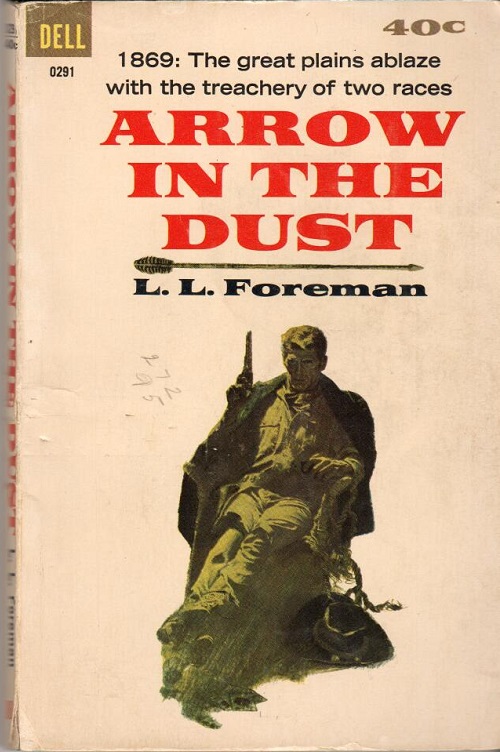
Forgotten Books: Arrow in the Dust - L.L. Foreman

Art by Ron Lesser

Bart Laish is not your typical stalwart Western hero. He’s a gambler, a gunfighter, and when ARROW IN THE DUST, L.L. Foreman’s novel from 1954 opens, an army deserter, having enlisted in order to hide out from the law only to take off for the tall and uncut rather than being thrown in the guardhouse for brawling. Not a nice guy.

And yet, through a series of frankly far-fetched coincidences, Laish finds himself wearing a general’s uniform, inheriting command of a bunch of inexperienced soldiers, and called upon to protect a wagon train bound for Fort Laramie from an Indian horde composed of warriors from several rival tribes who have banded together for some unknown reason. Oh, and with that wagon train is the dead general’s wife, who also happens to be one of Laish’s old flames.

Despite my long-windedness in describing it, the plot in ARROW IN THE DUST plays out pretty simply: make it to Fort Laramie without the whole wagon train being massacred. Throw in some romantic complications along the way. Does all this adversity offer Bart Laish a chance at redemption? I think you know the answer to that.


Original 1954 edition, art by Robert Stanley

While the elements that make up ARROW IN THE DUST may be pretty standard, L.L. Foreman does an absolutely superb job of blending them into a compelling, suspenseful Western yarn. This novel doesn’t have as much action as some—a lot of it is kind of a slow burn—but when violence does erupt, it’s very effective, and the final battle with the Indians is spectacular. Foreman devotes a lot of time to characterization and also writes very well about the landscape. His prose is nothing fancy, but it moves along in fine fashion.

L.L. Foreman was an Englishman, born in London and spending the first twenty years of his life there before moving to the United States. He started writing for the Western pulps in 1934 and continued for more than twenty years, expanding his career into novels in the Forties and writing until his death in the Sixties. ARROW IN THE DUST is an expansion of the novella “Platte River Gamble”, published in the June 1953 issue of ZANE GREY’S WESTERN MAGAZINE. It’s a really fine novel, and if you’re a fan of traditional Westerns, I give it a high recommendation.


Original novella version, cover art by Robert Stanley

There’s a personal story that goes with this one, too. In the Sixties, some of my relatives lived in the tiny, West Texas oilfield town of Goldsmith, northwest of Odessa. Every couple of years we would drive out there to visit them, usually in the summer, and would spend two or three weeks with them. My uncle was a hunter and taught me how to shoot and reload ammo. (I’ve long since lost my reloading skills, but I’m still a decent shot.) He was also an avid reader of Western novels, and during one trip, I read a Western paperback he had on hand. For years I didn’t recall the author or title, but for some reason the cover illustration stuck in my head: it was a painting of a cavalryman in a long coat, no hat, sitting with his legs stuck out in front of him. I had a feeling that it might be STEEL TO THE SOUTH by Wayne D. Overholser, but when I finally got curious enough to look up that book a few years ago, I couldn’t find any editions of it with a cover like that.

Well, that got my curiosity up even more. I knew the book was published by Dell. The size of it and the blue-edged pages were enough to tell me that. So I looked through listings of Dell Westerns and didn’t find it. I looked up other Overholser books, with still no luck. I was starting to think maybe my memory was playing tricks on me (believe it or not, that’s been known to happen). But one day, I got the idea of asking about it and describing the cover I remembered on the Men’s Adventure Paperbacks group on Facebook. Less than an hour later, I had the answer, complete with a picture of the book: ARROW IN THE DUST by L.L. Foreman. I never would have guessed that.

Not only did I now know what the book was, my friend on Facebook even offered to send me the copy he had. I traded him a couple of my books for it, and that’s the copy you see up at the top of this post, complete with cover art by Ron Lesser featuring model Steve Holland—neither of whom I knew anything at all about when I first read this book more than fifty years ago. I’ve finally gotten around to rereading, and I thoroughly enjoyed it. I had no memory of the plot from reading it all those years ago, so it was like a new book to me. And now you know . . . the rest of the story, as Paul Harvey used to say.

(Hmm. Why did I think it was STEEL TO THE SOUTH by Wayne D. Overholser, a book that, as far as I know, I’ve never read? I wonder if I should find a copy and read it . . .)

Thursday, August 26, 2021

A Middle of the Night Music Post: Grazing in the Grass - Hugh Masekala


They play this song on an insurance commercial (I think) that's running on TV these days. When I listened to it on the radio and liked it more than 50 years ago, I never dreamed I'd still be hearing it all these years later.


Wednesday, August 25, 2021

Three Novellas by Jeffery Deaver


I've read and enjoyed some of Jeffery Deaver's novels in the past, so when he started writing novellas and publishing them as e-books, I picked up a few and have been reading them. I really like the novella length, both as a writer and a reader. So here are some quick thoughts on three of Deaver's novellas, in the order in which I read them.

CAUSE OF DEATH is about a history professor whose wife dies in a car accident, but he thinks the wreck is suspicious and sets out to find the truth. Deaver is famous for big twists in his stories, and this yarn certainly has one. Trouble is, it's so over-the-top and hard to believe that it just comes off as silly. This one didn't work for me at all. Your mileage, as they say, may vary.


TURNING POINT follows a law enforcement task force on the trail of a serial killer. This one is tons better than CAUSE OF DEATH. I figured out the twist, but not until I was well into the novella, and I thought it was very clever and effective. One of the characters is really interesting. This is a good one and I recommend it to mystery fans.


BURIED is about an old-fashioned reporter on the verge of retirement who's after a serial kidnapper who buries his victims alive and torments the authorities with riddles about where to find them. I liked the characters in this one quite a bit. The big twist seemed to be lacking a little, though, like it needed one more sting in the tail. Still, it's a pretty good story and worth reading. Deaver has several more novellas available as e-books, and I'm almost certainly going to read them. 

Tuesday, August 24, 2021

Battling Britons, Volume Two, Issue One - Justin Marriott, ed.


The fanzine for collectors and readers of vintage British war comics such as Battle Picture Weekly, Commando, Air Ace Picture Library and more. 90 pages of interviews, reviews, features and articles. The first issue includes -

60+ reviews of vintage pocketbook titles

Garth Ennis and Keith Burns discuss their 2015 reboot of the Johnny Red character

Brent Towns talks about his work as a Commando scriptwriter

Columns on aerial combat in comics, Marvel goes to Vietnam, master artist Cam Kennedy, eccentric British war strips and historical adventure titles

And much more!

(I'm proud to have a regular column of COMMANDO reviews in this fanzine. This is a great issue with a wide variety of material from some excellent contributors. As usual, in going through it I've already found a number of books I want to buy and read! If you're interested in war comics or war fiction in general, I give it a high recommendation.)

Monday, August 23, 2021

Classic Space Opera Pulp: The Rebel of Valkyr - Alfred Coppel


There was some discussion on this blog and on Facebook a while back about Alfred Coppel and his work, and this novella sounded particularly intriguing, so I hunted up a copy and read it. "The Rebel of Valkyr" is set during the era of the Second Galactic Empire, following the collapse of the First Empire and the thousand-year-long Dark Age that resulted. Space travel still exists, but only a very select few--shamans, sorcerers, warlocks--know how to operate the ships. Technology of other sorts is banished and feared. So the galaxy is ruled by star-kings and warlords and an emperor. In the past, that leader has been benevolent, but his son, backed by the late emperor's consort, has taken over even though the crown should have gone to his older sister. And the Imperial Consort and her corrupt lackeys are plotting to solidify their hold on power, even if it means murder. The true empress's only hope is a young rebel star-king who is part of a fledgling rebellion bent on overthrowing those who have seized power illegally.

I swear, George R.R. Martin must have read this story at some point. This is a space opera version of GAME OF THRONES, or maybe I should say GAME OF THRONES is a fantasy version of "The Rebel of Valkyr", since the novella was published in the Fall 1950 issue of PLANET STORIES, with the usual great Allen Anderson cover. I don't know, of course, whether or not Martin ever read this story, and most of his inspiration came from English history, but still, there are some striking similarities. "The Rebel of Valkyr" is definitely science fiction, though, despite the swords and the armies mounted on horseback. The big twist at the end involving one of the villains is very much SF in nature.

Mostly, "The Rebel of Valkyr" is just great fun. Fast-paced, with lots of action and epic sweep and colorful settings, I would have raced through it in one sitting if I'd read it back in the Sixties on my parents' front porch on a lazy summer morning. It's the first thing I've read by Coppel, but it won't be the last. He expanded this story into a three-novel series published by Harcourt in the late Sixties under the pseudonym Robert Cham Gilman, then added a prequel novel in the Eighties. I have all four of those volumes on hand and look forward to reading them.