Tuesday, June 30, 2020

Halfway Point


Last year at this time, you may recall, I was moaning and complaining about how my long streaks of writing at least a million words a year and reading at least 100 books a year might well come to an end in 2019. Actually, as the year played out, neither of those things happened. So, how am I doing this year at the halfway point?

Despite all my blathering about how I was going to slow down, I’ve written about 550,000 words so far in 2020, and my schedule is full for the rest of the year (actually, a book or two probably will slop over into next year), so it looks like I have a reasonable shot at the million words for the 16th year in a row. Which is fine, whether it happens or not.

On the reading front, I’ve read 84 books so far this year, so I’m on a pace to have one of my best reading years ever. I guess maybe I’ve had more time to read, although it doesn’t seem like it.

I hope I haven’t jinxed either of those things by posting about them. We’ll see what the second half of the year brings. Some improvement in real life would be fine with me. All this other stuff doesn’t mean much in the long run.

Overlooked Movies: Magic in the Moonlight (2014)


I’d never heard of MAGIC IN THE MOONLIGHT because I really haven’t kept up with Woody Allen’s movies for the past thirty years or so. I’ll always love his work from the Sixties and Seventies, but I’ve found his movies since then to be wildly inconsistent and, even at their best, not nearly as good.

That said, 2014’s MAGIC IN THE MOONLIGHT isn’t bad. A friend of mine watched it and mentioned on Facebook that the same script could have been filmed in 1940 with Cary Grant and Ginger Rogers. That sounded like the sort of thing I wanted to see, so we gave it a try. That assessment is pretty accurate, too.

Colin Firth plays the Cary Grant part, if you want to call it that. He’s a stage magician whose secondary career is debunking phony mediums and spiritualists. Emma Stone takes on the Ginger Rogers role, a young American woman who has her hooks in a wealthy British family by pretending to be in contact with the departed patriarch. Or is she pretending . . .? Firth winds up involved in the whole thing because a magician friend of his was hired to expose Stone’s chicanery but failed to find any proof she’s a fake. If anybody can do it, though, it’s Firth.

Well, you know as well I do what’s going to happen. Firth and Stone wind up falling in love. Is she a con artist, or isn’t she? The answer to that question lies in a very clever twist in the script by Allen, one that I probably should have seen coming but didn’t, at all. The whole thing is frothy, well-acted, and beautifully filmed. The main objection most people seem to have is that Firth is too old for Stone, a fact that people who hate Allen for things he’s alleged to have done in his personal life seize on to criticize the film. My opinion is that, yes, the age difference probably is a little too much, but it didn’t really detract from the movie for me. If that’s likely to bother you, I’d say don’t watch MAGIC IN THE MOONLIGHT. Otherwise, I recommend it. It’s not as good as his early stuff, but like another fairly recent film of his, MIDNIGHT IN PARIS, I liked it quite a bit and think it’s a movie with its heart in the right place.

Monday, June 29, 2020

Terror of the Crimson Talons - Fred Blosser


Fred Blosser is best known for his non-fiction about the work of Robert E. Howard and other subjects related to popular culture. But he’s also a fine author of fiction himself, as I know because I published his excellent historical adventure novel THE SAVAGE PACK a few years ago. His latest fictional offering is TERROR OF THE CRIMSON TALONS, a novelette inspired by Howard’s stories about two-fisted detective Steve Harrison.

Blosser’s version is called Kirby Brill, two names familiar to readers of Howard’s yarns. Brill is a retired police detective who’s now a private investigator in a nameless city where the shadows are thick and the streets are always damp. In a very nice twist, Blosser has moved the action up from the Thirties to the Fifties, so the world is a little coarser and filled with new dangers such as the atom bomb. Brill’s methods haven’t changed from the old days, however. When he gets in trouble, he’s still inclined to slug or shoot his way out, although he’s actually a pretty clever thinker, too.

In TERROR OF THE CRIMSON TALONS, Brill get a call for help from the beautiful daughter of a famous explorer and archeologist. She was given Brill’s name by a friend of her father’s, who also happens to be one of Brill’s friends. Before the case can barely get started, though, Brill is almost seduced by an exotic Oriental beauty and attacked by Mongolian bandits. He’s also targeted by hatchet men working for a Chinese tong leader who carries an old grudge against him. Throw in an Afghan sidekick who’s a great character, some shadowy figures whose true allegiance is unknown, some torture and whipping scenes straight out of a Weird Menace yarn, abundant nudity, and a vicious catfight, and you’ve got a nonstop action yarn that’s incredibly entertaining. Blosser really knows the territory he’s working and does a superb job of it.

As a bonus, there are two short articles about Howard’s Steve Harrison stories included with this novelette, and they’re informative and enjoyable as well. I just had a great time reading TERROR OF THE CRIMSON TALONS, and I was glad to see that Blosser left an opening for Kirby Brill to return. To that possibility, I say an emphatic yes. I’m ready to read more of Kirby Brill’s adventures right now.

Sunday, June 28, 2020

Sunday Morning Bonus Pulp: Complete Stories, December 15, 1932


Pulp covers loved that bright red and yellow combination. Those are some scary-looking dogs on this cover by H.W. Scott, too. This issue of COMPLETE STORIES has some fine authors in it: Frederick C. Davis with a White Wolf story (ghosted under the name of the late Hal Dunning), George Harmon Coxe, Allan Vaughan Elston, Richard Howells Watkins, C.S. Montanye, Karl Detzer, and a pulpster I'm not familiar with, James Clarke. I've never read an issue of COMPLETE STORIES, but I know it doesn't have the same sort of reputation as the big-name general fiction pulps like ARGOSY, ADVENTURE, and SHORT STORIES. However, judging by the authors this looks like a pretty good issue.

Saturday, June 27, 2020

Saturday Morning Western Pulp: West, March 1950


An interesting cover by an unknown artist. The shadow almost makes the guy look like he's wearing a mask. And of course, this cover is further evidence that no poker game in the Old West ever ended peacefully. I also find it curious that a story by Harry C. Rubicam Jr. gets such prominent treatment when ol' Harry, whoever he was, apparently only published one other story in his career, also in WEST a couple of years earlier. He wrote a few non-fiction books and at least one Western novel, but this issue also includes stories by Johnston McCulley, Allen K. Echols, Richard Brister, and Dupree Poe, and if I was the editor I would have put any of them on the cover ahead of Rubicam. Barry Scobee is on the cover and was a top-notch pulpster, so I agree with that editorial decision. Anyway, it's an eye-catching cover.

Friday, June 26, 2020

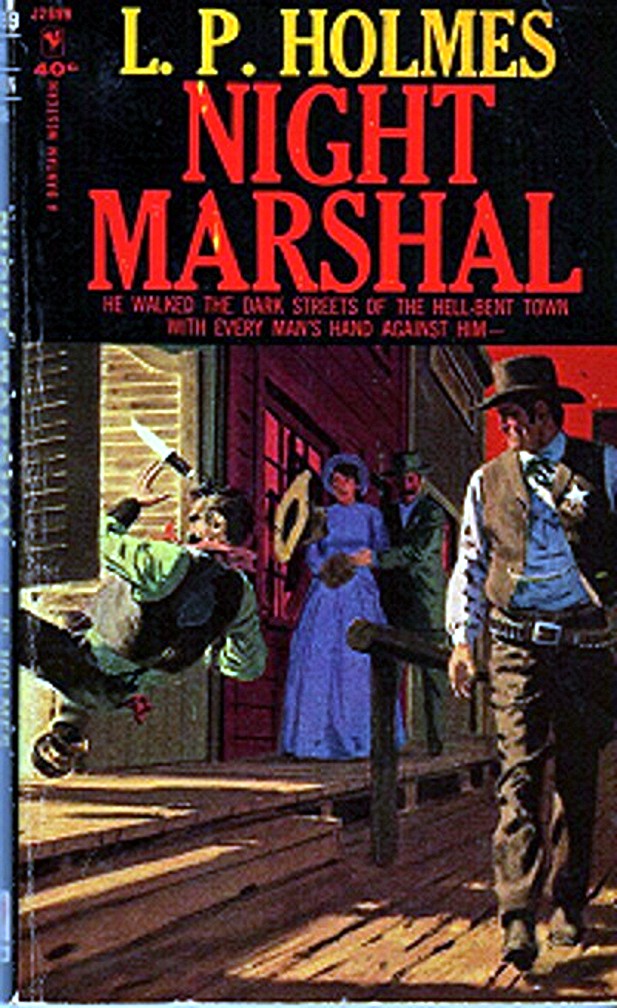
Forgotten Books: Night Marshal - L.P. Holmes


As I’ve mentioned before, I only started reading L.P. Holmes in the past ten years or so, even though I saw paperbacks of his Western novels around all the time when I was a kid. I’m not sure why I never picked up any of them. However, that’s worked to my benefit since I’ve found that I really enjoy his work, and there are still quite a few books and stories by him left for me to read.

Most recently, I read his novel NIGHT MARSHAL, published in hardback by Dodd, Mead in 1961 and reprinted in paperback by Bantam in 1964, the edition I read. That’s my copy in the scan. I don't know who painted the cover.

The protagonist is Chris Waddell, a down-on-his-luck lawman who takes the job of night marshal working for an old friend and mentor of his who’s the top lawman in the wild Montana mining town Midas Hill. Problem is, Waddell is still a straight-shooter while his old friend and boss has gone soft and corrupt and is under the thumb of the saloon owner and mining magnates. If Waddell wants to bring any real law and order to Midas Hill, he’ll have to buck all of them, which means he’ll have enemies on all sides.

From what I’ve read of his work, Holmes never strayed from the traditional Western elements but did an excellent job of working within that framework. I’ll be honest: while it’s enjoyable, NIGHT MARSHAL is the weakest novel of his that I’ve read so far. The plot meanders along and is really slow to develop, he sets up several characters and conflicts but then never does anything with them (speaking in particular of a potential romantic triangle that he never does anything with and seems to forget, as well as never resolving the question of whether a particular character is one of the bad guys or not), and the book ends in rather hurried fashion.

That said, Holmes does a fine job with the setting, the dialogue is good, Waddell is a likable, easy to root for protagonist, and the final shoot-out is effective even though it could have been longer and more dramatic. I’m glad I read the book, even though NIGHT MARSHAL isn’t one that I’d give to somebody who has never read Holmes before. If you’re already a fan of his work and come across a copy, I wouldn’t pass it up.

Tuesday, June 23, 2020

Overlooked Movies: Swamp Fire (1946)


As big a fan of Tarzan movies as I was when I was a kid, I’m not sure how I didn’t even know this Johnny Weissmuller movie existed until recently. Of course, considering how different SWAMP FIRE is from your typical Tarzan movie, maybe my ignorance isn’t a surprise. But I’m glad I came across it.

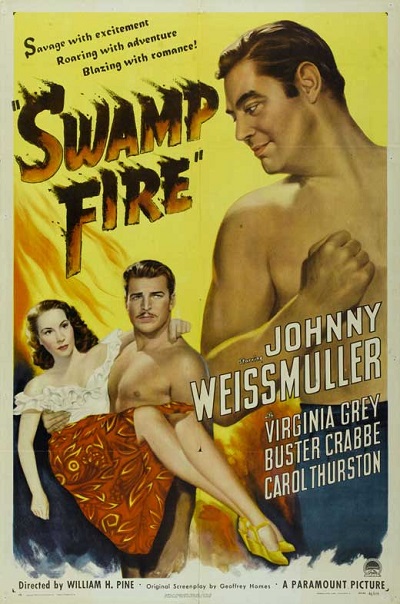
Made relatively on the cheap in 1946, this movie finds Weissmuller staying fully dressed the whole time (despite the poster), although there’s still a considerable amount of swimming in it. He plays Johnny Duval, a Cajun bar pilot (a guy who guides ships through the sand bars in the Mississippi River) returning to his home in the Louisiana swamps after serving in World War II. Johnny is tortured by the memory of a ship he commanded during the war being sunk in battle, with considerable loss of life. He doesn’t want to go back to being a bar pilot. He’s glad to get back to his girlfriend, played by Carol Thurston, though.

Complications arise in the form of an arrogant society girl (Virginia Grey) who sets her sights on Johnny and an old enemy of his, played by none other than fellow Tarzan and Olympic swimming champion Buster Crabbe, complete with sinister, pencil-thin mustache and thick Cajun accent. Will Johnny get over his guilt? Will he decide between the icy socialite and the hot-blooded Cajun girl? Will he wind up rasslin’ an alligator at some point? Will he have a violent final showdown with Crabbe? I think you know the answers to all those questions, but getting there is pretty darned entertaining.

The script, which packs a lot in 68 minutes, is by “Geoffrey Homes” (Daniel Mainwaring), who also wrote the classic film noir OUT OF THE PAST and the source novel it’s based on. (Confession time: I’m not a big fan of OUT OF THE PAST. I saw it once years ago, didn’t care much for it, and haven’t rewatched it since.) SWAMP FIRE has some good lines and a little more depth than some B-movies. Director William Pine, who also produced, probably could have kept things moving along at a little faster clip. There are too many stock footage scenes of ships not really doing much of anything, and they go on too long.

That said, I still enjoyed this movie. Weissmuller was never any great shakes as an actor, although he manages some nice poignant moments in some of the Tarzan movies. But he was a big, likable lug with a lot of screen presence and that’s true in SWAMP FIRE, as well. Supposedly he was drunk during much of the filming, but I couldn’t tell it. Buster Crabbe, usually cast as the Stalwart Hero (really, how much more stalwart can you get then Buck Rogers and Flash Gordon?), seems to really relish playing a bad guy for a change. His mustache is too thin to twirl, but you get the sense that if he could, he would have. He’s pretty effective in the role, creating a nice sense of menace while not being out-and-out despicable. You can almost sympathize with him at times.

Although this movie came out several years before the Gold Medal paperback line was launched, in many ways it plays like an early Gold Medal novel with its tortured hero, its romantic triangle, and its naturalistic setting. I would have enjoyed SWAMP FIRE when I was a kid—hey, Johnny Weissmuller rassles a gator, what else would 10-year-old me have wanted, other than maybe some quicksand (how can you make a swamp movie with no quicksand?)—but I think I probably appreciated it more now. It’s available to watch various places on-line, and I think it’s worth investing an hour or so of your time.

Sunday, June 21, 2020

Sunday Morning Bonus Pulp: Popular Detective, March 1936


Now there's a thoroughly bizarre cover for you. I'm not sure what's going on here, but I am certain there are some good authors in this issue of POPULAR DETECTIVE, including Hugh B. Cave, Steve Fisher, Edmond Hamilton, Barry Perowne, Emile C. Tepperman, Frederick C. Painton, and George A. McDonald. If I'd had an extra dime and nickel in my pocket back in 1936, I might've had to buy this one just to try to figure out the cover.

Saturday, June 20, 2020

Saturday Morning Western Pulp: Lariat Story Magazine, December 1935


That's a pretty dynamic cover by Emery Clarke on this issue of LARIAT STORY MAGAZINE. There are some really excellent writers to be found inside, too: Walt Coburn, Eugene Cunningham, Frederick C. Davis, James P. Olsen, and Theodore A. Tinsley all have stories in this issue, as well as lesser known authors Ralph Condon and Edgar L. Cooper, plus house-name John Starr, who could be any of those guys if you go by the theory that house-names were used when a writer had more than one story in an issue. If I had to venture a guess, I'd say that in this case, Starr is probably Olsen or Tinsley, both prolific pulpsters, or possibly Davis. Coburn and Cunningham were big names and an editor wouldn't have wanted to waste a story from either of them by putting a house-name on it. But all that's just speculation on my part. I love the title of Cunningham's yarn, "The Gun-Girl of Murder Mesa".

Friday, June 19, 2020

Forgotten Books: The Gladiator #4: Blood on the Sand - Andrew Quiller (Laurence James)


I meant to get back to this series of historical action/adventure novels set in ancient Rome sooner, but other books got in the way. However, I’ve now read BLOOD ON THE SAND, the fourth novel in the Gladiator series (originally published in England under the series title The Eagles). The author behind the Andrew Quiller house-name this time is the prolific Laurence James, who also wrote the first book in the series, HILL OF THE DEAD.

The protagonist of these books is Marcus Julius Britannicus, also known by his gladiator name Vulpus the Fox. As each novel opens, Marcus is the most famous gladiator in Rome, then the story flashes back to his earlier days as a Roman soldier and establishes his history as the son of a Roman centurion and a barbarian princess. Marcus is also motivated by a vengeance quest that runs through the series, as well as getting involved in various historical events such as the Siege of Masada and the eruption of the volcano Vesuvius.

The main storyline in BLOOD ON THE SAND wraps up that quest and also explains how Marcus went from being a soldier to fighting as a free gladiator sponsored by the Emperor Titus. It’s a fast-moving tale without an overly complicated plot, as I’ve come to expect from Laurence James. It’s also lurid, over the top, occasionally crude, and very violent, also hallmarks of James’s work. But he’s a great storyteller, and his books really keep the readers turning the pages. That’s certainly the case with BLOOD ON THE SAND. There’s also a nice, obscure in-joke involving Kenneth Bulmer, one of the other writers who shared the Andrew Quiller house-name.

This was the final Gladiator novel published by Pinnacle (that’s my beat-up copy in the scan), and with the wrapping up of several storylines it reads like the final book in the series. But it’s not. There’s one more, SEA OF SWORDS, written by Bulmer and published only in England. Copies of it can be hard to find, especially at an affordable price, but I came across one a while back and grabbed it. So I’ll be reading it, too, maybe in the reasonably near future.