Sunday, May 31, 2020

Sunday Morning Bonus Pulp: Planet Stories, Fall 1943


An excellent cover by George Rozen graces this issue of PLANET STORIES, and there's a really fine group of writers behind it: Leigh Brackett, Clifford D. Simak, Nelson S. Bond, Carl Jacobi, Wilbur S. Peacock, Charles R. Tanner, and Henry Hasse. I haven't read it, but you can read or download the entire issue here.

Saturday, May 30, 2020

Saturday Morning Western Pulp: Dime Western, August 1933


I'm not sure that shade of red hair appears in nature, but it appears on several different DIME WESTERN covers in 1933 and it's certainly eye-catching. Equally eye-catching is the group of authors in this issue: Max Brand (Frederick Faust), T.T. Flynn, Harry F. Olmsted (twice, as himself and a Tensleep Maxon story as by Bart Cassidy), Stephen Payne, J.E. Grinstead, and John Colohan. That's a potent pack of pulpsters.

While I don't own a copy of this issue, I have read the Max Brand novella, "Guardian Guns". It was reprinted under the title "The Stage to Yellow Creek" in THE LOST VALLEY, one of the Max Brand collections published by Five Star and Leisure. It's an excellent, action-packed yarn about a stagecoach journey, a bag full of money, a gang of outlaws, and one of Faust's typical good badmen as the protagonist. I enjoyed it a lot. It's almost long enough to be considered a novel.

Friday, May 29, 2020

Forgotten Books: Barge Girl - Calvin Clements


With a Barye Phillips cover and a title like BARGE GIRL, from a publisher like Gold Medal, I expected a noirish crime novel with a regular guy protagonist falling for some beautiful but scheming dame who has an older husband who just needs to be gotten rid of so that she and the protagonist can live happily ever after. And as I started this 1953 novel by Calvin Clements, it looked like that was what I was going to get, as our narrator, tugboat captain Joe Baski, mets and falls for gorgeous young Stella Murk, whose much older, barge captain husband takes her for granted and makes her live in near-squalor on the barge.

The thing is, for the longest time Clements dances right up to the edge of giving us that plot but then pulls back, and as a result, the first three-fourths of BARGE GIRL never amounts to more than a well-written but slow-paced domestic drama that will tell you more about barges and tugboats operating on the Hudson River between New York City and New Jersey than you ever wanted to know.

Maybe Clements was trying to subvert his readers’ expectations, or maybe he just wasn’t comfortable spinning a truly noir crime yarn. I don’t know. But BARGE GIRL was a considerable disappointment to me up until a late twist that almost salvages the book. The last few chapters pack a lot more punch and are more fun to read, although even then he seems to be setting up a twist that never comes to fruition. That makes the pretty good climax not as effective as it could have been.

Calvin Clements wrote a few novels but is best remembered for his long career as a screenwriter for movies and TV. He wrote excellent episodes of a number of different Western series. Based on BARGE GIRL, the only one of his books I’ve read, he wasn’t as skillful a novelist. Overall, though, the final fourth of this one impressed me enough that I can say I’m glad I read it. Don’t rush right out to look for a copy, but if you ever run across one, you might want to learn more about tugboats and barges than I did.

Wednesday, May 27, 2020

Kid Colt: Kill the Kid! - Tom DeFalco


Some of the first Marvel comics I ever read, before I discovered their superheros on Christmas Day, 1963, were early issues of KID COLT, OUTLAW that had found their way to our house some way. Because of that, I've always had a soft spot for the character, even though now I realize he's a pretty generic "good guy outlaw framed for a crime he didn't commit".

I didn't realize Marvel had brought him back briefly in 2009 in a three-part story written by Tom DeFalco and drawn by Rick Burchett. "Kill the Kid!" is an origin story (comics, like movies, love origin stories) that goes in for a little bit of retconning. Kid Colt's real name is Blaine Cole, instead of Blaine Colt as in the original, and I think the details of the crime that leaves him an outlaw are a little different, but I didn't do any research to confirm that. Either way, this reads and looks like a genuine Kid Colt, Outlaw yarn, and I enjoyed it quite a bit. If you're an old fan of the character, like me, you might enjoy it, too, and the digital version is really inexpensive, if you read comics that way. I've come to prefer that method, which surprises me a little.

Sunday, May 24, 2020

Sunday Morning Bonus Pulp: Argosy, January 13, 1940


It's been a while since I posted a Mountie cover, and this is a good one (not surprising since it's on an issue of ARGOSY) by Rudolph Belarski. There's an excellent group of authors inside this issue as well, including E. Hoffmann Price, Harry Sinclair Drago, Eustace L. Adams, Bennett Foster, William Gray Beyer, and Bruce Douglas. ARGOSY was always good, often great.

Saturday, May 23, 2020

Saturday Morning Western Pulp: Western Story, June 7, 1941


Another excellent and effective cover by H.W. Scott on this issue of WESTERN STORY, and another prime example of why I never liked to go to the barber shop: yuh never know when some ranny's liable to bust in and commence to slingin' lead. There's an all-star line-up of authors in this issue, too: Walt Coburn, Peter Dawson, Norman A. Fox, Harry F. Olmsted, Frank Richardson Pierce, and Glenn H. Wichman. Looks like a great issue to me.

Friday, May 22, 2020

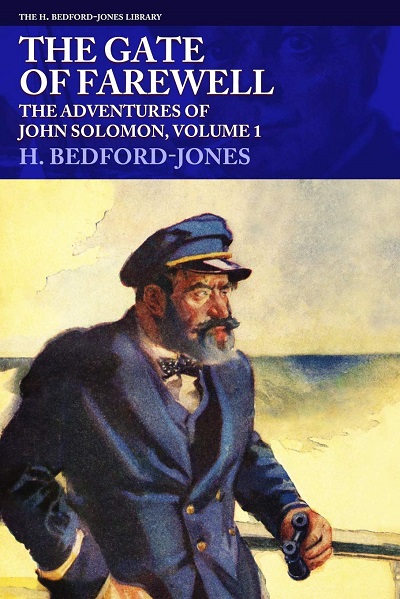
Forgotten Books: The Gate of Farewell - H. Bedford-Jones


Of the many, many series written for the pulps by H. Bedford-Jones, his longest-running featured a fat little Cockney named John Solomon, which ran from 1914 to 1936 and encompassed more than twenty novels and novellas. John Solomon may not seem very impressive at first glance, but he actually runs a far-flung intelligence network and makes a specialty of thwarting all sorts of criminal and espionage schemes around the world. I’ve been aware of this series for years but hadn’t read any of them until recently, when I started at the most logical place, the novel THE GATE OF FAREWELL, which was published originally as a serial in ARGOSY in 1914 and is Solomon’s first appearance. (It was later published as a novel under the pseudonym Allan Hawkwood.)


Solomon is a supporting character in this book and doesn’t play much of a part in the action until the late stages. The protagonist is an American businessman named Allen Tredgar, who is searching for his older brother who vanished in Arabia five years earlier. He hires a captain and a ship, gets a tip on where to look for his brother from John Solomon, goes through the Suez Canal, and then heads down the Red Sea to the area where his brother disappeared.

Unfortunately, there’s a sinister American working against Tredgar’s interests, and things are complicated even more when Tredgar and his companions rescue a beautiful young woman blown out to sea in a small boat during a storm. Ultimately, everybody winds up in a fortress on the coast of Arabia built by what today we would call an Islamic terrorist group. Torture, slavery, and epic battles ensue, along with a hunt for ancient relics that will give whoever possesses them great power in the Middle East.


For a novel written and published more than a hundred years ago, THE GATE OF FAREWELL is surprisingly modern. I can see this same basic plot being used by a number of today’s thriller writers (although the resulting book would be three or four times as long). This early in his career, Bedford-Jones’ prose is still a bit stodgy and old-fashioned and not as crisp and stream-lined as it would be later. Also, the plot is rather slow to develop, leading to the first half of the book just sort of meandering along.

The second half, though, has a lot of punch, building up a considerable amount of suspense that delivers an action-packed climax. The characters are interesting, including a suitably despicable villain. Bedford-Jones lays the groundwork for more adventures of John Solomon, which I’m sure I’ll be reading. THE GATE OF FAREWELL isn’t in the top rank of H. Bedford-Jones’ novels, as far as I’m concerned, but it’s an entertaining adventure yarn in the classic style and well worth reading, especially as an introduction to his longest-running character.


Wednesday, May 20, 2020

Commando: Destination Siberia - Alan Hebden


When Hector Salway and a bunch of mates decided to go halfway around the world to repay a debt, they knew it wouldn't be an easy task -- their destination was Siberia, with the Cold War between the West and East at its height. What they didn't know was that a vicious killer who had tried to murder them once before would already be there -- and was now even more dangerous.

(As always with Alan Hebden's COMMANDO stories, this is a well-written yarn with a bit more of an epic scope than usual, going from Italy in the final months of World War II to a Siberian prison camp in the post-war years. This is a reprint of a story originally published in 1994, and I'm glad COMMANDO brought it back because I really enjoyed it.)

Monday, May 18, 2020

Nameless - Dean Koontz


I wouldn’t go so far as to say that I have a love/hate relationship with the work of Dean Koontz, but my reading of his books has certainly gone back and forth over the years. Early on in his career, I read a few of his science fiction novels and remember liking them okay, but when he became a bestseller in the Eighties with a number of doorstop-sized horror/suspense novels, I tried a couple of them and didn’t like them. (WATCHERS was one; I don’t remember the other.) So for quite a while, I didn’t read anything by Dean Koontz.

Then, for some reason I no longer recall, I picked up a copy of his novel LIGHTNING, read it, and loved it. It’s probably still my favorite of his books that I’ve read. After that I went back and read a lot of his earlier books, some published originally under his name, some under pseudonyms that were, by that time, being reissued as Dean Koontz books. I read the new ones as they came out, including DARK RIVERS OF THE HEART, a great book that’s my second favorite of his.

Then, sometime after ODD THOMAS, I picked up a new one, started to read it, said to myself, “Nah,” and that was the end of it. I didn’t read Koontz again for years.

Which is my long-winded way of saying that recently I decided to try something by him again. I picked NAMELESS, a series of novellas published as single e-books on Amazon. These tell the story of an amnesiac avenger with no name who travels around the country, backed by a shadowy, seemingly all-powerful organization, righting wrongs and delivering truth (not justice, which he makes clear) to those who have committed evils. The titles of the individual novellas are IN THE HEART OF THE FIRE, PHOTOGRAPHING THE DEAD, THE PRAYING MANTIS BRIDE, RED RAIN, THE MERCY OF SNAKES, and MEMORIES OF TOMORROW.

I raced through these and enjoyed them, even the ones about serial killers, a genre I don’t particularly like. They’re well-written, fast-paced tales with thoroughly despicable villains and an interesting, likable protagonist. The final volume, MEMORIES OF TOMORROW, solves some of the mysteries that run throughout the series and provides a satisfying ending, although leaving the door open enough that Nameless could return. The whole thing reminded me of a slickly done cable or streaming TV series.

I liked NAMELESS well enough that I’m tempted to read more by Koontz, but honestly, the novella length was a big part of the appeal to me. I already have several of his recent novels on my Kindle that I picked up when they were on sale, so we’ll see.

Sunday, May 17, 2020

Sunday Morning Bonus Pulp: Adventure, April 1947


I tell you, this is the way I feel a lot of the time these days: ready to snarl and start bashing things with a shovel. By 1947, ADVENTURE may have been long past its glory days as the top pulp in the business, but it still had some great covers, such as this one by Peter Stevens, and some top-notch authors, represented in this issue by E. Hoffmann Price, Jim Kjelgaard, F.R. Buckley, Robert E. Pinkerton, S. Omar Barker, and Franklin Gregory.