Posting here may be sporadic for a while due to some ongoing medical issues in the family. Not me, I'm pretty much fine, just busy dealing with real life. I looked around the hospital for Dr. Kildare and Dr. Gillespie while I was there and didn't see them anywhere. The pulp posts should return this weekend and with any luck I'll have a few book reviews coming up.
Monday, June 15, 2026
Medical Matters
Posting here may be sporadic for a while due to some ongoing medical issues in the family. Not me, I'm pretty much fine, just busy dealing with real life. I looked around the hospital for Dr. Kildare and Dr. Gillespie while I was there and didn't see them anywhere. The pulp posts should return this weekend and with any luck I'll have a few book reviews coming up.
Saturday, June 06, 2026
Saturday Morning Western Pulp: Max Brand's Western Magazine, October 1950
MAX BRAND'S WESTERN MAGAZINE was a reprint pulp, but it had new covers including this dandy one by Norman Saunders. Once again, trouble has reared its ugly head at an Old West poker game! MAX BRAND'S WESTERN MAGAZINE usually included a story by Max Brand, naturally, but not this time around. The stories are reprints from various 1920s and '30s issues of ARGOSY and ARGOSY ALL-STORY WEEKLY. The best-known authors are Bennett Foster and Kenneth Perkins. Also on hard are Christopher B. Booth and Carroll Lichty, neither of whom is familiar to me. Even though the stories are reprints, chances are few if any of the readers of this pulp had read them in their original appearances, so they probably got their quarter's worth.
Monday, November 03, 2025
Reviews: Fixed/Beyond the Finish - Max Brand (Frederick Faust)
After reading and enjoying the first two Dr. Kildare stories by Frederick Faust writing as Max Brand, I decided to read more of Faust’s contemporary stories. Although most famous, and justly so, as a Western author, Faust wrote all sorts of stories. “Fixed” and “Beyond the Finish” are two with sports backdrops.
“Fixed” appeared in the June 13, 1936 issue of the slick magazine COLLIER’S. As you might suspect from the title, it’s a prize fight yarn about a middleweight title bout between the champ, a young Irishman named Slam Finnegan, and the challenger, a black fighter known as “Little David” Larue. Attending the fight is a gangster Faust refers to only as “Big Bill”. Bill knows something nobody else does: Slam Finnegan is going to take a dive in the ninth round, and Bill is going to clean up on a bet he made at long odds.
Of course, fixed fights never go exactly the way they’re supposed to. We all know that from the movies we’ve seen and the boxing yarns we’ve read. Sometimes the fix works, and sometimes it doesn’t. I won’t say which way it turns out here, but the fun for the reader is in the getting there, and Faust makes it fun, indeed, with lots of great dialogue between Big Bill, his lackey who attends the fight with him, other crooks and gamblers, and a beautiful girl who’s also ringside. You knew there had to be a beautiful girl, right? It’s fast and colorful and with more plot would have made a great movie with, say, Eugene Pallette as Big Bill, Joel McCrea as Slam Finnegan, and maybe Jean Arthur as the girl. I can’t help but see this stuff in my head.
“Beyond the Finish” also appeared in COLLIER’S, in the March 24, 1934 issue. With that title, it’s got to be a horse racing story. The protagonist is a young man who, after being orphaned, goes to live with his cousin, a wealthy horse breeder and trainer in Virginia. He becomes an excellent rider and is picked by his cousin to ride a new horse in the big steeplechase race. But there’s something shady going on, hijinks among horsey high society, if you will, and our hero winds up with quite a conflict going on, complicated (as these things always are) by the involvement of a beautiful young woman. Given all that, it’s not surprising that this story reminded me a little of a Dick Francis yarn, although it’s nowhere nearly as hardboiled and crime-oriented as Francis’s work. But Faust does a great job with the characters and the race itself, and he had me eager to find out what was going to happen next.
I really enjoyed both of these stories and plan to read more of Faust’s contemporary tales, even though I think maybe I’ve shaken out of my funk and am ready to go back to reading novels. We’ll see.
Wednesday, October 29, 2025
Reviews: Internes Can't Take Money/Whiskey Sour - Max Brand (Frederick Faust)
I often have spells when I can’t summon up the energy and attention span to read novels. One of those spells, combined with the urge to read something by Max Brand (Frederick Faust), one of my favorite authors, served to remind me that I’d never read “Internes Can’t Take Money”, the short story that introduced his famous character Dr. Kildare. It appeared originally in the March 1936 issue of the slick magazine COSMOPOLITAN and was made into a movie starring one of my favorite actors, Joel McCrea.
Dr. Jimmy Kildare is an interne who works at a famous hospital, assigned to the emergency room. As an interne, he receives no salary and actually lives in spartan quarters at the hospital. The only times he gets out are when he occasionally visits a nearby tavern for a couple of quick beers.
However, the tavern is owned by a powerful local politician/criminal, and it’s frequented by gangsters and strongarm men, one of whom shows up one evening with a bad knife wound in his arm that he suffered in a fight with a rival mobster. Kildare happens to be there, so against his better judgment he performs emergency surgery on the yegg and saves the use of his arm, if not his life.
That earns Kildare the respect of these denizens of the underworld, who try to turn him into a mob doctor. This creates quite a conflict for the morally upright but somewhat pragmatic Jimmy Kildare, who’s from a poor farming family and has nothing going for him except his medical talent, which is considerable.
As usual with Faust’s work, the writing in this story is very good. The guy could really turn a phrase. It’s full of colorful characters and the pace barrels along nicely. Jimmy Kildare is an excellent protagonist. I raced through this story and thoroughly enjoyed it.
I had such a good time reading it, in fact, that I immediately read “Whiskey Sour”, the second yarn starring Dr. Jimmy Kildare, which was published in the April 1938 issue of COSMOPOLITAN. In this one, Kildare is still mixed up with some of the same shady characters as in the previous story. When a man comes into the emergency room, or the “accident room”, as Faust calls it, with a gunshot wound, Kildare is plunged into another moral dilemma that’s complicated by the involvement of a beautiful redhead who has a secret. This is another really fine, fast-moving tale with a lot of good lines and some genuine suspense. Maybe not quite as good as “Internes Can’t Take Money” but almost.
These are the only two stories to feature this particular version of Dr. Kildare. The movie adaptation of “Internes Can’t Take Money” mentioned above was made by Paramount, but that was the only story to which they had the rights. Faust sold the character to Metro-Goldwyn-Mayer, and MGM wanted some changes. Faust, being the good freelance writer he was, said sure and rebooted the series beginning with the novel YOUNG DR. KILDARE, which was serialized in ARGOSY late in 1938 before being published as a book by Dodd, Mead in 1940. Faust followed that with five more novels and two novellas about Dr. Kildare. I read one of the novels about forty years ago and recall enjoying it quite a bit, but I don’t remember which one it was. Might be time to just start with YOUNG DR. KILDARE and read all of them, since they’re short and move fast.
“Internes Can’t Take Money” was reprinted in THE COLLECTED STORIES OF MAX BRAND from the University of Nebraska Press in 1994. “Whiskey Sour” hasn’t been reprinted, officially. But you can find both of these stories on-line if you know where to look, and I think they’re well worth reading. Faust’s greatest success, by far, was with Westerns, but I think his talents were very well-suited to contemporary yarns as well, and I’m thinking I might just try more of them while I’m stuck in this novel-reading funk.
Monday, June 09, 2025
Review: Twisted Bars - Max Brand (Frederick Faust)
Frederick Faust, better known as Max Brand, is one of those authors I’ve been reading for more than 60 years, and I suspect I’ll continue to read his work for as long as I’m around. TWISTED BARS, currently available from Amazon in e-book and paperback editions, reprints three pulp novellas: “The Duster”, WESTERN STORY MAGAZINE, November 2, 1929; “Twisted Bars”, WESTERN STORY MAGAZINE, November 16, 1929; and “The Duster Returns”, WESTERN STORY MAGAZINE, November 30, 1929.
Although they were published originally as individual novellas, these stories flow right from one into the next and actually form a novel. It’s narrated by a middle-aged cowboy named Baldy Wye, who works on a spread near the town of Christmas. When he hears that the notorious outlaw known as The Duster has shown up in town, Baldy indulges his curiosity and goes to see the famous desperado. The Duster has come to Christmas not to commit some daring crime, though. Instead, what he wants is to bury the ashes of his former partner, Hector Manness, in the local cemetery. Manness, mortally wounded by a posse, had asked The Duster to have him buried there. Unfortunately, the local minister is adamant that a criminal like Manness will never be laid to rest in the church’s graveyard.
The Duster sets out to change the minister’s mind, and the result is a dramatic story but one that’s almost totally lacking in action. That lack is a continuing problem in this book. There’s a bank robbery in the second story that’s very well done, and of course, everybody blames The Duster, but is he really guilty? In the third story, The Duster and the minister’s daughter have fallen in love, but in order to win her hand in marriage, he has to prove that he’s actually gone straight and given up his outlaw ways. There’s a twist that most readers will see coming, but it’s still effective and raises the stakes nicely.
The stories in TWISTED BARS are very well-written. Faust could turn a phrase with great skill, and he was one of the best at tormenting his protagonists and creating a lot of psychological drama. But most of this book consists of people sitting around and talking, and there’s very little of the action for which Faust is also famous. I think this is a very minor entry in his work, and if you haven’t read him before, I sure wouldn’t start here. If you’re a fan and just enjoy the way he writes, it’s worth reading, but don’t expect it to be in the top rank of his yarns.
Saturday, April 26, 2025
Saturday Morning Western Pulp: Western Story Magazine, January 14, 1928
Those hombres look like there's fixin' to be a necktie party. I don't want to be the guest of honor at that one! This issue of WESTERN STORY MAGAZINE, one of the most venerable of the Western pulps, features the first installment of a Max Brand serial, "Weakling of the Wild", which would be published by Dodd, Mead a few years later as the novel HUNTED RIDERS. I don't own this issue, but I do have a copy of the novel version and hope to get around to reading it one of these days. Also to be found in this issue are stories by Robert J. Horton (Walt Coburn's mentor and an author I really need to try), Frank Richardson Pierce (as Seth Ranger), Robert Ormond Case, Ray Humphreys, Harley P. Lathrop, and Roland Krebs (no idea if he's related to Maynard G.). The cover art on this issue is by Gayle Hoskins.
Sunday, December 08, 2024
Sunday Morning Bonus Pulp: All-American Fiction, May/June 1938
That's an intriguing cover by Rudolph Belarski on this issue of ALL-AMERICAN FICTION, and what a lineup of authors! It's hard to beat H. Bedford-Jones, Max Brand, Cornell Woolrich, Philip Ketchum, Richard Sale, and Karl Detzer. Also on hard are the lesser-known Eustace Cockrell, Robert Cochran, J.R. Beehan, and Thomas Nelson. The author of the featured story "Meet Me in Miami", Joseph Mickler, has only two credits in the Fictionmags Index, both in Munsey pulps in 1938, for whatever that's worth. I would read this issue just for those other guys if I had a copy.
Sunday, November 03, 2024
Sunday Morning Bonus Pulp: Argosy, April 21, 1934
I haven't featured an issue of ARGOSY in a while, and this one sports a nice dramatic cover by Paul Stahr, whose covers I nearly always enjoy. As usual, there are some fine writers inside this issue: Erle Stanley Gardner, Max Brand, Fred MacIsaac, J.D. Newsom, Karl Detzer, and the lesser-known Anson Hatch and Howard Ellis Davis. The Brand, MacIsaac, and Detzer stories are all serial installments, but if I had a copy of this one (I don't) I'd be happy to read the novelettes by Gardner and Newsom.
Sunday, September 08, 2024
Sunday Morning Bonus Pulp: Detective Fiction Weekly, January 11, 1936
I like the cover on this issue of DETECTIVE FICTION WEEKLY. I don't know who the artist is. Paul Stahr, maybe? There are some fine writers inside, including Max Brand, Cornell Woolrich, Borden Chase, Hulbert Footner, Howard Wandrei (as H.W. Guernsey), and J. Lane Linklater. Like the other Munsey pulps, the frequent serials are a bit of a problem with DETECTIVE FICTION WEEKLY, but there was still an awful lot of good fiction to be found in those pages.
Wednesday, July 24, 2024
Selling the Wild West: Popular Western Fiction 1860-1960 - Christine Bold
From time to time, I get in the mood to read some non-fiction, but it’s usually non-fiction about fiction. Case in point, SELLING THE WILD WEST: POPULAR WESTERN FICTION 1860-1960 by Christine Bold, published in 1980 by Indiana University Press. A friend of mine recommended this book to me, and the author’s name was familiar. I remembered that she contributed some of the essays about various authors in TWENTIETH CENTURY WESTERN WRITERS. So it seemed like something I might enjoy.
The book has an intriguing concept: it’s an examination of the way Westerns
became a mass-produced genre with a lot of constraints and rules that developed
because of the way it was published, as well as how some authors of
Westerns were able to achieve distinct authorial voices despite those
constraints and rules. Bold starts with the dime novels and progresses through
the early Twentieth Century and the pulp and original paperback eras, doing
quick surveys of each of those publishing methods and then analyzing in more
detail the careers of several different authors from each time period.
I’m not a big fan of dime novels, but I enjoyed reading about their origins and
learned a few things. The authors Bold concentrates on in this section are Ned
Buntline, Prentiss Ingraham, Edward S. Ellis, and Edward L. Wheeler. I knew quite a bit about Buntline and Ingraham (I once edited a novel in which Buntline is the
main character, THE DIME NOVELIST by Clay More), but Ellis and Wheeler were
pretty much new to me. Bold also discusses the different approaches of the two
main publishers of dime novels, Beadle & Adams and Street & Smith.
In the section on the early Twentieth Century, Bold focuses on the big sellers—Owen
Wister, Zane Grey, Max Brand (Frederick Faust), and Emerson Hough—as well as
Frederic Remington, who (I didn’t know this) wrote several novels as well as
being a legendary artist of the American West. Brand, of course, is something
of a transitional figure, bridging the early days of Wister and Grey with the
pulp era that he dominated. I’ve read a lot about Wister (who originated much
of what we think of as Western fiction), Grey (the first bestseller in the
genre), and Brand (the first King of the Pulps), but I knew much less about
Remington and Hough. Neither of whom I’ve ever read, by the way.
Moving on, Bold covers the careers of several writers who “escaped” from the
pulps: Alan Le May, Ernest Haycox, Jack Schaefer, and Louis L’Amour. Le May I
know mostly from the movies based on his books, although I have read the novel
THE SEARCHERS (and didn’t like it as much as the movie). I’ve read and loved
both of Schaefer’s novels, SHANE and MONTE WALSH. I’ve come to appreciate
Haycox’s work, although I have a preference for his pulp era novellas before he
“escaped” those untrimmed pages. And while I haven’t read all of L’Amour’s novels
and stories, by any means, I’ve read a bunch of them. L'Amour comes in for the
greatest amount of criticism from Bold. She praises his marketing abilities but
doesn’t seem to think much of his writing.
The book wraps up with some brief coverage of “Anti-Western Westerns” from the
Seventies such as E.L. Doctorow’s WELCOME TO HARD TIMES and Ishmael Reed’s
YELLOW BACK RADIO BROKE DOWN. There’s also a mention of what Bold erroneously
refers to as “Playboy Westerns”, clearly a reference to the various Adult
Western series published under house names. Comparing them to dime novels is
fair game, I think. There are certainly similarities in the way they’re
produced. But I’ve never heard anybody else refer to them as Playboy Westerns,
a misnomer Bold picked up probably from the fact that Playboy Paperbacks
published two of the early Adult Western series, Slocum by Jake Logan and
Raider and Doc by J.D. Hardin, before those series were sold to Berkley.
SELLING THE WILD WEST is an enjoyable book with plenty of interesting insights.
There are stretches where the academic density of the writing made my eyes
start to glaze over a little, but for the most part it moves right along and is
quite entertaining if you’re interested in the subject. Which I am, considering
that a huge part of my own career has been spent writing books within a
specific system and following the rules (mostly unwritten) of that system,
while at the same time trying to establish my own voice and get across the
things that I want to get across. That’s been a lot of fun and I think I’ve
been somewhat successful at it.
Monday, June 24, 2024
The Trail of Death - Peter Henry Morland/Max Brand (Frederick Faust)
“The Trail of Death”, which appeared in the May 21, 1932 issue of STREET & SMITH’S WESTERN STORY MAGAZINE under the pseudonym Peter Henry Morland, is the third and final novella to feature Jim Tyler, the daring gunman and adventurer also known as The Wolf. It’s a good wrap-up to the series with numerous references back to the previous two stories.
After battling Mexican bandits El Tigre and Miguel Cambista separately in the
first two stories, in this yarn the two villains team up to seek their
vengeance on Jim Tyler. Fate lends them a hand, as one of Tyler’s friends whom
he had previously rescued from the clutches of El Tigre, ventures south of the
border again because he’s in love with a beautiful señorita. El Tigre and
Cambista kidnap him, knowing that when Tyler gets word of his friend’s plight,
he will come to their stronghold to try to save him, and then they’ll have
Tyler right where they want him!
Of course, things don’t necessarily work out the way the two schemers hope they
will. Plenty of action and derring-do ensue as Tyler sets out to foil their
evil plan.
It all makes for an exciting, well-written tale that has a satisfying ending. Frederick
Faust leaves the door open for more adventures of Jim Tyler, but as far as I
know, there weren’t any. All three stories were reprinted under the Max Brand
name in the collection DON DIABLO, a puzzling title since there’s absolutely no
reference in any of the stories to a character known by that name. The e-book edition of that collection is still available on Amazon and Kindle Unlimited,
and used copies of the print editions are pretty easy to come by. Also worth
noting is that this third story appeared under the title “Greaser Trail” when
it was published in WESTERN STORY. Evidently “The Trail of Death” was Faust’s
original title for it, and somebody changed it back to that for its reprint
appearance.
DON DIABLO is a really solid collection. I’m a little surprised it wasn’t
published as a fix-up novel back in the Fifties or Sixties, as so many of Faust’s
series of linked novellas were. If you’re a Max Brand fan and haven’t read this
one, it’s well worth your time.
Monday, June 17, 2024
Rawhide Bound - Peter Henry Morland/Max Brand (Frederick Faust)
I was a little thrown by “Rawhide Bound”, the second Jim Tyler novella which appeared originally in the April 23, 1932 issue of STREET & SMITH’S WESTERN STORY MAGAZINE under the name Peter Henry Morland and then was reprinted in the collection DON DIABLO under the Max Brand name. As you may recall from my review of “Mountain Raiders”, the first novella in the series, Jim Tyler is a drifting gunman/outlaw/adventurer sometimes known as The Wolf. When I started reading “Rawhide Bound”, I expected another epic clash between Tyler and the Mexican bandit called El Tigre.
Instead, Tyler is back north of the border, visiting an old prospector who’s a
friend of his. The old-timer has discovered a fabulously valuable gold mine.
Then he’s wounded and kidnapped, and Tyler sets off to find and rescue him.
The trail leads Tyler to an abandoned hacienda in a desolate mountain pass
that’s been taken over by a gang of outlaws. Because of his encounter with
these owlhoots, he winds up being imprisoned and tortured by yet another
Mexican bandit.
At first, this doesn’t read like a sequel to “Mountain Raiders”, and Jim Tyler
(who is never referred to as The Wolf in this one) could be any of Frederick
Faust’s borderline superhuman protagonists. This novella also seems like it was
cobbled together out of elements from several different yarns.
However, Faust’s colorful, compelling prose elevates it beyond what it might
have been, and eventually, connections with the previous story are revealed.
The torture scenes are harrowingly suspenseful, although I thought the ending
itself wasn’t all it could have been. Overall, I liked this story, although not
as much as the first one, and I’m looking forward to the third and final Jim
Tyler tale, which I hope to read soon.
Monday, June 10, 2024
Mountain Raiders - Peter Henry Morland/Max Brand (Frederick Faust)
Max Brand, whose real name was, of course, Frederick Faust, is another author whose work I’ve been reading for 60 years. The first thing I read by him was the novel SINGLE JACK, in a Dodd, Mead hardback checked out from the Fort Worth Public Library bookmobile that came out to our little town every Saturday morning. I loved it and have gone on to read many more of his stories and novels over the decades. (Years later, the Fort Worth Public Library discarded that same exact copy of SINGLE JACK and it wound up in our local library, where I checked it out and read it again. I wasn’t nearly as impressed with the book that time around, but I remained a Max Brand fan.)
Faust wrote three novellas about a gunman/adventurer named Jim Tyler, sometimes
known as The Wolf. These were published in the venerable pulp STREET &
SMITH’S WESTERN STORY MAGAZINE under the pseudonym Peter Henry Morland in the
spring of 1932 and many, many years later collected in a Leisure paperback
volume under the Max Brand name called DON DIABLO. That collection is still
available in an e-book edition on Amazon, which is where I read the first Jim
Tyler novella “Mountain Raiders”, originally published in the April 9, 1932
issue of WESTERN STORY.
This one is set in the mountains of Mexico, where the manager of a group of
silver mines owned by an American syndicate hires Tyler to fight off the raids
of a notorious bandit known as El Tigre. Tyler rounds up a group of fellow
gunfighters and adventurers to deal with El Tigre. This part of the story has a
definite Magnificent Seven feeling to it. There’s a huge battle, of course, in
which (SPOILER—but not much of one) Tyler and his men emerge triumphant through
the use of a clever trick on Tyler’s part. Then, halfway through the story,
things abruptly change and Tyler, at the behest of a beautiful señorita,
gallivants off to rescue a Mexican revolutionary who’s been unjustly imprisoned.
Despite the fact that “Mountain Raiders” reads more like two short stories
crammed together than an actual novella, the writing is excellent, as you’d
expect from Faust, with vivid descriptions, top-notch dialogue, and some great
action. El Tigre is a fine villain and I’m sure he and The Wolf will clash
again. Jim Tyler is an intriguing character, and I’m eager to read more about
him, although I’ll probably space out the other two novellas. If you’re a Max
Brand fan, though, I think I can already recommend DON DIABLO.
Friday, April 12, 2024
A Rough Edges Rerun: The Phantom Spy - Max Brand (Frederick Faust)
Instead of one of the Westerns for which Max Brand (Frederick Faust) is most famous, I’m writing about one of Faust’s espionage novels. THE PHANTOM SPY is set in Europe in the mid-Thirties, the era during which it was written. This isn’t a Ruritanian, Graustarkian, comic opera Europe, either. It’s the real thing, with the grim threat of Hitler’s growing power in Germany looming over everything. In Faust’s novel, however, Hitler isn’t even the real menace. The true villains are an international cabal of warmongers who think that Hitler isn’t moving fast enough and want him to go ahead and invade France right away. To further that end, they’ve managed to steal the plans for the Maginot Line and intend to present them to Hitler so that Germany can attack France’s defensive fortifications at their weakest points. (In reality, the Maginot Line didn’t pose much of an obstacle to the Germans a few years later, but Faust had no way of knowing that.) The British Secret Service sets out to steal the plans back before Hitler gets his hands on them, and the agent entrusted with the job is Lady Cecil de Waters, a British noblewoman who has offered her services as a “talented amateur” in the espionage game. (Yes, Emma Peel without John Steed is exactly what I mean.)
Giving Lady Cecil a hand is a would-be suitor of hers, wisecracking millionaire American playboy Willie Gloster, as well as a mysterious phantom spy known only as Monsieur Jacquelin who turns up when he’s most needed. Faust keeps the action moving along briskly as the characters take turns stealing the plans back and forth from each other, and in the process Willie and Lady Cecil uncover the plotters pulling the strings behind the scenes. Sometimes in his Westerns, Faust can get a little flowery and long-winded in his prose, but not here. This one cooks along in a breezy, hardboiled fashion with double- and triple-crosses, characters pretending to be other characters, fistfights and shootouts, and only occasional pauses for reflection. There aren’t many real twists to the plot – really, if you don’t figure out the true identity of the Phantom Spy early on, like when the character first appears, I’ll be surprised – but that doesn’t matter much because Faust is having so much fun, and so is the reader.
THE PHANTOM SPY first appeared as a serial in the pulp ARGOSY in 1937, under the title “War For Sale”. It was reprinted in hardback by Dodd, Mead in 1973 and then in paperback by Pocket Books in 1975, when Pocket reprinted a number of Faust’s non-Western novels. Both of those editions are available pretty inexpensively on-line. As much as I enjoy Faust’s Westerns, I’d really like to see more of his non-Westerns reprinted, especially some of the pulp serials that have never been published in book form. I believe he wrote a Revolutionary War novel that’s never been reprinted, and I’d love to read that one. There are several pirate novels, too, as well as numerous mysteries and contemporary adventures. If you’ve only read Faust’s Westerns, or if you’ve never read his work at all, give THE PHANTOM SPY a try. I really enjoyed it.
(This post originally appeared in a somewhat different form on April 3, 2009. Since then, a number of Faust's non-Western novels have been reprinted, and I really need to get around to reading them.)
Saturday, February 03, 2024
Saturday Morning Western Pulp: Star Western, June 1934
This issue of STAR WESTERN sports a great cover by Emmett Watson, and look at that line-up of authors: Max Brand, Walt Coburn, E.B. Mann, Ray Nafziger, Cliff Farrell, Robert E. Mahaffey, Jay Lucas, and Malcolm Reiss. I don't own this issue. The scan and the information come from the Fictionmags Index. But I'm sure it's a great issue and I'd read it if I had a copy, you can bet a hat on that.
Saturday, January 27, 2024
Saturday Morning Western Pulp: Street & Smith's Western Story Magazine, December 16, 1933
I don't own this issue. The scan is from the Fictionmags Index. I don't know who painted this WESTERN STORY cover, but it's very evocative and I like it. It looks like there might be a little bit of a signature in the bottom right but not enough to make out. There's a strong line-up of authors inside: Max Brand (with part of a Silvertip serial; I'm sure it was published as a novel with a different title, but I don't know which one), Francis Thayer Hobson as Peter Field (with the final part of the serialization of OUTLAWS THREE, the first Powder Valley novel; it was published in hardback by William Morrow in January 1934, and I didn't know it had been serialized previously; another note of interest is that Hobson's wife, Laura Z. Hobson, was an uncredited collaborator on this novel, as well as the next one in the series, GRINGO GUNS), the great W.C. Tuttle, WESTERN STORY regular contributor Robert Ormond Case, and forgotten pulpsters Joseph F. Hook, Carlos St. Clair (really Carolyn St. Clair King), and Stanley Hofflund. Appears to be an issue well worth reading.
Saturday, April 30, 2022
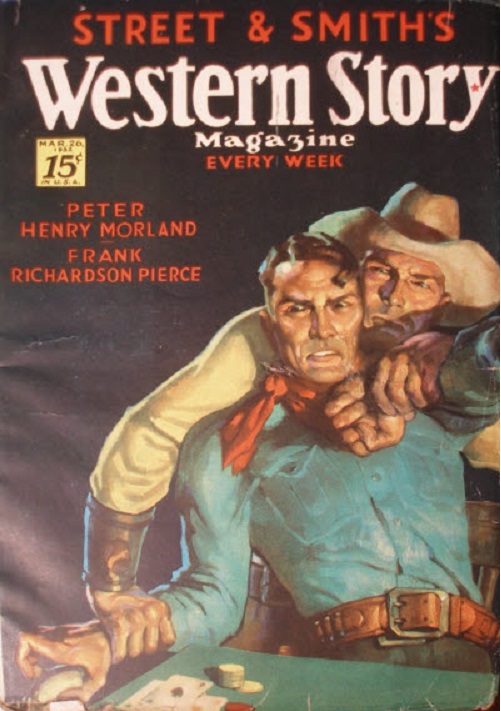
Saturday Morning Western Pulp: Street & Smith's Western Story Magazine, March 26, 1932
Here's more proof, as if we needed it, of just how dangerous it was to sit down at a poker table in the Old West. I don't know the artist on this cover, but I think it's a good one. The fellow being choked reminds me a little of Randolph Scott. (I don't know about you, but whenever I see or hear his name, I have this urge to put my hand over my heart and say, "Randolph Scott!" I don't actually do that, but the thought does cross my mind.) This is one of those issues of WESTERN STORY that's dominated by Frederick Faust. He has a novella under his Max Brand name in it, plus serial installments as by David Manning and Peter Henry Morland. I've wondered how many of WESTERN STORY's readers ever figured out that all of Faust's pseudonyms were the same guy. Also on hand in this issue are prolific and well-regarded pulpsters Frank Richardson Pierce, Hugh Grinstead, and Austin Hall.
Friday, April 29, 2022
Seven Faces - Max Brand (Frederick Faust)
(This post originally appeared in somewhat different form on May 2, 2008.)
Most of you who are familiar with Max Brand’s work know him as a Western writer, but Brand, whose real name was Frederick Faust, was also a prolific mystery author. During the Thirties his work appeared regularly in the pulp magazine DETECTIVE FICTION WEEKLY, among others, and DFW was where SEVEN FACES originally appeared as a serial in October and November of 1936.
The protagonists of this novel are a couple of New York City cops, Angus Campbell and Patrick O’Rourke, who make a formidable team despite the fact that they can’t stand each other. When a wealthy man named John Cobb appeals to the police department because he’s been receiving threats on his life, Campbell and O’Rourke are assigned to the case. Cobb has to go to Chicago on business, and the two detectives also have to travel to Chicago to present some evidence in a court case, so their superior decides they should take the train with Cobb and guard him from whoever wants to kill him.
Unfortunately, Cobb disappears on the way to Chicago, and Campbell and O’Rourke have to split up in their attempts to track him down and find out what happened to him. From there the story is a fast-paced yarn featuring torture, murder, greed, and evil coming back from the past to haunt the present. Sure, the characters are a little stereotypical – Campbell is a dour Scotsman, O’Rourke a fat, cigar-smoking, heavy-drinking Irishman – but the plot has some clever twists and Faust keeps things perking so nicely that the reader is drawn along effortlessly by the story.
While this book is obscure, it’s not that hard to lay your hands on a copy. It’s been reprinted twice, first by the University of Nebraska Press in their series of Max Brand reissues, and then in large print by Chivers/G.K. Hall. Faust wrote at least one more novel featuring Campbell and O’Rourke, MURDER ME!, and I intend to track it down and read it, too.
(UPDATE: So, in the almost exactly 14 years since this post first appeared, do you think I've actually read Faust's other Campbell and O'Rourke novel, MURDER ME? That's right, I have not. I'm pretty sure I own a copy, but now I can't find it. There are ebook editions of it and SEVEN FACES that weren't available back in 2008, so maybe I'll go that route.)

Saturday, October 09, 2021
Saturday Morning Western Pulp: Greater Western Magazine, June 1935
Considering the five authors in this issue of GREATER WESTERN MAGAZINE, all with new stories, apparently, it's a little odd who gets top billing on the cover: Rollin Brown. Now, as far as I know, Brown was a prolific, well-respected Western pulpster who ghosted for Ed Earl Repp as well as writing a lot under his own name. But deserving of top billing over Max Brand, Clarence E. Mulford (with a Hopalong Cassidy story, to boot!), and J. Allan Dunn? I wouldn't think so. The fifth author is Ralph Cummins, also a prolific, long-time pulpster but not a household name then or now.
Friday, December 04, 2020
Forgotten Books: Gunman's Gold - Max Brand
Several times a year, I get the
urge to read a Max Brand novel. Frederick Faust, the man behind the Max Brand
pseudonym (and many others), had such a distinctive style, really unlike that
of anybody else who wrote Westerns, that I have to space them out. But by doing
that, I nearly always enjoy his books quite a bit.
GUNMAN’S GOLD was published originally as an 8-part serial in the pulp WESTERN
STORY MAGAZINE from April 22 to June 10, 1933, under the name John Frederick, one of those
pseudonyms I mentioned earlier. Honestly, because of that distinctive style I mentioned, I have a
hard time believing that readers of the time didn’t realize Max Brand, John
Frederick, George Owen Baxter, Peter Henry Morland, and all the other Faust
pen-names were really the same author. But maybe they didn’t, and the ones who
did, didn’t care. Anyway, it was later reprinted in hardback by Dodd, Mead and
went through numerous paperback reprints from various publishers, always under
the Max Brand name.
Not surprisingly, considering the title, the plot revolves around the discovery
of a fabulously valuable gold mine. The villain of the piece, an Easterner
named Lee Swain who has come west, finds out about the strike, kills the two
prospectors who discovered the gold, and frames the man who grubstaked them for
their murders. Having done that, Swain figures he can get his hands on the
mine, but first the man he framed has to be caught and lynched by a posse.
A wealthy old friend of the fugitive’s father gets wind of this and hires a
freelance adventurer named Sam Shannigan to rescue the young man from this
predicament and clear his name. Shannigan gets some help in this mission from a
beautiful young woman who’s the daughter of his housekeeper and his unofficial
ward. So, off they go to rescue the innocent lad, stay one step ahead of the
posse, wear disguises, orchestrate jailbreaks, fall in and out of love, and
figure out who really killed the two old prospectors, and why.
Faust sets all this up pretty quickly, and as a result we’re left with a book
that’s a little thin on plot but that has a lot of action and character
development. Shannigan is a good protagonist, not everybody turns out exactly
as you might expect, and as always the writing is excellent, with Faust coming
up with a lot of lines that make it clear why he considered his real calling to
be as a poet, not a pulp writer. He was never very successful in that, but he
left us with a lot of mighty good pulp yarns. I wouldn’t put GUNMAN’S GOLD in
the top rank of his work, but it’s a solid second-tier yarn and I thoroughly
enjoyed reading it. If you’re a Faust fan and haven’t read it yet, it’s worth
picking up. Used copies of paperback reprints, print-on-demand editions, and
e-book versions are readily available.