Sunday, February 28, 2021

Sunday Morning Bonus Pulp: Detective Short Stories, April 1941


Are there people who collect covers with hook hands on them? Seems like there must be. I think this cover might be by J.W. Scott, but I'm not really familiar enough with his style to be sure. I'm sure there's a good bunch of authors in this issue of DETECTIVE SHORT STORIES, though: E. Hoffmann Price, Roger Torrey, W.T. Ballard, Edward S. Aarons (under his pseudonym Edward S. Ronns), J. Lane Linklater, Eric Howard, Dale Clark, Cyril Plunkett, and even legendary BLACK MASK editor Joseph T. Shaw under the pseudonym Mark Harper. Hard to go wrong with writers like that.

Saturday, February 27, 2021

Saturday Morning Western Pulp: Fifteen Western Tales, June 1947


We can add another category to the things we see on Western pulp covers: Injury to a Saddle. This is a really nice, dynamic cover on this issue of FIFTEEN WESTERN TALES. And as was common with the Popular Publications Western pulps, a strong group of authors with stories inside, as well. In this case, Peter Dawson (Jonathan Glidden), William Heuman, Walker A. Tompkins, William R. Cox (twice, once as himself and once as house-name David Crewe), Joe Archibald, Barry Cord (Peter Germano), T.C. McClary, the mysterious Frank Morris, Wallace Umphrey, James Shaffer, and house-name Lance Kermit. A very entertaining issue, I suspect.

Friday, February 26, 2021

Forgotten Books: Hill Girl - Charles Williams


(This post was originally published on March 16, 2005. I started to rewrite it some because so much has changed since then, but in the interest of historical accuracy, I decided to leave it as it was. There'll be some more reruns from the early days of the blog in the coming weeks that I hope will be new to many of you.)

Every time I get a new issue of Steve Lewis's excellent fanzine MYSTERY*FILE in the mail, one of the first things I read is Bill Crider's column "The Gold Medal Corner". And no matter what author Bill is writing about, I think to myself, "I gotta get some of this guy's books off the shelf and read them." But usually I get sidetracked before I get around to it.

Not this time. Bill's latest column is about Charles Williams, and after reading it I actually went to the shelves and pulled down my Charles Williams books. Now, for years I've heard Bill, Ed Gorman, and other people talk about how good Williams' books are. A few years ago, I read one of his Dell First Edition novels, GIRL OUT BACK, and liked it quite a bit. But I never got back to his other books. (That easily sidetracked business I mentioned above.) Until now. I just finished Williams' first novel, HILL GIRL, published by Gold Medal in 1951. Even knowing how people whose opinions I respect feel about his work, I was still surprised by how very, very good it was. Williams wrote very well, mixing vivid, almost lyrical descriptive passages with dialogue that rings absolutely true. Prose that doesn't want to let the reader's eyes stray away from the page. Like the Silverberg book I read a couple of days ago, HILL GIRL is more domestic drama than crime novel, but that doesn't mean there's no suspense in it. The plot unfolds leisurely but builds to a very suspenseful climax. This is a fine novel, and I suspect it's not even one of Williams' best. I hope I'll get around to another of his books soon, instead of waiting several years again.

Wednesday, February 24, 2021

Available Now: Rattler's Law, Volume 1 - James Reasoner


I don't do a lot of Blatant Self-Promotion (does anybody even use that term anymore?), but here's an e-book omnibus of eight full-length Western novels by me, more than half a million words of fiction, for less than a buck. It's available on Amazon, and if you're a fan of traditional Westerns, I think you'll enjoy it.

Monday, February 22, 2021

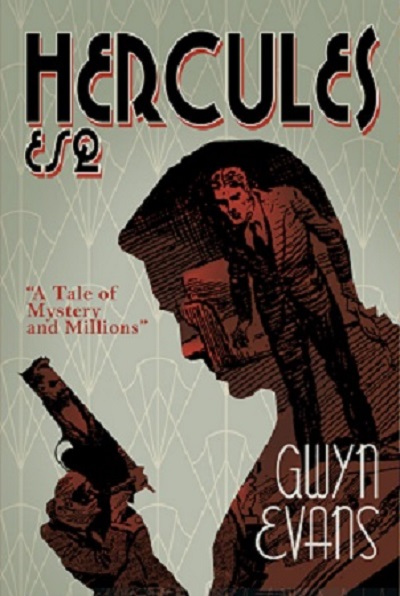
Classic British Thrillers: Hercules Esq. - Gwyn Evans


I’d never heard of Gwyn Evans until recently. He was a prolific author of some highly regarded stories in the very long-running Sexton Blake series, as well as writing novels about his own characters. My friend Steve Holland has published a biography of Evans and reprinted the four volumes of his Bill Kellaway series. I recently read the first one, HERCULES ESQ.

Bill Kellaway is a down-on-his-luck journalist, almost broke, sitting on an embankment in London, when he’s approached by a stranger offering him a million pounds for some sort of secretive mission. Although Bill isn’t really suicidal, this opening reminded me a little of the first chapter of THE LIVING SHADOW, the first novel from the long-running pulp, written by Walter B. Gibson. HERCULES ESQ. isn’t a whirlwind of crime-fighting like those early Shadow novels, though. Instead, it’s a much more light-hearted romp, as Bill finds himself trying to complete a series of difficult tasks assigned to him by the Secret Six, a group of bored millionaires who get their fun out of trying to give Bill impossible chores and making side bets on whether or not he can complete them. (The Labors of Hercules being where this novel gets its title, of course.) There’s also a beautiful, mysterious young woman involved, but is she working with Bill or against him?

Although there’s some criminous stuff going on and Bill often finds himself vying against or working with various lawbreakers, the stakes are never really life and death in this book. There are no murders to solve. Which works against it a little if you’re expecting more of a thriller. There is some slam-bang action, though, as well as a smart, really likable protagonist and a lot of really clever plot twists, but what really makes HERCULES ESQ. work is Evans’s style, which is consistently breezy, fast-paced, and funny. The word “blithe” could have been invented for this book. I really enjoyed it, even though it wasn’t quite what I expected. I have the other three books in the series, as well as the Evans bio, and I look forward to reading them. All of them are available here.

I also have a collection of Sexton Blake stories by him, too. Knowing a little about Evans’s background, one of the funniest bits in this book involves Bill’s indispensible valet/assistant and his reading habits.

Sunday, February 21, 2021

Sunday Morning Bonus Pulp: Real Mystery Magazine, April 1940


This is the first issue of a very short-lived Weird Menace pulp (there was only one more issue) debuting at a time when the Weird Menace boom was just about over. Most of the authors inside are house-names. The only ones who aren't are Ray Cummings (with a story as by Ray King), Bruno Fischer (with a story as by Russell Gray), and somebody named Lon Cordot, who published only a few stories and may well have been a pseudonym or house-name, too. I don't know who did the cover, but it's pretty eye-catching.

Saturday, February 20, 2021

Saturday Morning Western Pulp: Exciting Western, May 1948


Another Old West poker game gone bad in this excellent cover by Sam Cherry! EXCITING WESTERN was a consistently good Western pulp with several different series running regularly in its pages. In this issue there's a Tombstone and Speedy yarn by the great W.C. Tuttle, plus a Navajo Tom Raine, Arizona Ranger story by house-name Jackson Cole. Also on hand are top-notch pulpsters Wayne D. Overholser, Lee Bond, Gladwell Richardson, Ben Frank, and another house-name, Reeve Walker. 

Friday, February 19, 2021

Forgotten Books: Rustlers' Warning - E.B. Mann


RUSTLER’S WARNING by E.B. Mann is the other half of the Belmont Double Western that includes Walt Coburn’s EL HOMBRE, which I reviewed last week. Like EL HOMBRE, I feel like this short novel probably appeared first in a Western pulp, but I haven’t been able to track down its source. It’s a very entertaining yarn, wherever it first appeared.

The plot is pretty traditional. Young Steve “Snap” Calhoun returns to the ranch where he was raised after being away from home, leading an adventurous life, for several years. He left in the first place because he and his father and his brother fought a bloody war against a gang of rustlers. The wideloopers were wiped out, for the most part, but Steve’s father and brother were killed. Steve leaves the ranch in the capable hands of his foreman.

But now he’s back because rustlers are once again threatening the range, including one of the survivors from the previous clash. Steve knows who’s to blame for the thieving, so he posts a list of their names on a bulletin board in the local town and warns that he’s going to shoot them on sight. This prompts the owlhoots to come after him to try to get him first, which, of course, was exactly what Steve wanted all along.

Mann does throw in a twist that’s fairly predictable, but how everything works out came as a surprise to me, at least in some respects. Traditional it may be, but RUSTLERS’ WARNING is well written and has some great action scenes. I haven’t read much by E.B. Mann, but I’ve enjoyed everything I’ve read and admire his ability to come up with some excellent shootouts. I had a really good time reading this book, and I’m glad I have several more of Mann’s novels on hand.

Tuesday, February 16, 2021

Overlooked Movies: 49th Parallel (1941)


I had never heard of this British war film from 1941 until recently, but it sounded intriguing, so we watched it. 49TH PARALLEL refers to the border between the United States and Canada, and fittingly, since the movie is dedicated to the Canadian war effort, all but a few minutes of the action takes place in Canada.

It begins with a German submarine cruising up into Hudson’s Bay after destroying a Canadian tanker. The captain sends a six-man party ashore to capture a small fishing village so they can raid it for supplies and gasoline. However, the six Germans have barely made it to land when a couple of Canadian coastal patrol planes come along, spot the U-boat, and sink it. That leaves the shore party on their own, and the lieutenant in charge decides they’ll try to cross Canada to Vancouver where they can sneak aboard a Japanese ship. Failing that, they’ll try to reach the United States, which at this point is still officially neutral, and claim asylum.

This is the start of a journey that’s both epic and episodic, courtesy of director Michael Powell, screenwriter Emeric Pressburger, and a fine cast. Eric Portman, as the German lieutenant, is the only character who’s around for the entire movie, but others who come and go include a young Lawrence Olivier, playing a French-Canadian trapper; Leslie Howard as a foppish anthropologist/writer who’s tougher than he looks; and Raymond Massey, who plays an apparent hobo with a few surprises up his sleeve.

This is a propaganda film, no doubt about that, designed to point out the need for the United States to get into the war, but it accomplishes that aim with a considerable amount of subtlety and works just as well as a suspense yarn, with a few touches of humor and pathos along the way. Eric Portman is a great villain, and I was also impressed by Leslie Howard, who I think of mostly as Ashley Wilkes in GONE WITH THE WIND. The location photography is great, including some late shots of Niagara Falls. (And if you’re like me, you can’t even read the name of that place without hearing Moe Howard’s voice.) I really enjoyed 49TH PARALLEL and I’m surprised I never heard of it until recently. It’s an excellent film.

Monday, February 15, 2021

The Bozeman Trail War #1: Bluecoat Patrol - Alfred Wallon


Alfred Wallon is one of the leading Western writers in Germany and has been for many years. Recently some of his novels have begun appearing in English translations, as well, including BLUECOAT PATROL, the first in an epic series of historical Westerns called The Bozeman Trail War.

This novel is set against the background of the long-running clashes between the Plains Indians and the U.S. cavalry prompted by the various discoveries of gold in Dakota Territory and Montana. In BLUECOAT PATROL, a group of cavalrymen led by Captain Frank North and guided by scout Buckskin Charly Weatherford joins a group of prospectors headed to Alder Gulch, Montana. North’s assignment is to protect those goldseekers, but not surprisingly, he encounters trouble not only from the warriors led by chiefs Red Cloud and Dull Knife but also from the very men he’s supposed to protect.

Wallon’s historical research is very solid in this novel, and his characters are well-drawn. Frank North is a stalwart hero and Buckskin Charly a top-notch sidekick. The translation gives the prose a voice that’s not quite what we’re used to in traditional Western novels, but at the same time, it works just fine and the story moves along well. Not everything is resolved by the end of BLUECOAT PATROL, but that’s not surprising considering that the series continues for a number of other volumes. It actually reminds me a bit of the old Easy Company series published by Jove under the house-name John Wesley Howard, although it’s more realistic. If you enjoy historically based Western novels or cavalry yarns, check out BLUECOAT PATROL. I enjoyed it.